



Abstract
Objective:
The aim of this study was to determine the link between the physical activity (PA) and cognitive function among the elderly in the health and social centers in Kenitra, Rabat, and Sidi Kacem city (Morocco).
Materials and methods:
This study was conducted among 172 elderly (56.4% men) aged above 60 years (67.53 ± 7.53) in the health and social centers in Kenitra, Rabat, and Sidi Kacem city (Morocco). Cognitive functions were assessed by the Mini-Mental State Examination (MMSE) (Normal: MMSE’s score >24 and cognitive impairment (CI): MMSE’s score ⩽ 24). The physical activity (PA) was evaluated using the GPAQ (Global Physical Activity Questionnaire), ranking the elderly by high, moderate, and limited level of PA. The binary logistic regression was performed by the cognitive function (dependent variable), and PA level (independent variable).
Results:
The elderly people with cognitive impairment (MMSE score <24 tend to practice less walking and cycling activities
Conclusion:
Our finding demonstrates that moderate PA specially walking or cycling is associated with lower risk of cognitive impairment. This indicates that a regular practice of walking or cycling as PA can play an important role for cognitive impairment prevention. And the necessity for further researches to more understands this association.
Introduction
The United Nations in 2002 indicated that the number of people over 60 who accounted for almost 7% of the world population in 2000 is estimated to reach about 2 billion by 2050. 1 In Morocco, the percentage of the population aged over 60 years was 9.4% (3.2 million) in2004 and will reach 23.2% (10.1 million) of total population by 2050. 2 This rapid increase of the older population requires more studies on the living conditions, the physical and mental health of this category, in order to ensure the elderly population an aging success.
Aging is accompanied by a succession of biological and physiological changes affecting the physical condition of the elderly. Thus, various studies have confirmed the decline in physical capacities as the age progresses.3,4 Physical activity (PA) is defined by the WHO as any body movement produced by skeletal muscles requiring energy expenditure. 5 It includes all motor behavior such as stains of households and leisure, and it is considered a beneficial lifestyle for health. 6 The new recommendations of the WHO for PA for people aged 65 years and older are of the order of 150 minutes per week for a moderate intensity aerobic activity and 2 or more days a week for muscle building activities. 7
The physical activity improves the oxygenation of the central nervous system via increasing blood flow to the brain. PA was linked to better cognitive function in some studies and the elderly with regular physical activity practice have lower risk to develop dementia.18,20 To our knowledge no search that studied the association between physical activity and cognitive function was conducted in Morocco. Knowing that elderly centers are a new phenomena in Morocco. Elderly used to live in extended families and were taken care by the family in their usual environments. The new domiciliation may have an effect on physical activity. The structures do not allow reactive activities or gardening. Hence lack of physical activity and muscular effort may undermine cognition performance. The aim of this study was to determine the link between the physical activity (PA) and cognitive functions among the elderly in the health and social centers in Kenitra, Rabat, and Sidi Kacem city in northwestern Morocco.
Materials and Methods
Participants
This cross-sectional study was conducted between March 2017 and May 2018, among 172 Moroccan elderly (56.4% men) aged over 60 years (67.53 ± 7.53) in the health and social centers in Kenitra, Rabat, and Sidi Kacem city in northwestern Morocco. In our sample, 85.5% (n = 147) and 12.8% (n = 22) of the elderly had low and intermediate education respectively, 23.8% (n = 41) never had a profession, and only 11.1% (n = 19) receiving a pension. According to Geriatric Depression Scale 15 (GDS-15) and Mini nutritional assessment (MNA), 73.3% (n = 126) of the elderly in our sample were depressed (GDS-15 ⩾5 points), 49.4% (n = 85) at risk of malnutrition (MNA Score between 17 and 23.5) and 5.2% (n = 9) were malnourished (MNA score <17 points). All the tests were passed according to a direct interview with the participants.
Cognitive function evaluation
Many tests are available to assess cognitive function (eg, the Grober Buschke test for episodic verbal memory or the Stroop or Trail Making tests for visual attention). In our study the cognitive function was assessed with the MMSE (Mini-Mental State Examination). This brief tool elaborated by Folstein on 1975, represent the most used tool in world to assess global cognitive impairment with specificity and sensitivity 82% and 87% respectively. 8 With a cut-off 24 point, the elderly were classified into 2 categories: Normal (MMSE score >24) or cognitive impairment (MMSE score ⩽24).
Physical activity evaluation
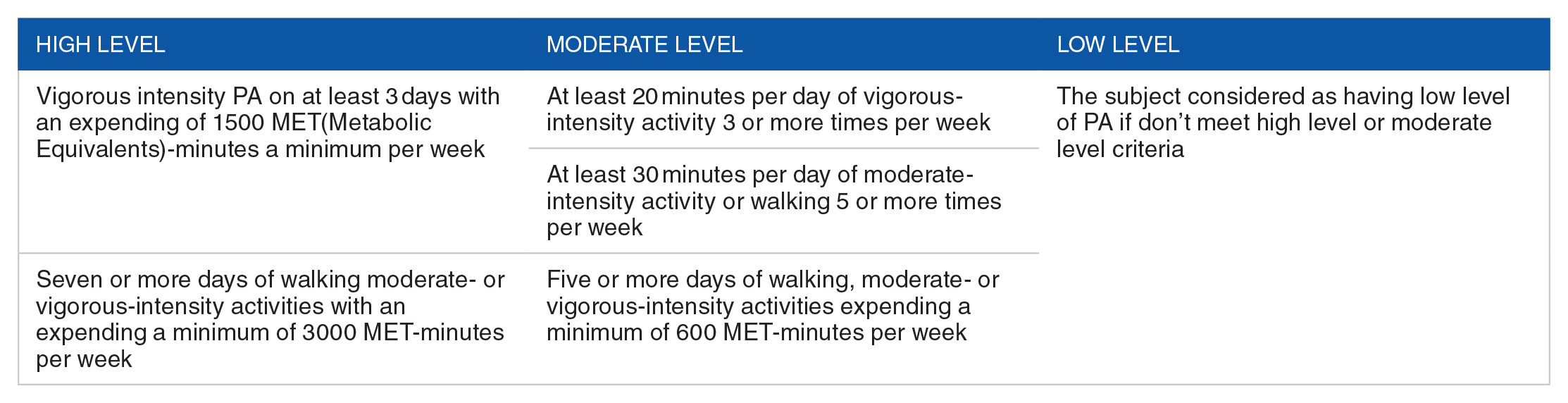
The Global Physical Activity Questionnaire (GPAQ) is a most using tool to assess the physical activity. This questionnaire composed of 16 items was developed in 2002 in the frame of the WHO “STEPwise approach for Surveillance of risk factors for chronic disease” (STEPS).9,10 It was developed to combine the strengths of the short and the long International Physical Activity Questionnaire (IPAQ) by including different domains: work, walking or cycling, leisure, and sitting time. 11 The properties of the GPAQ were assessed mostly in Asia, Africa, and South America. 9 Subsequently, the GPAQ was validated against objectively assessed PA in Malaysia, 12 Vietnam,13,14 USA, 15 and against accelerometers in a more recent study in Great Britain. 16 The PA of our sample was evaluated using the GPAQ. According to the norms recommended by the WHO for this tool, the participants were ranked into 3 levels:
Statistical analysis
To perform the statistical analysis, the Chi-square test was used to analyze the association between 2 categorical variables. The normality distribution of each variable was checked by Kolmogorov Smirnov and Shapiro Wilk test (P > .05). Consequently, for all quantitative variables, Mann Whitney test was performed for comparison between normal and cognitively impaired subjects because of their no normal distribution (P < .05).
The binary logistic regression was performed where the cognitive function was taking as dependent variable, PA as independent variable and all other outcomes associated with CI in bivariate analysis as covariate factors. The adequacy of the logistic regression was checked using Hosmer-Lemeshow test. At P-value <.05 was considered significant for all analysis.
Results
Physical activity according to cognitive function
The Table 1 demonstrates that Compared to the normal subjects those with cognitive impairment tend to practice less walking or cycling activities (P = .005). However no difference was seen between normal and cognitively impaired subjects for all other subtypes of physical activity (P > .05). The level of PA was significant associated with cognitive function (P < .001). Moreover the prevalence of CI was high then Normal among person with high level (44.2% vs 23.1%) and limited level (41.7% vs 42.3%) of physical activity. In contrast persons with moderate level of PA had low prevalence of CI then normal (14.2% vs 34.6%).
Physical activity according to cognitive function.

Abbreviations: df, degrees of freedom; NA, not analyzed; χ2, Chi-square test; Z, Mann Whitney test.
Multivariate analysis
The binary logistic regression adjusted for gender, education, profession, pension, depression, and nutritional status reveled that only the moderate level of PA was associated with lower risk of cognitive impairment compared to limited level (ORa = 0.136, 95% CI: 0.04-0.41).
Binary logistic regression of physical activity for subjects with cognitive impairment.

Discussion
The objective of the present study is to evaluate the association between PA and cognitive function among the elderly in the health and social centers in Kenitra, Rabat, and Sidi Kacem city in northwestern Morocco, in the purpose to determine if a regular physical activity practice could help in prevention of cognitive impairment. The results demonstrated that only moderate level of PA especially walking or cycling activities was associated with lower risk of CI. Physical activity induces structural and functional changes in the brain that could have biological and psychological benefits. 17 Lochbaum et al 18 , have demonstrated that aerobically trained or active participants performed significantly better on the fluid intelligence task than aerobically untrained or inactive participants. Moreover Scarmeas et al 19 showed that physical activity, even if reduced, would allow the individual to benefit from protective effects.
The association between PA and cognitive function in our finding was mostly explained by the walking activities as expressed with Mann Whitney test in bivariate analysis
The physical activities improve cardiovascular fitness, increases blood flow to the brain resulting better oxygenation of the central nervous system, which improves the carbohydrate and neurotransmitters metabolism, essential to good cognitive functioning. In fact, physical activity gives the elderly a feeling of competence and psychological satisfaction which could improve their cognitive function. Furthermore practicing physical activity will improve autonomy of the elderly, especially that people with Alzheimer’s disease show increased risk of falls, fractures, and loss of mobility. 24 The evaluation of the effect of a PA on cognitive functioning especially during Alzheimer’s disease has been examined in little interventionist studies. Nevertheless, all the results seem to indicate its real benefit on different cognitive and psycho-social parameters.25,26 In a randomized controlled trial published by Kemoun et al, evaluated the interest of a program based primarily on walking, balance, and endurance, 1 hour per week for 19 weeks. The cognition was evaluated by the battery BREF composed of 12 subtests measuring in particular the orientation, the attention, the immediate and deferred recall, and mental calculation. While the physical assessment focused on walking ability. The results showed that patients who participated in the PA program improved significantly their scores on cognitive measures and their walking abilities than control group. 27 This confirms the beneficial effect of PA on the physical and cognitive abilities of the elderly. For that, the elderly people are strongly advised to keep a regular physical activity practice. Moreover the social care institutions are recommended to develop a program that promotes regular practice especially walking or cycling as physical activity to preserve the cognitive functions of the elderly.
This study has some limitations like the small effective constituted our sample. The GPAQ questionnaire was not validated previously against accelerometers among a sample of elderly due to insufficient financial resources. Moreover as mentioned in previously publication we did not take into account sex, age, and education different in cut-off classification which could rank some normal illiterate persons as having CI. Further studies among a large sample taking into account these limitations are needed to confirm our results.
Conclusion
Our results proved that walking or cycling as physical activity is associated with lower risk of cognitive impairment. This indicates that a regular practice of walking or cycling as PA can play an important role for cognitive impairment prevention, and the necessity for the social care institutions to develop a program that promotes regular practice especially walking or cycling as physical activity to preserve the cognitive functions of the elderly.
Footnotes
Funding:
The author(s) received no financial support for the research, authorship, and/or publication of this article.
Declaration of conflicting interests:
The author(s) declared no potential conflicts of interest with respect to the research, authorship, and/or publication of this article.
Author Contribution
All authors contributed to initial coding of questionnaires, collection, statistical analysis and interpretation of data, writing, and critical revisions of the manuscript.
