



Abstract
Nowadays, the global medical tourism market size has grown quite rapidly, with a projected increase of 21.1% between 2021 and 2028. This study aimed to explore barriers and potential strategies for the development of medical tourism in Indonesia. A qualitative case study design was employed, where 8 respondents were selected using an expert sampling method from various groups according to the helix framework, including academics, government, professional organizations, the private sector, and the media. Data was collected through document analysis and in-depth interviews, and was analyzed manually using an inductive thematic content analysis approach. Limitations to the development of Indonesian medical tourism are related to regulations concerning medical tourism, the number of health services, distribution, supporting resources, public trust, and competition. At the institutional level, the challenges comprise services and products, hospital facilities, supporting facilities, and marketing processes. Furthermore, at the micro level, the low competency of both health and non-health workers persist as an obstacle. The potential strategy at the macro level include the development of robust marketing and branding strategies, health infrastructure, and resources. At the institutional level, it was necessary to develop related products and services provided, improve quality, and focus on branding and marketing strategies. Additionally, improving human resource skills was needed at the micro level.
Keywords
Background
Medical tourism is the practice of individuals traveling abroad with the main of obtaining medical treatment. 1 Another perspective defines it as travel primary aimed at receiving health services. 2 In the world of the tourism industry, medical tourism is a branch of tourism economy that has been actively evolving. 3 Traveling abroad for health services is motivated by various factors, including cost-effectiveness, access to services rooted in local expertise, or unavailability of health services. 4
In recent times, medical tourism is experiencing a positive trend and has developed into a global industry. The market size exceeded USD 11 billion in 2020 and is poised to grow by more than 21.1% (CAGR/compound annual average growth) between 2021 and 2028. 5 According to the latest report by the United Nations Agency for Tourism (UNWTO), more than 900 million of international tourists travel in 2022. This was almost double the number recorded in 2021, namely 455 million tourists. Tourism, as an industry, has ascended to become the largest sector, demonstrating consistent growth yearly. Additionally, the existence of modern tourism is currently being accelerated by the growth of world globalization which has led to interconnections between fields, nations, and individuals. 6
Global growth in healthcare and medical technology has led to the emergence of new patterns of healthcare consumption and production over the past few decades. Various healthcare providers in both developed and developing countries, as well as public or private, have taken steps to promote medical tourism and the various benefits it offers. Developed countries offer technology as one of the sources of excellence in the tourism concept. Meanwhile, patients from different nations travel to developing countries to achieve significant cost savings on medical treatment. Despite the lower cost of healthcare in developing nations, the quality of healthcare services remains important, underpinned by the availability of resources at low cost. 7
The success of medical tourism depends on the involvement of numerous stakeholders and their collaboration at different levels. According to a study, medical tourists, healthcare providers, government organizations, facilitators, accreditation and credentialing bodies, insurance companies, medical marketers, and infrastructure and facilities make up the 8 main stakeholders in the medical tourism sector. 8 Furthermore, according to organizational theory, an organizational entity—including hospitals that offer medical tourism services—is interdependent and engages in macro- and micro-level interactions with other entities.9,10 Thus, it is critical to identify different stakeholders at different levels in order to investigate the obstacles and approaches to the growth of medical tourism.
Indonesia is a developing country with significant potential for the promotion of medical tourism. This is supported by the fact that it offers a wide range of attractive tourist destinations, including cultural, culinary, and maritime tourism. Additionally, the government has made a substantial investment, surpassing US$ 14.95 million and boasts approximately 20 hospitals to meet international standards, in preparing a world-class hospital.11,12 Furthermore, the government has established the Indonesia Health Tourism Board (IHTB) with the aim of promoting and developing medical tourism and building trust in medical services. 13
Despite these promising prospects, the current development of medical tourism in Indonesia faces various challenges, necessitating the implementation of appropriate strategies for its growth. Contrary to the initial objective of attracting foreign tourists, Indonesia has become 1 of the largest sources of medical tourists in Singapore and Malaysia.12,14,15 It is discovered that over 1.7 million citizens travel abroad for medical treatment, which is estimated to result in a loss of around IDR 165 trillion in foreign exchange. 16 One of the reasons Indonesians seek medical tourism service is due to the perceived lack of Indonesian high-quality healthcare services. 17
However, medical tourism exploration related research in Indonesia remains understudied. Several studies conducted regarding medical tourism in Indonesia were limited to hospital level and marketing issues.18-21 The challenges associated with establishing a medical tourism sector in countries including the United Arab Emirates, Malaysia, Iran, Russia, and Thailand have been the subject of numerous studies.22-27 Conducting country-specific studies is crucial due to the fact that conditions in different nations can vary, necessitating the implementation of distinct development strategies in each country. Nevertheless, a study that exhaustively examines the obstacles and alternative remedies pertaining to the development of the hospital tourism sector in Indonesia through the participation of diverse stakeholders from multiple sectors has yet to be identified by researchers. As a result of limited investigations, extensive study is required to delve deeper into the challenges and potential in various aspects of developing medical tourism in Indonesia. Therefore, this study aimed to explore the challenges and potential for the development of medical tourism through a multi-level approach by involving various stakeholders.
Method
This study uses a case study design with a qualitative approach. Data were obtained through document analysis and in-depth interviews which were conducted during November 2022 via an online video conferencing platform. A total of 8 participants were selected based on the Helix Framework using the expert sampling method. The expert sampling method requires participants to be selected according to their experience and competence in answering study questions. 28 Furthermore, utilizing the helix model facilitated an understanding of the roles played by various actors in driving innovations including those related to medical tourism. 29 The selection of the participants involved in this study was based on previous study that involving multi stakeholder views regarding medical tourism issues (Table 1). In particular, the selected participants included experts in medical tourism from academia, medical tourism agency, health profession organization, governments, managers of hospitals, and journalists. The study respondents are presented in Table 2.
Multi stakeholder views on medical tourism studies.

Participant characteristics.

Guidelines for document analysis and interviews were created based on open questions exploring 2 themes, namely barriers and potential strategies for the development of Indonesian medical tourism. Ethical clearance was obtained before data collection. During data collection, recording was conducted by first seeking permission from the study participant. Subsequently, the recorded interviews were transcribed for analysis. Thematic content analysis was employed and the results were categorized into macro, meso, and micro levels. 32 This multilevel approach allows for the identification of challenges and potential from the perspective of individual actors, managerial, or national policy-making level. 9 To ensure the validity of the results, multi-coder analysis was conducted. 33 Data analysis was performed manually, without special software, through an inductive content analysis approach. 34
Results
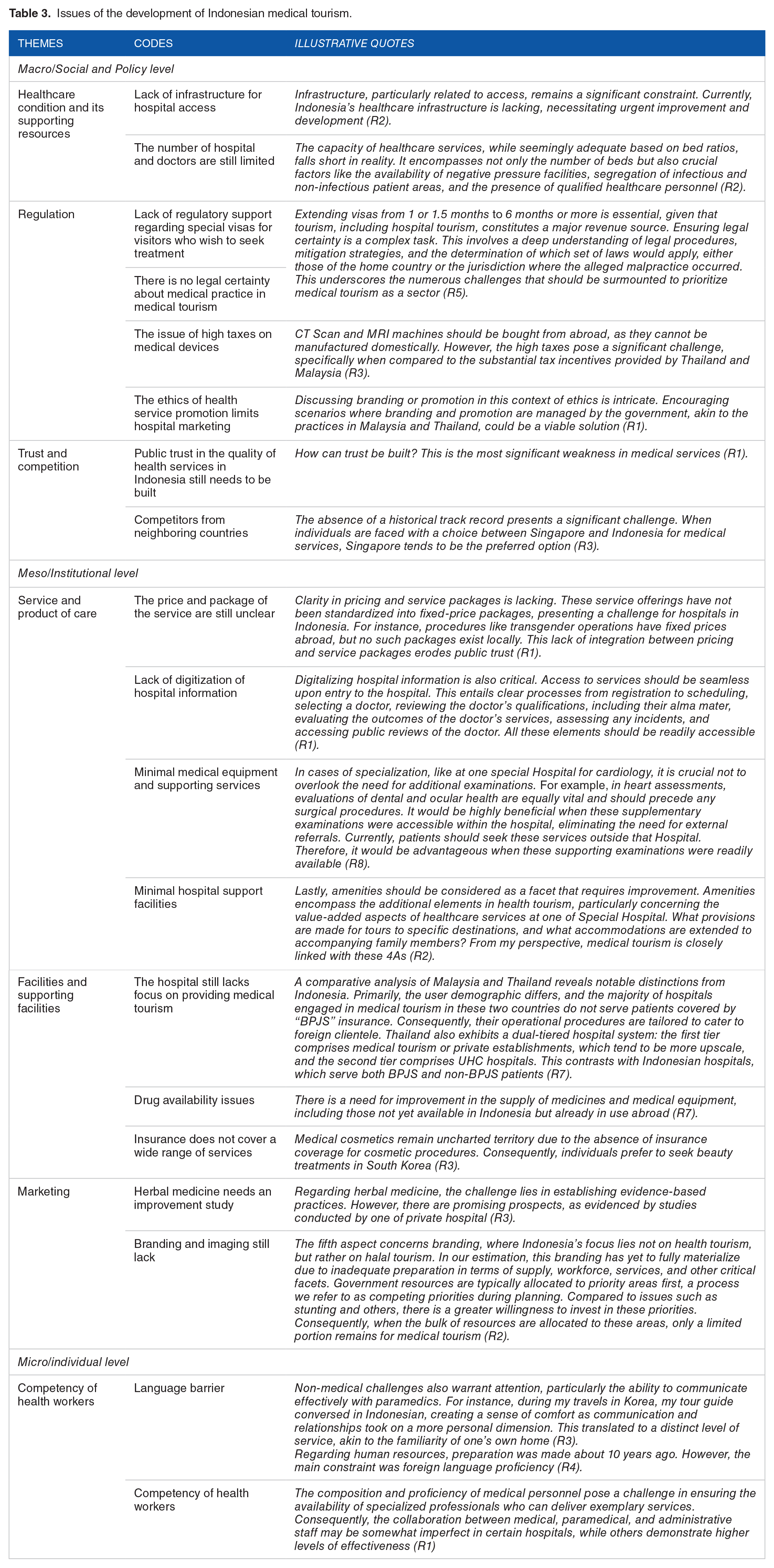
The study results were grouped at the macro, meso, and micro levels. A summary of the potential challenges and strategies for the development of medical tourism in Indonesia is presented in Tables 3 and 4 respectively.
Issues of the development of Indonesian medical tourism.
Strategies for the development of Indonesian Medical Tourism.

Macro level of challenges and potential strategies for Indonesian Medical Tourism Development
At the macro level, several major themes emerge as challenges for the development of medical tourism in Indonesia including regulatory aspects related to the provision of medical tourism, the number and distribution of hospitals and their infrastructure, as well as public trust and competition from neighboring countries. Additionally, key strategies for development include strengthening marketing initiatives, enhancing healthcare human resources, and improving healthcare infrastructure.
There are 3 issues related to regulations for organizing medical tourism in Indonesia, namely visas, legal certainty for organizing medical tourism, and hospital marketing ethics. Regarding visa regulations, respondents considered that there was no certainty about visas for visitors who specifically wanted to seek treatment in Indonesia. A respondent stated that visa for medical treatment and a regular visit should be different due to the extended duration often required for medical procedures. The second issue was related to the legal regulations for organizing medical tourism, specifically when malpractice occurs. Another was the problem of high taxes in the procurement of imported health technology. Furthermore, other challenge was related to ethical regulations as well as hospital promotion and marketing. Meanwhile, Indonesia has established a code of ethics for hospitals, respondents contend that this ethical consideration can hinder hospital to has various marketing strategies. Collaborative endeavors with government sectors, particularly the Ministry of Tourism, are seen as crucial in promoting medical tourism in the country.
Another obstacle was related to the limited number of hospitals and specialist doctors in Indonesia. This means that the current attention of the Government was based on increasing public access to health services and has not fully focused on policies for developing medical tourism services. Additionally, there were limitations in supporting facilities, such as transportation, which hinders access for foreign medical tourists to reach their destination hospitals.
Moreover, other Southeast Asian countries such as Malaysia, Singapore, and Thailand have developed medical tourism services that are considered to be much more advanced than in Indonesia. This poses a challenge for the medical tourism sector in the country in gaining a share of the tourism market. It also creates a situation where people, specifically Indonesians, have more trust in medical tourism services in the countries mentioned earlier.
There are several key policies that can be implemented for developing medical tourism in Indonesia including service product development and enhancing the marketing efforts within the medical tourism sector. Respondents have emphasized the vital role of government support, specifically from the Ministry of Tourism, in amplifying the promotion of medical tourism in Indonesia. Marketing should not only be done indirectly, such as through videos or images, but also by other means, including organizing conferences and expos. This is necessary to ensure that hospitals, do not violate the ethical marketing guidelines established in Indonesia. Another promoted policy is the development of Health Economic Zones. These specialized zones encourage the government to focus on providing healthcare infrastructure and resources to support the development of medical tourism in various specific regions. Additionally, an incentivized initiative centers on the attraction of local medical tourists, with a specific focus on those hailing from eastern Indonesia.
Meso level of challenges and potential strategies for Indonesian Medical Tourism Development
At the institutional level, the several challenges mentioned by the respondents in this study, include issues related to the products and services offered, facilities and supporting amenities, as well as inadequacies in marketing efforts. Specifically, there is a lack of clarity surrounding the service packages and pricing provided by hospitals in Indonesia. To address this, it is imperative that hospitals enhance their service packages to comprise not only treatment but also entire spectrum of care from departure to return. Furthermore, digital information technology should be used to provide information about service packages and doctor profiles for potential visitors. This is crucial because the targeted audience for medical tourism come from abroad, making digital information technology essential for facilitating access to information.
Another challenge that hospitals need to anticipate is related to the limited availability of medical equipment and supporting facilities. It is imperative for hospitals to ensure the completeness of services and equipment, allowing patients to receive comprehensive care within a single facility and not referring patients to another hospital during treatment. Another means required to support the implementation of medical tourism is the availability of supporting facilities, such as accommodations for family members accompanying patients during treatment. The importance of this lies in the fact that the treatments administered can be pretty time-consuming, necessitating the presence of family members.
Another challenge mentioned was the limited availability of medications in Indonesia. The medications abroad may not necessarily be found in the country, which can significantly affect the treatment process for international patients. Furthermore, it is advised that hospitals maintain a focused approach on providing medical tourism services without diversifying into other market segments, such as catering to social insurance patients. This is necessary to ensure hospitals have facilities tailored to the needs of medical tourism. Additionally, hospitals should establish collaborative relationship with insurance providers used by patients from various countries. This enables patients to use their insurance when seeking treatment in Indonesia.
Hospitals are also advised to build a strong brand and image as institutions providing medical tourism services. Respondents indicate that the marketing of hospitals in this capacity remains limited in Indonesia. Furthermore, when health institutions wish to promote herbal treatments, they should ensure that their marketing efforts are accompanied by evidence-based assessments of treatment effectiveness.
Regarding the strategy for the development of medical tourism, respondents stated that hospitals could focus on the development of natural tourism in providing services. This is considered an important aspect, given Indonesia’s abundance of beautiful natural destinations. Furthermore, various services need to be advanced, such as fitness centers and travel medicine. It is important to note that travel medicine caters to local and international patients. Fitness centers should target not only patients but also individuals in good health to enhance their fitness levels. Indonesian hospitals were viewed as having the potential to develop traditional medicine services, given the rich natural resources of the country.
Some other potential strategies that can be pursued include obtaining international accreditation. International accreditation is significant since the patients targeted for medical tourism come from abroad. Furthermore, it can increase the recognition of the quality of hospital services among international patients. In the pursuit of quality improvement, the development of sister-hospital programs with foreign institutions that already have good quality and reputation should considered. Additionally, hospitals should create marketing strategies centered on specific flagship services, such as specialized hospitals for cancer, brain, and heart care. Finally, marketing studies related to medical tourism in Indonesia need to be improved. The research result might useful for hospitals to formulate evidence-based strategies and programs.
Micro level of challenges and potential strategies for Indonesian Medical Tourism Development
Challenges stemming from individuals are related to health and non-health personnel working in hospitals. Respondents have mentioned critical issue of limited English language proficiency. This is crucial because in medical tourism, patients come from various countries, hence, healthcare professionals should be proficient in communicating in English as the most commonly used language. Additionally, challenges in coordination between healthcare professionals and administrative staff within hospitals need to be addressed in the provision of services.
Regarding the development strategy of medical tourism from a micro-level perspective, respondents emphasize the need to improve the competence of healthcare professionals and administrative staff delivering medical tourism services. This improvement includes proficiency in English, specifically pronunciation. Efforts to enhance competence related to service excellence were also essential. Furthermore, healthcare professionals need training on effective communication with patients. This was mentioned because patients do not only expect appropriate treatment but also effective communication to understand the causes, treatment, and prevention of their illnesses, rather than mere administration of treatment.
Discussions
This study found that Indonesian government still has limited focus on development of medical tourism as the government put a high effort on improving people’s access to the healthcare. According to data from the Ministry of Health, in 2020, the ratio of hospital bed availability in Indonesia was 1.4 per 1000 population. This figure met the minimum standard from WHO, which 1 hospital bed per 1000 population. However, at province level, this availability was not evenly distributed. In 2020, there were 2 provinces with hospital bed ratio below the minimum standard. These include West Nusa Tenggara (NTB) and East Nusa Tenggara (NTT) with a ratio of 0.9 each. 35 This imbalance is mirrored in the shortage of doctors and specialists. The current doctor-to-population ratio in Indonesia was below the World Health Organization (WHO) standard, which was 1 doctor per 1000 population. In recent time, Indonesia required approximately 270 000 doctors, while there were only about 140 000 doctors available. This means there was a deficit of approximately 130 000 doctors. The need for specialist doctors further underscores the gap, with a target ratio of 0.28 per 1000, resulting in a shortfall of roughly 30 000 specialists. 36
The presence of neighboring countries with well-developed medical tourism poses a challenge for Indonesia’s efforts to attract medical tourists. In this context, Indonesia trails behind neighboring countries with a mere 1.4% ratio of hospital beds to population. 37 A significant challenge also lies in the unequal distribution of specialist and sub-specialist doctors in each health service facility, 38 potentially posing a threat to the hospital sector and the economy in Indonesia. Other Southeast Asian countries such as Malaysia, Singapore, and Thailand have developed medical tourism services that are considered to be much more advanced than in Indonesia. These 3 neighboring countries offer advanced technology, internationally accredited hospitals, competent medical professionals, and competitive prices. 39 In mid-2023, the number of international tourist visits to Singapore was reported to reach 831 646 people. It was also discovered that the country recorded approximately 500 000 medical tourists each year.14,17 According to data, Indonesian citizens make up the largest group of medical tourists in Singapore and Malaysia.13,14 The driving factors that led some individuals to seek medical tourism in Singapore include the presence of fast public transportation, adaptable weather conditions, advanced and accurate medical technology, care systems, easily accessible medical facilities, as well as the proximity of medical facilities to various tourist attractions such as amusement parks and shopping centers. 15 According to other literature, supporting factors or opportunities for the development of medical tourism include the affordability of treatment with modern medical equipment and technology, excellent service, short distances, and attractive tourist destinations. 16
The developing medical tourism also happens globally. Poland is a favored choice for individuals seeking dental and cosmetic treatments as part of medical tourism. Moreover, a study has shown that Hungary is considered the global leader in dental services. A quick look at medical tourism websites confirms that a variety of procedures are actively promoted to attract tourists. Besides, ophthalmology, cosmetic, and dental procedures are the most sought-after surgical interventions in the Turkish medical tourism sector.40,41 Various services in the particular countries could be also adopted by Indonesian hospital in which based on the results, various services such as herbal medicine and wellness programs could be potentially developed by Indonesian healthcare.
Developing a cultural strategy was mentioned by the respondents. A previous literature showed that one of supporting factor to the development of medical tourism was the existence of a cultural wave, such as in South Korea, one of the developed countries for medical tourism in Asia. In 2022, the number of foreign patients visiting for the purpose of plastic surgery and dermatological treatment reached 82 000. 42 This surge is attributed to the Hallyu or Korean Wave, an influential force of Korean popular culture such as K-pop music and drama, which act as the reasons for international tourists seeking entertainment and medical treatment. 43 Individual competency development is also one of the strategies for expanding medical tourism. Individual abilities, such as the ability to provide services in English, are a crucial factor to consider, given that Indonesians do not use English in their daily lives. A previous study showed that the factors that led to limited development of medical tourism include the growth of illegal clinics, malpractice, poor communication skills due to language barriers, and incompetent human resources.43-45
In addition, the advancement of technology is a significant factor that can impact the operational procedures of the medical tourism industry. The medical tourism industry has been significantly disrupted by the advent of the Internet of Things (IoT), robotics, automation, virtual reality, cloud solutions, artificial intelligence, and big data analytics. The proliferation of digital technologies has enhanced communication, data sharing, and security, facilitating a more efficient and convenient travel experience, especially for patients traveling abroad.46,47 Furthermore, employing meta-based simulation of the hospital setting can enhance patients’ comprehension and encounters of the environment they will encounter, thus diminishing their anxiety, fostering a greater sense of safety, and resulting in an improved doctor-patient rapport and increased patient contentment. 48
Regarding the development of medical tourism in Indonesia, the healthcare can start by targeting local tourists. The Indonesian government estimates that two million Indonesians travel abroad annually for medical exams, treatments, and other medical services. 49 Moreover, access to health services is hampered by the unequal distribution of health services in Indonesia, which tends to be more advanced in the western regions.50,51 This is particularly pertinent for the people of eastern Indonesia. On the other hand, this presents an opportunity for western Indonesian health services to develop medical tourism services for eastern Indonesians. In addition, creating travel medicine services can be the first step in developing medical tourism. Travel medicine focuses on providing health services for leisure travelers, business travelers, overseas volunteers, missionaries, the military, and migrant populations looking for political asylum or economic opportunities, in contrast to medical tourism, which caters to tourists who consciously travel to obtain health services.2,52
One of the limitations of this research is that it focuses primarily on the perspectives of the government and health service providers; however, the public’s perspectives can also be represented by these various parties and other parties, such as the media, academics, and professional organizations, which frequently receive differing perspectives from the public. To develop medical tourism in Indonesia, additional research could investigate community perspectives. In addition, research is required to investigate patient satisfaction or experiences at hospitals that specialize in medical tourism and medical travel.
Conclusions
The research showed that the development of medical tourism in Indonesia still has challenges related to regulation, the number of health services, distribution, supporting resources, public trust, and competition issue. The challenges at the institutional level include lack of services and products quality, hospital facilities, auxiliary facilities, and marketing processes. In addition, the low competency of both health and non-health workers persists as a barrier at the microlevel. The development of medical tourism can begin with the creation of supporting medical tourism policies and the improvement of health service infrastructure by the government, building strong hospital marketing and branding strategies by the health provider in collaboration with the media, and improving the competency of individual health personnel by the health provider in collaboration with the academic sector.
Footnotes
Funding:
The author(s) disclosed receipt of the following financial support for the research, authorship, and/or publication of this article: We would like to thank to Directorate of Research and Development, Universitas Indonesia for funding this study with grant number NKB-730/UN2.RST/HKP.05.00/2022.
Declaration of conflicting interests:
The author(s) declared no potential conflicts of interest with respect to the research, authorship, and/or publication of this article.
Author Contributions
Conceptualization, S., B.A.A., A.N.; methodology, S., B.A.A., A.N.; validation, S., and A.N.; formal analysis, S., and A.N.; investigation, S., and A.N.; data curation, B.A.A.; writing—original draft preparation, B.A.A.; writing—review and editing, S., B.A.A., A.N., I.I.K.; project administration, A.N. and B.A.A.; funding acquisition, S. and B.A.A. All authors have read and agreed to the published version of the manuscript.
Ethical Approval
Ethical clearance was obtained before data collection from the Ethics Committee of the Faculty of Public Health, Universitas Indonesia with number Ket-537/UN2.F10.D11/PPM.00.02/2022.