




Abstract
Pharmaceutical strategic purchasing is considered as a key to improve access to medicines especially for developing countries. The aim of this scoping review is to determine the most important components affecting pharmaceutical strategic purchasing. Here, we employed a comprehensive search strategy across PubMed, ProQuest, EBSCO, ISI Web of Science, Scopus, ScienceDirect, and Google Scholar for the terms related to medicines strategic purchasing. Among 13 included studies, 7 (53.85%) and 6 (46.15%) studies belonged to the developing and developed countries, respectively. Six main variables were emphasized as the effective variables on medicines strategic purchasing, including purchasing interventions, target group and service users, providers and suppliers of interventions, methods and motivations, price, and finally structure and organization. It seems that the insurance organizations of developing countries can achieve strategic purchasing only through the modification of the pharmaceutical pricing system and payment systems. Furthermore, they should pay attention to the real needs of target groups (demand) and modify the structure and organization as well as purchasing the most effective medicines from the best pharmaceutical providers.
Introduction
Medicine is considered to be an imperative part of health systems and seen as an important bridge between patients and health care professionals. 1 In addition, pharmaceuticals are a significant part of health expenditures in the developing countries. 2 The main concerns of practitioners and policy makers in the health care system are efficient supply and distribution of essential medicines and reliable coverage of insurance agencies, as the main purchasers and recourse allocation agencies. According to the international organizations such as the World Bank and the World Health Organization, the possible way to overcome such concerns is the strategic purchase of pharmaceuticals. 3
Pharmaceutical strategic purchasing is to provide the most cost-effective medicines for the neediest people through the best supplier and with the most reasonable price and payment structure. 4 For this purpose, all structures of purchasing and resource allocation should ensure the access of pharmaceutical consumers.
As poor and vulnerable groups of people face many challenges and obstacles on the way to achieve the essential medicines, policies such as pharmaceutical subsidies for the target population and the legal use of medicines can be useful to combat the challenges. 5
In addition, the realization of the medicines strategic purchasing requires explaining the appropriate indicators to select the most desirable and highest quality medicines. Also, effective contracting with pharmaceutical suppliers provides the most appropriate, effective, and highest quality medicines for the target population on the right time and without delay. 6
Besides the foregoing, medicines strategic purchasing requires insurance organizations to provide and reimburse pharmaceuticals with a suitable, logical, realistic, and affordable price. 3 Furthermore, to increase the purchasing functionality, they should be able to use competitive advantages and bargaining ability to agree on the lowest acceptable price. 7
Finally, financial incentives, regulatory measures such as design and choosing the best methods of payment or penalties for noncompliance, determining the most important area of intervention, and modification of the cash flow process are of the issues which should be noted on the medicines strategic purchasing. 6 For example, in some organizations, patients pay the entire cost of purchased pharmaceuticals to the pharmacies at first and then the resource allocating and purchaser organization will seek repayment of all or a proportion (eg, India), while in other cases the organizations pay directly to the provider (eg, Tanzania). Obviously, the second pattern is more consistent with the principles of strategic purchasing and also can increase the access to medicines especially among the poor people. 8
In addition, various studies show that the pharmaceutical strategic purchasing is one of the key policy tools to achieve the goals of universal health coverage, promotes the equitable access, increases financial protection, enforces the competitive markets, increases the purchasing power of health services buyers, etc.9,10 Accordingly, in many countries especially in developing ones with a more resource shortage, strategic purchasing has been emphasized as a key to increase access to medicines. 4
Considering the importance of establishing strategic purchasing in the developing countries’ health system, the present study aimed to determine the most important effective factors on pharmaceutical strategic purchasing through a scoping review of studies between 2000 and 2018 to help policy makers and health care system decision makers to establish a clear way in pharmaceutical strategic purchasing.
Materials and Methods
The Joanna Briggs Institute scoping review method was followed as a framework. 11 A comprehensive systematic scoping review was performed to explain the effective components of medicines strategic purchasing in the world. In the first stage of this review, the research question was identified based on the PCC (Population, Concept, and Context) elements. This particular question includes all the health systems which use any kinds of pharmaceutical purchasing methods (Population), components and factors that affect pharmaceutical strategic purchasing and lead to this method of purchasing as a final outcome in a health system (Concept), and all health systems which use pharmaceutical strategic purchasing (Context).
In the stage of searching for relevant studies (second stage), the target population was all studies related to resource allocation, purchasing, and medicines strategic purchasing in the health sector in different countries of the world. For this purpose, all related studies regarding from 2000 (the publication year of the World Health Report about the use of strategic purchase) were retrieved through the exact research strategy (Table 1).
The search strategy of the research.

So, the original keyword content appropriate to the purpose of the research was selected in English at first based on the comments of the research team and the used keywords in available researches in this field and then above databases were searched.
It was decided that all articles with at least English abstract indexed in 1 of the above-mentioned databases were identified. It should be noted, as it is not possible to filter the search results just by the abstracts or titles in the Google Scholar, in addition for minimizing the search biases, manual search through the results was conducted, so most of the Google Scholar search results did not meet the search criteria. 12
In stage 3, the selection of relevant studies was carried out (Figure 1). It is necessary to mention that all of the research processes and selection of papers were conducted by 2 researchers independently and third researcher was used to reach consensus if necessary. Meanwhile, the protocols, review studies, and studies regarding the strategic purchase of cases except medications were excluded from the study.
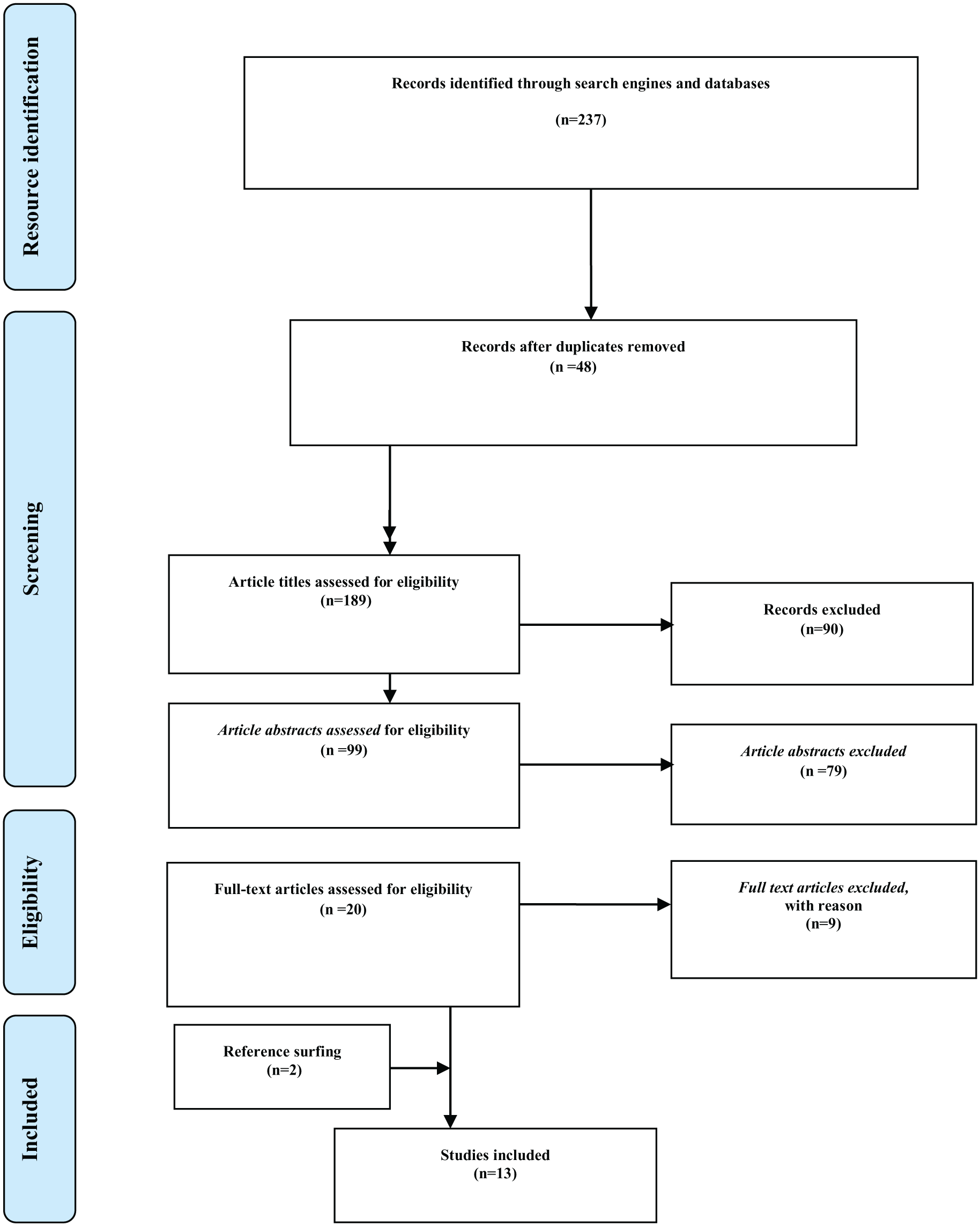
Preferred Reporting Items for Systematic Reviews and Meta-Analyses (PRISMA) flow diagram for the scoping review process.
Finally, the quality of final selected articles were evaluated by Critical Appraisal Skills Program (CASP) tool, as a guide it effectively covers the essential areas for critical appraisal of articles, 13 and then all papers were confirmed by the research team.
In stage 4, the data-charting form was used to extract data from each study (Appendix 1). Then, the collected data were collated and classified according to the thematic analysis in the last stage.
Results
The findings resulted from the analysis of 13 investigated studies were summarized in Table 2. Among these studies, 7 (53.85%) and 6 (46.15%) studies belonged to the developing and developed countries, respectively. Furthermore, 11 out of 13 retrieved documents were presented through qualitative or review methods, and 1 study conducted in a quantitative design and 1 in a format of mixed method study (Table 2).
Selected studies on pharmaceutical strategic purchasing.

As it mentioned in Table 2, most of the qualitative studies used data collection forms and topic guides, both were 4 out of 11 (36.36%) similarly.
Other findings showed that 6 main variables were emphasized as the effective variables on strategic purchase of medicines, including purchased interventions, target group and service users, providers and suppliers of interventions, methods and motivations, price, and structure and organization (Table 3).
Components affecting pharmaceutical strategic purchasing.

As it derives from Table 3, 8 articles (61.54%) pointed to the subcomponents of the main component of “price.” These subcomponents include pricing method, cost-price structures, and affordability of prices, competitive prices, real prices, and agreeable prices.
The second most referred main component belonged to “methods and incentives” with 7 articles (53.85%) and 6 subcomponents, namely, decreasing supply induced demand, payment mechanisms, behavioral incentives, rules and regulations, bargaining power, and pharmaceutical circulation funds.
Discussion
In summary, it seems that 6 categories of components—“target group and service users” (the demand side), “purchased interventions,” “providers and suppliers of interventions” (the supply side), “methods and motivations” (payment terms), “price,” and “structure and organization”—have been effective on the strategic purchase of medicines in different countries. This final categorization was similar to conceptual World Bank framework and another study.
Granting pharmaceutical subsidies to particular population groups and rational use of medicines are considered as the proposed sub-variables in the field of “target group and service users” or “demand-side interventions.” Gilson believes that governments are obliged to subsidize medicines that these subsidies can be used for some target groups as discount or exemption from the payment. 22 Other studies also mention that the success of discount project and subsidies subject is dependent on the existence of appropriate financing systems to compensate the lost revenue from the sale of medicines. 6 For example, 1 study showed that community-based financing projects increase moral hazard and limit the granting of subsides to the poor people. 21 These results emphasize the importance of granting subsides, with attention to some considerations about the way to assign subsidies to medicines, how to choose its appropriate financing method as well as how to select target groups.
Based on the present study, all purchasing structures and resource allocation consider the rational use of medicines to an optimized use of limited resources. 7 Different studies have mentioned different forms of irrational use of medicines, including prescribing too much medicines, multi-treatments, excessive intake of antibiotics, misplaced injections, small amount use of effective and appropriate products such as oral rehydration, and use of dangerous medicines. 24
Problems caused by the irrational use of medicines increase significantly in the case of oneness of prescribing and dispensing functions in time of economic pressures, information asymmetry, lack of education, poor monitoring and response, increased expectations of the people and sick persons, and motivation of earning more profit. 7 It is obvious that irrational use of medicines as an important issue, that can face the demand for medicines with problem, is more pronounced in developing countries facing with economic pressures, stewardship and regulatory challenges, and lack of control levers of inner and outer motivations. Other evidences show that the poor tend to self-medication more than rich people. This tendency reduces the potential benefits arising from the use of medicines, and imposes a macroeconomic burden to the health system and can greatly worsen medicine resistance in the community. 25 For this issue, it is necessary to reinforce the rational use of medicines and improve public awareness about the effects of indiscriminate use of medications on the people’s health and the health care system.
Other findings indicated that financing the most effective medicines and selecting the strategic medicines for the poor are considered as the most important sub-variables discussed in “purchased interventions.” In this regard, the evidence from Tanzanian insurance organizations represents the existence of pharmaceutical policy projects for using the selective contracts to purchase generic medicines available on the list of basic medicines of the World Health Organization. The relationship between above principles and payment system to physicians of the countries can lead to choosing the best and the most cost-effective interventions and essential medicines. 26
Therefore, it is essential to take steps toward institutionalization of pharmaceutical economic methods in selection of the best, the most effective, and the most affordable medications. In this regard, the implementation of electronic prescribing is suggested to help the physician in prescribing medicines covered by insurance plan and pharmacopeia of the related insurance organization. This technology results in access to information about the insurance coverage at the place of care and creates an instant electronic relationship between physician office, pharmacy, and health insurances.27,28
The sub-variables of “providers and suppliers of interventions” were identified in this research, including choosing the most reliable supplier of pharmaceuticals; choosing the best pharmaceutical provider in the public or private sector; promoting active competition between pharmaceutical drug providers on the quality, price, and volume of medicines; and making the basic medicine list and the rational policy of providing and purchasing medicines.
In this regard, the evidences also emphasize on this point that the selection process of the medicine suppliers is very important, so the active competition between public and private sectors on the price and volume of intended pharmaceuticals, in addition to decrease in prices and increase in the obtained value from money, has a great importance in this context. 7
Other findings of this research imply that reducing the induced demand of pharmaceutical providers, payment system, bargaining, cash flow of medicines, behavioral motivations, and monitoring are considered as the most important sub-variables of the methods and incentives (payment method). Various evidences show that the nature of pharmaceutical market combined with inconsistency and combination of relatively competitive retail market and also low competition in the production and wholesale are associated with the risk of severe induced demand by the service providers. 7
In addition, the various studies showed that behavioral changes have been known as an effective component for strategic purchasing that is possible through using financial incentives, penalties, and regulatory affairs and modifying the payment system in this market. 29 All these studies emphasize on the necessity of creating a proper competition in pharmaceutical market to reduce market failures and to achieve the competitive price. The importance of the payment term is as far as some evidences indicating the impact and the positive correlation of payment system to physicians with dose of drugs. This issue in the countries like Korea, where physicians combined prescribing and distribution rules, is intensified. 8
In this regard, evidence shows that 3 general payment methods to providers cause the creation of different motivations for prescribing medicines. For example, “budget” method of payment allocates the medicines budget in a linear or allocated form to medicines and other consuming products. In fact, budget payment is a form of credit allocation to the medicines depends on conditions.
In addition, “fee for service” is the base of private insurances and individual purchase. This method could increase the number of services and medicines consumption.
Regarding the “per capita” method which is not so common in the developing countries, people seek treatment sooner and therefore need less medications. However, under prescription would be occurred to reduce the medicine expenditures and increase the remained fund for the health professionals in this method.
The other studies show that in addition to the payment methods, cash flow is also effective on the prescription and consumption of medicines. For example, in India, patient pays the medicine cost directly to the pharmacy and then follows to return all or a part of his money from the buyer organization, whereas in Tanzania, the buyer organization pays directly to the provider. 8 These differences can be followed by different motivations; for example, it could lead to corruptions, forging, and overreporting by the providers to receive more fund from the buyer organization.
Finally, the results indicated that medicines pricing methods, cost-price structure, and competitive, real, and negotiated prices are known as the most important sub-variables of price.
In this regard, the evidence shows that the increased ability to purchase medicines needs medicines purchased with the lowest price and the standard quality. To achieve this goal, there is no way only to use the competition benefits, replacing brand medicines with the generic ones and achieving the agreed prices. 7 For example, in the Philippines, favorable price of basic medicines is obtained by negotiation with local producers, 30 or in Tanzania, only the distributor of medicines can adjust medical bills based on the price list of generic medicines. 8
On the other hand, evidence indicates that the price can be adjusted as the real cost (total amount), total amount plus percentage or fixed rate, and/or a fixed rate, for example, per prescription or per item that in case of using each item, we will face different options of behavioral requirements. 31
In addition, evidence of various countries indicates that the lack of guidelines for price and the lack of a control mechanism, even in case of the proper use of medicines pricing, can lead to a lot of variations in the amount received from the buyers.3,32 So, attention to price adjustment strategies, reforming the pricing mechanisms, and control of price volatility to achieve competitive, agreed, payable, and real prices will help as an important underpin to perform strategic purchasing.
Finally, the present results showed that hierarchy, priorities, organizational structure (decentralization), and organizational chart are proposed as the most important sub-variables of “structure and organization” in the strategic purchase of medicines.
In this regard, it was said that the organizational structures are the frameworks where purchasing and allocation of pharmaceutical resources are done, so efficacy of purchasing and allocating of resources depends on the characteristics and responsibilities for decision making and the level of risk. 7 In other words, many governments in developing countries have approved the national pharmaceuticals rules and policies to ensure the efficacy, safety, and rational use with a comprehensive approach, and this issue includes competitive bidding, management control, distribution strategy, educational activities for rational use of medicines, licensing, and other regulatory requirements. 23 Creation of decentralized structures in the purchase of medicines was another item which is pointed in developing countries in terms of organizational structure and its effectiveness in the purchase of medicines. 7
This article was conducted by a protocol reviewed by a research team with expertise in reviews. To ensure a broad search of the literature, the search strategy included 8 electronic databases. Each article was reviewed by 2 independent reviewers. We did not contact any researchers or experts for additional information we may have missed. Scoping reviews are not intended to assess the quality of the literature analyzed. Thus, the conclusions of this review are based on the existence of studies rather than their intrinsic quality. Nevertheless, this scoping review provides a comprehensive overview of the existing research on the pharmaceutical strategic purchasing. Due to the diversity of studies in different countries, the accurate comparison would be very complicated. For concentrating on the objective of the study and preventing diversity, the keywords were limited by expert opinions. So it could be mentioned as a limitation of study. Another limitation is lack of research study on pharmaceutical purchasing in the underdeveloped countries. The current scoping review provides foundations for further discourse and research on components related to the effects of pharmaceutical strategic purchasing on the health care system. Finally, it is proposed that more scientific research on the impact of pharmaceutical purchasing strategy on health and health care should be performed especially in underdeveloped countries in the near future.
Conclusions
According to the results, it seems that the insurance organizations affiliated with the developing countries can achieve the strategic purchase only through the modification of the medicine pricing system, modification of payment systems, attention to the real needs of target groups (demand) and modifying the structure and organization, as well as attention to the purchase of the most effective medicines from the best pharmaceutical providers.
Footnotes
Appendix
A draft chart of data extraction.

| General Information | |
|---|---|
|
|
|
| Article No | Language |
| Year of the publication | First author |
| Place (Country) | Corresponding |
| Type of article | Journal name |
|
|
|
| Aims of the study | |
| Study approach | Study design |
|
|
|
| Sampling Method | Study Environment |
| Data collection | Study Population |
| Data Analysis | Sample Size |
|
|
|
| Main results | |
| Conclusion | |
| Recommendations | |
| Limitations | |
Funding:
The author(s) received no financial support for the research, authorship, and/or publication of this article.
Declaration of conflicting interests:
The author(s) declared no potential conflicts of interest with respect to the research, authorship, and/or publication of this article.
Author Contributions
PB- Design of the study, reviewing the literature, analysis and interpretation of data, drafting of the manuscript, critical revision of the manuscript. AG- Analysis and interpretation of data, revising the article. SV- Drafting of the manuscript, acquisition of data. MS- Developing the search strategy, acquisition of data, participate in design of study, drafting of the manuscript, final revision of the manuscript. All authors read and approved the final manuscript.