



Abstract
Background:
Exposure to occupational risks constitutes one of the major public health concerns in the world. Nonetheless, very little attention has been paid towards improving safety in the workplace by employers, probably because, the direct losses associated with occupational risks (including reduction in labour productivity) are not widely known, especially across African countries. This study therefore sets out to investigate the association between occupational risks and labour productivity across African countries.
Methods:
The study uses secondary data on 42 countries in Africa over the period 1992 to 2021. Labour productivity is measured as output per worker while 5 indicators are used to measure occupational risk – occupational exposure to (i) noise, (ii) asthmagens, (iii) particulate matter, gases, and fumes, (iv) carcinogens, and (v) ergonomic factors. Ordinary Least Square (OLS) regression using Driscoll and Kraay (DK) standard errors is used as the baseline estimation technique while the system Generalised Method of Moments (GMM) regression is employed for robustness purposes.
Results:
Employing the baseline estimator, the study finds that a percentage increase in exposure to noise, asthmagens, particulate matter, gases and fumes, carcinogens and ergonomic factors at the workplace is associated with a decrease in labour productivity by 2.51%, 1.62%, 2.16%, 1.61%, and 1.24%, respectively at 1% level of significance. The estimates from the system GMM are not qualitatively different.
Conclusion:
There is a need to invest in occupational health as well as enforce related regulations to decrease the significant labour productivity losses associated with occupational risks in Africa.
Introduction
Exposure to occupational risks, such as poor ergonomic conditions, carcinogens, asthmagens, noise, and particulate matter, gases and fumes, could be associated with adverse health and economic effects. For instance, exposure to noise can lead to tinnitus and permanent hearing impairment among others. 1 Inhaling particulate matter or asthmagens can lead to aggravated asthmatic attack, 2 while poor ergonomic factors can be associated with musculoskeletal disorders. 3
Hence, globally, 10%, 21%, 28%, and 13% of Disability-Adjusted Life Years (DALYs) associated with occupational diseases are attributed to exposure to noise, ergonomic factors, carcinogens, and particulate matter, gases and fumes, respectively. 4 Moreover, each year, 395 million and 2.93 million workers are affected by non-fatal occupational injury and work-related deaths, respectively. 5 Concerning the African continent, estimates have shown that it has the highest proportion of work-related deaths as a fraction of all deaths. 5
Aside from the health consequences, occupational risks could lead to economic losses such as a reduction in labour productivity due to absenteeism, presenteeism or permanent withdrawal from the labour force, which could negatively affect firm performance as well as macroeconomic output.6,7 This is because, while theories of human capital (human capital model of demand for health and the human capital theory) posit that, health is a major component of human capital,8,9 theories of economic growth recognise human capital as a major enabler of economic performance. 10
Nonetheless, there is less investment in occupational health or safety. For example, about 70% of workers in the world do not have insurance against occupational diseases or injuries while only 15% of them have access to specialised occupational health services. 11 In developing settings such as Africa, only 5% to 10% of workers do have access to occupational health services. 12 To enhance investment in occupational health in developing settings such as Africa, beyond the health consequences, there is a need to provide cross-country empirical evidence of how exposure to occupational risks affects economic factors such as labour productivity.
Given this, some studies have been conducted on the association between labour productivity and occupational risks or health.13 -29 However, all the studies devoted to Africa13,14,16,19,23,25,29 focused on a particular sector or firm and 1 country, while all the empirics (except the reviews), among them, were cross-sectional in nature, using data collected at a single point in time. Meanwhile, providing cross-sectoral as well as cross-country macrolevel empirical evidence spanning different time periods (ie, panel data) is very important towards unearthing the broader labour productivity losses associated with exposure to occupational risks in Africa. Further, using panel data reduces the likelihood of omitted variable bias as well as enhances the precision of inferences drawn from estimates. 30 In addition, in the wake of limited resources, it is important to know which occupational risks are more detrimental to labour productivity to warrant more attention when designing policies. However, most of these past studies, especially those on African countries, did not provide this information, curtailing the possibility of comparing differences in the effects of various occupational risks. Further, there is the likelihood of endogeneity – the possibility of worsening labour productivity affecting investment in occupational health – which could lead to biased estimates. However, none of the past studies in Africa employed estimation techniques that can deal with endogeneity.
To fill the above gaps in the literature, this study, aims to use panel data to investigate the association between 5 occupational risks and labour productivity in various sectors (i.e. not sector specific) across different African countries while controlling for endogeneity, making it the first of its kind, especially in the African context. The robust findings of the study are expected to provide a wider overview of the labour productivity losses associated with different occupational risks among African countries which is important towards increasing attention on the need to invest in occupational health on the continent. Moreover, investigating the labour productivity losses of different occupational risks could greatly help in revealing which of these risks should be given enough attention when designing policies to improve exposure to occupational risks.
Methods
Data and Variables
Annual panel data on 42 African countries (see Appendix 1) covering the period 1992–2021 are used to achieve the objective of this study. Gaps in the data are filled using linear interpolation. The availability of data on all the study variables is used to determine the countries included in this study. Thus, countries with limited or incomplete data on the variables critical to this study are not included. This, however, does not introduce sampling bias because the countries included represent all the different sub-regions in Africa. Labour productivity, denoted by L, is the dependent variable, and the main independent variable is exposure to occupational risks (OR) among individuals aged at least 20 years, which is measured using 5 indicators: occupational or workplace exposure to (i) noise, (ii) asthmagens, (iii) particulate matter, gases and fumes, (iv) carcinogens, and (v) ergonomic factors. The control variables are Gross Domestic Product (GDP), schooling (S), population growth (population (P)), domestic investment (Id), foreign investment (If) and regulatory quality (R). Thus, schooling and population growth are used as proxies to human capital. In particular, schooling is added because, according to Becker, 8 training and education represent the most significant investments in human capital. Since occupational risks are also health indicators, we do not include other health-related human capital indicators such as life expectancy.
Data on labour productivity are sourced from ILOSTAT, 31 occupational risk indicators data are sourced from the Global Burden of Diseases Study (GBD), 32 and data on all the remaining variables are obtained from the World Development Indicators (WDI) of the World Bank. 33
Labour productivity is measured as GDP per worker in constant or real United States Dollars (USD). The occupational risk indicators are measured as summary exposure values (SEVs) to the various risks. It is worth noting that per GBD 34 definition, the occupational risk indicators refer to the proportion of the working population exposed to the above-mentioned risks due to occupational reasons; GDP is measured in real 2015 USD and schooling is measured as primary school enrolment as a percentage of the number of people officially designated to attend primary school. Population growth is measured by the growth rate of the total number of people living in a country measured in percentage, and domestic investment is measured by gross fixed capital formation as a percentage of GDP. Foreign investment is defined as net foreign direct investment in the balance of payment measured in current USD, and regulatory quality is measured by people’s perception about the capability of governments to implement regulations and policies effective towards ensuring private sector development, on a score between −2.5 and 2.5. All variable measurements are standardised measures from each data source, albeit the fact that the measure for domestic investment is a proxy used by the authors.
Expected Signs of Variables
Since exposure to occupational risks will hamper people’s ability to work, 6 it is expected that all the occupational risk indicators will have negative association with labour productivity. Given that an increase in GDP signals an increase in production of goods and services which is normally associated with an improvement in infrastructural facilities, 35 a positive association between GDP and labour productivity is expected. Also, because education can improve the efficiency of human capital,8,9 a positive association between an increase in school enrolment and labour productivity is expected. The association of population growth with labour productivity can be either positive or negative. Thus, if population growth increases and a significant number of the labour force is skilled with commensurate employment, then labour productivity will increase. However, if population growth increases but a greater proportion of the labour force remains unskilled and the few that are skilled do not get jobs that are commensurate with their skills, labour productivity will fall. 35 Both foreign and domestic investments are supposed to enhance the availability of infrastructure and technology 36 that will make labour more productive. Hence, it is expected that both investment indicators will have positive association with labour productivity. The association of regulatory quality with labour productivity is expected to be positive. This is because an improvement in regulatory quality is expected to enhance private sector development 37 and provide serene environment for people to work.
Empirical Model and Estimation Techniques
To achieve the study objective, based on the theories of human capital8,9 and economic growth, 10 we specify the nexus between occupational risks and labour productivity as follows:

where L is as defined already (ie, labour productivity), OR is a vector of the 5 occupational risk exposures and X is a vector of the control variables. For estimation purposes, equation (1) is respecified as follows:

where i and t represent countries and time (years) respectively,
Given the nature of the dependent variable, the Ordinary Least Square (OLS) regression with Driscoll and Kraay (DK) standard errors is used as the baseline estimation technique. Moreover, this estimator can deal with heteroscedasticity as well as spatial and serial correlation. 38 In running the regressions, all variables are log-transformed to ensure elasticity interpretation and reduce differences in measurement units39,40 except for population growth, foreign and domestic investments, and regulatory quality because they have negative values.
In this study, the occupational risk indicators are likely to be endogenous. For instance, worsening labour productivity could lead to an enhancement in occupational health. Nonetheless, the OLS regression with DK standard errors cannot deal with endogeneity. Therefore, for robustness purposes, the dynamic panel system Generalised Method of Moments (GMM) regression is used as an estimation technique due to its ability to deal with endogeneity,41 -43 while treating the occupational risks variables as endogenous (with lags 1, 1) and using the first lag of labour productivity, and control variables as instruments (with lags of 1, 2 for the noise and particulate matter, gases and fumes models, while lags of 1, 3 are used for the remaining models). Five-year averages of the data are taken before running the system GMM. Scientific reasons for such averaging are to enhance the suitability of the data for system GMM estimation (ie, short panel), curtail instrument proliferation and smoothen short-term fluctuations associated with recurrent observations, as have been documented elsewhere.35,43,44 Prior to the regression estimates, descriptive statistics of all variables and scatter plots of the main variables of interest are presented.
It is worth noting that to avoid multicollinearity, which is confirmed using the Variance Inflation Factor (VIF), 45 separate regressions are run for the different occupational risk indicators while taking account of the control variables. All the data analyses are done using Stata 14.0.
Results
This section presents the results of the study including summary statistics of the variables, scatter plots and regression estimates of the relationship between occupational risks and labour productivity among the sampled countries.
Summary Statistics
This sub-section presents summary statistics of the study variables (Table 1). The average output or GDP per worker (labour productivity) over the study period is $6992.84. The average occupational SEV due to noise, asthmagens, particulate matter, gases, and fumes, carcinogens and ergonomic factors are 11.21, 21.01, 10.51, 1.12, and 27.36, respectively. Summary statistics for the control variables are also reported in Table 1.
Summary Statistics of Variables.

Note. Variables are not log-transformed; Non-averaged data are used.
Correlation Between Exposure to Occupational Risks and Labour Productivity
Figure 1 displays scatter plots of the relationship between exposure to occupational risks and labour productivity. All the scatter plots are downward sloping which indicate negative association between all the occupational risk indicators and labour productivity. Thus, as exposure to occupational risks increases, labour productivity falls.

Scatter plots of the relationship between occupational risks and labour productivity.
Regression Estimates of the Association Between Exposure to Occupational Risks and Labour Productivity
This sub-section presents both the baseline and robustness regression estimates of the association between exposure to occupational risks and labour productivity. Table 2 presents baseline estimates of the OLS regression with DK standard errors while Table 3 presents the robustness estimates of the system GMM regression.
OLS with DK Standard Errors Regression Estimates of the Association Between Occupational Risks and Labour Productivity.
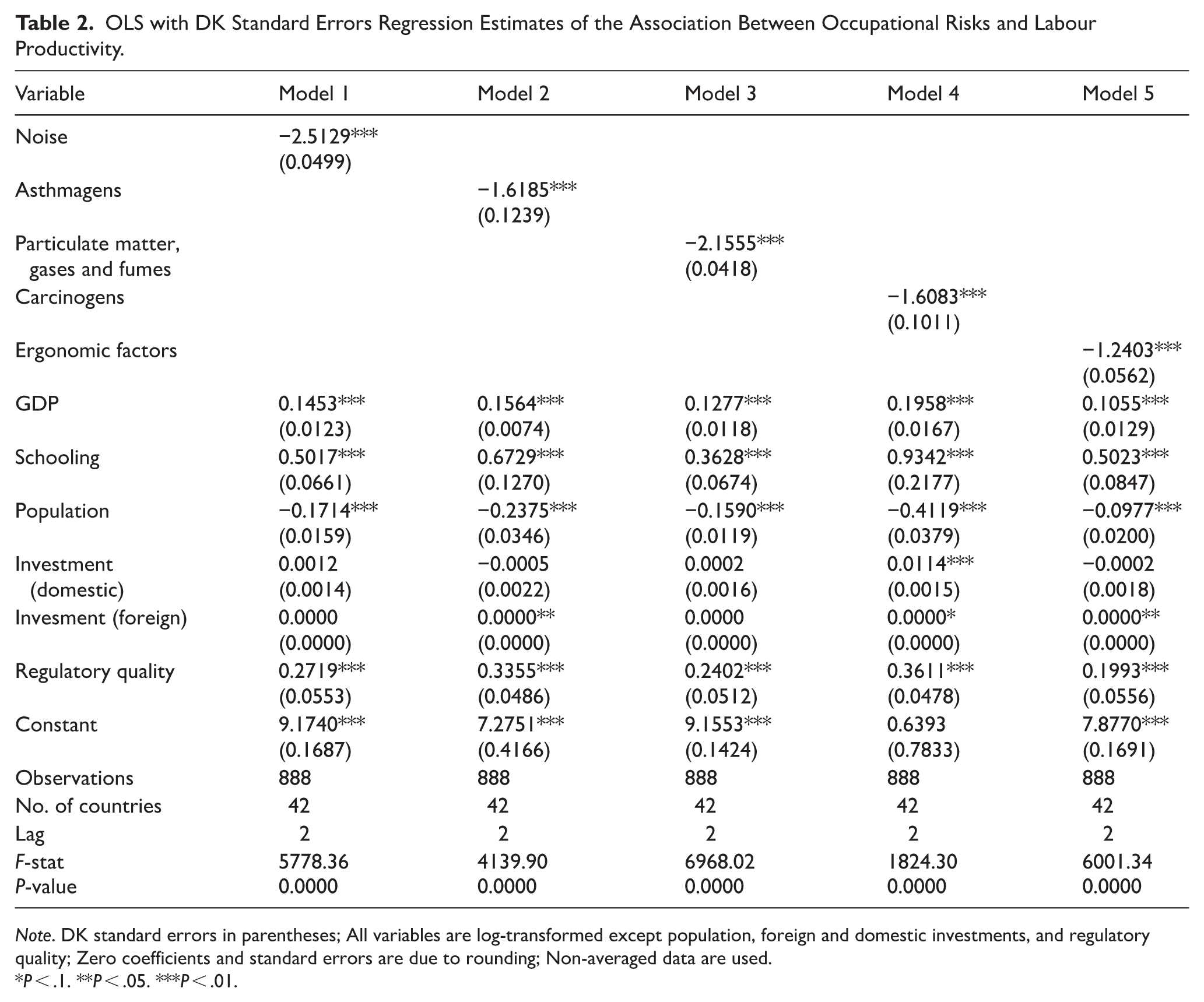
Note. DK standard errors in parentheses; All variables are log-transformed except population, foreign and domestic investments, and regulatory quality; Zero coefficients and standard errors are due to rounding; Non-averaged data are used.
P < .1. **P < .05. ***P < .01.
Two-Step System GMM Estimates of the Association Between Occupational Risk and Labour Productivity.
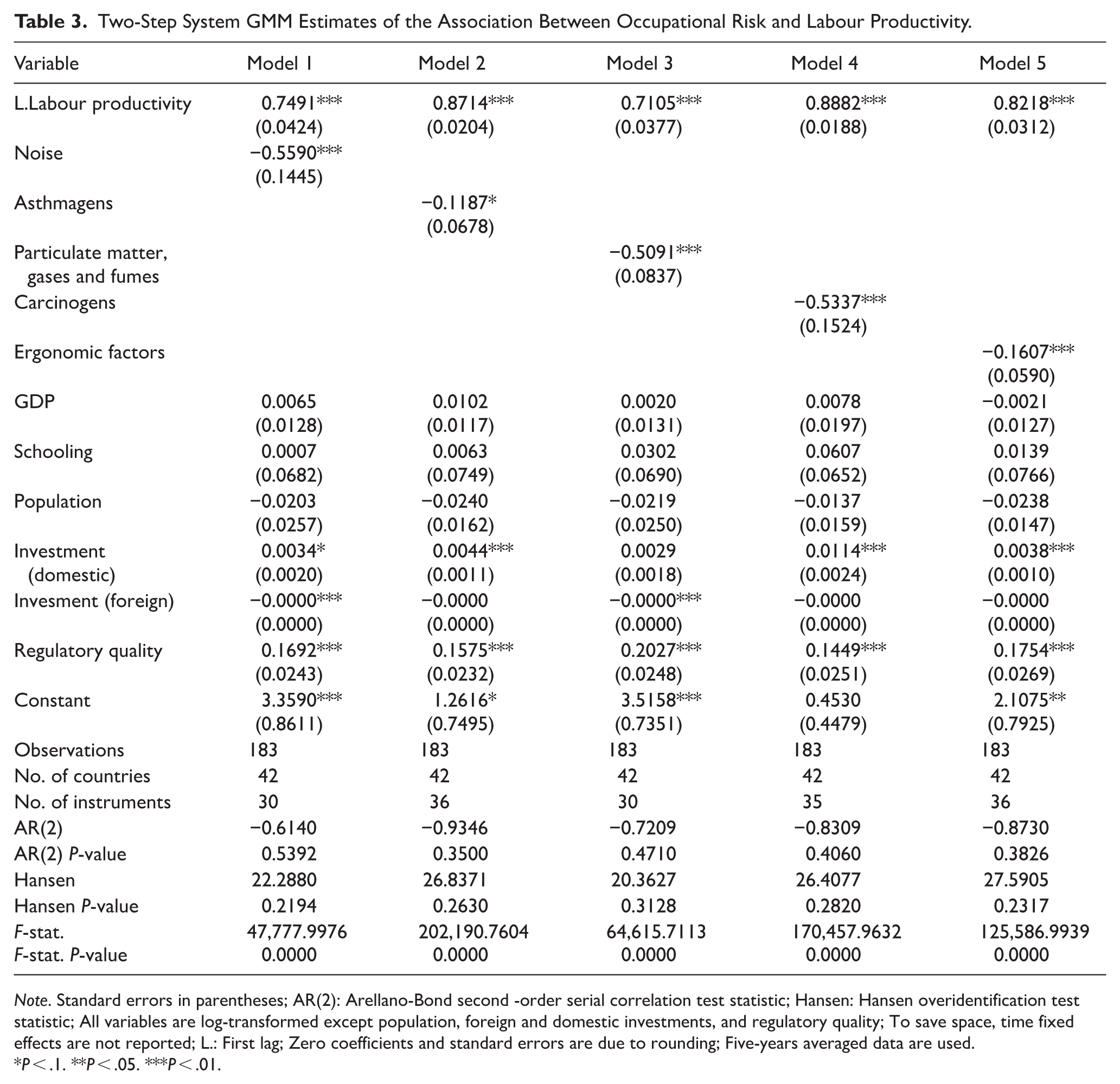
Note. Standard errors in parentheses; AR(2): Arellano-Bond second -order serial correlation test statistic; Hansen: Hansen overidentification test statistic; All variables are log-transformed except population, foreign and domestic investments, and regulatory quality; To save space, time fixed effects are not reported; L.: First lag; Zero coefficients and standard errors are due to rounding; Five-years averaged data are used.
P < .1. **P < .05. ***P < .01.
Baseline Regression Estimates
The OLS estimates using DK standard errors indicate negative statistically significant association between all the occupational risk indicators and labour productivity. Specifically, a 1% increase in the occupational SEVs of noise, asthmagens, particulate matter, gases, and fumes, carcinogens and ergonomic factors is found to be associated with a decrease in labour productivity by 2.51%, 1.62%, 2.16%, 1.61%, and 1.24%, respectively at 1% level of significance (Table 2).
Regarding the control variables, a percentage increase in income (GDP) is associated with 0.11% to 0.20% increase in labour productivity at 1% level of significance. Similarly, a percentage increase in school enrolment is found to be linked with an increase in labour productivity by 0.36% to 0.93% at 1% level of significance. However, population growth is negatively and significantly associated with labour productivity at 1% level (Table 2).
An increase in domestic investment is found to be positively associated with labour productivity (coefficient = 0.01, P > .01; Table 2, Model 4). In the same vein, a positive significant association is found between foreign investment and labour productivity (coefficient = 0.00) at 5% or 10% level. Also, a positive significant association is found between regulatory quality and labour productivity (Coefficients: 0.20-0.36, P < .01) (Table 2).
As already stated, the OLS estimates with DK standard errors are robust to both serial and spatial correlation as well as heteroscedasticity, and the models are fit given the statistical significance of the P-values of the various models (Table 2). In addition, there is no multicollinearity since the VIF estimates do not exceed the acceptable threshold of 5 and 10 45 (Appendix 2). These therefore confirm the suitability of the OLS estimates with DK standard errors.
Robustness Regression Estimates
The system GMM estimates (robustness checks) confirm the negative significant relationship between the occupational risk indicators and labour productivity found in the OLS regressions using DK standard errors. Thus, in the GMM estimates, a percentage increase in the occupational SEVs of noise, asthmagens, particulate matter, gases and fumes, carcinogens and ergonomic factors is found to be associated with a decrease in labour productivity by 0.56%, 0.12%, 0.51%, 0.53%, and 0.16%, respectively at either 1% or 10% level of significance (Table 3).
The system GMM estimates are free from second-order serial correlation and overidentification given the insignificance of the P-values of their respective tests. Moreover, there is no proliferation of instruments since in all the models, the number of instruments is less than the number of countries. The models are also fit given the highly significant nature of the F-tests (Table 3). These, therefore, confirm the appropriateness of the system GMM estimates.
Discussion
This study uses panel data to provide the foremost empirical evidence of the association between different occupational risks and labour productivity in various sectors in several African countries while controlling for endogeneity. The study finds negative significant relationship between all the occupational risk indicators (exposure to noise, asthmagens, particulate matter, gases and fumes, carcinogens and ergonomic factors) and labour productivity even after robustness checks. This finding is expected because occupational risks are responsible for hearing loss, respiratory diseases, chronic bronchitis, musculoskeletal disorders, asthma, and cancer among others 11 which could limit people’s ability to actively participate in economic activities, hence, negatively affecting their productivity. It is therefore not surprising that, in most countries, health problems associated with work are responsible for 4% to 6% losses in GDP. 11
The finding on the negative significant association between occupational risks and labour productivity is in tandem with some past studies.17 -19 For instance, in Zimbabwe, occupational health and safety problems have been found to negatively affect the productivity of workers in the food industry. 19 Similarly, in Cambodia, it was found that female garment workers perceived that, exposure to heat reduced their ability to understand tasks as well as perform physical tasks. 18 However, it is worth mentioning that the studies by Chea et al 18 in Cambodia and Katsuro et al 19 in Zimbabwe did not employ regression analysis, hence, could not quantify the actual impact of occupational risk on labour productivity. Moreover, the finding by Chavaillaz et al 17 of an annual extra labour productivity loss of 2% of GDP to be linked with a unit trillion tonne of carbon emitted is like the baseline finding of 2.16% fall in labour productivity associated with a percentage increase in exposure to particulate matter, gases and fumes in this present study, although the contexts are different. The similarity between these findings could be due to similar features of the 2 occupational health risks in question.
Further, looking at the different effects of the occupational risk indicators considered by our study, in the baseline, noise and particulate matter, gases and fumes, are the 2 occupational risks with the greatest labour productivity losses while ergonomic factors have the least effect. These findings may be explained by the fact that exposures to noise and particulate matter, gases and fumes are more common in several sectors relative to the other occupational risk indicators.
Notwithstanding these findings, and while basic preventative services (including safe working approaches) against work-related or occupational diseases cost averagely $18 to $60 purchasing power parity per worker, most working environments do not have these safety measures. 11 There is therefore the need for more investment in safe working environments to improve labour productivity, firm performance and macroeconomic output. This is because, research has shown that health measures at worksites can decrease healthcare costs and absenteeism due to sick leave by 26% and 27%, respectively. 11
In addition, to enhance safe working environments, there is the need to (i) improve cooperation between the labour and health sectors, (ii) implement occupational health and safety regulations, (iii) monitor the status and determinant’s of workers health at workplaces, national and subnational levels, (iv) enhance the basic prevention of occupational health risks based on the hierarchy of controls, and (v) ensure access to health services and interventions for prevention and control of injuries and diseases that are work-related. 4
Specifically, exposure to noise can be reduced or prevented by using hearing protection, barriers, enclosures, absorbent materials and screens, as well as designing workplaces to create quieter environments, and employing processes or equipment that are less noisy among others. 46 The use of Local Exhaust Ventilation (LEV) systems, dust suppression approaches, suitable respiratory protection (such as dust masks, respirators), air quality monitoring among others, could also reduce exposure to particulate matter, gases, and fumes, asthmagens, and carcinogens. 47 In addition, administrative measures such as awareness creation, job rotation to limit exposure and installation of decontamination stations can reduce exposure to occupational risks. 48 Doing so would aid in achieving the Sustainable Development Goal (SDG) 8.8, which by 2030 among others, aims to ensure secure and safe working environment for all groups of workers 49 as well as SDG 3.9 which by 2030 aims to decrease the number of morbidities and mortalities associated with contamination and pollution of soil, water, and air as well as exposure to hazardous chemicals. 50
Concerning the control variables, in the baseline, the positive significant association between GDP and labour productivity is expected. This finding is consistent with studies in the Organisation for Economic Co-operation and Development (OECD) countries 51 and South Africa. 52 Similarly, the finding on the positive association between education and labour productivity is in tandem with studies in Uganda 53 and 48 African countries. 54 Further, the negative significant association between population growth and labour productivity could be attributed to the likelihood of population growth being dominated by people without the requisite skills or those with the required skills not getting the jobs that match their skills. 35 The positive significant associations between both domestic and foreign investments and labour productivity are in line with the expectations of the study and supported by previous studies.55 -57 Since the development of the private sector is likely to include enhancement in the skills of labour and technological advancement among others, the positive significant association between regulatory quality and labour productivity among the selected countries is expected. 37 Similar findings have been reported in Jordan 58 and 12 other Asian countries. 59
Study Limitations
Despite the novelty of this study, there are limitations worth noting. First, the source of the occupational risk data normally faces challenges with data paucity in developing settings such as Africa. Although modelling techniques are used to address this data scarcity, obtaining more quality primary data from developing settings could improve the estimation outcomes. 60 Second, our study focuses on 5 of the most common occupational risk indicators rather than the full range of occupational hazards. The findings therefore reflect the effects of these major risks, which remain highly relevant across many work settings in Africa. In addition, while the statistical associations identified provide useful macro-level insights, they do not represent individual-level causal effects. Also, the study adopts a quantitative macro-level approach and does not incorporate qualitative evidence from firms and employees, which could provide additional context on the mechanisms linking occupational risks to labour productivity. Future research could build on these results by expanding the range of risk indicators and integrating complementary micro-level and qualitative insights.
Conclusion
While occupational risks remain major public health problems globally including Africa, there is less attention given to enhancing occupational safety. This is probably because, empirical evidence of the negative consequences of occupational risks, such as labour productivity losses is scant, especially on the African continent. Meanwhile, the few empirical studies conducted in Africa focused on a sector and a country, while using cross-sectional data without controlling for endogeneity, hence limiting their generalisability to different sectors and countries on the continent as well as the unbiasedness of their estimates. Further, while knowing which occupational risks are more detrimental to labour productivity is important when designing and implementing targeted interventions to curtail exposure to occupational risks, this information is lacking in the literature, especially in the African context. To fill the gaps in the literature, this study uses panel data to examine the associations between 5 different occupational risks (exposure to (i) noise, (ii) asthmagens, (iii) particulate matter, gases, and fumes, (iv) carcinogen, and (v) ergonomic factors) and labour productivity in various sectors in 42 African countries using the OLS regression with DK standard errors at baseline while controlling for endogeneity using the system GMM regression.
The findings of this study point to the conclusion that exposure to occupational risks is associated with a decrease in labour productivity, irrespective of the estimation technique used, with noise, and particulate matter, gases and fumes exposures, being the 2 occupational risks with the greatest labour productivity losses at baseline. Thus, reducing exposure to noise, particulate matter, gases and fumes should be prioritised in the quest to improve labour productivity. This can be achieved through the installation of hearing protection and barriers, the use of LEV systems, suitable respiratory protection (such as dust masks, respirators), air quality monitoring, awareness creation among others46 -48 (see the Discussion for details).
Footnotes
Appendices
VIF results.

| VIF | 1/VIF | |
|---|---|---|
| VIF results for noise model | ||
| Noise | 1.271 | 0.787 |
| GDP | 1.16 | 0.862 |
| Schooling | 1.078 | 0.928 |
| Population | 1.406 | 0.711 |
| Investment (domestic) | 1.129 | 0.886 |
| Investment (foreign) | 1.119 | 0.894 |
| Regulatory quality | 1.172 | 0.853 |
| Mean VIF | 1.191 | . |
| VIF results for asthmagens model | ||
| Asthmagens | 1.271 | 0.787 |
| GDP | 1.158 | 0.863 |
| Schooling | 1.083 | 0.924 |
| Population | 1.404 | 0.712 |
| Investment (domestic) | 1.169 | 0.855 |
| Investment (foreign) | 1.12 | 0.893 |
| Regulatory quality | 1.176 | 0.85 |
| Mean VIF | 1.197 | . |
| VIF results for particulate matter, gases and fumes model | ||
| Particulate matter, gases and fumes | 1.331 | 0.751 |
| GDP | 1.169 | 0.855 |
| Schooling | 1.082 | 0.924 |
| Population | 1.414 | 0.707 |
| Investment (domestic) | 1.133 | 0.883 |
| Investment (foreign) | 1.119 | 0.894 |
| Regulatory quality | 1.173 | 0.852 |
| Mean VIF | 1.203 | . |
| VIF results for carcinogens model | ||
| Carcinogens | 1.168 | 0.856 |
| GDP | 1.15 | 0.869 |
| Schooling | 1.2 | 0.834 |
| Population | 1.252 | 0.798 |
| Investment (domestic) | 1.105 | 0.905 |
| Investment (foreign) | 1.122 | 0.891 |
| Regulatory quality | 1.2 | 0.833 |
| Mean VIF | 1.171 | . |
| VIF results for ergonomic factors | ||
| Ergonomic factors | 1.611 | 0.621 |
| GDP | 1.198 | 0.835 |
| Schooling | 1.078 | 0.928 |
| Population | 1.593 | 0.628 |
| Investment (domestic) | 1.149 | 0.871 |
| Investment (foreign) | 1.12 | 0.892 |
| Regulatory quality | 1.18 | 0.848 |
| Mean VIF | 1.275 | . |
All variables are log-transformed except population, foreign and domestic investments, and regulatory quality.
Acknowledgements
Not applicable.
Author Note
The data used in conducting this study cannot be associated with households or individuals. In addition, all the important guidelines and regulations have been followed.
Ethical Considerations
Ethical approval is not required for this study since secondary data containing no information on human participants are used. Therefore, the Declaration of Helsinki as regards human participants is unapplicable to this study.
Consent to Participate
Not applicable.
Consent for Publication
Not applicable.
Author Contributions
Conceptualisation: MI; Data acquisition: MI, KN, GK, KK; Analysis: MI; Interpretation: MI; Writing of original draft: MI, KN, GK, CK, KK, IT, EA, NI, MD; Critical revision for important intellectual content: MI, KN, GK, CK, KK, IT, EA, NI, MD. All authors read and approved the final version of the manuscript.
Funding
The authors received no financial support for the research, authorship, and/or publication of this article.
Declaration of Conflicting Interests
The authors declare no potential conflicts of interest with respect to the research, authorship, and/or publication of this article.
Data Availability Statement
The data used in carrying out this study can be obtained freely from the websites of ILOSTAT (https://rshiny.ilo.org/dataexplorer12/?lang=en%26id=GDP_205U_NOC_NB_A), the World Bank (https://databank.worldbank.org/reports.aspx?source=World-Development-Indicators#advancedDownloadOptions) and the Global Burden of Diseases Study ( ). In doing so, readers should kindly pay attention to when the authors accessed the datasets as outlined in the reference list.