



Abstract
Background:
Traffic-related air pollution (TRAP) is an increasingly predominant source of air pollution in North Carolina (NC). Several executive orders have sought to address TRAP and prevent potential health effects from this source of exposure. In January 2022, NC Governor Roy Cooper signed Executive Order 246 (EO 246), which directed the North Carolina Department of Transportation to develop the North Carolina Clean Transportation Plan with considerations for environmental justice (EJ) and equity, in addition to establishing new goals for reduction of greenhouse gases in North Carolina and prioritizing EJ activities.
Method:
The purpose of this manuscript is to support implementation of clean transportation policies in North Carolina. It summarizes the current evidence on health and climate impacts of TRAP and documents the potential health benefits of implementing the clean transportation policies, especially if applied equitably to benefit communities with the greatest need.
Results:
There is a strong body of evidence demonstrating the deleterious impacts of TRAP exposure on many health outcomes. Throughout the United States, including in North Carolina, TRAP exposure disproportionately impacts communities of color and low income communities.
Conclusions:
Based on the strong public health evidence that TRAP exposure causes diseases and mortality and contributes to health disparities as well as the projected reductions in TRAP burden, particularly in near-road communities, we recommend implementation of clean transportation policies with an emphasis on equity.
Introduction
Air pollution is one of the greatest environmental threats to health worldwide, 1 and traffic-related air pollution (TRAP) accounts for about 25% of air pollution worldwide. 2 As clean energy becomes more cost competitive and regulations transition the power sector away from coal and other fossil fuels, TRAP is increasingly becoming a predominant source of air pollution in North Carolina (NC). 3
Several NC executive orders have sought to address TRAP and prevent its potential health effects. In January 2022, Governor Roy Cooper signed Executive Order 246 (EO 246), titled “North Carolina’s Transformation to a Clean, Equitable Economy.” EO 246 directed the North Carolina Department of Transportation to develop the North Carolina Clean Transportation Plan (NCCTP) with considerations for environmental justice (EJ) and equity, in addition to establishing new goals for reduction of greenhouse gases (GHG) in North Carolina. Executive Order 271 (EO 271), titled “Growing North Carolina’s Zero Emission Vehicle Market,” followed in October 2022. EO 271 recognized the economic contributions of medium and heavy-duty (MHD) vehicles (ie, vehicles weighing over 10 000 pounds, such as trucks, vans, and buses) in North Carolina, acknowledged the disproportionate impact of air pollution from MHD vehicles and other transportation-related sources on underserved communities and people of color. It also called for a transition to zero emission MHD vehicles to reduce air pollution emissions in all communities.
The NCCTP was published in April 2023 and provided actionable, near-term strategies to accelerate decarbonization in the transportation sector with an emphasis on equitable outcomes for all North Carolinians. The NCCTP identified 11 key recommendations to implement NC’s transition from gasoline and diesel vehicles to zero-emission vehicles, reduce vehicle-miles-traveled statewide, and build infrastructure to support clean transportation with active public participation and EJ considerations (Table 1). Implementation of the NCCTP and related policies will require public support, and several strategies will require legislative approval.
Recommendations of the North Carolina Clean Transportation Plan and the Governor’s Environmental Justice Advisory Council.

Executive Order 292 (EO 292) established the Governor’s Environmental Justice Advisory Council, which includes representatives from state agencies including the Department of Transportation, Department of Health and Human Services, and the Department of Environmental Quality, and which authored a report including recommendations for advancing EJ in NC in October 2024 focused on collaborating with, engaging, listening to, and documenting the needs of NC communities of color.
Policies to reduce TRAP and the associated impacts of climate change are critical to protect public health. Several studies have demonstrated associations between TRAP-reduction policies and public health benefits. Garcia et al found that California’s early transition to electric vehicles was associated with fewer asthma emergency room visits. 4 Tonne et al documented reductions in all-cause mortality and cardio-respiratory hospital admissions following implementation of the “London Congestion Charging Scheme” traffic reduction program. 5 Adar et al conducted a natural experiment in Washington state and found that electrification of school busses is associated with improved pulmonary outcomes among children, with stronger associations in children with asthma. 6 Analyses leveraging the traffic reduction efforts surrounding the 1996 Olympic Games in Atlanta, Georgia found reductions in childhood asthma emergency visits and hospitalizations. 7
The purpose of this manuscript is to briefly summarize the current evidence on health and climate impacts of TRAP and to document the potential health benefits of implementing the NCCTP and similar policies, especially if applied equitably to benefit communities with the greatest need.
Traffic-Related Air Pollution (TRAP)
TRAPs are contaminant mixtures including exhausts and evaporative emissions from vehicles, non-combustion emissions (eg, tire wear), and secondary pollutants generated in the atmosphere. Noxious gases (eg, nitrogen oxides (NOx)), particulate matter (PM), and smog are specific TRAPs of primary public health concern. 2
As part of the Clean Air Act, the United States (US) Environmental Protection Agency (EPA) defines 6 common air pollutants as criteria air pollutants (CAPs): carbon monoxide (CO), lead (Pb), sulfur dioxide (SO2), nitric oxide (NO) and nitrogen dioxide (NO2; ie, NOx), ground-level ozone, and PM. CAPs are designated based on strong scientific evidence of their association with adverse health outcomes, and the US EPA regulates them by setting emission limits for each pollutant to protect public health. 8 Two CAPs, NOx and PM, are TRAPs. Another CAP, ozone, interacts with NOx to contribute to smog. Therefore, the following summaries focus on TRAP broadly and the specific pollutants: NOx, PM, and ozone.
MHD vehicles are substantial sources of TRAP. They represent about 5% of the total vehicles traveling on-road, but have the highest annual average of vehicle miles traveled in the US. 9 MHD vehicles are also responsible for over 40% of NOx and 60% of PM2.5 (particles < 2.5 μm) released from the total on-road vehicle sources, nationally. 10
TRAP and Health
Nine out of 10 urban residents in the US experience TRAP-related health impacts. 11 NOx, PM, and ozone are all associated with adverse health outcomes with varying degrees of causal scientific evidence supporting these associations, which are documented in the US EPA’s Integrated Science Assessments (ISAs) and summarized below and in Table 2.
TRAP Exposure Health Impacts and Strength of Evidence According to US EPA’s Integrated Science Assessments.
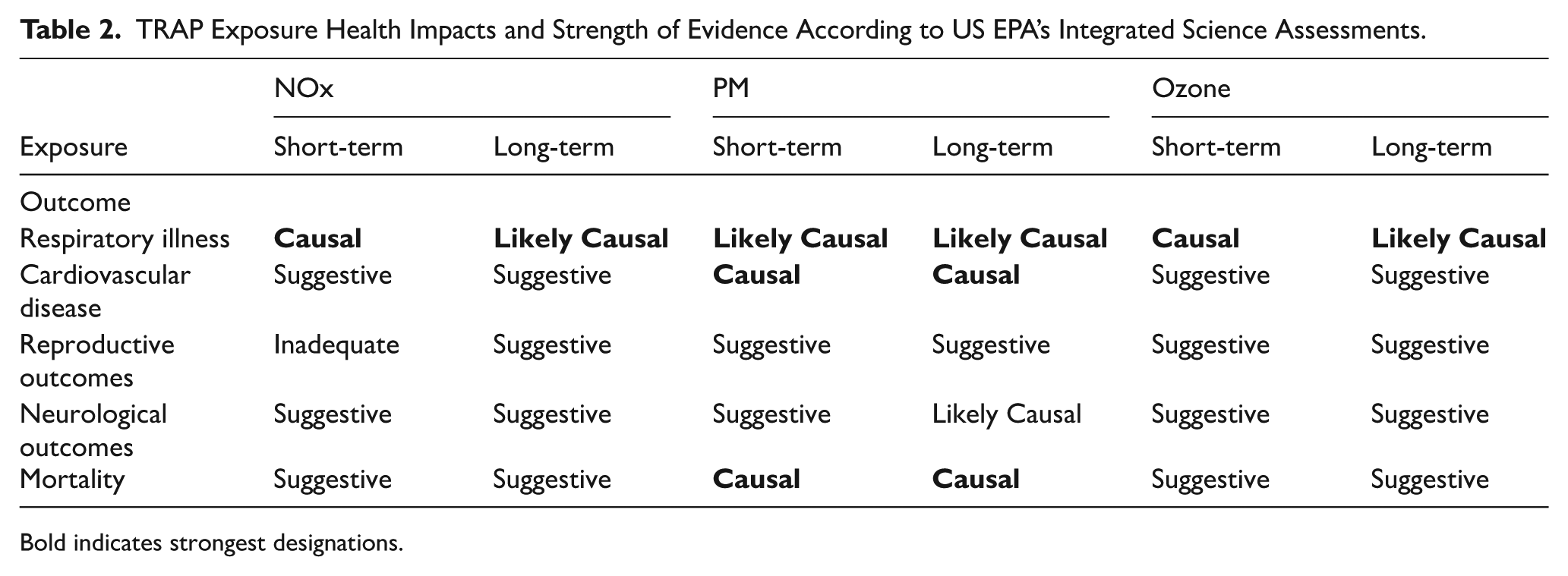
Bold indicates strongest designations.
According to the 2016 ISA, short-term exposure to NOx increases risk of respiratory effects and long-term exposure is likely related to respiratory effects. The ISA documents evidence that both short- and long-term NOx exposure may increase risk of cardiovascular effects, cancer, birth outcomes, and mortality. 12 The 2020 PM ISA indicates that PM2.5 exposure increases mortality and cardiovascular disease risk and likely impacts respiratory and cancer outcomes. It also documents suggestive association with fertility, pregnancy and birth outcomes, metabolic effects, and central nervous system disorders. There is less robust evidence for the impacts of other diameters of PM, but the ISA reports suggestive links with respiratory, cardiovascular, cancer, metabolic, and central nervous system impacts. The ISA also establishes that smaller particles are more dangerous because they better penetrate lung tissue. 13 The 2020 ozone ISA states that short-term exposure impacts respiratory outcomes, and long-term exposure may increase adverse respiratory outcomes. It also reports a suggestive association with mortality, cardiovascular disease, fertility, pregnancy and birth outcomes, metabolic effects, and central nervous system outcomes. 14
Respiratory Illnesses
TRAP enters the respiratory tract via inhalation and causes inflammation in the airway and lungs. Repeated exposure to TRAP damages lung tissues, causing respiratory symptoms and aggravating underlying chronic respiratory conditions. The incidence of childhood asthma is associated with both early-age and prenatal exposure to TRAP. In addition, studies have found an association between TRAP exposure and lung cancer mortality in adults. 15
Cardiovascular Disease
TRAP exposure causes increases in blood pressure and decreases in heart rate, likely related to molecular alterations from systemic inflammation. 16 TRAP exposure is associated with increased incidence of myocardial infarction and coronary artery disease in adults aged 65 and older. 17 Additionally, TRAP exposure during the entire gestational period is associated with an increased risk of preeclampsia, a serious vascular complication of pregnancy. 18
Birth Outcomes
Prenatal exposure to TRAP may also affect birth outcomes by disrupting tissue formation and inhibiting growth during critical developmental windows. Studies have documented associations between TRAP exposure and low birth weight and preterm birth. 19
Neurological Outcomes
When TRAP chemicals enter the circulatory system, they can move to the brain and induce oxidative stress and neuroinflammation. These reactions can potentially lead to neurodevelopmental and neurodegenerative disorders in children and in older adults. TRAP is associated with impaired cognitive development in primary school children and reduced sustained attention in adolescents. TRAP exposure during the third trimester of pregnancy and early childhood have been related to increased risk of autism spectrum disorder in children. Olfactory dysfunction, which can be an important symptom of neurodegenerative diseases, has been found more often in people who were exposed to high levels of air pollution compared to those who were not. 20
TRAP and Climate Change
Certain TRAPs, such as carbon dioxide (CO2), methane (CH4), nitrous oxide (N2O), hydrofluorocarbons (HFCs), are leading sources of greenhouse gases (GHG), which accumulate and cause atmospheric temperature rise. 1 As such, climate change and TRAP are indirectly linked, as reducing TRAP emissions is likely to also reduce emissions of GHGs. In North Carolina, the transportation sector accounts for approximately 36% of the total GHG emissions. N2O alone accounts for 3% of GHG emissions and remains underregulated. 3 While this far lower than GHG emissions from agriculture and industry, it highlights a policy gap, especially within the context of a multi-pollutants emissions reduction strategy. While some TRAP constituents are designated CAPs, 8 some are not regulated. Further, recent EPA announcements have indicated an intention to reduce federal regulatory standards, 21 increasing the need for state-level protections.
According to the North Carolina Climate Risk Assessment and Resilience Plan, the average temperatures in NC are projected to increase continuously under the current level of pollutant emissions. 22 Temperature rise and related climate change impacts affect public health through mechanisms beyond the direct pollutant exposure impacts discussed above. Higher temperatures cause droughts, sea level rise, and amplify extreme weather events that lead to flooding, all of which cause diseases, injuries, and fatalities.1,23 While TRAP is a local issue and climate change is a global issue experienced locally, multiple policies and actions must be implemented synergistically to simultaneously mitigate climate change, adapt to climate change, and improve air quality through multi-pollutant reduction strategies.
TRAP and Environmental Justice
Communities of color and low income populations have disproportionately high exposure to TRAP and reduced access to transportation infrastructure because of structural racism, that is, policies and institutions systematically cite hazards and restrict resources from these communities.24,25 Throughout the US, and in NC specifically, this disproportionate burden of TRAP can be attributed to inequitable municipal trucking and industrial distribution center siting, 26 traffic calming program targeting, 27 and public transportation program planning. 28 Further, there is a recurrent history of major highway construction through existing Black residential areas. 29 Climate change-related disasters also have disparate flooding and contamination impacts by race and socioeconomic status because of the unjust patterning of housing elevation, industrial pollution burden, access to protective infrastructure, and precarious living and working conditions. 30 In 2024, the Governor’s Environmental Justice Advisory Council published a list of initial recommendations that would further support considerations for EJ in transportation planning (Table 1).
Benefits of Implementing Clean Transportation Policies
The Clean Air Act, a federal air quality law, has been proven effective in reducing air pollutants and providing health benefits. According to the Natural Resources Defense Council, it is estimated that the Clean Air Act resulted in 370 000 fewer premature deaths and 189 000 fewer hospital admissions for cardiac and respiratory events in 2020 alone nationwide. 31 Although the Clean Air Act has resulted in air quality improvements, there are still demands for more specified and localized interventions for each state, as they all have different contributing factors to poor air quality and different circumstances that make certain interventions feasible.
In NC, the ninth most populous state, 32 implementation of the NCCTP would reduce statewide TRAP that is known to harm health as well as contribute to improvements in national air quality. The NCCTP assesses the opportunities and challenges with North Carolina’s transition to a clean transportation system with an emphasis on equitable access in communities most impacted by TRAP. The proposed solutions are informed by impacted community members through public participation in NCCTP development and recommendations from the Governor’s Environmental Justice Advisory Council. A combination of actionable strategies have been developed across 5 specific areas: zero-emission vehicle plan for light-duty vehicles, zero-emission vehicle plan for MHD vehicles, fleet transition plan for public and private vehicle fleets, vehicle miles traveled reduction plan, and clean transportation infrastructure plan. The NCCTP will raise awareness of the impacts of TRAP and the need for a transition to zero-emission vehicles to improve air quality in the state.
According to a study completed by the Research Triangle Institute, adopting standards in NC aimed at increasing the prevalence of zero-emission MHD vehicles, would lead to a 61% reduction in NOx and a 73% reduction in PM2.5 by 2050. They also highlight that 42% of these predicted emission reductions would occur in near-road communities, which have large populations of low income residents and communities of color who are disproportionately burdened by TRAP-associated illnesses. 33 NC is currently prohibited from adopting these standards following action from the NC General Assembly in 2023.
It is worth noting that shifting vehicles to electric power increases demand on the power sector, and our recommendations include ensuring that this demand is met with green energy, rather than historical reliance on fossil fuels (eg, coal, natural gas) or nuclear power. Based on the strong public health evidence that TRAP exposure causes diseases and mortality while contributing to health disparities as well as the projected reductions in TRAP burden (particularly in near-road communities), we recommend implementation of NCCTP and similar policies with an emphasis on equity. This approach is necessary for prevention of further deleterious population health impacts and environmental injustices.
Footnotes
Acknowledgements
We thank Dr. Adrien Wilkie, Dr. Sarah Hatcher, Dr. Aaron Fleischauer, and Dr. Zack Moore for their critical feedback on this manuscript.

Ethical Considerations
Because this study uses existing scientific literature and there was no contact with human subjects, the University of North Carolina Office of Human Research Ethics considered this non-human subject research.
Consent to Participate
There was no contact with human subjects, so informed consent was not necessary.
Authors Contributions
Elizabeth S. McClure drafted content, created the tables and figures, assisted with the literature review synthesis, and approved the final manuscript as submitted. Seowoo Jung drafted the initial manuscript, contributed to editing of the manuscript, and approved the final manuscript as submitted. Virginia T. Guidry conceptualized the study, assisted with the literature review synthesis, contributed to editing of the manuscript, and approved the final manuscript as submitted.
Funding
The authors received no financial support for the research, authorship, and/or publication of this article.
Declaration of Conflicting Interests
The authors declared no potential conflicts of interest with respect to the research, authorship, and/or publication of this article.
Disclaimer
None.