



Abstract
Introduction:
The inadequate enforcement and compliance with sanitary regulations and the lack of sanitary regulation resources at street food vending sites may result in the risk of food contamination and outbreaks of foodborne diseases. This study aimed to assess the enforcement and compliance with sanitary regulations at street food vending sites in Oyo State, Nigeria.
Method:
A cross-sectional survey research design was used for this study, in which data was collected from 600 street food vending sites in various towns in different senatorial zones in Oyo State, Nigeria. Street food vendors who were available and willing to participate in the study were then sampled conveniently. A structured sanitary compliance checklist was used for data collection at street food vending sites from 2023 to 2024.
Results:
Most street food vendors were female (89.7%) and above the age of 46. The vast majority of street food vending sites (75.7%) had low compliance with food safety regulations, 12.5% had moderate compliance, and 11.8% had high compliance. 85.7% of the street food vending sites had not been inspected by the authorities. Regarding enforcement of sanitary requirements by health inspectors, 85.7% of street vended facilities had not been inspected.
Conclusion:
The enforcement and compliance with sanitary requirements at street food vending sites were found to be low and therefore, the sanitary conditions and food safety practices at these sites cannot be guaranteed. A positive correlation exists between sanitary compliance and the enforcement of sanitary requirements at street food vending sites. It is recommended that municipal authorities register all the street food vending sites, to enable effective monitoring in ensuring that food safety regulations are implemented at street food vending sites.
Introduction
Street-vended foods are ready-to-eat foods prepared and sold in public places. 1 Globally, street-vended foods may serve as a vital source of affordable nutrition for a significant portion of the population due to their proximity to residential and commercial areas.2,3 Street foods remain an important meal option in most developing countries, including Nigeria, and have contributed to the daily nutrient intake of consumers. 4 The economic importance of street food vending activities cannot be underestimated as they provide self-employment opportunities to those who cannot gain employment in the formal sector. 5 The sale of street-vended foods constitutes a major source of income for self-employed individuals from low-income communities. 6 Street food vendors are mostly located in parks, bustling street corners, transportation hubs, public squares, marketplaces, commercial districts, and cultural and tourist attraction centers, where potential street food consumers can be found. 7 These areas are hotspots for street-vended food activities due to the presence of offices and businesses, heavy pedestrian traffic and the influx of visitors from other areas. 8 This setting encourages street food vending activities due to the provision of quick, convenient foods with diverse tastes and preferences, making them ideal destinations for diverse culinary experiences. 6
The rapid urbanization and population growth in some developing countries, such as Nigeria, have created a favorable environment for street food businesses. 9 The rise in population translates to more individuals with disposable income seeking cheap and convenient alternative meals away from home.2,10 Street foods play an important role in the everyday lives of Nigerians, offering different flavors, textures, and cultural experiences.5,11 Despite their accessibility and popularity, street-vended foods constitute an important public health issue due to a lack of an adequate understanding of food safety procedures. 12
The enforcement of food safety regulations at street food vending sites is often inefficient due to the overwhelming non-compliance with food safety regulations by street food vendors. 13 The vastness and the informal nature of street food vending activities can render monitoring and enforcement efforts by health inspectors ineffective due to the setting up of street food vending activities at non-designated areas.6,14 Most street food vending activities are not regulated and are often associated with poor sanitation and food safety practices, constituting a public health risk. 6 Most street food vendors have not undergone food safety training and are often not aware of existing food safety regulations and therefore do not comply with these regulations.7,15 Furthermore, low levels of enforcement of sanitary regulations at street food vending sites means street food vendors are unlikely to comply with sanitary regulations, hence the risk of food contamination at street food vending sites. 16 The sale of contaminated street-vended food under these instances, will remain a potential health risk to consumers.6,10 Non-compliant street food vending sites often lack access to electricity, potable water, waste disposal systems, and food preparation equipment and these conditions can contribute to unhygienic practices at street food vending sites. 17 The absence of potable water specifically can render washing of hands, and cleaning of surfaces and utensils ineffective. 18 The consumption of contaminated street-vended food by consumers can lead to foodborne disease outbreaks, which in turn, will lead to hospitalization and cost productivity losses due to illness and even death, especially in people with weak immune systems. 19 Oyo State is among the many states in Nigeria with increasing urbanization which is accompanied by expanding street food vending activities. 9 The findings from this study will provide detailed information on the extent of compliance and enforcement of food safety regulations, which will provide the basis for action by municipal authorities and other stakeholders to harmoniously balance the needs of vendors and consumers. 20 This study aimed to assess the enforcement and compliance of food safety regulations at street food vending sites in Oyo State, Nigeria.
Research Methodology
The Study Area
This study was conducted in the 3 senatorial zones (Oyo Central, Oyo North, and Oyo South) of Oyo State. The headquarters of all the 33 local government areas (LGA) within the senatorial zones were targeted. The Oyo State is in the southwest of Nigeria and has a population of around 7 976 100 inhabitants. 21 Agriculture is the cornerstone of Oyo State’s economy because of fertile land and a favorable climate. 22 In addition, the investment in Agriculture by the Government has led to higher wages and income generation in the state. 22 These activities have prompted rural-to-urban migration to vibrant commercial centers and dynamic trade sectors for regional economic opportunities. 23 Oyo State is home to many educational institutions, including universities, colleges, and secondary schools, and it has an influx of students who contribute to the human capital of Oyo State. 24 Street food vending has benefited the human capital with disposable income in Oyo State. 25
Research Design and Sampling
A cross-sectional survey research design was used to collect data from many different street food vendors at a single point in time. 26 A random draw was used to select 5 Local Government Areas from the list of each of the 3 senatorial zones in Oyo State NPCN. 27 Street food vendors were purposefully sampled in the headquarters of the 15 selected Local Government Areas. Forty street food vendors, individuals who sell food or drinks in public spaces, such as streets, sidewalks, or other outdoor areas, irrespective of their structures and who were available and willing to participate in the study were then sampled conveniently per Local Government Area. A total of 600 street food vendors and their vending sites were used for the study. The study sample size (n) was estimated using Cochran’s formula for a large population.
Data Collection
The data collection instrument consisted of a structured sanitary compliance checklist designed purposefully for this study The checklist had 3 sections: socio-demographics, characteristics of street food vending facilities, and sanitary requirements checklist. A pilot study was conducted using 30 street food vendors, and the information was used to ascertain the validity and reliability of the instrument. The instrument’s reliability was assured by administering the same questionnaire to the pilot group respondents at 2 different points in time and a Cronbach Alpha value of .7 and above was used to establish the internal consistency of the constructs. Furthermore, review feedback from 2 experienced researchers in food safety to ensure content validity. The sampled street food vendors were approached individually, and those interested in participating in the study were asked to sign the consent form before the data collection session. They were informed of the right to withdraw from the study anytime they wished. Data collection was done through face-to-face interviews with each respondent in a session that lasted 25 minutes in 2022. The questions were read to the respondents, and the researcher noted the responses anonymously. Ethics clearance with the reference 2021/CAES_HREC/037 was obtained from the UNISA-CAES Health Research Ethics Committee.
Statistical Analysis
Data were analyzed using the Statistical Package for Social Sciences (SPSS) IBM version 23. Descriptive statistics was used to observe the mean and frequency of variables. To calculate the sanitary compliance score, 1 point was assigned for each observed compliance requirement and 0 for non-compliance to a maximum total point of 33 (thirty-three), representing 33 sanitary requirements. To calculate the enforcement effectiveness score, 1 point was assigned for each inspection activity in the past year and otherwise a 0 for no observation activity to a maximum of 2 enforcement points per street food vending site. The sanitary compliance and enforcement scores were assessed as follows: Low compliance (0%-49%), moderate compliance (50%-74%), and high compliance (75%-100%). The nonparametric analysis of variance (ANOVA) was used to determine the difference in the compliance score between the factors of the independent variable and the relationship between the sanitary compliance score and the enforcement score. The Spearman rho correlation analysis was used to determine the correlations between sanitary compliance and enforcement of sanitary requirements at street food vending sites. Statistical significance was considered at P ⩽ .05.
Results and Discussions
Socio-Demographic Details of Respondents
The socio-demographic result data of street food vendors involved in this study is presented in Table 1. Most street food vendors in the study were female (89.7%). A similar finding of 90.2% was reported by Mahopo et al in a study conducted in the Vhembe district, South Africa, where female street food vendors were more than their male counterparts. 28 The reason was that the street food vending business focused on meal preparation and serving, which usually involved women. In most African countries, women are often entrusted with the task of preparing and serving food, hence learning cooking skills from a young age. It is, therefore, not surprising that most street food vendors in this study were women. 29 In Nigeria, some women often engage in street food vending, which is a form of self-employment that generates income to support their families. 30 The results reveal that street food vending is a source of employment for some women, enabling them to contribute to the local economy.31,32
Characteristics of street food vending sites (n = 600).
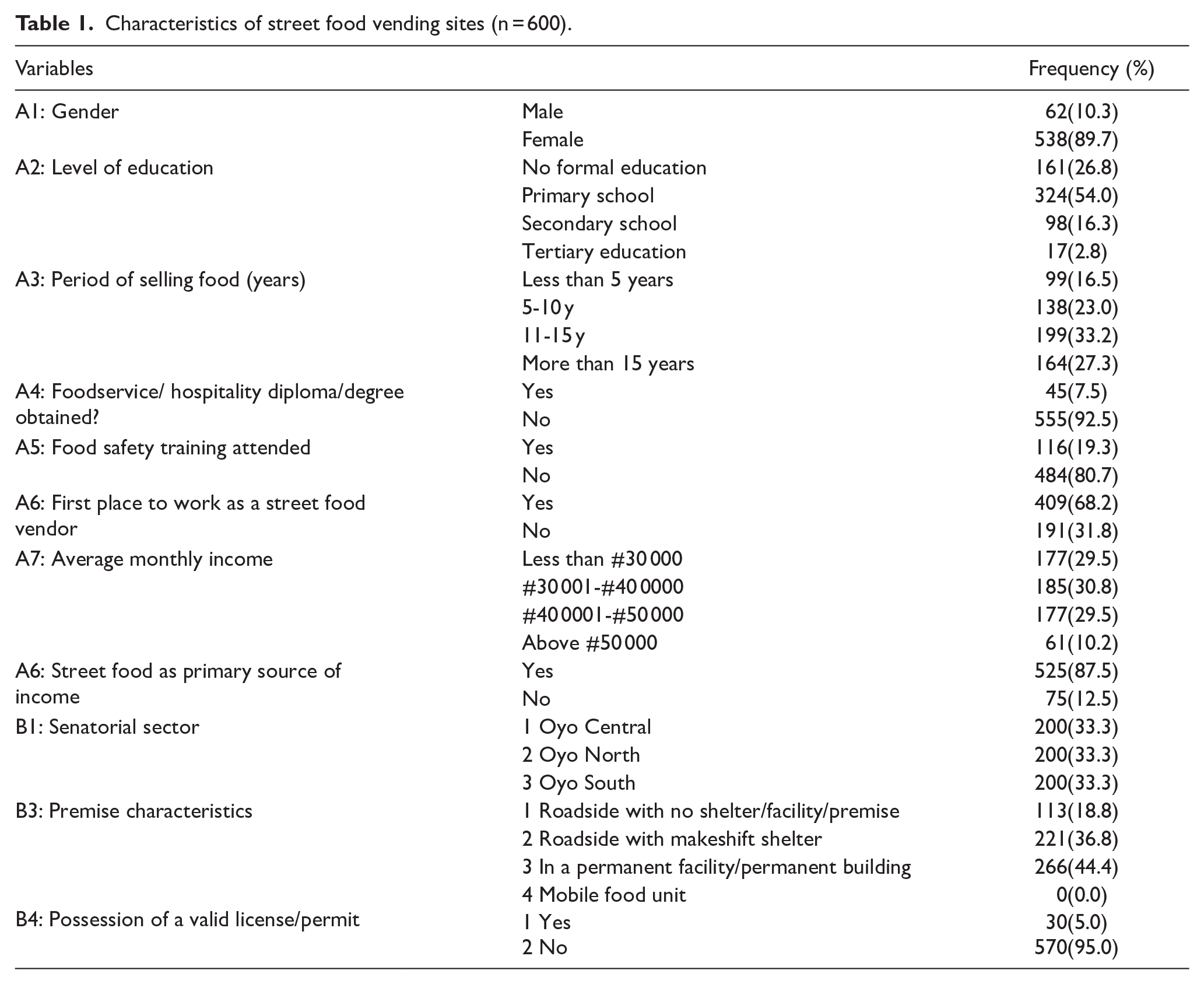
The majority of street food vendors had primary school (54%) as their highest education, while 26.8% had no formal education, and only a few had attained secondary (16.3%) or tertiary education (2.8%). This result is similar to those in a study conducted in Ghana in 2022 33 and in Ethiopia between December 2013 and June 2014, 34 where the primary school was the highest level of education for most street food vendors. This is because some cultural groups in these countries predominantly prefer boys to attend primary school, at the expense of girls. 35 In this study area, the lower level of education may be due to certain African cultures, where girls are typically limited to receiving only primary education, whereas boys are prioritized for further education. 3 Girls are confined to domestic duties, giving rise to unequal educational and training opportunities when compared to male children. 35 Furthermore, street food vendors often hail from lower-income families and hence may not have enough financial means to afford secondary and higher education for their children.3,25 Even though a higher level of education for a food handler does not always translate to high food safety knowledge and awareness, food handlers with higher levels of education can easily grasp food safety concepts when exposed to educational materials. 36 The governments of Nigeria should provide free post-primary education to low-income populations to enable them to acquire sufficient academic aptitude that can enhance the assimilation of content during food safety hence likely to comply with sanitary regulations. 37
Up to 60.5% of the street food vendors have been involved in street food vending for more than 11 years, among which 27.3% have done so for more than 15 years. A study conducted in Ghana in 2014, found that 80% of the street food vendors have been engaged in the street food vending business for the past decade, and the reason provided was the increasing interest in street food vending businesses. 38 Mahopo et al, in a study conducted in the Vhembe district in 2019, found that most street food vendors in rural South Africa have been operating for the last 10 years since it is their main source of income. 28 Street food vendors who have worked for many years must have accumulated street food vending experience and generate vital income from it. 39 These street food vending sites are strategically placed in areas with high human traffic such as city centers, open-air markets, moto parks, and or events sites to ensure high sales volumes.6,17 A stable street food vending business will contribute to the sustenance of the livelihood of street food vendors on a long-term basis in an environment where formal employment opportunities are limited. 3 An association has been established between work experience and food safety practices of food handlers (Islam et al 2024). Longer duration of work experience among street food vendors has been associated with better food safety and hygiene practices due to learning acquired on the job over some time (Bantie et al 2023).
Results on the characteristics of the street food vending sites of street food vendors are presented in Table 1. Most (55.6%) street food vendors had no street food vending facilities or were operating in makeshift street food vending facilities; only 44.4% had a permanent street food vending structure, and none had a mobile food unit. Similar results were reported in a study conducted in the Zululand District and Marabastad open market [06] in South Africa in which the majority of the street food vendors lack permanent food vending facilities. The lack of finance to construct proper food vending facilities is a significant challenge facing street food vendors.40,41 The lack of proper food preparation facilities, essential sanitary resources, and food preparation equipment hampers good hygiene. 5 Poor sanitation and inadequate food preparation facilities can lead to food contamination and non-compliance with food safety standards.6,42
The vast majority (95%) of street food vendors did not possess a valid permit or license to operate as street food vendors. Similarly, Hill et al report that most street food vendors in Central Cape Town, South Africa, were unlicensed due to the lack of awareness of the admin processes to get 1. 43 Due to low enforcement and monitoring of food safety regulations, many street food vendors may not be aware of licensing procedures. 6 Furthermore, street food vendors have been found to lack the finances to afford proper facilities and licensing fees,44,45 which results in only a few street food vendors having operating licenses. The high number of street food vendors operating without a permit means that the monitoring and enforcement of street food vending cannot be effective. 46 The lack of monitoring can lead to the perpetuation of unhygienic practices at street food vending sites and the potential to expose consumers to food safety risks.47, 48
Compliance of Street Food Vendors With Sanitary Regulations
Results on the compliance of street food vending sites with the food sanitation regulations of Nigeria are presented in Table 2. Sanitary requirements with more than 80% compliance were observed for clauses relating to non-exposure of cooked and uncooked food items (80.5%), availability of enough potable water at the vending premises (83%), presence of detergents for cleaning (83.7%), and no wounds or the exposure of wounds (93%). A similar result was reported by Olajubutu et al in which most street food vendors in Afijio Local Government Area, Nigeria, have adequate potable water at the food vending site. 47 The presence of potable water, cleaning detergents, and the absence of wounds, or exposure thereof, are the minimum requirements for basic hygiene practices that consumers can accept. 30 Compliance with basic hygiene requirements suggests a conscientious effort by street food vendors to mitigate food safety risks by implementing basic food hygiene practices.38,40
Compliance of street food vending sites with the food sanitation regulations of Nigeria (n = 600).

NB Total number of possible correct responses = 33, representing 33 sanitary requirement criteria.
The sanitary requirements with less than 5% compliance include painting of premises with white non-washable paint (0%), renewal of medical certificates every 6 months (0%), cooked and uncooked items being sold in approved vending areas (3.5%), adequate toilet facilities (3.5%), and cleaning of utensil with hot water (4.2%). This result also corresponds with findings from research conducted in Marabastad open market, South Africa where the street food vending facilities had low compliance considering that food items were being sold in street food vending sites without toilet facilities and hot water supply. 33 The non-compliance with these requirements can be attributed to financial constraints in acquiring adequate infrastructure equipped with resources and food preparation equipment. 16 Additionally, most street food vendors were unaware of the food safety regulations due to inadequate communication and outreach from local health authorities. Non-compliance with the aforementioned food safety regulations can lead to food contamination and the spread of foodborne diseases. 14
Regarding the overall assessment of the compliance of street food vending sites to sanitary regulations (Figure 1), 75.7% had low compliance, 12.5% had moderate compliance, and 11.8% had high compliance. The results from research conducted in the Marabastad open market, South Africa [06] show a similar trend with the street food vending sites having low compliance (less than 50%) for food safety sanitary requirements scores. The reason was that the street food vendors lacked access to infrastructure with adequate sanitary requirements such as potable water, handwashing facilities, waste disposal systems, and even electricity supply. 49 The lack of proper street food vending facilities can be because street food vendors do not have the financial resources to invest in adequate infrastructure, which could enhance their operations. 10 The informal nature of the street food vending business makes it difficult to access financial services or government assistance. 3 Similarly, the lack of government support for street food vendors aggravates non-compliance with sanitary requirements. 5 The consequences of low compliance with sanitary requirements at street food vending sites, increase the likelihood of unhygienic practices and food contamination, which pose a public health risk to consumers. 50

An overall assessment of the compliance of Street Food Vending Sites with the Food Sanitation Regulations of Nigeria (n = 600). NB: Low compliance (score 0%-49%), Moderate compliance (score 50%-74%) and High compliance (score 75%-100%).
The Kruskal Wallis test indicated that there was no significant difference in compliance with sanitary requirements among the different types of street food vending sites (P = .99) and street food vending sites within different senatorial sectors (P = .233; Table 3). The reason there were no significant differences in compliance with sanitary regulations between street food vending sites within the different senatorial sectors and between different types of vending premises, can be attributed to the overwhelming non-compliance and lack of enforcement of sanitary regulations by authorities.6,51 The low adherence to food sanitary regulations can lead to the risk of food contamination, increasing the risk of foodborne diseases, which can endanger the consumers’ health. 52
Analysis of variance of the sanitary compliance Score within location and characteristics of street food vending sites (n = 600).

There was a significant difference in sanitary compliance between street food vending premises in which the owner possesses a valid license/permit and those in which the owner did not possess a valid license/permit (P = .033; Table 3). The reason is that street food vendors who possess a license are likely to comply before the permit is issued. 53 The street food vendors with permits are likely operating in compliance with sanitary requirements and municipal bylaws, showcasing a commitment to food safety standards to uphold the terms of their permits to ensure that their permits will be renewed. 54 The importance of having a permit implies that street food vendors will be committed to upholding sanitary standards to ensure the retention of their permits. 55
Regarding the enforcement of sanitary requirements, there was a significant (P = .016) difference in the enforcement score among the senatorial sectors, with Oyo State having a relatively higher level of enforcement (Table 3). Lack of food safety compliance can be attributed to barriers such as the lack of trust in food safety legislation and enforcement officers; a lack of motivation in dealing with food safety legislation; and a lack of knowledge and understanding. 56 The higher level of enforcement in Oyo State could be attributed to higher levels of compliance by street food vendors with food safety regulations. 58 This shows that food safety regulations enforcement can be possible when municipal authorities plan and commit relevant resources to uphold bylaws. 59
Similarly, there was no significant difference in enforcement among the different types of street food vending sites (P = .919) and among street food vending premises in which the owner possessed or did not possess a valid license/permit (P = .216; Table 3). Nkosi and Tabit report that food vending facilities in Zululand District, South Africa, have inadequate monitoring of food safety regulations enforcement in food vending facilities. 6 The trend also corresponds with findings from research conducted in Kiambu County, Kenya, 14 where street food vending facilities lack the enforcement of authorities on appropriate food safety and hygiene practices. The informal nature of the vast street food vending activities prevents effective monitoring and enforcement of food safety regulations3,6,9. In many regions, limited financial resources contribute to municipal authorities’ lack of consistent monitoring of street food vending sites.16,38 Zones with intense informal street food vending activities can lead to resource constraints, which hinder effective monitoring and enforcement of food safety regulations. 5
Overall Assessment of the Enforcement of Sanitary Requirements
Up to 85.7% of the street food vending sites had not been inspected by the authorities and only 10% were inspected, with 4.3% receiving fines for violations (Figure 2). A similar result was reported by Nkosi and Tabit in which 64.7% of street food vending sites the in Zululand District, South Africa were found not to have been inspected by municipal authorities. 6 The reasons for the low inspection and monitoring by municipal authorities can be attributed to a lack of adequate financial, material and human resources, which include limited health inspectors, and the logistical hurdles posed by the multitude of street food vending sites located at non-demarcated areas. 16 The informal nature of street food vending means that new sites are often established spontaneously in non-demarcated areas, making monitoring challenging. 6 The low rates of inspections and penalties for violations identify systemic challenges in ensuring compliance with food safety standards. 60

Enforcement of the food sanitary requirements by health inspectors in the past year as reported by street food vendors (n = 600).
Regarding the overall assessment of the enforcement of sanitary requirements by health inspectors, 90% had low enforcement, 5.7% had moderate enforcement, and 4.3% had high enforcement (Figure 3). Research studies in Marabastad, Pretoria, Ejisu-Juaben Municipality, Ghana and Techiman Municipality, Ghana16,26 show a similar trend of results indicating that street food vending sites had low compliance (less than 50%) with food sanitary requirements. The lack of enforcement of sanitary requirements at street food vending sites is due to the vastness and informal nature of the street food vending sites, which can pose logistical challenges to municipal health inspectors, due to limited resources and manpower. 33 Municipal health authorities often prioritize larger formal food businesses over street food vending sites. 3 The significance of low enforcement of food safety is the increased risk of foodborne diseases, leading to potential outbreaks that can harm public health. 61

An overall assessment of the enforcement of the food sanitary requirements by health inspectors as reported by street food vendors (n = 600). NB: Low enforcement (score 0%-49%), Moderate enforcement (score 50%-74%) and High enforcement (score 75%-100%).
There was a significant moderate positive correlation (r = 5.131, P = .026) between sanitary compliance and the enforcement of sanitary requirements at street food vending sites (Table 4). A similar result was reported by Mwove et al in Kiambu County, Kenya, in which some (50%) street food vending sites that were monitored by authorities were found to have improved the implementation of food safety regulations. 14 The result suggests that as the enforcement of sanitary regulations increases, so does the level of sanitary compliance among street food vendors.58,62 This is because enforcement improves the street food vendors’ knowledge about food safety and as a result, their sites are improved. The result indicates that when authorities actively monitor and enforce compliance with food safety regulations, street food vendors are more likely to adhere to sanitary guidelines which decreases the exposure of consumers to food safety risks. 42 Besides the lack of enforcement, other barriers to compliance with food safety regulations by street food vendors include lack of business registration and issuance of permits, limited Resources, lack of awareness, the vast informal nature of street food vending, lack of zoning and the provision of food stalls by authorities. 63
Spearman’s correlation between sanitary compliance and the enforcement of sanitary requirements at street food vending sites (n = 600).

NB: *Correlation is significant at the 0.05 level (2-tailed).
Conclusion and Recommendation
This research investigated the enforcement of sanitary regulations by authorities and the compliance of these regulations at street food vending sites in Oyo State, Nigeria. The majority of street food vendors did not have a permanent street food vending structure nor a valid permit or license to operate as street food vendors. The majority of street food vending sites had low compliance with food safety regulations. There was no significant difference in enforcement between street food vending premises in which the owner possesses a valid license/permit and those in which the owner did not possess a valid license/permit. Most of the street food vending sites had not been inspected by the authorities hence enforcement was very low. A positive correlation was established between sanitary compliance and the enforcement of sanitary requirements at street food vending sites. This study is the first to study both sanitary requirements of street food vending sites and the enforcement of sanitary requirements. It is recommended that municipal authorities register all the street food vending sites, to enable effective monitoring in ensuring that food safety regulations are implemented at the street food vending sites. Furthermore, the government should facilitate and subsidies the acquisition of street food vending facilities and suitable catering equipment to enable food handlers to comply with sanitary requirements. More research should be done to determine the food safety knowledge of street food vendors and establish factors that limit compliance with food safety regulations.
Footnotes
Acknowledgements
We are grateful to the street food vendors who volunteered to participate in this study. We are also grateful to the UNISA-CAES Health Research Ethics Committee for providing us with ethics clearance for this study.

Author’s Contribution
OWA conceptualize the study, material preparation, data collection, data curation, data analysis, wrote the main manuscript, FTT validation, data analysis, supervision of all the investigation processes, edited, and reviewed the final manuscript. All the authors read and approved the final manuscript.
Funding
The author(s) received no financial support for the research, authorship, and/or publication of this article.
Declaration of Conflicting Interests
The author(s) declared no potential conflicts of interest with respect to the research, authorship, and/or publication of this article.
Data Availability Statement
The data used for analysis in the current study are available from the corresponding author and will be shared upon reasonable request