




Abstract
Per- and polyfluoroalkyl substances (PFAS) are a group of man-made chemicals that are widely present in many industries. Monitoring and analyzing PFAS in Africa is challenging due to the limited availability of mass spectrometry (MS), which is an essential technique for detecting PFAS. This review assesses the scope and impact of the shortage of mass spectrometry instruments in Africa, emphasizing the resulting limitations in monitoring environmental and public health threats. The review analyzes the existing PFAS monitoring, the accessibility of MS instruments, and the technical capabilities within the continent. This study suggests that fewer African countries have sufficient MS instruments, resulting in significant underreport of environmental data and related public health issues. The review proposes financial support and programs to address these difficulties to provide necessary MS instruments. The review suggests that it is highly important to develop regional centers of excellence for PFAS monitoring using MS instruments and investing in training programs to address the gap in monitoring efforts. So, enhancing these are crucial for the successful management of the environment and safeguarding public health from the effects of PFAS contamination.
Introduction
Per-and polyfluoroalkyl substances (PFAS) continue to pose significant environmental and human health concerns globally. Within this area of pollutants, PFAS have garnered considerable attention due to their prevalent persistence and adverse effects on ecosystems and human health. 1 These compounds, commonly found in industrial and consumer products, which have been linked to a range of health issues. Studies on PFAS contamination and its impacts have been extensively conducted in various regions worldwide.1 -5 However, there needs to be a gap in the monitoring and analysis of these substances in Africa. This shortage, particularly in the utilization of mass spectrometry (MS) techniques for PFAS detection presents a challenge in assessing the extent of contamination and implementing effective mitigation strategies across Africa. Therefore, addressing the shortage of mass spectrometry application in PFAS monitoring is essential for developing targeted interventions and policies to safeguard both the environment and public health.
Globally, concerns are escalating regarding environmental pollution, with emerging contaminants posing significant challenges to human and animal health and ecosystems. PFAS encompass a diverse group of chemicals, each with unique properties and potential health. Some of the most well-known PFAS include, Perfluorooctanoic acid (PFOA), Perfluorooctanesulfonic acid (PFOS), Perfluorohexane sulfonic acid (PFHxS), Perfluorononanoic acid (PFNA), Perfluorodecanoic acid (PFDA), Perfluorobutanesulfonic acid (PFBS), Perfluorohexanoic acid (PFHxA), Perfluoroheptanoic acid (PFHpA), Perfluoroundecanoic acid (PFUnA), Perflourododecanoic acid (PFDA).1 -3
PFAS are characterized by carbon-fluorine bonds, making them essential in various industrial and consumer applications.1,2 Their chemical and physical properties stems from having water-repelling and grease-resistant properties, leading to extensive utilization across industries such as textiles, electronics, and aerospace.1,3 PFAS are primarily composed of a carbon chain with hydrogen atoms replaced by fluorine atoms. Various functional groups and substituents are present in different PFAS chemical types, either at the beginning or the end of the chain. (Figure 1). 1

Chemical structure of PFOA.
Among the most researched PFAS chemicals are perfluorooctanoic acid (PFOA) and perfluorooctane sulfonate (PFOS),2,3 because of their advantageous thermal stability, chemical resistance, and hydrophobic/lipophobic properties stemming from the robust carbon-fluorine bond. 4 Many African countries are parties to the Stockholm Convention on Persistent Organic Pollutants (POPs). 5 Although the convention primarily focuses on substances such as PCBs and DDT, it also addresses the need to manage other persistent chemicals. 6 As the understanding of PFAS grows, these countries may start incorporating PFAS into their regulatory frameworks under this convention. The African Ministerial Conference on the Environment (AMCEN) and the African Union have frameworks and strategies related to environmental health and pollution. 5 While these frameworks may not specifically target PFAS, they provide a basis for addressing chemical pollutants more broadly.
Regulations on PFAS are rare across African countries, some countries may address them under broader environmental protection or chemical safety laws, but specific PFAS regulations are still emerging. 6 For instance, South Africa has some regulatory measures related to hazardous substances and waste, which might cover PFAS indirectly. 7 Also, Kenya has the Environmental Management and Coordination Act provides a general framework for environmental protection which could encompass PFAS-related issues. 7 Additionally, the Food and Drug Administration (FDA) is actively involved in testing food products for PFAS contamination and assessing their safety. 8 Despite their technical advantages over hydrocarbons, PFAS detection, sensing, and remediation present challenges due to the generation of toxic short-chain intermediates during high-energy degradation processes, while effective remediation strategies involve identifying pollution sources. 9
Instruments Used in Monitoring PFAS
In monitoring PFAS, a range of analytical instruments are utilized to detect, quantify, and characterize these compounds in the environment. Apart from mass spectrometry (MS), these analytical instruments play significant roles in PFAS analysis, offering unique advantages. 9 The significance of monitoring per- and polyfluoroalkyl substances (PFAS) contamination in the environment has increased due to their extensive usage and potential detrimental impacts on human health and ecosystems. 10 To accurately evaluate and mitigate the risks linked with PFAS, robust instrumentation, and analytical methodologies are important. Recent years have witnessed notable progress in the development of sensitive, selective, and efficient instruments specifically designed for the detection and quantification of PFAS across diverse environments. 10 Various analytical techniques and instruments are employed for monitoring per- and polyfluoroalkyl substances (PFAS), which will be discussed in detail:
Chromatography-Mass Spectrometry
Liquid Chromatography-Tandem Mass Spectrometry (LC-MS/MS) stands out as an analytical technique, seamlessly integrating the separation capabilities of liquid chromatography with the high sensitivity and selectivity of mass spectrometry. 11 This fusion enables precise identification and quantification of PFAS within substances like eggs, fishery products, meat, milk and milk products, and vegetables. 11 By employing liquid chromatography to segregate PFAS compounds based on their chemical attributes and subsequently employing mass spectrometry for detection, LC-MS/MS offers a robust approach.
Notably, triple quadrupole mass spectrometry systems, equipped with 2 quadrupoles and a collision cell, facilitate the filtration of specific mass transitions for each analyte, thereby enhancing the method’s selectivity. 12 This approach have widespread application in PFAS quantification, serving as a crucial tool for risk assessment and regulatory compliance. 13 Notably, sample pre-concentration is often necessary to detect low levels of PFAS, particularly in environmental samples where concentrations tend to be minimal. 13
Moreover, the presence of PFAS in laboratory equipment, notably polytetrafluoroethylene (PTFE) components, can introduce background interference during sample measurement, necessitating precautions and the use of alternative materials to minimize contamination. 14 Additionally, LC-MS methods may encounter challenges in simultaneously detecting and quantifying a broad spectrum of PFAS compounds within a single analytical run, adapting to diverse sample matrices, and devising efficient sample preparation strategies. 14 The procedure for using LC-MS/MS in PFAS monitoring involves several critical steps to ensure accurate and reliable analysis. Initially, sample preparation is essential, where LC-MS samples undergo liquid chromatography (LC) separation to isolate target analytes from other compounds and contaminants. 15
High-performance liquid chromatography (HPLC) is an analytical method employed for the separation, identification, and quantification of environmental samples such as PFAS.16,17 Operating as a form of column chromatography, HPLC involves pumping a sample dissolved in a solvent (mobile phase) at high pressure through a column packed with stationary phase material. The interplay of sample properties, solvent characteristics, and stationary phase nature facilitates the separation of sample constituents based on differences in relative affinities. However, columns are developed for quantitative and qualitative work, method parameters determine which will be applied. 16 These applications underscore the significance of HPLC in PFAS monitoring and analysis across varied environmental and biological samples.17 -20 Despite this, HPLC does present certain limitations, these include the requirement for a high level of expertise in method development and optimization, the potential for column degradation and contamination, and the limited capacity to separate compounds with similar properties. 20
Gas Chromatography-Mass Spectrometry (GC-MS) is a robust analytical technique, joining the separation capabilities of gas chromatography with mass analysis. 21 It is widely utilized for both qualitative and quantitative analyses of mixtures. GC-MS has extensive applications in metabolomics and environmental research to study PFAS. 21 In environmental monitoring, GC-MS has been instrumental in assessing Per- and Polyfluoroalkyl Substances (PFAS), particularly in gaseous samples.21,22
The US Environmental Protection Agency (EPA) has adopted Thermal Desorption-Gas Chromatography-Mass Spectrometry (TD-GC-MS) for analyzing PFAS in gaseous samples, leveraging its solvent-free nature and ability to capture volatile PFAS species effectively. 23 Moreover, TD-GC-MS optimization has been pivotal in enhancing the low-temperature thermal treatment process of gas-phase PFAS, thereby mitigating the risk of PFAS release into the atmosphere.23,24 GC-MS has facilitated the development of targeted methodologies for PFAS analysis of PFAS compounds successfully analyzed using GC-MS/MS and/or GC-MS. 25 However, utilizing GC-MS for PFAS monitoring entails certain limitations, which are the risks of contamination during the analytical workflow and contamination from laboratory materials poses a significant concern, given the limits of detection.
To mitigate matrix effects and enhance accuracy in quantifying PFAS compounds, isotopically enriched PFAS substances are introduced into the original sample. These isotopically enriched standards serve as internal references that allow for correction of potential interferences and variations in sample matrices during extraction and analysis. 24 In gas chromatography, the isotopically enriched PFAS are used to account for matrix-induced variations in retention times and detector responses. In liquid chromatography, they help correct for differences in ionization efficiency and chromatographic behavior across various sample matrices. The use of isotopically enriched PFAS improves the precision and reliability of quantification by compensating for matrix effects that can otherwise lead to inaccuracies. 25 The incorporation of these standards involves adding known quantities of isotopically enriched PFAS to samples prior to extraction, which is then used to calibrate the analytical system.
Ion Chromatography (IC) is a powerful analytical technique used to analyze anionic and cationic species in various samples. 26 In the context of PFAS analysis, IC can be particularly useful for detecting and quantifying specific PFAS compounds due to its sensitivity and accuracy. 26 IC relies on ion-exchange chromatography (IEC), a technique commonly utilized for the separation of ions and ionizable molecules. 27 In environmental monitoring, IC has been found in different PFAS analyses, such as food and water.7,27,28 Nevertheless, IC does present limitations that necessitate consideration during the design and implementation of IC-based methods for PFAS monitoring. These limitations encompass the PFAS types, matrix effects, challenges in sample preparation, detection limits, analytical complexity, and regulatory considerations. 27
In monitoring of PFAS in environmental samples, IC serves as a pivotal analytical technique. The procedure begins with sample collection in clean, polypropylene containers and subsequent extraction using solid-phase extraction (SPE) techniques, following established EPA methods such as 537.1 or 533. 28 African countries can reference international guidelines provided by the United Nations Environment Programme (UNEP) and other global bodies on Persistent Organic Pollutants (POPs). 7 These guidelines can serve as a foundation for developing national standards for PFAS monitoring. Countries that are parties to the Stockholm Convention can use its principles to inform the development of PFAS-related regulations, incorporating international best practices. 29 Countries with environmental protection laws, such as South Africa’s National Environmental Management Act, can adapt these frameworks to include PFAS monitoring requirements.29,30 This involves updating regulations to specify the use of IC for detecting and quantifying PFAS. National standardization bodies can develop specific standards for IC-based PFAS analysis, drawing from international methods and adapting them to local needs. This includes setting protocols for sample preparation, calibration, and quality control.
Mass Spectrometry
Triple Quadrupole Mass Spectrometry (TQMS) represents a highly sensitive and precise technique utilized for monitoring per- and polyfluoroalkyl substances (PFAS) in environmental and biological samples. 31 TQMS finds application across various studies aimed at detecting and quantifying PFAS in diverse matrices such as water, soil, and blood.31 -34 While TQMS stands as a formidable tool for PFAS monitoring, it is imperative to acknowledge its limitations. These include potential matrix effects, the incapacity to detect large molecules, background contamination, the requisite expertise, associated costs, and the challenge of resolving isomers. These limitations necessitate careful consideration when employing TQMS for PFAS analysis, and alternative techniques may prove warranted under specific circumstances. 35
To utilize Triple Quadrupole Mass Spectrometry (TQMS) effectively for PFAS monitoring, the procedure begins with sample preparation, extraction, purification, and concentration steps are undertaken based on sample characteristics and PFAS compounds of interest. 36 Instrument setup follows manufacturer guidelines, configuring ionization methods, mass range, and analyzers for precise mass filtering or scanning modes. Method development involves selecting suitable m/z ratios, optimizing collision-induced dissociation conditions, and tuning instrument parameters for sensitivity and selectivity. Subsequent sample analysis entails introducing prepared samples, ionizing PFAS compounds, and detecting ions for quantification using TQMS. 37 Data analysis employs software tools for PFAS compound identification, quantification, and method performance evaluation. Method validation and quality control ensure accuracy, precision, and adherence to quality standards. 37
Inductively Coupled Plasma-Mass Spectrometry (ICP-MS) stands as a potent analytical technique utilized for detecting and quantifying trace elements and isotopes in different environmental settings. 38 Within the realm of PFAS monitoring, ICP-MS serves as a valuable tool for fluorine-specific detection, aiding in the identification of PFAS degradation products in non-targeted analyses. 39 Nonetheless, ICP-MS methodologies have proven effective in monitoring various pollutants in water.38 -40
High-Resolution Mass Spectrometry (HRMS) assumes a pivotal role in monitoring per- and poly-fluoroalkyl substances (PFAS), owing to its capability to detect a broad spectrum of compounds within this category, encompassing both established and emerging contaminants. 41 HRMS offers increased sensitivity and specificity, facilitating PFAS identification of retention time, exact mass (including isotopic patterns), and MS/MS spectra.41,42 This technique finds application in environmental monitoring, particularly pertinent in addressing the challenge posed by the extensive array of PFAS compounds that traditional targeted screening methods may struggle to encompass.42 -44
Current State of PFAS Research in Africa
When compared to other parts of the world, especially developed countries where a great deal of research has been done, Africa’s PFAS research is noticeably deficient. 45 Africa’s contribution to the study of PFAS has increased recently, despite obstacles such as funding, and availability of instruments.45,46 Concerns about possible risks to human health and environmental harm are the main causes of this increased interest. 44 A variety of matrices, such as fish and invertebrates, suspended particles, drinking water, wastewater, sediments, sewage sludge, and environmental waters, are essential for PFAS research in various parts of Africa.29,47 These components are crucial for researching PFAS and comprehending its effects on the environment and human health in the African context.
Sewage sludge
In Africa, wastewater sludge is a crucial medium for PFAS research. Sludge samples from hospitals, homes, and industrial Wastewater treatment plants (WWTPs) have been found to contain PFAS, such as PFOA and PFOS, according to studies done in Nigeria and Kenya.46,48 Even though reported levels in African nations are often lower than in industrialized countries in terms of Parts per billion (ppb), Parts per trillion (ppt), Micrograms per liter (µg/L), Nanograms per liter (ng/L), disposing of biosolids is still difficult because there are not many sophisticated treatment options available. 49 Therefore, there is a risk of environmental pollution from improperly built landfills or direct fertilizer application. To solve this problem, strict regulations on allowable PFAS levels in sludge and enhanced waste management techniques are essential.
WWTPs are essential sites for PFAS study sampling in African contexts because they have effects on humans and the environment. 49 Research undertaken in nations such as South Africa, Uganda, and Kenya has reliably revealed the existence of PFAS in wastewater, albeit in different quantities.50,51 For example, PFAS, such as PFOA and PFOS, were found in Kenyan WWTPs by Chirikona et al. 49 at values ranging from 0.9 to 9.8 ng L−1 and 1.3 to 28 ng L−1, respectively. According to research conducted in South Africa, PFAS concentrations in WWTP effluents ranged from 4.22 ng L−1 to 508 ng L−1, as reported by Kibambe et al. 52 In Uganda, however, Dalahmeh et al. 53 discovered lower amounts. These differences highlight the necessity of extensive monitoring systems in various geographic areas.
In Nigeria, Sindiku et al. 50 and Chirikona et al. 49 analyzed perfluoroalkyl carboxylic acid (PFCAs) and perfluoro alkane sulfonic acid (PFSAs) levels in sludge sourced from domestic, hospital, and industrial wastewater treatment plants (WWTPs). They reported varying concentrations of perfluorooctanoic acid (PFOA; 0.01-0.416 ng/g and 0.032-0.345 ng/g dry weight) and perfluoro octane sulfonic acid (PFOS; <0.01-0.540 ng/g and <0.015-0.673 ng/g) in the sludge samples respectively. The heightened levels were primarily linked to hospital discharges, including medical devices containing PFAS layers such as tetrafluoroethylene copolymer (ETPE), radio-opaque ETFE production, in vitro diagnostic medical devices, and Charge-Coupled Device (CCD) color filters.
Drinking water
Research on PFAS contamination in African sources of drinking water has been limited. Ghanaian, Ivory Coast, and Burkina Faso reports show that tap and bottled water samples contain PFAS, especially PFOA and PFOS, in relation to African safe drinking limits.54,55 Excessive concentrations over safe drinking water limits point to ineffective water treatment methods. To guarantee that African populations have access to clean drinking water, extensive monitoring programs in infrastructure for water treatment are crucial. 56 There is evidence of efforts to reduce the presence of PFAS in wastewater, with some WWTPs showing comparatively high removal efficiency. For example, a South African WWTP’s PFOS removal effectiveness was reported to be 94% by Kibambe et al. 52 However, issues such as inadequate treatment procedures, improper operation and maintenance, and the disposal of membranes polluted with PFAS continue to exist, increasing environmental exposure.56,57 The significance of efficient wastewater treatment cannot be emphasized, given the significant role WWTPs play in preventing PFAS contamination.
Soil
Despite the paucity of research on PFAS levels in African soils and crops, what is known about them generally points to modest levels, with variations according to the degree of industrialization as based on the measurement in ppb (ng/L) levels using instrumentation such as MS/MS. 58 The release of wastewater into urban or industrial runoff and the use of sewage sludge as fertilizer or soil conditioner are the main sources of PFAS in plants. Poor waste management techniques were identified as the source of PFAS in the soil surrounding solid waste dumpsites in Calabar, Nigeria, according to a study conducted in West Africa. 58 In soil samples from different parts of Africa, PFAS was found in every study, albeit at lower concentrations than in Asia and North America. 59
The fact that PFAS are found in diverse locations, including aquatic systems, suggests that water can transport PFAS to different environments, including soil, raising the possibility of long-distance pollution. 60 Research conducted in South Africa showed that PFAS bioaccumulated in medicinal plants that were watered with contaminated water, suggesting a possible low-level human exposure pathway. 61 The amounts of PFAS in Ugandan soils and crops differed; PFOS predominated in the soil, whereas PFHpA and PFOA predominated in distinct plant tissues, indicating the particular behaviors of PFAS in various matrices. 62 In order to safeguard the environment and the public’s health in Africa, PFAS contamination in crops and soils must be monitored and controlled.
In African environments, various sources such as industrial, urban centers, hospitals, and landfill leachates contribute to organic pollutants, including pharmaceuticals,60,63 polycyclic aromatic hydrocarbons, 64 and halogenated contaminants.65,66 Similarly, PFAS are prevalent in wastewater treatment plants (WWTPs). Studies in South Africa and Uganda have shown notable concentrations of PFAS in WWTP effluents, exceeding those in influents due to factors like poor removal efficiency, desorption from biosolids, and transformation during treatment processes.67 -70 For example, Adeleye 71 analyzed PFAS in the wastewater treatment plants (WWTPs) of Beaufort West and Scottsdene. The highest concentration found in effluents was 6.21 ng/L of perfluorodecanoic acid (PFDA) from Beaufort West and 4.22 ng/L of perfluorodecanoic acid (PFUnDA) from Scottsdene. 71 In a study, Dalahmeh et al. 53 examined 26 PFAS in influents and effluents from a WWTP managing wastewater from Kampala, Uganda’s most urbanized city.
Total PFAS in effluents from the treatment plant (ranging from 5.6 to 9.1 ng/L) exceeded those in corresponding influents (ranging from 3.4 to 5.1 ng/L), possibly due to inadequate PFAS removal by the treatment plant. However, other factors, such as desorption from biosolids within the plant 53 and the creation of contaminants through the transformation of precursor compounds during wastewater treatment processes, 51 could also contribute to higher effluent levels. Notably, the occurrence of elevated PFAS concentrations in WWTP effluents compared to influents is not uncommon, even in developed countries outside Africa. 72
This phenomenon is attributed to the unique physicochemical properties of PFAS (Figure 1), including high thermal and chemical stability. For instance, the strong C-F bond in PFAS is resistant to breaking during conventional water treatment methods such as ozonation. 73 This phenomenon is observed globally due to the robust chemical properties of PFAS. Novel methods like nanofiltration are employed in developed countries to mitigate PFAS contamination, while traditional methods such as granular activated carbon may not effectively remove shorter-chain PFAS congeners.73,74 African researchers are encouraged to explore cost-effective water remediation techniques, such as agro-based adsorbents, to address these challenges.75,76 Table 1 below discusses the levels of PFAS in wastewater, where most of the methods adopted in the listed research are based on Mass Spectrometry techniques.
Level of PFOS and PFAS in sludge samples from WWTPS.
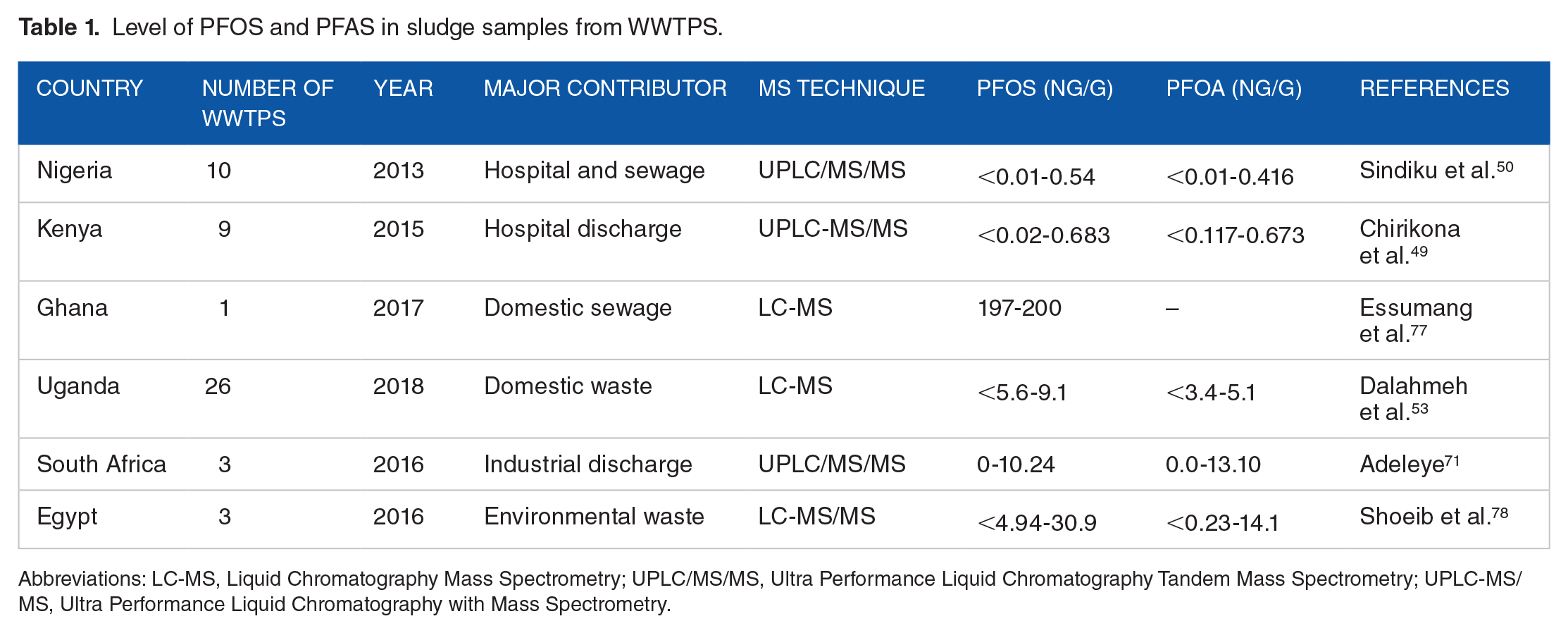
Abbreviations: LC-MS, Liquid Chromatography Mass Spectrometry; UPLC/MS/MS, Ultra Performance Liquid Chromatography Tandem Mass Spectrometry; UPLC-MS/MS, Ultra Performance Liquid Chromatography with Mass Spectrometry.
The PFAS levels reported by Sindiku et al. 50 and Chirikona et al. 49 in Nigeria were notably lower compared to those found in highly industrialized regions such as North America,79 -81 Asia,82,83 and Europe.84,85 Nonetheless, there remains a necessity for comprehensive background studies across all African countries and the establishment of strict guidelines regarding permissible PFAS levels in ppb, ppt, and ng/L in sludge as applicable to soil, as shown in Table 2. The methods utilized in some of the analyses in Table 2 are mass spectrometry techniques to analyze the level of PFAS in the environment in Africa. Furthermore, environmental management authorities in Africa should ensure that municipal landfills receiving these biosolids adhere to standard guidelines to prevent leachates from contaminating groundwater, 86 mitigating potential adverse health effects.
Level of PFAS in surface and pure water (ng/L) from different water bodies.

The identification of PFAS in drinking water sources, including tap and bottled water, provides insight into potential ongoing human exposure to these compounds. 90 Essumang et al. 77 discovered total perfluoroalkyl acid (∑PFAA) levels ranging from 197 to 200 ng/L in tap water in Ghana, with PFOA and PFOS being the predominant compounds, accounting for around 99% of the ∑PFAAs. These levels frequently surpassed the Environmental Protection Agency’s (EPA) safe drinking water concentrations of 70 ng/L for the combined total of these compounds, 91 indicating potential long-term health risks linked to tap water consumption. Kaboré et al. 57 found low levels of PFAS in tap and bottled water samples from Burkina Faso and Ivory Coast, with PFOA and PFOS concentrations ranging from <0.06 to 1.89 ng/L in Burkina Faso and from <0.06 to 0.04 ng/L and <0.03 to 1.32 ng/L in Ivory Coast, respectively.
These findings highlight a broader issue of water source pollution, including groundwater, affected by industries and wastewater treatment plants (WWTPs) located nearby. The studies justify the importance of increased monitoring efforts across Africa and the implementation of strict guidelines to ensure drinking water quality.57,77,88 -91 Monitoring both established and emerging pollutants in hotspot areas, such as landfills, industrial zones, and WWTPs, is crucial due to the risk of groundwater contamination. This contamination can lead to human exposure to pollutants, including PFAS. Table 3 discusses the level of PFAS in solids and sediments in water bodies in Africa. All of the studies indicated in the table adopt mass spectrometry techniques for the analysis of PFAS.
Level of PFAS in solids (ng/g dw) and sediments in water bodies in Africa.

In Uganda, Dalahmeh et al. 53 investigated PFAS levels in surface water from Lake Victoria and the Nakivubo Channel, finding concentrations 5 times higher in the Nakivubo Channel (8.5-12 ng/L) compared to Lake Victoria (1.0-2.5 ng/L). Meanwhile, in Kenya, Orata et al. 51 reported PFOA and PFOS concentrations ranging from 0.4 to 9.64 ng/L and <0.4 to 13.2 ng/L in river water, and 0.4 to 11.7 ng/L and <0.4 to 2.53 ng/L in Lake Victoria water, respectively.
Additionally, these pollutants were detected at levels of 0.8 to 2.8 ng/L and 3.9 to 10.1 ng/L, respectively, in surface water, and 1.71 to 16.2 ng/L and 10.9 to 20.4 ng/L, respectively, in pore water from 7 rivers in Nigeria.87,89 The literature reveals regional variations in PFAS concentrations across freshwater bodies in Africa, likely stemming from diverse pollutant sources.90,92 Remarkably, high levels of PFOA were detected in the uMvoti Estuary, South Africa, 93 while sediment in the Western Cape region showed elevated PFAS levels.
Reliability of Africa PFAS Data
The methods used, and the accessibility of sophisticated equipment for monitoring PFAS are 2 major factors influencing the accuracy of data on PFAS in Africa. 94 The accuracy of data gathered in the region may be compromised by inconsistent monitoring procedures and restricted access to cutting-edge technology. 94 Therefore, a careful analysis of current data is necessary to establish a strong basis for future research endeavors. Accurate measurement of PFAS contents in environmental samples requires the use of reliable sampling techniques and analytical methodologies.94,95 Also, sufficient financial resources, well-developed facilities, and specialized knowledge are essential for carrying out thorough PFAS investigations in African. 94 The scarcity of resources can influence the extent and magnitude of research, which may result in low data collection.
One major obstacle to African PFAS research is the need for more analytical capacity on the continent. With cooperation from organizations in Europe, Asia, and the USA for other studies, the majority of PFAS analysis has taken place in laboratories in Kenya and South Africa. 95 Technical limitations present difficulties for analytical techniques such as gas chromatography-mass spectrometry (GC–MS), such as the low volatility and unstable derivatives of PFAS. 96 Native, and isotopically labeled PFAS standards are manufactured outside of Africa as there is currently limited or no capacity. 96 That means added expense in ensuring reliability of results through confirmation with certified reference material. The lack of funding for sophisticated instrumentation, such as ultra-performance liquid chromatography/tandem mass spectrometry (UPLC-MS), hinders extensive PFAS analysis, even though many African laboratories are equipped with GC-MS and UV-VIS equipment. 97 Therefore, there is still an inadequate proficiency in the continent’s advanced equipment operation.
Furthermore, because of the possible health dangers associated with developing perfluorooctanoic acid (PFOA) and perfluorooctane sulfonate (PFOS) compounds, such as F-53 and 3MTM NovecTM 1230, research into these chemicals is essential. 6 Nevertheless, nothing is known about how these substances may affect health, which emphasizes the necessity for thorough research in Africa.
The Impact of Effective PFAS Identification in Africa
PFAS in African countries, as well as in Asia, Europe, and the USA.46,98 -100 In Africa, logistical and technical challenges hinder PFAS analysis, including limited volatility and unstable derivatives, which restrict the use of gas chromatography/mass spectrometry (GC-MS). 101 The presence of PFAS in the African environment is worsened by inadequate governance, ineffective legislation, and the illegal importation of products containing these compounds from developed countries. 102 To address this, key stakeholders in Africa, such as academics, policymakers, and industrialists, must advocate for and enforce existing policies, strengthen laboratory capacities, and routinely implement quality control measures to handle PFAS. This includes removing background contamination from laboratory materials like polytetrafluoroethylene (PTFE). Governments should consider involving commercial research laboratories in both public and government institutions for analysis. Improved protocols for sharing findings should ensure accessibility to environmental and trade organizations and the public to raise awareness about the prevalence and impact of PFAS. 103 Enhanced community engagement will boost environmental health literacy and influence waste management practices, ultimately reducing human and environmental exposure to PFAS and other pollutants. 103
Systematic monitoring studies on PFAS levels in Africa are limited, but available data suggests highly variable exposure among different regions and socioeconomic strata within countries.104,105 Continuous monitoring is essential to grasp the origin, spatial and temporal trends, and the fate of these chemicals in both environmental and human matrices across Africa. African researchers and governments should allocate limited resources to testing areas near identified PFAS sources, such as wastewater treatment plants, municipal ponds and landfills, and industrial zones. Examining industrial operations, waste management methods, and consumer product utilization in Africa can uncover distinct origins of PFAS pollution. 47 The identification of these sources may result in the detection of new PFAS compounds linked to production processes or products often utilized in African communities. Studying indigenous species in Africa, including plants, animals, and microorganisms, can offer valuable knowledge on their interactions with PFAS chemicals in the environment. These organisms can generate or break down unique PFAS chemicals, which could result in the identification of previously undiscovered chemical configurations. As African nations progress and undergo industrialization, there is a possibility of introducing novel chemicals into the environment. Through the implementation of comprehensive monitoring methods for PFAS pollution, researchers can identify nascent PFAS chemicals before their extensive dissemination. Adopting this proactive strategy can aid in the early detection of new PFAS compounds during their first stages of development.
Encouraging regional collaborations among well-equipped laboratories in African countries is also recommended. Regular profiling of PFAS levels in these areas will aid in assessing each source’s contribution to overall PFAS pollution and associated health risks. This approach will also help enhance research capacity across more African nations. Additionally, there is a scarcity of studies on the health effects of PFAS exposure, so researchers should evaluate ecological and human health risks and dose-effect relationships arising from reported levels of PFAS contamination. 106 To effectively measure the ever-changing and increasing amounts of PFAS, African researchers should consider using established bulk methods to measure total organic fluorine instead of focusing solely on individual compounds.
Transparency and collaboration are crucial in improving the credibility and reliability of African data on PFAS. By fostering collaborative efforts among local researchers, foreign partners, government agencies, and non-governmental groups, we can strengthen the accuracy and trustworthiness of this data. Transparent data-sharing policies and the publication of peer-reviewed articles enhance the validity of research findings. It is crucial to comprehend the socio-economic, environmental, and cultural circumstances surrounding PFAS pollution in Africa to interpret and utilize the data correctly. Industrial operations, waste management techniques, and dietary choices might impact the pathways through which PFAS exposure occurs and affect health outcomes. The correctness and reliability of the findings on PFAS in African data can be further confirmed by independent validation and verification conducted by respected scientific institutions or regulatory bodies. By cross-referencing data with established literature and global databases, one may evaluate the coherence and detect possible inconsistencies.
Although the concentration of PFAS in Africa might be lower relative to developed nations, sediment and water samples still reveal detectable levels, suggesting that the importation of PFAS-containing products and inadequate waste management practices may contribute to localized contamination. To mitigate PFAS exposure, African environmental authorities should implement stringent waste management protocols. Furthermore, continuous monitoring of both emerging and legacy persistent organic pollutants is crucial in heavily industrialized areas.
Challenges Facing the Identification of PFAS in Africa
The detection of PFAS in Africa has several obstacles, and the need for more availability of different mass spectrometers contributes to constraints in producing dependable data on PFAS in the region. A number of African nations such as Nigeria, Congo, Burundi, Zambia etc, experience a deficiency in adequately equipped laboratories that possess the requisite instrumentation, such as high-resolution mass spectrometers, to precisely detect and measure PFAS.107,108 There is need for more analytical facilities to carry out thorough PFAS analysis. 109 In some African countries, there is often a scarcity of well qualified professionals who possess experience in PFAS analysis, including the operation and interpretation of data from mass spectrometers. 109 The inadequate number of proficient experts hinders the ability to carry out complex analytical methods necessary for PFAS detection. 110
Also, insufficient monitoring and research have resulted in substantial data gaps concerning the occurrence and spread of PFAS in Africa. 110 Therefore, the lack of sufficient data poses challenges in assessing the magnitude of the issue and implementing effective measures to mitigate its impact. Many African nations are currently contending with urgent challenges, including infectious diseases, poverty, and food security. 111 Therefore, there is a gap in the allocation of attention and resources to environmental pollutants like PFAS, which should be prioritized alongside other pressing health and developmental issues.
The acquisition and upkeep of sophisticated analytical instruments such as mass spectrometers might be excessively costly for numerous African universities and research organizations. 112 The exorbitant expenses linked to acquiring, operating, maintaining, and purchasing consumables for instruments present a substantial obstacle to doing extensive PFAS investigation. The insufficient coordinated data sharing and collaboration across African countries and with international partners is impeding collective efforts to address PFAS pollution. Insufficient collaboration networks make it difficult to effectively share resources, expertise, and best practices for the identification and control of PFAS. 102 A number of African nations do not have well-defined legislation and procedures in place to effectively monitor and manage PFAS pollution.113,114
Alternatives to Mass Spectrometry in PFAS Identification
Mass spectrometry is a highly effective method frequently employed to identify and measure PFAS because of its exceptional sensitivity and specificity. 42 However, there are other analytical techniques available that can also be used for PFAS detection and analysis.
I. HPLC: HPLC when combined with detectors such as UV/Vis, fluorescence, or electrochemical detectors, is suitable for analyzing PFAS. 115 It is particularly effective in separating and measuring specific PFAS compounds.
II. GC: GC methods, whether used in conjunction with electron capture detection (ECD) or mass spectrometry (GC-MS), can be utilized to analyze specific PFAS chemicals that can be effectively separated in the gas phase. 28
III. Enzyme-Linked Immunosorbent Assay (ELISA): ELISA kits designed for the quick screening and qualitative analysis of PFAS in environmental and biological samples are accessible. 116 These kits are specific to particular PFAS compounds or classes. 116
IV. NMR spectroscopy can yield structural insights into PFAS compounds by analyzing their nuclear spins. Although mass spectrometry is more frequently employed for routine PFAS analysis, NMR can provide useful insights into chemical structures and serve as a means of validating identities. 117
V. Electrochemical sensors can be created using concepts such as voltammetry or impedance spectroscopy to monitor PFAS contamination in water or soil samples in real-time or on-site. 118
VI. XRF spectroscopy is applicable for elemental analysis of solid samples, including materials containing PFAS, such as textiles or coatings. 119 Although XRF cannot offer molecular-level details, it can assist in detecting the existence of components linked to PFAS, such as fluorine.
Recommendations
The detection and monitoring of per- and polyfluoroalkyl substances (PFAS) pose significant challenges in Africa due to a shortage of advanced analytical methods, particularly mass spectrometry, which is essential for accurate and sensitive measurement of these persistent chemicals. Mass spectrometry, especially in combination with liquid chromatography (LC-MS), is the gold standard for PFAS analysis, yet many African countries face barriers such as limited access to this technology, inadequate infrastructure, and a lack of trained personnel. Addressing these gaps is critical for effective environmental monitoring, and the protection of public health. The following recommendations aim to provide actionable steps to enhance PFAS monitoring capabilities across the continent:
International entities, academic institutions, and non-governmental organizations are progressively acknowledging the significance of investigating PFAS pollution in Africa and providing assistance to research in the area. Partnerships between African and foreign researchers can enhance expertise and produce significant data on PFAS exposure and its effects on human health and the environment in Africa. Nevertheless, additional focused endeavors and substantial resources are required to guarantee that Africa does not lag behind in PFAS research and management endeavors.
Despite the presence of obstacles, it is crucial to depend on African data about PFAS in order to effectively tackle environmental and public health issues on the continent. Stakeholders may improve the dependability and usefulness of African data on PFAS for decision-making, policy creation, and public awareness activities by backing capacity-building programs, fostering collaboration, and guaranteeing openness.
Collaborative efforts between African academics and their colleagues from other regions can promote the sharing of knowledge, skills, and analytical techniques for PFAS analysis. Collaborative research efforts can reveal new PFAS chemicals by analyzing shared data and conducting comparative investigations in various geographical areas. Identifying PFAS in Africa offers a chance to broaden the worldwide comprehension of PFAS pollution and uncover new compounds that may possess distinctive qualities or environmental characteristics. This knowledge is crucial for evaluating the hazards linked to PFAS exposure, formulating efficient measures to minimize the risks, and safeguarding global human health and the environment.
To tackle the scarcity of MS, it is crucial to allocate substantial resources toward research and capacity building. It is crucial to have training programs that focus on developing local competence in MS technologies, as well as collaborations with international research institutes and financing for laboratory infrastructure. By improving local analytical capabilities, not only will PFAS monitoring be enhanced, but it will also facilitate larger breakthroughs in environmental science and public health research throughout Africa. In order to effectively tackle the PFAS issue in Africa, it is crucial to adopt a comprehensive strategy that combines technological, educational, and policy interventions.
Each of these strategies possesses distinct advantages and limits in terms of sensitivity, selectivity, cost, and complexity. Researchers may opt to utilize a combination of these techniques or choose the most appropriate method based on the sample matrix, target analytes, and accessible instruments, depending on the individual analysis requirements. To tackle these difficulties, governments, research institutions, international organizations, and industry partners need to collaborate and provide resources toward developing analytical infrastructure, enhancing expertise, establishing data exchange systems, and implementing regulatory frameworks for managing PFAS in Africa. African countries can enhance their capacity to identify and mitigate PFAS pollution by surmounting these challenges.
Conclusion
The shortage of advanced analytical methods, particularly mass spectrometry, in the monitoring of PFAS in Africa presents a significant barrier to addressing the growing concerns related to environmental and human health. Mass spectrometry, especially LC-MS/MS, offers unparalleled sensitivity and specificity necessary for detecting PFAS at trace levels, often in the ppt range. However, the widespread adoption of this technology in Africa has been hindered by several key factors, including the high cost of equipment, limited infrastructure, and a shortage of trained personnel. The insufficient local capacity to perform advanced PFAS analysis restricts the continent’s ability to implement stringent regulatory standards and conduct large-scale environmental assessments. In many African nations, reliance on outdated or less sensitive techniques—such as single quadrupole MS or basic chromatographic methods—may lead to underreporting of PFAS contamination, exacerbating the risks associated with these persistent chemicals. This gap also hampers the continent’s ability to comply with evolving global regulatory frameworks and contribute to international data on PFAS prevalence.
Therefore, addressing this shortage requires a multifaceted approach involving substantial investments in laboratory infrastructure, human capital development, and the establishment of regional centers of excellence equipped with advanced mass spectrometry capabilities. Moreover, fostering public-private partnerships and international collaborations is essential to mobilize the financial and technical resources needed to overcome these barriers. With increased capacity for PFAS monitoring, Africa will be better positioned to safeguard public health, enforce environmental regulations, and contribute meaningfully to global efforts in managing PFAS contamination. Ultimately, bridging this technological gap is not only a matter of environmental justice but also critical for advancing the region’s scientific autonomy, enabling African nations to make informed decisions based on high-quality data.
Footnotes
Funding:
The author(s) received no financial support for the research, authorship, and/or publication of this article.
Declaration of conflicting interests:
The author(s) declared no potential conflicts of interest with respect to the research, authorship, and/or publication of this article.
Authors’ Contributions
All authors contribute to the manuscript equally.
