




Abstract
In Bangladesh, ensuring food safety from various hazardous contaminants, including heavy metals in different food items, has become a significant policy concern. This systematic review aimed to summarize the heavy metal contamination of locally produced fruits in Bangladesh and estimate the subsequent health risks of heavy metals upon consumption of reported fruits. A total of 1458 articles were retrieved from PubMed, Google Scholar, and manual Google searching, of which 10 were included in the current review. Health risks associated with the intake of these metals were evaluated in terms of estimated daily intake and carcinogenic and noncarcinogenic risks by target cancer risk, target hazard quotient, and hazard index. The heavy metal concentrations (mg/kg of fresh edible weight) in the fruits were As (ND-1.3), Cd (ND-0.64), Pb (ND-2.4), Cr (ND-2.5), Mn (ND-570), Ni (ND-9.0), Cu (0.5-32), Zn (0.24-134), and Hg (ND-0.006). The concentration of different heavy metals in various fruits particularly in the banana, mango, jackfruit, guava, litchi, blackberry, lemon, and tamarind fruit, were higher than the maximum acceptable concentration. All of the metals were consumed daily in amounts below the maximum tolerated daily intake for all fruits. The results showed that, except for As, all metals’ target hazard quotients were below the safety level. The target hazard quotient for strawberry, guava, mango, pineapple, banana, and papaya surpassed the safety level. On the other hand, the target cancer risk levels of As, Cd, Cr, and Ni were higher than the acceptable levels for most fruit items, suggesting that long-term exposure to these toxic metals may raise the risk of developing various malignancies, including stomach and lung cancer. A more integrated strategy to reduce the contamination burden of heavy metals in fruits is important to conserve the health of the population.
Introduction
Food safety has become a significant public health issue worldwide due to the increasing risks from biological, microbial, and chemical hazards in foods. Among these hazards, toxic heavy metal contamination in foods has recently drawn significant attention. 1 Consumers who have had foods contaminated with excessive amounts of toxic/hazardous metals for a long time are at risk of developing cancer and various non-communicable diseases like cardiovascular disease, liver impairments, renal damage, etc.2 -4 Trace metals have been found to play both positive and negative roles in human health and are classified as toxic (arsenic (As), cadmium (Cd), lead (Pb), mercury (Hg), nickel (Ni), etc.), probably essential (vanadium (V), and essential (copper (Cu), zinc (Zn), iron (Fe), manganese (Mn), selenium (Se), and cobalt (Co)).2,3,5 However, when taken in excessively high amounts, the last 2 classes of metals have also been identified with their toxic effects on human health. World Health Organization (WHO) and the Food and Agriculture Organization (FAO) have recommended a safety level of heavy metals in water, fruits and vegetables, and other foodstuffs. 6 Consumption of heavy metals beyond the Maximum Allowable Concentration (MAC) through foodstuffs may substantially pose a risk to human health.2 -4
Humans are exposed to these heavy metals through inhaling air, drinking water, and consuming foodstuffs contaminated with toxic metals. The metals come to soil and water through atmospheric deposition, vehicular pollution, metallo-pesticides, or herbicides, phosphate-based fertilizers, industrial waste, effluent, sewage or sludge pollution, etc.7 -10 These metals, from contaminated soil and contaminated irrigated water, accumulate in the crops through soil-root-crop and water-root-crop routes and thus enter the food chain of animals and humans.7 -9 Hazardous metals present in high concentrations in these contaminated water, crops (rice, fruits, vegetables, etc.), and aquatic animals (fish) can substantially perturb the normal metabolic process of the consumers, leading to deleterious effects on health upon long-term consumption.2 -4,11
A high concentration of different toxic metals in water, fish, rice, fruits, vegetables, and other foodstuffs has been reported by recent studies. For instance, several studies focused on heavy metals concentration in water and various foods in Ethiopia,12,13 Nigeria,14,15 and Tanzania 16 indicate that the concentration of Cr, Cd, Pb, As, Hg, Zn, Cu, Ni, Co, Fe, and Mn was excessive compared to the WHO/FAO recommendation. On the contrary, a recent review on heavy metals in fresh and processed fruits reported that the concentration and risk patterns of As, Cd, Cu, Pb, Fe, Ni, etc. differed in various countries. 17 However, they concluded that the consumers are not at risk of the non-carcinogenic effect of toxic metals upon consumption of fresh and processed fruits. 17 A recent study on heavy metals in rice, fruits, vegetables, and fish in Bangladesh reported that the level of heavy metals was beyond the safety limit in most cases. 18 Similarly, Islam et al 19 reported that As, Pb, Cd, and Cr-contaminated fruits and other foodstuffs exceeded the maximum allowable limits in many instances.
In the food-based dietary guidelines of Bangladesh, it is recommended to consume 1 to 3 servings of fruits daily for good health. Different fruits are grown all year round in Bangladesh, and according to the latest national survey, the average per capita daily intake of fruits is 95.4 g 20 . Many primary studies have been conducted in Bangladesh in the last decade on heavy metal concentrations in fruits.18,21 -25 Given the importance of the presence of heavy metals in fruits and their adverse effects (carcinogenic and non-carcinogenic) on human health, it is necessary to investigate their levels in these products as a quality factor. A few reviews are available in the literature regarding heavy metal contamination in soil, water, plants, and different foods.26 -28 However, they highlighted the heavy metal contamination and paid little attention to the carcinogenic and non-carcinogenic health risks upon consumption of those foods. Thus, this systematic review aimed to address this critical gap in the literature for the first time. Moreover, the study estimated the maximum potential health risks of heavy metals in terms of carcinogenic and non-carcinogenic effects on human health upon consumption of these fruits. The findings of the present study might contribute to urging national policymakers to take action to prevent the contamination of heavy metals and secure the health of the population of Bangladesh.
Methods
Search strategy
The original articles were identified through systematic searches of PubMed, Google Scholar, and manual Google searching. The search strategy was conducted as follows, using a combination of Boolean logic operators (AND, OR, and NOT), Medical Subject Headings (MeSH), and key terms (heavy metals OR trace elements OR trace minerals OR toxic metals) AND (fruit OR vegetable OR food) AND (Bangladesh). The complete search strategy is given as a Supplemental File. Moreover, manual Google searching was done to get additional articles relevant to this study. For manual Google searching, we used the names of heavy metals such as arsenic, cadmium, lead, mercury, nickel, chromium, and copper. Two authors conducted the article search independently during August to September 2022.
Eligibility criteria
The relevant studies were selected based on the following criteria: (1) Study design: Cross-sectional studies; (2) Study area: Studies conducted in Bangladesh; (3) Language: Articles published in the English language; (4) Outcome: Studies that reported the concentration of heavy metals in fruits; (5) Type of articles: Original, published, and full-text articles; (6) Publication year: 2012 to 2022.
Study selection
All the articles obtained from systematic and manual database searches were exported to Rayyan, a free website that helps expedite the initial screening of abstracts and titles. 29 Duplicate articles were identified and removed using the Rayyan. Articles were screened based on their titles and abstracts, and articles irrelevant to the study were removed. Then, the full text of the articles was assessed against the eligibility criteria to evaluate their relevance to the study. Two authors independently reviewed the identified articles based on the eligibility criteria to reduce selection bias. If any discrepancies were found between these 2 authors regarding the study selection a third author was consulted to resolve the issue.
Data extraction and reporting
Relevant data (the author, year of publication, study area, study design, name of sample, description of the sample, analytical methods, quality assurance method, and heavy metal concentration) were extracted from the included articles based on a predetermined data extraction form using Microsoft Excel 2016. The extracted data were presented in the form of a table and text. We contacted the corresponding authors of the included studies via email for relevant information required for the study. For example, it was ambiguous from the articles whether the concentration of heavy metals was reported on the edible weight basis of the fruits. We contacted the authors to obtain this information.
Assessment of the outcome
This systematic review aimed to determine the concentration and public health significance of different heavy metals in various fruits of Bangladesh. The concentration of each heavy metal was presented as a range (min-max) for each fruit. The public health significance of different heavy metals was assessed in terms of estimated daily intake (EDI), target hazard quotient (THQ), and carcinogenic risk (TR). 30 For estimating the health risk, the highest concentration of the heavy metals was used in this review.
Estimated daily intake (EDI) of heavy metals
The EDI of heavy metal was calculated using the respective highest metal concentrations in various fruits (on a fresh weight basis), daily consumption of fruit, as well as body weight. The following formula was applied to calculate the respective EDI for each heavy metal.

FIR is adult residents’ daily food consumption rate (g/person/day), C is the highest metal concentration in the fruit sample (mg/kg of fresh weight), and BW is the body weight for an adult man (65 kg). 31 In Bangladesh, the daily fruit consumption rate for an adult was an average of 95.4 g on a fresh weight basis. 20
Target hazard quotient (THQ)
The following equation was used for estimating the THQ.

Where Efr is the exposure frequency (365 days/year); ED is the exposure duration equivalent to the average lifetime for a man in Bangladesh (ie, 73 years); FIR is the food ingestion rate (g/person/day); C is the highest metal concentration in the fruit sample (mg/kg of fresh weight); BW is the average body weight for adult (ie, 65 kg); AT is the averaging time for non-carcinogens (365 days/year
The combined risk of multiple metals
It has been reported that exposure to 2 or more pollutants may result in additive and/or interactive effects. The total THQ (TTHQ) of heavy metals for individual fruits was treated as the mathematical sum of each metal THQ value:

Based on the Guidelines for Health Risk Assessment of Chemical Mixtures of USEPA, a hazard index (HI) has been formulated as equation (4) to assess the overall potential for noncarcinogenic effects from more than 1 heavy metal.

Carcinogenic risk of heavy metals
The following equation was used for estimating the target cancer risk (lifetime cancer risk).

Where TR represents the risk of cancer over a lifetime; EFr is the exposure frequency (365 days/year); ED is the exposure duration (73 years) equivalent to the average lifetime for man in Bangladesh; FIR is the food ingestion rate (g/person/day); C is the highest metal concentration in the fruit sample (mg/kg of fresh weight); BW is the body weight (65 kg for an adult) and AT is the averaging time for non-carcinogens (365 days/year × number of exposure years, assuming 73 years); CSFo is the oral carcinogenic slope factor from the Integrated Risk Information System database which was 1.5, 6.1, 0.41, 0.91, and 0.0085 mg/kg/day for As, Cd, Cr, Ni, and Pb respectively. 30
Results and Discussion
Study selection
The study selection process for this systematic review has been demonstrated in Figure 1. A total of 1444 studies were identified through a systematic search in PubMed and Google Scholar using a predefined search strategy. Among these studies, 526 were retrieved from PubMed and 918 from Google Scholar. An additional 14 articles were identified through a manual search on Google. After an initial screening, 130 duplicate articles were identified and excluded, and the titles and abstracts of the remaining 1328 articles were screened. After screening the titles and abstracts, 1308 articles were excluded. Then, the full text of 18 articles was assessed against the eligibility criteria to evaluate their relevance to this review. Finally, a total of 10 articles that were conducted to determine the heavy metal concentration in fruits of Bangladesh were included in this systematic review.

PRISMA flow diagram indicating the study selection process for this systematic review.
Characteristics of the included studies
Of the 10 included articles, 6 (60%) were conducted in Dhaka and the neighboring districts, 3 (30%) in the northern region, particularly in the Bogra and Rajshahi districts, and 1 study included fruits from 30 agroecological zones of Bangladesh. Among all the studies, 8 studies reported that they analyzed edible parts of the fruits for quantifying heavy metal concentrations. Analytic methods used in these 10 studies included atomic absorption spectrometry (n = 4), inductively coupled plasma mass spectrometry (n = 4), flame atomic absorption spectrophotometry (n = 1), and inductively coupled plasma optical emission spectroscopy (n = 1). Most of the studies (n = 8) reported quality assurance methods such as internal quality controls, certified reference materials, standard reference materials, and accuracy and precision analysis (Table 1).
Characteristics of the included studies (n = 10).

Abbreviations: AAS, atomic absorption spectrometry; FAAS, flame atomic absorption spectrophotometer; ICP-MS, inductively coupled plasma mass spectrometer; ICP-OES, inductively coupled plasma optical emission spectroscopy; IQCs, internal quality controls.
Concentrations of heavy metals in fruits
The concentrations of heavy metals (As, Cd, Pb, Cr, Mn, Ni, Zn, and Hg) in different fruits of Bangladesh (on a fresh weight (FW) basis) are presented in Table 2. The concentration of As ranged from ND to 0.3 mg/kg of FW. Although As was not detected in many fruits mango, and guava contained the highest As concentration (1.3 mg/kg of FW). Mango, guava, papaya, banana, strawberry, etc. had As concentration above the WHO/FAO recommended MAC (0.1 mg/kg of FW). 6 Chronic exposure to excessive concentration of inorganic As in water, fruits, and vegetables could have human carcinogenic effects causing skin, lung, liver, and bladder cancer.11,36 Moreover, recent studies have also suggested a relationship between chronic arsenic exposure with diabetes, neurological effects, cardiac disorders, adverse pregnancy outcomes, and decreased intelligence quotient among children.11,36 In Bangladesh, arsenic pollution is a public health problem where the people are exposed to As through drinking water, air, soil, and irrigated water contaminated with As.37,38 The higher level of As in vegetables could be due to several reasons, such as using groundwater for irrigation that contains As and applying As-enriched fertilizers and pesticides. 39
Heavy metal concentration in fruits (mg/kg of fresh edible weight) of Bangladesh.

Abbreviations: MAC, Maximum allowable concentration; ND, Not detected.
Among the fruit samples, the highest concentration of Cd was found in the stone apple (0.64 mg/kg of FW) whereas it was below the detection level in several other fruits including lemon, dragon, and strawberry. The concentration of Cd was above the WHO/FAO recommended MAC (0.05 mg/kg of FW) 6 in banana, mango, guava, litchi, blackberry, Indian persimmon, sapodilla, stone-apple, and tamarind fruit. Exposure to excessive Cd may cause toxic health effects including renal dysfunction, renal cancer, and bone damage.3,40 Moreover, maternal exposure to Cd may cause low birth weight and an increase in spontaneous abortion. 41
The highest and lowest Pb levels were found in mango (0.75 mg/kg of FW) and lemon (0.01 mg/kg of FW), respectively. Banana, mango, jackfruit, papaya, guava, litchi, blackberry, coconut, dragon, pomegranate, and tamarind fruit had average Pb concentration above the WHO/FAO recommended MAC (0.1 mg/kg of FW). 6 Chronic exposure to excessive Pb may have deleterious effects on human health causing cognitive dysfunction and increased risk of hypertension, anemia, and gastrointestinal, renal, liver, and hematologic impairments.2,42 This may be a result of Pb poisoning from industrial sources and vehicles contaminating the water and soil from where Pb enters the food chain through fish, fruits, vegetables, etc.
Cr is essential in improving insulin sensitivity and maintaining blood glucose levels when it remains within safety limits. 43 On the contrary, chronic exposure to excessive Cr may cause harmful health effects such as dermatitis, allergic problems, gastro-enteritis, bronchial carcinomas, hepatocellular deficiency, and renal impairments. 44 This study found that most fruits contained Cr concentration below the WHO/FAO recommended MAC (1 mg/kg of FW). 6 This indicates that the people of Bangladesh had little health risks of Cr from the intake of different fruits. However, consumers should be concerned about lemons, bananas, papayas, guavas, and mangoes that contain Cr above the safety level.
Ni concentration varied in the range of ND- 9.0 mg/kg of FW in the fruits, with the highest level in guava. Among the fruits, mango, jackfruit, banana, and guava contained Ni concentration above the MAC of Ni in fruit (0.8 mg/kg of FW).6,23 Chronic exposure to excessive Ni may exert harmful effects on human health, such as allergies, cardiovascular and kidney diseases, lung fibrosis, and lung and nasal cancer.45,46
Copper (Cu) plays an essential role in the human body: deficiency of Cu may result in the development and progression of diseases, including cardiovascular disease, and diabetes. 4 Moreover, maternal deficiency of Cu may cause an adverse effect on pregnancy outcomes and persistent neurological and immunological abnormalities in the offspring. 4 On the contrary, acute and chronic exposure to excess Cu may result in liver disease and severe neurological defects. 4 The Cu concentration in fruits was in the range of 0.5 to 32 mg/kg of FW, and the concentration of Cu in mango, jackfruit, banana, and guava was above the maximum permissible limit (4.5 mg/kg of FW). 6
In the fruit samples, the maximum Mn level was found in papaya (570 mg/kg) followed by jackfruit, banana, mango, etc. Mn is both an essential nutrient and a potential neurotoxicant. Although there is little evidence regarding the MAC of Mn in fruits chronic overexposure to Mn can affect the nervous system. 47 Among all the fruits, banana contained the highest concentration of Zn (134 mg/kg of FW) followed by papaya and guava. Zinc is considered an essential toxin that has a vital role in the human body, while acute and chronic exposure to excess Zn could have an adverse effect. 5 Hg was below the detection level in many fruits and the highest concentration was found in elephant apple (0.006 mg/kg) followed by sapodilla, and tamarind fruit. Like Mn, there is little evidence regarding the safety level of Hg concentration in fruits. However, chronic overexposure to dietary methyl mercury can impose adverse health effect. 48
Estimated daily intake of heavy metals
Humans can be exposed to hazardous metals in various ways including oral, dermal, and respiratory pathways. Among these, the primary route of exposure to metals is oral intake of foods. 49 In Bangladesh, an adult consumes 95.4 g of fruit daily 20 ; hence, estimating the daily intake of heavy metals from fruit intake is a critical way to assess health hazards. Table 3 reports the EDI of the heavy metals (As, Pb, Cd, Cr, Mn, Ni, Cu, Zn, and Hg) from the intake of the fruit samples and their maximum tolerable daily intake (MTDI). EDI has been calculated using the highest concentration of each metal in the fruits and their daily ingestion rate. The daily highest intake of As was from mango and guava, Cd from banana and mango, Pb from mango, Cr from lemon, Mn and Zn from ripe papaya, Ni and Cu from guava, and Hg from elephant apple. Total EDI values from all fruits were also below MTDI and decreased in the following order: Mn > Zn > Cu > Ni > Cu > Pb > As > Cd > Hg. Daily intakes of all the metals were less than the MTDI for all fruits. It indicates that these metals are not significantly contributing to possible health risks from fruit consumption.
Estimated daily intake (EDI) of heavy metals in fruits with the corresponding maximum tolerable daily intake (MTDI) in the Bangladeshi population.

Abbreviations: EDI, Estimated daily intake; MTDI, Maximum tolerable daily intake.
Noncarcinogenic risk of heavy metals
THQ values are crucial for estimating the non-carcinogenic health hazards associated with food consumption. It is the ratio of the estimated daily intake to the reference dose level. Table 4 shows the THQ of heavy metals due to the consumption of different fruits by the Bangladeshi people. THQ ⩾ 1 denotes that there might be potential risks for individuals upon exposure to toxic metals from the consumption of the studied fruits.30,32,50 The findings indicated that the THQ of all the listed 8 metals was <1 for most of the fruit samples which is considered safe for human consumption. Thus, the consumers might have different noncarcinogenic health impacts from the Pb, Mn, and Cu from mango, papaya, and guava, respectively. However, the THQ of Pb from mango, Mn from papaya, and Cu from guava was higher than 1. Thus, the consumers might have different noncarcinogenic health impacts from the Pb, Mn, and Cu from mango, papaya, and guava, respectively. Similarly, the THQ of As was higher than the safety level (THQ < 1) for strawberry, guava, mango, pineapple, banana, and papaya. The consumers might experience a non-carcinogenic risk of As from consuming these fruits. Inorganic As exposure has been linked to non-carcinogenic problems including diabetes, cardiovascular disease, pregnancy issues, neurological conditions, renal disease, and neurobehavioral consequences among children.51 -54 On the other hand, 7 fruits (banana, mango, jackfruit, papaya, guava, pineapple, and strawberry) had a TTHQ value of greater than 1, and the highest TTHQ value was found in guava (9.426), followed by mango (8.25), and papaya (8.039). Most of the metals except Cr and Ni had TTHQ > 1; it indicates that if people ingest these metals from consuming the fruits included in this study, they would experience significant health hazards. 30 Among all the metals, As had the highest TTHQ level (28.08), which was >1 and far higher than the other studied metals. HI value that indicates the combined noncarcinogenic effects of consuming multiple metals was found to be 45.93, implying that consumers may experience adverse health outcomes from fruit consumption only.30,50
Target hazard quotient (noncarcinogenic risk) of heavy metals from consuming fruits in Bangladesh.

Abbreviations: HI, hazard index; TTHQ, total target hazard quotient.
Carcinogenic risk of heavy metals
The carcinogenic risks (TR) of As, Pb, Cd, Cr, and Ni due to the consumption of different fruits are shown in Table 5. The results show that TRs of As, Cd, Pb, Cr, and Ni ranged from 6.6E-05 to 0.0029, 1.8E-05 to 0.0057, 1.2E-07 to 3.0E-05, 1.2E-05 to 0.0015, and 0.00001 to 0.012, respectively. The TR level of As, Cd, Cr, and Ni was above the safety level (TR < 0.0001) for most fruit items. However, the TR level of Pb was within the safety level, which indicates that the people would experience little carcinogenic effect by consuming the fruit items. The total TRs from 22 varieties of fruits were found to be the highest for Cd (0.028) and lowest for Pb (0.0001). The ranking order of the total TRs of the metals from fruits was Cd > Ni > As > Cr > Pb. Total TR > 10−4 is considered to be unacceptable, 30 and in this study, the total CR of all heavy metals except Pb (0.0001) was above the unacceptable level. Evidence suggests that chronic exposure to these toxic metals increases the risk of different cancers, including lung and stomach cancer.45,50,54 -59 Cancer magnitude in the Bangladeshi population is rising quickly,60,61 and the leading causes of cancer are food adulteration, tobacco, and sexual and reproductive factors. 60 Therefore, the Bangladeshi population might have an increased risk of developing cancer resulting from oral exposure to hazardous carcinogenic metals through the intake of fruits and other foodstuff. Therefore, it is crucial to keep an eye on the concentrations of heavy metals in food, and appropriate measures should be taken to reduce the levels of harmful components in Bangladeshi foods.
Target carcinogenic risk (TR) of heavy metals due to consumption of fruits in Bangladesh.
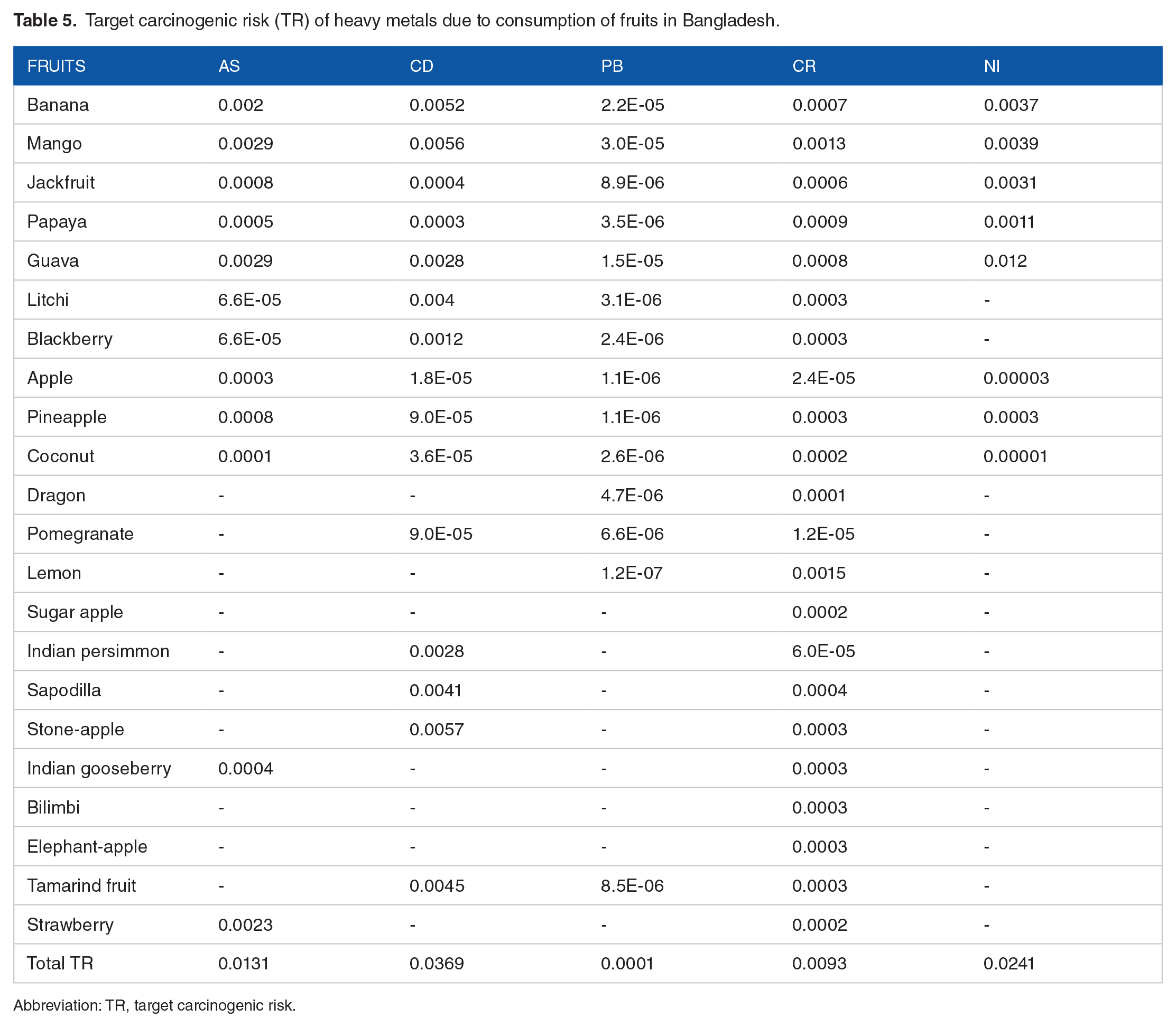
Abbreviation: TR, target carcinogenic risk.
Control strategies for heavy metal contamination
Recent studies established that arsenic contamination in groundwater has been found in 62 districts out of 64 districts of the country 37 and arsenic comes to the food chain when this groundwater is used for irrigation. 62 Moreover, fertilizers, pesticides, industrial waste, etc. also contribute to arsenic pollution in the water leading to penetrating the food chain of humans. The air and water are heavily contaminated with lead (Pb) from a variety of sources, including chemical fertilizers, pesticides, industrial and municipal waste, traffic, and waste management practices. Pb is subsequently absorbed by the body through food chains, including fruits, vegetables, and rice. According to a study by Islam et al highlighted industrial and municipal waste as the sources of Cr in Bangladesh. 28 Controlled regulations, monitoring, and management of industrial and municipal waste might contribute to reducing Cr contamination to the environment and foodstuffs. The possible sources of these hazardous metals should be monitored and controlled to secure public health. Limited use of chemical fertilizers, and pesticides might help in resolving heavy metals contamination in Bangladesh. Hence, a more comprehensive strategy that routinely tests the edible parts of vegetables for heavy metals and devises ways to lessen the burden of contamination is essential.
Critical appraisal of the studies
All the studies reported their measurement tools and methods. Only 40% of the studies used ICP-MS for heavy metal analysis and other studies mostly used AAS and FAAS. ICP-MS is the most suited method for the analysis of heavy metal concentration because of its high sensitivity and its ability to analyze multiple metals simultaneously. However, the better results obtained from using the ICP-MS technique may not be the result of ICP-MS per se. It may be that the ICP-MS technique is only employed by more specialist laboratories with greater specializations of the staff. This implies that one single technique is not more accurate than others, because individual laboratories achieve satisfactory results using any of the main digestion techniques and any of the detection techniques. 63 Two studies did not report the quality assurance methods which are very critical to ensure the reliability and accuracy of the data.22,24 A few studies did not report the detailed food description of the fruits including the name of their variety and the parts they took for analysis. Several studies did not use any standard reference material for quality control which is important to note the true value of the analytes. Future studies intending to assess the heavy metal concentrations in fruits or vegetables may report a detailed description of the samples along with their varietal names. Moreover, it is recommended that future studies adequately report the sampling strategy, the exact number of samples taken for analysis, the quality assurance procedure, and details of the standard reference materials to make the findings more reliable.
Limitations of the review
This study has some limitations. The review relied on PubMed, Google Scholar, and manual Google searching to obtain suitable articles and excluded theses and conference papers. This might have publication bias, and some important findings on other databases might be overlooked. However, Google Scholar alone can provide relevant original articles obtained through different databases search for systematic reviews and meta-analyses. 64 Thus, the use of PubMed and Google Scholar for literature searches is expected to have sufficient coverage of relevant articles for this review. The review did not assess the methodological quality of the included studies. Nonetheless, we reviewed the quality assurance methods and analysis methods of the studies. Most of the studies collected samples from industrial, polluted, and highway/roadside areas of Bangladesh. Thus, the findings of this review might not be generalizable beyond industrial and polluted regions. Future studies intending to assess the heavy metal concentrations in fruits or vegetables may report a detailed description of the samples along with their varietal names. Moreover, it is recommended that future studies adequately report the sampling strategy, the exact number of samples taken for analysis, and the quality assurance procedure to make the findings more reliable. The use of the highest concentration of heavy metals might lead to an overestimation of health risks, especially when considering data quality variations. However, our approach was explicitly aimed at identifying the worst-case scenario to emphasize the necessity of continuous monitoring and market surveillance for heavy metals in fruits.
Conclusion
This study assessed the presence of heavy metals in various fruits from different areas of Bangladesh, the EDI of metal from those foods by the adult Bangladeshi population, and the potential health risks associated with those fruits in terms of THQ and TR. The fruits, especially banana, mango, jackfruit, guava, litchi, blackberry, lemon, and tamarind fruit, contained heavy metals above the maximum allowable concentration. Daily intakes of all the metals were less than the maximum tolerable daily intake for all fruits. The findings indicated that the THQ of all the metals was within the safety level (THQ < 1) for all fruits except As. The THQ of As was higher than the safety level for strawberry, guava, mango, pineapple, banana, and papaya. On the other hand, the TR level of As, Cd, Cr, and Ni was above the safety level for most fruit items. Concerned authorities should take urgent actions to facilitate safety and quality evaluations of the fruits regarding toxic metal contamination in Bangladesh, particularly in industrial areas.
Supplemental Material
sj-docx-1-ehi-10.1177_11786302241309280 – Supplemental material for A Systematic Review on Heavy Metals Contamination in Bangladeshi Fruits and Their Associated Health Risks
Supplemental material, sj-docx-1-ehi-10.1177_11786302241309280 for A Systematic Review on Heavy Metals Contamination in Bangladeshi Fruits and Their Associated Health Risks by Md. Hafizul Islam, Abira Nowar, Saiful Islam, Md. Moniruzzaman Nayan and Ahmed Jubayer in Environmental Health Insights
Footnotes
Acronyms and Abbreviations
AAS: Atomic absorption spectrometry
AT: Averaging Time
BW: Body Weight
ED: Exposure Duration
EDI: Estimated Daily Intake
FAAS: Flame atomic absorption spectrophotometer
FIR: Food Ingestion Rate
FW: Fresh Weight
HI: Hazard Index
ICP-MS: Inductively Coupled Plasma Mass Spectrometer
ICP-OES: Inductively coupled plasma optical emission spectroscopy
IQCs: Internal quality controls
MAC: Maximum Allowable Concentration
MTDI: Maximum Tolerable Daily Intake
ND: Non-Detectable
THQ: Target Hazard Quotient
TR: Carcinogenic Risk
TTHQ: Total Target Hazard Quotient
Author Contributions
MH: Conceptualization, Data curation, Formal Analysis, Methodology, Software, Writing—original draft, Writing—review, and editing. AN: Conceptualization, Data curation, Formal Analysis, Methodology, Software, Writing—original draft, Writing—review, and editing. SI: Conceptualization, Methodology, Supervision, Writing—original draft, Writing—review, and editing. MN: Formal Analysis, Methodology, Visualization, Writing—original draft, Writing—review, and editing. AJ: Formal Analysis, Methodology, Visualization, Writing—original draft, Writing—review, and editing.
Declaration of conflicting interests:
The author(s) declared no potential conflicts of interest with respect to the research, authorship, and/or publication of this article.
Funding:
The author(s) received no financial support for the research, authorship, and/or publication of this article.
Data Availability Statement
Data sharing is not applicable to this article as no datasets were generated or analyzed during the current study.

Supplemental Material
Supplemental material for this article is available online.
References
Supplementary Material
Please find the following supplemental material available below.
For Open Access articles published under a Creative Commons License, all supplemental material carries the same license as the article it is associated with.
For non-Open Access articles published, all supplemental material carries a non-exclusive license, and permission requests for re-use of supplemental material or any part of supplemental material shall be sent directly to the copyright owner as specified in the copyright notice associated with the article.
