




Abstract
Occupational exposure to smoke and polycyclic aromatic hydrocarbons (PAHs) poses significant health risks, especially for commercial fish smokers who are regularly exposed to high levels of smoke and particulate matter. This study aimed to evaluate the exposure levels and assess the health risks associated with PAHs, phenols, phthalates, and substituted benzenes among 155 fish smokers in Ghana. A total of 155 urine samples from fish smokers across selected coastal regions in Ghana were collected and analyzed. The sample preparation was conducted using the Quick, Easy, Cheap, Effective, Rugged, and Safe (QuEChERs) method, as standardized by the Association of Official Analytical Chemists (A.O.A.C.). Analysis was performed utilizing the Shimadzu GC-MS QP 2020. The type of firewood used by fish smokers significantly influenced the levels of PAHs detected in the urine samples. Hardwoods such as odum, acacia, and cocoa, with their dense structures and combustion characteristics, were found to produce higher levels of PAHs. In contrast, softer woods like sugar cane and palm kernel released lower PAH levels during combustion. The findings indicate that fish smokers utilizing various wood types and unfiltered ovens, specifically the “Chorkor Oven,” are exposed to elevated levels of PAHs, phenols, phthalates, and substituted benzenes through inhalation during work hours. Cancer risk assessments revealed risk levels for PAHs ranging from 6.00E−04 to 4.14E−01, phenols from 0.00E+00 to 3.70E−01, substituted benzenes from 9.04E−08 to 1.99E−01, and phthalates from 3E−04 to 2.09E+04. These values exceed the limits by the U.S. Environmental Protection Agency (U.S.E.P.A.) of 10E−06. Furthermore, the estimated non-cancer hazard quotient values for hydrocarbons ranged from 8.42E+00 to 1.99E+01, all exceeding the threshold of 1, as outlined by both the U.S.E.P.A. and the World Health Organization (WHO), indicating substantial potential health risks for commercial fish smokers.
Keywords
Graphical abstract

Introduction
Fish smoking is a culturally and economically significant practice in Ghana and many developing countries globally.1,2 It is deeply rooted in the history of many nations, especially along the coastal regions of the countries. The industry serves as a platform for preserving fish locally and promotes local economies through employment and entrepreneurial opportunities for mostly women (FAO in 2014; Weyant et al 3 ). Fish processing via smoking also contributes enormously to food security, cultural heritage, and access to affordable, nutritious, and rich protein food,4,5 extends the shelf life of fish and enhances flavor. 6 Occupational exposures in commercial fish smoking are however high. 3
The fish smokers in this work used chorkor smoker ovens. According to Nunoo et al 7 and Adeyeye and Oyewole, 8 the chorkor smoker is an advancement over Ghana’s existing traditional fish smoking oven. Women who do traditional fish smoking found the Chorkor smoker to be quite appealing. A combustion chamber and a smoking device with trays are included. The combustion chamber is rectangular in shape, twice as long as it is wide, with 2 stokeholes in front and a wall along the length of the chamber. Smoking fish directly with fuel wood at high heating temperatures, according to Akpambang et al, 9 may be the cause of elevated PAH levels in processed meals. Furthermore, Essumang et al 10 found elevated levels of benzo[a]pyrene (BAP) in wood-smoked fish samples. Since fish smokers use Chorkor ovens in indoor smokehouses, they could be exposed to smoke particulates.
Recently, advanced biomarker analysis has become a focus for accurately assessing PAH exposure among occupational groups. Biomarkers like 1-hydroxypyrene, found in urine samples, serve as reliable indicators for PAH exposure, particularly in industries involving combustion processes, such as fish smoking. This advancement is notable in studies that have identified high levels of urinary PAH biomarkers among fish smokers exposed to smoke from biomass fuels.11,12 The findings emphasize the need for biomarker-based monitoring to manage exposure risks, especially since traditional environmental monitoring might underestimate the levels of PAHs workers are exposed to in confined spaces. 13 Research has also advanced in assessing PAH exposure through region-specific studies, highlighting the influence of localized practices, such as fuel type and smoking methods. A study by Appiah-Dwomoh et al 14 found that fish smokers in Ghana’s coastal regions show considerable variation in PAH levels due to different biomass sources. This underscores the need for regionally tailored interventions, as certain woods used for smoking produce significantly higher levels of carcinogenic PAHs, necessitating region-specific monitoring and policy approaches to reduce health risks.
Region-specific studies have shown that localized practices, such as the choice of fuel type and smoking techniques, significantly impact PAH exposure levels. Bortey-Sam et al 15 identified high PAH levels among fish smokers in Ghana’s Volta and Central regions, correlating these with differences in wood types used. These findings highlight the need for interventions that address specific local practices, supporting ongoing efforts to create targeted monitoring and reduce occupational risks.
Focusing on improving the techniques for enhanced food safety and reduced health risks; maximizing benefits while minimizing hazards16,17 has been recent advancements. Health concerns associated with the traditional fish smoking methods, particularly the contamination of fish with carcinogenic polycyclic aromatic hydrocarbons (PAHs), a sub-group of Semi-volatile organic compounds (S.V.O.C.s) have been raised in the past.14,18 The routine occupational exposure to high levels of smoke and soot by fish smokers has therefore generated a hot debate recently (Figure 1).

(A) (left): A commercial fish smoker at work in a smokehouse from the study site and (B) (right) represents a schematic S.V.O.C.s cycle.
Semi-volatile organic compounds (SVOCs) encompass a range of chemical compounds, including polycyclic aromatic hydrocarbons (PAHs), phthalates, and chlorinated organic compounds, which pose significant health risks in occupational settings involving combustion processes. Exposure to SVOCs is associated with a variety of adverse health effects, including respiratory, endocrine, reproductive, and carcinogenic outcomes, particularly in populations with prolonged, unregulated exposure to these compounds.3,14,19 -21 S.V.O.C.s are teratogenic, mutagenic, cancer-causing, and have reproductive and hormonal toxicities,22 -25 low birth weight and I.Q. 27 The increased exposure to these carcinogenic pollutants partly explains the growing trend of all forms of cancers and cancer-related mortalities globally (I.A.R.C., WHO, 2020). Their exposures are above acceptable limits in smoked fish, 25 soot and meats, 27 and plant materials. 22
Multiple anthropogenic activities and incomplete combustion are among their principal emissions sources of S.V.C.O.C.s28-30 (Figure 1B). The fish smokers under study spend on average 6 hours a day going about their activities. As a result, they may be exposed to pollutants in the form of semi-volatile organic compounds (SVOCs) from firewood smoke. 31 S.V.C.O.C.s are bioaccumulative and persist in the environment. 32 In the soil, certain plants take up PAH as part of the food chain, polluting them in the process (Figure 1B). Burning the contaminated plant materials, as well as rubbers, and car tires releases S.V.O.C.s and other poisonous hydrocarbons into the smoke. The continual occupational exposure by commercial fish smokers to S.V.O.C.s poses health risks (Figure 1A and 1B). When exposed, part of S.V.O.C.s is excreted via urine following the normal excretion cycle. Urinalysis has therefore been previously used in the U.S.A. to evaluate the biomarkers for aromatic polycyclic hydrocarbon analysis. 33 However, to our knowledge, similar studies on commercial fish smokers have not been done in Ghana.
The present study is, therefore, novel in studying polycyclic aromatic hydrocarbons (PAHs), chlorinated phenols, phthalates, and substituted benzenes exposure and their health risk estimations in a less-studied occupational class of the population of local fish processing workers in selected communities in Ghana using non-invasive urine samples. Secondly, we also seek to investigate the toxic health risks of the studied hydrocarbons among this occupational group.
Methodology
The main activities in the sampling area are fishing and smoking the fish for commercial purposes. The study involved the collection of hundred and fifty-five (155) urine samples from commercial fish smokers according to Cochran’s 34 sampling techniques. These samples were collected from 3 different coastal regions in Ghana—Central, Volta, and Western, with 60, 59, and 36 samples from each region respectively, as illustrated in Figure 2 of this study. To ensure the accuracy and reliability of the analysis, 2 well-established methods were employed. The A.O.A.C. method and the QUECHERS Q110 En method proposed by Lehotay 2007, is a standardized procedure recognized for its precision in analytical chemistry.

Map of study sites. Pink dots represent sampling sites.
Urine sample collection
Sterile, metal-free plastic urine containers were used to collect urine samples from study participants. They were instructed to void out the first portion of the urine stream before collecting 15 to 20 ml of midstream urine into the plastic containers. Urine samples were kept in cool containers containing ice packs at 4°C to 8°C and transported to be analyzed at the laboratory at the Chemistry Department, University of Cape Coast.
Urine sample preparation
For the preparation of urine samples, the A.O.A.C. method 2007 and the QUECHERS Q110 En approach, as outlined by Restek (visit www.restek.com) were used. About 4 ml of urine sample was measured and transferred into a 10 ml centrifuge tube. About 4 ml of acetonitrile was added, followed by a precise amount of 1.625 g of QUECHERS salt. The mixture was then subjected to a vortexing for 5 minutes for thorough mixing. The mixture was then centrifuged at a speed of 3500 rpm for 15 minutes. The clear supernatant liquid was then carefully poured off into a new tube which already contained primary secondary amine (P.S.A.) for purification and MgSO4 for drying.
The clean-up sample was again centrifuged for 15 minutes at the same speed of 3500 rpm. The final, purified sample was then collected into 1.5 ml glass vials for Gas Chromatography-Mass Spectrometry (GC-MS) analysis. This meticulous preparation is key to ensuring accurate and reliable results in our analysis as proposed by the A.O.A.C. method 2007.
Chemicals and standards
High-purity analytical reagents and standards were used for reagent preparation and recovery study. The 8270 Megamix standards (#31850), S.V. internal standards comprising 6 components (#31206), B/N Surrogates mix (4/89 SOW, #31062), and the GC-MS tuning mixture, which includes benzidine, D.F.T.P.P., 4,4′-DDT, and pentachlorophenol (#31615), all from Restek. The solvents, including G.C. grade hexane with a purity of 99.8% and dichloromethane also at 99.8% purity (# K4799165633), were provided by Millipore Corporation, based in Germany. From B.D.H. Chemicals Limited in Poole, England, we obtained silica gel with a 60 to 120 mesh size. Additionally, the anhydrous Na2SO4 (99.0% purity, #7630-4405), along with 99% analytical grade acetonitrile and acetone were obtained from D.A.E.J.U.N.G. Chemical and Metals.
Preparation of standard and operational conditions for GS-MS
From a standard of 1000 ppm, Standard solutions of the analyte of concentrations 10, 20, 50, 100, and 500 ppb were prepared. The urine samples were examined using a Shimadzu GS-MS QP 2020 system. Environmental Protection Agency protocol 8270 (SIM) was used for the GS-MS analysis, with slight modifications to enhance both selectivity and sensitivity. The system was equipped with an A.O.C. 20i auto-injector and utilized a Rtx-5 ms fused capillary column measuring 30.0 m in length, 0.25 mm in internal diameter, and 0.25 µm in film thickness.
Helium (purity of 99.9995%), was used as the carrier gas. Our analysis focused on detecting polycyclic aromatic hydrocarbons (PAHs), phenols, phthalates, and substituted benzenes. The injection port of the Shimadzu GC-MS QP 2020 was maintained at a temperature of 265.0°C, while the column oven had a baseline temperature of 70.0°C. A temperature programing was approach employed for the GC tasks. The initial temperature was set at 70°C and held for 2.0 minutes, followed by an increase to 90°C at a rate of 20°C/min. Subsequently, the temperature was raised to 250°C at 10°C/min, and finally to 300°C at a rate of 5.0°C/min, where it was maintained for 3.0 minutes. The total duration of the temperature programing was 32.00 minutes. The injection volume chosen was 1.0 µl, and the system operated with a column flow of 1.33 ml/min and a total flow of 8.7 ml/min, maintaining a linear velocity of 42.3 cm/s. This meticulous setup ensured precise control and accurate results in our analysis.
Operational conditions of mass spectrometer
Quantitative data was collected using the SIM mode with 2 ions monitored for each molecule using an electron impact ionization source. The ion source and the interface were set to 230°C and 280°C, respectively.
Quality control
In this study, we adopted an internal standard quantitative approach for measurement accuracy. For quantification purposes, a five-point calibration curve was used, with concentrations of the standards ranging from 0.01 to 0.5 mg/l. To each of these standards, 50.0 µl of a 5.0 mg/l internal standard (I.S.T.D.) was added. Surrogate standards (S), were also included with concentrations between 0.30 and 3.0 mg/l, in both the standards and the samples as per the E.P.A. method 8270. To validate the GS-MS method, initial calibration verification (I.C.V.s) at 0.2 mg/l and continued calibration verification (CCVs) at 0.5 mg/l were used across 10 consecutive sample runs. At the start of each batch of sample analyses, a procedure reagent blank, with I.S.T.D. and surrogate standards, was processed. In line with method 8270 E/D, the GS-MS tuning mixture was manually tuned every 12 hours to maintain optimal performance.
Additionally, to assess the variability of means among different regions, an analysis of Variance (ANOVA) was conducted. The statistical technique was used to evaluate whether there were significant differences in the variables we measured across the various regions included in the study.
Risk assessment
The health risk assessment methodology was based on established protocols by Unwin et al, 35 with some modifications for our specific study requirements. The method outlined by Unwin et al 35 was used to justify the use of urinary 1-Hydroxypyrene (1-OHP) as a biomarker for assessing exposure to polycyclic aromatic hydrocarbons (PAHs). We back-calculated exposure levels in μg/m3 from urinary 1-OHP concentrations, following the method proposed by Lakind and Naiman. 36
The estimated daily intake of pyrene for adult women in the various study regions was calculated by employing the following formula:
Daily Pyrene Intake Dose (D.D.) in mg(kg-day)−1 = Urine 1-OHP Concentration (C in mg/ml) × Estimated Urine Output (P in ml/day)/Body Weight (W in kg) × Fraction of Pyrene Eliminated as 1-OHP in Urine (F).
For non-carcinogenic health risks, we calculated the Hazard Quotient (H.Q.) by dividing the daily intake dose of 1-OHP (D.D.) by its reference dose (RfD), which, according to the U.S. Environmental Protection Agency (1993), is 30 μg/kg/day for pyrene.
The assessment of cancer risk from oral exposure was based on the following parameters: average body weight of 70 kg, a water ingestion rate of 2 l/day, an exposure frequency of 365 days/year, and a lifetime exposure duration of 70 years.
The cancer risk in each region was then determined using this equation: Cancer Risk = Mean Concentration × Exposure Frequency × Exposure Duration × Ingestion Rate/Body Weight × Cancer Slope Factor (CSF). The CSF is a value that estimates the risk of developing cancer over a lifetime due to exposure to a specific level of a carcinogen and is usually expressed as risk per mg(kg-day)−1. The resulting cancer risk is a dimensionless probability, interpreted as the likelihood of developing cancer over a lifetime due to the specific level of chemical exposure.
PAH concentrations among commercial fish smokers
The mean concentrations of PAHs among Volta, Central, and Western Regions are presented in Figure 3. There is considerable variability in PAH concentrations across the 3 regions. For instance, pyrene is high in the Volta region, compared to Central and Western regions. The commercial fish smokers self-reported that they use the following types of firewood: sugar cane, palm kernel, cocoa, acacia, esa, odum, rubber, yaya, light pole, and abode. In addition, some of them use edua, bolambo, okanto, abodua, denta, kumkum ban, pepe, duaawon, danwoma, apam, duany, gyama, wawa, nyinadzen, tanta, edua awor, emire, charcoal (using oven), embir, and wobinbo.

Mean concentration of PAHs among Volta, Central, and Western Regions.
Most commercial fish smokers preferred esa since smoking with it made the fish look nice and stronger. Esa also helps the fish to dry fast, has better flame, is available of firewood, less harmful to eyes, prevents fish from insects, is hygienic, attracts customers, and saves money.
The types of firewood used by fish smokers vary significantly. These variations in firewood types could result in the different levels of PAH exposure observed in Table 1 because the composition and moisture content of the wood can significantly affect the quantity and type of PAHs produced during combustion. The variability in PAH concentrations could also be due to differences in the smoking techniques, or the duration and, intensity of exposure to smoke.
Estimated daily intake dose of pyrene (Dose) and hazard quotient (H.Q.).

The use of local firewood types such as sugar cane, palm kernel, cocoa, acacia, and others by commercial fish smokers plays a significant role in the emission of Polycyclic Aromatic Hydrocarbons (PAHs). Essumang et al, 25 linked the type of firewood used, such as mangrove and acacia, to increased PAH levels in smoked fish, highlighting the health risks associated with the traditional fish-smoking methods practiced in many parts of the country.
Kafeelah et al 37 showed different types of wood used for fish smoking, contributed to varying levels of PAHs in smoked fish. Nyström et al, 38 found that the combustion temperature and the specific wood type significantly influenced PAH concentrations, suggesting that certain wood species may increase the risk of PAH contamination. Bouka et al 39 also indicated that the use of traditional smoking methods and specific types of firewood, such as Cassia siamea and Eucalyptus camaldulensis, were key factors contributing to the high PAH concentrations in smoked fish. Essumang et al 40 found that traditional ovens, often used with locally sourced wood, resulted in higher PAH levels compared to more modern smoking technologies and called for the adoption of improved smoking methods, such as the FTT-Thiaroye technique, which can significantly reduce PAH emissions and enhance the safety of smoked fish products.
The reference dose (RfD) is an estimate of the daily exposure to a substance that is likely to be without an appreciable risk of adverse health effects over a lifetime. 41 Several PAHs, such as naphthalene, fluoranthene, and benzo[a]pyrene, have high urinary concentrations compared to their respective RfDs. 42 This suggests a potential health risk, as continuous exposure at these levels could exceed what is considered safe.
PAHs are known carcinogens and can also cause other health issues such as respiratory problems and skin irritation for commercial fish smokers. Chronic exposure to high levels of PAHs, as indicated for some commercial fish smokers in this study, could increase their risk of developing cancer (skin, lung, and bladder cancers). The metabolites of PAHs, such as 1-Hydroxypyrene, are often measured in urine to assess exposure to pyrene, a specific PAH. High levels of 1-Hydroxypyrene in all regions suggest significant exposure to pyrene, which has a high carcinogenic potential.
The data in Table 2, showing phenol concentrations in urine samples from commercial fish smokers in the Central, Volta, and Western regions, offers valuable insights into the exposure levels of various phenolic compounds. These smokers use a variety of firewood types to smoke fish in indoor environments, which likely contributes to their exposure to phenolic compounds due to the combustion of wood.
Cancer risk assessment (Oral) for PAHs.

Phenol concentration variances across region
Figure 4 shows the phenol concentration variances across regions. The Volta region shows high concentrations of 2-methylphenol compared to the Central and Western regions. Similarly, the Western region has a high level of phenol concentration. Also, 3-methylphenol is higher in Volta and Western regions compared to Central. The variations could be due to regional differences in the type of firewood used or the smoking process itself.

Mean concentration of phenols.
In addition, 2-nitrophenol shows a significantly high concentration in the Central region compared to others. This might indicate a unique type of firewood usage or differences in the wood combustion process in this region. The Western region has lower concentrations of 2-chlorophenol and various chlorophenols compared to other regions, which could be influenced by the specific types of wood used or different combustion conditions.
The concentrations of tetrachlorophenols (like 2,3,5,6-tetrachloro phenol) are fairly similar across the regions, suggesting a common environmental exposure or similar smoking techniques that favor the formation of these compounds. 9-Phenanthrenol shows the highest concentration in the Central region, which could be due to the types of wood used or the condition under which the wood burns.
The wide variety of firewood types used includes sugar cane, palm kernel, cocoa, and acacia, among others. These woods likely vary in their chemical compositions, influencing the types and amounts of phenolic compounds released during combustion. 43 Woods like acacia, which are known for their dense and resinous nature, might produce more complex phenols when burned, while softer woods like sugar cane might result in less intense smoke and therefore lower concentrations of certain phenolic compounds. 25
Exposure to high levels of phenols, especially in enclosed areas, can pose significant health risks, including respiratory issues and potential long-term effects like cancer. 44 The high levels observed in the urine samples indicate substantial exposure and highlight the need for interventions to reduce these levels, such as improving ventilation in smokehouses or exploring alternative smoking methods.
Variability in concentrations substituted benzenes across regions
Nitrobenzene shows high levels in the Western region compared to others, which could be due to regional differences in firewood composition or combustion conditions (Figure 5). Isophorone has a high concentration in the Central region, which could indicate specific types of wood or contamination sources unique to this area.

Mean concentration of substituted compounds.
The Volta region shows high levels of Bis(2-chloroethyl) ether and Bis(2-chloroisopropyl) ether which could also indicate potential exposure to specific chemicals that may be more prevalent in the firewood types used in this area.
In the Central region, 4
Many of the compounds, particularly chlorinated benzenes, and ethers, can be by-products of burning specific types of wood or even the contamination in the wood (eg, treated or painted wood). The variety of firewood reported by commercial fish smokers, such as sugar cane, palm kernel, and cocoa, have different compositions and will burn differently. 45 Each type might release distinct chemicals upon combustion. For instance, hardwoods like cocoa and odum might release different compounds compared to softer, more resinous woods like palm. 25
Exposure to high concentrations of compounds like nitrobenzene and chloroaniline can pose significant health risks, including potential carcinogenic effects. 46 The occupational setting of fish smoking should consider these risks, particularly in poorly ventilated areas. The release of these compounds into the atmosphere can affect local air quality and broader environmental health, impacting not just the workers but also the surrounding communities.
Concentration variability and regional differences of phthalates
Considering the variations of phthalates in the 3 regions (Figure 6), Diethyl phthalate shows higher concentrations in the Central and Western regions compared to Volta, suggesting significant regional differences in exposure sources. Dimethylphthalate is notably higher in the Volta region, implying different environmental or occupational exposures.

Mean concentration of phthalates in urine samples.
Substances like Di-n-octyl phthalate and Benzyl butyl phthalate are relatively low across all regions, suggesting either lesser usage or better containment within environmental sources.
While phthalates are generally associated with plastics and industrial pollutants rather than combustion products, their presence in urine samples of fish smokers could indicate: That commercial fish smokers use rubber bags and cartons to set fire which could be the source of phthalates. Phthalates might be present in materials used around the smokehouses, such as plastic coverings, containers, or even in protective gear and clothing. 47
The type of firewood might not directly influence phthalate concentrations unless the wood is recycled or treated with phthalate-containing substances, which is less common. 48
Phthalates are known endocrine disruptors, and exposure at high levels could lead to several adverse health effects, including Reproductive Health Issues: (effects on fertility and developmental problems in children if pregnant women are exposed), Hormonal Disruptions: Phthalates could interfere with hormone systems, which can cause a variety of health issues. 49
The estimated daily intake of pyrene and the resulting hazard quotients across 3 regions (Central, Volta, and Western) are presented in Table 1. Pyrene is a PAH commonly found in the environment, especially in areas affected by combustion processes, like fish smoking.
The concentrations of pyrene are higher in the Volta region, and significantly higher than in the Central and Western regions. This could indicate more intensive or less controlled smoking practices or differences in the types of fuel used or the type of fish smoked.
The daily intake dose is calculated based on the concentration of pyrene, the amount of contaminated food (fish) consumed, and the body weight of the consumer. 50 Again, the intake dose is highest for the Volta region. The significant difference in doses between the regions could be due to differences in fish consumption rates, body weights of the average consumer, or both. The U.S. EPA provides detailed methods for assessing human exposure to environmental contaminants, including calculating daily intake doses. The guidance specifies that dose calculations involve the concentration of contaminants in food, ingestion rates, and body weight to assess health risks from exposure.
The hazard quotient (H.Q.) is a ratio used to indicate the health risk posed by exposure to a toxic substance. It is calculated by dividing the estimated dose of the substance by a reference dose considered safe for human consumption. An H.Q. greater than 1 suggests potential health risks. The H.Q. values are high, indicating significant potential health risks associated with pyrene exposure through fish consumption in these regions. While both are concerning, they are substantially less than the H.Q. for Volta. The H.Q. is nearly 20, which is alarmingly high and suggests a very high potential health risk to the population consuming smoked fish from this area.
Cancer risk assessment for PAHs
Table 2 provides a comparative assessment of cancer risks (oral exposure) for 7 carcinogenic 51 polycyclic aromatic hydrocarbons (PAHs) across the Volta, Central, and Western regions of Ghana. Data from urine samples of commercial fish smokers reveal that cancer risks vary significantly across regions, with Volta consistently showing the highest levels. For instance, the risk from chrysene was much higher in Volta (0.0255) compared to Central (0.0011) and Western (0.0053). Benz[a]anthracene also had a substantially elevated risk in Volta (0.4138) over Central (0.0006) and Western (0.0025). Benzo[a]pyrene, a priority pollutant due to its strong carcinogenic potential, presented the most significant difference, posing a risk of 0.5309 in Volta, while Central and Western remained low at 0.0006 and 0.0029, respectively. The regional disparities in exposure levels align with the literature, suggesting that biomass-based fish smoking practices and combustion efficiency play a crucial role.
These findings underscore the importance of region-specific interventions to manage PAH exposure. For example, health education campaigns are needed to raise awareness about the risks of biomass smoke, while regulations could promote safer smoking technologies. More comprehensive mitigation strategies should prioritize reducing exposure to highly carcinogenic compounds like benzo[a]pyrene and benz[a]anthracene, which are prevalent in the Volta region. Adopting successful practices from other regions and countries where PAH exposure has been reduced could prove beneficial. These steps will help ensure safer working conditions and protect the health of commercial fish smokers across Ghana. Also, transitioning to improved smoking technologies, such as enhanced ovens with filtration systems, is crucial to capture harmful emissions and limit exposure. Almost, all the fish smokers’ houses are closed up therefore enhancing workplace safety through better ventilation in smokehouses, including exhaust fans or smoke-free zones, can lower airborne pollutants. Encouraging the use of cleaner fuels or alternative smoking methods like solar or electric smokers can also reduce toxic emissions associated with traditional wood-burning practices, making the smoking process safer and more sustainable. On a policy level, regulatory actions like setting standards for fuel types, permissible toxic substance levels in smoked fish, and offering financial incentives for adopting safer practices are vital.
Cancer risk assessment for phenols
Table 3 shows phenolic compounds, which can form during the smoking process as wood breaks down. Phenol and its derivatives, like 2-methylphenol and 3-methylphenol, show varying cancer risks across regions. 52 The significant disparity in numbers, such as between Volta and Western for phenol, suggests differences in the concentration of these chemicals in the smoked fish, possibly influenced by the type or condition of the wood used for smoking.
Cancer risk assessment ingestion for phenols.

Phenols and their derivatives, as listed, including 2-methylphenol and 3-methylphenol, also have associated cancer risks. These compounds are known irritants and have been linked to systemic toxicities, including effects on the liver and kidneys, and carcinogenic outcomes. Regular intake through consumption of smoked fish could lead to long-term health issues, including the potential for cancer development, particularly in digestive organs. 52
Cancer risk assessment for substituted benzenes
Substituted benzenes also show varied cancer risks across regions, with notable chemicals like nitrobenzene and Bis(2-chloroisopropyl) ether presenting high values, particularly in the Volta Region. This indicates either a high presence of these chemicals or increased susceptibility of the population in Volta Regions to these compounds. 53
Substituted benzenes, such as Nitrobenzene and Bis(2-chloroisopropyl) ether, exhibit various levels of toxicity and cancer risk. Nitrobenzene, for instance, is known to be toxic to the liver and kidneys and can cause significant harm to the blood, such as methemoglobinemia. Regular exposure to high levels of these compounds, as seen in the Volta region, could lead to severe health problems, including chronic diseases and cancer. 53
A cancer risk assessment for several substituted benzene compounds across 3 regions in Ghana: Volta, Central, and Western (Table 4). This data was obtained from fish smokers who use biomass fuel for smoking fish. Biomass fuel, such as wood or crop residue, can release toxic chemicals during combustion, which may deposit on the smoked fish and expose individuals, particularly fish smokers and consumers, to these chemicals.
Cancer risk assessment (oral) for substituted benzenes.

There are notable differences in the cancer risk associated with various compounds across the Volta, Central, and Western regions. Generally, the Volta region shows higher cancer risk values for many compounds compared to the Central and Western regions. This could indicate a higher exposure to hazardous compounds in the Volta region due to either the type of biomass fuel used environmental factors, or different smoking practices.
Several compounds show particularly high cancer risk values, especially in the Volta region: Nitrobenzene has a significantly high cancer risk in all regions, with a value of 0.199 in Volta, 7.64 × 10⁻³ in Central, and 2.55 × 10⁻³ in Western. Nitrobenzene is known for its toxicity, and its presence in fish smokers’ environment is concerning due to its link with serious health hazards.
2-Methyl-1,3-dinitrobenzene also presents high cancer risk values, particularly in the Volta region (0.160), followed by Central (5.92 × 10⁻³) and Western (8.84 × 10⁻⁴). Bis (2-Chloroisopropyl) ether has a relatively high cancer risk value, particularly in the Volta region (2.61 × 10⁻²), with lower but still concerning values in the Central (3.50 × 10⁻⁴) and Western (1.28 × 10⁻⁴) region
4-Bromophenyl ether shows very low cancer risk values in the Western region, Central, and Volta. 1,2,4-Trichlorobenzene has uniformly low cancer risk values across the regions, with the highest risk in Volta, and decreasing in Central and Western.
The Volta region generally shows higher cancer risk values for most compounds compared to Central and Western. The higher risk in Volta could be attributed to factors such as the type of biomass which may vary across regions, with different fuels releasing varying amounts of harmful substituted benzenes. Also, variations in smoking practices (such as duration of smoking, type of equipment used, or exposure time) may affect the level of compound deposition on the fish.
Cancer Risk Assessment for phthalates and other compounds
In Table 5, we present the cancer risk assessment values for different phthalates across the Volta, Central, and Western regions in Ghana. These phthalates were detected in the environment of fish smokers who use biomass fuel for smoking fish. Phthalates are a group of chemicals commonly used as plasticizers and can be released into the environment through various means, including the burning of materials in biomass fuel. Prolonged exposure to certain phthalates is associated with potential health risks, including cancer.
Cancer risk assessment (oral) for phthalates.
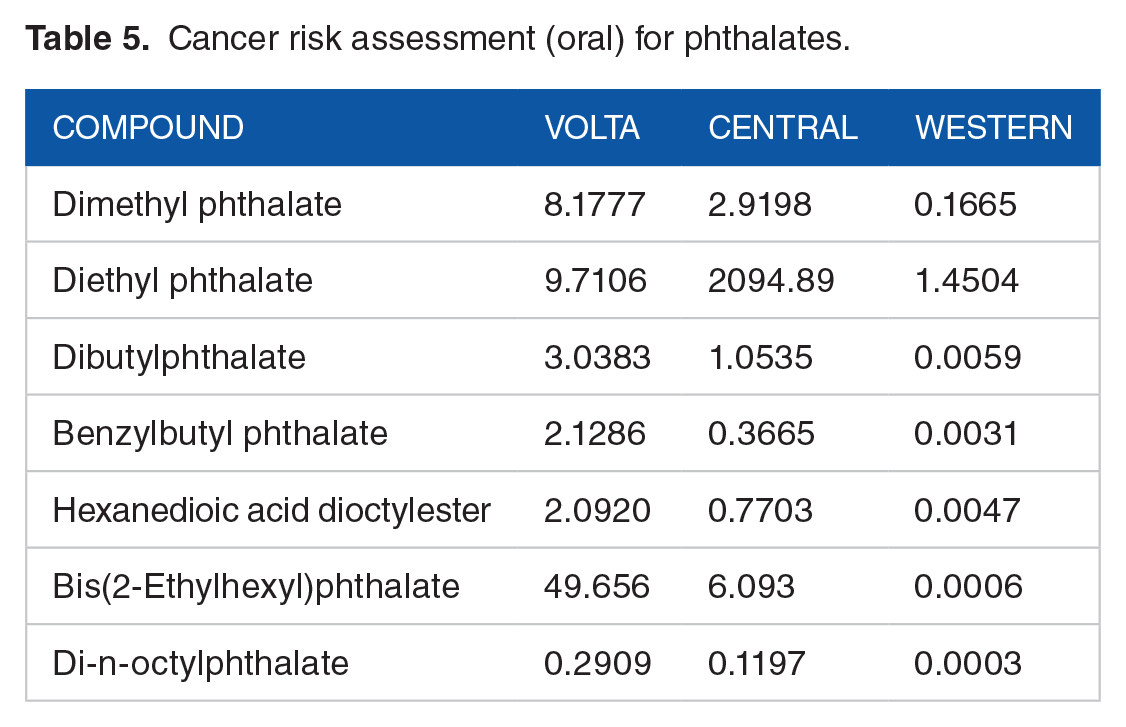
There are significant regional differences in cancer risk values for the phthalates examined. The Volta region generally shows higher cancer risk values for most phthalates, while the Western region consistently shows the lowest values across all compounds. This pattern is similar to those in Table 4 (substituted benzenes), which suggests that environmental or behavioral factors may contribute to these differences, such as the type of biomass used or varying smoking practices.
Bis(2-Ethylhexyl) phthalate presents the highest cancer risk value in the Volta region (49.656), which is much higher compared to the Central (6.093) and Western (0.0006) regions. Bis(2-ethylhexyl) phthalate is one of the most commonly used plasticizers and is considered potentially carcinogenic, particularly through prolonged exposure.
In the Central region, diethyl phthalate shows a high cancer risk value (2094.89), far surpassing values seen in the Volta (9.7106) and Western (1.4504) regions. This stark difference suggests the Central region may experience higher exposure to diethyl phthalate, possibly due to variations in fuel or other environmental factor
Some phthalates, such as di-n-octylphthalate, show relatively low cancer risk values in all regions. In particular, the Western region shows the lowest values for many phthalates, indicating that fish smokers and consumers in this region may have less exposure to these harmful chemicals.
Effect size
Effect sizes indicate the practical relevance of differences in exposure levels to harmful compounds across Ghana’s Volta, Central, and Western regions. A small effect (d ≈ 0.2) suggests minor disparities with limited impact, while a medium effect (d ≈ 0.5) signals moderate, practically relevant differences, as seen in some PAH levels that may raise public health concerns. Large effect sizes (d ≈ 0.8 or higher) highlight substantial differences with significant implications, warranting immediate public health action. For example, extremely high effect sizes (d = 3.34 and d = 4.12) in compounds like naphthalene and 1,2-dichlorobenzene reveal pronounced exposure disparities, particularly affecting the Central and Volta regions, which could necessitate urgent intervention.
Phthalates and phenolic compounds also exhibit concerning exposure levels, with diethylphthalate showing a large effect (d = 1.64), posing significant risks in the Central region. These findings underscore the need for targeted public health strategies to reduce exposure, especially in regions with high effect sizes, where continuous monitoring and further research are essential to inform effective policy decisions. Addressing these disparities through interventions will help mitigate the risks associated with hazardous compound exposure and protect the health of affected populations.
Discussion
Urinary concentration of PAHs
Urinary biomarkers of PAH exposure, such as naphthalene and 1-hydroxylysine, were studied in fish smokers using firewood as biomass across Central, Volta, and Western regions. The analysis revealed significant regional variations in PAH levels, with notably higher levels in Volta and Western regions due to different smoking practices and the types of wood used. 54 Health risks associated with specific PAHs such as acenaphthylene, acenaphthene, and fluorene were also highlighted, underscoring the need for protective measures to mitigate the risks associated with PAH exposure. 12
Carcinogenic PAHs like benz[a]anthracene, chrysene, benzo[b]fluoranthene, and benzo[a]pyrene were found in considerable amounts, especially in Volta region samples. These compounds are known for their mutagenic and carcinogenic properties, 55 necessitating urgent public health interventions and occupational safety measures among commercial fish smokers. Other detected PAHs such as pyrene, indeno[1,2,3-cd]pyrene, dibenz[a,h]anthracene, and benzo[ghi]perylene further highlighted the substantial PAH exposure among commercial fish smokers, reinforcing the need for emission control technologies and policy-level changes to regulate biomass usage.11,56−58
Furthermore, the detection of methylated naphthalenes and the widespread presence of 1-hydroxypyrene indicate cumulative exposure to PAHs, emphasizing the importance of improved occupational health practices including the use of personal protective equipment (PPE) and enhanced personal hygiene.59,60 These findings underscore the importance of transitioning to cleaner biomass fuels or adopting improved smoking techniques to reduce the health risks associated with traditional fish smoking practices.
The level of 16 USEPA PAHs in this study is higher as compared to De Craemer et al. 61
The concentration of pyrene in this study is higher than that observed in Vimercati et al. 62 Also, the level of benzo a pyrene in this study is higher than Vimercati et al. 62
The level of 1-OHpyrene is comparable to Alshaarawy et al 63 and Shahsavani et al. 64 In the case of Motorykin, 65 the concentration of 1-OHP was higher than that of other species.
The findings of the study on occupational exposures among commercial fish smokers in Ghana present significant health risk implications related to polycyclic aromatic hydrocarbons (PAHs), phthalates, and semi-volatile chlorinated organic compounds. High levels of PAHs, particularly pyrene, benz[a]pyrene, and benz[a]anthracene, were detected in urine samples, with effect sizes indicating severe potential health risks, especially in the Volta region. The calculated cancer risk assessments for PAHs ranged from 0.0006 to 0.5309 across the regions, significantly exceeding the U.S. EPA’s acceptable threshold of 1 in a million, which highlights an urgent need for interventions to mitigate exposure. Continuous inhalation of smoke containing these carcinogenic compounds can increase the risk of developing various cancers, particularly lung, skin, and bladder cancers, thereby posing a serious public health threat to those engaged in traditional fish-smoking practices.
Additionally, the study identified substantial concentrations of phthalates and substituted benzenes, with compounds like diethyl phthalate showing high cancer risk values, particularly in the Central region. Phthalates are known endocrine disruptors, linked to reproductive health issues and developmental problems in children, emphasizing the potential long-term health consequences of exposure for both fish smokers and consumers of smoked fish. The overall high hazard quotient values indicate a significant likelihood of adverse health effects due to cumulative exposure to these hazardous substances. The results underline the necessity for policy reforms aimed at improving fish smoking practices, such as the adoption of cleaner combustion technologies, better ventilation in smoking environments, and the use of personal protective equipment to protect workers from the health risks associated with these harmful pollutants.
Urinary phenols concentrations
We observed high levels of chlorophenols in urine samples from commercial fish smokers as a result of exposure to phenols through inhalation or skin absorption during biomass burning. Studies have linked chlorophenol exposure to adverse health effects such as disruptions in thyroid function and liver enzyme changes. 66 Elevated phenol concentrations in urine samples from the Western Region suggest significant exposure, possibly due to the type of biomass or fish smoking method used. Chronic exposure to high phenol levels is known to cause systemic toxicity and skin issues. 67 Furthermore, 2-methylphenol and 3-methylphenol are present at elevated levels, which could affect the central nervous system, respiratory health, and endocrine functions of commercial fish smokers.68,69
Several other chlorophenols, such as 2-nitrophenol, 2,4-dimethylphenol, 2,4-dichlorophenol, 4-chloro-3-methylphenol, and 2,4,6-trichlorophenol, present varying levels of exposure risks to commercial fish smokers. While 2,4-dimethylphenol showed relatively low levels across regions, 2,4-dichlorophenol, suspected of disrupting thyroid function, may be linked to specific wood types or contaminants in biomass. In the Central region, high concentrations of 4-chloro-3-methylphenol might reflect regional fish smoking practices or variations in air quality, posing respiratory and dermal risks. 70 2,4,6-Trichlorophenol and 2,4,5-Trichlorophenol could disrupt the immune system and cause hormonal imbalances.
Additionally, consistently high levels of 2,3,5,6-Tetrachlorophenol across regions suggest widespread exposure. These compounds are known carcinogens with links to reproductive and endocrine toxicity. Similarly, the presence of 9-Phenanthrenol indicates potential exposure to polycyclic aromatic hydrocarbons (PAHs), which are carcinogenic and harmful to multiple organ systems. Overall, the elevated presence of these chemicals in urine samples highlights significant health risks associated with fish smoking practices.
In comparing the concentration of phenols in this study to other studies, we observed that the concentration of 1-hydroxy pyrene is higher than the values reported by Clark et al, 71 Fan et al, 72 Feldt et al, 73 Choosong et al, 74 Alshaarawy et al, 13 Pruneda-álvarez et al, 75 Kamal et al, 76 Weinstein et al, 24 Okonkwo et al, 77 Vimercati et al, 62 Bortey-Sam et al, 78 Oliveira et al, 79 Riojas-Rodriguez et al, 80 Ruíz-Vera et al, 81 and Bieniek. 82 Also, the concentration of phenol in this study is higher than Okonkwo et al, 77 Singh et al, 56 and Pollack et al. 83 The concentration of 2,4-Dichlorophenol in this study is higher than those in Vernet et al, 84 Engel et al, 67 Philippat et al, 85 Guidry et al, 86 and Vernet et al. 87 These observations could be because the commercial fish smokers smoked fish indoors with biomass fuel with little ventilation. Most of them do not use any personal protective equipment which could have led to the inhalation of a lot of smoke particles.
Substituted benzenes in urine samples
The data reveals significant regional variation in substituted compound concentrations found in fish smokers’ urine, with certain compounds like bis(2-chloroethyl) ether (Western Region, 28 255.64 µg/l) and 1,2-dichlorobenzene (Volta Region, 11 776.58 µg/l) having concentrations. According to Smith et al 88 and Jones and Wang, 89 these compounds are linked to liver damage, respiratory complications, and organ toxicity. Other compounds like 1,3-dichlorobenzene and 1,4-dichlorobenzene, though present in moderate levels, can still irritate the respiratory tract and affect reproductive health as per Lee and Smith 90 and Kim et al, 91 emphasizing the need for regular health monitoring and exposure reduction strategies among the commercial fish smokers.
The high level of nitrobenzene levels (209 725.7 µg/l) in the Western Region underscore the risks of anemia and neurotoxicity, as Kim et al 92 have shown. Isophorone has the potential of causing liver toxicity Lee and Wang 93 is a particular concern in the Central Region where it peaks at 378 833.4 µg/l. Meanwhile, Volta Region’s elevated bis(2-chloroisopropyl) ether (21 650 µg/l) suggests reproductive and neurodevelopmental toxicity risks, according to Garcia and Moore. 94 Similarly, the probable carcinogenicity of compounds like 1,2,4-trichlorobenzene and 4-chloroaniline, as reported by Nguyen et al 95 and Park and White, 96 highlights the need for policy measures to limit exposure.
There should be advocacy for protective measures like improved ventilation, safer fuel alternatives, and personal protective equipment are critical. Furthermore, policy interventions should target region-specific causes of exposure while further research investigates underlying factors. Health assessments and consistent monitoring will be vital to safeguard fish smokers, as underscored by Wilson et al, 97 Lopez and Zhang, 98 and others.
Phthalates in the urine sample
Phthalates, widely used as plasticizers, have raised significant health concerns due to their presence in various consumer products. Their combustion in biomass, especially during indoor fish smoking, exposes workers to elevated levels, contributing to endocrine disruption, reproductive toxicity, and developmental issues. 99 Regional disparities in phthalate exposure levels, such as those noted with higher diethyl phthalate concentrations in Central and Western Regions compared to the Volta Region, suggest differences in local smoking practices, biomass selection, and sources of phthalate contamination. 100
Exposure to phthalates is further exacerbated by the direct handling of equipment containing phthalate plastics and using biomass that can release pollutants during combustion. 101 Different tree species used for firewood may also influence phthalate emissions due to environmental variations like soil composition. 102 Phthalates can accumulate in fish tissue, posing a risk to consumers through dietary exposure. 103 These levels often exceed the Mean Residual Levels (MRLs), highlighting the need for stricter regulation and control, as suggested by WHO (2020) guidelines.
The elevated risks of phthalate exposure call for targeted interventions. National and regional policies should enhance the monitoring and regulation of phthalate emissions while promoting safer biomass alternatives and equipment for fish smoking. 104 Public awareness campaigns can inform workers and consumers of the health risks involved. Future research should focus on identifying additional phthalate sources and developing comprehensive public health initiatives, including regular health screenings for fish smokers. 105
Source apportionment
To calculate the source apportionment ratios (pyrogenic, petrogenic, and biomass combustion) for Table 1 (concentration of PAHs), the guidelines from Essumang et al 106 were used. This approach involves using well-known diagnostic ratios that indicate the primary source based on the presence and concentration relationships between certain PAHs.
In the Volta region, strong pyrogenic sources are indicated for compounds like Pyrene, Benzo[a]pyrene, and Chrysene, suggesting high exposure to combustion-related activities, likely due to extensive use of biomass fuels in traditional fish-smoking practices. Compounds such as Naphthalene and Acenaphthene show mixed sources, with petrogenic influence suggesting environmental oil contamination alongside biomass use, adding a layer of complexity to the regional exposure sources.
The Central region reveals significant biomass combustion signatures for compounds like Fluorene and Phenanthrene, commonly associated with incomplete combustion of plant-based fuels. Lower ratios for pyrogenic sources here imply relatively reduced exposure to high-temperature combustion, which may indicate more controlled practices. A notable observation in this region is the concentration of 2-Methylnaphthalene, which hints at local industrial or vehicular contributions impacting exposure levels, marking this region’s unique exposure profile.
In the Western region, mixed pyrogenic and biomass combustion sources are evident for compounds like Benzo[a]anthracene and Benzo[ghi]perylene, suggesting both high-temperature combustion and biomass fuel sources. Additional petrogenic influence is observed for Acenaphthylene and Benzo[b]fluoranthene, indicating potential industrial or vehicular activities affecting the area. Overall, the source apportionment ratios underscore the importance of targeted interventions, including improved ventilation systems for the Volta and Western regions, the adoption of low-emission biomass stoves, particularly in the Central region, and regular monitoring of industrial activities to mitigate petrogenic sources across all regions.
General conclusions from the 3 regions
The analysis revealed that the Volta region had the highest concentrations of PAHs, which are well-known carcinogens. Pyrene and benzo[a]pyrene were notably elevated in this region, presenting significant cancer risks when compared to the Central and Western regions.
For phthalates, the Central region exhibited the highest concentration of diethyl phthalate, suggesting substantial exposure risks associated with endocrine disruption. The Western region, while generally lower in PAHs, showed elevated levels of nitrobenzene, a toxic substituted benzene, further highlighting significant regional variations in contaminant exposure.
In the Volta region, high concentrations of PAHs, particularly pyrene and benzo[a]pyrene, were found, posing a significant cancer risk. The Central region showed the highest levels of diethyl phthalate, a known endocrine disruptor. In the Western region, nitrobenzene was prevalent, highlighting occupational exposure to substituted benzenes.
Limitations of the study
The main limitation of this study is its generalization of findings. It was conducted in only 3 coastal regions of Ghana, and we hope to include additional regions in the future for a more comprehensive conclusion. Furthermore, the study did not provide an in-depth assessment of respiratory and eye health issues among fish smokers. Future research should consider this aspect to enhance understanding and offer alternatives that reduce exposure to harmful pollutants. Additionally, the cross-sectional design of the study restricts our ability to establish causal relationships between exposure and health outcomes. We plan to organize educational programs that focus on the health risks associated with traditional fish smoking and the advantages of using improved technologies.
Strength of the study
This study on occupational exposure among Ghanaian fish smokers addresses critical health risks linked to compounds such as polycyclic aromatic hydrocarbons (PAHs), phthalates, and chlorinated organic compounds. Unlike general studies on smoke exposure, this research employs a detailed risk assessment of individual compounds, including measurements of urinary biomarkers, to gage exposure levels accurately. The use of precise chemical analysis techniques, such as QuEChERS preparation and Shimadzu GC-MS QP 2020, underscores the study’s methodological rigor, ensuring high-quality data. This approach not only provides a clear view of specific health risks but also aligns with global health protocols, allowing the findings to be compared with international studies and offering valuable insights specific to Ghana.
Recommendation
Due to the significant health risks associated with exposure to polycyclic aromatic hydrocarbons (PAHs), toxic phenols, phthalates, and substituted benzenes identified in the study, there is an urgent need for public health interventions and policy development to support fish smokers. These interventions should focus on promoting safer fish smoking technologies, such as improved stoves that reduce smoke emissions, and implementing protective measures like adequate ventilation and personal protective equipment. Future efforts should address these issues comprehensively. Collaboration among government agencies, health organizations, and non-governmental organizations (NGOs) will be essential in ensuring robust health protections and promoting safer working conditions. This will help safeguard the well-being of those involved in the fish-smoking industry and contribute to its sustainability as part of the policy initiatives.
Informing policy
The study could be beneficial for researchers aiming to develop technologies that effectively filter smoke from ovens, particularly for fish-smoking communities that use biomass fuel. Additionally, this research could assist non-governmental organizations (NGOs) that work with fish smokers by providing personal protective equipment, conducting workshops on proper and hygienic fish handling, and promoting safety practices in smokehouses. Furthermore, the study would supply valuable information to the fisheries sector, enabling it to implement various institutional interventions to support fish smokers. It would also encourage the leaders of fish smokers to collaborate with occupational health and safety experts to build capacity among their members regarding health and safety issues. These leaders could further motivate fish smokers to invest in modern ovens designed to minimize smoke exposure.
Conclusions
In conclusion, in this work, the studied urinary PAHs, toxic phenols, phthalates, and substituted benzenes among commercial fish smokers in selected Ghanaian regions showed that professional fish smokers using unfiltered smoke sources (“Chorkor Oven”) were highly exposed to most of the studied toxicants. This indicates that, with correction, commercial fish smokers could suffer detrimental health effects and their implications resulting from high levels of volatile hydrocarbon exposure. The mean urine concentrations were mainly high due to the incremental exposure to the S.V.C.O.C.s from the unfiltered smoke. The risk assessment on urinary contaminants showed high health risk values in the study areas and could pose adverse health problems for the fish smokers in the studied communities. Also, cancer risk estimation indicated a potential health risk because the cancer risk assessment ranges are higher than the stated value for the limits of the U.S.E.P.A of 10E-06. Moreover, the estimated non-cancer hazard quotient values for the hydrocarbons ranged are all greater than 1, as stated by the U.S.E.P.A. and WHO, and pose potential health risks. Through this study, we recommend source tracing studies to trace the source of the observed contaminants in the urine samples. The study’s findings on occupational health call for advocating for improved training, safer biomass practices, and enhancements to the smoking environment, like better ventilation and the use of filtered ovens. These suggestions align with global occupational safety standards and present practical steps to reduce exposure to hazardous compounds, making the research a valuable resource for public health policy and occupational safety improvements in Ghana and similar settings.
Footnotes
Acknowledgements
The authors sincerely thank the commercial fish smokers for their cooperation and support.
Author Contributions
All the authors have accepted responsibility for the entire content of this submitted manuscript and approved the submission. All authors contributed substantially during the study.
Declaration of Conflicting Interests:
The author(s) declared the following potential conflicts of interest with respect to the research, authorship, and/or publication of this article: The authors declare that there is no intended conflict of interest regarding the preparation and publication of this manuscript. However, the exact locations in the selected communities along the coastal towns cannot be disclosed but are stated as Volta, Central, and Western regions.
Funding:
The author(s) received no financial support for the research, authorship, and/or publication of this article.
Ethical Clearance
This study was reviewed, and an ethical clearance certificate was granted. Ethical clearance was obtained from the University of Michigan Health Sciences and Behavioral. Sciences Institutional Review Board (HUM00138934) and the University of Ghana Institutional Review Board (ECBAS 0033/17-18).
Consent to Participate
All the participants (women fish smokers) agreed to participate in this study.
