




Abstract
This article empirically analyzes the influence of green finance (GF) on ocean health. Employing 10 indicators and a composite Ocean Health Index (OHI) to measure the efficiency and sustainability of ocean economies, the study spans 9 years across 35 countries. Multiple econometric methodologies, including Feasible Generalized Least Squares (FGLS), Panel-Corrected Standard Errors (PCSE), and the 2-step Generalized Method of Moments (GMM), demonstrate a substantial negative association between GF and ocean health. An extensive analysis of GF’s relationship to the Ocean Health Index (OHI) components indicates that GF negatively impacts each of the 6 aspects of OHI. In the long run, however, when a Pooled Mean Group Autoregressive Distributed Lag (PMG-ARDL) model is used to assess the short- and long-term impacts, the results show a substantial positive association between GF and the ocean health.
Introduction
It is a prerequisite that measures have been taken immediately to protect the global blue ocean. Green finance (GF) is an essential supply for international development finance, but it also has significant (positive and negative) social and ecological influences.1,2 Therefore, defining, quantifying, and monitoring GF contributions and influencing their actions and consequences is critical to promoting a sustainable, inclusive, green economy. The phrase “green finance” has evolved to target investments that promote environmental and climatic goals. According to Abbas et al, 3 Agrawal et al, 4 Akomea-Frimpong et al, 5 Alharbi et al, 6 Broadstock et al, 7 and Cao and Tao, 8 GF can boost production in host nations through the phenomena of technical spillover. Studies conducted by Blasiak and Wabnitz 9 and Nham and Ha 10 show that GF is a critical tool to preserve and diversify marine living resources. With over 70% of the region suffering from significant seawater pollution and over 60% dealing with marine eutrophication problems, this increase, however, frequently comes at the price of the marine ecosystem. Yu 11 claim that GF can catalyze innovation in marine technologies and sciences, a change in the marine industrial framework, and a rise in interest in ecological protection among the general public. This would help the marine industry follow the green growth trend for environmental protection and transition from fast expansion to high-quality growth. Still, the marine industry has several obstacles that prevent it from growing faster than it would like, including its long cycles, complicated regulations, and inadequate funding.12 -15 Furthermore, as Xu 16 point out, the lack of financial tools tailored to the maritime industry limits the assistance of GF may offer this sector. Thus, it is imperative to investigate the connection between GF and the improved expansion of the maritime sector, considering the paucity of scholarly literature on this topic.
Concerns regarding the possibility that GF will worsen marine environmental issues have been raised by reports of pollution incidents involving multinational corporations, such as ConocoPhillips leaking oil into the Bohai Sea, Jiangsu Prince Paper’s unlawful releases, and L’Oréal in Shanghai.17 -21 Much empirical research has surfaced, igniting debate over the opposed notions of “pollution paradise” and “pollution halo.” According to the “pollution halo” idea, GF uses cleaner industrial processes and cutting-edge technology to improve resource utilization in host countries, lower emissions, and protect the environment.22,23 On the other hand, the “pollution paradise” theory contends that GF may cause highly polluting businesses to relocate from industrialized to developing nations, worsening the environmental conditions in the host countries.24 -27
One key factor that determines the success of a nation’s marine economy is its capacity to use GF to improve the marine environment strategically, boost marine economic growth, and increase the efficacy of the maritime green economy. The ambiguity surrounding GF’s effects on the efficiency of the green economy gives rise to its significance. China has made great efforts to tighten environmental laws in coastal regions in response to these difficulties. A few noteworthy initiatives are the First Resource Tax Law that was passed in 2019, the 3 amendments to the People’s Republic of China’s Marine Environmental Protection Law that were made by the National People’s Congress Standing Committee in 2017, and the State Council’s 2018 directive to strengthen reclamation laws and safeguard coastal wetlands. These steps, which aim to lessen any potential adverse effects, are anticipated to impact GF’s size, industry distribution, entrance strategy, investment plans, and choice of locations. 28
However, the literature has still kept silent on this nexus thus far. Our paper fills the gaps in the literature to seek answers to the following questions: (i) How do green finance policies improve a nation’s blue health performance? and (ii) what are the policies to help promote the efficiency of green finance policies in improving blue health performance? The analysis of our research contributes significantly to the current studies. This is the first study assessing the linkage of GF and the efficient utilization of marine mineral natural resources toward a sustainable marine economy. Consequently, our research enhances and complements our understanding of the economic influence on the environment or the power usage pattern.29,30 In this paper, we evaluate green finance’s (GF) efficacy. The data including 35 countries over the 2014 to 2022 period permits a thorough examination of the connection between the adoption of GF and the economical utilization of marine mineral resources to promote a sustainable marine economy. Based on our research questions, we use the Grossman and Krueger’s 31 ground-breaking theoretical model and different empirical techniques, including Feasible Generalized Least Squares (FGLS), Panel-Corrected Standard Errors (PCSE), and the 2-step Generalized Method of Moments (GMM), to examine the relationships between green finance and ocean health. Due to the dearth of thorough green finance data in the area, we selected this databaseThe subsequent segment examines the correlation between the implementation of GF and the effective utilization of marine mineral resources through the application of Panel-Corrected Standard Errors (PCSE), Feasible Generalized Least Squares (FGLS), 2-step Generalized Method of Moments (GMM), and the Autoregressive Distributed Lag (ARDL) technique. After examining longitudinal correlations and asymmetry, the PCSE model fits the dynamic analysis of panel data by considering cross-sectional dependency. We used the FGLS model to take heteroscedasticity into account for further validation. Furthermore, ARDL is utilized to calculate the effects using the Dynamic Fixed Effects (DFE) estimator for both the short and long horizons. Time-fixed and country-fixed effects may be identified using the DFE-ARDL approach, as mentioned by Ha32,33 and Ha and Thanh. 34 Below is the section arrangement of the paper. The second portion of this section covers the literature on variables. The study procedures and an explanation of the variables and data are covered in section number 3. Section 4 covers the findings and discussion. Section 5 presents the last thoughts, the consequences of policy, and the limitations for further strategies.
Literature Review and Mechanism Analysis
The growth of the maritime sector
In the 1990s, China’s maritime sector expanded quickly, and it has since grown to be an essential component of the national economy, according to Jiang et al. 35 In addition, statements made during the 19th CPC National Congress emphasized the significance of strengthening marine power. Still, problems such as extreme maritime pollution, marine resource depletion, and regional development inequities have worsened, as Luo and Lyu 36 mentioned. Achieving remarkable economic change depends on determining criteria to evaluate outstanding marine goods and discovering new motivators. The literature suggests 2 main ways to determine superior growth in the maritime sector. The first tactic is creating an indicator system to boost marine economic growth and giving each indication a weight based on techniques like entropy evaluation. However, the outcomes differ according to the variables that the researchers used. The second approach calculates marine green total variable production, which is thought to be the primary component of developing the highest caliber. This article uses the second method to evaluate the extent of high-quality items in developing nations’ marine economies. An extensive index system for ecological limits is constructed to evaluate undesired output, in contrast to the majority of prior research that chooses specific indicators, such as the amount of industrial effluent directly released into the ocean, as shown by Ren et al. 37
Literature discussing the connection between finance and the maritime economy’s development
As per Dong’s 38 analysis, the marine industry can only become a high-quality sector by finding and utilizing new development drivers during the current economic downturn. From several angles, green financing appears to be a workable way to encourage the marine industry’s stellar growth. The modernization and transformation of maritime industrial infrastructure may be aided by green finance.39 -42 Furthermore, this reorganization may result in lower energy use and incredible technological innovation, especially in the maritime industry’s cleaner and more technologically sophisticated segments.43 -46 According to Li and Gan, 47 the marine economy experiences high-quality development since green financing is a significant factor in international commerce for higher-quality items generated by marine firms after transformation. In order to reallocate capital from energy-intensive maritime industries to more ecologically and energy-efficient sectors, Liu et al 48 stress the need of green financing. Comparing newer, environmentally conscious businesses like marine biopharmaceutics to more established ones like maritime communications, shipping, and fishing, the former 3 have a higher energy consumption. Green finance contributes to the transformation of the maritime industry by directing more money into developing new marine firms that better meet industry standards for growth.
Technical improvement in the maritime industry is facilitated by green funding, as per Hong et al. 49 In order to overcome the financial limitations that frequently impede advancements in marine technology, green finance offers funds for innovation.50 -53 Financing has historically been an obstacle in the maritime domain’s long-term, high-risk, and cycle-oriented scientific and technical growth. But thanks to the cash that green finance has brought in, banks can now provide maritime enterprises with environmentally friendly financing options, including green loans. Green credit offers long-term funding essential for further technological advancement.48,54 -57 Technology innovation plays 2 critical roles in promoting superior growth in the marine sector.54,57 It first improves worker productivity, streamlines production processes, and turns the sector from energy-intensive to technology-intensive, changing the maritime industries as a whole. With new economic growth opportunities and consumer needs brought about by this shift, new maritime industries are encouraged to arise. Technical advancement improves worker quality, product efficiency, and management systems and is the main engine of economic growth.58,59 Their reasoning is based on the notion of endogenous growth. Second, they contend that technological improvement directly fosters superior economic development. Technology improvements boost productivity, cut pollution, and encourage the premium growth of the marine industry, all of which have a substantial positive impact.
Government rules are essential for bringing together money from multiple sources using financial tools like variable interest rates, differentiated lending, and other tactics to support ecologically beneficial maritime projects and encourage green investment. According to Peng and Zheng, 60 a noteworthy outcome of green finance is the emergence of a “green signal” in the marketplace. This green light improves the growth possibilities of maritime enterprises involved in green development by drawing investor attention to them. The green signal also encourages investors to support initiatives that protect the environment and save energy. Figure 1 shows how green financing contributes to the maritime sector’s excellent growth.
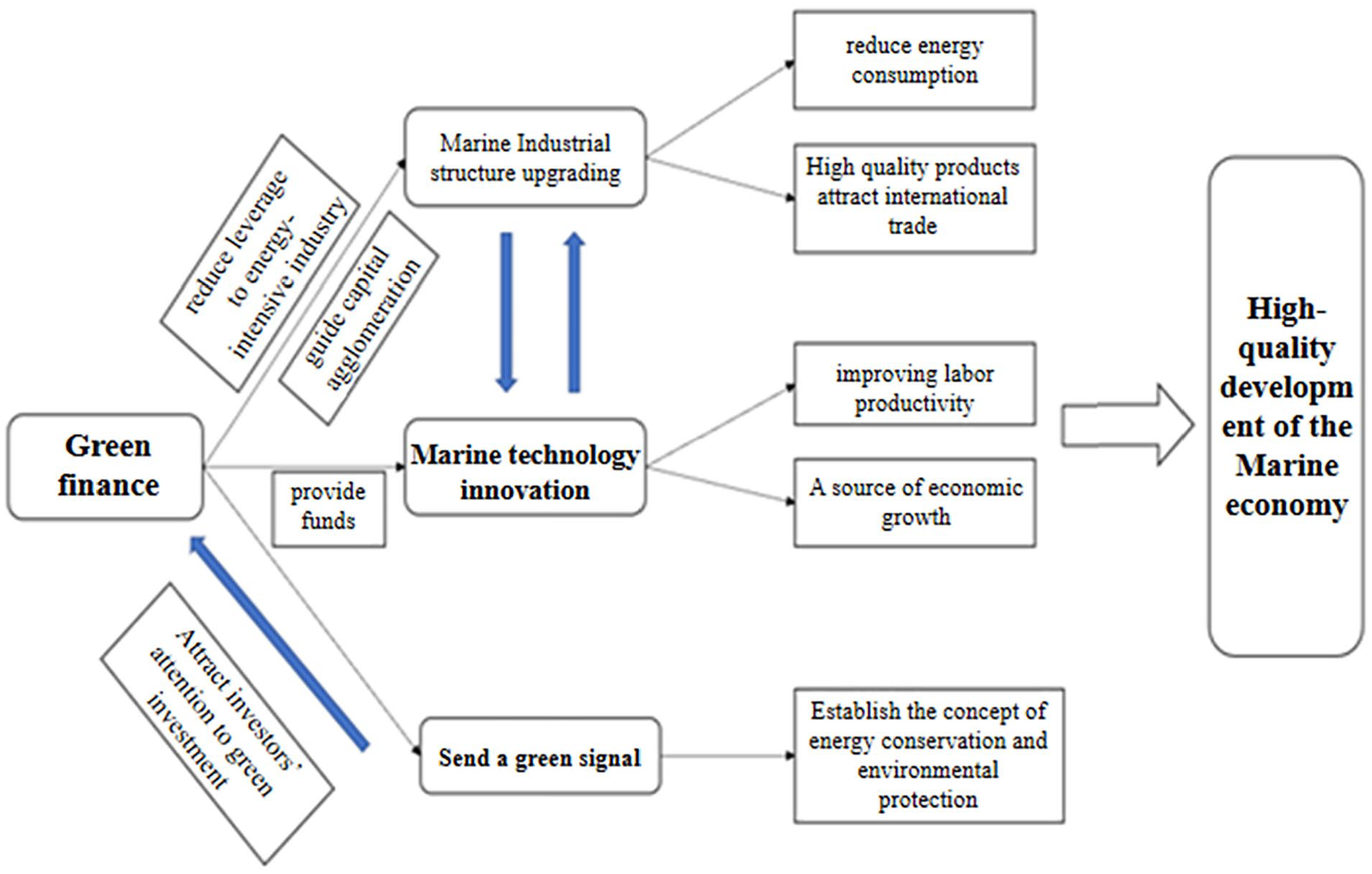
Mechanism analysis diagram.
The link between green financing and the superior growth of the marine sector is further validated using a 2-stage method. Green financing and better marine economic growth are first investigated using a data-efficient technique known as gray correlation analysis. 61 An extensive index system for ecological limits is constructed to evaluate undesired output, in contrast to the majority of prior research that chooses certain indicators, such as the amount of industrial effluent directly released into the ocean, as shown by Ren et al. 37
Empirical Methodology
Data description
Regarding ocean health index (OHI), 10 main public goals, some of which have sub-goals, comprise the OHI. One indicator that evaluates the potential of artisanal fishing as a social, cultural, and livelihood activity is the Artisanal Fishing Potential (OHI_AO) indicator. The protection of species and ecosystems for their inherent worth is measured by the Biodiversity Index (OHI_BD). The livelihood and economic advantages produced by marine industries reliant on the coast and ocean are assessed by Coastal Protection (OHI_CP). The value contributed to factor costs from catch fisheries is used to calculate carbon storage (OHI_CS). The clean waters found in coastal ecosystems that store and absorb carbon from the atmosphere are measured by Clean Waters (OHI_CW). Marine-related sectors’ economic and environmental advantages are used to evaluate Coastal Livelihoods and Economies (OHI_LE). Sustainability in procuring natural resources from living marine resources is the benchmark for measuring Natural Products (OHI_NP). Sense of Place (OHI_SP) represents preserving culturally significant physical locations and iconic animals. The accessibility of coastal regions for recreational purposes for locals and tourists is a criterion for evaluating Tourism and Recreation (OHI_TR). Halpern et al 62 and Wu et al 63 state that there is no need to calculate the data if the region being assessed or the indicator itself has little bearing on or no relevance to a specific aim. The Ocean Health Index for 2011-2021 served as the source of these variables.
Regarding the key independent variable, the OECD’s Creditor Reporting System (CRS) and 3 indicators from IRENA—Public Investments in Green Energy (GPI), Green Debt (DEBT), and Green Securities (SECU)—are the 4 measurements we use to track green finance activities. We choose explanatory factors based on the empirical studies documented in prior research. Based on the study of Bhattacharya and Dash 64 and Nham and Ha, 10 the baseline explanatory variable lists are economic growth (INC), democratization level (GE), total population (POP), and total savings (SAV). The extended model to check for robustness also includes total trade activities share in GDP (EXP) and inflation rate (INFL) as additional explanatory variables, as suggested by Bhattacharya and Dash, 64 Bu et al, 65 Huo et al, 66 Shahbaz et al, 67 and Sun et al.68,69 Table 1 provides the definition and summary statistics for all variables, while Table 2 presents the correlation matrix (CRS is considered instead of reporting all 4 measures of the critical independent variable). The matrix reveals that CRS has negative correlations with the composite index (OHI Index) and 6 out of 10 dimensions of the index. The only 4 positive correlations are CRS with the following dimensions of the Ocean Health Index: Coastal Protection (CP), Food Provision (FP), Natural Products (NP), and Tourism and Recreation (TR). After the data cleaning process, the database consists of 35 countries from 2011 to 2021. Table A1 in the Appendix provides information on the included countries.
Variable’s description.

Correlation coefficients.
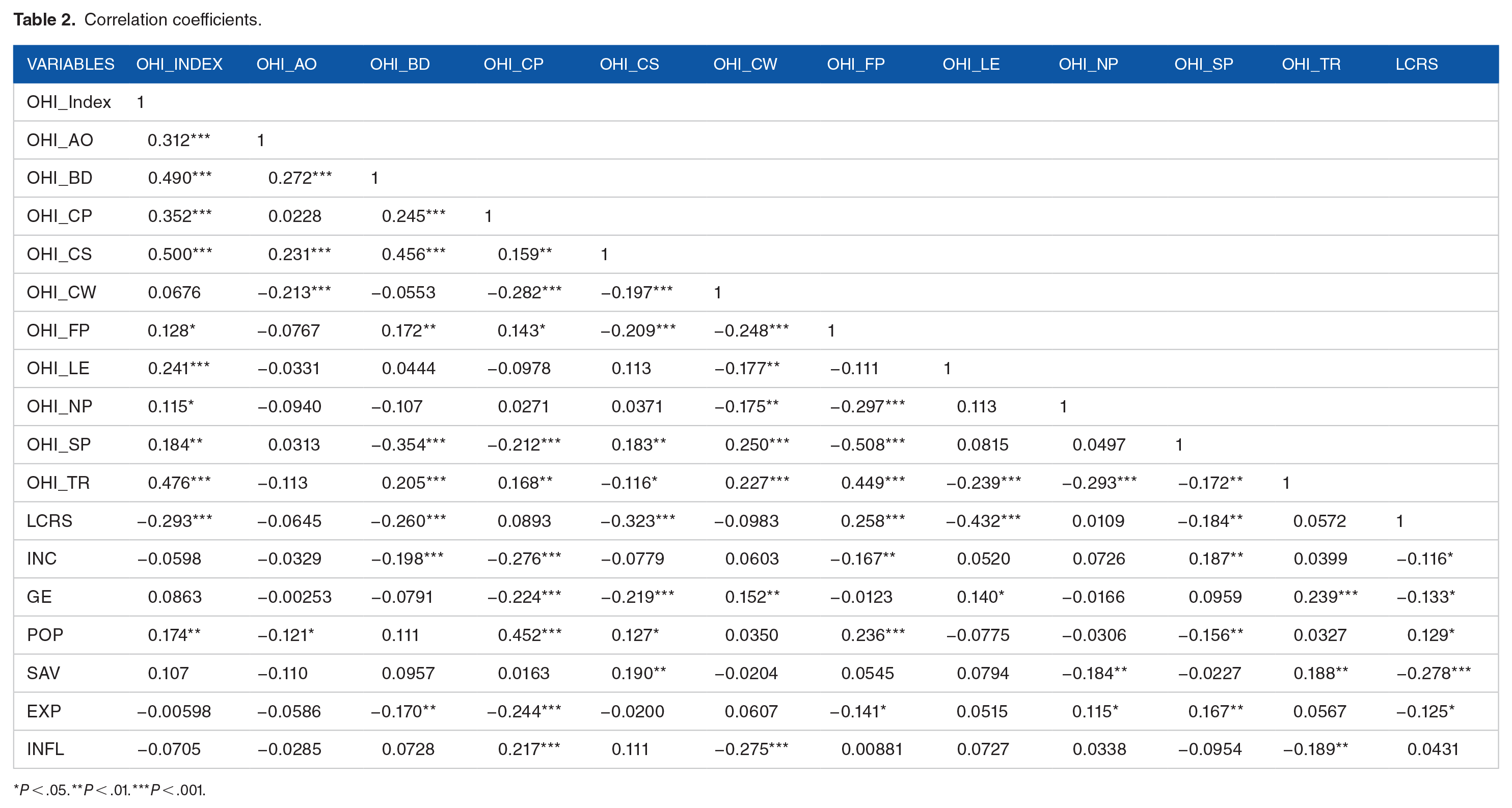
P < .05. **P < .01. ***P < .001.

P < .05. **P < .01. ***P < .001.
Model specification
The following is the presentation of the model that was utilized to look into the relationship between green finance (GF) and the ocean health index (OHI):

where i and t respectively represent country i and year t,
Cross-sectional reliance is assessed throughout the data processing process using the cross-sectional dependency (CD) test created by Pesaran. 70 The findings of the CD test, with a 1% confidence level, clearly show cross-sectional dependency between the variables. Consequently, the Im-Pesaran-Shin unit root test, first presented by Im, 71 is utilized to evaluate the data’s stationarity while considering cross-sectional dependence. Table 3 displays the results, which indicate that every variable is stationary at the level and first difference.
Cross-sectional dependent and Unit-root test.

Regarding the CD test, the null hypothesis is that the cross-section is independent. P-value is closed to zero, implying that data are correlated across panel groups. Regarding the Im-Pesaran-Shin test, the null hypothesis is “All panels contain unit root” and the alternative hypothesis is “At least one panel is stationary.”
*, **, *** are significant levels at 10%, 5%, and 1%, respectively.
The panel-corrected standard error (PCSE) model is employed in our research to account for the stationarity and cross-sectional dependency of first-difference variables, as recommended by Beck and Katz, 73 Ha, 74 Thanh et al, 75 and Thanh et al. 76 Traditional methods, such as fixed-effect or random-effect models, are inappropriate for the dynamic panel with CD, where the time is short (T = 10) and the number of entities is small (N = 35), as Pesaran 70 argues. The outcomes of these methods will be skewed.77,78 To ensure that the highly balanced data support the tests and applied methods, we used the empirical procedure to eliminate gaps, missing observations, and outliers from the data. Equation (1) indicates that, in order to address endogeneity, all explanatory variables are delayed by one period due to the simultaneous association between the Ocean Health Index and green financing. Furthermore, we replicate our model with the 2-step Feasible Generalized Least Squares (FGLS) and Generalized Method of Moments (GMM) to confirm our findings. According to Gala 79 and Ha, 33 these techniques control the potential issues of heterogeneity and endogeneity problems in equation (1).
The autoregressive distributed lag (ARDL) approach, created by Pesaran and Smith, 80 assesses the project’s short- and long-term consequences. The model employs a pooled mean group (PMG) technique to handle heteroscedasticity between countries, perhaps due to endogeneity, and considers causal relationships between variables. 81 Kao’s 82 and Westerlund’s 83 cointegration tests are used as the first stage in the estimate procedure to determine whether cointegration exists between the variables. Long-term cointegration between green financing projects and ocean health is demonstrated by the results presented in Table 4.
Cointegration test.

Regarding the Kao test, the null hypothesis is “No cointegration,” while the alternative hypothesis is “All panels are co-integrated.” Regarding the Pedroni test, the null hypothesis is “No cointegration,” while the alternative hypothesis is “All panels are co-integrated.” Regarding the Westerlund test, the null hypothesis is “No cointegration,” while the alternative hypothesis is “Some panels are co-integrated.”
In general, we followed a standard empirical approach to apply the related methods to the dynamic panel database. The data processing is conducted carefully to meet the preconditions of PCSE techniques and related tests. We then confirm the findings in the baseline model by conducting various robustness checks, including (1) adding more explanatory variables to the baseline model; (2) using other econometric techniques to control some potential issues (2-step GMM for controlling endogeneity and FGLS for dealing with heterogeneity) reported in Table 7; (3) other dimensions of sustainable marine economy reported in Table 8.
Empirical Results
Baseline results
In this analysis, we utilize the PCSE and FGLS models, which are appropriate for the dynamic panel with CD, to examine green finance and ocean health. The results are presented in Table 5. In this model, each of the 4 measures of green finance is employed independently to assess their effects on the composite index, OHI_Index. The regression outputs from the PCSE method are similar to those from the FGLS method in terms of impact magnitudes. There is a slight difference in the significance of the GPI and DEBT influences on the OHI_Index, but most other variables show consistent significance levels. Table 5 demonstrates a positive relationship between green finance and ocean health, with all green finance coefficients being negative and ranging from −0.14 to −0.73. According to this study, there is a significant but negative correlation between these variables, which is in accordance with previous research.
Impacts of green finance on ocean health.
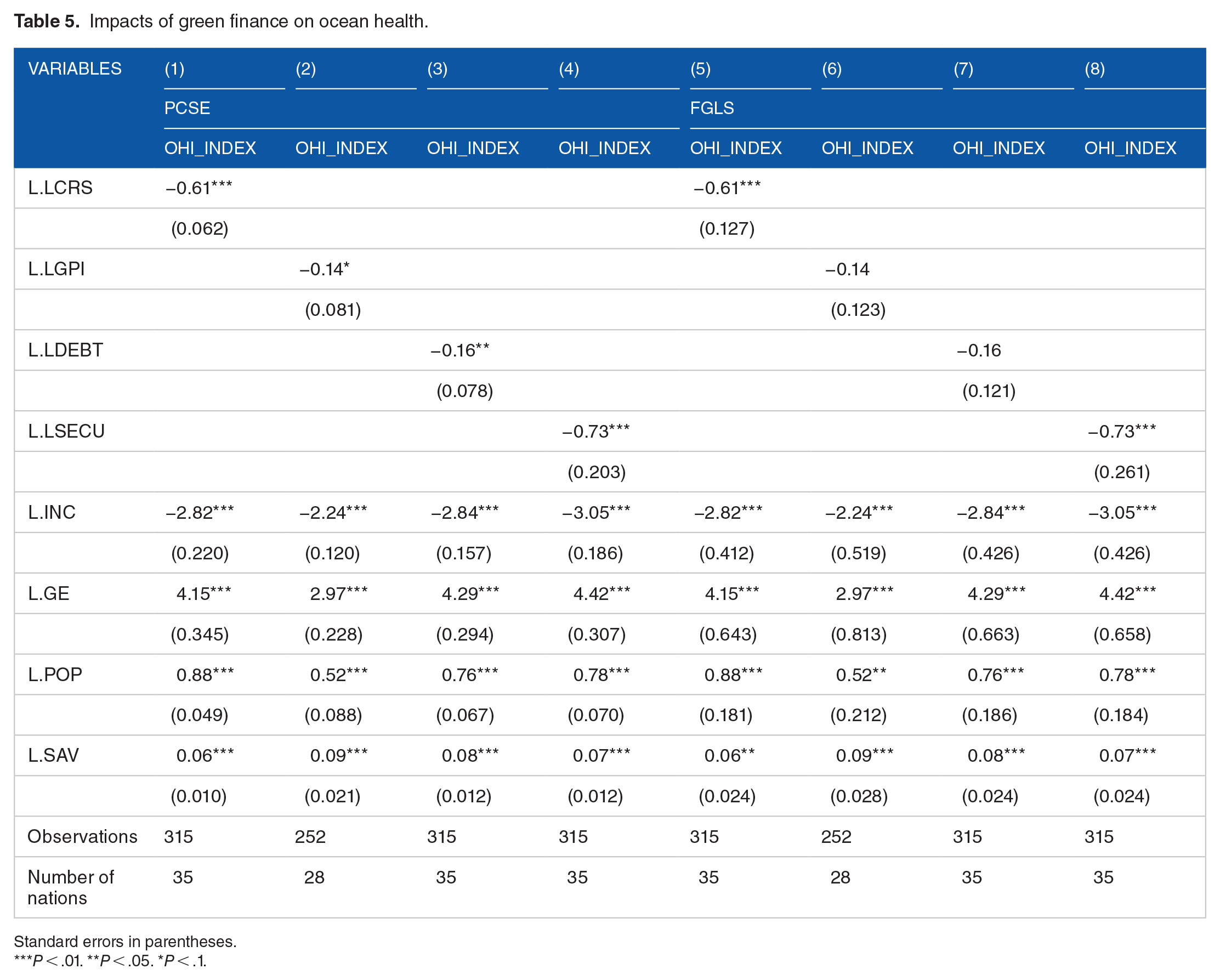
Standard errors in parentheses.
P < .01. **P < .05. *P < .1.
With respect to the control variables, every impact is discovered to be very significant at the 1% threshold. Economic growth has a negative influence, indicating that higher growth rates are detrimental to ocean health sustainability. In contrast, the level of democratization, population, and savings exert a positive influence on ocean health, with GE having the largest coefficient magnitude, thereby effectively promoting ocean health.
Robustness checks
Robustness checks: Adding more explanatory variables
Two more explanatory variables are added to the baseline model to guarantee its robustness. Table 6 displays the outcomes of this expanded model. The influence of green financing on ocean health remains unchanged, mainly even with the inclusion of these factors. The key dependent variable is still negatively impacted significantly by CRS, GPI, DEBT, and SECU. Adding the trade share (EXP) and inflation rate (INFL) to Table 5 results in only slight modifications to the effects of the control variables. Economic growth has a more detrimental effect than a beneficial one, and the degree of democratization has a more minor beneficial effect. The impact of population remains essentially unchanged from the baseline model. Surprisingly, the influence of national savings diminishes to zero, reverses to negative, and becomes insignificant. The trade share variable effectively promotes the sustainability of ocean health, mainly when green finance is measured using GPI. The inflation rate hurts ocean health when the critical independent variable is GPI; otherwise, it is positive for the other 3 measures. Additionally, the significance of the inflation rate is more pronounced when employing the PCSE method, but it is insignificant when using the FGLS method.
Impacts of green finance on ocean health: Adding more explanatory variables.

Standard errors in parentheses.
P < .01. **P < .05. *P < .1.
Robustness checks: Two-step system GMM
Table 7 presents the findings of additional analysis using the 2-step GMM approach, which indicates differing outcomes. The past approaches and models that suggested a negative correlation between green funding and ocean health are lessened by the 2-step GMM methodology. Only the GPI is said to affect the OHI Index significantly, although other green finance coefficients are still negative. This mitigating effect also extends to the negative impact of economic expansion on ocean health, where the effects are negligible and less in scope. The population has an unexpectedly negative influence on ocean health, whereas the model suggests that the sound effect of savings is reversed. On the other hand, trade share and democratization levels are still having a favorable impact.
Impacts of green finance on ocean health: 2-step system GMM.

P < .01. **P < .05. *P < .1.
Overall, earlier models and approaches that examined the connection between green finance and ocean health (using the composite index OHI) had poor results. The influence is less noticeable when examining the 2-step system GMM than when examining the PCSE and FGLS methods. Economic growth is observed to deteriorate ocean health sustainability for the control variables, but trade share and democratization level both favorably impact sustainability. The influence of population and savings is inconclusive, but based on the baseline model, we can assume a positive impact on the general index.
Robustness checks: Different aspects of ocean health
In this analysis, we used measures capturing the different aspects of ocean health to confirm our findings. These variables include artisanal fishing opportunities, biodiversity, coastal protection, carbon storage, clean waters, food provision, coastal livelihoods and economies, natural products, sense of place, tourism, and recreation. Table 8 summarizes the regression outputs for the baseline model, further analyzed using all 10 measures of the OHI index. Panel A employs the PCSE method, while Panel B uses the FGLS method. A comparison of the 2 panels reveals that both methods yield identical outcomes, but FGLS regression results in fewer significant coefficients.
Impacts of green finance on different aspects of ocean health.

Standard errors in parentheses.
P < .01. **P < .05. *P < .1.

Standard errors in parentheses.
P < .01. **P < .05. *P < .1.
Consistent with previous models and the correlation matrix, it is unsurprising that the introduction of green finance significantly worsens 6 out of 10 measures. When measured by CRS, green finance only positively influences coastal protection, food provision, and tourism and recreation. This finding is counterintuitive, as green finance hinders rather than promotes ocean health sustainability. Even within the economic dimensions of the OHI index, CRS has only limited positive impacts.
The control variables’ effects remain broadly consistent, with some minor variations. Economic growth continues to negatively impact 6 out of 10 dimensions while significantly enhancing OHI_CS and OHI_SP. The level of democratization and savings positively affects 6 dimensions, and the population positively affects 5 dimensions.
Table 9 shows how green finance affects ocean health sustainability both in the medium and long term using a PMG-ARDL model and a variety of green finance measures. All other variables have little implications on the sustainability of ocean health in the short term, except the first difference of the logged GPI. The fact that all error correction (EC) factors are substantial in the short run is another observation that suggests long-term convergence of aberrations brought on by earlier shocks to equilibrium. However, the pace of adjustment is slower for the EC terms for DEBT and SECU, which have values of −0.14 and −0.13, respectively. In the long run, green finance significantly improves the ocean’s health. This finding contradicts previous results, suggesting that green finance requires a considerably long period to enhance ocean health sustainability effectively.
The influence of green finance on ocean health: Short-run and long-run effects.

P < .01. **P < .05. *P < .1.
Discussion of the Findings
Typically, blue economy projects are financed through conventional public and development finance mechanisms. Blue economy projects, however, exemplify the need to go beyond conventional financing options such as multilateral and bilateral assistance. It is clear from the literature that there is a mixed finding of a relationship between financial issues and sustainable blue economies.10,84 -86 In particular, the research of Tirumala and Tiwari 86 finds that current initiatives, such as blue bonds, are relatively small, and accelerating investments is dependent on access to additional financing instruments and a transformation in stakeholders’ perspectives. Sun et al 85 argue that a significant contribution to the sustainable growth of the marine economy can be attributed to financial development. It is important to note, however, that the interaction between financial development, technological digitalization, and low-carbon initiatives leads to diminishing returns in terms of sustainability.
Our argument is that green finance can have positive impacts, but there are certain conditions and requirements that can facilitate these effects. There are many challenges associated with green finance, including a lack of regulatory compliance, transition risks, and a reluctance to venture into the realm of green finance due to financial concerns.87 -89 As a result of the experience gained from assessing climate-related financial risks, significant advances have been made in the development of tools for assessing these risks, but several analytical and conceptual challenges have also been revealed. Despite decades of research on the interaction between climate and economic systems, central banks and regulators did not begin conducting systematic stress testing exercises to capture climate-related risks for banks and other segments of the financial system until the middle of the last decade. Even though these exercises are becoming increasingly sophisticated, their role in guiding policy remains limited. Furthermore, there may be inadequacies in the prudential toolkit that are best suited to address the risks associated with climate change. The use of green finance faces a number of challenges, including a need for a more standardized framework and improved data transparency. We contend that it is more likely that favorable effects will appear in the long run when the adoption of green financing reaches a certain threshold.
Conclusions
This article has assessed whether green finance (GF) initiatives sustain or hurt ocean health. The data for the 2 key variables were collected over 9 years for 35 countries. Control variables such as economic growth, level of democratization, population, savings, trade share, and inflation rate were also employed in the model. This analysis shows that GF negatively affects the sustainability of ocean health. Further analysis demonstrates that the adverse effect applies to 6 OHI Index dimensions. However, contrary to the previous findings, GF can promote ocean health in the long run. This unexpected result may be due to the nature of the relationship, where GF requires a longer time to implement and sustain ocean health effectively.
Our findings indicate that while enacting green funding policies, sample countries ought to seek assistance from other national laws and regulations to lessen the short-term adverse effects. In the context of a green economy, green finance is inevitable. As such, governments have to cooperate among different policies and consider financial support for families living off ocean resources. Additionally, efforts should also be made to preserve, protect, and sustainably extract ocean resources, as they are the non-economic aspects negatively affected by green finance innovation. Stricter laws should be enacted to punish those who fail to abide by the rules.
Footnotes
Appendix
Countries in the sample.

| Albania | Bahrain | Brazil | Costa Rica |
| Angola | Bangladesh | Brunei Darussalam | Cote d’Ivoire |
| Arab | Barbados | Bulgaria | Switzerland |
| Argentina | Belarus | Burundi | United Arab Emirates |
| Armenia | Belgium | Cabo Verde | United Kingdom |
| Aruba | Belize | Cameroon | |
| Australia | Benin | Canada | |
| Austria | Bhutan | Chile | |
| Azerbaijan | Bolivia | China | |
| Bahamas | Botswana | Colombia |
Funding:
The author received no financial support for the research, authorship, and/or publication of this article.
Declaration of conflicting interests:
The author declared no potential conflicts of interest with respect to the research, authorship, and/or publication of this article.
Author Contributions
Le Thanh Ha and To Trung Thanh contributed to all stages of preparing, drafting, writing and revising this review article. Le Thanh Ha made a substantial, direct, and intellectual contribution to the work during different preparation stages. To Trung Thanh read, revised and approved the final version of this manuscript.
Ethics Approval and Consent to Participate
Not applicable.
Consent for Publication
Not applicable.
Data Availability Statement
Data available on request due to privacy/ethical restrictions.
