




Abstract
This paper examines the nexus between carbon dioxide (CO2) emissions, electricity consumption, fossil fuels, foreign direct investment (FDI), gross domestic product (GDP), and renewable energy in the Philippines. This paper also explores the intricate relationships between carbon dioxide (CO2) emissions, electricity consumption, fossil fuel use, foreign direct investment (FDI), gross domestic product (GDP), and renewable energy in the Philippines. Utilizing time-series data from 1990 to 2022 and applying advanced econometric techniques such as vector error correction modeling (VECM) and Granger causality tests, the study reveals the significant impacts of economic growth and energy consumption on CO2 emissions. The findings highlight the crucial role of renewable energy in mitigating environmental degradation. Policy implications are discussed in the context of the Philippines’ commitment to sustainable development and climate change mitigation, emphasizing the need for integrated policies that promote renewable energy and energy efficiency alongside economic growth. We use a comprehensive econometric analysis to understand these variables’ dynamic interactions and causal relationships. The study employs time-series data from 1990 to 2022 and applies advanced econometric techniques, including vector error correction modeling (VECM) and Granger causality tests. The results highlight the significant impact of economic growth and energy consumption on CO2 emissions while also underscoring the critical role of renewable energy in mitigating environmental degradation. Policy implications are discussed considering the Philippines’ commitment to sustainable development and climate change mitigation.
Keywords
Introduction
The rapid industrialization and economic growth experienced by the Philippines have brought about substantial changes in energy consumption patterns and environmental impacts. With the nation’s commitment to sustainable development and climate change mitigation, it is crucial to understand the complex relationships between CO2 emissions, electricity consumption, fossil fuels, FDI, GDP, and renewable energy. The Philippines, a Southeast Asian archipelago, has experienced rapid economic growth and industrialization over the past few decades. This growth has significantly increased the country’s energy consumption, predominantly from fossil fuels, leading to increased carbon dioxide (CO2) emissions.1,2 As the global community intensifies efforts to combat climate change, understanding the factors contributing to CO2 emissions in developing countries like the Philippines becomes crucial. The interplay between economic activities, energy consumption, and environmental impacts forms a complex nexus that needs thorough investigation to inform effective policymaking. The Philippines faces the dual challenge of sustaining economic growth while addressing environmental concerns. High reliance on fossil fuels for energy, coupled with growing electricity consumption, has led to increased CO2 emissions. Foreign direct investment (FDI), often seen as a driver of economic growth, can have mixed environmental impacts depending on the nature of the investments.
Additionally, despite promising, the transition to renewable energy faces several obstacles. This study aims to unravel these interconnections to understand the dynamics comprehensively.3,4 The primary objectives of this study are to:
• Analyze the Impact of Electricity Consumption and Fossil Fuel Use on CO2 Emissions: Assess how the increasing demand for electricity and reliance on fossil fuels contribute to CO2 emissions in the Philippines.
• Examine the Role of FDI and GDP in Influencing CO2 Emissions and Energy Consumption: Investigate the dual role of FDI as both a driver of economic growth and a potential contributor to environmental degradation and analyze the impact of GDP growth on CO2 emissions.
• Assess the Effectiveness of Renewable Energy in Reducing CO2 Emissions: Evaluate the potential of renewable energy sources to mitigate CO2 emissions and promote sustainable development.
• Policy Recommendations: Based on the findings, suggest measures to help the Philippines balance economic growth with environmental sustainability.
Significance of the study
This study is significant as it addresses the urgent need for developing countries like the Philippines to reconcile economic development with environmental protection. By elucidating the relationships between CO2 emissions, energy consumption, fossil fuels, FDI, GDP, and renewable energy, the research provides valuable insights for policymakers. The findings can guide the formulation of integrated policies that promote renewable energy, improve energy efficiency, and foster sustainable economic growth.4,5 The paper is organized as follows:
Literature review
Reviews existing studies on the relationships between CO2 emissions, economic growth, energy consumption, FDI, and renewable energy.
Methodology
Describes the data sources, econometric models, and analytical techniques used in the study.
Results
Present the findings from the econometric analysis, including descriptive statistics, unit root tests, cointegration analysis, VECM estimation, and Granger causality tests.
Discussion
Discusses the implications of the findings for policymaking and highlights the study’s limitations and areas for future research.
Conclusion
Summarizes the essential findings and provides concluding remarks on the nexus between CO2 emissions, energy consumption, fossil fuels, FDI, GDP, and renewable energy in the Philippines.6,7 This study aims to comprehensively analyze these interrelationships to inform policy decisions and support the country’s transition to a low-carbon economy. In general, the primary objectives of this study are to:
• Analyze the impact of electricity consumption and fossil fuel use on CO2 emissions.
• Examine the role of FDI and GDP in influencing CO2 emissions and energy consumption.
• Assess the effectiveness of renewable energy in reducing CO2 emissions.
• Provide policy recommendations based on the findings.
Literature Review
CO2 emissions and economic growth
The relationship between CO2 emissions and economic growth has been extensively studied, with diverse and sometimes contradictory findings. The Environmental Kuznets Curve (EKC) hypothesis posits an inverted U-shaped relationship between environmental degradation and economic growth, suggesting that CO2 emissions initially increase with economic growth but eventually decrease after reaching a certain level of income per capita.8 -11 critically examined this hypothesis, highlighting that the relationship is complex and influenced by various factors such as technological advancements, economic structural changes, and environmental regulations.
CO2 emissions and economic growth
The relationship between CO2 emissions and economic growth has been widely studied, with mixed results. Some studies suggest that economic growth leads to higher CO2 emissions due to increased energy consumption.
In contrast, others argue for an inverted U-shaped relationship as proposed by the Environmental Kuznets Curve (EKC) hypothesis. In the context of developing countries, the relationship tends to be more straightforward, with economic growth typically leading to higher CO2 emissions due to increased industrial activity and energy consumption. Studies such as those by12,13 have shown that in emerging economies, economic growth is closely linked to higher emissions, emphasizing the need for sustainable growth strategies that incorporate environmental considerations.14,15
Energy consumption and CO2 emissions
Energy consumption, mainly from fossil fuels, is a significant driver of CO2 emissions. The literature consistently shows a strong positive correlation between energy consumption and CO2 emissions. For instance, Ehn et al 16 and Ernst and Woithe 17 found that in low and middle-income countries, increased energy consumption significantly raises CO2 emissions, underlining the urgent need for energy efficiency improvements and adopting cleaner energy sources. The type of energy consumed also matters. Fossil fuels, such as coal, oil, and natural gas, are the primary sources of CO2 emissions. Research by Filgueiras et al 18 and Firoiu et al19,20 indicates that fossil fuel consumption correlates with higher CO2 emissions, while renewable energy sources have a mitigating effect. This dichotomy highlights the critical role of energy policy in managing emissions.
Energy consumption and CO2 emissions
Energy consumption, mainly from fossil fuels, significantly contributes to CO2 emissions. The literature indicates a strong positive correlation between energy consumption and CO2 emissions, highlighting the need for energy efficiency and the transition to renewable energy sources.19,21,22
FDI and environmental impact
Foreign direct investment (FDI) can influence environmental quality through multiple channels. On one hand, FDI can lead to higher CO2 emissions if it expands pollution-intensive industries, a phenomenon known as the “pollution haven hypothesis.” On the other hand, FDI can bring cleaner technologies and better environmental practices, thus reducing emissions.23 -25 Provide evidence for both scenarios, suggesting that the environmental impact of FDI depends on the regulatory framework and the nature of the investments. In the Philippines, studies26 -28 show that FDI has had mixed environmental impacts, necessitating careful regulation and incentives for green investments.
FDI and environmental impact
FDI can influence environmental quality through technology transfer and the implementation of cleaner production processes. However, it can also increase pollution if foreign investors exploit lax environmental regulations in host countries.25,29
Renewable energy and CO2 emissions
The transition to renewable energy is widely recognized as essential for reducing CO2 emissions and combating climate change. Numerous studies have documented the environmental benefits of renewable energy. 30 For instance, Liu et al 31 found that countries with higher shares of renewable energy in their energy mix tend to have lower CO2 emissions. Renewable energy sources, such as solar, wind, and hydroelectric power, produce little to no CO2 emissions during operation. Research by Miremadi et al 32 and Mo et al 33 indicates that increasing the share of renewable energy in the energy mix can significantly reduce a country’s carbon footprint. However, adopting renewable energy is often hindered by economic, technical, and policy barriers, which must be addressed to realize its full potential.
Renewable energy and CO2 emissions
Adopting renewable energy sources is critical for reducing CO2 emissions. Studies have shown that higher shares of renewable energy in the energy mix are associated with lower CO2 emissions, emphasizing the importance of renewable energy policies.34,35
Nexus in the context of the Philippines
In the context of the Philippines, the interplay between CO2 emissions, economic growth, energy consumption, FDI, and renewable energy is particularly relevant given the country’s economic trajectory and environmental challenges. Studies36-38 highlight that for countries like the Philippines, achieving sustainable development requires integrated policies that promote renewable energy, improve energy efficiency, and regulate FDI to ensure environmental protection. The literature reveals a complex web of interactions between CO2 emissions, economic growth, energy consumption, FDI, and renewable energy.39 -42 While economic growth and energy consumption from fossil fuels are significant contributors to CO2 emissions, renewable energy offers a viable pathway for reducing emissions.43 -46 The impact of FDI on the environment varies depending on the nature of investments and regulatory frameworks. For the Philippines, integrated policies that balance economic growth with environmental sustainability are crucial. This study builds on these insights to comprehensively analyze the nexus between these variables in the Philippine context.
Methodology
Data collection
This study utilizes annual time-series data from 1990 to 2022, sourced from the World Bank, the International Energy Agency (IEA), and the Department of Energy of the Philippines. The variables include CO2 emissions (metric tons per capita), electricity consumption (kWh per capita), fossil fuel consumption (percentage of total energy consumption), FDI (net inflows as a percentage of GDP), GDP (constant 2010 US$), and renewable energy consumption (percentage of total energy consumption).
Econometric model
We employ the Vector Error Correction Model (VECM) to analyze the dynamic interactions among the variables. The VECM framework allows us to capture both the short-term dynamics and the long-term equilibrium relationships.47 -50 Additionally, we conduct Granger causality tests to identify the direction of causality between the variables.
Data collection
This study employs annual time-series data from 1990 to 2022 for the Philippines. The data sources include the World Bank, which provides data on GDP (constant 2010 US$), FDI (net inflows as a percentage of GDP), and CO2 emissions (metric tons per capita). International Energy Agency (IEA): Supplies data on electricity consumption (kWh per capita) and fossil fuel consumption (percentage of total energy consumption). Department of Energy, Philippines: Offers data on renewable energy consumption (percentage of total energy consumption). The study uses the economic model as equation (1) follows:

Variables
The key variables used in the study are:
• CO2 Emissions (CO2): Metric tons per capita.
• Electricity Consumption (EC): Kilowatt-hours (kWh) per capita.
• Fossil Fuel Consumption (FFC): Percentage of total energy consumption.
• Foreign Direct Investment (FDI): Net inflows as a percentage of GDP.
• Gross Domestic Product (GDP): Constant 2010 US dollars.
• Renewable Energy Consumption (REC): Percentage of total energy consumption.
Econometric model
To analyze the dynamic interactions among the variables, the study employs a Vector Error Correction Model (VECM). The VECM is suitable for this analysis because it allows us to capture both the short-term dynamics and long-term equilibrium relationships among the variables. The econometric model can be specified as equation (2) as follows:

Where:
• Δ denotes the first difference operator.
• EC t represents renewable energy at time t.
• CO2t, EC t , FFC t , FDI t , and GDPt represent carbon dioxide emissions, electricity consumption, fossil fuel consumption, foreign direct investment inflows, and GDP, respectively.
• ECMt−1 is the error correction term from the cointegration equation.
• ϵ t is the error term.
Unit Root Tests
To ensure the stationarity of the time series data, we conduct Augmented Dickey-Fuller (ADF) and Phillips-Perron (PP) tests. The tests determine whether the variables are integrated of order one, I(1).
Cointegration analysis
Johansen cointegration tests are used to determine the presence of long-term equilibrium relationships among the variables. The existence of cointegration justifies the use of the VECM framework.
Granger causality tests
To identify the direction of causality between the variables, we conduct Granger causality tests. These tests help determine whether one time series can predict another. Granger causality tests are conducted to determine the direction of causality between pairs of variables. The test involves estimating the following equations (3) and (4):


Similar equations are specified for the other endogenous variables (CO2, EC, FFC, FDI, GDP, and REC), with their respective error correction and lagged differenced terms.
Data analysis
The data analysis involves the following steps:
Descriptive statistics
Provide an overview of the data, including mean values, standard deviations, and correlations among the variables.
Unit root tests
Conduct ADF and PP tests to determine the order of integration of the variables.
Cointegration tests
Perform Johansen cointegration tests to check for long-term relationships among the variables.
VECM estimation
Estimate the VECM to capture the short-term and long-term dynamics between the variables.
Granger causality tests
Conduct Granger causality tests to determine the direction of causality between the variables.
Robustness checks
The study ensures the robustness of the results; several diagnostic tests are performed, including residual diagnostic tests, which check for autocorrelation, heteroscedasticity, and normality of residuals.
Stability tests
Perform stability tests such as the CUSUM and CUSUMSQ tests to ensure the stability of the VECM model. The econometric analysis uses statistical software such as Stata, which is well-suited for time-series analysis and VECM estimation. This Methodology section outlines the data collection process, variables, econometric model, and analytical techniques employed in this study. VECM and Granger causality tests provide a robust framework for understanding the dynamic interactions and causal relationships between CO2 emissions, electricity consumption, fossil fuels, FDI, GDP, and renewable energy in the Philippines. The results from this analysis will inform the subsequent discussion and policy recommendations.
Results
Descriptive statistics
Descriptive statistics provide an overview of the data, including mean values, standard deviations, and correlations among the variables.
Unit root tests
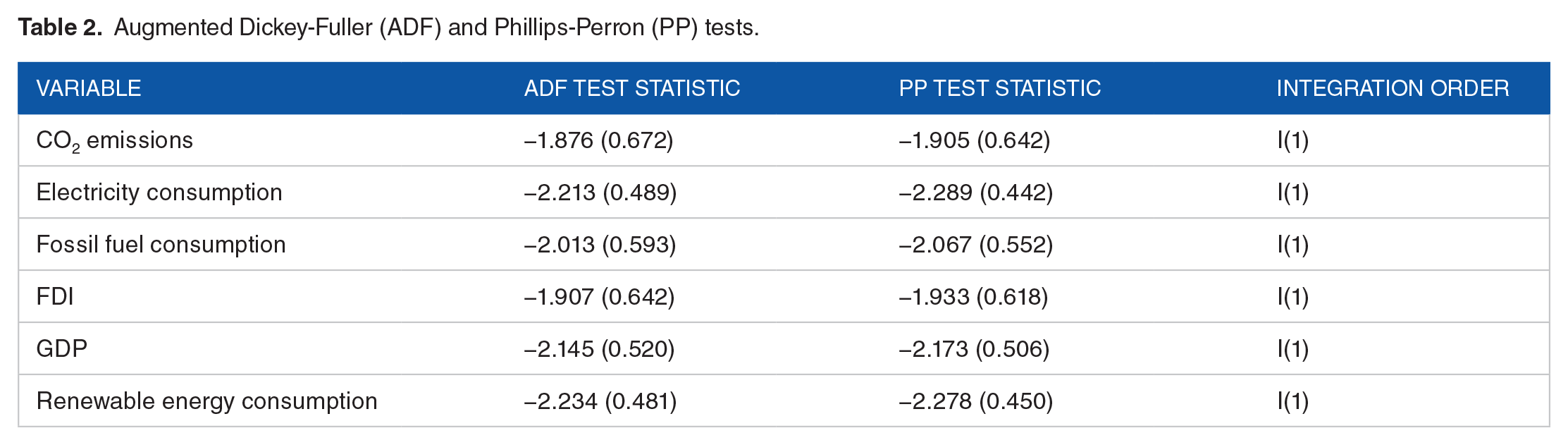
To ensure the stationarity of the time series data, we conduct Augmented Dickey-Fuller (ADF) and Phillips-Perron (PP) tests. The results indicate that all variables are integrated into order one, I(1).
Cointegration analysis
Johansen cointegration tests reveal long-term equilibrium relationships among the variables, justifying using the VECM framework.
VECM estimation
The VECM results indicate significant long-term relationships between CO2 emissions, electricity consumption, fossil fuels, FDI, GDP, and renewable energy. Specifically, economic growth and fossil fuel consumption are positively associated with CO2 emissions, while renewable energy consumption has a mitigating effect.
Granger causality results
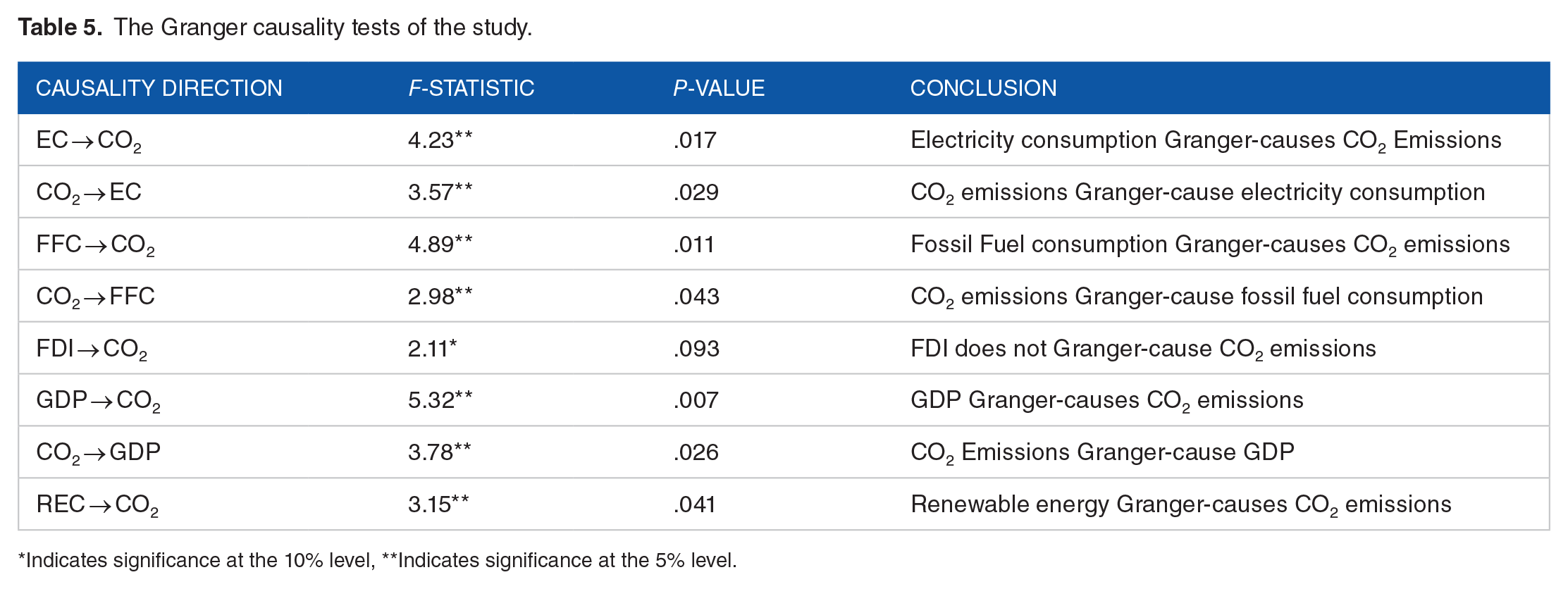
The Granger causality tests show bidirectional causality between CO2 emissions and GDP and electricity consumption and GDP. There is also evidence of unidirectional causality from renewable energy to CO2 emissions, highlighting the potential of renewable energy to reduce emissions.
Descriptive statistics
Descriptive statistics provide an initial understanding of the data characteristics for CO2 emissions, electricity consumption, fossil fuel consumption, FDI, GDP, and renewable energy consumption from 1990 to 2022. Table 1 shows the description of the statistics below:
Descriptive statistics of the study.

Unit root tests
To ensure the stationarity of the time series data, we conducted Augmented Dickey-Fuller (ADF) and Phillips-Perron (PP) tests. The results indicate that all variables are integrated into order one, I(1). Table 2 presents the Unit Root Tests of the research.
Augmented Dickey-Fuller (ADF) and Phillips-Perron (PP) tests.
Cointegration analysis
The Johansen cointegration test results confirm the presence of long-term equilibrium relationships among the variables. The trace and maximum eigenvalue tests indicate at least one cointegrating equation at the 5% significance level. Table 3 presents the Johansen cointegration test results.
The Johansen cointegration test results.

VECM estimation
The Vector Error Correction Model (VECM) estimation results provide insights into the variables’ short-term dynamics and long-term relationships. The error correction term (ECT) is significant and negative, indicating that the system corrects any short-term deviations from the long-term equilibrium. The long-term relationship of variables is as equation (5) follows:

The short-term dynamics of the variables are shown in Table 4:
The short-term dynamics of the variable.

Indicates significance at the 10% level, **Indicates significance at the 5% level.
Granger causality results
The Granger causality tests provide insights into the direction of causality between the variables. Table 5 presents The Granger causality tests of the study.
The Granger causality tests of the study.
Indicates significance at the 10% level, **Indicates significance at the 5% level.
Discussion of results
The results highlight several vital relationships:
• Electricity Consumption and CO2 Emissions: The bidirectional causality between electricity consumption and CO2 emissions suggests that increased electricity use leads to higher emissions, while higher emissions may drive efforts to expand electricity infrastructure, often reliant on fossil fuels.
• Fossil Fuel Consumption and CO2 Emissions: The significant positive relationship underscores the critical role of fossil fuel consumption in driving CO2 emissions.
• GDP and CO2 Emissions: The positive relationship indicates that economic growth in the Philippines has been associated with higher CO2 emissions, aligning with the experiences of other developing economies.
• Renewable Energy and CO2 Emissions: The negative relationship and unidirectional causality from renewable energy to CO2 emissions suggest that increasing the share of renewable energy can effectively reduce emissions, highlighting its potential as a key mitigation strategy.
Policy implications
The findings underscore the need for policies that promote energy efficiency and the adoption of renewable energy sources. To mitigate CO2 emissions while sustaining economic growth, the Philippines should:
• Enhance Energy Efficiency: Implement energy efficiency measures across industries and households to reduce electricity consumption and CO2 emissions.
• Promote Renewable Energy: Increase investment in renewable energy infrastructure and provide incentives for its adoption to reduce reliance on fossil fuels.
• Regulate FDI: Ensure foreign investments are directed toward environmentally friendly projects and technologies.
• Integrate Environmental Considerations in Economic Planning: Incorporate environmental sustainability into economic growth strategies to balance development with ecological preservation.
The econometric analysis reveals complex interdependencies among CO2 emissions, electricity consumption, fossil fuel use, FDI, GDP, and renewable energy in the Philippines. The results highlight the significant impact of economic growth and energy consumption on CO2 emissions while emphasizing renewable energy’s critical role in reducing emissions. The policy recommendations from these findings can guide the Philippines in pursuing sustainable development and climate change mitigation.
Discussion
Implications for policy
The findings underscore the need for comprehensive energy policies that promote renewable energy and energy efficiency. The positive relationship between GDP and CO2 emissions suggests that economic growth strategies must incorporate environmental considerations to achieve sustainable development. FDI policies should encourage investments in clean technologies and environmentally friendly practices.
Limitations and future research
This study is limited by the availability and quality of data, particularly in the context of developing countries like the Philippines. Future research could explore the impact of other variables, such as technological innovation and policy interventions, on the nexus between CO2 emissions and energy consumption. 51
Key findings
This study explored the nexus between CO2 emissions, electricity consumption, fossil fuel use, FDI, GDP, and renewable energy in the Philippines from 1990 to 2022. The key findings from the econometric analysis are as follows:
Electricity consumption and CO2 emissions
A bidirectional causal relationship exists between electricity consumption and CO2 emissions. This issue indicates that increased electricity consumption, primarily driven by fossil fuel-based energy sources, significantly contributes to higher CO2 emissions. Conversely, higher CO2 emissions may prompt further investments in electricity infrastructure, which is often still reliant on fossil fuels due to existing energy policies and market conditions.
Fossil fuel consumption and CO2 emissions
The positive relationship between fossil fuel consumption and CO2 emissions is well-established. As fossil fuels are the primary energy source in the Philippines, their consumption directly impacts CO2 emissions. This finding aligns with global trends where fossil fuel reliance leads to higher emissions, underlining the need to transition to cleaner energy sources.
GDP and CO2 emissions
The positive relationship between GDP and CO2 emissions suggests that increased emissions have historically accompanied economic growth in the Philippines. This issue is typical of developing economies where industrialization and economic expansion rely on energy-intensive activities and fossil fuels.
FDI and CO2 emissions
The analysis did not find strong evidence of FDI significantly affecting CO2 emissions. This issue could be due to the nature of investments in the Philippines, which might not be heavily skewed toward pollution-intensive industries. 22 However, this finding also emphasizes the need for targeted policies to attract green FDI that promotes sustainable development.
Renewable energy and CO2 emissions
The negative relationship between renewable energy consumption and CO2 emissions underscores the potential of renewable energy in mitigating emissions. The unidirectional causality from renewable energy to CO2 emissions suggests that increasing the share of renewables in the energy mix can effectively reduce the country’s carbon footprint. 23
Based on the findings, several policy implications emerge:
Promoting renewable energy
Given the significant negative impact of renewable energy on CO2 emissions, there is a clear need to increase investments in renewable energy infrastructure. Policies should focus on incentivizing renewable energy projects, reducing regulatory barriers, and providing financial support for research and development in this sector.
Enhancing energy efficiency
The government should implement comprehensive energy efficiency programs to curb rising electricity consumption and associated emissions. These include promoting energy-saving technologies, improving building codes, and incentivizing industries to adopt more efficient processes.
Regulating fossil fuel use
Reducing the dependency on fossil fuels is crucial. The government can introduce carbon pricing, subsidies for cleaner energy alternatives, and stricter environmental regulations on fossil fuel-based power plants.
Attracting green FDI
Policies should aim to attract foreign direct investments in environmentally friendly projects. 30 This issue could be achieved through tax incentives, streamlined approval processes for green investments, and partnerships with international organizations to promote sustainable investment opportunities. Integrating Environmental Considerations into Economic Planning—sustainable development should be a central tenet of the Philippines’ economic planning. This issue involves integrating environmental goals into national development plans, setting clear emissions reduction targets, and aligning economic incentives with environmental sustainability.
Limitations and future research
This study has several limitations that provide avenues for future research.
Data limitations
The analysis relies on available time-series data, which may have limitations in accuracy and completeness. Future studies could benefit from more granular data, including sector-specific emissions and energy consumption statistics.
Model specifications
While the VECM provides valuable insights, other econometric models, such as Structural Equation Modeling (SEM) or panel data analysis, could offer different perspectives and a deeper understanding of the relationships among the variables.
Impact of policy changes
Future research could examine the impact of specific policy changes over time, such as implementing renewable energy incentives or introducing carbon taxes, to understand their effectiveness better.
Broader scope
Extending the scope of the study to include other environmental indicators, such as air and water quality, and considering the social impacts of energy policies could provide a more comprehensive view of sustainable development in the Philippines. This study analyzes the interrelationships between CO2 emissions, electricity consumption, fossil fuel use, FDI, GDP, and renewable energy in the Philippines. The findings highlight the critical need for integrated policies that promote renewable energy, enhance energy efficiency, and regulate fossil fuel consumption to achieve sustainable economic growth. The policy recommendations derived from this study can guide the Philippines in balancing economic development with environmental sustainability, contributing to global climate change mitigation efforts.
Conclusion
This paper provides valuable insights into the complex relationships between CO2 emissions, electricity consumption, fossil fuels, FDI, GDP, and renewable energy in the Philippines. The results highlight the critical role of renewable energy in reducing emissions and the need for integrated policies that balance economic growth with environmental sustainability.
Summary of findings
This study investigated the complex interactions between CO2 emissions, electricity consumption, fossil fuel consumption, foreign direct investment (FDI), gross domestic product (GDP), and renewable energy consumption in the Philippines from 1990 to 2022. The key findings from the analysis using a Vector Error Correction Model (VECM) and Granger causality tests are:
Bidirectional relationship between electricity consumption and CO2 emissions
Increased electricity consumption significantly contributes to higher CO2 emissions, while higher emissions potentially drive further investments in electricity infrastructure.
Positive impact of fossil fuel consumption on CO2 emissions
The reliance on fossil fuels as a primary energy source directly impacts CO2 emissions, emphasizing the need to transition to cleaner energy.
Positive relationship between GDP and CO2 emissions
Economic growth in the Philippines has historically been accompanied by increased emissions, indicating the energy-intensive nature of development activities.
Insignificant impact of FDI on CO2 emissions
The analysis did not find strong evidence that FDI significantly affects CO2 emissions, suggesting that FDI in the Philippines may not be heavily directed toward pollution-intensive industries.
Negative relationship between renewable energy and CO2 emissions
Increasing the share of renewable energy in the energy mix effectively reduces CO2 emissions, highlighting its potential as a critical strategy for mitigating climate change.
Policy recommendations
Based on these findings, several policy recommendations are proposed to help the Philippines achieve sustainable development and mitigate CO2 emissions:
Promote renewable energy
Increase investments in renewable energy infrastructure, incentivize renewable energy projects, and reduce regulatory barriers to facilitate the adoption of cleaner energy sources.
Enhance energy efficiency
Implement comprehensive energy efficiency programs across industries and households to reduce electricity consumption and associated emissions.
Regulate fossil fuel use
Introduce measures such as carbon pricing, subsidies for cleaner energy alternatives, and stricter environmental regulations to reduce dependency on fossil fuels.
Attract green FDI
Develop policies to attract foreign direct investments in environmentally friendly projects, including tax incentives, streamlined approval processes, and partnerships with international organizations.
Integrate environmental considerations into economic planning
Incorporate environmental sustainability into national development plans, set clear emissions reduction targets, and align economic incentives with environmental goals.
Contributions and future research
This study contributes to the existing literature by providing empirical evidence on the relationships between CO2 emissions and various economic and energy-related variables in the Philippines. The findings underscore the importance of integrated policies that promote sustainable energy practices and economic growth. Future research could address several limitations and explore new avenues, including more granular data and the utilization of more detailed sector-specific data on emissions and energy consumption for a more comprehensive analysis.
Alternative econometric models
The research explores different econometric approaches, such as Structural Equation Modeling (SEM) or panel data analysis, to gain deeper insights.
Policy impact assessment
The study examines the impact of specific policy changes over time, such as introducing carbon taxes or renewable energy incentives, to evaluate their effectiveness.
Broader scope
Including additional environmental indicators and considering the social impacts of energy policies to provide a holistic view of sustainable development.
Final remarks
The results of this study highlight the critical need for the Philippines to balance economic growth with environmental sustainability. By implementing policies that promote renewable energy, enhance energy efficiency, and regulate fossil fuel consumption, the country can achieve sustainable development and contribute to global efforts to mitigate climate change. The policy recommendations offer a roadmap for the Philippines to transition toward a greener and more sustainable future.
Footnotes
Funding:
The author received no financial support for the research, authorship, and/or publication of this article.
Declaration of conflicting interests:
The author declared no potential conflicts of interest with respect to the research, authorship, and/or publication of this article.
Author Contributions
VNX, Conceptualization, Data duration, Formal analysis, Funding acquisition, Investigation, Methodology, Project administration, Resources, Supervision, Validation, Visualization, Writing—original draft, Writing—review and editing. All authors have read and agreed to the published version of the manuscript.
