




Abstract
This comprehensive analysis examines the multifaceted impacts of population growth on public health in Nigeria. Drawing parallels with Omran’s epidemiological transition model (that focuses on the intricate means that patterns of health and illness are changing, as well as the relationships that exist between these patterns and the sociological, demographic, and economic factors that influence them) and referencing experiences from Chile and Ceylon. The study highlights a substantial rise in Nigeria’s population causing a double burden of infectious and non-communicable diseases, leading to higher morbidity, and mortality rates, increased healthcare costs, decreased productivity, and health inequalities, posing significant challenges to the country’s healthcare system. Furthermore, the correlation between low education levels and health outcomes underscores the importance of addressing systemic deficiencies in Nigeria’s educational sector. The article emphasizes the urgent need for strategic interventions to mitigate the adverse effects of population growth on health. Recommendations include revitalizing primary healthcare centers, fostering public-private partnerships to enhance healthcare accessibility, leveraging technological advancements like telemedicine, and promoting initiatives to improve nutrition and environmental sustainability. Moreover, prioritizing education on reproductive health and family planning emerges as a crucial strategy to manage population growth sustainably. In conclusion, the article underscores the imperative for collaborative efforts across sectors to navigate Nigeria’s evolving health landscape amidst increasing population growth. By implementing targeted policies and interventions, Nigeria can strive toward achieving universal health coverage, enhancing health outcomes, and ultimately raising the standard of living for its populace.
Keywords
Introduction
Nigerian population growth has different implications for health. A country’s growth rate affects citizens’ health and the resultant causes of death and life expectancy at birth. Beyond the direct implications on education, and health, Nigeria’s growing population brings with it a plethora of other health issues. 1 These include increasing pressure on the healthcare system, a worsening environmental deterioration that results in pollution and resource depletion, difficulties brought on by fast urbanization, such as crowded living conditions and poor sanitation, risks to food insecurity that lead to malnutrition, growing social gaps in access to opportunities and healthcare, and possible public safety issues like social unrest and eviction. 2
Throughout history, several nations have experienced population growth, notably the Soviet Union, Czechoslovakia, Yugoslavia, East Germany, and Siam (which eventually became Thailand). The Soviet Union, which consisted of several republics, saw a notable increase in population between 1922 and 1991. Comparably, before its disintegration in the 1990s, the population of Yugoslavia increased, a communist federation in Southeast Europe. 3 Population growth was also observed in Czechoslovakia, a country in Central Europe, before its peaceful division into the Czech Republic and Slovakia in 1993. Population growth has been a common phenomenon among various former countries across different regions and historical periods. 4 For example, Siam, now known as Thailand, experienced population growth at different points in its history, and East Germany experienced population growth before its reunification with West Germany in 1990. 5
Following the lead given by Omran 6 in his classic epidemiological transition (that focuses on the intricate means that patterns of health and illness are changing, as well as the relationships that exist between these patterns and the sociological, demographic, and economic factors that influence them), reminiscent of the trend in Chile and Ceylon, both death and birth rates are falling. 6 However, the death rate has been falling faster than the birth rate, causing a bloat in the population in recent years. In Nigeria, there exists a double burden of diseases, which include infection and regeneration as both characterize the death rate. 7 These have repercussions for the relationship between the population’s aggregate levels of education and health, income and health, environment and health, health facilities available to people, and the patient-health-worker ratio, among others. 8
The features of the population in Nigeria are similar to the descriptions of people in Chile and Ceylon as described by Omran in his classic work (Figure 1). From the figure stated below, there are notable falls in both the death and the birth rate. However, the death rates indicate a more rapid fall than the birth rate. The increased birth rate causes consistent growth in the populations of Ceylon and Chile. This study aims to assess the health implications of population growth in Nigeria and provide strategic recommendations for addressing associated challenges to improve overall health outcomes.

Demographic trends in selected countries (Adapted from Omran classic work of epidemiological transition).
The Trend of Population Growth in Nigeria
Nigeria has the largest population in Africa, with a population of 218.5 million. 9 The population has been increasing significantly and has been attributed to the birth rate in the country. 9 The annual birth rate of a country is expressed as the number of live births per 1000 people. 10 The birth rate in Nigeria is rapidly increasing, and leading to rapid population growth, which significantly affects the country’s health, food, and socioeconomic status (Figure 2). Nigeria’s population has continued to grow even faster than other countries similar or ranked at the same level as Nigeria in terms of size, with a decline in the death rate (Figure 3). With the current death rate of 2.26%, it is predicted to slow or decline in the coming years to 2.04% by 2050. 11

Nigeria birth rate 1950 to 2023.
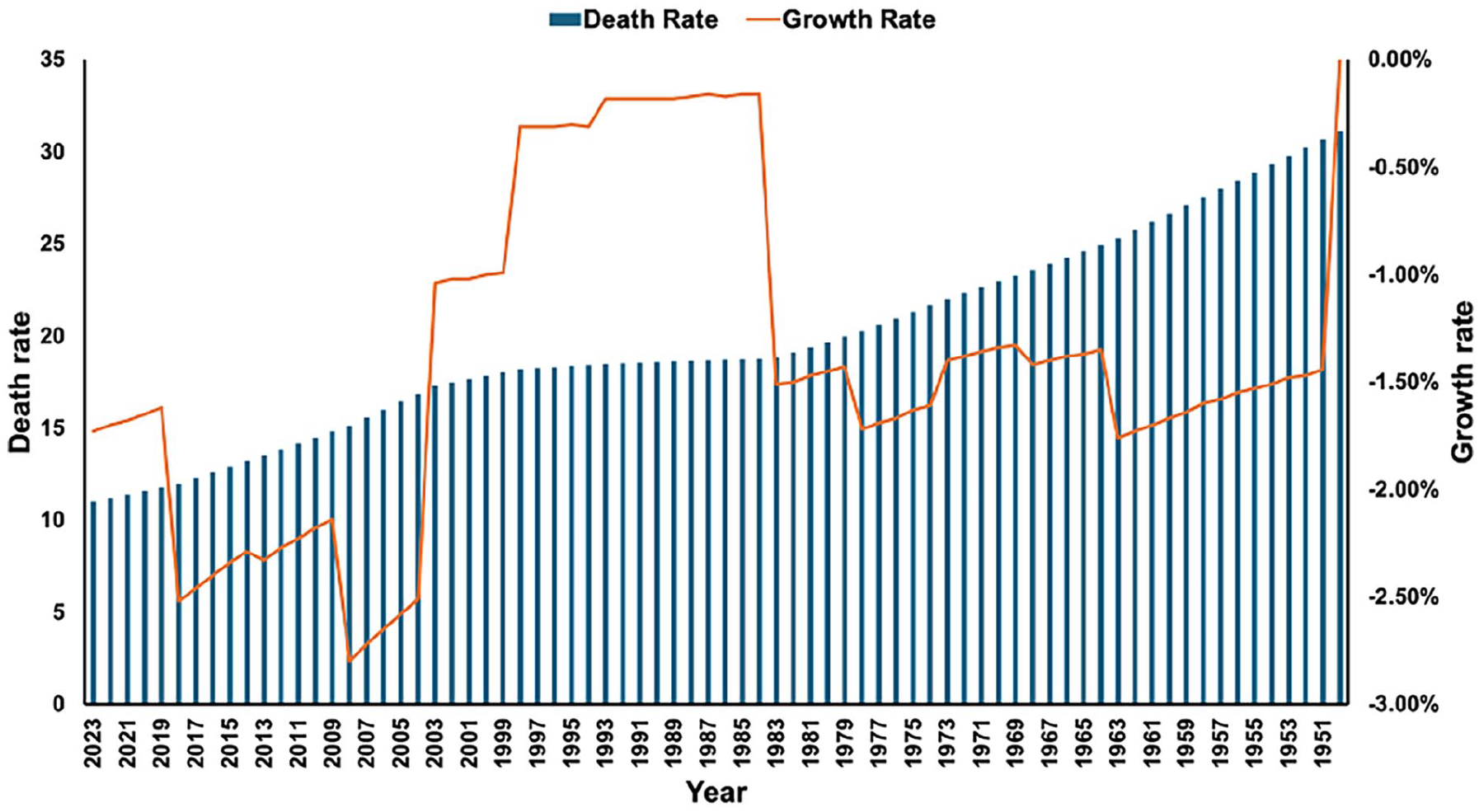
Nigeria death rate 1950 to 2023.
Health Implications of Increasing Population Growth in Nigeria
When infectious and non-communicable diseases coexist in a population, they are referred to as having a double burden of disease, which poses a significant challenge for healthcare systems. Increased morbidity and mortality, higher healthcare costs, decreased productivity, and health inequalities are just a few of the adverse effects that the double burden of diseases can have on a population’s health and well-being.
Infectious Diseases Health Implications
The crisis of the double burden of disease among Nigerians is the cause of increased mortality rates. 12 Factors like overcrowding, increased activity among people, strained healthcare infrastructure, and environmental degradation can increase the risk of both infectious and non-communicable diseases as a result of increasing population. 13 Higher density can accelerate transmission rates of diseases, whereas overcrowding can promote their spread in living environments. Infectious agents may spread to new locations as a result of increasing human travel, and the overburdened healthcare system may find it difficult to meet the additional demand, which could delay diagnosis and treatment. Degradation of the environment can provide disease vectors with new habitats, raising the possibility of an outbreak.14,15 Infectious diseases are caused by infectious agents or pathogenic microorganisms, such as viruses, bacteria, fungi, or parasites, capable of defeating the host immune system and driving disease conditions. Rapid population growth, increased human movement, and infrastructural destruction in the northern part of Nigeria following the outbreak of emerging and re-emerging pathogens and the Boko Haram crisis have caused increased public health challenges in recent years. 16 Among these infectious diseases, influenza, pneumonia, diarrhea, tuberculosis, and malaria, with 207 281, 144 724, 127 335, and 100 693, respectively, were the top killers of people in Nigeria in 2020. 17 Other diseases and conditions that are ravaging communities in Nigeria include meningitis, typhoid, HIV/AIDS, Lassa fever, and diphtheria. In recent years, there have been increases in population, industrialization, exploration of mineral resources, traveling activities, wildlife invasion in Nigeria, and in the number of internally displaced persons (IDPs). These are among the factors responsible for the emergence and reemergence of infectious diseases and have facilitated the spread of pathogens in a population. Other factors include the level of community hygiene and antimicrobial resistance, and the absence of which, could lead to lingering disease infectivity.
Non-communicable Diseases Health Implication
Another cause of increased mortality is non-communicable diseases, which are a class of diseases that do not spread from person to person and are not caused by infectious agents. These conditions, usually referred to as chronic diseases, encompass a variety of health issues, including diabetes, cancer, chronic respiratory conditions such as chronic obstructive pulmonary disease and asthma, cancer, heart disease, and stroke, and frequently result from a confluence of genetic, environmental, and lifestyle factors, such as unhealthy eating habits, inactivity, tobacco use, and alcohol use. Due to inadequate healthcare funding for non-communicable diseases, and underdeveloped and unprepared health systems for these diseases, low- and middle-income countries are likely to have a more significant burden of these diseases than affluent ones. 18 More so, Inadequate levels of education and malnutrition could also be factors that make non-communicable diseases a global health issue. Nigeria has recorded about 40% of global non-communicable disease cases. 19 People between the ages of 30 and 69 account for about 40% of these fatalities, and low- and middle-income nations account for 80% of these early deaths. 20 Cardiovascular disease accounts for approximately 40% of all annual fatalities from non-communicable diseases, whereas malignancies, respiratory illnesses, and diabetes cause 22%, 10%, and 4% of deaths, respectively. 20 Over 80% of all premature deaths are caused by these 4 diseases. 21 In one study, the most prevalent risk factors were low fruit and vegetable intake and physical inactivity. 22 By 2030, it has been predicted that non-communicable diseases will be Nigeria’s leading cause of morbidity and mortality. 23
Impact of Education on Population Health
As education provides people with the knowledge and skills to make educated decisions about their health, it plays a critical role in influencing population health outcomes. Better health outcomes are correlated with access to high-quality education because educated people are more likely to seek out preventative healthcare, adopt healthy habits, and effectively manage chronic diseases. 24 In addition, education gives people the ability to think critically and solve problems, which helps them to understand complex health information and make better decisions for their families and themselves. Furthermore, communities with higher levels of education are better able to address health inequities and push for laws that advance the general welfare. 25 Likewise, Nigeria’s population growth is causing a surge in educational needs, leading to a need for more resources and infrastructure. However, inadequate investment in education often results in overcrowded classrooms, teacher shortages, and poor-quality education. This also worsens existing disparities in access, especially in rural and marginalized communities. This makes achieving universal access to quality education difficult, hindering efforts to improve literacy rates, reduce poverty, and foster socio-economic development. 26 Researchers have identified the basic mediators influencing the relationship between education and health as economic, social, psychological, interpersonal, and behavioral health. 27 Acute and preventative medical care access is governed and determined by economic factors such as income and occupation, which moderate the relationship between education and health. 28 People with varied levels of education can use social, psychological, and interpersonal resources to access coping mechanisms (actions intended to prevent stress or negative feelings), social networks, and cognitive and problem-solving skills to deal with the effects of illnesses, such as stress. Individuals who practice healthy habits are better equipped to identify early disease symptoms and seek medical attention.29 -32
Nigeria’s educational standards are declining at all levels, making our educational system’s output inadequate for making a meaningful contribution to national progress.33,34 Therefore, the greater the education level, the greater the health of the population. In 2020, 68% of Nigeria’s youth were secondary school graduates while 15% of them were primary school graduates. After completing secondary education, 17% of Nigerian youths sought higher education. 34 Nigeria’s low level of education significantly affects the population, including disease prevention and control, treatment, vaccination, food consumption, and community sanitation.
As a result of the low level of education in Nigeria, several lives have been lost, ranging from children to adults and pregnant women. Mortality rates in children are usually associated with a low level of immunization and vaccination due to hesitancy, inequality, and other beliefs among communities with low levels of education. The Expanded Program on Immunization (EPI), which intends to immunize children under the age of 2, saw some early but patchy successes. In the early 1990s, when the nation’s rate of universal child immunization coverage reached 81.5%, the best level was noted. However, since then, Nigeria has seen a gradual but steady decline in vaccine coverage. 35 Polio, measles, diphtheria, whooping cough, tuberculosis, and yellow fever are the 6 killer illnesses that EPI in Nigeria aims to eradicate to improve the health of Nigerian children. 36 The Multiple Indicators Cluster Survey/National Immunization Survey Coverage study found that 40% of children in this age range in Nigeria did not receive any vaccinations, falling well short of the established 90% national target. In addition, 77% of children aged 12 to 23 months in Nigeria did not receive all of the routine vaccinations advised by the national EPI schedule. 37 Three risk variables, including individual, community, and health system factors, were identified for zero- or missed-dose children based on a study conducted in Nigeria. 38
Additionally, about a 2.63% decrease in Nigeria’s infant mortality rate was recorded in 2023, which accounted for 54.740 deaths per 1000 live births. Also, a 2.57% decrease in Nigeria’s infant mortality rate was recorded in 2022, which accounted for 56.220 deaths per 1000 live births. 39 According to the research, several important factors are linked to childhood mortality, including; region, domicile, education, wealth index, religion, and age of the parent, 40 Both northern and southern Nigeria have different causes of new-born and pediatric fatalities (children aged 1-59 months). 41
Relationship Between Income and Population Health in Nigeria
To determine the association between income and the health of a population, the income per head and skewed income distribution of such a population should be considered. The income per head of a population is also known as income per capita. Therefore, the money made per person within a country or geographical area has a substantial impact on their health. Per capita income was used to calculate the average income per person in a region and assess the population’s standard of living and quality of life. 42 According to Statista, Nigeria’s national gross domestic product (GDP) per capita increased by $60 (+2.97%) over the previous year. In total, the country’s gross domestic product in 2021 was 2080 USD. 43 Family finances may be strained as a result of population growth in Nigeria, making it more difficult for people to afford healthcare. Growing costs for food, housing, and education might push families to put other necessities ahead of healthcare, which can lead to postponed or avoided medical care. In highly populated locations, competition for jobs can lead to lower wages and precarious work environments, which makes it harder for families to pay for healthcare. This intensifies financial strains, exacerbating inequalities in healthcare service accessibility and sustaining poverty and illness cycles.44,45
Individuals with meager incomes experience many health challenges, such as limited access to healthcare, poor nutrition, and unhealthy living conditions. People may not often afford medical bills even in government-owned hospitals; they cannot afford laboratory tests and expenses for medical procedures. Poor nutrition makes them vulnerable or susceptible to infectious agents in their communities.
For governments, the cost of delivering healthcare services to a bigger population presents serious challenges. The demand for healthcare resources, staff, and infrastructure rises with population size, driving up healthcare costs. To fulfill the population’s increasing healthcare needs, governments must set aside a sizeable amount of money for the expansion of healthcare facilities, the training of medical personnel, and the acquisition of medical equipment and supplies. 26 The burden is further increased by the frequency of infectious outbreaks and chronic illnesses, which necessitate continuous expenditures in healthcare management, treatment, and prevention. Insufficiently tackling the financial strain of healthcare delivery can put a strain on public finances, restrict access to healthcare, and lower the standard of care, all of which can worsen social and economic inequality and public health consequences. 45 Therefore, to effectively manage the financial challenges associated with delivering healthcare services to a greater population, governments must establish strategic healthcare finance structures, strengthen health systems, and encourage preventative measures. 46
Impact of Increasing Population Growth on Environmental Health
The environment has a significant influence on the health of a population and is a critical determinant of disease occurrence in a population. This implies that the quality of the environment affects the health status of the population. In addition to promoting human health and well-being and fostering safe and secure communities, environmental health focuses on interactions between people and their environment. 47 Environmental challenges such as ecological pollution pose significant problems for human health, including water, air, and land pollution, causing numerous degenerative, infectious, and non-communicable diseases. Exposure to environmental pollutants can have several detrimental effects on human health. Some of the most significant adverse effects include perinatal disorders, infant mortality, respiratory disorders, allergies, malignancies, cardiovascular disorders, increased oxidative stress, endothelial dysfunction, and mental disorders.48,49
Numerous contaminants resulting from the environment play a significant role in human disease. Particulate matter is one of them; it enters the respiratory system by inhalation and causes cancer, reproductive and cardiovascular disorders, and central nervous system malfunction.50,51 When contaminants are introduced into water streams without being adequately treated, they result in physical, biological, and chemical changes in the water source. This phenomenon is known as water pollution. This type of pollution is primarily caused by unintentional spilling or leakage of chemicals and oil into freshwater streams without any prior treatment. The harmful health effects of contaminants in water include hepatitis, encephalitis, gastroenteritis, diarrhea, vomiting, stomach aches, reproductive issues, and neurological abnormalities.
Moreover, land pollution or soil pollution is when hazardous and poisonous chemicals are used to contaminate land. This type of pollution is primarily caused by human activities, including industrial processes, agricultural chemicals, and improper waste disposal. Petroleum hydrocarbons, solvents, pesticides, lead, mercury, and other heavy metals are the most common sources of land pollution. All of the risks mentioned above can harm people’s health in various ways. Their effects include minor ailments such as headaches, eye discomfort, skin rashes, and many more severe disorders. For instance, Lead (Pb) in soils at high concentrations can harm young children’s brain development. However, exposure to mercury (Hg) increases the risk of organ deterioration.
Energy consumption and waste discharge have increased due to urbanization, industrialization, and economic growth. Public health issues include waste management, acid deposition, greenhouse gas (GHG) emissions, and other forms of global environmental pollution. Furthermore, urbanization and urban development modify the urban environment and resident lifestyles, which can individually and jointly cause problems for human health. 52 The fact that cities have greater work possibilities and salaries, better educational and medical resources, and stronger social links than rural places reflects the favorable impact of urbanization on health. 53 Urbanization is thus one of the most ubiquitous social and economic processes that affects population health, ecological health, and economic development. 53 Flooding is another crucial natural disaster that affects the health of the population. In the past 20 years, flooding has been the most prevalent type of natural catastrophe, accounting for 47% of all-natural disasters documented and affecting 2.3 billion people globally. 54 Floods may threaten ecological factors that influence health, such as access to clean water, secure access to food, and adequate shelter. 55 For instance, deteriorated or destroyed water and sewage systems can contaminate drinking water with chemicals, sewage, industrial waste, or agricultural waste. This results in water shortages, increased rivalry for water, and the development of water-borne illnesses, including cholera and typhoid. 56
Challenges in Nigeria’s Health Infrastructure
For a very long time, Nigeria has been facing health challenges due to its vulnerable health facilities, which makes it difficult for healthcare professionals to offer very effective treatment while diseases become persistent. Apart from healthcare facilities, healthcare workers must be adequately provided to meet the health needs of Nigeria’s increasing population. Furthermore, the healthcare system needs help owing to Nigeria’s poor maintenance culture, which affects most sectors. 57 This is particularly the case for infrastructures, medical equipment, and vehicles. Other challenges include; inadequate drug management, drug shortages, improper drug storage, utilization and distribution, improper drug compounding, and ineffective telemedicine use. 58
Telemedicine is the use of communications technologies and electronic information to support and provide health care support to patients over a long distance. 59 Telemedicine holds potential for improving the availability, efficiency, and management of health care. Although research in this field is still in its initial stages, it has developed rapidly because of the COVID-19 pandemic, and healthcare automation is becoming increasingly widespread. 59 It is a great option for the treatment of different health conditions. 60 It eliminates some of the issues that keep patients from getting adequate health care. Telemedicine is an increasingly important and useful part of health information systems in both developed and developing countries. 61 However, there is little data on the appropriate application of telemedicine in the delivery of healthcare in the majority of sub-Saharan African nations, including Nigeria. 62
Lack of access to quality healthcare in Nigeria’s rural, suburban, and urban areas has led to poor health outcomes and reduced quality of life for low-income citizens. Primary health centers (PHCs) are the closest healthcare facilities to the populace for health delivery. However, despite their proximity to the grassroots, they are not adequately equipped with the resources and personnel necessary to provide comprehensive healthcare services. This has resulted in the spread of preventable diseases and increased mortality rates, particularly among women and children. 57
Despite Nigeria’s rapidly expanding population, which is expected to reach 400 million by 2050, medical professionals are in low supply, with only approximately 35 000 doctors available compared to the WHO’s suggested total of 237 000. 59 This problem is partially caused by the widespread exodus of healthcare personnel to other countries. According to the Nigerian Medical Association, Nigeria loses at least $1.5 billion a year to medical tourism and over 2000 medical practitioners depart the country every year. 60 This massive movement of medical professionals traveling abroad is a result of the poor infrastructure in Nigeria’s hospitals, underpayment of workers, and a lack of commitment from the government. The typical doctor-to-patient ratio is 1:600, while Nigeria’s doctor-to-patient ratio is 4:10 000 in 2021, which is lower than the recommended level worldwide. 63 This has caused the medical brain to drain, leaving many people in Nigeria without access to medical care.
Recommendation
Rapid population growth has increased the demand for healthcare services and affected access to high-quality healthcare services. To address the implications of population growth, there is a need to invest in healthcare infrastructure and implement policies to improve healthcare systems. The following factors can be addressed to achieve improved healthcare systems.
Revitalizing PHCs would improve the health of the population and reduce the burden on the existing secondary and tertiary health facilities. As PHCs are the closest healthcare facilities to the populace, standard PHCs will serve as an avenue to get close to the community and provide them with adequate medical care.
Adopting public-private partnerships is an innovative way for health systems to strengthen and enhance program sustainability over time. Partnering with local businesses, the private sector, and non-profit organizations would create sustainable healthcare solutions rooted in the needs and resources of communities. This collaboration would provide a holistic approach to healthcare that is accessible, affordable, and effective.
Technological advancements such as telemedicine enable phone or video appointments between patients and healthcare practitioners and increase access to rural and underserved populations, benefiting both health and convenience.
The detrimental effects of population growth on the health population can be lessened by employing strategies such as boosting investment in the healthcare industry, growing the health workforce, upgrading the health infrastructure, bolstering health systems, and supporting universal health coverage.
There is a need for better knowledge and instruction on reproductive health and family planning, which can help lower Nigeria’s population growth rate. One of the main factors affecting Nigeria’s fertility pattern and population growth rate is the low use of family planning. The Nigeria Demographic and Health Survey (NDHS) reported that in 2008, the country’s contraceptive prevalence rate was 9.7% for modern techniques and 14.6% for any method. 64 The problem is mostly caused by a culture that strongly encourages having large households, false beliefs about family planning techniques, poverty, low levels of education among women, and unmet needs resulting from a lack of access to and availability of family planning. Campaigns to promote health, community-based interventions, and advocacy initiatives can all help increase the knowledge of people on family planning.
The need for food is rising as the population increases. To preserve excellent health, it is crucial to guarantee that Nigerians have access to nutrient-rich foods. The government should fund agricultural development initiatives and encourage wholesome eating practices to improve the nutritional status of the population.
Addressing environmental issues is also essential, as population expansion can result in increased pollution, deforestation, and other ecological problems that may affect the general public’s health. Therefore, it is crucial to address these issues by encouraging them. In addition, investment in education and improving the health of the population require significant education. Nigerians can learn about illness prevention and good practices by investing in educational initiatives.
Conclusion
Population growth in Nigeria has a significant effect on the country’s health. The Nigerian healthcare system needs help meeting the needs of its population, which currently numbers over 200 million and is expected to expand by approximately 2.6% per year. Population growth strains the healthcare system, resulting in insufficient funding, subpar treatments, and restricted access to essential medical treatments. A multi-sectoral strategy combining the public sector, commercial industry, civil society, and international organizations is required to address the effects of population expansion on Nigeria’s health. Lastly, the health of the population in Nigeria is significantly impacted by population growth, and immediate action is required to address these issues. Collaboration would help Nigeria achieve better health outcomes and raise the standard of living.
Footnotes
Acknowledgements
None.
Funding:
The author(s) received no financial support for the research, authorship, and/or publication of this article.
Declaration of Conflicting Interests:
The author(s) declared no potential conflicts of interest with respect to the research, authorship, and/or publication of this article.
Author Contributions
All authors contributed equally to the writing of this manuscript and I’ve read and approved the final draft.
Data Availability Statement
Not applicable.
Ethics Approval and Consent to Participate
Not applicable.
Consent for Publication
Not applicable.