




Abstract
This study was the first to investigate the levels of heavy metals in commercially important fish species (Lates niloticus and Oreochromis niloticus) and the human health risk in Southern Ethiopia. Sixty fish samples were collected from the Omo delta. The target hazard quotient (THQ), hazard index (HI), and target cancer risk (TCR) were used to estimate the human health risks. The mean levels of heavy metals detected in the liver and muscle of Lates niloticus generally occurred in the order of Fe> Zn > Pb > Cu >Mn> Cr > Co > Ni and Fe > Pb > Zn >Mn > Cu > Co > Cr >Ni, respectively. Similarly, the mean levels of iron in the muscle and liver tissues of Oreochromis niloticus were in the order of Fe > Pb > Zn >Mn> Cu > Cr > Co > Ni and Pb > Fe > Zn >Mn> Co > Cu > Ni, respectively. The THQs in the muscle of L. niloticus and O. niloticus decreased in the order Pb > Cr > Cu >Mn> Co > Zn > Fe> Ni and Pb >Mn> Co > Cu > Zn > Ni> Fe respectively. Pb had the highest THQ value in L. niloticus and O. niloticus, which were 0.61 and 0.409, respectively in adult. Similarly, Pb had noted that, L. niloticus and O. niloticus had the highest THQ values, at 0.87 and 0.58, respectively in children. The HI values due to consumption of L. niloticus muscle were 0.668 for adults and 0.942 for children. The mean concentrations of Pb and Cr in the tissues of L. niloticus and O. niloticus were above the FAO/WHO permissible limits. Consequently, investigating heavy metal pollution levels in fish and human health risks from the Omo delta is imperative for addressing environmental and public health concerns.
Introduction
Heavy metal contamination in freshwater fish tissue is a serious concern throughout the world. Consumption of these contaminated fish possesses serious threat to the associated consumers at a global level.1,2 Heavy metals are severe threats to both aquatic organisms and humans. 1 The threat is increasingly considerable in developing countries such as Ethiopia.2,3 Heavy metals may be taken up and accumulate in fish muscles, which are consumed by humans, 4 causing health hazards indifferent vital organs of humans5,6 and fish. 7 As a result, heavy metals in human diets such as fish have emerged as serious hazards worldwide and warrant attention, particularly in developing nations such as Ethiop3,7
Oreochromis niloticus and Lates niloticus are the most commercially important fish species in Ethiopia.8,9 The food sources of these fish in the Omo Delta include phytoplankton, attached algae in the sub littoral zone (attached to mud, sand, rock, leaves, etc.), Macrophytes (aquatic plants), corixids (aquatic insects), benthic insects, chironomid pupae and adults, zooplankton, mollusks, and fish.9,10 Oreochromis niloticus species have diverse feeding habits and include plankton (phytoplankton and zooplankton), Macrophytes, aquatic insects and their larvae and pupae, nematodes (round and flatworms), and sediment.10,11 The diet of Lates niloticus in the Omo Delta consisted of fish, insects, crustacea and mollusks. The type of prey ingested by the predator depended on both predator size and prey availability and abundance within a given habitat. The diet of Lates niloticus in the Omo Delta consists of fish, aquatic insects, crustacea and mollusks. 10 It is a top predator in the Omo Delta. It exhibits different morphological attributes indicative of a predatory lifestyle in which a large gape size allows for the consumption of prey items and the presence of a tapetum lucidum enhances hunting under low light conditions. 10 The environmental factors that affect the distribution of fish in the Omo delta mainly include salinity, temperature, and incoming river floods.10,12
Various studies3,4,8 have revealed that elevated heavy metal levels occur in fish, similar to what occurs in human diets. In Ethiopia, their occurrence in fish muscle of human diets has been reported in the findings of different studies. Accordingly, Cd, Co, Cr, Cu, and Pb from fish tissue 4 ; As, Co, Cr, Cu, Fe, Hg, Ni, Pb, Se, and Zn from fish muscle 3 ; and As, Cd, Cr, Fe, and Zn from fish muscle 8 have been reported in different parts of Ethiopia.
Recently, the Omo delta has experienced rapid growth of industry, urbanization, and intensive agriculture (use of agrochemicals) in its upper stream part, which drains into the delta 10 and has already resulted in changes in the environment of the River delta and freshwater water chemistry.11,12 Currently, the upstream part of the Omo delta is under heavy agro-processing, factory, and intensive irrigation, which are being undertaken with agrochemicals by the government and at the private investment level in addition to urbanization along the River which drains to the delta. 12 Moreover, various studies have revealed that elevated levels of heavy metals occur in fish tissues from Lake Turkana, which is adjacent to the Omo delta (present study area). Accordingly, the occurrences of Ag, Al, Cd, Cu, Cr, Li, Pb, and Zn in liver and muscle tissues 13 and of Cd, Cu, Ni, and Pb in fish muscle 14 were reported from Lake Turkana. These differences could be attributed to the occurrence of heavy metals in the fish tissues investigated in the present study.
Despite these serious environmental concerns in the Omo delta (present study area), to the best of our knowledge, studies of the level of heavy metals in fish tissues and associated human health risks from Omo Delta in Ethiopia might not have been reported. Consequently, investigating the pollution level and human health risks of heavy metals in fish tissues from the Omo delta is imperative for addressing public health concerns. Therefore, the present study was done to assess the levels of heavy metals in the liver and muscle of commonly consumed fish species (L. niloticus and O. niloticus) and the associated human health risks of these metals through the consumption of fish muscle from the Omo delta near Lake Turkana.
Materials and Methods
Description of the study area
The present study was done at the Omo delta, which is approximately 50 km downstream from Omorate town (Figure 1). The Omo delta is situated in the Eastern Arm of the Great Rift Valley of East Africa 12 and lies across the Ethiopia–Kenya border in the Southern Ethiopia lowlands, forming the Bird’s foot delta with an area of 98 km2. 10 It starts off in the southwestern Ethiopian highlands at 2200 meters above sea level (a.s.l.) and flows in its lower portion (Omo Delta) at an altitude of 365 m. 10 It is nearly 820 km south of Addis Ababa (capital city) and 508 km from the regional city (Hawassa). Its catchment is accompanied by heavily irrigated commercial agriculture, urbanization, and other developmental activities in its upstream. The mean annual air temperature and precipitation in the study area from Omo Delta are 30°C and 400 mm, respectively. 15 Many studies from Kenya in Lake Turkana, which is adjacent to the study area (Omo delta), revealed the occurrence of heavy metals in freshwater fish.13,14 However, no studies have been reported yet on the levels of heavy metals in the freshwater fish in this study area.

Coordinates in the Omo Delta Fish sampling site.
Sample collection and storage
Fish samples were taken from the Omo River Delta. The APHA and EMERGE methods were used for the collection and storage of samples.16,17 A sample of 30 fish per species was taken. Fish samples were taken from fishermen who collected fresh traps of L. niloticus and O. niloticus from the sampling sites using plastic nets between June and September 2022 for the study (Table 1). The fish samples were washed with deionized water just before dissecting the tissues. The fish were then dissected in the field using plastic blades to obtain liver and muscle tissue. 17 After removal, each liver and muscle tissue sample was carefully covered with aluminum foil and sealed separately in polyethylene bags instantaneously after removal. The tissues were then separately labeled based on species and tissue type. The wrap samples were cautiously placed in an icebox, transported to Arbaminch Minch University of Chemistry Laboratory immediately after dissection and wrapping in an icebox and then stored in a freezer at −20°C until analysis.
Sampling point, geographic coordinates and major anthropogenic activities in the Omo Delta catchments.

Sample preparation and digestion
The samples were prepared following USEPA guidelines. 18 Accordingly, fish muscle and liver tissue was oven dried separately at 60°C until a constant weight was obtained. To make powder, the dried tissues were then crushed using a mortar and pestle. The powdered tissue samples (0.5 g) were separated and ready for digestion. Ash digestion was carried out by taking 0.5 g of muscle and liver tissue and placing it into a dish, which was then transferred into a furnace at a temperature of 550°C for 4 hours. After each sample was turned completely into ash, it was removed and cooled in desiccators. The ash samples were mixed with 10 ml of 20% HNO3 in 50 mL beakers, placed on a hot plate and then heated slowly at 120°C for 30 minutes. After digestion and cooling, dilution and filtration were carried out using distilled water and filter paper (Whatman No. 42), respectively. Digestion was performed using the analytical method for atomic absorption spectrometry. 19
Sample analysis
The heavy metal content of the fish tissues was analyzed using a flame atomic absorption spectrometer (FAAS, novAA400p, Germany). Analytical grade standards of each target heavy metal were used to construct calibration curves. The analysis was carried out in accordance with the APHA guidelines. 17
Human health risk assessment
Noncarcinogenic risks
The target hazard quotient (THQ) and hazard index (HI) were used to determine whether consuming heavy metals from fish muscles would likely pose noncarcinogenic health risks to humans. The THQ result signifies health risk for a single heavy metal, while the HI result signifies cumulative risk in fish muscle. The human health risk was evaluated on a wet mass basis by using a conversion factor of 4.8. A THQ and HI value <1 indicate that health effects are unlikely to occur on exposed individuals. However, when the THQ and HI values are >1.0, this implies that potential noncarcinogenic health hazards are likely to occur in exposed individuals. The THQ and HI were estimated using EPA guidelines 20 equations (1) and (2) below:


Where THQ is a noncarcinogenic health risk and ED is the exposure duration, which is equivalent to the average life expectancy in Ethiopia, which is 65 years for adults and 6 years for children.21,22 EF is the exposure frequency, which is 365 days/year for people who eat fish muscle 7 times a week and 52 days/year for those who eat once a week 23 ; IR is the average fish ingestion rate of an individual in a day (g/day/person), which is 30g for adults and 15 g for children in Ethiopia.24,25 The RfD is the oral reference dose, which is the daily ingestion of a contaminant that is unlikely to cause health effects during the lifetime, as defined by Ref. 26 in mg/kg/day, which was 0.001 for Cd, 0.003 (Cr), and 0.03 (Co); 0.040 (Cu), 0.7 (Fe), 0.020 (Ni), 0.14 (Mn), 0.0035 (Pb), and 0.30 (Zn); AT is the average exposure time for noncarcinogens (EF × ED); cm is the average concentration of heavy metals in fish muscles (mg/kg dry weight); and WAB is the average body weight, which is 60 kg for adults and 21 kg for children in Ethiopians. 21 The consumption habits of Ethiopians have recently been increasing in areas with an adequate supply of fish. 27 In such a society, annual fish ingestion can reach more than 10 kg/person. 23 Thus, the daily average fish ingestion rate for adults (IR) in Ethiopia was estimated to be 30 g/day/person.3,27 According to the WHO 22 and USAD, 24 child consumption is approximately one-half that of adults. Therefore, the daily average fish ingestion rate for children (IR) in Ethiopia was estimated to be 15 g/day/person.22,24
Carcinogenic risk (TCR)
The target carcinogenic risk (TCR) estimates an individual’s possibility of developing cancer over a lifetime while exposed to a potential carcinogen, and the acceptable risk levels for carcinogens range from 10−4 to 10−6. 28 The TCR was estimated using equation (3) below.

Where TCR is the target cancer risk; CSFO is an oral carcinogenic slope factor in mg/kg/day, and the values include 1.7 mg/kg/day for Niand 0.5 (Cr), 0.001 (Cd) and 0.0085 for Pb. 18 The other parameters are presented in equations (1) and (2).
Data quality
The precision of the method and validation of the results were checked via a recovery test. 17 The fish samples were spiked with known concentrations of heavy metals, and spiked samples were digested in triplicate using the same method used for the original samples. The percent recovery was then calculated using equation (4).

All the recovery values were within the acceptable range (80%-120%) for heavy metal analysis 29 and are summarized in Figure 2 below.
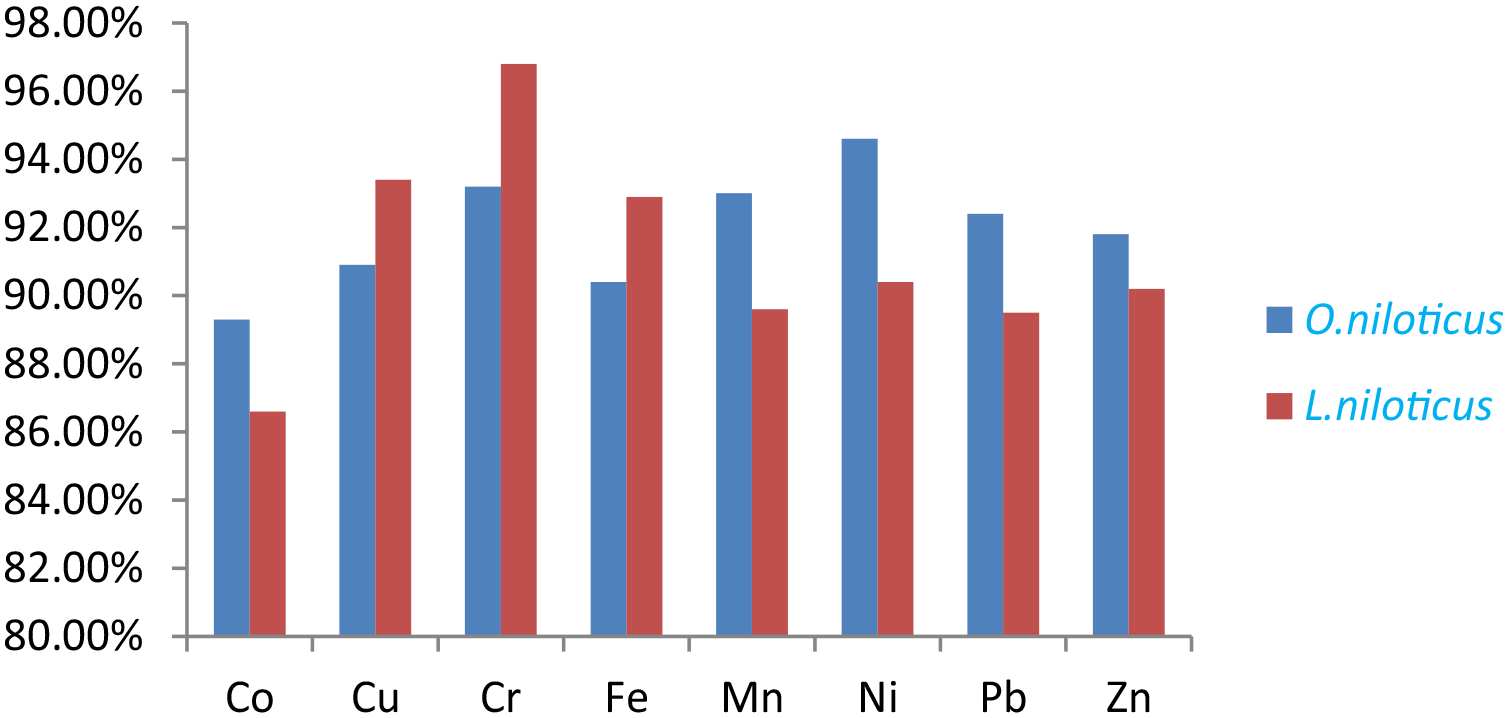
Percentage recovery in muscle of L. niloticus and O. niloticus.
Data analysis
The data were analyzed using IBM SPSS 21 statistical software. To determine a normal distribution and homogeneity of variance, Levine’s test was applied. Variations in the mean levels of heavy metals between fish muscle and liver and species were evaluated using a T-test. A Pearson correlation coefficient matrix was used to determine the correlation between metal in the fish tissues. The target hazard quotient (THQ), hazard index (HI), and target cancer risk (TCR) were used to evaluate human health risks.
Results and Discussion
Heavy metal concentrations in L. niloticus and O. niloticus
The mean levels of the detected heavy metals in the muscle and liver tissues of both fish species are presented in Table 2. The mean level of heavy metals ranged from 0.013 to 1.81 mg/kg. The maximum mean concentration of heavy metals detected in the liver of L. niloticus was Fe (1.81 ± 0.465 mg/kg), and the minimum mean level was Ni (0.018 ± 0.01 mg/kg), which was detected in the liver of O. niloticus. Similarly, the maximum mean level in muscle of O. niloticus was 0.89 ± 0.099 mg/kg for Fe, and the minimum muscle level was for Ni (0.013 ± 0.006 mg/kg. The Fe content in the muscle tissues of O. niloticus in the present study was lower than that in the study by Samuel et al 3 in Ethiopia from Lake Hawassa. A lower mean level of Ni was recorded in the study by Samuel et al 3 and Magu et al. 14 The mean concentrations of the metals in the liver and muscle of L. niloticus generally occurred in the order of Fe > Zn > Pb > Cu > Mn > Cr > Co > Ni and Fe > Pb > Zn > Mn > Cu > Co > Cr > Ni, respectively.
Mean concentrations of heavy metals (mg/kg, dry weight) in L. niloticus and O. niloticus from Omo Delta.

MPL is Maximum permissible limit in the diet of human according to FAO/WHO 1989.
Similarly, the mean concentrations in the liver and muscle tissues of O. niloticus were as follows: Fe > Pb > Zn > Mn > Cu > Cr > Co > Ni and Pb > Fe > Zn > Mn > Co > Cu > Ni. Except for Cd, all the investigated heavy metals were detected in the liver tissues of both species. Cadmium was not detected in the muscle and liver of L. niloticus and O. niloticus which was similarly reported in the study by Gure et al. 4 This might be due to the pollution sources of the freshwater fish may not contain significant level of cadmium or not at all. Higher levels of heavy metals were generally observed in liver tissues. This difference may be related to the content of the metallothioneins protein in the liver tissue which is rich in thiol content that helps to bind the heavy metals. The liver acts as a detoxifying filter by storing heavy metals. High metal accumulation capabilities make the liver the most important target and storage tissue in aquatic organisms. The Pb levels in muscle and liver tissues from both fish species were above the 30 permissible limits. This implies that lead toxicity related health complication to human health and, decreased growth and reproductive rates in fish.3,14 The mean concentration of manganese (Mn) ranged from 0.384 to 0.394 mg/kg. The maximum and minimum mean concentrations of Mn were observed in the liver of L. niloticus and muscle of O. niloticus, respectively, following the order L. niloticus (liver)>O. niloticus (liver) > L. niloticus (muscle) > O. niloticus (muscle). The detected concentration is below the 30 permissible limit for human diet and is comparable to that reported for the muscle of O. niloticus species from Lake Hawassa. 31 The Mn content of muscle tissues (O. niloticus) in the present study was lower than that in previous reports in Ethiopia from Lake Hawassa31,32 and from the Volta Basin of Ghana. 33 A possible explanation might be due to different agricultural activities and pollution from cities and villages in the basin may have acted as additional Mn sources, and the continued release of Mn from estuarine soils led to Mn accumulation.
The mean zinc level ranged from 0.394 to 1.127 mg/kg. The maximum mean level was detected in the liver of L. niloticus, whereas the minimum was observed in the muscle of O. niloticus, following the order L. niloticus (liver) > O. niloticus (liver) > L. niloticus (muscle) > O. niloticus (muscle) > O. niloticus (muscle). The Zn content in the muscle tissues of O. niloticus in the present study was greater than that in the study by Zenebe 34 in Ethiopia. However, the Zn content in the muscle of O. niloticus in this study was lower than that in earlier studies of freshwater fish from Ethiopia3,32 in the Volta Basin of Ghana 33 and from freshwater fish in Kenya. 14 Similarly, the level of Zn in the liver tissues of O. Niloticus in the present study was greater than that in previous studies of the same species. 35 This difference might be due to differences in the pollution sources in the catchment area and the large amounts of agrochemicals containing zinc that may leach into freshwater, which could contribute to heavy metal pollution in fish tissue.
The copper level of the tissues ranged from 0.071 to 0.407 mg/kg. The maximum and minimum mean Cu level was detected in the liver tissue of L. niloticus and in the muscle tissue of O. niloticus, respectively. The order of Cu concentrations was, L. niloticus (liver) > O. niloticus (liver) > L. niloticus (muscle) > O. niloticus (muscle). The levels in all tissues are below the 30 maximum permissible limit in the human diet. The mean Cu content in muscle tissues of O. Niloticus in this study was greater than that in earlier reports. 34 However, the Cu content in muscle tissues of O. Niloticus in the present study was lower than that in previous studies.4,14,32 Similarly, the concentration of Cu in the liver tissues of O. niloticus in the present study was greater than that in the previous study 35 but lower than that reported previously. 4 The mean muscle content of Cu in L. niloticus in the present study was lower than that in previous studies 36 but higher than that in studies by Magu et al. 14 As depicted in Table 3, the concentrations of the investigated heavy metals in fishes were significantly correlated with each other.
Pearson correlation coefficient matrix for metal concentrations in the fish muscle.

Correlation is significant at the .05 level (2-tailed).
Correlation is significant at the .01 level.
The chromium level ranged from being below the detection limit to 0.154 mg/kg. A greater level of Cr was observed in the liver tissues of L. niloticus. Chromium was not detected in the muscle tissues of O. niloticus in the present study, which was similar to the findings of earlier study. 32 This difference may be due to the high binding capacity of the liver for metals in which the liver acts as a filter detoxifying by storing heavy metals.
The muscle content of Cr in L. niloticus in this study was lower than that in previous studies.3,33 However, the Cr content in the liver tissue of both fish species in the present study was greater than that in the study by Gerenfes and Teju 35 and lower than that in the study by Gure et al 4 from Ethiopia. Cadmium was not detected in the liver and muscle of both species. This might be because the pollution source of freshwater might not contain cadmium. This was similarly reported by Ermias et al. 32
The lead level ranged from 0.597 to 1.24 mg/kg. The maximum mean concentration of Pb was recorded in the liver tissue of L. niloticus, whereas the minimum level of Pb was observed in the muscle tissue of O. niloticus, following the order L. niloticus (liver) > L. niloticus (muscle)> O. niloticus (liver) > O. niloticus (muscle). The mean Pb levels in the muscle of both species were above the FAO/WHO recommended limits in the human diet. 30 This finding implies that the consumption of these 2 fish muscles results in health complications from the toxicity of lead. The Pb content in muscle tissues of both fish species in this study was greater than that in earlier reports3,14,37 but lower than that in previous reports. 36 However, the Pb content in the liver tissue of O. niloticus in the present study was lower than that in previous studies.4,35 On the other hand, the Pb content in the muscle of L. niloticus in the present study was greater than that in previous reports 14 but lower than that in reports. 36 This difference might be due to the difference in pollution sources in the study area.
The mean concentration of Fe ranged from 0.411 to 1.81 mg/kg. The maximum mean Fe concentration was detected in the liver of L. niloticus, whereas the minimum was detected in the muscle of O. niloticus, followed by L. niloticus (liver) > O. niloticus (liver)>L. niloticus (muscle) > O. niloticus (muscle). The tissue levels of Fe in this study are below the 38 allowable limits and were below those recorded for the muscle of O. niloticus. 37 The present findings also indicated that O. niloticus had lower Fe contents in muscle tissues than the study reported by Gerenfes and Teju. 35 In contrast, the Fe content in the liver of O. Niloticus in the present study was greater than that in a previous study. 35
The mean nickel concentration ranged from 0.013 to 0.033 mg/kg. The maximum mean concentration was detected in the liver tissue of L. niloticus, while the minimum level was detected in the muscle tissue of O. niloticus, in the order L. niloticus (liver) >L. niloticus (muscle) > O. niloticus (liver) > O. niloticus (muscle). These concentrations are within the 30 recommended permissible human diet intake levels. The Ni contents of muscle tissues from O. niloticus and L. niloticus in the present study were comparable to those in previous reports3,14,34 and lower than those in studies. 33
The cobalt content in the liver and muscle tissues ranged from 0.045 to 0.085 mg/kg. The maximum mean content of Co was detected in the liver of L. niloticus, while the minimum was detected in the muscle of L. niloticus, followed by L. niloticus (liver)> O. niloticus (muscle) > O. niloticus (liver)> L. niloticus (muscle). The mean muscle level of cobalt in O. niloticus was greater than that in a previous report. 3 However, the mean Co level in the present study was lower than that in the study of the muscle and liver tissue of O. niloticus. 4
The Cu in fish tissues may be from the agrochemicals through the use of fungicides, algaecides, and insecticides on agricultural land, which can be drained by runoff to the freshwater fish. 39 Thus, the occurrence of Cu in the fish tissues in this study could be from agrochemicals that may have arisen from irrigation land along the Omo River, which may drain into the River delta. The Pb concentration in freshwater fish may increase from different anthropogenic sources, such as agricultural discharge, factories, solid waste and wastewater, that may reach the River delta and subsequently fish tissues 40 . Consequently, the occurrence of Pb in the fish tissues in the present study could be attributed to agrochemical activity from intensive irrigation farmland to the delta, urban discharge and solid waste from Omorate town, which is adjacent to the delta, wastewater from upstream factories and other anthropogenic activities. The presence of Ni in the fish tissues in this study could be due to the location of the river in the rift valley, where it is naturally abundant in the Earth’s crust. 14 The occurrence of Zn in fish tissues in the present study could be due to the urban runoff, wastewater and agrochemical use observed in the catchments. 41 The occurrence of the detected heavy metals in the present study could also be attributed to Lake Turkan, which is adjacent to the present study area (Omo delta), as reported by different researchers, who revealed the presence of Cr, Cu, Mn, Ni, Pb, and Zn.13,14,42 The statistically significant differences in the mean contents of the detected heavy metals between the fish tissues of both fish species are presented in Table 4 according to the T-test. A T-test (P < .05) revealed that there were significant differences in the mean levels of all heavy metals except for Mn, Cu, and Ni in the muscle and liver tissues of L. niloticus. Similarly, significant differences in the mean levels of heavy metals were detected between the muscle and liver tissues of O. niloticus, with the exception of Zn and Co. There were also species-dependent significant differences in the mean contents of Pb, Ni, and Co in the liver tissues of L. niloticus and O. niloticus. Similarly, the mean contents of Pb, Fe, and Ni in the muscle tissues of both species were significantly different (P < .05). Many researchers have shown that fish species-dependent differences in heavy metal accumulation might be associated with feeding habits, such as carnivores, herbivores, or omnivores, and the habitats of fish species.43,44 Differences in habitat utilization and feeding practices may be the cause of the variations in the mean heavy metal concentrations observed in the present study between L. niloticus and O. niloticus. 45 The differences in heavy metal concentrations between L. niloticus and O. niloticus43,46 in the present study could be attributed to the biological factors, such as age and the growth rate of the fish species.
The mean difference of heavy metals among the fishes tissues.
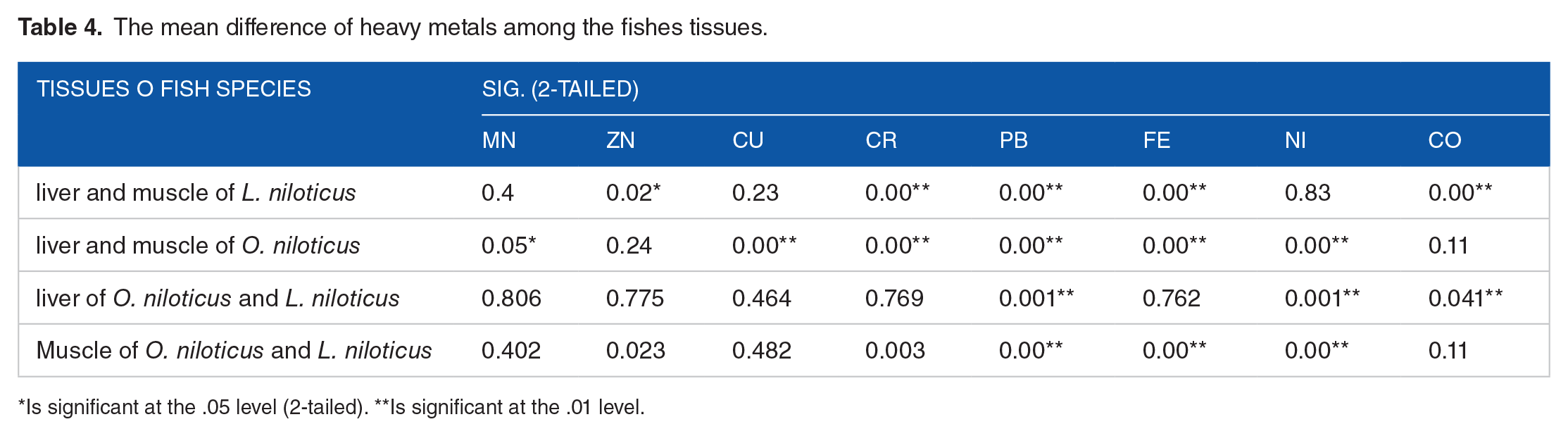
Is significant at the .05 level (2-tailed). **Is significant at the .01 level.
The differences in the mean levels of heavy metals between the fish tissues (liver and muscle) in these studies could be due to the ability of various metals to bind with carboxylate oxygen, amino functional groups, and nitrogen in metal-binding proteins.4,39,47 The variations in metal concentrations among tissues could also be ascribed to differences in the physiological role of each tissue in which muscle generally accumulates lower levels of heavy metals.41 -46 Many studies have confirmed that there is variation in heavy metal levels among fish tissues and species,3,4 which was also observed in the present study.
In general, L. niloticus had a greater burden of heavy metals than O. niloticus. This could be due to differences in the behavior and feeding habits of the 2 species. Thus, the relatively high level of metals in the L. Niloticus tissues in the present study could be attributed to their feeding habits, as they are bottom-dwelling carnivores that feed on zooplankton, shrimp, clams, snails, insects and other fish species, unlike O. niloticus, which feeds on algae and other vegetables.14,16 Carnivores are more likely to accumulate heavy metals than are other fish. 46
Human health risk
The noncarcinogenic health risks associated with the heavy metals detected in adults and children who consumed muscle from L. niloticus and O. niloticus from the Omo delta were assessed using THQ and HI indices. The human health risk was evaluated on a wet mass basis by using a conversion factor of 4.8. The index results (THQ and HI) obtained by eating the muscle of fish within 1 to 7 times a week are presented in Tables 5 and 6 for adults and children, respectively. The THQs in the muscle of L. niloticus and O. niloticus for all the ingestion levels (1, 3, 5, and 7) decreased in the order Pb > Cr > Cu >Mn > Co > Zn > Fe and Pb > Mn > Co > Cu > Zn > Fe, respectively.
Estimated THQ and HI in adults due to heavy metal exposure in muscle of L. niloticus and O. niloticus.

Abbreviation: d/w, days per week.
Estimated THQ and HI in children due to heavy metal exposure in muscle of L. niloticus and O. niloticus.

Abbreviations: ND, not detected; d/w, days per week.
Cd was not detected in the muscle and liver of both fish species.
The HI values due to consumption of L. niloticus muscle 7 times a week were 0.668 (for adults) and 0.942 (for children). Similarly, the HI values for O. niloticus were 0.433 (for adults) and 0.653 (for children). The maximum THQs were observed for Pb in both L. niloticus (0.872) and O. niloticus (0.585), whereas the minimum THQs were observed for Fe in the muscles of O. niloticus and L. niloticus. In all the evaluated samples, the THQs for heavy metals in fish muscle ingested by adults and children were less than 1, which indicates that individuals are unlikely to experience considerable health risks due to ingestion of individual heavy metals through intake of the fish muscles. Similarly, the HIs of the combined heavy metals were less than 1, indicating that there was no substantial adverse health effect due to the intake of L. niloticus and O. niloticus muscle tissues from the Lower Omo River source at the present time of study. As seen from the risk assessment data, more emphasis should be given to the noncarcinogenic risk of Pb in the muscle of both fish species. A previous study in the Volta Basin River, Ghana, recorded a lower THQ value for Mn (0.00325) than for Mn (0.04389) from O. niloticus. 33 They also reported lower THQs for Zn (9.2 × 10⁻⁵) and Fe (2.14 × 10⁻⁸) than did the present study via the intake of O. niloticus muscle by adults and children. On the other hand, 3 from their study in Ethiopia from Lake Hawassa, reported higher THQ values for Fe (0.01), Cu (0.02), and Zn (0.039) than did the present findings. However, Samuel et al 3 reported lower THQs for Co (0.001) and Pb (0.026) than for Co (0.00937) and Pb (0.872), respectively.
The probable cancer risk due to the ingestion of Cr, Pb, and Ni through the muscle of L. niloticus and O. niloticus at 1, 3, 5, and 7 days a week is presented in Table 7. The target cancer risk (TCR) values in the muscles of both L. niloticus and O. niloticus were in the order of Cr > Pb. All levels of exposure to Pb in this investigation had TCR values within the acceptable range (10−6 to 10−4). 48 Taken together, these findings demonstrated that eating Cr and Pb through the muscle of L. niloticus and O. niloticus at any exposure level was not a carcinogenic health concern. It was also observed that children had a greater probability of developing risk when exposed to heavy metal pollution. The results of this study showed that people who consumed O. niloticus muscle had a TCR for Pb of 1.22 × 10⁻⁵, which was greater than that found in a previous study that evaluated the TCR for Pb (7.65 × 10⁻⁸). 33
TCR in adults and children due to heavy metal exposure in muscle of L. niloticus and O. niloticus.

Abbreviations: d/w, days/week; E, exponent; ND, not detected.
E= exponent (power of 10). Cd was not detected in the muscle of both fish species.
The TCRs for Pb and Cr in this study were within the tolerable range of 10−6 to 10−4 48 for all levels of exposure. Taken together, these findings revealed that there was no carcinogenic health risk from the ingestion of Cr and Pb through the muscle of L. niloticus and O. niloticus at all levels of exposure in adults. It was also observed that children had a greater probability of developing risk when exposed to heavy metal pollution. A study in Ethiopia from Lake Hawassa reported a lower TCR for Pb (7.65 × 10⁻⁸) than that in the present study (1.22 × 10⁻⁵) via the intake of O. niloticus muscle by adults. 3
Limitations of the Study
The limitations of this study include the nonconsideration of heavy metals such as arsenic and mercury.
Conclusions and Recommendations
The present study provides the first baseline information on the pollution levels of 9 heavy metals in L. niloticus and O. niloticus from Ethiopian lowland freshwater bodies (Omo Delta). With the exception of Pb and Cr, the levels of all heavy metals under investigation were below the allowable limits set by Ref. 30 This implies that consumptions of the muscle of the 2 fish spices might results to human health complication caused by lead and chromium toxicity. Higher accumulations of heavy metals were generally observed in the liver and muscle tissues of L. niloticus than in those of O. niloticus, which might be due to difference in feeding habit of the species. Generally, the liver accumulated more heavy metals than did the muscle tissues. This might be due to the fact that liver tissue is rich in thion content which helps to bind the heavy metals. 49
The study indicated that the level of heavy metals in fish tissue is a warning signal for early intervention. The health risk assessments showed that exposure to the studied heavy metals is less probable to impose potential human health risk. However, the mean Pb levels found in the liver and muscle tissue of both fish species were above the FAO/WHO (1989) allowable level, which might call for regular monitoring of freshwater fish from the Omo Delta. In view of the extensive agriculture and agro-industry currently being undertaken in the catchments of the study area, the level of heavy metals in the investigated fish species may increase in a short period of time. Therefore, monitoring heavy metal levels in the tissues of L. niloticus and O. niloticus is vital, and policy makers are attempting to take appropriate action at this alarming level to protect freshwater fish and people from the threat of heavy metal pollution from the River Delta.
Footnotes
Funding:
The author(s) received no financial support for the research, authorship, and/or publication of this article.
Declaration Of Conflicting Interests:
The author(s) declared no potential conflicts of interest with respect to the research, authorship, and/or publication of this article.
Authors Contributions
AAK: The primary investigator of the study was responsible for the study′s conception, design, writing of the proposal, data gathering process, and final analysis and article production. Participating in the study′s design, GTY, SSS, and YSB reviewed and critiqued the entire paper, paying particular attention to the procedure and analysis sections. The final manuscript was read and approved by all the writers.
Availability of Data and Materials
The dataset is made available on the manuscript.
Ethical Approval
Before the research began, letters of support were obtained from the Hawassa University Department of Biology and Debub-Omo Agriculture and Fishery Bureau. Furthermore, ethical clearance and approval were obtained from the Hawassa University Institutional Review Board (IRB). All methods were performed in accordance with relevant guidelines and regulations.
Consent for Publication
Not applicable.
