



Abstract
Background:
The provision of safe water, sanitation, and hygiene (WASH) facilities and services for schools is vital to students’ health, development, and educational performance. However, school WASH coverage in developing countries remains low. This study aimed to assess the adequacy of WASH services in Addis Ababa, Ethiopia.
Methods:
A school-based quantitative cross-sectional study was conducted from January to March 2020 in 98 schools. A multistage sampling technique was used to select schools included in the study. Data were collected using observational checklists and pretested interviewer-administered questionnaires. We entered the data into EPI Info version 7.2.2.6 and analyzed using SPSS 22.0. Logistic regression was used to examine the associated factors with school WASH services.
Results:
The basic school water, sanitation, and hygiene services were found to be 65.3%, 31.6%, and 36.7%, respectively. The facility-to-student ratio was 1:48 for drinking water point, 1:59 for toilet stance, and 1:147 for handwashing point. The analysis of facilities access by sex revealed that the toilet to student ratio was 1:68 for females and 1:49 for males, whereas the handwashing point-to-student ratio was 1:179 for females and 1:114 for males, indicating disparities in facilities access by sex. The non-functionality rates for drinking water, toilets, and handwashing facilities were 22.5%, 8%, and 19.5%, respectively. School ownership was significantly associated with the availability of basic water services [COR = 4.6, 95% CI: 1.466-14.426] and basic sanitation services [COR = 15, 95% CI: 3.27-68.28]. Moreover, the results demonstrate training on WASH [COR = 5, 95% CI: 1.087-23.018] and teaching programs on WASH [COR = 0.21, 95% CI: 0.056-0.810] were significantly associated with basic hygiene services.
Conclusions:
The provision of WASH facilities and services in schools was inadequate and not on track to meet the targets of SDG 6. Training, WASH education program, and stakeholder commitment and cooperation at all levels are required to achieve the goal.
Keywords
Introduction
The Sustainable Development Goal 6 (SDG 6) call for universal access to safe water, sanitation, and hygiene (WASH) services for all by 2030. 1 Access to safe water, sanitation, and hygiene services is a fundamental human right for school children.1 -7 Ensuring the provision of these essential WASH services in schools is vital for establishing a safe, healthy, and clean learning environment, and fostering good hygiene behavior that students can maintain throughout their lives.1 -7 However, half of the low-income country schools lack sufficient water, and sanitation facilities, and face inadequate hygiene conditions.8,9 Extensive evidence indicates improving WASH services in schools is crucial for enhancing student health, as inadequate provisions can negatively impact student learning, health, and dignity.3,10 -17
The progress report on WASH services in schools by the WHO/UNICEF joint monitoring programme (JMP) in 2022 revealed that numerous schools globally, including those in low-income countries such as Ethiopia, lack access to basic WASH facilities. This JMP report highlighted that only 71% of schools have access to basic drinking water, 72% to basic sanitation, and 58% to basic hygiene services. 6 The study conducted by Morgan et al 18 examined the WASH in rural schools in 6 Sub-Saharan African countries and showed that improved water sources on-premises, improved sanitation, and water and soap for handwashing ranged from 1% in Ethiopia and Mozambique to 23% in Rwanda, and fewer than 23% rural schools met the World Health Organization’s recommended student-to-latrine ratios for boys and girls.
Ethiopia faces significant challenges in providing basic water, sanitation, and hygiene services to schools. For example, the UNICEF survey indicated that 77% of schools lack access to basic water services, 60% lack sanitation services, and 94% lack basic hygiene services. 19 This situation has a severe potential impact on school-aged children, with 37 out of 39 million anticipated to be denied basic hygiene services at their schools.5,8
Studies conducted in various regions of Ethiopia have reported the level of basic school WASH services provision status. A study done in Bishoftu town schools’ found that about 74.7% had access to basic drinking water, 61.3% had access to sanitation facilities, and 37.3% had access to hygiene services. 20 Another study in Kimbibit Woreda revealed that many schools had poor WASH facilities, with a latrine seat ratio of 60:1, simple pit latrines in 70.8% of schools, only 33.3% schools had sex separated latrines, and only 6.3% had handwashing facilities near the latrine, with none of these facilities had a water supply and soap for handwashing. 21 The progress of WASH services in public primary schools in the South Gondar zone of Northern Ethiopia has also been limited, with only 68.8% of urban students having access to basic drinking water, 66.7% had access to sanitation services, and 35.4% had access to handwashing facilities. 22
Interventions to improve WASH in schools typically involve both hardware and software components. Software components may include hygiene education, training, strengthening of school governance structures related to WASH, and establishing WASH-specific budgets. Hardware components may include the provision of adequate WASH facilities, such as handwashing stations, toilets, and clean water sources. These interventions have been believed to be effective in improving access to basic water, sanitation, and hygiene services in schools. 23 The studies conducted across 14 low- and middle-income countries have shown that community and external supports such as schools with a parent-teacher association, external WASH programs, and the presence of key WASH infrastructures are more likely to have basic water, sanitation, and hygiene services. 24
The Government of Ethiopia launched the first Five-Year National Hygiene and Sanitation Strategy Development Plan in 2016 and the goal of this plan was to provide universal access to water, sanitation, and hygiene in all schools by 2020. 25 The Ministry of Education in Ethiopia is responsible for overseeing the education system’s WASH services, expanding access, ensuring equity, and improving the quality of services. However, the current progress of school WASH services toward achieving SDG 6 and the national hygiene and sanitation strategy achievement in Addis Ababa has not been studied. As a result, the study investigated the progress of school WASH services level in Addis Ababa based on SDG 6 indicators established by JMP and Ethiopian national requirements, which could be used as input for SDG implementation.
Methods
Description of the study area
Addis Ababa is the capital city of Ethiopia, with 10 sub-cities (Figure 1) and 117 woredas. 26 The city has a yearly population growth rate of 4.37%, with a 2020 city population anticipated to be 4,793,699 people.27,28 Male and female adult literacy were 93% and 80%, respectively. 26 According to Addis Ababa Education Bureaus, the city had a total of 2147 schools, with 37% being primary, 10.2% secondary, and 52.8% Kindergarten (KG). Among the schools, 527 were public schools while 1620 were private schools.

Map of Addis Ababa, with sub-cities, Ethiopia.
Study design and period
A school-based quantitative cross-sectional study was conducted to assess the status of school WASH services in Addis Ababa, Ethiopia, from January to March 2020.
Sampling techniques
A multi-stage sampling method was used to select schools in Addis Ababa. Sub-cities of Addis Ababa were categorized into 2 groups with 4 sub-cities as inner and 6 as peripheral sub-cities. Then, the Kirkos sub-city from the inner and the Akaki Kality sub-city from the peripheral sub-cities were drawn at random from each group. Besides, the selected schools in each sub-city were proportional in terms of ownership and school level. The primary investigator requested a list of schools from the selected sub-cities education offices, and the schools were selected using simple random sampling method. The director of each selected school was interviewed by using a structured questionnaire about the existing WASH services. The detail sampling procedure is presented in Figure 2.
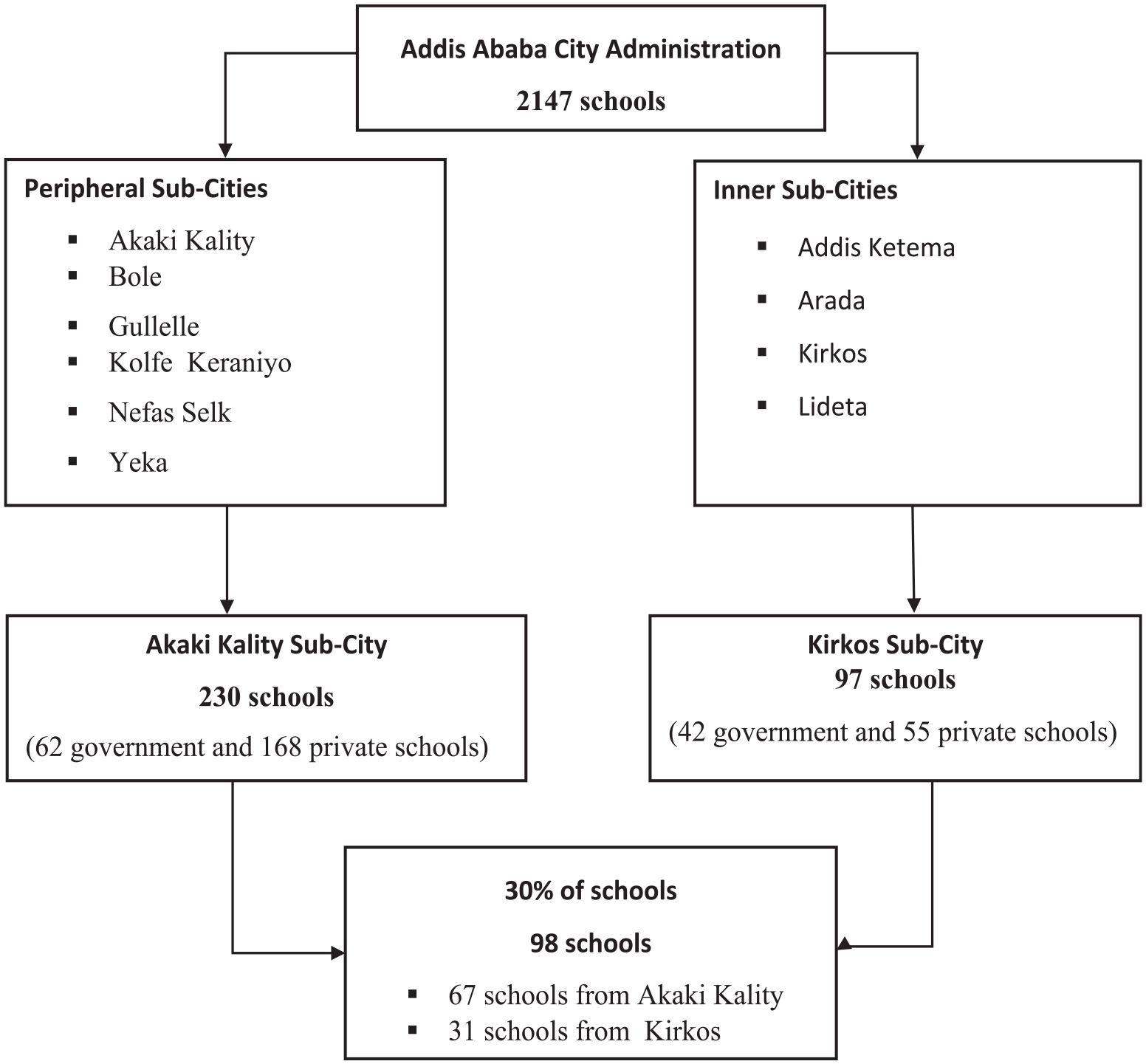
Sampling scheme of schools in Addis Ababa, Ethiopia, 2020.
Sample size determination
Ninety-eight (30%) of the schools were believed to be representative, with 31 from Kirkos (18 KG, 10 primary, 3 secondary and preparatory schools) and 67 from Akaki Kality sub-city (38 KG, 24 primary, 5 secondary and preparatory schools).
Data collection methods
Data on the status of school WASH services were collected using a structured questionnaire adapted from the JMP and observing on-site using observational checklist.22,29 -31 The school directors provided information about the school’s WASH facilities and services, which was cross-checked using observational checklists. The data were collected by 4 trained environmental health officers with bachelor’s university degree.
Study variables
Geographic location, school level, school ownership, budget allocation, maintenance plan, parent-teacher associations, health clubs, training, and health education were considered independent variables while school WASH services which were classified as basic, limited, and no service were dependent variables.
Definitions
The School WASH services for facilities were defined according to JMP ladders30 -32:-
Data processing and analysis
After coding, the obtained data were entered into EPI Info 7.2.2.6 and exported to IBM SPSS version 22.0 for data cleaning and analysis. Descriptive statistics such as percentages and ratios were used to assess the condition of WASH services, and the results were presented in appropriate tables and figures. Binary logistic regression was used to investigate the factors associated with basic WASH services status
Data quality control
Before data collection, the data collectors were received 2 days of training. A pretest was conducted in 10 schools in Lideta and Yeka sub-city to assess the clarity of the survey tool and the responses of the respondents. The questionnaire was first prepared in English. The English questionnaire was translated into Amharic and then back-translated into English to ensure consistency.
Ethical considerations
The study was conducted after obtaining an ethical clearance letter from the Ethiopian Institute of Water Resources of Addis Ababa University Ethical Review Committee (Ref. No. EIWR/ERC/06/19, dated: December 15, 2019). The Ethiopian Institute of Water Resources of Addis Ababa University was wrote a support letter to the Addis Ababa Education Bureau to obtain the necessary collaboration for the study. The Education Bureau then sent a letter to the sub-city education offices requesting cooperation. Similarly, the sub-city education office sent a letter of participation to the schools. To maintain anonymity, the study used participant identification numbers, and all information gathered was kept confidential. Before data collection began, the data collectors informed the school directors about the study’s purpose and goals, and the data was collected after obtaining consent from each study participant.
Results
Characteristics of the study participants
The study examined the status of WASH services in 98 schools, consisting of 53 (54.1%) private and 45 (45.9%) government schools. The results indicated that nearly half of the schools (42.9%) did not have a WASH budget, and the majority (66%) schools lacked a maintenance plan for their WASH facilities. Furthermore, half of the schools had no a health club (Table 1).
Characteristics of sampled schools and participants in Addis Ababa, Ethiopia, 2020.

Status of school water, sanitation, and hygiene services in Addis Ababa
The study revealed that 64 (65.3%) schools provided basic water services, 31 (31.6%) provided basic sanitation services, and 36 (36.7%) provided basic hygiene services. WASH service level varied with school level and ownership (Table 2).
The status of school WASH services in Addis Ababa, Ethiopia, 2020.

School drinking water, sanitation, and hygiene facility adequacy in Addis Ababa
The WASH facility-to-student ratio was 1:48 for drinking water points, 1:59 for toilet stance, and 1:14 for hand washing. Males and females in government schools had large inequalities in student-to-toilet ratio and handwashing facility ratio (Table 3).
The school WASH facility to student ratios in Addis Ababa, Ethiopia, 2020.

Drinking water functionality and availability status in Addis Ababa schools
One thousand one hundred four (77.5%) of the 1425 water points in the schools were functional. There were differences in the non-functionality rate between the private and public sectors, as well as between school levels. Six hundred sixty-four (87.8%) of the 756 drinking water points in private schools were functional, while water points functionality in government schools was 65.8%. The functionality of water points in secondary schools, elementary schools, and KG were 66.3%, 75%, and 85.2%, respectively. The main reason given by school administrators for the non-functionality of water points was poor operation and maintenance (76.9%) (Figure 3).

The main reasons for the non-functionality of drinking water points in schools (in percent) in Addis Ababa, Ethiopia, 2020.
Almost all schools, 96 (97.9%), had drinking water available for non-disabled pupils, however, 57 (58.2%) did not have water available for disabled students. During the study period, 64 (65.3%) of the schools had drinking water from the main source. Drinking water availability from the main source had incontinence issues and just 5 (5%) schools received water 24 hours a day (Figure 4).
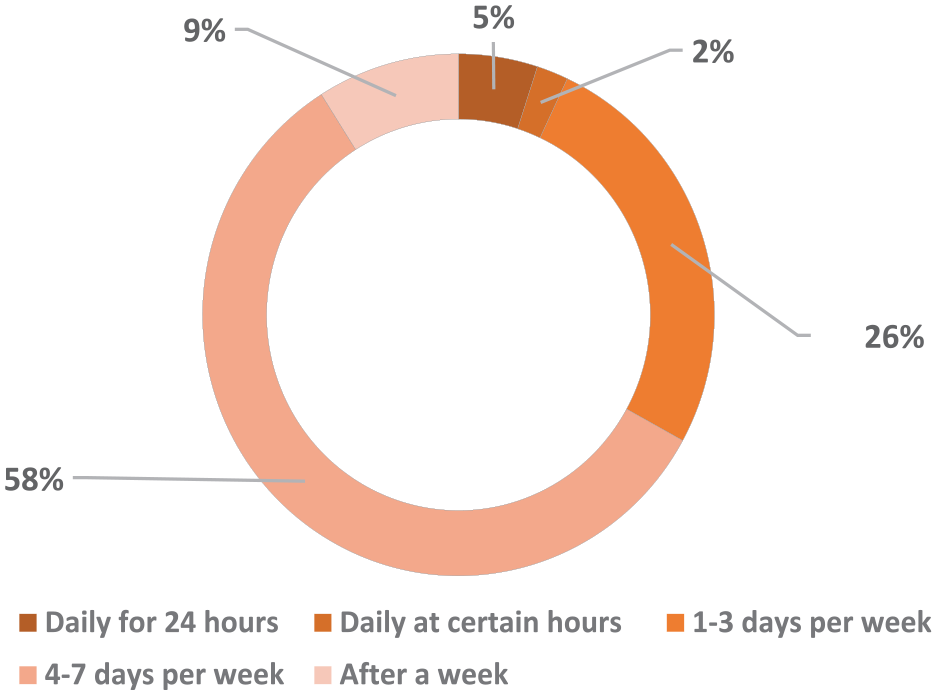
Drinking water availability from the main source in schools Addis Ababa, Ethiopia, 2020.
School sanitation facilities functionality and adequacy in Addis Ababa
All schools possessed sanitation facilities, with the majority of them, 72 (73.5%) had VIP latrines, 5 (5.1%) pour-flush latrines, and 21 (21.4%) unimproved pit latrines. One thousand ninety-seven (92%) of the 1192 toilet drop holes were operational. The functionality of the latrine drop hole had disparities by the ownership of the school. In government schools, 504 (87.2%) of the 578 latrine drop holes were functional, while 593 (96.6%) were functional in private schools.
There were no urinals in 96 (98%) of the schools, and 2 (2%) of the schools had 1 continuous gutter and 1 individual urinal. Sixty-seven (68.4%) schools had no adequate toilet facilities due to factors stated in (Figure 5).

The main reasons for the lack of adequate toilet facilities in schools in Addis Ababa, Ethiopia, 2020.
Though 96 (98%) schools had toilets accessible to non-disabled students, only 26 (26.5%) and 22 (22.5%) were accessible to impaired boys and girls, respectively. The main reasons for the inaccessibility of the toilets were inconvenient toilet design 74 (96%) and 3 (4%) of the toilet was too far away.
According to the observational checklist data, 94 (95.9%) of the schools were free of open defecation, whereas 4.1% had open defecation. The main causes for open defecation given by school directors were lack of latrine 1 (25%), strong disagreeable odors 2 (50%), and lack of privacy 1 (25%). Among the studied schools, 47 (48.5%) cleaned the latrine more than once daily, where as 44 (45.4%) schools cleaned daily. Almost all school directors mentioned that lack of water is the primary cause of not being able to clean regularly. The majority of the latrines 63 (64.3%) provide pupils with privacy, and the toilet superstructure was in good condition 92 (94%) (Table 4).
Schools sanitation facility, privacy, and functionality status in Addis Ababa, Ethiopia, 2020.

School hygiene facility status in Addis Ababa
Most of the schools 86.7% had handwashing facilities. However, both soap and water were accessible only in 33 (38.8%) of the schools, water in 34 (40%) of the schools, and soap only in 2 (2.4%) of the schools (Table 5). From the total hand washing points accessible in 85 schools, 81.5% were functional. The functionality of handwashing stations differed between government and private schools, as well as at the school level. The functioning rates for government and private school handwashing points were 71.8% and 89.6%, respectively. Hand washing points were functional in 53.8% of secondary and preparatory schools, 82.6% of primary schools, and 88.2% of KGs. Concerning access to soap for hand washing in schools, 45 (45.9%) and 29 (29.6%) schools receive it from student families and schools, respectively, while 24 (24.5%) schools have no soap at any time. About 83.5% of the schools had hand washing facilities near the latrine.
Schools hand washing facility, sitting and functionality status in Addis Ababa, Ethiopia, 2020.

The factors associated with school water, sanitation, and hygiene services
There was a statistically significant association between school ownership with the availability of basic water services [COR = 4.6, 95% CI: 1.466-14.426] (Table 6).
Association of selected study variables with basic drinking water services, Addis Ababa, Ethiopia, 2020.

There was a statistically significant association between school ownership with the availability of basic sanitation services [COR = 15, 95% CI: 3.27-68.28] (Table 7).
Association of selected study variables with toilet facility service, Addis Ababa, Ethiopia, 2020.

There was a statistically significant association between the availability of basic hygiene services and both training on WASH [COR = 5, 95% CI: 1.1-23] and teaching programs on WASH [COR = 0.21, 95% CI: 0.06-0.81] (Table 8).
Association of selected study variables with hygiene service, Addis Ababa, Ethiopia, 2020.

Bold values are statistically significant at p value less than 0.05.
Discussions
This study was conducted to assess the adequacy of WASH facilities and services in Addis Ababa, Ethiopia. The basic drinking water and hygiene service levels in Addis Ababa schools were lower than global studies done by JMP for the world school, which were 64 (65.3%) for Addis Ababa and 69% basic drinking water service for world school and better than UNICEF studies for Ethiopian schools, none of which had basic drinking water services, while sanitation service levels in Addis Ababa were higher.19,31 The basic drinking water service level in Addis Ababa may be smaller than the world schools due to water incontinence being higher in Addis Ababa.
In this study, drinking water, sanitation, and hygiene service levels differ between private and public schools, as well as by school level. Private schools had higher basic drinking water services, better basic sanitation services, and the highest basic hygiene services than government schools. The disparities could be attributed to private schools having a good budget, most toilets being improved during construction, school students receiving soap from their parents, regular maintenance, construction, usage, and good follow-up by school management. 31
In Addis Ababa, 36% of secondary and preparatory schools had basic hygiene, 34.7% had limited hygiene, and 28.6% had no service. This compares to 53% of the world’s schools with basic hygiene, 11% with limited service, and 36% had no service. The report also showed Ethiopia’s 6% basic service, which was lower than this study. 31
Non-functionality rates for drinking water, sanitation, and hygiene facilities in Addis Ababa schools were 22.5%, 8%, and 19.5%, respectively. The non-functionality rate for drinking water points in Addis Ababa schools was higher than the 13.5% reported by the Addis Ababa education bureau, and the non-functionality rate reported by the MoE was 20.1% for primary schools and 9.7% for secondary schools.32,33 This may be the recent maintenance; usage and management of WASH facilities were poorer than previously done by schools.
This study’s sanitation coverage was better, and its functionality was almost identical to a study conducted by the MoH, which found that 76% of Ethiopian schools had latrines, and 93% were functional. 34 Because Addis Ababa is Ethiopia’s capital city, coverage, and improved sanitation facilities may be better, and the Ministry of Health study includes rural schools as well. At the same time, this study found that this district had better latrine coverage than the GhanaTano district, where 53% of schools lacked toilet facilities. 35 The non-functional hand washing points were better than those found in Arada Sub-city 30%, 36 Kenya (Nairobi Kajiado District) 70% of schools, and Tanzania primary schools 57%.37,38 However, the non-functionality rate was higher than stated by the MoE, at 11.1% in primary and 16% in secondary schools. 39
The functionality rate of drinking water, sanitation, and hygiene facilities varied greatly between owners and school levels. Private schools and kindergartens had better functionality. This could be due to poorer maintenance and use of drinking water, sanitation, and hygiene facilities in government and secondary and preparatory schools. The non-functionality of drinking water points in 48% of schools lasts more than 6 months without maintenance, and in most government schools, the main reason was a lack of budget, student usage issues, and school management commitment.
The water facility-to-student ratio was 1:48 for water, 1:59 for toilets, and 1:147 for hand washing facilities. There were significant differences in the ratio of students to water, sanitation, and hygiene facilities between the private and public schools, as well as by the levels of the school. This could be because the number of students in government schools was higher than in private schools, and the maintenance, construction, and management in private and KG schools may be better. The water, sanitation, and hygiene facility-to-student ratio in Addis Ababa schools was lower than the Addis Ababa education bureaus’ standards 1:20, nationally set standards for city administrations 1:50 male, 1:25 toilet stances for females, and 1:50 male, 1:25 toilet stances for females set by WHO.32,33,40
The functional drinking water point-to-student ratio in Addis Ababa schools was higher than the 1:114 found in Dessie City schools in the same study. This could be because Addis Ababa is a capital city with better budget allocation, construction, and maintenance than Dessie. 41 However, the average water tab-to-student ratio was lower than the 1:40 reported by the Addis Ababa education bureau. This could be due to poor maintenance following the bureau’s assessment. The average water and handwashing facility-to-student ratio appears to be unacceptable, as it was more than twice as low as the Addis Ababa education bureau recommended. 33
The average hand-washing facility-to-student ratio in secondary schools was 1:138 for males and 1:294 for females. Females had nearly twice less handwashing point ratio as males. The average hand-washing facility-to-student ratio in secondary schools was 1:138 for males and 1:294 for females. Females had nearly twice less handwashing point ratio as males. In Addis Ababa, the handwashing facility ratio was less than 7 times the bureau’s recommended 1:20. 39 This implies that the average number of water, sanitation, and handwashing facilities currently available in the sampled schools is severely inadequate. The average toilet facility to student ratio in this study was better than the national average for Ethiopia 1:109, 39 Arada sub-city 1: 68, 36 Dessie city 1:64, 41 and Haitian schools 9.5% had 1:500 latrine, 33% 1: 100 to 300 students. 42
All schools in Addis Ababa had drinking water and 99% of children had access to it, which was higher than the MoE’s reported 68.5%, and only 58.2% of disabled students had access to it, which was better than the MoE’s reported 40.4% in primary and 32.6% in secondary, and studies done in Kazakhstan showed that 53.2% of school students had access to drinking water. 29 However, this study is smaller than the one conducted in South Wollo, where 62.5% of water points are accessible to children with disabilities. This could be because in Addis Ababa schools, student consultation and stakeholder participation during the design and construction of WASH facilities at all levels were extremely low. 43
The toilet accessibility was found to be 98% for normal students, 26.5% for disabled men, and 22.5% for disabled females. The finding on toilet accessibility for normal children was higher than the MoE and lower for disabled, with 53% for normal children and 35.9% for the disabled. 39 The majority of schools are free of open defecation, and only 4% had open defecation, which was significantly lower than the same study done in Zimbabwe (Masvingo district) schools, which revealed open defecation in 27% of schools. 44
At the time of the survey, 86.7% of schools had hand washing facilities, with both soap and water available in 38.8%, 40% water, 2.4% soap only, and 18.8% having neither water nor soap, which was better than studies done in Arada sub-city, where 88.1% did not have hand washing facilities, 73.5% had water available, and 99.9% had no soap, 36 Nepal secondary schools had proper hand washing facilities but no soap available. 45 However, poorer than global studies on world school hand washing facilities which have 53% of schools had soap and water, 11% had only water and 36% had no hand washing service. 31
There was a statistically significant association between the school’s basic drinking water and sanitation services with school ownership. The school basic hygiene service was a statistically significant association with teaching programs and training availability in Addis Ababa schools. This finding was supported by a study done in Bishoftu schools 20 and studies done in Indonesia by Karon. 23
Conclusions
This study found that access to WASH facilities and services in schools was not on track to meet the targets of SDG 6. Access to basic school WASH services varied with school level, ownership, and gender. Private schools and female students had higher rates of functionality for water, sanitation, and hygiene facilities and services. However, the most prevalent school WASH problems identified were the lack of maintenance in existing facilities, water supply interruptions, unclean toilets with a foul odor, non-inclusive facility design, and inadequate privacy, all of which contribute to the aggravation of open defecation. This shows the urgency of improving inclusive WASH infrastructure and hygiene products provision in schools to ensure equitable access taking into account factors such as sex, disability, ownership, and school levels. Achieving this goal would require training, WASH education programs, and stakeholder commitment and cooperation at all levels.
Supplemental Material
sj-docx-1-ehi-10.1177_11786302231199003 – Supplemental material for The Status of School Water, Sanitation, and Hygiene Services in Addis Ababa, Ethiopia: Progress Towards Achieving the SDG 6
Supplemental material, sj-docx-1-ehi-10.1177_11786302231199003 for The Status of School Water, Sanitation, and Hygiene Services in Addis Ababa, Ethiopia: Progress Towards Achieving the SDG 6 by Abayneh Melaku, Bezatu Mengistie and Taffere Addis in Environmental Health Insights
Footnotes
Acknowledgements
We would like to acknowledge and thank the school directors, administrations, teachers, and the concerned government officials such as the head of the Education Bureau and Sub-city Education office for providing the necessary information.
Funding:
The author(s) disclosed receipt of the following financial support for the research, authorship, and/or publication of this article: The authors received financial support for the research from Addis Ababa University.
Declaration of conflicting interests:
The author(s) declared no potential conflicts of interest with respect to the research, authorship, and/or publication of this article.
Funding
This work was supported bythe Addis Ababa University [grant number 158, 2019].
Author Contributions
All authors: Read and approved the manuscript.

Data Availability Statement
The data used to support the findings of this study are available from the corresponding author upon reasonable request.
Supplemental Material
Supplemental material for this article is available online.
References
Supplementary Material
Please find the following supplemental material available below.
For Open Access articles published under a Creative Commons License, all supplemental material carries the same license as the article it is associated with.
For non-Open Access articles published, all supplemental material carries a non-exclusive license, and permission requests for re-use of supplemental material or any part of supplemental material shall be sent directly to the copyright owner as specified in the copyright notice associated with the article.
