



Abstract
Due to rapidly growing demand, the production of vegetables is increasing along the Akaki Rivers. The objective of this study was to examine the degree of fecal contamination and levels of fecal contamination and dissemination throughout the wastewater irrigation system. Irrigation water, irrigated soil, and leafy vegetables were collected twice during 2 vegetable growing seasons, at the maturity period of the growing season, from 19 sampling points along the 2 Akaki Rivers. Composite samples were taken from all sampling points and E.coli was enumerated. The mean E.coli load in wastewater and non-wastewater sources were 1.16±5.53 CFU/100 ml and 2.232±1.292 CFU/100 ml respectively. All counts of E. coli in the wastewater exceeded the WHO’s standards indicating that the irrigation water quality was unacceptable. In the wastewater-irrigated and non-wastewater-irrigated soil, the mean E.coli were 3.62 ±1.582 CFU/g and 1.322±87.1 CFU/g respectively. Meanwhile, the mean E.coli counts on the lettuce and Swiss chard were 78 ± 2 CFU/g and 44 ±3CFU/g respectively. The E.coli count on the leafy vegetables was found to be associated with the E.coli in the wastewater and soil. The production of leafy vegetables using wastewater with unacceptably high levels of E.coli and high occupational exposure introduces high levels of risk to the farming communities and to the consumers. Leafy, low-growing raw edible vegetables need careful treatment during food production and harvesting procedures or activities.
Introduction
The reuse of wastewater for agricultural irrigation is widely used around the world in treated or untreated forms.1,2 Approximately 1.5%-6.6% of the global irrigated areas, which grow 10% of the world’s crops, are irrigated by treated wastewater in developed nations. 2 Using untreated wastewater for agriculture is becoming popular in developing countries, particularly in regions where freshwater is scarce. 2 In Sub-Saharan Africa, about 10% of the population in cities is involved in the practice of wastewater irrigation; in West Africa, 50 to 90% of urban dwellers reported consuming vegetables irrigated with wastewater or polluted surface water. 3 The reuse of wastewater for agricultural irrigation is valuable for farmers because of its high nutrient content, reducing the cost of chemical fertilizers and increasing productivity. 4 In developing regions, besides being a source of water and nutrients, re-using wastewater helps to control pollution and tackle the challenge in food production. 4 Wastewater reuse may reduce the nutrient loads from wastewater discharges into different waterways, thereby reducing and preventing pollution. 5
Nevertheless, the use of wastewater for crop production represents a potential public health hazards including severe health risks and contamination of drinking water sources, agricultural land, and crops with toxic metals, parasites, and microbial pathogens. Among the most important health problems, pathogenic microorganisms (viruses, protozoa, and bacteria) are the most pervasive, and are known to cause a wide range of diseases in a human beings. 6 Among these pathogens, foodborne bacteria capable of causing severe gastrointestinal diseases including Salmonella spp., Klebsiella spp., Enterobacter spp., E. coli O157:H7, and Listeria monocytogenes are found in irrigation water and agricultural soil. 7 Fecal pathogens can be transmitted via multiple routes to reach human beings and cause infections. Several outbreaks of human gastroenteritis associated with the consumption of raw vegetables have been reported in Canada, China, Nigeria and Ghana.8 -12 Salmonellosis due to consumption of raw tomato and watermelon, Shigella flexneri gastroenteritis associated onion consumption, and listeriosis associated with consumption of lettuce and cabbage also have been reported. 8
Enteric pathogen species are becoming a major concern because it can easily transfer from the farm to the food web and cause diseases even under low ingestion doses. 13 Most coliform bacteria are not harmful, but some strains of E. coli, particularly the strain 0157:H7 can cause serious illness. Though vegetables can become contaminated in various ways, the use of wastewater effluent for irrigation has been reported as the primary route. Once ingested, some E.coli produces Shiga toxins, which cause various syndromes such as dysentery, hemolytic anemia, hemorrhagic colitis, reduced platelet count, and thrombotic thrombocytopenic purpura. 14 According to the World Health Organization (WHO) Global Burden of Foodborne Diseases report, more than 300 million illnesses and 2000 deaths are caused by diarrheagenic E.coli globally. 15 Asia, the Middle East, Africa, Central and South America have the highest risk of diarrheagenic E.coli. 16 Among the global population, children, the elderly, and immunocompromised people are the worst affected and most vulnerable. 17 Wastewater irrigation serves as a potential route for the introduction of new pathogens into the domestic environment through the contamination of household drinking water, consumption of raw vegetables, and occupational exposure.18 -21
Addis Ababa City gets about 90% of its fresh leafy vegetables and 61% of the overall vegetables from farmers along the Akaki Rivers which receive all waste types from multiple sources in the city including toilets and health centers. 22 Water quality reports over the last several years show that the 2 rivers are extremely polluted.23,24 Due to the increasing demand for fresh produce, vegetable production along these rivers is mounting; however, despite high occupational exposure, farmer’s awareness of both the health risks and management of wastewater hazards is very low. 25 Therefore, quantifying the fecal contamination level at different exposure stages is crucial for intervention. Moreover, the contaminants’ mobility in the irrigation system can also be give useful information during intervention. E. coli is a good indicator of fecal contamination. 26 It also helps to determine hygiene conditions for the primary production of leafy vegetables and to verify the application of good agricultural practices (GAP) 27 as part of the Codex Alimentarius Commission’s code of practice for fresh fruits and vegetables. 28 Moreover, determining the occupational and hygiene-related risk factors associated with the reuse of wastewater is the baseline information to reduce the impacts of fecal pathogens. Therefore, the objective of this research was to examine the degree of fecal contamination in wastewater irrigation systems and the potential transfer of fecal pathogens (using E. coli as a fecal indicator) from irrigation water to soil and crops in the irrigation system.
Materials and Methods
Description of the study area and sampling sites
This survey was carried out in nineteen urban farming sites along the 2 rivers (Big Akaki and Little Akaki Rivers) that cross Addis Ababa, the capital city of Ethiopia (Figure 1). According to the World Population Review, the population of the city by 2023 is estimated to be 546 891. 29 Only 64% of the solid waste produced is properly disposed of; about 74% of the residents use pit latrines, 7% use flush toilets, and 17% use open defecation (open defecation in the field). 30 The 2008 UN-Habitat basic indicators assessment in the city showed that 26% of the houses and the majority of slum dwellers had no toilet facilities, 33% of households shared a toilet with more than 6 households, 35% of the generated garbage/refuse was never collected, and 71% of the households did not have adequate sanitation facilities. 30 Like most Sub-Saharan African nations, polluted stream water has been used for crop production within and on the outskirts of Addis Ababa since the 1940s to produce a variety of crops for both market and home consumption. 22 More than 1240 ha of land is irrigated for vegetable production using the Akaki River only, supporting more than 1260 farming households in the city and its surroundings. 22 Almost all of these farmers use untreated wastewater and polluted rivers to irrigate the majority of the city’s leafy vegetable supply.22,25

Study area and sampling sites.
Sampling sites were selected based on pre-set criteria including the practice of permanent irrigation activities, using either wastewater or non-wastewater water sources but not both, and production of leafy vegetables. A total of 19 sampling sites that met the selection criteria were identified along the 2 Akaki Rivers. The 19 sampling sites included 11 sites irrigated by wastewater only (rivers receiving waste discharges directly from hosueholds), 8 sites irrigated by non-wastewater sources (non-wastewater irrigation sources include groundwater, tap water and rivers with no connection with toilet discharges). A land use record and information obtained from the farmers indicated that the non-wastewater irrigated farms had never been irrigated with wastewater. The farms are small in size and mainly used to produce vegetables for domestic use or for the nearby community supply.
Study design, data and sample collection
The data were collected using 2 study designs: cross-sectional study consisting farm and water, sanitation and hygiene (WASH) survey and microbiological analysis. The cross-sectional study was used to examine farmers exposure to wastewater pathogens. In this design, only 197 farmers using wastewater for irrigation were included, whilst microbiological analysis was carried out for both wastewater and non-wastewater irrigating farms. The latter was done for 26 farmlands (13 wastewater-irrigated farms and 13 non-wastewater-irrigated farms).
Farm and WASH (survey)
The survey data were collected from 197 study population (wastewater-irrigating farmers) in the sampling sites by using cross-sectional study. The data were collected through interview and observation with the household member most engaged in farming practices. Information was gathered by using list of structured questionnaire questions focusing on factors potentially exposing the farmers to wastewater-related pathogens including personal hygiene, occupational exposure, the use of protective clothes and vegetable production, processing and consumption. Before the actual field data collection began, the tools were pilot-tested with farmers who were not included in the study by trained data collectors.
Sample collection and microbial analysis
Sample collection and microbial analysis of irrigation water, soil and vegetables were carried out side by side with the farm and WASH surveys. During 2 vegetable growing periods (approximately February to May 2022, and October 2022 to January 2023), composite samples of irrigation water, irrigated soil (moistened soil within the irrigated land), and 2 types of leafy vegetables (lettuce and Swiss chard) were collected from the 19 sampling sites (farm lands) (Figure 1). A total sample of 208 composite samples (2 × 26 samples of irrigation water, 2 × 26 samples of soil, 2 × 26 samples of lettuce, and 2 × 26 samples of Swiss chard from 19 sampling sites) were collected during the 2 growing seasons (26 samples from 19 sites in 2 seasons).
To get representative composite samples, irrigation water, soil and vegetable samples were taken from 3 points within each plot. 250 ml of composite irrigation water samples were collected with sterilized sampling bottles; about 100 g of composite healthy and edible lettuce and Swiss chard samples, which did not have direct contact with the soil and 100 g of irrigated composite soil samples were collected from each sampling site in sterilized plastic bags. All the samples were properly labeled, kept in an icebox, and conveyed to the laboratory within 4 hours of collection for further processing. The analyses of the samples were done at Addis Ababa Water and Sewerage Authority (AAWSA) central laboratory and the Kotebe University of Education microbiology laboratory. All the samples were processed by membrane filtration.
Irrigation water samples were subjected to serial dilution (10−1, 10−2, and 10−3), and then for the enumeration of E. coli, 100 mL of diluted sample was membrane filtered via 0.45 µm pore size and 37 mm diameter membrane filters in duplicates aided with a vacuum pump. 31 The E.coli enumeration in the irrigation water was done following standard methods of membrane filtration counting. 32 25 grams of vegetable samples were taken, rinsed with 225 ml of sterilized water, and shaken to wash the bacteria from the vegetables surface and get into the solution. Similarly, 25 g of soil samples were dissolved in 225 ml of sterilized water, and shaken to break up the soils, and get into the solution. Like irrigation water, the vegetable-washed and soil-dissolved water samples (the homogenate supernatant) were also subjected to serial dilution (10−1, 10−2, and 10−3). Enumeration of E. coli on vegetable samples was also done following standard methods of membrane filtration technique. 33 Sample filtration was done similarly to the water samples.
All the membranes of irrigation water samples, vegetable-washed samples, and soil-washed-samples were incubated for 24 hours at 44.5°C in aluminum petri dishes (47 mm with pad) that have lauryl sulfate broth for E.coli growth on well-wetted pad. For each serial dilution across the 4 sample types, Petri dishes containing between 20 and 60 colonies were selected for enumeration. 34 For vegetable and soil samples, the number of bacterial colonies counted was reported as CFU/g after calculating with the dilution factors; whilst for the irrigation water samples, the count was reported as CFU/100 ml of a water sample. In cases where more than one replicates had ideal colony counts, the results were converted to reporting units, and then averaged results were taken. Petridishes containing colony too few to count (TFTC) and too numerous too count (TNTC) were not considered.
Data analysis
Bacterial counts were log10 transformed before performing statistical analyses to minimize skewness and to ease the interpretation. The analysis was carried out by using STATA ver.14 (Stata Corp, College Station, TX) and Minitab ver. 16. Descriptive statistics were applied to summarize the basic information about variables in the dataset. The mean microbial count variations among the 3 components of the irrigation system were determined by checking for significant differences. The differences in E.coli concentration between the irrigation water sources and the WHO and other irrigation water quality standards were analyzed by using one-sample t-test. Two-sample independent t-test was also employed to examine the differences in E. coli load on the leafy vegetables between different irrigation water sources. The association between the E.coli load in the irrigation water and irrigated soil with the E.coli load on vegetables was evaluated by using a negative binomial regression model.
Factor analysis was used to simplify several exposure variables into few dimensions/categories of variables. This made the descriptive analysis easy and evaluate the effect on the outcome variables.
Result and Discussion
E.coli occurrence in the irrigation water and irrigated soil
The irrigation water samples taken from the 2 polluted rivers (Big Akaki and Little Akaki Rivers), and all the soil samples taken from wastewater-irrigated farms were positive for E.coli. However, during the 2 sampling phases, 12% of the non-wastewater irrigation water samples and 23% its irrigated soil samples were E.coli negative. Table 1 shows the descriptive statistics of the E.coli load of the irrigation water and soil. The concentration of E. coli in the irrigation water and irrigated soil varied considerably.
Descriptive statistics of the E.coli load in the irrigation water sources (CFU/100 ml) and irrigated soil (CFU/g).

The mean E.coli load in wastewater, non-wastewater sources, and wastewater-irrigated soil were 1.16 ± 5.453 CFU/100 ml, 2.232 ± 1.292 CFU/100 ml, and 3.62 ± 1.62 CFU/g respectively. The occurrence of E. coli in the water samples has been taken as an indicator of recent fecal pollution of the water body. 35 E.coli is normally found in the intestine of vertebrates, including humans, and is defecated into the surrounding environment through feces or wastewater effluent. Thus, E. coli is taken as the best indicator of the bacteriological quality of water. 36 Therefore, the occurrence of E.coli in the irrigation water and irrigated soil, in this study, is an indication of fresh fecal contamination in irrigation water and irrigated soil. The variability of E.coli load between different measurements and locations in the waterway may be due to the source of the contaminants, the timing of disposal, and survival of the contaminants in the environment, and other factors including ambient environmental conditions, availability of nutrients and energy sources, and water quality. 35 Moreover, the changes in the toilet discharge time from the resident houses built along the river and sampling time differences can affect the E.coli variability in the contaminated river. Discharges from health centers including hospitals and industries can also cause variability of the E.coli population in the rivers. 37 The most important source in the urban environment includes open defecation, connecting septic tanks and toilets with the rivers, and damage to sewerage systems. 30 The differences in E.coli in the irrigation water and irrigated soil may be due to several factors including differences in the survival of E.coli in the soil and water environment. This is because the 2 environments offer different conditions to the microbial community such as pH, temperature, availability of nutrients and energy sources, presence of other microorganisms, and ability to form biofilm in the secondary environments. 35 E.coli can survive in water for 4 to 12 weeks, 38 whereas in the soil, it can live for more than 200 days depending on the type of strain and different environmental factors. 39
Spatial variabilities of fecal contamination in the irrigation system
Spatial fecal contamination variability in the irrigation system along the Akaki Rivers was estimated as E.coli CFU load in the irrigation water, irrigated soil, and vegetables (Figure 2). In the wastewater, the maximum E.coli load was recorded around the mid-length of Little Akaki River, between upstream and downstream (Gofa Kamp = 6.5 log10/100ml, Lafto = 6.29log10/100ml), and Qera = 6.25log10) and downstream of Big Akaki River (Kality w8 = 6.20 E.coli log10/100 ml) (Figure 1). The minimum E.coli load in wastewater was recorded at the Kality w7 site (Figure 1), downstream of Little Akaki River (Figure 1) (5.778log10/100ml), showing that the minimum microbial load in the 2 rivers was found at the farming plots located downstream of the 2 rivers. Similarly, the E.coli load in the irrigated soil and the leafy vegetables varied significantly across the sampling sites. These minimum E.coli loads in the irrigated soil and the leafy vegetables were recorded in sites where minimum E.coli loads in the wastewater were found. The maximum E.coli loads were also associated with the maximum values recorded in the irrigation water.

Comparative spatial variations of E.coli load in the leafy vegetables, irrigated soil and wastewater.
Wastewater is a favorable habitat for microbial growth, however, factors such as variabilities in nutrients and oxygen concentration, and the discharge of toxic substances from the source can affect the microbial population. 40 The E. coli count in a given environment is influenced not only by the sources but also by the prevailing physical, biological, and chemical factors in the environment.41 -43 The maximum E.coli count at the 3 sites along the Little Akaki River may be due to the direct river-toilet connection of the crowded inhabitants with poor sanitation facilities close to the river sites. Moreover, these sites are relatively flat so the slow velocity of the river may give relatively better survival opportunities for the E.coli. 44 Reports show that some specific strains of E. coli can live for months or years, and possibly grow, in extra-intestinal environments.35,45
The E.coli load in the irrigation system in an order of magnitude from lowest to highest was Swiss chard, lettuce, irrigated soil, and wastewater. But, it should be understood that the irrigation water is the ultimate source of contamination to the irrigated soil and the vegetables.
The graph clearly shows the simultaneous fluctuations of the E.coli load in the irrigation systems at the same sampling sites. This implies that the various loads of E.coli in the irrigation water cascade down to the system, and thus the corresponding E.coli load in the irrigated soil and the vegetables were high or low depending on the load in the wastewater. Both the maximum and minimum E.coli counts in the wastewater represents to maximum and minimum E.coli counts in the soil and the vegetables respectively. This is an indication that the microbial mobility in the irrigation system is high and therefore vegetables produced from most polluted river segments usually have more fecal contaminants and thus, have poor microbial quality.
Microbial quality of the irrigation water and soil
The microbial quality of the wastewater used for irrigation was compared to the non-wastewater irrigation water sources and to the international irrigation water standards using a t-test (Table 2). There were significant differences between the microbial quality of the wastewater used for irrigation and the non-wastewater irrigation water sources, t(12) = 18.0, P < .001).
Microbial quality differences between the different types irrigation water sources (n = 26).

The presence of E. coli in the groundwater, the river water, or the tap water indicates contamination of water with fresh fecal matter that may contain other harmful or disease-causing microorganisms including bacteria, viruses, and parasites. 35 Similarly, the microbial quality of both the contaminated and non-wastewater irrigation water sources significantly differ from the WHO standards, t (12) = −9.7, P < .001) and t (12) = 19.6, P < .001 respectively (Table 2).
Figure 3 shows the microbial quality of irrigation water and irrigated soil by irrigation water sources compared to WHO and other irrigation water quality standards. Irrigation water quality guideline and standards for wastewater reuse in agriculture vary considerably from country to country. 46 The 2006 WHO water guideline defines health-based targets regarding wastewater reuse, indicating that <6log10 disability-adjusted life years should be induced as one of the 4 components of the health-based targets. 47 According to the report, this is equivalent to <3log10 − 4log10 E.coli/100 ml wastewater.
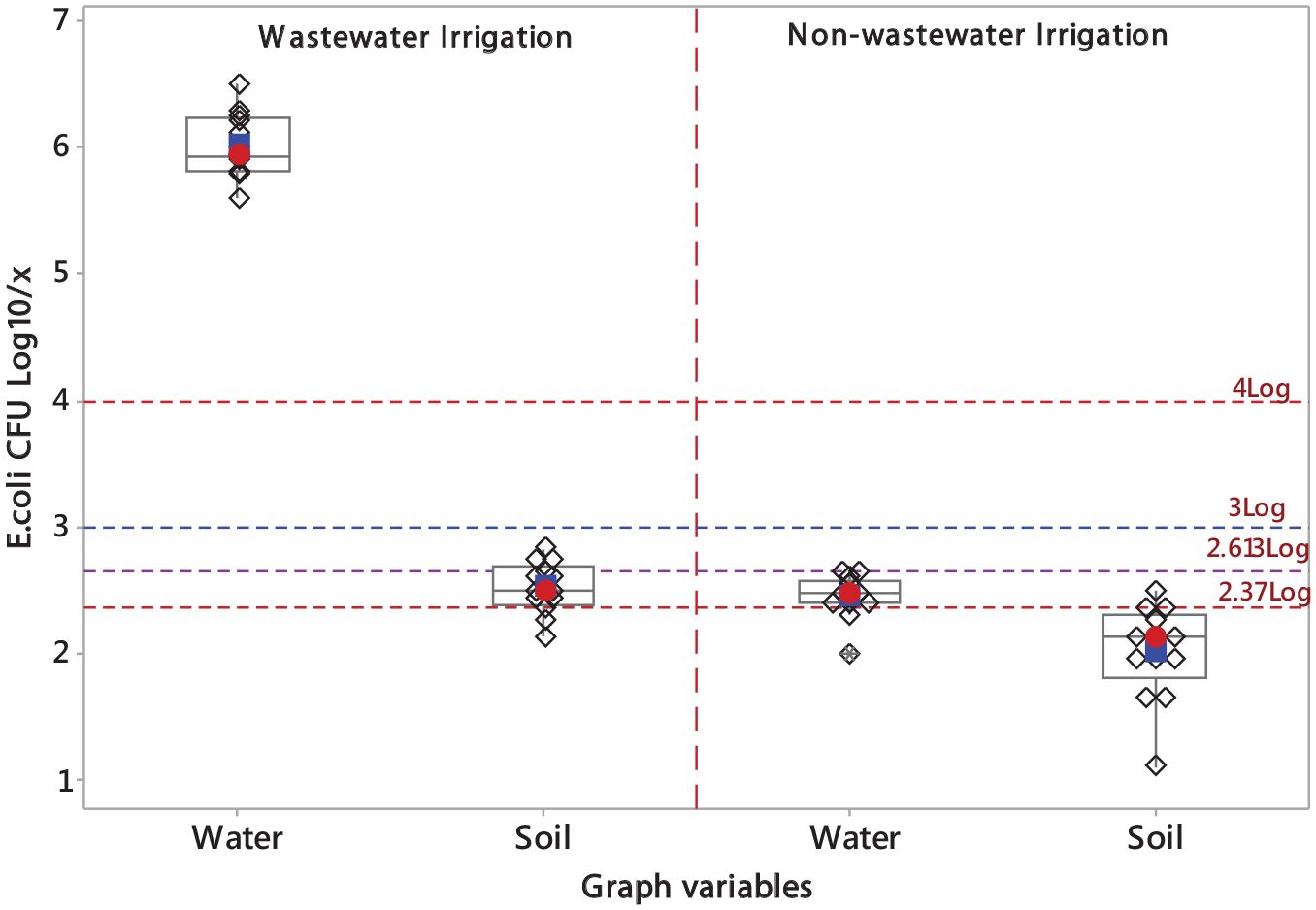
Irrigation water and soil quality by the type of water irrigation water sources.
For restricted irrigation, less than 5log10 E.coli CFU/100 ml is acceptable, whereas for unrestricted irrigation of crops eaten raw, the E.coli CFU/100 ml should be 3log10 is acceptable. 47 The irrigation water sources that have a direct trace on the edible part of a crop should not have more than 2.37log10 CFU generic E. coli/100 mL for any single sample with a geometric mean (n = 5) of ⩽2.1log10 CFU E.coli/100 mL of water. 48 More recently, the US Food and Drug Administration (USFDA) reviewed the maximum limit of the irrigation water quality criteria to a threshold value (STV) (ie, a value that should not be exceeded by more than 10% of the samples taken) ⩽2.613log10 CFU of generic E. coli/100 mL of water. 49 All of the wastewater samples did not meet the WHO standards for unrestricted irrigation water (3log 10 ) and the strictest irrigation water standards (2.37log10). Although all of the non-wastewater irrigation water sources meet the WHO standards for unrestricted irrigation, 84.6% did not met the standard for irrigation used for edible crops which has direct contact with the irrigation water.
In this study, the E.coli load in all wastewater samples was beyond the WHO’s standard for crops whose edible part can directly contact the irrigation water. This indicates that the irrigation water is not acceptable for the production of crops like lettuce and Swiss chard because these crops are low-growing crops and soil and are normally eaten raw. Likewise, the E.coli count in the present study was also much higher than the USFDA standard. However, the quality of the non-wastewater irrigation water sources is below the standards set by the WHO (4log10 CFU/100 ml) and USFDA (2.65log10/100ml) for the use of wastewater to grow crops that are normally eaten raw. The most common leafy vegetables produced in the study area, apart from lettuce and Swiss chard, include Ethiopian kale, cabbage, and cauliflower.
Fecal contamination of leafy vegetables growing on wastewater irrigation
The E.coli load on lettuce (CFU/g) varies between 1.43 ± 1.1 log10 (27 ± 12.7) at the Kality site (downstream) and 2.55 ± 0.81 log10 (3.562±6.4) at the Gofa sites; and on Swiss chard, the count varies between 1.26 ± 1.1 log10 (18 ± 12.7) at Kality sites and 2.39 ± 2.01 log10 (2.432±1.022) at Gofa sites. The maximum E.coli loads of the 2 vegetables were recorded at Gofa sites and the minimum at Kality sites (Figure 1). The wide variations between separate E.coli counts (large standard deviations) and differences in the E.coli count of the different sampling sites of the farmland along the river bank may be because of the high dynamicity of the E.coli population and thus fecal contamination at source as well.
Figure 4 shows the E.coli load on lettuce and Swiss chard produced from different irrigation water sources. For the farming plots using wastewater, the mean E.coli load on lettuce (1.89 ± 0.36 log10/g) was higher than the mean E.coli load on Swiss chard (1.64 ± 0.42 log10/g). But, in non-wastewater farming plots, the mean E.coli load for lettuce (1.11 ± 0.27 log10/g) all counts were low compared to the mean E.coli load of Swiss chard (1.14 ± 0.2 1og10/g). This may indicate the variabilities of the vegetables in providing favorable conditions under different fecal contamination levels. Researchers show that chemical factors including the availability and type of nutrients can affect the survival and growth of pathogens on vegetables. 50

E.coli concentration in the vegetables grown by using wastewater and surface and ground water.
There was no significant differences in the E.coli counts between lettuce and Swiss chard on both contaminated rivers, t(11) = 1.63, P = .12, despite the mean E.coli load of both lettuce and Swiss chard produced by using Little Akaki River being higher than the E.coli load of lettuce and Swiss chard produced by using Big Akaki River. Nevertheless, vegetables produced by using contaminated irrigation water contain significantly higher concentrations of E.coli than vegetables produced by using non-wastewater irrigation water sources, t(24) = 6.2, P < .001 for lettuce, and t(24) = 3.8, P < .001 for Swiss chard respectively. Leafy vegetables are prone to microbial contamination through several routes such as direct contact between irrigation water and the edible portion of the crop and splash of irrigation water from the soil onto the leaves at different stages of the production process.51,52 Studies in other Sub-Saharan cities also reported likewise high levels of fecal contamination of lettuce produced with wastewater. 20 Another study in Addis Ababa pointed out high levels of fecal coliforms ranging from 3.46 to 5.03 log10MPN/g on fresh lettuce produce from Akaki River. 53
The sources of E.coli on the vegetables can be through contact with the contaminated water and the soil or cross-contamination by humans during farm activities or other animals. The levels of fecal contamination of vegetables depend on the growing conditions as well as the exposure and contact with soil, manure, or irrigation water. 54 In the present study, the irrigation water and soil were unacceptable for growing all types of vegetables particularly for low-growing leafy vegetables, both the irrigation water and the soil were not appropriate. It should be understood that for both the soil and vegetables, the ultimate source of contaminants comes from the wastewater. The magnitude and variability of E.coli in the soil and vegetables depend on the E.coli load and variability in the wastewater.
The effect of E.coli load in wastewater and soil on the quality of vegetables
Due to the inflated variance of the E.coli count and a small number of zero values, a negative binomial regression model was used to evaluate the relationship between wastewater and irrigated soil with the vegetables (Table 3). The overall model fit was significant [model: x2(2) =92.97, P < .001 for lettuce, and model: x2(2) =54.33, P < .001, for Swiss chard, showing that the overall relationship between the E.coli on the vegetables and E.coli load in the irrigation water and soil was well explained. The analysis indicated that the E.coli load of both vegetables showed a significant positive relationship with the E.coli of the wastewater and the irrigated soil. For instance, with a one unit CFU increase in the irrigated soil, the log10 count of the E.coli on the lettuce is expected to increase by [0.005 (b = 0.005, P < .001, x2(2) = 92.97, 99% CI (0.002, 0.007)], given the other predictor variables in the model are held constant. For every E.coli increase in the soil, the incidence on the vegetable increases by 4.4%. Similarly, the E.coli count in the irrigated soil also showed a strong association with the E.coli count on the Swiss chard (b = 0.0055, P < .001). Although it is not significant, the irrigation water also influenced the levels of E.coli in the vegetables. For each one log 10 unit increase in the E.coli count in the wastewater, the log10 count of E.coli CFU in the Swiss chard is expected to increase by approximately 0.00002. In other words, for each log 10 unit increase of E.coli in the wastewater, in the Swiss chard, it increases by 0.4% [b = 0.0002, x2(2) = 54.3, P = .08, 99% CI (−0.00015, 0.00018)]. The morphology and structure of leaves may also affect the ability to retain water on their surface so that the survival and population size of the pathogens can vary accordingly. For instance, wrinkled, rough surface and folded leaves can retain more water and soil than smooth and unfolded varities. 55 Moreover, the binding kinetics of different pathogens to the surfaces of the leaves (adherence) may also contribute the daynamics of pathogens on the leaves surface.56,57
Negative binomial regression analysis of the effect of E.coli load of the wastewater and irrigated soil on the microbial quality of lettuce and Swiss chard.

Incidence rate ratio.
model: x2(2) lettuce = 92.97, P < .001.
model: x2(2) Swiss chard = 54.33, P < .001.
The contamination of vegetables grown in soil irrigated with fecal-contaminated water will largely depend on the survival capabilities of the pathogens in the wastewater, soil, and vegetables.58,59 Several reviews highlighted the effect of microbial quality of irrigation water on the pathogenic populations on vegetable products have been published.60,61 Several research findings also linked vegetable contamination to contact with soil,62,63 others reported that the irrigation water is more determinant.64,65 Where leaves contamination takes place, depending the type of the pathogens present and their pathogenesity, pathogen tenacity and survival may induce a risk to consumers’ health. 66 The longer the pathogens survive in the wastewater or soil, the greater the potential they have to become in contact with individuals and the environment. 67 An increased contaminant persistence and survival in the wastewater and soil increases the chance of spreading the contaminants into the community and household environment. Thus, there will be an increased risk of contamination and infections to the farmer, their families, and the consumers.
Potential risks of fecal contamination in the irrigation system
The proportion and factor analysis of the potential risk factors of fecal contamination and mitigating measures data was collected through observation and interviewing presented (Table 4). The levels of farmers’ exposure to fecal contamination were high. The greatest risk identified were as follows: approximately 90% hand contamination, 83% eating raw vegetables, 73% using their working at home, 68% using irrigation water for body washing and 68% walking through the irrigation water were the highest risk factors. On the other hand, farmers’ practice toward mitigating factors were found to be very poor, ranging from only 10% of them washing their hands with soap before eating to a maximum of 48% practicing onsite hand washing.
Descriptive Statistics of exposure variables to fecal contaminants for farmers working on wastewater irrigation (n = 197).

F* = F1, F2 etc .. referes to factor1, factor 2.
Factor analysis (multivariate analysis) was carried out for both exposure (behaviors that put farmers at risk) and mitigating variables (behaviors that protect farmers from the risk of contamination or infection) separately. The analysis indicated a strong correlation between the variables and the factors (factor in factor analysis are latent variables created as result of a set of observed variables that have similar response patterns giving different levels as factor 1, factor 2 etc). Among the exposure variables, washing vegetables with irrigation water (0.788) and consuming raw vegetables (0.827) have large loadings on factor 1 indicating that the exposure variables are strongly correlated to the factor. Hand contamination by soil and water (0.761) and using working clothes at home (0.727) have also large loadings on factor 2 indicating a strong correlations between the variables and the factor. Washing body with irrigation water (0.902) and touching body with contaminated hands (0.876) have also large positive loadings on factor 3 and 4 respectively indicating strong correlation between the exposing variables and the factor. Together, all the 4 factors explained 0.644 or 64.4% of the variation in the data. Therefore, washing vegetables with irrigation water, consuming raw vegetables, hand contamination by soil and water, using working clothes at home, washing body with irrigation water and touching body with contaminated hands are identified as the major exposure variables to the large E.coli loads in the wastewater, irrigated and vegetables.
Among the mitigating variables, wearing protective equipment (0.905) and taking a bath after farm work (0.876) have large positive loadings on factor 1 indicating strong correlation between mitigating variables and factor 1. Washing hands with soap before eating (0.766) and regular hand washing after farm work (0.679) have also large loadings on factor 3. Together, all the 3 factors explained 0.601 or 60.1% of the variation in the data. Therefore, although wearing protective equipment, taking a bath after farm work, washing hands with soap before eating and regular hand washing after farm work were poorly practiced by wastewater-irrigating farmers, they are confirmed to be key mitigating variables.
While an average 70% of the farmers are exposed to fecal contaminants as defined by “no hand washing and non changes of clothes,” an average 28% of the farmers implement mitigating factors such as wearing protective clothes, washing hands and feet (Table 4). The big difference between practicing exposure and protective behaviors indicate an increased potential of infection. The elevated levels of E coli quantified on the leafy vegetables and the absence of preventative measures such as glove use, hand washing, changing clothes before arriving in the house, there is potential for high levels of exposure to these workers. The primary drivers appear to be wash body with irrigation water, touch body with contaminated hands, eating raw vegetables, wearing protective equipment, and taking a bath after irrigation work (Table 4). Therefore, high exposure rates combined with poor hygiene behavior and low protective equipment use would actually increase the infection rate and suggest the need for an intervention. All major farm activities like forking and weeding, which are causes of hand and clothes contamination, were regarded as risk activities found to expose farmers to fecal contamination. 36 Farmers may ingest fecal contaminants when they accidentally touch their mouth, nose, or eyes with contaminated hands or clothes during farm work. Reports show that all exposed populations take in at least small quantities of soil attached to the fingers because of hand-to-mouth movement.36,68
Conclusion
The E.coli load in the wastewater compared to both WHO and FSMA FDA standards, is not acceptable for all types of vegetable production, particularly for the production of leafy, low-growing vegetables. The high level of E.coli in the wastewater contaminates the soil, which may give a conducive environment for the pathogens to survive and grow. In the presence of high levels of E.coli in the irrigation water, soil, and vegetables, and high level of exposure in the absence of using protective equipment and poor hygiene behavior, the risk of contamination for the farming households and the whole community will be high and put communities at risk of E.coli infection. Therefore, interventions such as on-farm wastewater treatment to reduce pathogen load in the wastewater and improved hygiene practice to interrupt the transmission are recommendable. To reduce the potential hazards of wastewater-related infections, relevant public health education interventions can be used to help inform the communities at greatest risk. Public health interventions are also required to inform and educate vulnerable individuals on food preparation to reduce the chances of infection for the foreseeable future. Future studies should focus on measuring actual symptomatic disease incidence in Akaki River farming populations to quantify the risk of enteric disease due to exposure to wastewater or measure levels of E coli on farmworkers hands and in their households as an exposure stepping-stone.
Footnotes
Acknowledgements
We would like to thank Water and Land Resource Center of Addis Ababa University for their timely resource support. We are very grateful to Water Security and Sustainable Development Hub, The UK Research and Innovation’s Global Challenges Research Fund (GCRF). We are also thankful to Addis Ababa Water and Swerage Authority for allowing us to work in their standard laboratory. We also appreciate Wagtech-Ethiopia for the laboratory in put supply and timely material support.
Funding:
The author(s) disclosed receipt of the following financial support for the research, authorship, and/or publication of this article: This work was partly supported by the Water Security and Sustainable Development Hub, which is funded by the UK Research and Innovation’s Global Challenges Research Fund (GCRF), Grant no.: ES/S008179/1.
Declaration of Conflicting Interests:
The author(s) declared no potential conflicts of interest with respect to the research, authorship, and/or publication of this article.
Availability of Data and Materials
The datasets used and/or analyzed during the current study available from the corresponding author on reasonable request.
Ethical Clearane
This research was carried out in accordance with the National Research Ethics Review Guidelines Fifth edition. We obtained ethical approval and clearance from National Research Ethics Review Committee, under Ethiopian Ministry of Education.