



Abstract
Ventilating indoor spaces helps prevent COVID-19 transmission. We investigated self-reported rates of opening windows to improve ventilation in the home, perceived effectiveness of opening windows, and confidence that if you wanted to, you could open windows. One in 6 people reported rarely, if ever, opening windows in their home in the last week. Three in 4 people knew that opening windows to improve ventilation was an effective way to prevent the spread of COVID-19 and 5 in 6 were confident that they could open windows in their home. Official messaging should continue to seek to improve knowledge about the effectiveness of ventilation for reducing COVID-19 transmission, and increase the frequency of window opening.
COVID-19 spreads through droplet and airborne transmission. 1 Droplet transmission occurs when an infected individual coughs, sneezes or speaks, releasing droplets into the air that deposit quickly, typically within 2 m. If there is direct air flow from an infected individual, transmission can occur at a greater distance. 2 Airborne transmission occurs when smaller aerosols carrying a virus evaporate to form droplet nuclei that remain suspended in the air for long periods. Ventilation prevents the spread of infection by diluting droplet nuclei in the air and extracting them outdoors where they are dispersed. 3 Improving ventilation in indoor spaces reduces transmission of COVID-19. 4 This is important in home settings, where other protective measures (eg, physical distancing, wearing a face covering) may be less likely, and in non-domestic settings, where there is increased household mixing. Opening doors or windows also has other health benefits by dispersing airborne pollutants. We investigated self-reported rates of opening windows to improve ventilation in the home, perceived effectiveness for opening windows, and confidence that if you wanted to, you could open windows (self-efficacy).
Data from CORSAIR, a series of nationally representative cross-sectional online surveys conducted by BMG Research on behalf of the Department of Health and Social Care, England, were used (collected 26 October to 2 December 2020; n = 10 207 responses from 10 152 participants). This period spanned the launch of a marketing campaign highlighting the importance of ventilation in reducing the spread of COVID-19 in England on 18 November 2020. 5 We asked participants how often in the last 7 days they had “opened windows to improve ventilation in [their] home.” Participants were asked to what extent they agreed that opening windows regularly to improve ventilation in indoor spaces was an effective way to prevent the spread of COVID-19 and they were confident they could open windows regularly to improve ventilation in their home and other indoor spaces. We investigated whether perceptions and behavior changed over time (comparing survey waves). We coded answers of “not applicable” or “don’t know” as missing (self-reported behavior n = 122, 1·2%; perceived effectiveness n = 216, 2·1%; confidence n = 144, 1·4%). This work was conducted as part of a service evaluation of the marketing and communications run by the Department of Health and Social Care, and so did not require ethical approval.
One in 6 people reported rarely, if ever, opening windows in their home in the last week (Table 1). Only 3 in 4 people agreed that opening windows to improve ventilation was an effective way to prevent the spread of COVID-19 and 5 in 6 were confident they could open windows. There was no difference in self-reported behaviour (χ2(20) = 15·0, P = .78), perceived effectiveness (χ2(20) = 22·3, P = .32) or confidence (χ2(20) = 22·3, P =.32) or confidence (χ2(20) = 24·3, P = .23) over time.
Numbers (n) and percentages (%) of people who reported opening their windows in the last 7 days, and perceived effectiveness of, and confidence for opening windows to improve ventilation.
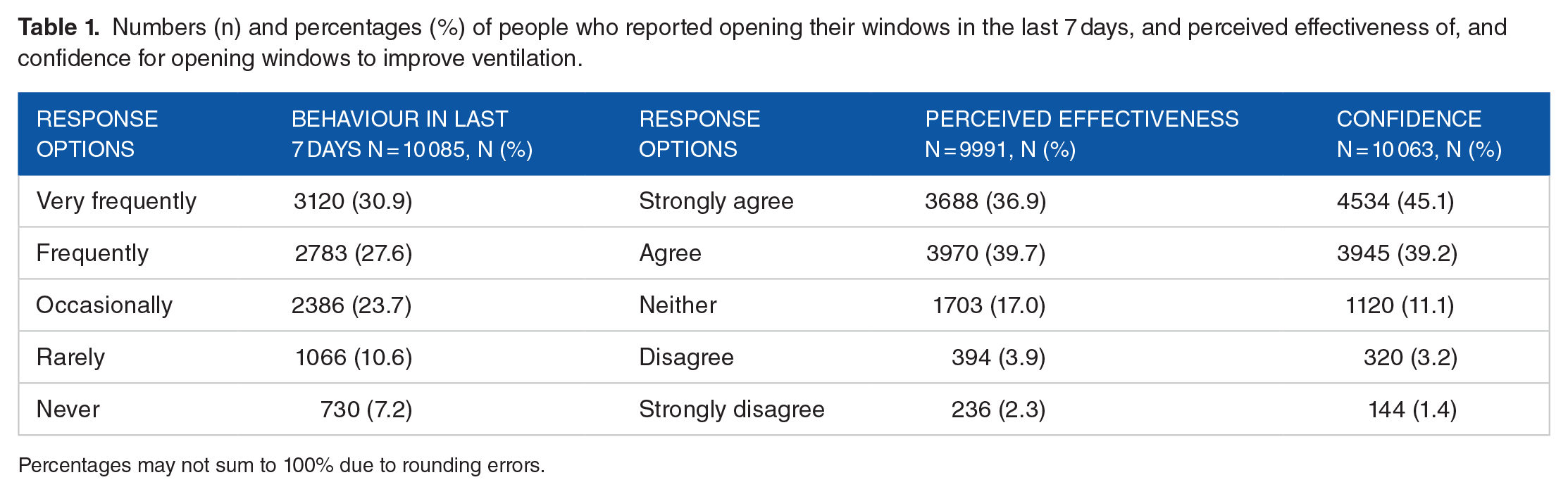
Percentages may not sum to 100% due to rounding errors.
Opening windows for short periods of time (10 minutes every hour or 2 hours) may be effective at reducing transmission without compromising temperature. The importance of ventilation in preventing the spread of COVID-19 should be emphasised in official messaging to help improve knowledge about the effectiveness of ventilation for reducing COVID-19 transmission and the frequency of people opening windows at home.
Footnotes
Acknowledgements
The authors would like to thank Professor Catherine Noakes for her contribution to the manuscript.
Funding:
The author(s) disclosed receipt of the following financial support for the research, authorship, and/or publication of this article: LS, RA and GJR are supported by the National Institute for Health Research Health Protection Research Unit (NIHR HPRU) in Emergency Preparedness and Response, a partnership between Public Health England, King’s College London and the University of East Anglia. HWWP receives funding from Public Health England and NHS England. NTF is part funded by a grant from the UK Ministry of Defence. The views expressed are those of the authors and not necessarily those of the NIHR, Public Health England, the Department of Health and Social Care or the UK Ministry of Defence. The Department of Health and Social Care (DHSC) funded data collection.
Surveys were commissioned and funded by DHSC, with the authors providing advice on the question design and selection. DHSC had no role in analysis, decision to publish, or preparation of the manuscript. Preliminary results were made available to DHSC and the UK’s Scientific Advisory Group for Emergencies (SAGE).
Declaration of Conflicting Interests:
The author(s) declared the following potential conflicts of interest with respect to the research, authorship, and/or publication of this article: All authors had financial support from NIHR for the submitted work; RA is an employee of Public Health England; HWWP receives additional salary support from Public Health England and NHS England; no other financial relationships with any organisations that might have an interest in the submitted work in the previous three years; no other relationships or activities that could appear to have influenced the submitted work. NTF is a participant of an independent group advising NHS Digital on the release of patient data. All authors are participants of the UK’s Scientific Advisory Group for Emergencies or its subgroups.
