



Abstract
Pineapple production in Benin is dominated by conventional monocropping with high levels of agrochemicals and the burning of harvest residues. This study aimed at evaluating the decomposition of pineapple harvest residues (PHR) under different modes of placement (surface mulching and burying). A complete random block design with for factor “residues application method” at two levels (surface mulching or burying) and four replications was installed in southern Benin. The residues decomposition was monitored through random sampling of eight litter bags each 60 days for the determination of residual weight, carbon (C), nitrogen (N), phosphorus (P), and potassium (K) contents. A linear mixed-effects model was carried out on the data. The results showed that buried PHR were more rapidly degraded in the soil and the analysis revealed a drop of its K (90%) and P (75%) contents at 4 months after application, while N and C contents decreased slowly until 12 months. Burying at deep of 10 cm can be recommended for direct PHR application to soil. The study highlights the importance of residue management practices in pineapple cultivation and recommends further exploration of methods to optimize the use of PHR in agricultural systems for enhanced soil health and reduced environmental impact.
Keywords
Introduction
Pineapple is one of the most important fruits, with large production in tropical and subtropical regions and great appreciation by consumers in the world (Reinhardt et al., 2018). In Benin, the pineapple production is of great economic importance, with a contribution of 4.3% to agricultural gross domestic product (GDP) behind cashew (7.4%) and cotton (25%; INStaD, 2022). Pineapple remains the only cash crop in southern Benin that allows producers including women to make a substantial profit (Alidou et al., 2022). Despite its importance, pineapple production faces numerous constraints, particularly soil fertility decline (Anani et al., 2020; Ramadhani et al., 2021). Indeed, pineapple cultivation contributes to a rapid degradation of physical, chemical, and biological characteristics of acrisoil in southern Benin (Sossa et al., 2015). Its production is dominated by conventional monocropping with high levels of agrochemicals inputs (Loeillet, 2013; Sossa et al., 2014). However, pineapple crop generates a large quantity of harvest residues estimated at around 90 to 150 t ha−1 and containing on average 678 g kg−1 of organic matter, 10 g kg−1 of total nitrogen, approximately 1 g kg−1 of phosphorus, and 11 g kg−1 of potassium (C. H. Liu et al., 2013; T. Liu et al., 2021). Despite its high availability, pineapple harvest residues are poorly valorized in Benin and are either burned or disposed of, leading to resource losses and environmental pollution (Kamaruddin et al., 2023; Sarangi et al., 2023). Returning crop residues to soil is a cost-effective and ecological method for conserving soil and water, essential for sustaining crop production (Andrews et al., 2021; Datta et al., 2019). Indeed, crop residues mineralization in the soil is important for nutrients (C, N, P, and K) release, which increase soil N, P, K, and exchangeable cations contents (Fu et al., 2021; Lui et al., 2013; Sarkar et al., 2020), leading to reducing of mineral fertilizers use (Chikae et al., 2006; Gabhane et al., 2012). Pineapple residues valorization as fertilizers is limited by its high containing of complex polymer of cellulose, hemicellulose, and lignin, which making them difficult to manage and to mineralize (Graves & Hattemer, 2000; Nguyen et al., 2021). Several authors mentioned composting or vermicomposting as a good alternative to transform pineapple harvest residues to use it as fertilizers (Irawan et al., 2023; Miito et al 2021; Sokri et al., 2023). But adoption level of composts is low, despite their proven usefulness in restoring and maintaining soil fertility, cause producers often lack time, space, and financial means to produce compost by their own (Kaboré et al., 2010; Sayara et al., 2020). Given this context, it is timely to implement effective strategies for directly recycling pineapple harvest residues to enhance soil fertility while minimizing environmental impacts. Direct recycling of pineapple harvest residues may improve its yield and fruits quality (Sossa et al., 2017, 2019).
The rate of decomposition of crop residues into soil is affected by some factors as its initial placement (Grzyb et al., 2020). Some works have evaluated the influence of placement (surface or deeper application) on rice, wheat, mungbean, and maize crop residues and have notably notified that incorporating into the soil of residues improve their decomposition process due to better contact with soil (Huang et al., 2021; Li et al., 2024; Wang et al., 2021). This increase carbon mineralization and release of N, P, and K, due to activity of soil fauna and fungal (Andrews et al., 2021; Rakesh, 2021). Indeed, residues is decomposed by microorganisms and enzymes (Su et al., 2020), and releases nutrient upon decomposition. According to Yan et al. (2019) and Han et al. (2020), nutrients release rates vary depending on their condition in residues, with the following release rate order K > P > C > N. So, residues directly release K and P for plant absorption and utilization (Hou et al., 2021; Lv et al., 2019) while C and N are gradually release depend of residues decomposition rate (Li et al., 2024). However, research specifically addressing the mineralization of pineapple harvest residues in relation to placement is lacking.
We hypothesized that burying pineapple residues in soil increase its decomposition rate and nutrients release than surface application modality. This study aims to characterize the dynamics of pineapple harvest residues decomposition and carbon, nitrogen phosphorus, and potassium release, following application methods. The findings from this study will improve our understanding on decomposition process of pineapple harvest residues depend on its valorization way. Moreover, it will provide information on the agronomic potential of the use of pineapple residues as soil amendment for partially substitution to chemical fertilizers.
Material and Methods
Study area
The experiments were carried out at two sites (06°31′N and 2°19′), (06°34′N and 2°15′E), located in southern Benin, especially in Allada municipality. This area is the main pineapple production municipality in Benin, and is located in a tropical savannah climate with dry winter (Aw) according to Köppen-Geiger climate classification scheme (Rubel & Kottek, 2010). The climate is characterized by two rainy seasons (April–July and September–November) and two dry seasons (December–March and July–August). The Average precipitation is 1,100 mm year−1 and temperature varies from 25°C to 29°C. The dominant soil type is a low-desaturated lateritic soil, commonly called “terre de barre” (Sossa et al., 2015).
Vegetable material and soil characteristics
Pineapple harvest residues proceeding from the same field were used for the experiments. Analysis of samples taken from pineapple harvest residues revealed that it contained average 1.54% N, 0.35% P, 12.73% K, 53.85% carbon, and 34.96 for C:N ratio. The litter bags of 2 mm mesh and square dimensions (0.5 × 0.5 m²) were used for experiments.
The soil of experimental site had a silty-clay-sandy texture, adequate contents of organic matter (2.85%), K (0.67 meq 100 g−1) and assimilable P (17.3 mg kg−1), moderate cation exchange capacity (CEC; 12.79 cmol kg−1) and acid (pH 5.5), and low N content (0.06%). The C:N ratio of 27 indicated a slow decomposition of organic matter by microorganisms in the soil.
Experimental design, management, and data collection
The experimental design was a complete randomized block with four replications. One factor (application method) with two levels (surface mulching and burying) was considered in this study. On each replication, there was 18 litter bags.
At the onset of the experimentation, soil composite samples were taken per block at depths 0 to 20, for assessment of the initial soil characteristics. Residues were also sampled to determine their initial chemical composition. Residues were then cut into 10 to 15 cm pieces with a cutter and introduced into litter bags (of 0.5 m² surface). For this purpose, 200 g of residues mixed with 3 kg of soil were introduced on each bag (Traoré, 2003). The litters bags were placed at the soil surface (surface mulching) or buried at usual tillage depth (10 cm depth) following the experimental design. Distances of 1 m were left between replications and between litter bags within each replication.
On each site, assessment of residues decomposition was done each 60 days by sampling one litter bag per treatment (surface mulching and burying) and per replication. The observations ended after 12 months, until complete decomposition of residues. At the sampling’ time, the residual content of each bag is obtained by sieving and drying. This residual residue is then weighed and analyzed on laboratory for determine its chemical composition (carbon, nitrogen, phosphorus, and potassium; Anderson & Ingram, 1994). For this purpose, total nitrogen was measured by Kjeldahl method’ (Fleck, 1967), total phosphorus by method of Black (1965), potassium by method of Helmke and Sparks (1996) and organic carbon by the method of Bell (1964).
Statistical analysis
The data for each parameter were submitted to a linear mixed-effects model using R nlme package (Pinheiro et al., 2017). The application method (burying or surface mulching) was considered as a fixed factor and site, replication and time were considered as random factors. Let Y ijkl be the response variable for the lth observation in the kth replication at the jth site at time i, the linear mixed-effects model was written as:

Where:
Y ijkl is the observed response for the lth observation.
β0 is the overall intercept.
β1 is the fixed effect of the treatment (burying or surface mulching).
Treatmentij is an indicator variable for the application method level (e.g. 0 for burying, 1 for surface mulching).
u0j is the random effect for site j, which is assumed to be normally distributed : u0j ∼N(0,
u1(j) is the random effect for replication k within site j, which is assumed to be normally distributed : u1k(j)∼N(0,σ2replication).
u2(j) is the random effect for time i within site j, which is assumed to be normally distributed : u2i(j) ∼N(0,
∈
ijkl
is the residual error, which is assumed to be normally distributed : ∈
ijkl
∼N(0,
The random effects u0j, u1(j) , and u2i(j) are assumed to be independent of each other and of the residual error ∈ ijkl .
Adjusted means for application methods were obtained using the lsmeans function of lsmeans package (Lenth, 2016). These means have been graphically represented using Hmisc package (Harrell et al., 2017). All the analyses were carried out in the software R 3.4.0 (R Core Team, 2017).
Results
The results of linear mixed-effects model performed on the different parameters were presented in Table 1. Notably, nitrogen, potassium, and carbon contents in the residues significantly varied over time (p < .05), while phosphorus content remained relatively stable. The interaction between time and treatment revealed a positive variation coefficient for nitrogen and carbon contents, indicating faster mineralization rates for these nutrients in buried residues compared to those applied as surface mulch. Conversely, potassium mineralization was more rapid in the surface mulching treatment.
Results of Linear Mixed-effects Model on Mineralization Dynamics of Pineapple Residues.
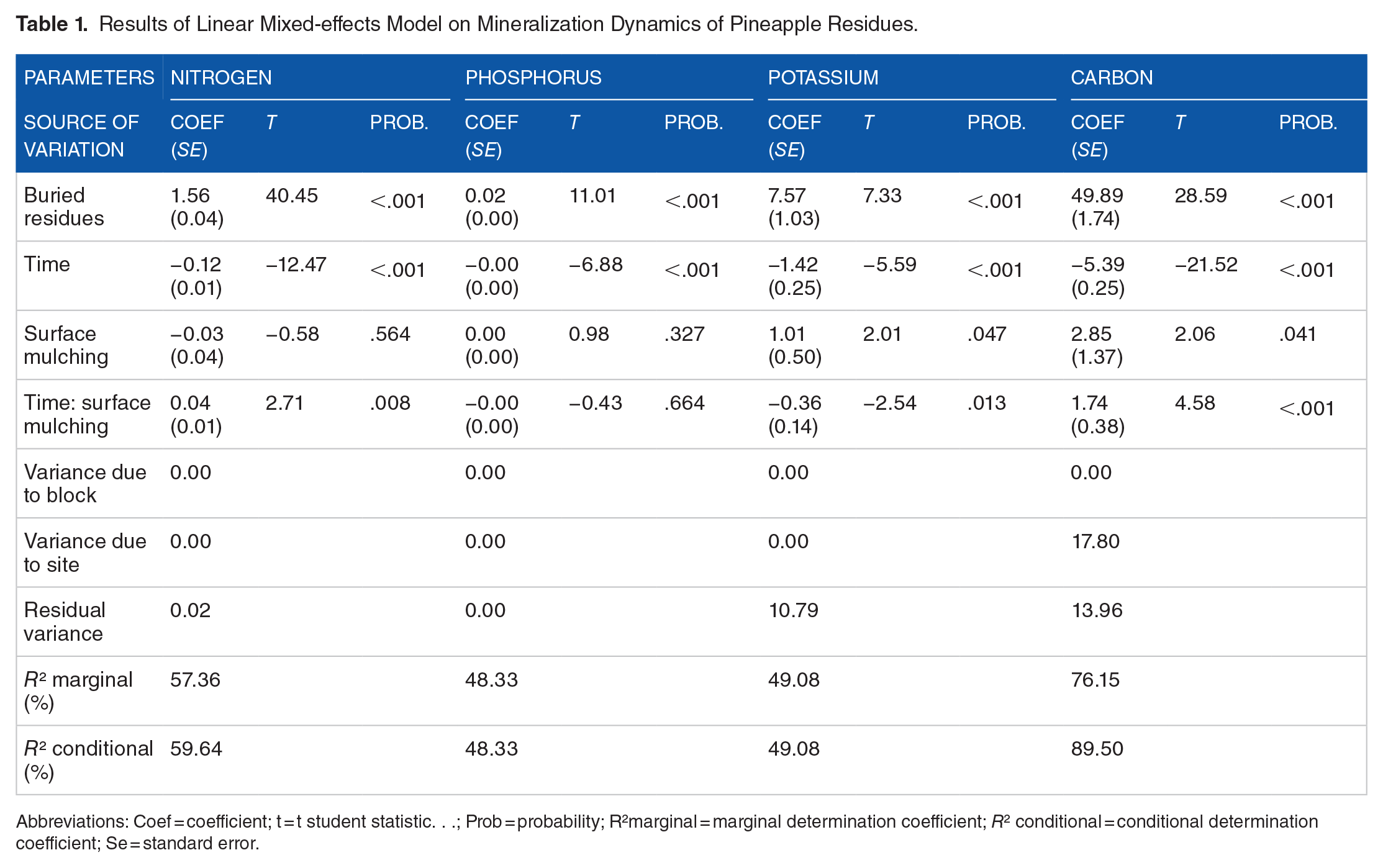
Abbreviations: Coef = coefficient; t = t student statistic. . .; Prob = probability; R²marginal = marginal determination coefficient; R² conditional = conditional determination coefficient; Se = standard error.
The decomposition dynamics of the residues exhibited a progressive decline in all nutrient contents (C, N, P, and K) over time, influenced by the application method (Figure 1).

Photo showing the disposition of litter bags containing pineapple residues during experiment.
The nitrogen content in the residues decreased steadily throughout the 12-month observation period. At each measurement point, residual nitrogen levels were consistently higher in the surface mulching treatment than in the burying treatment. After 4 months, nitrogen content had declined by 9% and 12.34% in the surface mulching and burying treatments, respectively (Figure 2a).

Influence of application method on nitrogen (a), phosphorus (b), potassium (c), and carbon (d) content of pineapple residues during the time.
The phosphorus content experienced a significant drop of 75% by the fourth month. Initially, residues under surface mulching exhibited higher phosphorus levels until the eighth month, after which there was no significant difference between the treatments (Figure 2b).
Potassium Content: The potassium content exhibited a rapid exponential decline, with reductions of 91.8% and 90.8% at the second month for the burying and surface mulching treatments, respectively. Throughout the remainder of the observation period, potassium levels stabilized at low values (0%–2%), showing negligible differences between the two application methods (Figure 2c).
Carbon content also gradually decreased over the 12 months, remaining higher in the surface mulching treatment compared to burying. After 4 months, carbon content dropped by 10.86% and 29.43% for surface mulching and burying, respectively (Figure 2d).
Discussion
Nitrogen release from pineapple harvest residues over time
Our results showed that pineapple residues nitrogen content decreased gradually, more rapidly in burying application mode than surface mulching. This finding can be attributed to the slower initial mineralization of nitrogen, influenced by the high carbon-to-nitrogen (C/N) ratio and lignin content of the PHR, as well as the acidic soil conditions (pH < 6.5). Indeed, the release of nitrogen from decaying organic materials depend of microorganisms and their activity. This process, known as ammonification, converts amino acids into ammonia (NH₃) in the presence of deaminases secreted by microorganisms (Grzyb et al., 2020). The faster nitrogen mineralization observed in buried residues is likely due to increased soil contact, which creates a more stable microenvironment conducive to microbial activity (Li et al., 2021). According to Coppens et al. (2007), microbial activity is limited by low N availability at the soil surface. Therefore, less immobilization of mineral nitrogen occurs when residues are deposited on the soil surface comparatively to incorporated into the soil (Chen et al., 2020). Our findings align with earlier studies demonstrating enhanced nitrogen release from incorporated residues compared to surface-applied ones (Chen et al., 2020; Giacomini et al., 2007).
Carbone release from pineapple harvest residues over time
The results indicated that pineapple harvest residues carbon content decrease gradually over 12 months, remaining higher when used as surface mulch compared to burying. This slower decomposition is linked to the high C/N ratio and lignin content of the residues, which restrict microbial breakdown (Grzyb et al., 2020; Lui et al., 2021). Studies have shown that burying residues enhances carbon mineralization due to improved temperature conditions that promote microbial metabolic activity (Uwamahoro et al., 2023). During decomposition, easily decomposable carbon fractions are rapidly mineralized, while more complex compounds like cellulose and lignin persist in the soil (Guo et al., 2018).
Phosphorus release from pineapple harvest residues over time
The results indicated a 75% drop in phosphorus content of residues by the fourth month. Initially, phosphorus levels were higher in the surface mulching treatment until the eighth month, after which no significant differences were noted. The substantial release of phosphorus is likely due to the initial phosphorus content in the PHR, which, combined with moderate soil phosphorus levels, facilitated nutrient mobilization (Iqbal et al., 2015). This finding is consistent with studies on other organic residues, which reported significant phosphorus release during mineralization (Saha et al., 2010; Yan et al., 2019).
Phosphorus availability is primarily influenced by microbial activity, which mineralizes organic phosphorus forms, enhancing nutrient accessibility for plant uptake (Lupwayi et al., 2007). The greater stability of buried residues likely creates a more favorable environment for phosphorus release, emphasizing the role of placement in nutrient dynamics.
Potassium release from pineapple harvest residues over time
The potassium content in PHR exhibited a rapid decline, particularly noted at the second month, with reductions of 91.8% and 90.8% for burying and surface mulching treatments, respectively. This quick release is attributed to the high potassium content in pineapple residues, which solubilizes readily upon incorporation into the soil (Li et al., 2024; Zhang et al., 2021). Our findings indicate that potassium is released rapidly regardless of the decomposition state of the residues, reinforcing its role as a critical short-term nutrient source (Yan et al., 2019). Similarly, Andrews et al. (2021) mentioned that potassium ions solubilize readily from plant material into soil solution due to potassium’s high mobility as a predominately unbound monatomic cation in plant tissues. Yadav et al. (2019) studying soybean residues mineralization found that mulching of 7.0 t of this residue added 89.7 kg of potassium to soil; and returning of 13.8 t of wheat residues added 232.2 kg of potassium to soil in 5 years. The very low difference between residues K contents in burying and surface mulching mode could be explained by the fact that the K is the nutrient most release from residues; and like the P its release rates are not influenced by whether the residues is decomposed or not (Yan et al., 2019). K is easily dissolved when residues is returned to fields, which increases soil available K levels for plant absorption and use (Wang et al., 2021; Zhu et al., 2022). Therefore, residues constitute a valuable K source in the short term but a valuable N and C source in the long term (Yan et al., 2019).
Conclusion
The study investigated the decomposition dynamics of pineapple harvest residues (PHR) under different application methods (surface mulching and burying) in acrisoil conditions in Benin. Our findings highlight the significant role of placement method on the mineralization and nutrient release profiles of residues, focusing on carbon (C), nitrogen (N), phosphorus (P), and potassium (K). The results demonstrated that burying PHR at a depth of 10 cm accelerated their decomposition rate compared to surface mulching. Specifically, buried residues exhibited faster release of potassium and phosphorus within the first 4 months, while nitrogen and carbon were released more gradually over the course of 12 months. Moreover, the research highlights the potential for integrating PHR management into sustainable agricultural practices in southern Benin. By utilizing pineapple residues effectively, farmers can enhance soil fertility while minimizing environmental impacts associated with residue disposal. Future investigations should focus on developing practical guidelines for farmers to optimize the use of PHR in their cropping systems, ultimately supporting more sustainable and productive agricultural practices.
Footnotes
Acknowledgements
The authors acknowledge the University of Abomey-Calavi for providing funds for the experiment and technical support.
Author Contributions
Elvire Line Sossa, Codjo Emile Agbangba, and Pierre Gbènoukpo Tovihoudji: conceptualization, methodology, data analysis, and original draft writing and editing. Jamali Oladédji Ayifimi, Bana Donsaré Nadège Bouko, and Oloushègun Isidore Achille Falolou: data collection and original draft writing. Guillaume Lucien Amadji: review and validation.
Declaration of Conflicting Interests
The author(s) declared no potential conflicts of interest with respect to the research, authorship, and/or publication of this article.
Funding
The author(s) disclosed receipt of the following financial support for the research, authorship, and/or publication of this article: This work was supported by the Competitive Fund Program for Research of Abomey-Calavi University (PFCR/UAC) [grant number 2].
