



Abstract
Soil erosion presents a pressing global issue that gravely impacts agriculture, food security, and the environment, necessitating immediate attention. Exploring innovative alternatives to combat soil degradation effectively is imperative while ensuring sustainable soil management. This study aims to investigate the feasibility of utilizing geo-textiles as a sustainable solution for soil erosion compared to conventional methods like weeding. The primary objective is to assess the economic efficiency of geo-textiles and rank them against traditional approaches. To achieve these objectives, we have developed mathematical models to evaluate and rank the alternatives comprehensively. The study utilized the Single Price Model method to establish a complete ranking of the alternatives. By considering economic efficiency as a key criterion, geo-textiles demonstrated their potential as a viable solution for soil erosion management, with model 4, geo-textiles made from recyclable materials, being the most efficient model of the geo-textiles studied behind the traditional plough. In conclusion, geo-textiles offer a promising alternative to traditional weeding methods, demonstrating their potential for economic efficiency and sustainable soil management. This study’s results underscore the importance of adopting innovative approaches to combat soil erosion, providing crucial guidance to decision-makers and practitioners in pursuing sustainable agricultural practices.
Introduction
Soils play a vital role in sustaining humankind (Alewell et al., 2015; Dignam et al., 2016). Consequently, soil degradation poses a significant global environmental, social, and economic problem that requires urgent solutions (Butzer, 2005; Martínez-Casasnovas & Ramos, 2006). Soil erosion can affect any biome, but it becomes a form of land degradation when erosion rates exceed the natural soil formation processes, resulting in significant soil losses (Verheijen et al., 2009).
Land degradation (Prăvălie, 2021) entails the enduring decline in a land’s biological productivity, ecological integrity, and its utility to humanity. The global extent of land degradation is estimated at between 20% and 40% of the total land area (FAO, 2021). Substantial empirical research has demonstrated that land degradation adversely impacts agricultural producers’ incomes. These impacts manifest through diminished crop yields, reduced livestock productivity, and heightened input requirements, as highlighted in studies by Barbier and Hochard (2018) and Mirzabaev et al. (2023).
Erosion is a significant problem not limited to a specific region. Studies like that of Ananda and Herath (2003) have highlighted how technical changes, inappropriate government policies, and weak institutions contribute to ongoing soil erosion in developing countries, resulting in substantial social and environmental costs in the short, medium, and long term.
In Mediterranean agricultural lands, soil erosion has been found to be higher in agricultural lands compared to forest lands and exceeding sustainable levels (García-Ruiz et al., 2013). Among agricultural lands, vineyards and orchards like olives or almonds experience the highest rates of soil erosion globally (Martínez-Hernández et al., 2017; Rodrigo-Comino, 2018; Taguas et al., 2010). Consequently, it becomes essential to identify strategies and management practices that can effectively reduce and control soil erosion rates using efficient techniques (Diyabalanage et al., 2017; Gómez et al., 2009). Previous research has suggested that catch crops, straw mulches, chipped-pruned branches, or rock fragments cover can significantly reduce soil losses and promote biodiversity (Cerdà, Rodrigo-Comino, Giménez-Morera, & Keesstra, 2018; Certini et al., 2004; Komainda et al., 2016). However, these techniques are not readily accepted by farmers, who often view them as messy or as unwanted vegetation (Marques et al., 2015; Sastre et al., 2016). Addressing this perception and finding ways to effectively implement these techniques in agricultural practices are critical steps toward sustainable soil management and erosion control in Mediterranean agricultural lands.
In that sense, implementing cost-effective and efficient measures like geo-textiles can contribute to preserving arable land, enhancing agricultural productivity, and promoting a healthier environment. Tanasă et al. (2022) mentioned that modern times have promoted natural fibers-based geo-textiles as a viable alternative to reduce the environment impact and pollution despite their limited-life service owing to their biodegradability.
Using geo-textiles can indeed be a viable option for reducing soil and water losses (Álvarez-Mozos et al., 2014; Davies et al., 2006). Previous research has shown that geo-textiles are beneficial for restoring degraded soils, including road embankments and agricultural land (Giménez-Morera et al., 2010; Hueso-González et al., 2016). To effectively combat land degradation, a country’s economy needs to be sustainable, necessitating continuous innovation and interest. One critical aspect is the transformation of residue into resources (de Vries, 2016; Yang et al., 2013). Agricultural textiles are recognized as one of the most promising products in this regard (Suits & Staff, 2014). However, the Mediterranean textile industry is facing a significant crisis due to market deregulation and higher costs compared to countries like China (Dunford et al., 2016). Hence, finding new applications and niches in the textile market is crucial, applying the potential derived from research and innovation in laboratory and field work. Innovation and new product development can play a key role in sustaining the textile industry and building a sustainable society despite these challenging circumstances (Jotisankasa & Rurgchaisri, 2018; Sumi et al., 2018).
In Valencian crop fields in Eastern Spain, soil degradation is a prominent issue caused by conventional tillage using machinery, herbicide usage to conserve bare soil, and extreme and concentrated rainfall events (Cerdà et al., 2009; Cerdà, Rodrigo-Comino, Giménez-Morera, & Novara, et al., 2018b). Furthermore, the introduction and expansion of localized irrigation over the past three decades have led to increased water consumption and the overuse of groundwater. Addressing these concerns is vital for promoting sustainable agricultural practices and soil conservation in the region.
The excessive and almost constant uncontrolled use of chemicals in agriculture, such as fertilizers, pesticides, and herbicides, aimed at increasing land yields, has resulted in extremely negative effects, including ecosystem destabilization (Choi et al., 2017; Kraaijvanger & Veldkamp, 2015). As confirmed by Calleja-Cervantes et al. (2015) in other Mediterranean fields, the intense use of herbicides in cultivated fields for more than three decades can increase soil quality loss. The widespread use of these chemical agents can lead to the proliferation of pests, mainly due to the low selectivity of insecticides used in relation to the predators and parasites of the enemies of plants grown in the trophic pyramid (Lu et al., 2007; Wu et al., 2009). Although the short-term yields of agricultural land have been increased through the use of pesticides, it is also true that the chemical dependence of this land has led to the appearance of new unknown pests, creating hard-to-solve problems in areas of intense agriculture.
Farmers play a critical role in implementing soil conservation measures, but it is also essential to manage and discuss appropriate arguments and subsidies to support their efforts (Biratu & Asmamaw, 2016; Tur-Cardona et al., 2018). Sustainable agricultural practices and reduced chemical dependency can contribute to preserving soil health and protecting the environment in the long term.
Therefore, the use of geo-textiles could emerge as an interesting alternative to ploughing or the use of herbicides to control weeds, improve organic carbon stores, and enhance infiltration and soil aggregate stability (Broda et al., 2017; Cheah et al., 2017; Faure et al., 2010). However, more research is needed to understand better the cost-effectiveness and acceptance of geo-textiles for agricultural applications. The use of geo-textiles has always been a subject of questioning, mainly due to the cost of implementation and concerns about their durability. Geo-textiles exposed to light, heat, and ultraviolet radiation may undergo degradation of the polymer chains, leading to a loss of mechanical strength (Allen, 2016; Saha et al., 2012; Sumi et al., 2018). It is crucial to address these challenges and develop durable and cost-effective solutions to promote the adoption of geo-textiles in agriculture. Research and innovation in this field can pave the way for the successful integration of geo-textiles as a sustainable soil conservation measure in agricultural practices.
Therefore, the main objective of this paper is to study the feasibility of using geo-textiles in citrus orchards as an alternative to traditional management methods like weeding. We conducted tests with four different types of geo-textile blankets: (i) synthetic fiber, (ii) natural straw, (iii) natural coconut, and (iv) recyclable textile. Our approach considers technical efficiency by evaluating agronomic and economic variables, which provides a comprehensive classification of the alternatives for mitigating soil degradation using the Data Envelopment Analysis (DEA) model. The results of this study will allow us to classify the different alternatives as efficient or inefficient.
We hypothesize that this research will significantly contribute to linking farmers, enterprises, and scientists in order to improve agricultural land management plans in Mediterranean rainfed agriculture lands. By exploring the use of geo-textiles as a sustainable soil conservation measure, we aim to promote the adoption of environmentally friendly and cost-effective practices in citrus orchards and potentially other agricultural systems.
Materials and methods
Study area
We selected a representative citrus plantation located in the experimental station for water soil erosion research in agricultural fields in the municipality of Montesa, in the Valencia region, Spain (38°56′59′N 0°39′04′W). The annual rainfall range between 500 and 715 mm. The hot season lasts 2.9 months, from June 16 to September 11, with an average daily maximum temperature exceeding 29°C (79°F). The cool season lasts 3.9 months, from November 15 to March 13, with an average daily maximum temperature below 18°C (64°F). The plot is situated inside the Canyoles River, flowing (SW-NNE) close to the Enguera Mountains. The local slopes oscillate between 8% and 14%, and the main parent materials are limestones. The soil is classified as Xerorthent (Soil Survey Staff, 2014) with a grain size distribution of 30% clay, 30% silt, and 40% sand. The total area of the plot is 4,000 m2, with 200 citrus plants cultivated on March 15, 2006, using the Clementine of Nules variety. The plantation framework is 4–5 × 7 m. The irrigation systems consist of trees with 1, 2, or 3 droppers on the soil, covering a total area of less than 2% (0.15 m2 per plant). Weeds are eliminated using herbicides, and tillage is conducted with heavy machinery.
Experimental procedure and measured economic and agronomic variables
The efficiency of four geo-textiles and traditional weeding was assessed to compare and reference traditional methods. For the assessment, 2,000 m2 of the plot were utilized, divided into five subplots with a total of 100 citrus trees planted in each subplot. The geo-textiles implemented were: (i) synthetic fibers, (ii) natural blanket 100% straw, (iii) natural blanket 100% coconut, and recyclable textile blanket.
The geo-textiles were placed to cover the surface from the tree trunk to 1 m in the furrow of each of the subplots. Each piece of geo-textile used was 2 m wide and 5 m long. The considered variables were organized into two groups or decision-making units (DMUs) with different output criteria: “more is better” and “more is worse.” In the first group, we measured the crop growth (mm), the reduced need for geo-textile replacement, and the reduced amount of irrigation needed. On the other hand, for the second group, we considered the price of the geo-textiles (obtained through surveys from both distributors and farmers as few reference prices were available) expressed in €; the number of hours required for placement; the number of holes dug during fieldwork, and the use of herbicides expressed in €/hectare. Although one of the reasons for using geo-textiles is to minimize herbicide use, sometimes small quantities are still necessary. Although such use is minimal, it was taken into consideration since one of the primary objectives was to minimize their use. The study was conducted between 2016 and 2021 (Table 1).
Variables Used to Develop the Economic Survey.

Economic assessment
Different methodologies based on multicriteria techniques have been developed to analyze efficiency (Sabaei et al., 2015; P. Wang et al., 2016). In this case, we considered using DEA. Since Charnes et al. (1978) developed DEA, demonstrating how to convert a linear measure of efficiency into a linear programming (LP) format, this model has been used to analyze the efficiency of various sectors, including tourist destinations (Lado-Sestayo & Fernández-Castro, 2018), social networks (Simon de Blas et al., 2018), transportation (Ennen & Batool, 2018), and enterprise integration (Fazlollahi & Franke, 2018). In our study, several DMUs are considered to analyze efficiency in geo-textiles. These DMUs are defined based on a set of outputs (more is better variables) and inputs (more is worse variables).
In DEA, the empirically collected information is incorporated into a fractional model to maximize the efficiency ratio while ensuring that each ratio for the various activities is equal to or less than one. The unknowns in this model are aggregation weights (Banker, 1984). DEA is a non-parametric method used to estimate production boundaries and evaluate the efficiency of a sample of production units. It compares the inputs and outputs of each DMU relative to all other DMUs to determine their relative efficiency (Sarkis, 2007). However, DEA does not provide a complete ranking but rather classifies the activities into efficient and inefficient, giving each inefficient DMU an efficiency rate of 1. Therefore, DEA may not be suitable when a differential rate for each activity is required. While DEA is useful for detecting inefficiencies, it does not provide an objective measure of efficiency.
To overcome this limitation and obtain a complete ranking of alternatives, we also use the Single Price Model (SPM), initially proposed by Banker (1984) and further developed by Ballestero (1999). The SPM allows us to obtain a comprehensive ranking of alternatives and identify the most efficient ones, which complements the results obtained from DEA analysis, especially when the number of DMUs is relatively low.
Based on the aforementioned methodology, a multi-criteria model has been developed, the procedure of which is detailed below. This model measures the relative levels of efficiency for a set of alternatives.
This methodology consists of two stages. First, the alternatives are classified as either inefficient or non-inefficient. For this purpose, the following linear program is considered for an alternative efficiency measurement (p):
Following linear program is considered for an alternative efficiency measurement (p):

s.a.




where
The model continues by identifying a single price system for non-inefficient alternatives (j = 1, 2, . . ., q,. . ., n). The model is stated as follows (Ballestero, 1999):


for all non-inefficient alternatives (j = 1, 2, . . ., n) with the non-negativity restraints,
Second, we have to add and subtract



where
Thus, model (2) to (3) becomes:



with the non-negativity restraints
The non-inefficient alternatives are non-dominated points on an efficient frontier (we assume that the feasible set of alternatives in the

where
Finally, the points (10) are introduced into the model through the restraints:

where µ = 1, 2; . . .,
The above models (8), (9), and (11) have the following single solution which does not depend on the q-alternative considered in the objective function to minimize:

Therefore, we can measure the efficiency of an j-alternative by the ratio:

where
The process of obtaining scores for each variable is applied using the SPM method to the geo-textiles, which helps prioritize the variables based on the objective criteria set with a single weighting system. This single system ensures the consistency of the collected data. The ranking of geo-textiles is then established, allowing us to select the most efficient ones and distinguish them from the less efficient ones (Ballestero, 1999). To determine if any of the methods were dominated by another, minimization models were considered using equation (1), and these models were resolved using the Lingo (Linear Generalized Optimizer) program (version 18.0). Lingo is capable of formulating and analyzing linear and non-linear problems to propose optimized results for identifying the best alternatives. All calculations and analyses were performed using the Lingo software.
Results
Application of SPM to the case study
After determining the numerical values of the variables under study, it was necessary to first determine whether any of the methods were dominated by another. For this purpose, a few minimization models had to be considered in accordance with equation (1), which was resolved using the Lingo software. This minimization model was applied to each one of the methods under study to determine which of the models are dominated and which are not (Table 2). After the minimization, we observe that 1 is assigned to the model for the synthetic fibers, which means that this model is not-dominated.
Results of the Dominance Study.

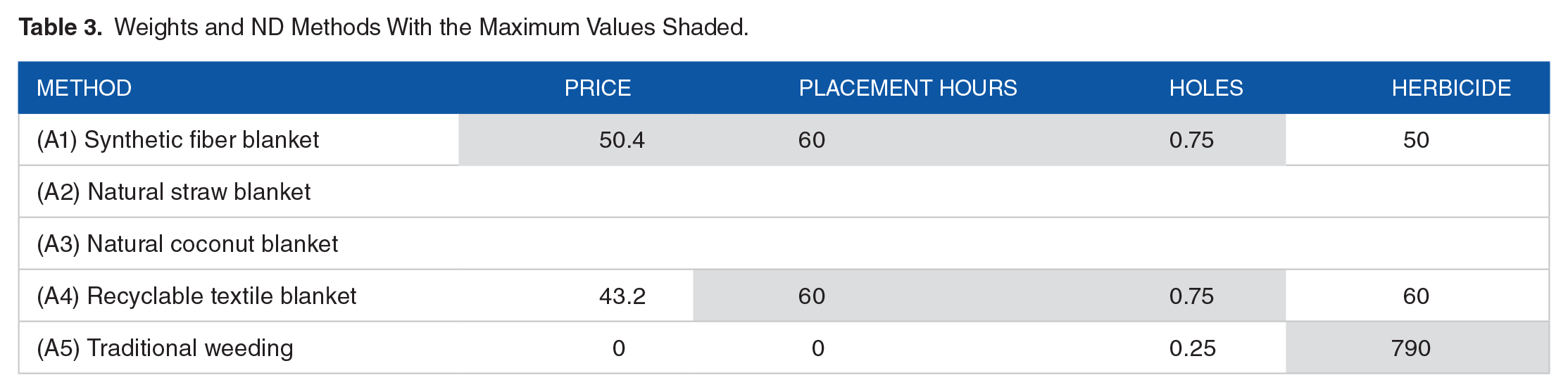
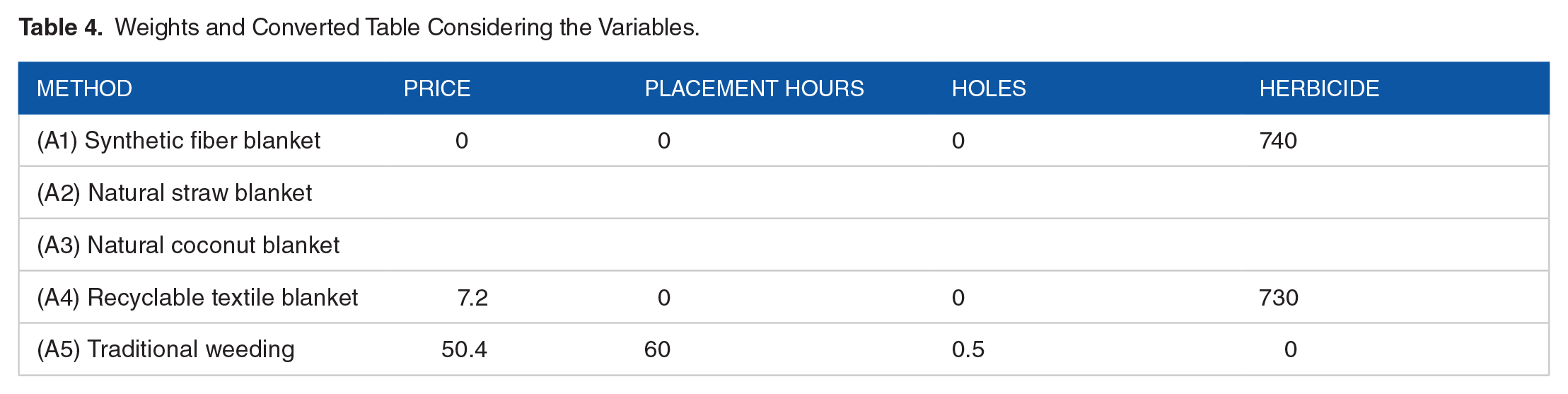
From the minimization results, it can be concluded that the synthetic fiber, the recyclable textile, and control plot models are not dominated by any of the other models. However, the natural straw model is dominated by the recyclable textile model, while the natural coconut model is dominated by a linear combination of the synthetic fiber and the recyclable textile. Continuing with this process, the variables were weighted by converting the more is worse variables (inputs) into more is better variables. For this operation, the maximum value of activities that are not dominated was calculated, and each of the model values was then subtracted from this value (Tables 3 and 4).
Weights and ND Methods With the Maximum Values Shaded.
Weights and Converted Table Considering the Variables.
Based on the results obtained from the weights, a new minimization model is established by means of equations (8), (9), and (11), with which the weights of each variable are obtained prior to the calculation of efficiency rates. These weights were:
Crop growth (W1): The study has been carried out with a citrus crop. Plant growth is one of the variables to be considered since it will determine the achievement of benefits in a greater or lesser time. Depending on the use of the geo-textiles, it has been found that their development varies. Therefore, we must consider it in the analysis since it is one of the most appreciated variables for most respondents.
Lower geo-textile replenishment (W2): Depending on the geo-textile used, its replenishment varies since inclement weather, vegetative growth of the surroundings, and consistency are reasons they must be replenished or repaired quite often. From this point of view and due to the differences, that exist between them, it was decided to take this variable as a reference.
Hours used in its installation (W3): We refer to this question by applying it as a variable since the results obtained regarding hours of installation of the geo-textile are significant when comparing and deciding on one or the other.
Price of geo-textiles (W4): From the research process carried out through surveys to both distributors and farmers, we have determined some reference prices for each geo-textile, which will serve as a reference and one of the variables to be considered.
Tillers (W5): It has been observed during fieldwork and experimentation that the number of tillers varies according to the c used. As with the previous variable, it is important to consider them since there are considerable differences between crops that use geo-textiles and those that use the traditional weeding method.
The lower amount of irrigation (W6): During the study, it was observed that depending on the geo-textile used, humidity is maintained to a lesser or greater degree; this variable is considered since it will allow us to optimize and regulate a scarce resource such as water.
Use of herbicides (W7): Although one of the applications of geo-textiles is to avoid the use of herbicides, in some of them, the use of herbicides is necessary, although in small quantities. Such use varies in very small amounts, but they are considered since, as we have indicated above, one of the main objectives is the non-use of herbicides.
After solving the problem using Lingo, the results can be seen in Figure 1.

Weights associated with models.
Efficiency indexes
The last step in the procedure is to calculate the efficiency rates. To do this, the weights obtained are multiplied by the values that correspond to each variable, calculating the ratio between the “added benefit” and “aggregate cost,” using equation (13). The resulting efficiency ratios (Figure 2A) for each model allowed us to obtain an efficiency ranking (Figure 2B) of the necessary efficiencies to be obtained without the errors that could have been incurred if the results had only been obtained using the DEA method.

(A) Efficiency ratios and (B) Efficiency ranking.
As shown in Figures 2A and B, the efficiency ratios obtained reveal that model 5 exhibits the highest efficiency index among the models considered. However, it should be noted that model 4, which employs geo-textiles made from recyclable materials, is the closest in efficiency, while straw and coconut fiber geo-textiles exhibit lower efficiency due to the negative impacts of durability and price variables compared to the other options.
Discussion
The hierarchical model based on our study of the proposals allows for the design of an efficient model, which would otherwise not have been possible, or at least would not have the necessary guarantees to optimize yields directly related to consumers’ priorities.
The efficiency ratios obtained indicate that model 5 has the highest efficiency rate compared to the others, that is, considering the characteristics of the variables studied, ploughing is the best option. These results confirm that traditional weeding or ploughing continues to be the most cost-effective means. In addition to being the most profitable in this study, they are shown to be the most efficient. In this case, it was considered preferable not to include any type of subjective environmental variable since doing so would essentially have distorted the model. However, it can be observed that model 4, geo-textiles made from recyclable materials, is the next most efficient model, reaching almost the same level as that obtained by fiber geo-textiles. The straw and coconut fiber geo-textiles are less efficient because the durability and price variables negatively affect the others.
These types of models facilitate the comparison and understanding of the efficiency that different geo-textiles can have, providing new alternatives to tackle serious environmental issues such as erosion. By identifying more efficient geo-textile options, this research opens doors for sustainable soil management practices, which in turn can lead to improved soil conservation and reduced erosion rates. For example, Fan and Rowe (2023): “Effect of geosynthetic component characteristics on the potential for geosynthetic clay liners (GCL) internal erosion.”
Moreover, expanding the use of geo-textiles in agriculture can also have positive socioeconomic impacts. For instance, using recyclable textile geo-textiles addresses soil erosion issues and promotes sustainable waste management practices by repurposing discarded materials. This approach aligns with the principles of the circular economy, fostering resource efficiency and reducing waste generation. As climate change intensifies, there is an urgent need to adopt innovative and effective strategies to mitigate its adverse effects. A clear example is the research of Molina et al. (2023), who developed a model to represent the relationship between the level of precipitation and the water contribution to reservoirs in the province of Malaga. Geo-textiles can play a crucial role in enhancing the resilience of agricultural systems to extreme weather events, such as heavy rainfall and droughts. By promoting better water retention and reducing soil losses, geo-textiles contribute to maintaining soil fertility and enhancing crop yields (Singh et al., 2019). The influence of the properties and method of use of plastic materials used to cover soils, such as the number and thickness of layers and color of the material, significantly alters soil thermal-physical properties (Al-Shammary, Kouzani, Gyasi-Agyei, Gates, & Rodrigo-Comino, 2020). However, the adoption of geo-textiles and other sustainable soil management practices relies not only on technical efficacy but also on their acceptability among farmers and stakeholders. It is crucial to consider the perspectives and preferences of the agricultural community to ensure successful implementation and long-term sustainability of these interventions.
Introducing additional variables related to environmental sustainability and industrial recycling could further enhance the decision-making process and provide a comprehensive assessment of geo-textiles’ efficiency. Including such variables would allow the model to capture the broader environmental impact and potential benefits of geo-textiles in terms of recycling materials and reducing waste. By incorporating environmental sustainability and recycling aspects, the model could shed light on the overall ecological footprint of different soil management techniques. This would enable stakeholders to make more informed decisions that align with sustainable development goals and promote responsible land use practices. Geo-textiles, especially those made from recyclable materials, can significantly reduce the environmental burden associated with traditional agricultural practices. Although ploughing might currently appear to be the most cost-effective option based on the available data, a broader consideration of the lifecycle costs and environmental impacts may reveal that geo-textiles offer a more sustainable and economically viable solution over time.
The use of geo-textiles indeed offers a wide range of applications across various fields, as evidenced by the studies conducted by L. Wang et al. (2011) on geo-textile-reinforced embankments during earthquakes, and the research by Davies et al. (2006) on the potential contribution of palm-mat geo-textiles to soil conservation. These examples demonstrate the versatility of geo-textiles, which can be utilized in engineering projects, protection measures, and agricultural practices. Considering the diverse applications of geo-textiles, it becomes increasingly crucial to study their economic efficiency. Such studies provide valuable insights into sustainable alternatives for reducing soil degradation and help make informed decisions regarding the use of geo-textiles. By employing mathematical models, decision-makers can optimize their understanding of the contributions that geo-textiles can offer in various scenarios.
Our research has also paved the way for exploring new research questions. We acknowledge a few potential limitations in our study that could guide future research endeavors. First, our focus was primarily on citrus groves, which might limit the generalizability of our results. Exploring the efficiency of geo-textiles in other types of crops could offer a broader perspective on their applicability in diverse agricultural settings. Second, investigating the influence of soil characteristics on geo-textile efficiency could be an essential area for further study. Soils with varying properties may interact differently with geo-textiles, affecting their performance and effectiveness. Examining geo-textile efficiency in regions with different soil characteristics can provide valuable insights into tailoring their use for specific soil conditions. These limitations do not diminish the significance of our findings but instead inspire future lines of research. By addressing these aspects, we can refine and expand our understanding of geo-textiles’ role in soil conservation and agricultural practices. As we continue to explore the economic and environmental benefits of geo-textiles, we move closer to adopting sustainable and efficient solutions for soil management and erosion control.
Conclusions
The article presents a thorough classification of alternatives for mitigating soil degradation using the DEA method. This classification allows for ranking different approaches and highlighting their main characteristics, providing researchers and practitioners with a clear understanding of the potential benefits and limitations of geo-textiles compared to other methods. The primary conclusion drawn from this study is that traditional ploughing emerges as the most efficient method for citrus crops. However, it is essential to note that recyclable textiles demonstrate the highest efficiency among the geo-textiles studied. Furthermore, the use of geo-textiles not only acts protectively against erosion but also presents the added advantage of recycling textile materials for agricultural purposes. Thus, their impact is twofold, addressing environmental concerns and promoting sustainable practices. The best model derived from the research findings and the ranking of activities will influence and aid in calculating parameters for projects aimed at improving crop field treatment systems. In essence, the article contributes to promoting geo-textiles as a sustainable and economically efficient solution for combating soil erosion. By employing mathematical modeling and conducting a comprehensive analysis of various alternatives, the study positions geo-textiles as a promising approach in the fight against soil degradation. Our research provides valuable insights into the effectiveness of geo-textiles and advocates for their implementation as a viable and eco-friendly strategy for soil conservation. It highlights the potential of geo-textiles as a practical and environmentally conscious alternative, ultimately contributing to the broader effort of addressing soil erosion and promoting sustainable agricultural practices.
Footnotes
Author Contributions
Antonio Giménez: research, methodology, data analysis, software, and original draft writing. Jordi Capó Vicedo: research, conceptualization, original draft writing, writing, and editing. Casandra Muñoz: research, original draft writing, review, and validation.
Funding
The author(s) received no financial support for the research, authorship, and/or publication of this article.
Declaration of Conflicting Interests
The author(s) declared no potential conflicts of interest with respect to the research, authorship, and/or publication of this article.