



Abstract
Integrating water, energy, and food (WEF) systems can generate synergies and help Eastern Mediterranean countries solve climate change-related concerns. The WEF nexus strategy provides a comprehensive and integrated approach to solving the issues faced by climate change and a roadmap toward sustainable water, energy, and food systems. The significance of understanding the WEF nexus in the context of climate change cannot be emphasized, and further study and implementation are required to reach its full potential. In this study, we investigated the available options for decision-makers to combat climate change; for example, renewable energy is seen as a critical component for assisting the water, energy, and food sectors in addressing the issues faced by climate change. Renewable energy may supply clean, dependable, and sustainable electricity for water treatment and distribution systems, agricultural and food processing enterprises, and energy-intensive businesses. In addition, for the region’s sustainable development, cooperation between Eastern Mediterranean countries in addressing the issues of climate change and the WEF nexus is crucial. Promoting cross-border commerce and establishing regional frameworks and initiatives can play a vital role in tackling these difficulties and assuring the region’s sustainable future.
Introduction
The unique geology, climate, and cultural variety of the Eastern Mediterranean region make it particularly susceptible to the effects of climate change. Turkey, Cyprus, Egypt, Israel, Jordan, Lebanon, Palestine, and Syria are included in this region (see Figure 1). They face several environmental and socioeconomic issues, including water shortages, energy insecurity, food poverty, and ecosystem destruction (Mitchell & Tanner, 2006).

Eastern Mediterranean countries (Google Maps).
In the Eastern Mediterranean, water shortage is a crucial obstacle. Several countries’ rivers, lakes, and underground aquifers meet domestic, industrial, and agricultural demands. Climate change exacerbates this problem by modifying precipitation patterns, producing an increase in evaporation, and decreasing freshwater supply (De Larramendi et al., 2020). For instance, due to climate change, declining water availability in Syria impacts agriculture and aggravates food insecurity (UNICEF, 2018).
Due to the effects of climate change, the energy industry in the Eastern Mediterranean is also experiencing substantial problems. For instance, the region’s energy consumption is growing due to population increase and economic development. However, energy production is getting more complex and expensive as the quality and availability of conventional energy sources decline. This increases economic and political concerns by heightening reliance on foreign energy (Edenhofer et al., 2011; Guler & Kumar, 2022). As a result of climate change, the Eastern Mediterranean area is also facing substantial food security issues. For instance, changing rainfall patterns, water scarcity, and soil degradation are decreasing agricultural production and heightening the danger of food shortages. These difficulties are exacerbated by the region’s rapid population increase, which places extra strain on the food supply (FAO, ECA and AUC, 2021; IPCC, 2019).
Increased temperatures and erratic precipitation patterns caused by climate change have contributed to regional water shortages (Noto et al., 2023). This has added pressure on already precious water supplies, making it harder for Eastern Mediterranean countries to satisfy their water needs. Reduced water availability has significantly influenced agriculture, a vital industry in many countries (Salem et al., 2022). The energy industry in the Eastern Mediterranean area has obstacles as well. The growing energy demand and finite energy supplies have resulted in a reliance on fossil fuels, which adds to greenhouse gas emissions and exacerbates the effects of climate change (Bamati & Raoofi, 2020).
Food security is an additional key concern in the Eastern Mediterranean. Climate change has caused soil degradation, water shortages, and declining agricultural production, making it harder for the region’s countries to satisfy their food requirements (Pozza & Field, 2020).
Regarding climate change and the related concerns of water, energy, and food, eastern Mediterranean countries confront several obstacles. Considering the interdependencies between sectors, addressing these difficulties requires integrated and sustainable methods.
Climate Change and WEF in the Eastern Mediterranean Region
The effects of climate change provide substantial concerns for the Eastern Mediterranean area. These effects influence the region’s water supplies, agriculture, and human health.
As a result of climate change-induced decreases in precipitation and increases in evaporation, the Eastern Mediterranean water supply is a significant problem. This is causing a loss in surface and groundwater supplies, making it more challenging to supply the region’s expanding water demand. The decline in available water is especially troublesome for countries already experiencing severe water scarcity. Climate change is also impacting agriculture in the Eastern Mediterranean region. Changing temperature and precipitation patterns alter the growing seasons and diminish food production. As a result, food security problems arise as agricultural yields in the region decline (Fader et al., 2020).
Human health is also affected by climate change in the Eastern Mediterranean region. Increasing temperatures and shifting precipitation patterns are causing an increase in vector-borne and other climate-sensitive diseases. This primarily impacts vulnerable groups, such as children, the elderly, and those with previous health concerns. In addition to these effects, coastal regions in the Eastern Mediterranean region are threatened by climate change. Cities, ports, and tourism infrastructure are extremely vulnerable to floods, erosion, and other consequences of rising sea levels due to climate change-induced sea level rise (Neira et al., 2023). These effects underline the need for intensified efforts in the Eastern Mediterranean area to reduce and adapt to the effects of climate change. This involves implementing sustainable water management methods, promoting food security through agriculture adaptation measures, and improving public health by tackling climate-sensitive diseases
One key issue is the region’s heavy reliance on fossil fuels, particularly oil, and gas, which contribute to greenhouse gas emissions and air pollution. Climate change may also affect the availability and quality of these resources, potentially leading to higher prices and supply disruptions. To address these challenges, there is a need for a transition toward cleaner, more diversified, and resilient energy systems. This could include increasing the use of renewable energy sources, such as solar, wind, and geothermal, as well as improving energy efficiency and reducing energy waste. In addition to these measures, there is also a need for greater cooperation and coordination among regional countries to address common energy challenges and opportunities. This could involve developing regional energy markets, sharing expertise and technology, and promoting policy and regulatory harmonization.
The Köppen-Geiger climate classification system is widely used for defining different climate zones based on temperature and precipitation patterns. The main categories of the Köppen-Geiger climate classification system are (Table 1) (Beck et al., 2018):
Köppen-Geiger Climate Classification.
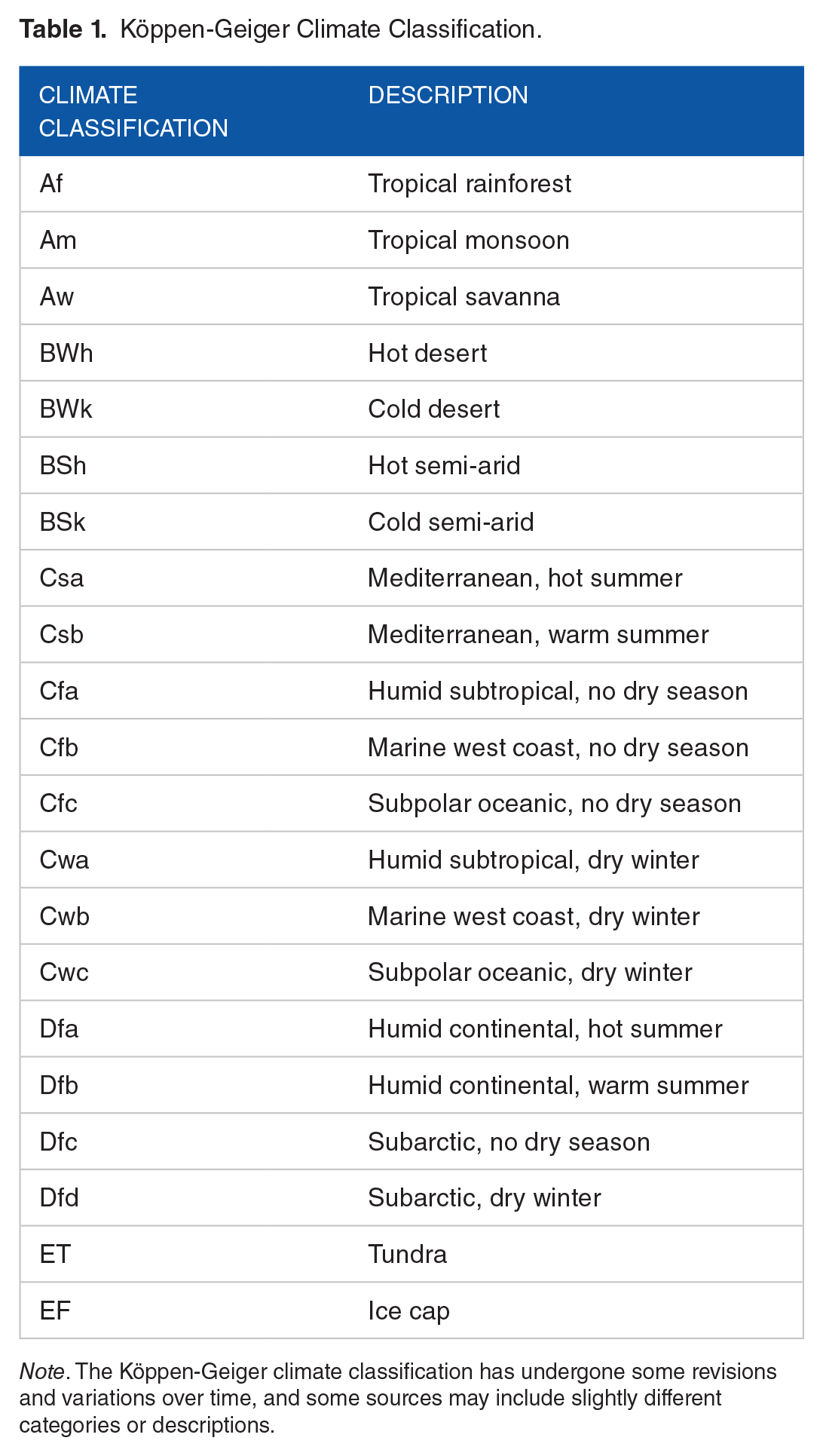
Note. The Köppen-Geiger climate classification has undergone some revisions and variations over time, and some sources may include slightly different categories or descriptions.
Addressing climate change and promoting sustainable energy systems in the Eastern Mediterranean region will require a comprehensive and collaborative approach considering the region’s unique challenges and opportunities. The following section covers the east Eastern Mediterranean;
Increased frequency and intensity of extreme weather events, such as droughts, heatwaves, and floods, can inflict considerable damage to infrastructure and agriculture due to climate change. These disasters also reduce the water flow and quality of the Nile River, the nation’s principal water supply. Hydroelectric power is one of Egypt’s key energy sources. Hence this affects the energy industry. Due to its rising population, urbanization, and industrialization, Egypt faces a growing need for this valuable resource (World Bank Climate Change Knowledge Portal, n.d.).
This demand is straining the country’s already limited water supplies, and it is anticipated that by 2025, the nation will suffer a severe water deficit. To solve this issue, the government is investing in water-saving technology such as desalination and wastewater reuse. However, these methods present environmental and economic obstacles. Egypt’s reliance on fossil fuels for energy contributes to the country’s carbon footprint and makes it more susceptible to swings in the global oil market. To remedy this, the government is investing in alternative energy sources such as solar and wind power. However, these technologies have been implemented slowly due to economic and political hurdles. Egypt has several obstacles concerning food, such as soil deterioration, water shortages, and the influence of climate change on agriculture. The government invests in sustainable agricultural methods, including irrigation and water management, to solve these issues. Nevertheless, more must be done to secure food security for the nation’s expanding population (Food and Agriculture Organization of the United Nations, 2021; International Energy Agency, 2019; United Nations Development Programme, 2018; World Bank, 2018).
Egypt faces tremendous difficulties regarding climate change, water, energy, and food security, and more must be done to solve these problems. The government invests in solutions that must be implemented more rapidly and efficiently to secure the nation’s sustainability. The Grand Ethiopian Renaissance Dam (GERD) is a massive hydroelectric power plant currently under construction on the Blue Nile River in Ethiopia. Once completed, the dam is expected to generate around 6,350 MW of electricity, making it one of Africa’s largest hydroelectric power plants. This project’s main objective is to improve Ethiopia’s energy situation and turn the country into a major electricity supplier. However, the construction of the GERD has raised concerns and conflicts with downstream countries, especially Egypt and Sudan, due to the potential impact on the water level in the Nile River. Egypt, heavily dependent on the Nile for water supply, is concerned that the GERD will reduce water flow downstream, leading to water shortages and economic damage. On the other hand, Sudan is worried about the safety of its dams downstream and the impact of the GERD on its own water supply. The dispute over the GERD has been ongoing for several years, with negotiations and talks between the three countries taking place. While some agreements and compromises have been made, there is still no final resolution. The GERD is a complex and sensitive issue involving energy and water security and political, economic, and social factors for the future of Egypt (Borowski, 2022).
Jordan faced various difficulties regarding climate change, water, energy, and food. The research emphasizes that the country’s water resources are overused and that the rising demand for water due to population increase and economic development exerts extra strain on those resources. Jordan relies significantly on imported fossil fuels to cover its energy requirements, leaving it susceptible to price swings and supply interruptions. To minimize its reliance on fossil fuels, the nation seeks to diversify its energy mix and boost renewable energy sources like wind and solar (MoEnv, 2020).
With a significant reliance on food imports and little agricultural area, Jordan also faces issues regarding food security. The country’s inability to boost food production is hindered by dry and semi-arid climate, water shortages, and soil degradation, among other vital obstacles. With estimates of higher temperatures, less precipitation, and more frequent and harsh droughts, climate change is predicted to worsen these difficulties (UNDP, 2016). These effects are anticipated to result in a drop in water resources, an increase in water stress, and a decrease in agricultural production, aggravating Jordan’s water, energy, and food security issues. Jordan has a complex and interconnected mix of water, energy, food, and climate change-related concerns. To address these difficulties, a comprehensive and integrated strategy is required that considers the interdependencies between various sectors and the effects of climate change.
The climate change situation in Palestine and its effects on water, energy, and food are complicated. It is anticipated that climate change may increase the frequency and severity of extreme weather events in Palestine, such as heat waves, droughts, and floods. Palestine has water shortages owing to limited natural resources, rapid population expansion, and ineffective water management techniques. The over-extraction of groundwater has lowered the water table and limited freshwater availability. Climate change exacerbates this problem by decreasing precipitation and evaporation rates and increasing water resource depletion (Ben Hassen et al., 2022).
Syria has relied mainly on oil and natural gas for its energy requirements. Nonetheless, the civil conflict has caused substantial damage to the nation’s oil and gas infrastructure, lowering its energy production and increasing its reliance on imports. This has contributed to the nation’s high energy prices, badly affecting the economy and household budgets. The food situation in Syria is equally precarious, with widespread food shortages and malnutrition, especially among children and women, who are vulnerable populations. Civil conflict has interrupted food production and delivery, reducing food supply and accessibility (Tabor et al., 2023). In addition, water shortages and decreased agricultural production have contributed to the country’s food insecurity and malnutrition crises. Syria’s problems with climate change, water, energy, and food are generally interconnected and intricate, and their resolution will need a concerted and persistent effort.
Lebanon is especially susceptible to precipitation patterns and water availability variations regarding food security, which can negatively affect agricultural and food production. Various initiatives are ongoing in Lebanon to boost the efficiency of water usage, reduce greenhouse gas emissions from the energy sector, and improve food security in response to these issues. For instance, there have been programs to increase rainwater collection, minimize non-revenue water, and enhance water management techniques. There are attempts in the energy sector to expand the use of renewable energy sources and enhance energy efficiency. In addition, attempts have been undertaken to improve farming methods and lessen the nation’s reliance on imported food. Climate change, water, energy, and food security are complicated and interconnected issues for Lebanon. Efforts across many sectors and stakeholder groups must be coordinated and thorough if these difficulties are to be addressed.
Concerning food security, Turkey has difficulty guaranteeing food security for its fast-expanding population, which necessitates an increase in food production and distribution. Changing weather patterns have a detrimental effect on crop production. Therefore climate change exacerbates this issue. Turkey and neighboring countries in the Eastern Mediterranean confront complex, interconnected concerns concerning climate change, water, energy, and food security. Integrated methods, collaboration across sectors, and investments in new technology and regulations are required to address these difficulties (Zarei, 2020).
Water and the climate change
Water is a critical resource for mitigating the effects of climate change and can play a crucial role in decreasing greenhouse gas emissions and delivering future-proof solutions. Improving water management methods, such as practical usage, storage, and distribution, is one strategy to achieve this goal. In addition, using renewable energy technologies such as hydropower, solar pumps, and wind-powered water treatment facilities may lower the carbon footprint of water systems and improve energy efficiency. Moreover, water conservation and the protection of wetlands and other ecosystems that serve as water sources can assist in preserving a healthy water cycle and lessen the danger of water shortages in response to climate change. Green infrastructure, such as rain gardens and green roofs, can aid in managing stormwater and alleviate pressure on water treatment facilities.
A per capita water availability below 1,000 cubic meters per year is considered water-scarce; below 500 cubic meters per year is considered severe water scarcity. Several countries, such as Jordan and Palestine, have per capita water availability below the water scarcity threshold, highlighting the importance of sustainable water management in these regions as follows (Chandio et al., 2020; FAO, 2019).
Cyprus: 154.8 cubic meters per year. Egypt: 582.8 cubic meters per year. Jordan: 86.3 cubic meters per year. Israel: 194.8 cubic meters per year. Lebanon: 826.1 cubic meters per year. Palestine: 70.7 cubic meters per year. Syria: 719.9 cubic meters per year. Turkey: 1,346.1 cubic meters per year.
Improving water efficiency in agriculture helps lower methane and other greenhouse gas emissions. Precision irrigation systems, such as sensors and drip irrigation, can reduce water loss and boost agricultural yields. Additionally, supporting sustainable agricultural methods such as conservation tillage and integrated crop management helps lower agriculture’s carbon footprint and protect water resources. Desalination has been suggested to solve the water shortage problem, especially in places with water stress or dry climates. As population expansion and industrialization raise the need for freshwater, desalination technology has become more necessary to satisfy these demands. However, desalination also has adverse environmental effects, such as the vast quantities of energy necessary to create drinkable water and the release of salty brine into the ocean, which can destroy marine life and ecosystems. Climate change exacerbates these problems since the increased frequency and intensity of extreme weather events and rising sea levels can impair the operation of interdependent desalination plants, water, and electricity networks (Elimelech & Phillip, 2011).
To counteract the effects of climate change, it is necessary to address the energy-water nexus in desalination implementation and to employ sustainable, environmentally-friendly technology, such as renewable energy sources. It has been suggested that solar energy be used in desalination operations to minimize greenhouse gas emissions and dependency on nonrenewable energy sources. Desalination can help mitigate the effects of climate change and water shortage. A holistic, sustainable strategy is vital to maintaining long-term profitability and avoiding adverse environmental repercussions (Okampo & Nwulu, 2021).
Integrating water, energy, and food (WEF) systems can generate synergies and address climate change-related concerns. For instance, using treated wastewater for irrigation can provide a sustainable water source while lowering the energy required for pumping and treating fresh water. In addition to providing electricity, hydropower may also contribute to water storage and management. These nexus techniques can enhance climate change resistance and support sustainable development. Considering the water-energy-food nexus and adopting sustainable solutions can therefore aid in combating climate change and fostering a more sustainable future.
Food and the climate change
In addition to contributing heavily to greenhouse gas emissions and climate change, food systems are very susceptible to its effects. It is estimated that agriculture, land use changes, food waste, and other variables related to food production and consumption account for more than a quarter of worldwide greenhouse gas emissions. Agriculture is impacted by climate change, including temperature and precipitation patterns, extreme weather events, and water scarcity, affecting food sources’ production, quality, and stability. On the other hand, adopting sustainable food practices and minimizing food waste can help minimize the effects of climate change and contribute to sustainable food security.
The relationship between air, soil, and climate change is complex and interrelated. Changes in one aspect of the environment can significantly impact others, creating a feedback loop that can further exacerbate environmental degradation. Climate change, for example, can lead to changes in soil properties and structure, reducing soil fertility and making it more difficult for plants to grow. In turn, changes in plant growth can affect the carbon and water cycles, further impacting the climate. Soil and air exchange gases such as carbon dioxide, water vapor, and methane. Soils can act as both a source and sink for greenhouse gases, depending on the balance between carbon inputs and outputs. Changes in land use and management, such as deforestation, can alter the balance between carbon inputs and outputs, increasing the number of greenhouse gases released into the atmosphere. The nexus approach to managing air, soil, and climate change recognizes these resources’ interdependence and seeks to optimize their use to achieve multiple goals, such as improved food security, reduced greenhouse gas emissions, and enhanced ecosystem health. For example, sustainable land use practices, such as agroforestry and conservation agriculture, can help to conserve soil health, reduce greenhouse gas emissions, and improve food security by improving crop yields and reducing the need for inputs like fertilizer and water (Lal et al., 2011).
Air, soil, and climate change are closely linked, and managing these resources in an integrated manner is crucial for addressing the challenges posed by climate change and for promoting sustainable development. Climate change is having a significant impact on air and soil quality. Air pollution, caused by emissions from human activities such as transportation, industry, and energy production, contributes to the increase in greenhouse gases and exacerbates climate change. Soil degradation, caused by overuse, erosion, and loss of organic matter, impacts soil health and increases atmospheric carbon dioxide. Recent studies have shown the negative impacts of climate change on air and soil quality. For example, a study found that climate change is causing a decline in air quality in cities, leading to increased exposure to air pollutants and a greater risk of respiratory and cardiovascular diseases. Another study showed that soil degradation reduces soil’s ability to sequester carbon and mitigate climate change. In order to address these challenges, it is essential to implement policies and practices that reduce emissions and improve air and soil quality. This includes transitioning to renewable energy sources, reducing waste, and promoting sustainable land use practices. Investing in research and development of new technologies and strategies to mitigate the impacts of climate change on air and soil quality is crucial.
Air, soil and climate change are interrelated, forming the environmental nexus. The air we breathe and the soil we grow crops in both play a crucial role in maintaining the delicate balance of our ecosystem and the quality of life on earth. On the other hand, climate change is causing changes in air and soil quality, leading to severe environmental problems such as air pollution, soil degradation, and extreme weather conditions. In the context of the environmental nexus, air and soil quality are closely linked. Poor air quality can lead to soil degradation and vice versa. For example, air pollution from industrial activities and transportation can contaminate soil and reduce its fertility, reducing crop yields. On the other hand, soil degradation caused by over-farming, deforestation, and other human activities can contribute to air pollution by releasing dust particles into the air (Dale et al., 2011).
Similarly, climate change is having a significant impact on both air and soil quality. Global temperatures are causing changes in atmospheric circulation, leading to an increase in air pollutants and the formation of ozone holes. Climate change is also causing soil erosion and degradation, reducing soil fertility and desertification. Addressing the air, soil, and climate change nexus is essential for maintaining our environment’s health and our community’s well-being. To achieve this, it is crucial to adopt integrated and sustainable approaches that address the interrelated challenges posed by air, soil, and climate change.
Heavy metal pollution can significantly impact soil and water quality, especially with industrial activities. For example, mercury contamination can result from gold mining activities, and the discharge of untreated sewage can contribute to water pollution. This can have serious health implications for communities that rely on these resources for their livelihoods. One study found that the discharge of untreated sewage and industrial effluent is a significant source of water pollution in many low- and middle-income countries. Similarly, a study conducted in the Niger Delta region of Nigeria found that heavy metal contamination in soil and water was a significant environmental concern due to oil and gas activities in the area (Prüss-üstün et al., 2016).
Energy and climate change
Energy and climate change have a complicated and multidirectional interaction. On the one hand, the energy sector contributes significantly to greenhouse gas emissions and global warming, accounting for around 70% of total CO2 emissions. According to the Intergovernmental Panel on Climate Change (IPCC) Fifth Assessment Report (2014), “the energy supply sector (including energy use for heat, electricity, and transport) accounted for about 72% of the total anthropogenic GHG emissions in 2010” (p. 49). However, more recent data from the Global Carbon Project shows that the energy sector’s share of global CO2 emissions increased to 73.1% (Intergovernmental Panel on Climate Change (IPCC), 2014; Le Quéré et al., 2020). In contrast, the shift to renewable energy sources with low carbon emissions is essential for lowering these emissions and minimizing the effects of climate change. In addition to enhancing energy security and decreasing reliance on fossil fuels, renewable energy sources such as wind and solar power may also improve energy independence. Nevertheless, the move to renewable energy creates obstacles, such as the requirement for substantial investments in research and development, infrastructure, and regulatory frameworks.
Energy consumption is a significant contributor to climate change since the combustion of fossil fuels emits greenhouse gases such as carbon dioxide, resulting in global warming and other adverse environmental effects. To combat climate change, moving to low-carbon, renewable energy sources such as solar, wind, hydro, and geothermal power is vital. In recent years, several countries have established goals and enacted laws to expand their usage of renewable energy and decrease their dependence on fossil fuels. The European Union, for instance, has set a goal of obtaining 32% of its energy from renewable sources by 2030, while China has set a goal of obtaining 15% of its energy consumption from renewable sources by 2020. In addition to lowering greenhouse gas emissions, deploying renewable energy may enhance energy security, boost local economic growth, and decrease air pollution. The International Energy Agency (IEA) emphasizes the significance of continuous investment and policy assistance to promote the broad adoption of renewable energy technology. In order to combat the difficulties of climate change and ensure a sustainable future, countries must prioritize the development of renewable energy sources.
Renewable Energy to Tackle the Climate Change
Renewable energy can play a vital part in tackling climate change’s difficulties. Renewable energy sources such as solar, wind, and geothermal create low greenhouse gas emissions, minimizing the carbon footprint and lessening climate change’s effects. Increased usage of renewable energy decreases reliance on fossil fuels, which are limited and contribute to air pollution, water pollution, and other environmental issues. While hydropower is generally considered a clean and renewable energy source, it is not without its environmental impacts. One such impact is the production of methane (CH4) from the decomposition of organic matter in reservoirs created by hydropower dams. Methane is a potent greenhouse gas with a global warming potential many times higher than carbon dioxide (CO2). The amount of methane (CH4) produced by hydropower stations varies widely depending on the size and type of the plant, as well as factors such as temperature and water flow rate. Some studies suggest that small run-of-river hydropower plants can produce up to 30 times more methane per unit of electricity generated than larger hydropower dams. However, the amount of methane produced by hydropower is generally considered small compared to other sources of greenhouse gas emissions in the energy sector (Borowski, 2022).
Renewable energy offers several advantages, including better air and water quality, decreased greenhouse gas emissions, enhanced energy security and less reliance on fossil fuels, and employment development in the renewable energy sector. In addition to renewable energy, energy efficiency initiatives such as lowering energy consumption, enhancing energy management, and using energy-efficient goods can contribute to the fight against climate change. It is feasible to minimize emissions and delay the rate of climate change by utilizing energy more effectively. The shift to renewable energy and adopting energy-efficient measures are essential to a holistic approach to addressing climate change issues. Governments, corporations, and individuals must collaborate to advance the transition to a future of sustainable, low-carbon energy.
The utilization of renewable energy sources, such as solar, wind, and hydropower, can play an essential role in supporting the water-energy-food (WEF) nexus and solving climate change issues. Renewable energy may provide a clean and sustainable energy source for desalinating salt water, pumping groundwater, and agricultural irrigation, which are essential components of the WEF nexus. Incorporating renewable energy into the WEF sector can also cut greenhouse gas emissions and aid in climate change mitigation. For instance, using renewable energy in the desalination process can lower the carbon footprint of creating fresh water. In contrast, incorporating renewable energy into irrigation systems can minimize the energy needed for water pumping. To reach the full potential of renewable energy in the WEF nexus, governments, businesses, and communities must stimulate investment, research, and innovation in this field.
In particular, wind, solar, and geothermal energy have enormous growth potential in Eastern Mediterranean countries. According to a study by the International Renewable Energy Agency (IREA), the region can generate more than one trillion kilowatt-hours (TWh) of renewable sources by 2050. This would significantly reduce the region’s reliance on fossil fuels and aid in combating climate change. With high sun irradiation levels in countries such as Egypt, Jordan, and Israel, solar energy is a promising expansion area in the Eastern Mediterranean.
Similarly, wind energy is a prospective growing sector in the region, with Cyprus, Greece, and Israel possessing significant wind resources along their coastlines. These countries also invest in offshore wind farms, which can create substantial quantities of sustainable energy. Geothermal energy also has significant growth potential in the area, notably in Turkey and Greece, which have considerable geothermal resources. Utilizing geothermal energy may reduce reliance on fossil fuels, enhance energy security, and mitigate climate change. Developing renewable energy sources in the Eastern Mediterranean may significantly address the region’s water, energy, and food security issues and foster sustainable development.
The potential for renewable energy differs per nation in the Eastern Mediterranean area. For instance, the government of Cyprus has set a target of meeting 13% of its energy consumption using renewable sources by 2020. Solar, wind, and biomass are the most potential renewable energy sources on the island. According to research by the Cyprus Institute, with its high solar irradiance, wind resources, and biomass potential, Cyprus can meet its energy demands through renewable energy sources. Egypt has also demonstrated substantial renewable energy potential, particularly solar and wind power. Egypt has a wind energy potential of up to 50 gigawatts (GW) and a solar energy potential of up to 2,000 GW, as the IREA reported. By 2022, the Egyptian government aims to get 20% of its energy from renewable sources (International Renewable Energy Agency, 2021). Jordan, which faces serious energy security and water shortage concerns, has also demonstrated renewable energy potential. According to research by the International Renewable Energy Agency, Jordan can generate 4,8 GW of wind power and 2,2 GW of solar power, which could provide almost 50% of the country’s electricity need.
Compared to other countries in the Eastern Mediterranean, the renewable energy situation in Syria and Lebanon is not well developed. In Syria, renewable energy sources have been restricted due to a lack of government financing and support and continuous conflict and instability. Due to political instability, a lack of investment, and grid inadequacies, the renewable energy industry in Lebanon has lately experienced obstacles. However, both countries have tremendous renewable energy growth potential, especially solar and wind power. Recent attempts in Syria have included the development of renewable energy, such as a solar power facility near Aleppo that seeks to create 20 MW of electricity. In addition, there are proposals to construct a wind farm in Latakia that might generate up to 200 MW of power.
Several attempts have been made to develop renewable energy in Lebanon, including creating a national renewable energy strategy to expand renewable energy sources and decrease the country’s reliance on imported fossil fuels. In addition, there have been measures to encourage solar energy, such as installing solar panels on residential and commercial buildings. In recent years, various wind farms have been planned as part of attempts to expand wind energy in the nation. Despite the obstacles, Syria and Lebanon have enormous renewable energy growth potential. The importance of renewable energy in tackling the region’s climate change, water, energy, and food security concerns is becoming increasingly apparent.
The Eastern Mediterranean area has a substantial renewable energy potential, with individual countries concentrating on different sources depending on their particular conditions and obstacles. Renewable energy development might be vital in resolving the region’s water, energy, and food security issues and guaranteeing a sustainable future. Adopting renewable energy may reduce greenhouse gas emissions, contribute to climate change, and generate new prospects for regional economic growth and job creation. In addition, renewable energy technologies such as solar and wind power may be linked with water management systems to improve efficiency and resiliency and provide a sustainable water-energy-food nexus in Eastern Mediterranean countries. For instance, using treated wastewater for irrigation can provide a sustainable water source while lowering the energy required for pumping and treating fresh water. In addition to aiding water storage and management, hydropower may produce electricity and store extra renewable energy. These nexus techniques can enhance climate change resistance and support sustainable development.
The Water-Energy-Food (WEF) Nexus to Tackle the Climate Change
Increasingly, the Water-Energy-Food (WEF) nexus is recognized as a vital tool for solving climate change challenges. Climate change impacts all three nexus components; thus, treating them as interconnected is essential to create sustainable solutions. The interdependencies of water, energy, and food systems can result in beneficial synergies, such as the efficient use of water in energy generation and energy in water delivery systems. In contrast, imbalances in the WEF nexus can lead to trade-offs and potential conflicts, such as water withdrawals for energy production and a reduction in the amount of water available for agriculture. Therefore, a nexus approach that considers the interconnection of many systems can help identify the most sustainable and practical solutions to alleviate the consequences of climate change. Hydropower and solar energy, for instance, can cut greenhouse gas emissions and provide energy security. In addition, these energy sources can reduce water use in energy production and improve water management strategies. In addition, enhanced water management and drought-resistant crops can help boost food security in the face of precipitation pattern shifts and water scarcity caused by climate change. While hydropower is generally considered a clean and renewable energy source, it is not without its environmental impacts. One such impact is the production of methane (CH4) from the decomposition of organic matter in reservoirs created by hydropower dams. Methane is a potent greenhouse gas with a global warming potential many times higher than carbon dioxide (CO2). The amount of methane (CH4) produced by hydropower stations varies widely depending on the size and type of the plant, as well as factors such as temperature and water flow rate. Some studies suggest that small run-of-river hydropower plants can produce up to 30 times more methane per unit of electricity generated than larger hydropower dams. However, the amount of methane produced by hydropower is generally considered small compared to other sources of greenhouse gas emissions in the energy sector.
A nexus approach that considers the interrelationship between water, energy, and food is vital for addressing climate change challenges and generating sustainable solutions. By acknowledging the interconnection of these systems, a more complete and integrated approach for mitigating the consequences of climate change and enhancing community resilience may be implemented.
Climate change, water scarcity, energy security, and food security are interconnected issues addressed by WEF Nexus. The WEF nexus approach recognizes that these difficulties are interconnected and that solutions in one sector may have unanticipated consequences in other areas. Recent studies have highlighted the need to analyze the WEF nexus in light of climate change. A paper published in the journal “Nature Sustainability” in 2020 demonstrated that reducing greenhouse gas emissions from the energy sector can improve water quality and availability while reducing water consumption in the energy sector can improve energy security and reduce greenhouse gas emissions.
The WEF nexus plan offers a comprehensive and integrated approach to addressing climate change challenges and a road map for sustainable water, energy, and food systems. Understanding the WEF nexus in the context of climate change is crucial, and additional research and implementation are necessary to realize its full potential.
Collaboration Between Eastern Mediterranean Countries to Tackle the Challenges
Cooperation between Eastern Mediterranean countries to address climate change, water, energy, and food security concerns is essential for sustainable development. This may be accomplished through exchanging knowledge and resources, creating regional frameworks and initiatives, and promoting cross-border commerce in these industries. Similarly, encouraging cross-border commerce in the water, energy, and agricultural sectors can be crucial in tackling climate change concerns in the Eastern Mediterranean. This might be accomplished by establishing regional trade agreements and constructing links between the energy and water systems of the region’s countries.
This collaboration might include exchanging information, technology, best practices, cooperative investment, and the execution of renewable energy projects to help the water, energy, and food industries. By collaborating, the countries of the Eastern Mediterranean can maximize the use of their resources, minimize greenhouse gas emissions, and strengthen their resistance to climate change’s effects. In addition, regional collaboration can help develop trust and minimize political tensions, enhancing the region’s capacity to address these difficulties collectively. Countries in the Eastern Mediterranean region can collaborate to tackle climate change through nexus collaboration in the following ways:
Sharing best practices and experiences: Sharing knowledge, technologies, and best practices between countries can help promote sustainable practices and support decision-making on resource use.
Joint research and development programs: Collaborating on research and development programs on water, energy, and food security can help identify the interrelations between resources and inform the development of integrated policies and practices.
Cross-border infrastructure projects: Developing cross-border infrastructure projects, such as water and energy transfer systems, can help optimize resource use and reduce the impact of climate change.
Regional cooperation on policy and regulations: Countries in the Eastern Mediterranean region can work together to develop harmonized policies and regulations that promote sustainable use of resources and support efforts to address climate change.
Joint advocacy and awareness-raising initiatives: Collaborating on advocacy and awareness-raising initiatives can help to increase public understanding of the nexus, climate change, and resource use and support efforts to tackle the challenge.
Integration of resource management into regional economic development plans: By integrating the sustainable management of resources into regional economic development plans, countries in the Eastern Mediterranean region can ensure that economic growth is achieved sustainably and that efforts to tackle climate change are aligned with broader development objectives.
Regional energy and water management systems: The countries could work together to develop and implement regional energy and water management systems that promote energy efficiency and sustainable water use. This would involve developing policies and regulations to reduce greenhouse gas emissions and promote renewable energy sources.
Joint agriculture and food security initiatives: The countries could collaborate in agriculture and food security initiatives to improve soil health and promote sustainable agriculture practices. This would involve the development of policies and regulations aimed at reducing the impact of agriculture on air, soil, and climate and promoting food security.
Environmental monitoring and reporting: The countries could work together to establish and implement regional environmental monitoring and reporting systems to track progress in addressing the challenges of the WEF nexus. This would involve collecting, analyzing, and sharing data on nexus, climate change, and their interconnections.
These are some ways that countries in the Eastern Mediterranean region could collaborate to tackle climate change through the nexus approach.
Conclusion
Renewable energy is crucial to the water-energy-food nexus for tackling climate change issues. Renewable energy sources, such as solar and wind power, may support water treatment, irrigation, and agricultural production systems with clean and reliable energy. This can help cut greenhouse gas emissions and strengthen these systems’ resistance to climate change’s effects. Incorporating renewable energy into water management and agricultural production systems can also improve their effectiveness and contribute to their long-term viability. Incorporating renewable energy into the water-energy-food nexus is essential for tackling climate change issues.
Internal commerce between the Eastern Mediterranean countries can be crucial in tackling climate change, water, energy, and food security concerns. This may entail exchanging resources, experience, and information to improve resilience and sustainability. For example, countries experiencing water shortages may benefit from increased access to desalinated water from countries with sufficient resources. In contrast, countries with excess renewable energy could trade with those experiencing energy instability. Internal commerce might also improve food security by allowing countries to diversify their food source and lessen their reliance on imports. However, political difficulties and other obstacles may impede the growth of these partnerships.
There are several ways of collaboration for Eastern Mediterranean countries, such as;
Joint research and development efforts on climate-resilient technologies, such as renewable energy sources, energy efficiency measures, and water-saving practices.
Cross-border cooperation on environmental protection, such as reducing greenhouse gas emissions and combating desertification.
Development of regional agreements on water sharing and management to ensure the sustainable use of water resources.
Joint investment in energy infrastructure, such as renewable energy power plants, to increase energy security and reduce reliance on fossil fuels.
Sharing data and knowledge on climate change impacts and best practices for mitigation and adaptation.
Promotion of sustainable agriculture and food security through developing joint agri-food projects and cross-border trade agreements.
Joint capacity building and education efforts to raise awareness and promote the adoption of sustainable practices among local communities and decision-makers.
A vital step in tackling the region’s water, energy, and food security issues is for Eastern Mediterranean countries to work together to combat climate change. This may be accomplished by exchanging knowledge and resources and establishing regional efforts and frameworks. However, the political friction between Eastern Mediterranean countries impedes regional cooperation and coordination in solving daily concerns such as climate change, water, energy, and food security. Countries in the region find it difficult to collaborate effectively and implement solutions due to their divergent political interests and historical difficulties. To successfully address the region’s urgent environmental and resource issues, it is essential to address this political friction.
Footnotes
Declaration of conflicting interests
The author declared no potential conflicts of interest with respect to the research, authorship, and/or publication of this article.
Funding
The author received no financial support for the research, authorship, and/or publication of this article.
