



Abstract
In northern Peru, the mangrove crab Ucides occidentalis is of great importance due to its ecological, economic, and social role. In this study, we reported for the first time the presence of microplastics in the gills and digestive tract of the mangrove crab U. occidentalis derived from local markets in Tumbes. Microplastics were identified in 100% of the crabs analyzed with a total of 921 items, 475 items (52.57%) found in the gills, and 446 (48.43%) found in the digestive tract. The size range was established in 2 to 250 µm, 250 to 500 µm, 500 to 1 mm, and 1 to 5 mm, microplastics with sizes between 2 and 250 µm were the most common with 53.79% in the digestive tract and 90% in the gills. A total of six different types of microplastic were recorded; The highest percentages for each tissue were fibers (59.64%–61.05%) and films (19.28%−36.63%), with clear fibers being the most prevalent microplastic type in both tissues. Microplastics with less than 250 µm size were found 90% in the gills and 53.79% in the crab digestive tract. Although the present study is a baseline for rapid identification of microplastics in mangrove crab, we suggested that these findings provided more information on the state of contamination as well as food security alert for local markets.
Background
Marine litter is mainly made up of plastic (90%) (Crawford & Quinn, 2017), with land-based sources contributing 80% of that plastic litter, associated with the fastest-growing size population and the lack of waste management infrastructure (Jambeck et al., 2015). Furthermore, direct input such as aquaculture, fisheries (loss of nets), maritime transport, and tourism (loss of litter) (Barboza et al., 2018), contributed large amounts of plastic that through currents within the Humboldt Current System (HCS) transfer floating plastic into the South Pacific Subtropical Gyre (SPSG) with highest concentration in the Oceanic and Polynesian sector (Thiel et al., 2018).
Due to its persistence for centuries and its ability to absorb chemical pollutants such as polycyclic aromatic hydrocarbons (PAH), polychlorinated biphenyl (PCB), organochlorine pesticides (OCP), diphenyl-dichloro-ethane (DDT), brominated diphenyl ethers (BDE), and organophosphorus flame retardants (OPFR) (Camacho et al., 2019; De-la-Torre, 2020) resulting in a cockatiel of contaminants (Rochman, 2015) plastic is considered a risk to the global environment, socioeconomic well-being, and an impact on food security (Botterell et al., 2019; Walkinshaw et al., 2020). However, the main concern is on any plastic particles between 1 µm and 5 mm denominated microplastic, which are created at microscale (primary microplastics) or derived through degradation in the environment (secondary microplastics) (Crawford & Quinn, 2017; Watts et al., 2014) bioavailable to wildlife (Rochman, 2015); morphological properties, including shape, size, and color of the plastic are also important for the rapid identification of main sources of contamination, exposure to biota and their fate in the environment (Rodríguez-Seijo & Pereira, 2017).
These plastic particles can interact with different species through trophic levels by ingestion; including marine mammals (Zhu, Yu et al., 2019), seabirds (Provencher et al., 2018), fish (Pannetier et al., 2020), crustaceans (Cau et al., 2019), mollusks ( Li et al., 2018), echinoderms (Plee & Pomory, 2020), corals (Rotjan et al., 2019), and zooplankton (Botterell et al., 2019); moreover, microplastics can accumulate organisms on their surface (biofouling) being able to represent potential pathogens (Kooi et al., 2017). The presence of microplastics has also been detected in commercial seafood consumed by humans (Walkinshaw et al., 2020); fish (eg, peruvian anchovie), bivalves, crustaceans (eg, blue crab), and echinoderms (Baechler et al., 2020; Li et al., 2015; Ory et al., 2017; Waddell et al., 2020). Microplastics have been shown to accumulate in the gills or gastrointestinal tract, with human exposure to plastics occurring where the whole organism is consumed (Baechler et al., 2020).
Microplastic pieces have been found in different ecosystems (Pauna et al., 2019) including coastal mangroves (Garcés-Ordóñez et al., 2019). This ecosystem functions as a natural biological filter for waste from marine and land-based sources (Martin et al., 2019); they trap marine plastic debris for years, especially when they are geographically close to maritime routes and have a large amount of pneumatophores (Cordova et al., 2021). They remove and degrade different types of contamination in water and sediment (plastic, pesticides, and heavy metals) (Moroyoqui-Rojo et al., 2015), allowing the presence of microplastics in the sediment, water column, and local aquatic organisms (including fish production from wild or aquaculture fisheries and commercial crabs) (Barasarathi et al., 2014; Cordova et al., 2021; Moroyoqui-Rojo et al., 2015).
As mentioned before, microplastic have the ability to interact with different mangrove species through trophic levels, especially in commercial seafood that may have implications for food security (Cordova et al., 2021). In Peru, the mangrove crab Ucides occidentalis plays an important role in this ecosystem, promoting the retention of nutrients, the reduction of organic matter to increase nitrogen recycling in mangrove soils, and the oxygenation and fertilization of muddy soil through the construction of its burrow (Nordhaus & Wolff, 2007; Solano & Moreno, 2009; Zambrano & Meiners, 2018). These crabs are considered ecosystem engineers, as they change the availability of resources for associated organisms by modifying the physical structure, transport conditions, and the chemistry of the substrate (Advíncula, 2017). As a commercially-exploited, edible species, its main wholesale centers are in Tumbes (El Tumpis) and Zarumilla (Puerto 25 and El Bendito), with 2,204,585 kg (70.62%) landed each year compared to the black shell (34.3%), hollow shell (3.82%), and striped shell (5.79%) (Ordinola et al., 2013). Through seafood, humans can ingest 37 microplastics annually (Baechler et al., 2020). Although humans can remove 90% of microplastics through feces, they may have an adverse effect on human health (disturbance of the gut microbiome, transfer of pollutant, and inflammatory responses) (Wright & Kelly, 2017).
In Tumbes, the mangrove receives the waters of the Tumbes River (INRENA, 2007). In the river, the city sewage is discharged directly without prior treatment, as the wastewater treatment system is not optimal and has been malfunctioning since 2007 (SUNASS, 2010). Lebreton et al. (2017) considered rivers as a main source of microplastics input. Additionally, human activities in the mangrove ecosystem: tourism, recreational activities, and marine industries (aquaculture) can affect the abundance of microplastics (Andrady, 2011). In the mangroves of Tumbes, the tourist and recreational zone comprises a total area of 137.5 ha, where U. occidentalis is located (INRENA, 2007). Also, the aquaculture of shrimp in mangrove zones (INRENA, 2007) produced microplastics that could enter directly into the mangrove environment by currents or tides (Cole et al., 2011; Deng et al., 2021). Although microplastics have been identified in a variety of edible shellfish species, (Deng et al., 2021; Walkinshaw et al., 2020), there have been no studies on the mangrove crab U. occidentalis, one of the most important crustaceans for the mangrove ecosystem in Tumbes.
Since 2022 knowledge, and practices related to the extraction of the mangrove crab U. occidentalis is considered Cultural Heritage of the Nation in Peru (R. VM N° 000036-2022-VMPCIC/MIC). This activity is carried out by 450 families in Tumbes belonging 72% to Tumbes district and 28% to Zarumilla district (PNIPA, 2018). Being the only economic activity of the crabbers, with a maximum extraction of 64 crabs per person per day, they receive the minimum wage apart from closed season when they do not carry out the activity (PNIPA, 2018). The possible absence and/or decrease of the mangrove crab would generate not only an economic loss for the families that dedicate themselves exclusively to this activity, but also a cultural one, since this activity is learned from generation to generation.
Therefore, the objective of this study is to characterize and morphologically classify the presence of microplastics in the gills and digestive tract of the mangrove crab (U. occidentalis) sourced from the main local markets in Tumbes city, Peru. The study will contribute to the development of ideas for future research in the Peruvian mangrove ecosystem, as well as for its use in integrated management plans in the marine coastal areas of Tumbes.
Methods
Sample site
U. occidentalis (Ortmann 1897) has a distribution from Isla Espiritu Santo (Mexico) to San Pedro de Vice mangrove, Sechura (Peru) (Alemán & Ordinola, 2017). In the present study, the principal city local markets were selected: El Tumpis and Tumbes Market (Figure 1).

(A) Location of Peru and (B) Tumbes region. (C) Local Markets in Tumbes city: El Tumpis and Tumbes Market.
Thirty crabs were purchased from local markets in the city of Tumbes fulfilling the minimum landing size (MLS) according to Peruvian Article No. 3 of RM 445-2014-PRODUCE with a cephalothorax width (CW) greater than 65 mm, the measurements were taken once with the crab alive (Table 1 and Figure 2). According to Zambrano et al. (2018), this size range is consistent with the age of 2 years in the mangrove crab U. occidentalis. The samples were transported in a cooler to the Universidad Nacional de Tumbes laboratory. There they were sexed according to Carbajal Enzian and Santamaría (2017), all samples were male crabs due to the Peruvian Article No. 5 of RM 445-2014-PRODUCE prohibiting the extraction and commercialization of ovigerous females.
Ucides occidentalis (mangrove crab) Average Width and Length (±SD) From Local Markets (n = 30).

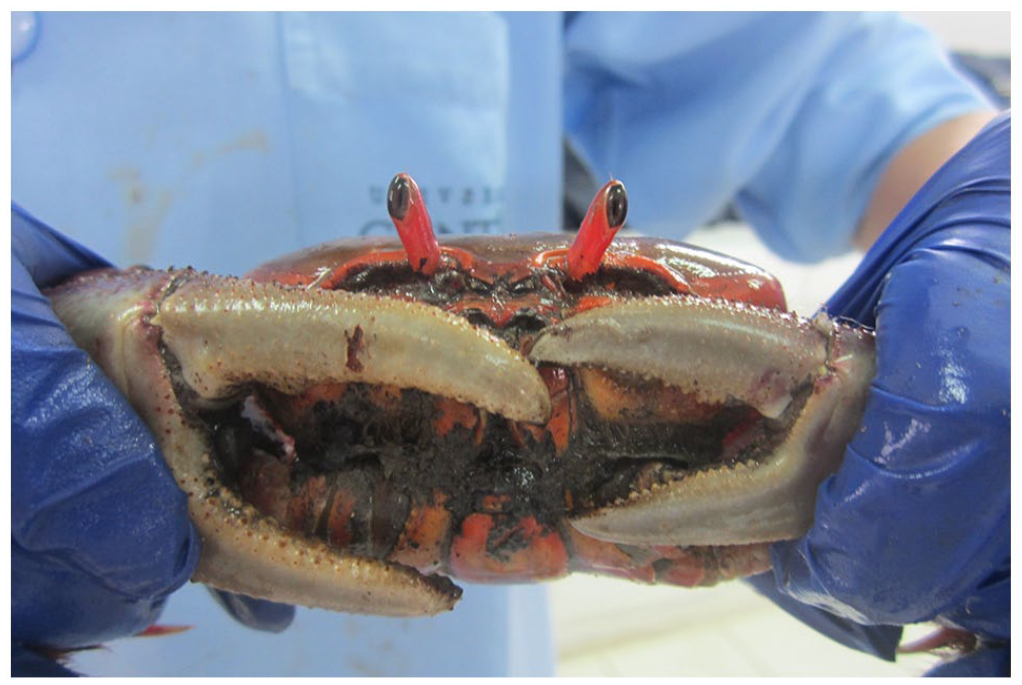
Mangrove crab (Ucides occidentalis).
The gills and digestive tract were dissected and stored in individual falcon tubes prior to digestion and characterization. To prevent airborne contamination, the falcon tubes were covered in aluminum foil and stored in a hermetical cooler at 0°C (Naji et al., 2018) to be transported to the laboratory at the Instituto del Mar del Peru (IMARPE) in Lima until further treatment.
Quality assurance
The laboratory was kept clean, all work surfaces were wiped with 70% ethanol, and all windows and doors were closed to avoid air movement.
To avoid potential contamination in treatment, KOH was filtered through a support membrane filter with a pore size of 0.2 µm and the distilled water was vacuum filtered on a cellulose membrane with a pore size of 0.45 µm (Merck) prior to use. Then, all the apparatus (falcon tubes, glass beakers, Petri dishes), were rinsed with distilled water four times before use. Air movement during filtration was minimized using a “transparent PVC vinyl protector” in the laminar flow cabinet.
Soft tissue digestion
According to Protocol 1b with a modification by Dehaut et al. (2016) approximately 50 ml of 10% KOH were added to each falcon tube to digest the organic matter and placed in an incubator at 60°C for 48 hours.
Due to its habitat in muddy areas (Alemán & Ordinola, 2017), the digested material in the digestive tract had a lot of sediments, so the sediment protocol of Coppock et al. (2017) was used to extract microplastics from the sediments found in the crab digestive tract. Therefore, 30 beakers (100 ml) were sterilized where the digestive tract and 450 ml of water were added with 83 g of NaCl and 9 g of ZnCl2. A magnetic stirrer was used to mix them for 5 minutes at 70 rpm and kept in an incubator at 30°C to avoid evaporation.
Filtration and Characterization
The supernatant in the samples was vacuum filtered over a support membrane filter (hydrophilic polyethersulfone—PES) with a pore size of 0.2 µm (Support® 100, Gelman Sciences) in a laminar flow cabinet.
The number and type of microplastics were recorded for the gills and digestive tract. Six categories were identified to classify microplastics according to their shape: foam, film, fragment, pellet, fiber, and microbead using a digital camera with the Motic Images Plus 3.0 program for visual identification and classification described by Kovač Viršek et al. (2016). There is currently no FTIR- situated in Peru limiting the capacity for verification.
FTIR-ATR analysis
The polymer characterization was performed by a FTIR-MIR-ATR Perkin Elmer Frontier Dual Range at the Department of Sciences-Chemical Section from Pontificia Universidad Catolica del Peru.
Fibers (4) were randomly chosen for the analysis. Each sample was placed on the Universal Attenuated Total Reflectance Accessory (UATR) crystal, pressed, and the spectrum was collected. Each result is the average of 64 scans, with a precision of 4 cm−1, in the mid infrared range (MIR: 380–4000 cm−1). The obtained spectra were compared with De Frond et al. (2021) polymer spectra library, the type of microplastic was determined when the correlation rate was higher than .70. The final results were processed in the program OriginPro 2022b (Origin (Pro), 2022).
Statistical analysis
To compare the abundance of microplastics between the gills and the digestive tract of the mangrove crab. First, normality (Shapiro-Wilk’s test) and homogeneity of variance (Levene’s test) were calculated. To be considered statistically significant, the p-value was established at 0.005. Data did not meet the parametric statistics criteria (Shapiro-Wilk normality test and Levene’s homogeneity test p-values < .005). Consequently, the Mann Whitney-Wilcoxon test was used to compare differences in microplastic abundance between gills and digestive tracts. No blank correction was applied; we used an air filter to avoid microplastic contamination in the laboratory fume hood. All analyzes were performed with Microsoft Excel and RStudio (R Core Team, 2016).
Results
We identified a total of 921 microplastics and established them in four ranged sizes: 2, 250, 250, 500,and 500 µm to 1, 1, and 5 mm, with 475 (52.57%) found in the gills and 446 (48.43%) found in the digestive tract. Fibers were the most common microplastic type in the gills (61.07%) and digestive tract (59.54%). The color of each type of microplastics related to the tissue was described: In the gills, a greater number of clear fibers 125 (13.57%) and black films 77 (8.36%) were found; instead, in the digestive tract clear fibers 192 (20.84%) and black fragments 81 (8.79%) were the most predominated (Figure 3). The median abundance of microplastics was significantly different (p = .0045) between the gills and digestive tract. The higher percentages of microplastics types for each tissue were fibers and films (Table 2).
Total Percentage (%) of Microplastics Type for Each Tissue (gills and digestive tract) in U. occidentalis..


Microplastic abundances according to their color type and examined tissue.
The size of the microplastic ranged from 2 to 5 mm in the gills and digestive tract of the mangrove crab. Microplastics less than 250 µm were the most common, consisting of 90% for the gills and 53.79% for the digestive tract (Figure 4). The digestive tract (46.21%) had microplastics larger sizes (0.25–5 mm) than the gills (10%) (Figure 4).

Composition of the different sizes found in the gills and digestive tract.
The spectra obtained from the randomly chosen microplastics is illustrated in Figure 5. FTIR-ATR analyses indicated that the microplastics found are made of two main polymers due to the correlation matching ratio with the standard spectrum from De Frond et al. (2021): Polyester ([polyethylene terephthalate, PET] :1714,1243,1097,726 cm−1) with a correlation rate between .91 and .96, and Polyethylene-vinyl acetate (PEVA:2243,1737,1452,1238 cm−1) with a correlation rate around .89 (Figure 5).

FTIR-MIR-ATR spectra of the main polymers found in the microplastics ingested by U. occidentalis: Polyethylene terephthalate (PET), and ethylene-vinyl acetate (PEVA). The value in parenthesis is the correlation matching ratio with the standard spectrum for each polymer.
Discussion
The present study represents the first report of microplastics in the gills and digestive tract of the mangrove crab U. occidentalis of Tumbes. Our study evidenced the presence of microplastics in 100% of the evaluated organisms. This could be due to the origin of the crab; the local markets commercialize mangrove crabs from the high intertidal zone (INRENA, 2007), and plastic pollution in this area is directly related to the number of habitants in its zone (Yin et al., 2020). Furthermore, the intertidal zone, where the crab makes it burrows, is composed of the root system of the mangrove Rhizophora mangle (Garcés-Ordóñez et al., 2019; Zambrano & Meiners, 2018); studies showed a great abundance of microplastics in the roots of the mangrove, which act like litter traps (Garcés-Ordóñez et al., 2019; Martin et al., 2019).
Crab ingestion and ventilation systems are the pathways of microplastic entry into crabs (Daniel et al., 2021). All Infraorder-Brachyura commercial crabs (Table 3) reported the presence of microplastics in edible tissue. The highest average of microplastic intake (327.56 MPs) was recorded by Patria et al. (2020), for the crab Metopograpsus quadridentatus, which as an opportunistic omnivorous- scavenger consumes a wide variety of invertebrates allowing the presence of microplastics in its food (Torn, 2020). Not et al. (2020) found 90% of the microparticles (>10 µm) inside the stomach of Parasesarma bidens, Metopograpsus frontalis and Thalamita crenata suggesting that ingestion system is the main path of microplastic intake. In our results, U. occidentalis hat 15.83 ± 4.38 (items/individual) in the gills and 14.86 ± 3.59 (items/individual) accumulating more microparticles less than 250 µm (Figure 4). Based on the results, even though it has a feeding behavior as a detritivorous species, consuming decaying mangrove leaves (Forgeron et al., 2021; Zambrano & Meiners, 2018), the ventilation system is the main path of intake for microparticles less than 250 µm.
Comparison of Microplastics Abundance and Their Morphological Properties Between Commercial Crabs of the Same Infraorder: Brachyura.

Burrowing crabs.
Gills as a mode of uptake
In this study, microplastic was significantly found in the gills than in the digestive tract (p = .0045). Detritivorous mangrove crab P. bidens, filter sediment pellets and water employing different mechanisms to store it into gills chambers (Not et al., 2020). The microplastic recovered from the gills of U. occidentalis (52.57%) (Table 2) and Neohelice granulata (77%–91%) (Villagran et al., 2020) associated with plastic particles in the water column may have been retained during gills irrigation (Villagran et al., 2020; Watts et al., 2014). This suggest that the fine structures of the gills allow microplastics to be trapped and accumulate (Brennecke et al., 2015). However, only 10% of microplastics were found in the gills of the mangrove crabs P. bidens, M. frontalis, and T. crenata, dismissing the ventilation system as a possible route of microplastic intake (Not et al., 2020). This is due to the blockage of the opening of the gastrointestinal tract caused by the microplastics, preventing their egestion, therefore it produces an increase in the retention of microplastics in the digestive system (McGoran et al., 2020).
The presence and accumulation of microplastic in gills may reduce osmoregulatory and respiratory capability due to the gas exchange that is generated in the gill’s chambers (Miller, 1961; Villegas et al., 2021). The water in the gill chamber is recycled and evaporated trickling down to the top of the legs, allowing more concentration of microplastic in the gill chamber (Villegas et al., 2021).
Digestive gland as a mode of uptake
The abundance and type of microplastic in the digestive tract are related to the crab’s feeding behavior and its role in the food web (Not et al., 2020). Crabs with opportunistic feeding behavior can consume microplastic with their food (Torn, 2020). Only microplastic with too large sizes are expelled from the digestive tract through feces (Torn, 2020).
This study showed that U. occidentalis and Eriocheir sinensis have 14.86 ± 3.59 (digestive tract) and 11.35 ± 7.91 microplastic per individual ±SD, respectively (Table 3). Both being burrowing crabs remove decaying plant material—mangrove leaves from the sediment and dragged it into their burrows for 2 weeks before its consumption (Forgeron et al., 2021; Nordhaus et al., 2011). This behavior increases their exposure to plastic waste during their burying and storing activity (Forgeron et al., 2021; McGoran et al., 2020 ). Also, this activity allowed the presence of mud in the stomach of many crabs (Clark et al., 1997). McGoran et al. (2020), evidenced 1.9% of mud in the stomach of E. sinensis and 16.0% in Carcinus maenas. As well, we evidence the presence of mud in every digestive tract of each crab. U. occidentalis is a detritivorous species that mainly ingest Rhizophora mangle leaves and organic sediment on the mangrove floor (Zambrano & Meiners, 2018).
The sediment on the mangrove floor has a great abundance of plastic particles that can be accumulated for a long time near the vegetation and possibly settle to greater depths, were crabs carry out the burying and storing activity (Maghsodian et al., 2022; McGoran et al., 2020). In the southern mangrove’s sediments of China, a total of 3,520 ± 107 microplastic per kg were reported (Zhang et al., 2020a,b), in Colombia 540 ± 137 microplastic number per hectare were collected (Garcés-Ordóñez et al., 2019). The average number of particles isolated from mangrove sediments around the world depends on the levels of human activity (Nor & Obbard, 2014). In Tumbes, recreation and aquaculture activities may affect the number of microplastic in the Peruvian mangrove’s sediment and its exposure to U. occidentalis.
Types of microplastics found
Fibers were the most common microplastic morphotype in U. occidentalis for the gills (61.05%) and the digestive tract (59.64%). The predominance of fibers is consistent with the reports of Panapeus herbstii (85%) (Waite et al., 2018), Chiromantes dehaani (59.15%) (Zhang et al., 2020a,b), N. granulata (60%) (Villagran et al., 2020), C. maenas and E. sinensis (78%) (McGoran et al., 2020). Organisms such as bivalves allow the presence of fibers during their ventilation process (Li et al., 2015, 2018; Not et al., 2020). Furthermore, the low density of fibers allows their abundance on the water surface, which is in direct contact with the crab ventilation system (Dai et al., 2018). Horn et al. (2020) found that with an increasing number of fibers in crab organs or tissue, crab mortality increased severely.
The study conducted by Syakti et al. (2017) indicated that 71% of floating microplastics with sizes between 0.33 and 5 mm are white or clear (71%), blue (19%), green (11%), red (5%), black (2%), and yellow (1%). A wide range of species such as seabirds, sea turtles and the planktivorous pelagic fish Decapterus muroadsi showed selectivity to blue (40%) microplastics ranging from 0.2 to 5 mm, resembling their copepod prey ( Ory et al., 2017). However, in our study, clear, black, and blue microplastics were the most common with sizes below 0.25 mm (Figures 3 and 4). Other studies also reported that the clear or white color is the most predominant (Daniel et al., 2021; McGoran et al., 2020; Zhang et al., 2020a), as shown in Table 3. Organisms will eat microplastics colors that resemble their natural food (Ory et al., 2018), especially light colors (clear, white, and grey) and some black colors (Engler, 2012).
Mangrove crabs feed on decaying leaves of the mangrove family trees Rhizophoraceae (Forgeron et al., 2021). Mangrove crab U. occidentalis removed Rhizophora mangle (red mangrove) leaves from the sediment and stores them in its burrow (Holguin & Bashan, 2007). Rhizophora mangle decaying leaves colors are brown and black sometimes they are covered with a thin film of detritus (Hopper et al., 1973). The microplastic color clear and black found in this study (Figure 3) resemble the mangrove crab’s food.
Microplastics with a smaller size range of 0.002 to 0.25 mm constituted 90% in the gills and 53.79% in the digestive tract of U. occidentalis (Figure 4); this is also shown in the crab Portunus pelagicus with a maximum microplastic size of 200 µm (Table 3); the presence of gastric mills apparatus in the digestive tract of crabs, function as a down food breaker (McGaw & Curtis, 2013). Microplastic agglomeration is caused by the contraction of the gastric mill and foregut muscles, tangling the fibers (Torn, 2020). The crab Nephrops norvegicus showed that the microplastic filaments are unable to be excreted and some of them are shredded into smaller fibers (Andrade & Ovando, 2017; McGoran et al., 2020).
The most common polymers ingested by crabs are polyethylene terephthalate (PET), polystyrene (PS), polyethylene (PE), polypropylene (PP), and polyamide (PA) (Yi et al., 2021). PET is the most abundant polymers found in the digestive tract of crabs (Yi et al., 2021), due to their large annual global production and their prevalence as clothing fibers,bottles for water, plastic films, food jar, microwavable packaging, etc.(Jones et al., 2020). As these polymers are denser than water (>1.35 g cm−3) they precipitate and settle down in the underlying sediments where the mangrove crabs makes its burrow (Yi et al., 2021; Zambrano et al., 2018). The polyethylene-vinyl acetate (PEVA) is originated from adhesive, foam padding, foam floats, fishing rods handles, etc. (Jones et al., 2020), in Tumbes mangroves, recreational activities include the use of plastic items that can be ingested by U. occidentalis. This study adds the first dot in the Equatorial Eastern South Pacific Ocean of the world map revision of microplastics presence in mangrove crabs of the characterize with PET and PEVA (Maghsodian et al., 2022).
Crab health and food security
The presence of microplastics in the gills and digestive tract of U. occidentalis could cause serious harm to the crab, the fine particles can block the glands of the digestive system disturbing body functions such as the absorption of nutrients, the storage of energy reserves, and the segregation of digestive enzymes (Brennecke et al., 2015). Discontinuation of these functions can lead to a decrease in the performance of the organism and in the ecosystem services it provides as the bioecological dynamic balance of the mangrove ecosystem (Brennecke et al., 2015; Zambrano & Meiners, 2018). Additionally, the retention of microplastics in the digestive tract may affect the organism’s health by giving the crab a feeling of false satiety, affecting its feeding behavior (Walkinshaw et al., 2020).
Although, the plastic particle can be detoxified on day 21 and this may result from a decapod behavior called “gill grooming,” crabs counteract microbe colonization in their gills since their habitat is exposed to microbial fouling (Farrell & Nelson, 2013; Waite et al., 2018). Waite et al. (2018), considered the possible use of this behavior to expel a large amount of microplastic from the mud crab gills Panopeus herbstii.
The translocation of plastic particles to crab organs and tissues has been identified (Brennecke et al., 2015; Crooks et al., 2019; Farrell & Nelson, 2013; Watts et al., 2014). Smaller plastic particles from Necora puber, C. maenas, and Uca rapax were found to enter the brain, ovary, gills, stomach, and hepatopancreas (Brennecke et al., 2015; Crooks et al., 2019; Watts et al., 2014).
Morphologically, the surface of the microplastics evidenced a lower degree of degradation (Figure 6). The edges of microplastics films and fragments were fractured (Figure 6B and C), and the surface of microplastics pellets had a cracked texture (Figure 6D). The surface morphology of plastic is affected by physical, biological, and chemical processes in the coastal environment producing degradation (Li, Zhang et al., 2019). Dai et al. (2018) also observed that irregular surfaces and edges in microplastics may increase the probability of attachment and adhesion of contaminants or microorganisms (biofouling), decreasing their buoyancy. Microplastic act as pollutant vector of organophosphate pesticides, found in the sediment and water of Leptuca festae and Minuca ecuadoriensis habitats, being able to enhance toxicological effects on crabs, including DNA damage, metabolic, AchE inactivation, histological, physiological damage, especially in acute and chronic exposure to this pollutant (Knapik & Ramsdorf, 2020; Villegas et al., 2021).

Different types of microplastics in mangrove crab. Fiber (A), Film (B), Fragment (C), Pellet (D), Foam (E), and Microbead (F).
The plastic association with the microbial community (plastisphere) is present in intertidal zones, and bacteria pathogens for humans and animals such as Vibrio sp., Leptolyngbya sp., and Pseudomonas spp. were attached to microplastic samples taken from the Yangtze estuary in China (Jiang et al., 2018). This can have implications for food security, especially for those species that are in direct contact with plastic particles and live in areas with no sanitary management (Walkinshaw et al., 2020). Mangrove crab meat (U. occidentalis) can be contaminated with microbial agents: Escherichia coli, Pseudomonas spp., and Salmonella spp. (Guaman Quishpi & Renteria Minuchi, 2012). The presence of microplastics in the mangrove crab shown in this study and the lack of a wastewater treatment system in the Tumbes region (SUNASS, 2010) increases the risk of contracting pathogens that could affect the organism and human health.
Through seafood, humans can ingest microplastic, especially in organisms that are consumed whole (Smith et al., 2018). In Peru, U. occidentalis consumption can be whole crab or only claws depending on the dish. The effect of microplastic in humans is based on the frequency, exposure, concentration, and chemical and/or additive adsorption in the microplastic surface (GESAMP, 2015). Also, microplastic toxicity is related to the nature, size, porosity, and hazard of the toxin (Wright & Kelly, 2017). Nevertheless, certain microplastic characteristics allow translocation through cells in the mammalian systems that affect cell health (Smith et al., 2018). Wright and Kelly (2017), explained that microplastic ingestion is a pathway for harmful bacteria that compromise immune cells.
Subsequently, microplastics in the environment can be transported throughout the food web and biomagnified (Maghsodian et al., 2022). This may affect the natural predators for U. occidentalis such as the crab raccoon (Procyon cancrivorus), estuarine fishes, the bare-throated tiger heron (Trigrisoma mexicanum), the great egret (Ardea alba) and the little blue heron (Egretta caerulea) (Diele & Koch, 2010) since these carnivorous predators could indirectly introduce microplastics into their bodies (Maghsodian et al., 2022). The bioaccumulation of microplastics in top predators can cause internal and external deleterious effects due to the concentration and/or absorption of chemicals in the microplastic surface (Capparelli et al., 2022; GESAMP, 2015). Hence, further research is needed to assess the biomagnification of these emerging pollutants in the mangrove ecosystem.
Conclusion
Our research reported the first evidence of microplastics in the gills and the digestive tract of the mangrove crab U. occidentalis. The plastic litter in the mangrove and the local markets allowed the presence of microplastics in all organisms. Being the gills the main pathway of microplastics intake in the mangrove crab, accordingly to its retention mechanisms. Although the present study is a baseline for rapid identification of microplastics in the mangrove crab, we suggested that these findings provided more information on the state of contamination as well as food security alert for the local markets of Tumbes city.
Footnotes
Acknowledgements
This study was carried out with the support of Universidad Científica del Sur, Instituto del Mar del Peru (IMARPE) and Universidad Nacional de Tumbes. Special thanks to Dr. Matthew Cole for the language and structure revision, to Dr. Betty Galarreta for the FTIR-MIR-ATR analysis, and to Consorcio Manglares del Noroeste del Peru for the information provided.
Author Contributions
AAS: Conceptualization, software, formal analysis, investigation, data curation, writing-review & editing, visualization. SP: Conceptualization, methodology, validation, resources, supervision, writing-review & editing, visualization. AGI: Conceptuali-zation, validation, resources, supervision, writing-review & editing, visualization.
Declaration of Conflicting Interests
The author(s) declared no potential conflicts of interest with respect to the research, authorship, and/or publication of this article.
Funding
The author(s) received no financial support for the research, authorship, and/or publication of this article.
Research Ethics and Patient Consent
This research was carried out according to an ethic committee “Reglamento del Comite Institucional de ética en investigación con animales y biodiversidad” from the Universidad Científica del Sur.
Clinical Trials
Not applicable
