



Abstract
Early vaping research often did not differentiate between substances vaped. The present study investigates risk perceptions for vaped nicotine and vaped cannabis. A school-based census of 9th and 11th graders yielded 431 responses to the California Healthy Kids Survey. Differences in harm perceptions were evaluated using multilevel mixed-effects models. Students were more likely to report nicotine vaping as great-moderate risk in comparison to cannabis vaping. Additionally, vaped cannabis was viewed as riskier than traditional administration. These results indicate that differences in harm perceptions may need to be addressed when targeting specific classes of substance use in investigations and interventions.
Keywords
Introduction
Early research on adolescent vaping focused on vaping as a method of nicotine consumption. As a broad class, these devices are often referred to as electronic nicotine delivery systems (ENDS) in the literature. However, youth may vape without intending to consume nicotine or referring to them as ENDS. 1 The first collection of nationwide data on adolescent vape use (ie, electronic devices that deliver psychoactive substances through inhaled aerosol or vapor) was the 2011 National Youth Tobacco Survey (NYTS), which listed e-cigarettes in a section pertaining to “Other Tobacco Products.” 2 Monitoring the Future (MTF) began collecting data on adolescent e-cigarette use in 2014, 3 a point at which the prevalence of adolescent cigarette use had fallen since the mid-1990’s.2,4 Reductions in smoking continued to drop in concert with the mass marketing of vape devices, which escalated around 2014. 2
Much of the early research related to vaping was conducted in contexts where nicotine consumption or generalized vaping was being evaluated. Since 2013, the biennial California Healthy Kids Survey (CHKS) has assessed vaping by asking high school students to report lifetime and past 30-day use of “electronic cigarettes . . . or other vaping devices . . . ” without differentiating the type of substance being used. 5 While the MTF began asking about the general class of devices in 2015, the NYTS only inquired about “e-cigarette” use; however, estimates of prevalence from MTF and NYTS have been concordant, 2 which may indicate respondents had been construing e-cigarettes as referring to the broader class of devices. In 2015 to 2017 the CHKS found a decline in lifetime and current vape use. 5 These findings align with other survey-based reports of decreased vape prevalence during 2015 to 2016, although retail sales data suggest underreporting coincided with the emergence of JUUL. 6 Hrywna et al provided further evidence that adolescents sometimes fail to report use of products such as JUUL in assessments that were intended to capture all vape (ie, ENDS) devices. 7 Even vaping experienced adolescents have been inconsistent in how they categorize various types of vaping devices. 8 Combining this finding with the imprecise conceptualization and operationalization in instruments used in substance use surveys has created challenges for interpreting changes in patterns and cognitions related to vaping. Only in 2017 did MTF begin to ask about nicotine and cannabis vaping separately. 2 Compounding the issue caused by variation in device types is the diversity of psychoactive consumables (eg, cannabis beverages and edibles).
Harm perceptions is an area that may be particularly sensitive to the low specificity of the questionnaire items used in surveys assessing health youth health behaviors. It has been established that perceptions of health harms related to nicotine use differ based on the modes of administration 9-11; Adolescents have reported perceiving “e-cigarettes” as the least risky nicotine administration mode. 9 Similarly, there are reports indicating that cannabis-using adults who prefer vaping tend to perceive traditional cannabis modes of administration to be more harmful.12,13 However, the extent to which these perceptions of lower risk are universal to the mode of administration across substances is unclear.
Objectives
The overarching aim of the present study was to compare the perceived health risks between modes of administration and consumed substances. Such comparisons would bridge previously fragmented research regarding adolescent vaping. The specific aims of the present study are: (1) reproduce earlier finding on youth’s differentiation of the perceived harms of specific substances based on the mode of administration, (2) evaluate the extent that youth differentiate the harms of vaping based on the substances being vaped, and (3) evaluate how risk perceptions differ between adolescents who have initiated substance use and those who are substance use naive. We hypothesized that both nicotine and cannabis vaping would be viewed as less risky than traditional use because they are often used as a form of harm reduction 14 and considered a cessation aid by some youth. 15 We also hypothesized that vaping cannabis would be seen as more risky than vaping nicotine due to the popular press coverage of e-cigarette or vaping product use associated lung injury that was primarily associated with cannabinoid containing consumables.16,17 We predicted that this pattern would be observed for substance use naive but not for experienced users, most of whom will have had experiences without acute harms.
Materials and Methods
Participants
In winter 2020, an attempted census of all freshmen and juniors was conducted at a suburban southern California high school. A total of 604 students participated. The participation rate was >92% of the student body and >97% of the students on campus the days of survey administration. All students capable of completing the self-administered survey instrument were eligible for the study. The district captures an area of upper-middle-class communities, with few students (10.1%) eligible for reduced-price lunches.
Procedures
Data were collected in conjunction with the biennial statewide administration of the CHKS. The CHKS assesses multiple psychosocial and health-related domains, including substance use and school connectedness. 5 As a requirement of the school district, the standardized CHKS instrumentation was used to assess the majority of the constructs measured in this study. Participants completed self-administered computerized structured questionnaires. No incentives were provided. Students without parental consent or withholding assent were discretely provided alternative activities during the survey administration period. Multiple redundant passive methods were used to ensure parental consent. Students were informed that their participation was voluntary and that their individual responses would be anonymous and confidential. Trained survey administrators from outside the community proctored the surveys. The research project was approved by the human research protection program at University of California San Diego.
Measures
The standard CHKS core instrument was used to assess demographics, substance use and harm perceptions. 5 A limited number of supplemental items related to harms perceptions were added to the instrumentation to address the study aims.
Substance use
Assessment of frequency of lifetime use listed 12 classes of substances in addition to “vape products,” a bogus item used to detect random responders, and “other drug, pill, or medicine to get high for reasons other than medical.” Response options were on a 6-point scale ranging from 0 to 7 or more times. Recent substance use explicitly assessed 5 substance classes (alcohol, cannabis, nicotine, inhalants, and prescription drugs) in addition to the “vape products” and a catch-all other drugs item. The response options ranged from 0 to 20 to 30 days on a 6-point scale. Students are also asked to report the number of times they had “five or more drinks of alcohol in a row, that is, within a couple of hours,” during the past 30 days. The use of this sex-neutral item was required for compliance with CHKS requirements.
The standardized instrument included a definition of vaping to help students construe vaping-related items. This definition read, “VAPES or VAPE PRODUCTS: Electronic devices like vape pens, e-cigarettes, e-hookah, hookah pens, e-vaporizers, tanks, pods, or mods used to inhale a vapor. Can be used to vape many things, including nicotine or just flavoring. Popular brands are JUUL, Suorin, SMOK, Zodiac Constellation, and Stiiizy.”
Harms perceptions
Perceptions of harms related to substance use relied on both standardized items and supplemental items. The item stems were consistent for all. The items read, “How much do people risk harming themselves physically and in other ways when they do the following?” This stem was followed by a series of substance-intensity combinations, including vape nicotine occasionally, vape nicotine daily, vape THC/Marijuana occasionally, vape THC/marijuana daily, smoke cigarettes occasionally, use marijuana occasionally (smoke, vape, eat, or drink), or use marijuana daily. Response options were great, moderate, slight, and none.
Analysis
Analyses excluded cases when respondents endorsed using a bogus substance, evidenced inconsistent recent and lifetime reports, or reported being untruthful. Mixed-effects ordinal logistic regression was the pre-planned analysis approach. Models for the scaled risk perception included explanatory variables for the type of substance (nicotine or cannabis), mode of administration (vaped or traditional/unspecified), and the interaction between substance and administration mode. A random effect was included for each student. Because of the random effect, the parameter estimates from this model gauge the effect of the substance and administration mode beyond the participant level demographic characteristics. Because the proportionality assumption of this model was violated, a parallel set of mixed-effects logistic regression models were conducted at each of the 3 harms thresholds in the response scale (ie, great vs moderate-none, great-moderate vs slight-none, great-slight vs none). Models were estimated using the Newton-Raphson algorithm and integration was based on adaptive Gauss-Hermit quadrature (>8 points of integration). Consistent with STROBE guidelines, inferential analysis was limited to assessing the paper’s aims. 18 All confidence intervals (CI) are reported at the 95% confidence level.
Models were stratified by participants’ substance use history. Participants were grouped by whether or not they reported any lifetime substance use. This approach was taken to distinguish among adolescents who were at higher risk of using cannabis or nicotine based on unmeasured developmental and environmental determinants, such as parental monitoring and pre-initiation normative escalation of positive substance use expectancies.19,20
Several exploratory analyses were conducted to evaluate the sensitivity of the findings to analytic choices. Sex was entered as a main effect and a set of interaction terms with the type of substance, mode of administration, and their interaction (a 3-way interaction). The significance of the addition of the 3 interaction terms as a group was evaluated with a likelihood ratio test comparing the base model to the model with the interaction terms. 19 A set of models was also run where models were stratified by lifetime cannabis use history and nicotine use history rather than lifetime substance use history as was used in the primary analyses.
Results
Sample characteristics
Overall, the proportion of girls in the sample was 50.3%. The majority (69.6%) of students reported being white, and 18.5% reported being Hispanic or Latina/o. Almost all students (97.2%) lived at home with a parent. Most (81.0%) had a parent with a college degree. The distribution of these demographic characteristics was similar across grades and evidenced few substantial differences between the lifetime substance use experienced and the substance use naive students (Table 1). The most notable difference was for academic grades, where substance use naive students were more likely to report receiving good grades as compared to substance use experienced students (Table 1). Only 1.6% of cases were excluded based on being flagged as a random responder.
Sample description.

>4 Drinks/event.
Overall, 47.6% of the students reported using one or more substances in their lifetime. In terms of substances, 31.0% reported using cannabis and 4.0% reported having used a whole cigarette in their lifetimes. In this sample, 30.1% reported using an “electronic cigarette or other vaping device” in their lifetimes. Of the lifetime substance users, 65.5% reported having used cannabis and 63.6% reported having vaped. Items regarding recent use indicated that 30.0% of students used one or more substances in the past 30 days. Of those reporting any lifetime substance use, 33.0% of students reported recent cannabis use and 1.5% reported recent cigarettes use. For vaping, 26.1% of substance-experienced students reported having used an e-cig or vape device in the past 30 days.
Harms perceptions
The level of perceived harm of daily substance use was contingent on both mode of administration and the substance (Table 2). Patterns of perceived harms also varied based on lifetime substance use experience (Figure 1, Supplemental Table S1, LR χ2interaction = 31.23, df = 3, P < .0001). Each of the models for the 2 highest risk thresholds demonstrated clear evidence of associations (Table 2; P’s < .0002) and moderate evidence for the lowest risk threshold (P = .011) for students without lifetime substance use experience. Among these students, vaping as a mode of cannabis administration received 18.2% more reports of great harms as compared to general cannabis use (OR = 1.68, CI = 1.13, 2.50). This was similar to what was observed for great-to-moderate risks (Figure 1). As for vaping nicotine, it was less frequently reported as a great risk than cigarette use (OR = 0.33, CI = 0.16, 0.67); differences at the lower risk thresholds could not be resolved (Table 2, P’s ⩾ .07). At both the great and great-moderate risk threshold, students with a history of substance use were much more likely (OR’s > 6.0, P’s < .001) to report nicotine vaping as riskier than cannabis vaping (Figure 1). The level of discrimination between nicotine vaping and cannabis vaping was less pronounced among substance use naïve students (Table 2, Figure 1). These students were also more likely to ascribe great risk to using cannabis under either mode of administration (Figure 1, P’s < .001) than students with a history of substance use.
Logistic regression model estimates for perceived health risks of daily substance use.


Perceptions of health harms for different substance-administration mode combinations stratified by substance use history and frequency of use. Groups with different letters indicate significant differences. Lower case indicates P < .05. Upper case indicates P < .01.
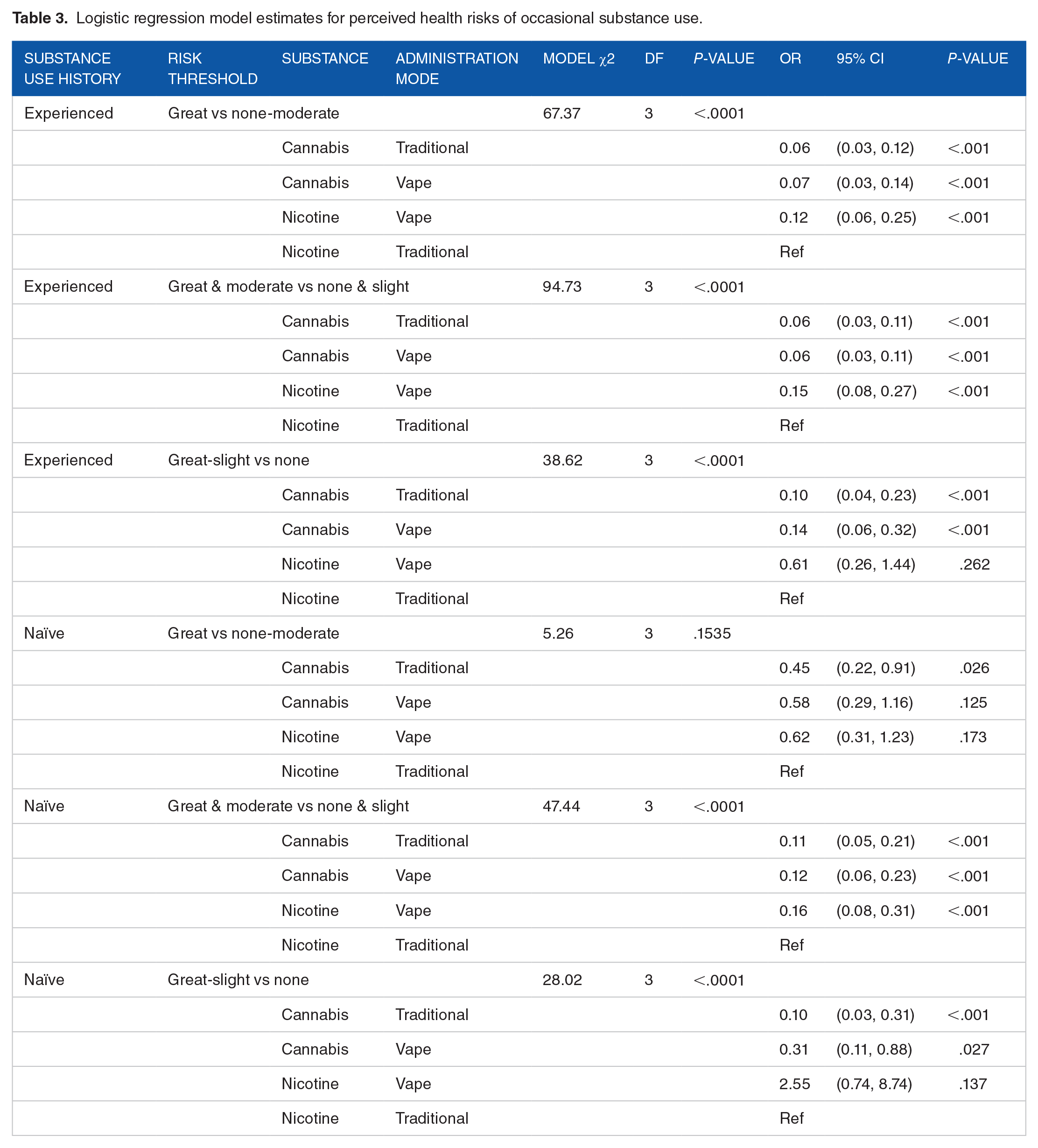
As with daily use, patterns of perceived harms differed between students with lifetime substance use experience and those without when considering occasional substance use (Figure 1, Table 3, Supplemental Table S1, LR χ2interaction = 41.59, df = 3, P < .0001). Differentiation of perceived harms between modes of administration in the context of occasional use was less consistent than was observed for daily use (Figure 1). Both the great threshold (OR = 8.08, CI = 4.07, 16.04) and great-moderate threshold (OR = 6.68, CI = 3.76, 11.86) were more likely to be reached for cigarette use than for nicotine vaping among lifetime substance use users (Figure 1). Discrimination between administration modes for nicotine among substance use naïve students was only demonstrated for the great-moderate threshold (OR = 6.29, CI = 3.20, 12.34). For both strata of students, the risks of occasional use of cannabis were similar between modes of administration (0.77 < OR < 0.90, P’s > .73, Figure 1). Only the lifetime users clearly differentiated the risks between the vaped substances at the higher risk thresholds; higher risk was more likely to be reported for nicotine (Figure 1; great-moderate OR = 2.49, CI = 1.49, 4.15; great-slight OR = 4.49, CI = 2.06, 9.78; P’s < .001). Finally, among substance use naive students the odds were 3.0 (CI = 1.12, 8.26) times higher for vaping to be reported as having no health risks in the context of cannabis use than compared to nicotine use (Figure 1, P = .001).
Logistic regression model estimates for perceived health risks of occasional substance use.
Sensitivity analyses
The sensitivity analyses indicated that the models were sufficiently robust to sex- and substance-specific constraints. The addition of sex to each of the models as a main effect (|z| < 1.19, P > .23) and interaction terms ( > 3.7, P’s > .29) failed to reach statistical significance. A parallel set of models was run on the subset of participants that had lifetime experience with cannabis. The overall patterns and strengthens of association were similar to the results reported in the harms perceptions section found above. All of the confidence intervals substantially overlapped in each of the comparisons between the 2 sets of models. The most extreme difference in the mode of administration and substance type contrasts was in the model for daily use at the great risk threshold. Among the lifetime substance users, the odds ratio for the comparison between cigarette use and vaping cannabis was 9.64 (CI = 3.68, 25.26). In comparison, among lifetime cannabis users the odds ratio was 13.09 (CI = 3.73, 45.99).
Another parallel set of models was run on the subset of participants that had lifetime experience with vapes. The overall patterns and strength of associations were again found to be similar to the primary analyses. The most extreme difference was the contrast between daily cigarette use and daily cannabis vaping at the great risk threshold. For the lifetime substance users, the odds ratio was 9.64 (CI = 3.68, 25.26). In comparison, for lifetime cannabis users, the odds ratio was 20.44 (CI = 5.01, 83.42).
Discussion
The current study demonstrates that adolescents discriminate between modes of administration for cannabis and nicotine in terms of their perceived health risk. Vaping was associated with reduced risk perceptions for nicotine use compared to smoking. A detectable difference in risk perceptions for vaping cannabis at each severity threshold was limited to daily use, where vaping was viewed as a riskier administration route. The only difference that was detected for occasional use of cannabis was observed among the responses from the substance use naive students. For these students, vaped cannabis was perceived as more likely to result in health issues than general cannabis use.
Differences between these administration modes for cannabis may be more substantial than what is estimated in this report. One of the limitations of this study was that the comparator for vaped cannabis risk assessment was the CHKS standard cannabis item. This item refers to cannabis use without limiting the mode of administration. Thus, the 2 cannabis risk perception items are not fully complementary; they overlap. This likely leads to an attenuated estimate of the differences in harms between traditional and vaped cannabis. Nevertheless, the notable and consistent differences observed for the daily use comparison indicate that students were differentiating the administration modes to some extent.
Some of the patterns observed here are consistent with previous research on adolescent nicotine risk perceptions. Vaped nicotine has been found to be reported as less harmful than nicotine consumption through traditional modes, like cigarette use.14,20,21 This is consistent with the view that vaping can serve as a harm reduction behavior and a smoking cessation aid.22-24
Our findings regarding cannabis risks contrast with earlier reports. Malouff et al and Lee et al found cannabis users rated traditional modes of administration as being more harmful.12,13 In this study, vaped cannabis was viewed as posing a greater risk when used daily and there was little differentiation of higher health risk thresholds for occasional use. It is not clear whether or not this represents a change in perceptions, is specific to the studied population, or is related to instrumentation artifacts.
The current study extends prior work by directly comparing the perceived risk of vaping different substances. The current study provides evidence that at least some adolescents view the risks of vaping as being contingent upon the substances being vaped. Recognition of their discrimination may create challenges for the interpretation of some research findings. This may be particularly important in studies of vaping related attitudes, beliefs, and perceptions that treat vaping as a monolithic construct that does not distinguish among the substances being consumed.25,26 It is unclear how respondents are construing and formulating responses to generic vaping-related items.
Conceptualization, instrumentation, and intervention design would benefit from specifying whether vaping refers only to the mode of administration or the combination of the mode and the substance being used. Independent of the risks that are attributable to the devices, each instance of the consumable substrate (eg, fluid, e-liquid, juice, vapors, pods, cartridges) and source of product may contribute to variance in perceived risk profiles. Youth may recognize that illicit and counterfeit vape products may be more likely to have adulterants. 27 Additives were associated with E-Cigarette or Vaping Product Use-Associated Lung Injury (EVALI). 16 The EVALI incidents of 2019 were primarily associated with cannabinoid products, and thus may have created an increased risk perception for cannabis vaping. This may help explain the changes in perceptions regarding the relative risk of the modes of cannabis administration mentioned above. However, this does not explain why the risks of cannabis use were viewed as similar across the administration modes when used only occasionally.
Further complicating vaping studies and interventions is the growing diversity of vape devices and ENDS in general. There have been substantial technological evolution and diversification of vape devices over the last decade. In this study, to be consistent with the current standardized instrumentation of the CHKS, a vape device was defined so as to include all ENDS. The relative perception of harms of subclasses of vape devices and of individual makes have not been well-established. Some youth may believe they have mitigated their risks by using devices and consumables from reputable sources or purported to be of lower potency. Attitudes among youth toward the use of these products may be very specific to particular subclasses or contexts (eg, products purchased from a trusted source). Assessment that is not sensitive to differences in the substance, device, and source may miss important processes. Unfortunately, it may be challenging to increase the specificity of vaping-related assessments to address certain device types even with the use of thorough instruments. This is because vaping experienced youth frequently do not correctly categorize devices to sub-type level even if the sub-types have distinct characteristics that adolescents recognize. 8
Among adults, risk perceptions are most influential in modulating behavior when the harms are substantial, the cost of effective alternative behaviors are low, and self-efficacy is high. 28 Adolescent behavior may be less sensitive to uncertain distal health risks as risk-taking is heightened during this developmental period. 29 Further, affective and experiential risk perceptions, as opposed to deliberative perceptions, may be most influential for some youth. 30 Adolescence is a period of heightened reward sensitivity and sensation seeking, which occur in the context of immature impulse control functions. 31 It is also a period where the influence of peer norms strengthen.32-35
To some extent, health risk perceptions are associated with substance use in adolescents.15,35-38 In the context of experimental manipulation of risk perceptions, Katz et al found a moderate inverse association between perceptions of greater risk and behavioral intentions to vape. 39 Work by D’Amico et al outlines the importance of lowered perceptions of risk and increasing perception of health benefits for the rise in youth cannabis use. 40 In contrast, there is a body of evidence that indicates that knowledge of distant and uncertain associated harms may have a relatively weak role as a determinant of normative substance use among youth.15,29,41 Potential long-term health consequences of substance use are often not considered crucial in explaining variance in the use of prevalent substances among youth, which is why individual and school-level prevention efforts for substance use often do not prioritize this construct as mediators of behavior change. 42 However, a majority of interventions targeting vaping have a substantial component targeting youth knowledge of vaping health risks 43 ; a body of evidence has yet to emerge that adolescents in the interventions change their affective or deliberative risk assessments for the contexts which are relevant to each adolescent. Further, when reporting the disadvantages of vaping, adolescents report more concern about social risks, such as upsetting friends or getting in trouble, than health harms. 15
The current study has several important limitations. Chief among these is that the participants in the study were geographically limited to one school district that is relatively economically advantaged and unrepresentative in terms of self-identified race (68% white, 20% Latina/o); thus, generalization to broader demographic groups should be made with caution until further work is conducted in additional samples. Although it may not be unique, some students in the sample were exposed to locally tailored communications targeting the high school community with content addressing the harms associated with vaping. This was in addition to classroom education that was part of the standardized health curricula that all California students receive. Further, respondents addressed variation in their risk perceptions as a function of substance use frequency, but they were not asked to consider differences in sources, concentration, or total dosage. Where youth source their substances may be related to variation in risk perceptions, particularly as unexpected mixtures or contaminants in consumables become more salient to youth.44,45 Although users may attempt to titrate their consumption during use events, some cannabis products have notably high cannabinoid concentrations. This has led to the increased incidence of cannabinoid hyperemesis syndrome (scromiting) associated with exposure to high concentrations of tetrahydrocannabinol. 46 The current study protocol does not address variation in dosage or these high-dose exposures. Finally, some users co-use nicotine and cannabis during substance use events. The current protocol does not address perceptions of risk for co-use or delineate mono-use from poly-use events.
Adolescents distinguish between the health-related harms of vaping nicotine and vaping cannabis. Assessing vaping-related cognitions in a way that does not acknowledge these distinctions may cloud our understanding of substance use behaviors and reduce intervention efficacy. The findings in the present study highlight adolescents’ recognition that the substance consumed modulates the perceived health risks of using a vape device.
The current study justifies targeting and assessing vaping as a specific mode of administration for different substances. In the context of prior work on substance use and the rapid changes in the vape market, other related recommendations can be suggested. Health risk assessment in youth may benefit from increased specificity of contexts, settings, and substances that youth recognize as creating important distinctions for the risk profile. The use of blunt health risk perception instruments may be obscuring our understanding of school-age youth’s health behaviors. A first step in refining the instrumentation is distinguishing between risks related to the substance being vaped and the device itself. 38
Supplemental Material
sj-docx-1-sat-10.1177_11782218221119584 – Supplemental material for Adolescents’ Perceptions of Substance Use Harms are Contingent on Mode of Administration and Type of Substance
Supplemental material, sj-docx-1-sat-10.1177_11782218221119584 for Adolescents’ Perceptions of Substance Use Harms are Contingent on Mode of Administration and Type of Substance by Kevin Cummins and Yang Lu in Substance Abuse: Research and Treatment
Footnotes
Funding:
The author(s) received no financial support for the research, authorship, and/or publication of this article.
Declaration of Conflicting Interests:
The author(s) declared no potential conflicts of interest with respect to the research, authorship, and/or publication of this article.
Author Contributions
KC developing the research question and design. YL conducted the analyses. Both KC and YL contributed to the acquisition of data and the drafting and revision of the manuscript.
Supplemental Material
Supplemental material for this article is available online.
References
Supplementary Material
Please find the following supplemental material available below.
For Open Access articles published under a Creative Commons License, all supplemental material carries the same license as the article it is associated with.
For non-Open Access articles published, all supplemental material carries a non-exclusive license, and permission requests for re-use of supplemental material or any part of supplemental material shall be sent directly to the copyright owner as specified in the copyright notice associated with the article.
