



Abstract
Introduction:
Internet addiction (IA) is causing academic failure, decreased concentration ability, and a negative affective state. In Ethiopia, studies conducted on IA were limited; therefore, this study aimed to assess its prevalence and risk factors among medicine and health science (MHS) students of Ambo University.
Materials and Methods:
This study was a cross-sectional study and included MHS students of Ambo University from July 15 to August 15, 2021. Data were collected using a self-administered questionnaire after receiving informed consent from study participants. The results were analyzed using the statistical software for social sciences version 24. Bivariate and multivariate logistic regressions were performed to explore the relationship between IA and dependent variables.
Results:
Of the 253 participants who participated in the study, 201 (79%) were found to have an IA. Having one’s own computer, Internet access at home and an email account were 2 times more risky to develop IA compared to their counterparts with AOR = 2.615 (95% CI = 1.118-5.956) with a P value of .022, AOR = 2.154 (95% CI = 1.054-4.405) with a P value of .35 and (=2.154 (95% CI = 1.054-4.405 with a P value of .035 respectively. Additionally, those who use the Internet for news were 2.5 times more likely to develop IA compared to those who do not (AOR = 2.551 (95% CI = 1.225-5.349) with a P-value of .013). The use of the Internet for scientific research and education reduces IA by 0.7 times (AOR = 0.323 (95% CI = 0.120-0.868) with a P value of .025).
Conclusions:
The prevalence of IA was found to be high in this study. Therefore, strategies are needed to minimize the prevalence of this problem.
Introduction
Background
Internet addiction (IA) is defined as uncontrollable use of the Internet for a prolonged period of time per day regardless of any activity once started using. 1 It became one of the important research topics for mental health and psychologists. These days the use of the Internet is more common among all the population groups. The use of the Internet is increasing with the better accessibility of smart phones and the use of the Internet in helping the learning and teaching process for students. There are many positive impacts of the Internet for the scientific world as researchers and educators could get millions of information with a single click. 2 Despite this benefit, the use of the Internet is not without risk. As many studies conducted in China, America and other countries around the world have shown the prevalence of problematic internet use, the so-called IA is getting global concern.3,4 Problematic use of the Internet or IA could in turn resulting in academic failure, poor direct social interaction, decreased concentration ability, negative affective state, and poor engagement in physical activity. 5
IA was found to have a positive association with psychiatric comorbidities, insomnia, depression, suicide ideation, anxiety, tobacco use disorders, alcohol use disorders, and sleep disorders.6-9 It was also shown to have an association with gender, smartphone use, and living area.10,11 Furthermore, IA was found to have a significant risk for the development of obesity. 12
There is inconsistent reporting on the variation in the prevalence of problematic internet use between males and females, as some studies indicate a higher prevalence in females and others reporting vice versa.13,14 On the other hand, being unmarried, younger, having access to a smartphone, and being unemployed, which are common characteristics of university students, were frequently found to have statistically significant positive relationships with problematic internet use.1,13 Although IA has been extensively studied in China and America, there are limited online data on the prevalence of the disease in Africa. In addition to this, there was no agreement among the studies regarding predictors and prevalence of IA. However, most studies were conducted by focusing on adolescents6,8,15,16 and very few studies were conducted among university students7,17 particularly on medicine and health science students where the prevalence of mental illness was found to be common.7,18,19 In Ethiopia nearly 1/4th of the total population were using internet as reported in January 2021 and number of internet users increased by 13% from 2020 and 2021. 20 However, studies on Internet addiction were limited; hence, this study was aimed at assessing the prevalence of IA among medical and health science students from Ambo University. The study will also determine factors that will have an association with Internet addiction.
Methods and Materials
Study design
The present study was a cross-sectional study conducted among regular undergraduate medicine and health science students of Ambo University from 15 July to 15th August, 2021.
Study setting
Ambo University is one of the public universities in Ethiopia located in the Oromia region of Ethiopia. The university has 4 campuses with over 11 Colleges/institutes/schools. The College of Medicine and Health Sciences is located on the main campus with over 10 degree-granting programs. Among degree-granting programs, 6 of them provided undergraduate education with regular programs. These are Pharmacy, Medicine, Midwifery, Medical Laboratory Science, Nursing, and Public Health Officer.
Study population
The study populations were regular undergraduate students who were following their study at the College of Medical and Health Sciences of Ambo University. Accordingly, the populations studied were students in the 6 departments mentioned above (ie, Pharmacy, Medicine, Midwifery, Medical Laboratory Science, Nursing, and Public Health Officer). The college consists of a total of 685 students, with 193 female and 492 male students.
Study participants and sampling
The sample size was calculated to be 259 using a single population proportion formula and considering a 5% non-response rate. We have taken the prevalence of Internet addiction as 50% since no studies were conducted in this particular area and population, and a 95% confidence interval to get the maximum possible sample size. Consequently, we have randomly selected 62, 56, 31, 26, 41, and 37 students from Pharmacy, Medicine, Midwifery, Medical Laboratory Science, Nursing, and Public Health Officer, respectively.
The response rate of respondents with the current study was found to be 97.68% (253/259) as 2.32% 6 of them failed to complete the questionnaire though they signed their consent. Inclusion criteria were: being undergraduate medical and health sciences student with regular admission, and found to use the Internet. Students who were not willing to participate were excluded from the study.
Data collection procedure
After explaining the objective of the investigation and getting the consent of the study participants, the self-administered questionnaire developed was distributed to the participants in the classroom setting and the clinical practice site. The data was collected by 2 well-trained BSc Nursing professionals.
Study tool
This study has used a structured questionnaire consisting of 4 sections. The first section was developed to collect sociodemographic data (age, sex, field of study, background residence, body mass index (calculated from participants self-reported body weight and height), self-reported academic performance, and family-related factors such as fathers and mothers’ education, family relationships, and family financial status). The second section contains behavioral factors such as the current state of Khat use, alcohol consumption and cigarette use, and the third section is about factors related to the Internet and the purpose of the Internet use, and the final section is Young’s Internet addiction tool, the standard tool that contains 20 questions that were based on a 5-point Likert scale. As presented in the IAT manual tool, the total score of the Internet Addiction Test (IAT) is the sum of the ratings given by the studied participants for the 20 item responses. Each item was rated on a 5-point scale ranging from 0 to 5. The maximum score is 100 points. The higher the score, the greater the severity of the addiction to the Internet. Total scores that ranged from 0 to 30 points were considered to have a normal level of internet usage; scores of 31 to 49 indicate the presence of a mild level of internet addiction; 50 to 79 reflect the presence of a moderate level, and scores of 80to 100 indicate a severe dependence on the Internet.
Statistical analysis
Categorical variables are presented with frequency and percentage. Age was presented as a categorical variable in terms of frequency and percentage taking the median age as the basis of categorization. Logistic regression was performed at the bivariate and multivariate levels to check the association between Internet addiction and the independent variable. Upon bivariate logistic regression, variables that were shown to have an association with a P-value less than .25 were taken for multiple logistic regressions. Finally, variables found to show an association with P-values less than .05 were declared to have a significant association with our independent variable. The YIAT was found to be reliable for internet addiction research in university and college students, as revealed by different studies across the world21-24 and in Ethiopia. 25 Cronbach alpha in our study was .82. With regard to multicollinearity test for association between Independent variables and Internet addiction VIF for all the independent variables was less than 2.5. The model fitness was tested with a Hosmer-Lemeshow chi-squared and found to be good fit with P-value of 1.00.
Ethical consideration
The ethical clearance letter with Ref No: AU/PGC/335/2021 was obtained from the IRB of the College of Medicine and Health Sciences of Ambo University to conduct this study. Study participants were found to consent to participate in the study after providing clear information about the objective, benefit and risk of participating in the study. No risk was associated with the current study and participants were ensured the right to withdraw, stop filling out the questionnaire anytime, and confidentiality is kept by not including their name and identification number on the completed questionnaire.
Results
Sociodemographic and behavioral characteristics of study participants
The median age of the study participants was 22 years. 174 (68.8%) of the participants were male. The background residence of them was nearly equally shared between urban 124 (49%) and rural 129 (51%). Regarding body weight, 185 (73.1%) have normal weight and only 3 (1.2%) have obesity. Regarding paternal education, 45.1% and 56.5% of fathers and mothers of the study participants have attended primary school or less. 84.6% of them responded, as they have a good relationship with their family. 87.7% of the participants came from families with poor financial/economic status. Smoking, drinking alcohol, and Khat use was reported among 5.9%, 17.4%, and 11.9% of respondents, respectively (Table 1).
Sociodemographic characteristics of the medicine and health science students studied at Ambo University, Ambo, Ethiopia, 2021.

Internet-specific characteristics of the studied participants
Almost two-thirds of the participants (66.4%) have their computer own computer, while 9.5% replied that they have a computer at home and only 24.1% of them responded that they do not have a computer at home. 68.3% of them did not have internet access at home and 37.7 had access at home. When asked if they use the internet on their own mobile phone, 87.4% of them replied that they use the internet on their own phone, 11.9 % do not use the mobile internet and only 0.8% of them do not have a mobile phone (Table 2).
Internet-specific characteristics of the students studied in medicine and health sciences of Ambo University, Ambo, Ethiopia, 2021.

Purpose of using the Internet
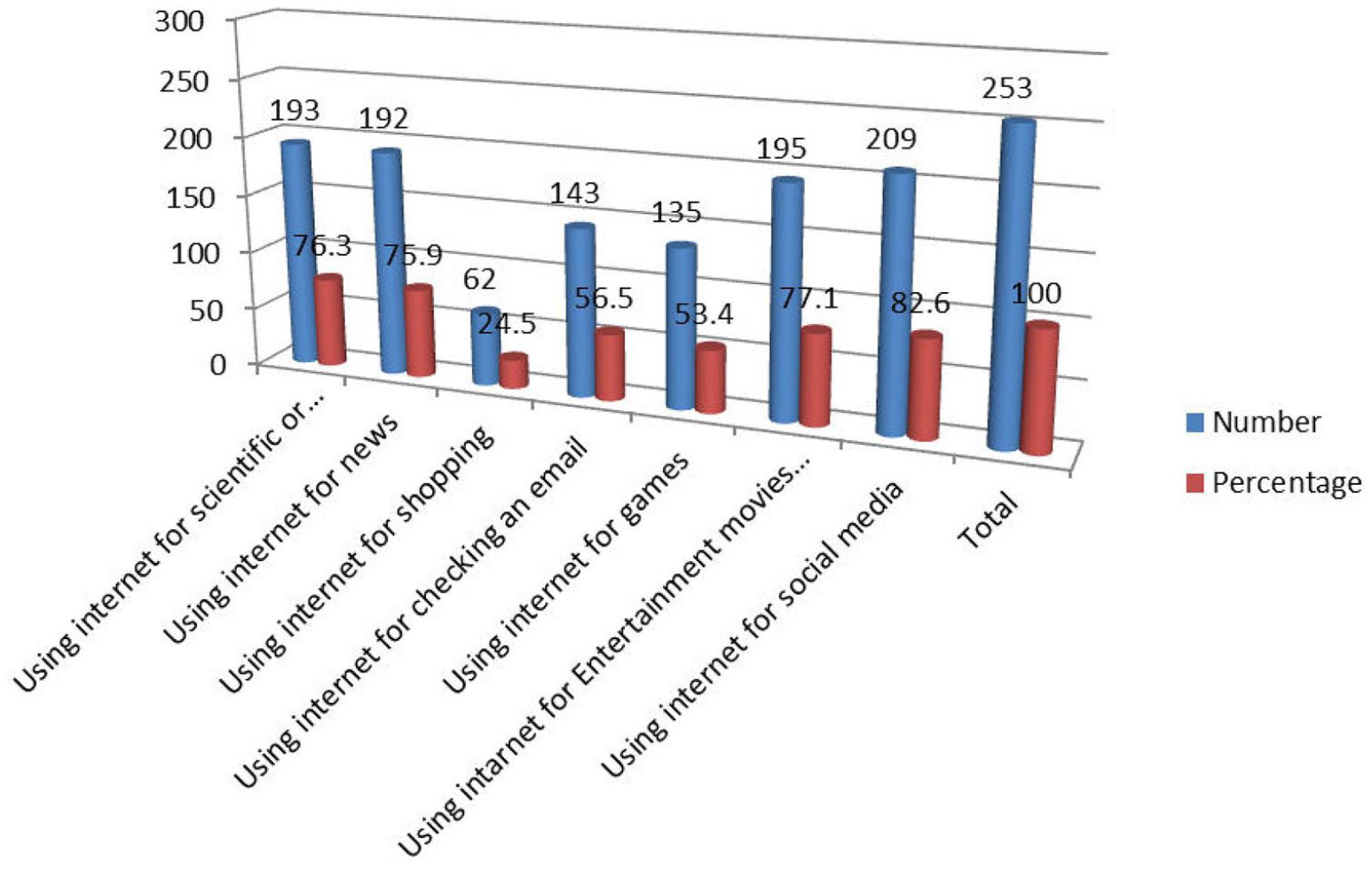
As shown in the figure below, the most common purpose of using the Internet was to use the Internet for social networks, followed by to use the Internet for entertainment, movies, and songs, to use the Internet for scientific research and educational purposes, and to use the Internet for news as responded by 82.6%, 77.1%, 76.9%, and 75.9% of the participants studied. 56.5% of the respondents use the Internet to check an email, 53.4% for games on the Internet, and the least common purpose for using the Internet is to use the Internet for shopping, which is reported only by 24.5% of the participants (Figure 1).
The distribution of students studied in College of medicine and health science of Ambo University based their purpose on the use of the Internet, Ambo, Ethiopia, 2021.
Prevalence of Internet addiction and its severity
As depicted in the figure below, the prevalence of internet addiction among our participants was found to be 79%. Only 21% of the participants were free of Internet addiction. 45% of the total study participants have mild Internet addiction while 34% have a moderate level of it (Figure 2).

Presence and severity of Internet addiction among study participants.
Relationship between Internet addiction and sociodemographic, family relationships, and internet-specific characteristics of study participants
Univariate logistic regression was performed before multivariate logistic regression. All variables found to show an association with Internet addiction with a P value of less than .25 in univariate logistic regression were transferred to multivariate logistic regression to test the significance of the association. Therefore, the department of study, fathers education, having a computer at home, having an email, having an account on social networks, using the Internet for scientific research and education, using the Internet for shopping and using the Internet for news were found to have a significant association with univariate logistic regression and then entered for multivariate logistic regression. Finally, a significant association was found between Internet addictions and father’s education, having a computer at home, the internet at home, having an email, using the Internet for educational and scientific purposes and using the Internet for news using multivariate logistic regression. Students of fathers with an educational status of high school were found to be 4 times more likely to have internet addiction compared to students of fathers of an educational status university or more (AOR = 4.068, 95% CI (1.095-15.116, P value = .036) (Table 3).
Bivariate and multivariate logistic regression to determine the association between Internet addiction and sociodemographic and behavioral factors, among studied students of the Ambo University School of Medicine and Health Sciences, Ambo, Ethiopia, 2021. .

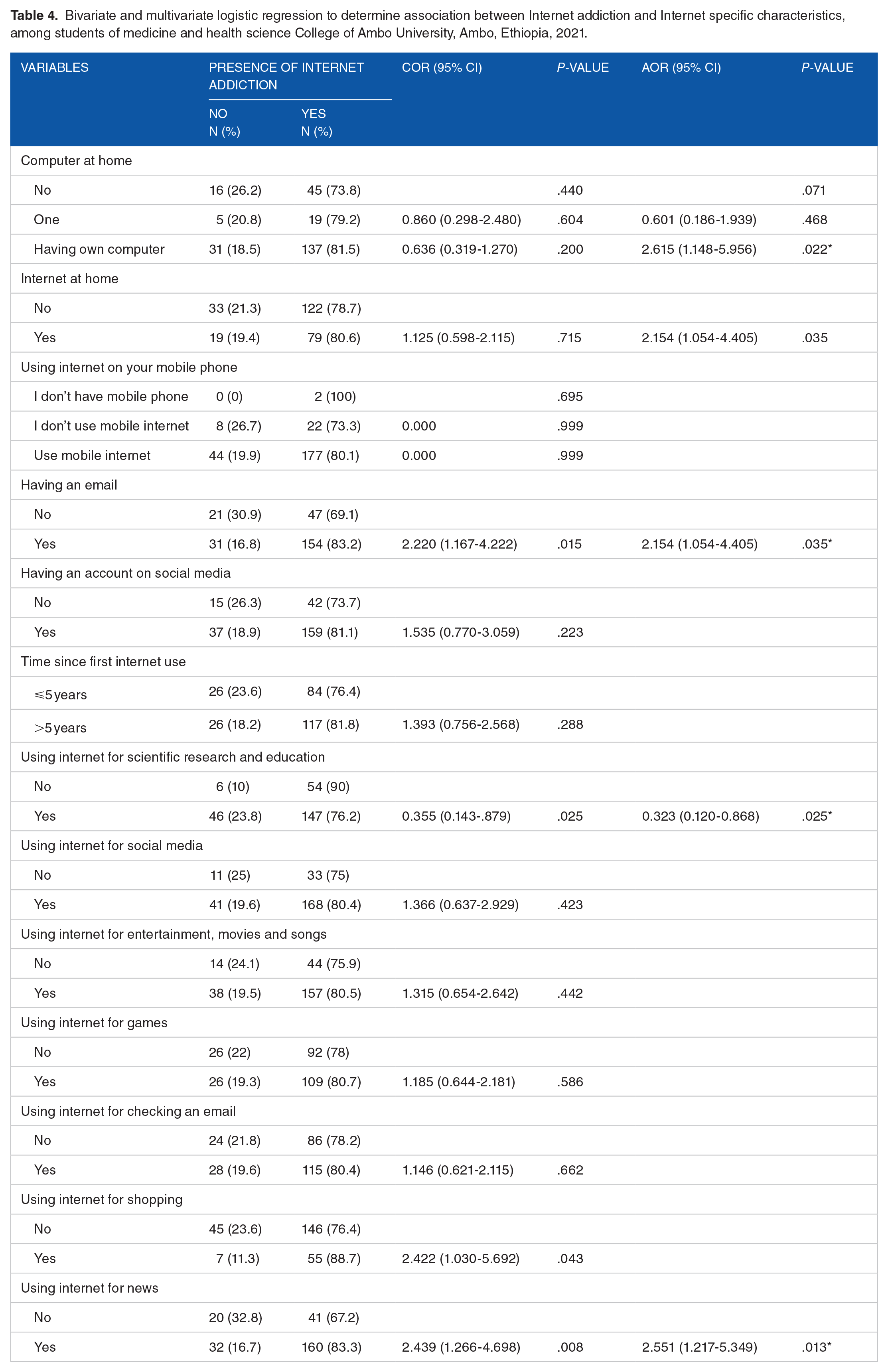
Regarding the characteristics specific to the Internet, the following relationship was found to be significant; those who have their own computer are twice more likely to develop internet addiction compared to those who do not have a computer at home (AOR = 2.615 (95% CI = 1.148-5.956 with a P value of .022). Similarly, those who had Internet access at home were twice as likely to have internet addiction compared to their counterparts (AOR = 2.154 (95% CI = 1.054-4.405) with a P value of .35). Those who have an email were also twice as likely to develop internet addiction compared to those who do not have an email account (AOR = 2.154 (95% CI = 1.054-4.405 with a value of .035). Beside that those who use the Internet for news were 2.5 times more likely to develop internet addiction compared to those who do not use the internet for news (AOR = 2.551 (1.224-5.349) with a P-value of .013) (Tables 3 and 4).
Bivariate and multivariate logistic regression to determine association between Internet addiction and Internet specific characteristics, among students of medicine and health science College of Ambo University, Ambo, Ethiopia, 2021.
Discussion
Today, the Internet has become very essential for our routine activities. Its uncontrolled use has negative health consequences. Many studies have been conducted to determine the prevalence and predictors of internet addiction. However, most of them have focused on adolescents and high school students.26-32 Very limited studies were conducted among university students and much smaller in number among medical and health science students17,33 where mental health problem is reported to be common. This study has included 253 medical and health science students from Ambo University to participate in the study, of 259 sampled to participate with a response rate of 97.7%.
In the assessment of the purpose of Internet use among study participants, the most common purpose of using the Internet was to use the Internet for social networks followed by using the Internet for entertainment, movies and songs, using the Internet for scientific research and educational purposes, and using the Internet for news, using the Internet to check an email, using for Internet games, and the least common purpose of using was to shop. Therefore, our studies are consistent with the study done among Sohag University Medical students and the one done among Wollo University students in Ethiopia.17,25
This study has revealed that almost 4/5th (79%) of the studied medical and health science students have an internet addiction, of which 56.7% had mild internet addiction and 43.3% had a moderate level of addiction. This prevalence report is inline with the study done among University students in Ethiopia. 25 . The findings of this study are inconsistent with almost all previous studies in which the prevalence rate of Internet addiction was reported in almost half or less than half of the study participants.7,17,26-28,33-35 There are 3 possible reasons for the variation in the prevalence of internet addiction; the first is the studies conducted in China and Hong Kong conducted in adolescents and elementary school students where family follow-up and access to electronic devices were expected to be lower compared with University students.26-28 The second reason for the difference in prevalence rate is the variance in the country’s policy on Internet use, the difference in the use of social networks, and restriction of social media use.17,33,34 The third and final possible reason for inconsistencies was that the studies were conducted among university students; they did not focus on medical and health science students and used a different sample size, study period, and setting from the present study.23,24,35
Our study has not shown that age and sex have a significant relationship with Internet addiction. Accordingly, in terms of age, many studies are consistent with our findings. 17 But in terms of sex, our study is different from most previous studies, as our studies did not reveal any significant differences between men and women in regard to internet addiction. The previous studies themselves were inconsistent in reporting Internet addiction related to sex; Some studies, such as the one conducted at Sohag University of Egypt, Chinese University students and Saint Joseph University, have revealed that being male is significantly associated with having internet addiction.17,35,36 Although other studies have reported that being female is significantly associated with internet addiction; such as the study conducted among college students of Korea and University students in Japan.11,32 These inconsistencies might be due to social, cultural, political and economic differences among the studied countries, particularly with regard to the use and access of internet use.
Family relationships, family financial status, being overweight or obese, self-reported academic performance, behavioral factors like; the current state of drinking alcohol, chewing Khat or smoking tobacco was not found to have a significant relationship with Internet addiction in contrast to the study conducted among medical students of Sohag University Egypt and studies conducted among Korean and Hong Kong Adolescents.17,28,31 The possible reason for this inconsistency is that there is a clear difference between the socioeconomic conditions of students at the Ethiopian University compared with those in Egypt. 28 On the other hand, the studies conducted in Korea and Japan were conducted among adolescents, while the current study was conducted among university students, especially among students at the School of Medicine and Health sciences college.28,31
According to a previous study, parental education, particularly father’s education status, has been shown to have a significant correlation with Internet addiction among the sociodemographic variables studied in our study. Accordingly, participants from fathers with educational status of high school were 4 times more likely to have internet addiction compared to students with fathers with educational status University or more (AOR = 4.068, 95% CI (1.095-15.116, P value = .036). However, in contrast to this study, studies which have shown a significant association between parenteral education and Internet addiction did report that; Fathers education level in high school and college was found to be protective for internet addiction. 31 The variation will possibly be due to differences in the study setting and the study participants.
Among the specific characteristics of the Internet and the purpose of using the Internet among the study participants who had their own computer, the internet at home, having an email, the use of the Internet for scientific research and education and the use of the Internet for news, the internet was found to be predictors of internet addiction. Those who have their own computer are 2 times more likely to develop internet addiction compared to those who have no computer at home (AOR = 2.615 (95% CI = 1.148-5.956 with a P value of .022). Similarly, those who had internet access at home were twice as likely to have internet addiction compared to their counterparts (AOR = 2.154 (95% CI = 1.054-4.405) with a P-value of .35). Those who have an email were also twice as likely to develop internet addiction compared to those who do not have an email account (AOR = 2.154 (95%CI = 1.054-4.405 with a value of .035). Beside that those who use the internet for news were 2.5 times more likely to develop internet addiction compared to those who do not use the Internet for news (AOR = 2.551 (1.17-5.349) with a value of .013). Our study has also identified the use of the Internet for scientific research and education as a protective factor for internet addiction; Participants who use the Internet for scientific research and education develop the IA 7 times less likely compared to their counterparts (AOR = 0.323 (95% CI = 0.120-0.868) with a P value of .025). The study carried out among medical students from Sohag University of Egypt has shown very similar results to the current study, as the study found both the protective effect of using the Internet for scientific research and education and the risk of having the Internet at home for Internet addiction. Otherwise, our study is not similar to it with regard to other variables found to be predictors, which could result due to the difference in sample size between the 2 studies. 17
Our study has great strength. The study used YIAT-20, which is the most reliable and validated tool for assessing the addition of the Internet. The second strength is that our study has a random sampling technique that has the ability to detect bias in participant selection. The third and important point is that the study has attempted to include all possible factors that could affect internet addiction in the prepared questionnaire.
Limitation
As a limitation of the study, the study was conducted in a single public university, which could affect the representativeness of the data to private universities in the country. On top of this, since we have used YIAT to know what the Internet use of the participants looks like over a month, recall bias is expected.
Conclusions and Recommendations
This study revealed a higher prevalence of Internet addiction among students in medicine and health sciences at Ambo University. Our study has shown parenteral education, having a computer, having Internet access at home, using the Internet for news, and having an email account as predictors of Internet addiction. Our study has also shown that the use of the Internet for scientific research and education has a protective effect against internet addiction.
So, Ambo University and the Ministry of Health needed to develop a strategy and program to minimize the prevalence of internet addiction and risk factors to develop the condition. Future researchers shall better work on how to control risk factors to minimize the prevalence of internet addiction.
Footnotes
Acknowledgements
We are grateful to the Ambo University pharmacy department for providing the necessary stationery in the completion of this research document, and we are also very grateful to those who cooperated in filling out the questionnaire of this investigation as participants in the study.
Declaration of Conflicting Interests:
The author(s) declared no potential conflicts of interest with respect to the research, authorship, and/or publication of this article.
Funding:
The author(s) received no financial support for the research, authorship, and/or publication of this article.
Author Contributions
All authors made a crucial contribution in the conception, study design, execution, and collection, analysis, and interpretation of data. In addition, all the authors participated in drafting, revising the manuscript, and approved the final version to be published.
