




Abstract
Objectives:
To examine the same-day associations between substance use and objectively measured antiretroviral therapy (ART) nonadherence among persons living with HIV (PLWH).
Methods:
PLWH (N = 53) were given an electronic pill box (EPB), and their ART adherence was monitored for 14 days. During a follow-up interview, participants were asked about any alcohol or drug use that occurred during those same 14 days.
Results:
Daily heavy drinking (⩾5 drinks for males and ⩾4 drinks for females) was associated with a nearly five times greater likelihood of same-day ART nonadherence (OR = 4.90, 95% CI = 1.79-13.36, P = .002). Further, drug use was associated with a nearly two times greater likelihood of ART nonadherence on the same day (OR = 1.80, 95% CI = 1.14-2.85, P = .012).
Conclusions:
These results highlight the importance of continuing to pursue interventions to effectively address heavy drinking and drug use among PLWH in order to improve ART adherence.
Introduction
According to 2019 estimates from the Centers for Disease Control and Prevention (CDC), approximately 1 140 400 individuals are living with HIV in the United States. 1 Between 2012 and 2017, the incidence rate of HIV infection decreased; however, there are still thousands of new HIV diagnoses each year. 2 For example, in 2017 there were 38 739 new diagnoses of HIV infection in the United States. 2 Antiretroviral therapy (ART) allows persons living with HIV (PLWH) to achieve viral suppression and live healthy lives. 3 However, a recent meta-analysis revealed that only 63.4% of adults living with HIV achieve optimal adherence, and CDC monitoring found that only 60% of PLWH achieved viral suppression between 2014 and 2015.4,5 Despite improvements in medication efficacy, adherence is still key for preventing disease progression.6-8
Substance use, including alcohol use, is highly prevalent among PLWH and may contribute to poor ART adherence.9,10 To date, associations between substance use and ART adherence have mostly been evaluated within cross-sectional designs, with few examining relationships between daily substance use and same-day ART adherence.11,12 The goal of the data analyses highlighted in this brief report is to contribute to our understanding of the temporal associations between substance use and same-day ART adherence, expanding on previous work through the examination of the relationship between daily alcohol and other substance use and objectively measured ART adherence.
Methods
Overview
PLWH were recruited for a study to test the efficacy of a mobile health intervention, Fitbit Plus, aimed at increasing ART adherence (Project SMART). After completing a baseline interview, participants were given an electronic pill box (EPB) in which to store their ART. We initially used EPBs developed by MedSignals but switched to MEMS Caps after MedSignals ceased operations. Daily adherence data provided by the two devices were identical, and there were no lapses in data collection due to the transition to MEMS Caps. Adherence was monitored for 14 days prior to randomization to treatment condition. During the 1-month follow-up interview, information about alcohol and drug use occurring on those 14 days was collected.
Participants
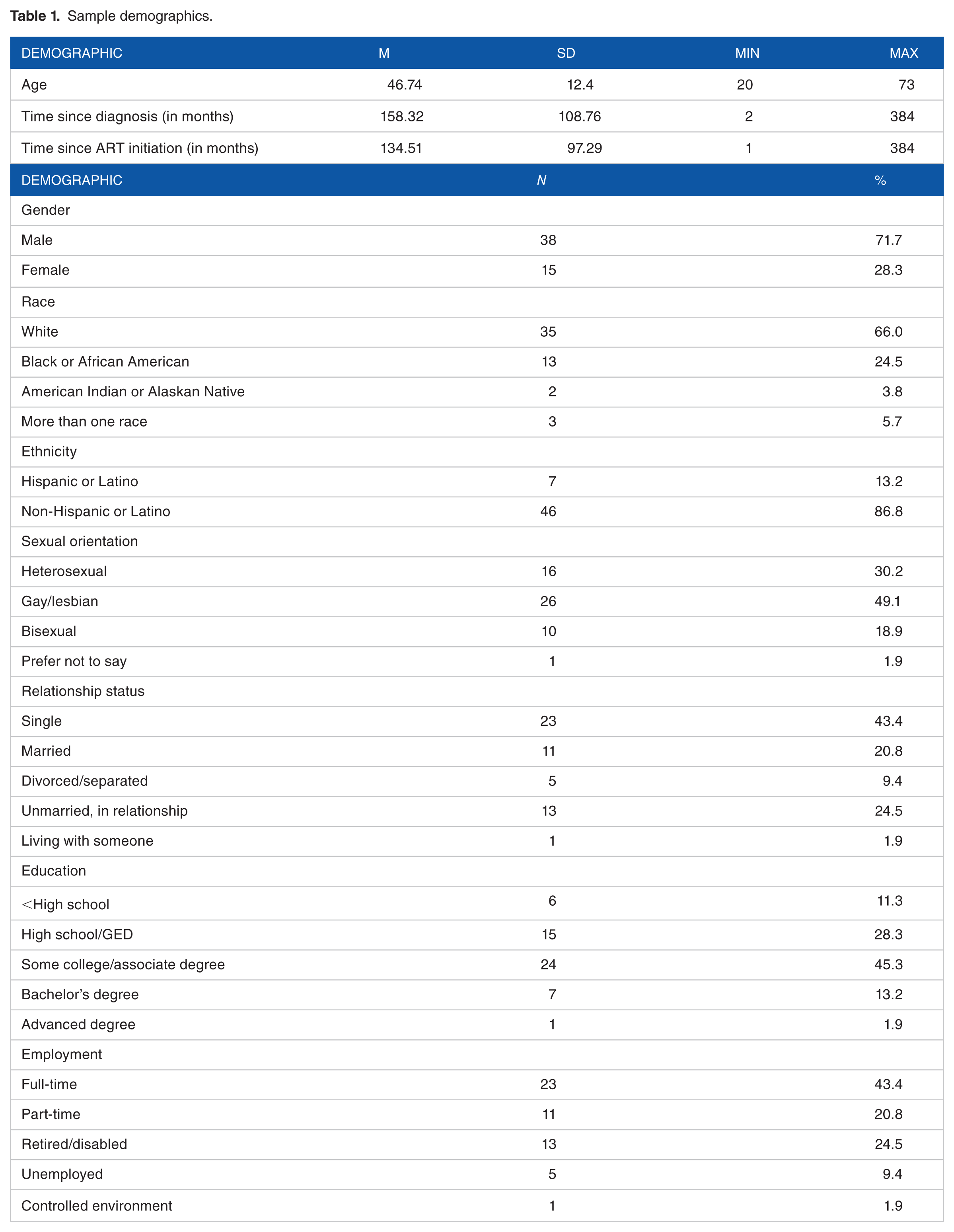
PLWH (N = 53) were recruited from an urban HIV treatment setting in the Northeastern United States and online via digital advertisements. All participants met the following criteria: (1) infected with HIV; (2) prescribed ART; (3) detectable viral load within the past 6 months (>20 copies/mL); (4) reported <100% adherence; (5) at least 18 years of age; (6) own a smartphone compatible with Fitbit Plus; (7) willing to download Fitbit Plus. Exclusion criteria were: (1) physical impairments that prevent study completion; (2) cognitive impairments that would jeopardize informed consent or study comprehension; (3) active psychosis; (4) not fluent in English. More than half (53%) of the sample had a viral load >200 copies/mL within the 6 months prior to baseline (see Table 1 for demographic information).
Sample demographics.
Measures/data collection
Baseline interviews were completed with participants from January 2017 to February 2019. EPB data were retrieved 2 weeks after the baseline interview. Adherence was defined as taking prescribed ART within 2 hours of the prescribed time. At the 1-month follow-up, the Timeline Followback (TLFB) interview was used to collect information about the number of standard drinks consumed per day and classes of drugs used each day.13,14 The TLFB is an instrument that has been validated for the collection of retrospective substance use data.13,14 We defined a heavy drinking day as ⩾5 drinks for men and ⩾4 drinks for women, consistent with definitions from the National Institute on Alcohol Abuse and Alcoholism. 15 The time period over which alcohol consumption occurred was not collected; therefore, we are unable to determine if drinking behavior met the definition of binge drinking. 15 Drug classes included sedatives, cannabis, stimulants, opioids, cocaine, hallucinogens, PCP, and other. Descriptive information regarding adherence and substance use during the 14-day period are located in Table 2. No participants reported using opioids, hallucinogens, PCP, or other drugs.
Descriptives of daily ART adherence and substance use.

Data analysis
Data were configured with demographic variables in Level 1 and repeated measures in Level 2 and analyzed using Hierarchical Linear Modeling (HLM). First, we evaluated whether sex, age, socioeconomic status, time since HIV diagnosis, and time since ART initiation should be included in the model. No relationships were observed between Level 1 variables and Level 2 variables; therefore, they were not included in models regressing ART nonadherence onto same-day substance use variables. Separate models regressed ART nonadherence onto any alcohol use, heavy drinking, drug use, and days in which both alcohol and drug use occurred. Odds ratios were adjusted for multiple comparisons.
Results
HLM revealed that neither any drinking nor co-occurring drinking and drug use on a given day were associated with same-day ART nonadherence; however, heavy drinking and drug use were associated with same-day ART nonadherence (see Table 3).
Odds ratios of predictors and same-day ART nonadherence.

P < .01.
Conclusions
The findings from these analyses indicate a temporal relationship between substance use and same-day ART nonadherence. During days in which heavy drinking occurred, there was a nearly five times greater likelihood of same-day ART nonadherence. Further, during days in which drug use occurred, there was a nearly two times greater likelihood of same-day ART nonadherence.
These results are consistent with previous research that has found heavy drinking to convey risk for multiple problematic behaviors, including nonadherence, and support the differentiation between any alcohol use and heavy drinking days as a meaningful distinction.11,12 Our confidence in these findings is strengthened by objectively measuring adherence, which to our knowledge has not been done in similar research evaluating daily associations between alcohol use and nonadherence.11,12 In addition, these analyses expand on previous research by also examining the relationship between drug use and adherence. The odds of ART nonadherence were greater during days in which heavy drinking occurred compared to days in which drug use occurred. This difference may be due to the high prevalence of cannabis use and the relatively low prevalence of other drug use in this sample. Possible mechanisms underlying the relationship between substance use and nonadherence, such as forgetting or intentional nonadherence, warrant further investigation.16,17
An important limitation is that substance use data were collected retrospectively. This may have resulted in either underestimation or overestimation of substance use. Prospective capture of substance use data may produce more accurate estimates in future research. Our modest sample size is also a limitation.
While further examination of these relationships is warranted, these results suggest that it is important to continue to pursue interventions to effectively address heavy drinking and drug use among PLWH in order to improve ART adherence. Harm reduction strategies, or strategies that reduce forgetting or intentional nonadherence as a consequence of substance use, may be used by clinicians to improve adherence among PLWH who drink alcohol or use drugs. 18
Footnotes
Funding:
The author(s) disclosed receipt of the following financial support for the research, authorship, and/or publication of this article: Research reported in this publication was supported by the National Institute of Mental Health of the National Institutes of Health under award number R34MH108431 to Dr. Susan Ramsey. The content is solely the responsibility of the authors and does not necessarily represent the official views of the National Institutes of Health.
Declaration of conflicting interest:
The author(s) declared the following potential conflicts of interest with respect to the research, authorship, and/or publication of this article: Dr. Ramsey is the recipient of an Investigator Sponsored Research Agreement with Gilead Science, Inc. for the provision of medication for another trial.
Author Contributions
SER is the study principal investigator and developed the theoretical background and conceptualization of the study. SER and EGA contributed to the study design, writing, data analysis, and editing. JU and SH collected data and helped to finalize the manuscript. SC served as the study physician and helped to finalize the manuscript. DWV helped to finalize the manuscript. All authors reviewed and approved the final draft.
