



Abstract
Gaining accurate information on illicit drug use and policing in real-world settings is a challenge. This study examines the utility of a smartphone app (‘Going Out In Sydney’) to prospectively follow up illicit drug use and policing encounters at music festivals and licensed entertainment precincts in Sydney, Australia. In all, 38 regular festival and licensed entertainment venue attendees used the app to log nights out over a 3-month period, including (1) where they went (eg, festival, nightclub), (2) the prevalence of illicit drug use, and (3) the incidence and nature of police encounters. A survey and interview were then conducted about the utility of the app. The app enabled rich data collection (n = 353 entries) about illicit drug use and policing at both target settings. Follow-up surveys indicated that most participants were extremely satisfied with the ease of use of the app and privacy afforded, and compared with other data collection modes, such as paper-based logs and online surveys, rated the app the most desirable method of data collection. This suggests smartphone apps may be a viable option for future studies on illicit drug use and policing of drugs.
Introduction
Music festivals and outdoor licensed entertainment precincts are popular sites of illicit drug use, and police are commonly deployed at such sites in efforts to prevent or curtail drug offending at such settings. 1 Yet, gaining accurate information on drug use and policing in real-world settings and whether or not police presence curtails illicit drug use remain a challenge.2–4 For example, we have a lot of data on illicit drug use at festivals and licensed entertainment precincts, including through cross-sectional retrospective surveys, wastewater analysis, drug swabs, and official crime data,1,5–7 all of which illustrate illicit drug use is a common behaviour at such sites. However, each data collection method has limitations. Cross-sectional retrospective surveys (the most common method of data collection) are subject to recall and social desirability bias.5,8–11 Official crime data, in contrast, provide more objective data, but they significantly underestimate illicit drug use as most drug use is never detected by police.12,13 For example, in a national survey of regular festival attendees in Australia, we found that of those who had used drugs (n = 1884) 94.6% had no prior criminal convictions and 88.2% had never been charged or arrested by police (for drugs or any other offence). 1 Most importantly, all current methods tend to ignore the situational context in which drug use occurs, particularly whether or not police were at a festival or licensed entertainment precinct. Data that take into account both policing and drug offending behaviours are critical to assess whether police can prevent or curtail illicit drug offending.
In 2016, we conducted one of the first studies that examined both drug use and police encounters at festivals and licensed entertainment precincts using a retrospective survey. 1 This showed that at the last festival attended, 71.2% of patrons encountered police, but 65.3% nevertheless used illicit drugs. 1 Given this was based on a retrospective estimate at a single point in time, it left unanswered how generalisable this estimate was. Criminological deterrence theories suggest that multiple factors are likely to shape police deterrence,14–17 including the extent and nature of policing on any night out, offender perceptions about the risks and benefits of drug use and the consequences of being caught, and situational factors such as when and where people go out. Repeated measures of drug use and police encounters will be critical to assess the impacts of policing at festivals and licensed entertainment precincts. A growing number of studies have gathered repeated measures of offending over time via a life-events calendar,18–20 whereby participants self-report criminal behaviour, offending timing, and detailed information about offending contexts over a specified period (eg, a month, year, or 2 years). That said, most methods are retrospective and rely on paper-based logs or telephone interviews.
A newer technology is that of smartphone apps: specifically designed software programs or ‘applications’ that can be designed for use on mobile phone operating systems.19,21–24 Often used for health monitoring, eg, fitness,22,25 they have increasingly been used as a means to gather research data over time, including for monitoring alcohol consumption on nights out.26–28 This article describes the development of the first smartphone app for prospective follow-up of real-world illicit drug use and policing encounters at music festivals and licensed entertainment precincts. In this article, we report on the utility of the app for monitoring drug use and police encounters: particularly compared across other methods such as online surveys, telephone interviews, and paper-based logs.
The rise of the smartphone app research
There have been a number of reviews of the use of smartphones for data collection and research.22,23,29 For example, Şahin and Yan 29 reviewed 115 studies that used mobile phones as a tool for data collection and research. They found that mobile phones and smartphone apps had been used in diverse fields, including medicine, engineering, and education. The review concluded that phones were an efficient tool for research that can provide accurate data. 29 Moreover, Miller 23 found that smartphone apps have a number of advantages when compared against other data collection methods, such as paper-based diaries, telephone interviews, and SMS. Advantages include (1) convenience: apps are easy for participants to use when and where they want; (2) ecological validity: apps provide an unobtrusive data collection tool which increases the capacity to study behaviours ‘as lived’ and ‘as experienced’ in real-time or close-to-real-time; (3) data quantity and quality: apps generate more data per participant and often better quality data, eg, less recall bias and more fine-grained data; and (4) swift data upload: apps enable automatic data upload, thereby reducing demands on researchers.
Apps have been found to be particularly useful for researching behaviour over time. 24 For example, one Dutch study developed an app to monitor time usage over a 12-month period. 21 Piloted with 150 people, it showed that the app generated data that were similar to those obtained through more traditional means (such as paper or phone calls) and that respondents recorded their activities on average 11 times a day: increasing capacity for accurate recall. They have also been found to be useful to researching crime and crime desistance. Of note, Sugie 30 used a smartphone app to monitor the activities of 156 men on parole in the United States tracking their efforts over a 3-month period at attaining jobs after release from prison: producing novel insights into the mechanisms for successful reintegration into the community.
Overall, such experiences suggest that apps can offer benefits for research data collection.21-24,29 Two key challenges in the use of smartphone apps are technical hitches/problems in poor design and privacy: namely that the use of mobile technology makes it harder to control where and how collected data are shared.21,29,31 That said, increasing studies have showed that piloting and anonymisation can lessen both issues. For example, Şahin and Yan 29 found that 29 of 115 studies using mobile phones collected anonymous data and 18 collected pseudo-anonymous data (where participants were given a nickname).
Use of apps for drug and alcohol research
To date, there have been surprisingly few drug and alcohol apps developed for research purposes.
32
Apps for real-time reporting on alcohol consumption are a noted exception.26,27,33 For example, Kuntsche and Labhart got 183 young adults in Switzerland to complete logs/questionnaires about their drinking at 8
In recent years, there have been increasing calls for smartphone apps to be used in drug and alcohol research.23,24,30,34 For example, as argued in an Addiction editorial, Kuntsche and Labhart
35
noted,
Most of what is known in substance use research is based on retrospective answers in paper-and-pencil questionnaires or given online or in telephone interviews. Current smartphone technology, however, opens virtually unlimited possibilities for collecting data in real-time and real-life situations, including sounds, pictures or locations, and with (almost) no recall bias.
They argued that the main limitation to expansion in the substance use field is ‘researcher’s hesitance’.
35
That said, Capon et al
36
and Muerk et al
37
have argued that although apps hold promise for the drug and alcohol field, there are specific legal and ethical issues that necessitate addressing particularly before their routine application to researching illicit drug use:
Foremost among these is the protection of participants’ privacy and the legal risks associated with collecting potentially incriminating data. Data collected by researchers on illegal drug use and other activities can be subpoenaed by law enforcement agencies in most countries.
37
They further argued that app developers and researchers need to ensure that apps are designed in a way that reduce the risk of personal information being accessed by third parties and maximises user anonymity: through for example anonymising data, password-protecting data, and avoiding collecting personal information, eg, demographic data that may otherwise reveal the identity of research participants. 36
Cognisant of the potential utility of apps for illicit drug research, 35 as well as of the ethical and legal issues of doing so,36,37 this study develops the first smartphone app to simulate and adapt the traditional life-events calendar 18 to enable prospective follow-up of real-world illicit drug use and policing encounters at music festivals and licensed entertainment precincts. We further tested it in Australia: one of the biggest adopters of smartphone technology, with 95% of those aged 18 to 34 in 2016 owning a smartphone 38 and 83% of people aged 18 to 24 years who had a smartphone downloading an app in the 6 months to May 2013. 39 In this article, we seek to examine the utility of the app for monitoring drug use and police encounters in Sydney, NSW.
Aims
To examine the utility of a smartphone app (the ‘Going Out In Sydney’ [GOIS] app) to gather data on drug use and policing encounters at festivals and licensed entertainment precincts.
To compare the utility of a smartphone app with other methods, such as paper-based and telephone logs: including the ease of making logs, privacy, and confidentiality.
Methods
The research team designed a smartphone app called GOIS in late 2015 to prospectively monitor drug use and police encounters over a 3-month period at festivals and licensed entertainment precincts in Sydney. Ethical approval was obtained from the UNSW Human Research Ethics Committee: HC15837.
About the GOIS app
The GOIS smartphone app was built using ‘iBuildApp’, a basic app development platform available online (http://ibuildapp.com/). The application was carefully designed and piloted to make the user interface as intuitive/user-friendly as possible. As such, the app consisted of 5 screens:
A home screen (Figure 1);
A privacy policy and an abridged participant information consent form (the ‘information’ tab);
A brief overview of what the app was for (a tab called ‘about’);
A quick email function (‘email us’) so that participants were able to make contact through the app if necessary;
A log screen (Figure 1) which transferred all data directly to a password-protected Google Form.
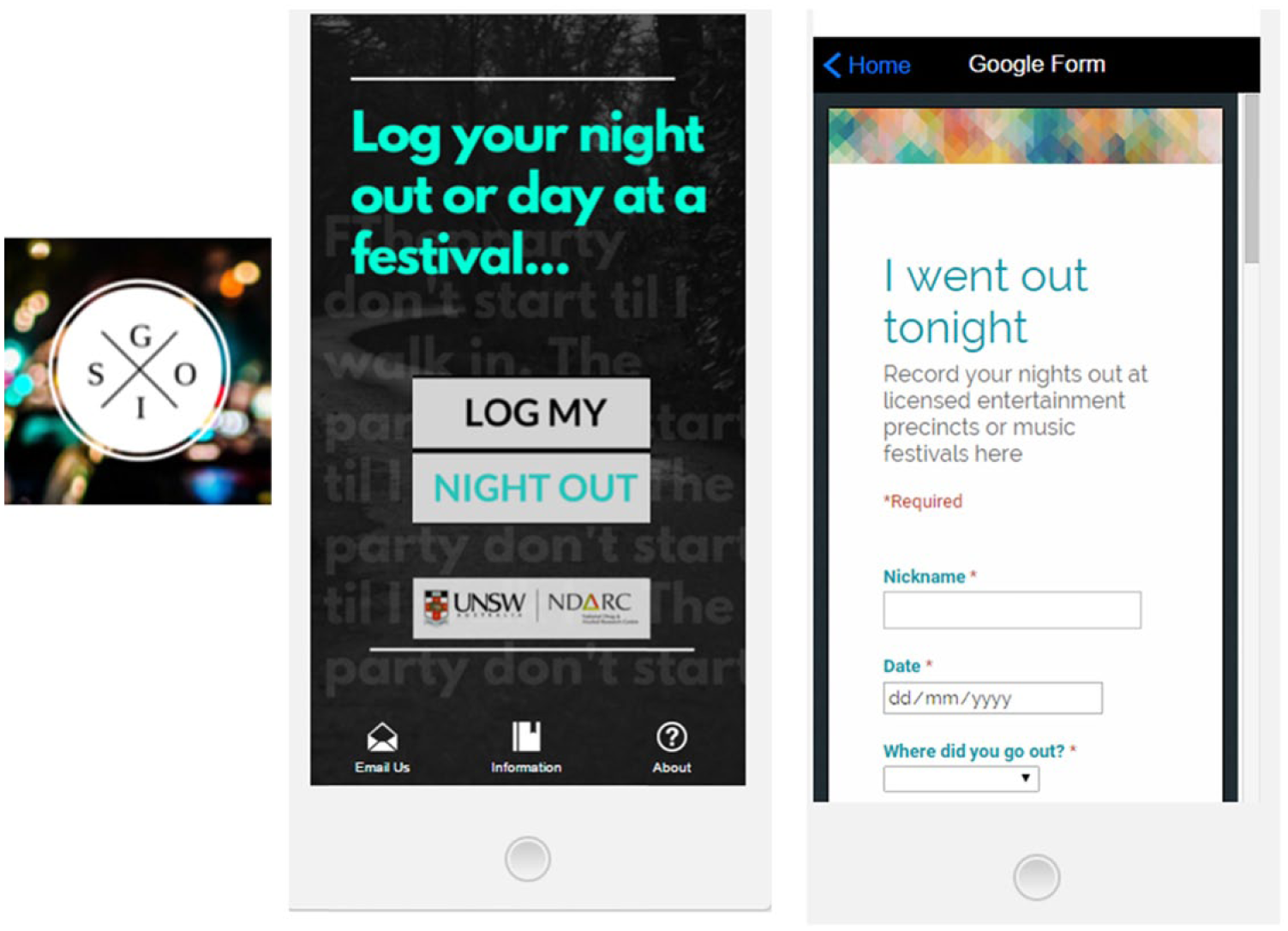
Screenshots of the Going Out In Sydney (GOIS) app logo, home page, and log form.
The logo was created so that it was nondescript and could sit on a person’s phone without drawing attention (see Figure 1).
The main part of the app for data collection purposes was the log screen. This asked participants to do a short (5 minutes) log of all visits to music festivals and licensed entertainment precincts over a 3-month period, noting for each
The date they went to the festival or licensed entertainment precinct;
Where they went (festival, nightclub, pub/hotel, or a small bar);
The prevalence and nature of any alcohol use, eg, beer, spirits, and wine;
The prevalence and nature of any illicit drug use, eg, cannabis, ecstasy, and cocaine;
The number of police encountered (ranging from 0 to 200+) and, where relevant, the type of police encountered (eg, uniformed police officers or police with drug detection dogs).
The app was designed to be used after the event (eg, when participants got home or the next day). This meant it was a close-to-real-time, not a real-time app. The app used a 1-way communication form only (ie, from participants to the researchers). No logs were stored on the phone or in the app itself, so once a log was submitted it was only accessible by the researchers via a password-protected Google Form. Monthly reminders and 3 × $10 music gift vouchers were emailed to participants to prompt them to log their nights out for the whole data collection period.
Privacy in the GOIS app
We were cognisant that the use of mobile technology brings with it unique privacy considerations. This was particularly important in this study given our focus on asking participants to record illegal behaviours and police encounters. In line with Capon et al, 36 6 steps were undertaken to minimise legal and privacy risks to research participants. First, we pseudo-anonymised all app data by giving nicknames to all participants to use in the app. This ensured that no real names were associated with data entered into the GOIS app. Second, we avoided collecting high-risk non-essential data through the app. As such, we collected demographic information (eg, age, gender, education, criminal justice history) outside of the app (via email). We further chose not to collect Global Positioning System (GPS) coordinates on the location of ‘going out’ or location of drug use: albeit we asked about the utility of adding this feature for future studies. Third, no data were stored in the app or the phone itself – instead all data were stored in an external password-protected server (Google Forms). Such steps meant, for example, that if police were to stop someone who had the app on the phone, they could see the app but not any data connected with it, unless they submitted a request to the research team. Fourth, all data stored via Google Forms were protected using a 2-step verification process accessible only to the researchers. Fifth, we developed a GOIS app privacy policy, which in accordance with Australian Privacy Principles on apps 40 clearly outlined to research participants how we would collect, store, and disseminate information through the app. Sixth, we outlined the limits to our privacy and security protections on the GOIS app data. Of note, we told participants that although all app data were pseudo-anonymised, we could not prevent third parties from monitoring user activity (such as who was using our app) as cookies are used by some third parties to monitor app traffic patterns. 41 That said, we noted that participants could reduce this risk by disallowing cookies through their personal web browser settings. Finally, we made clear that although we did not intend to share the GOIS app data to any other third party, we could be required to provide the data by law/law enforcement. That said, by gathering data on drug use, not supply, avoiding geo-tagged locations, and collecting close-to-real-time as opposed to real-time data, we reduced the likelihood of this occurring. As such, while cognisant that app developers can never prevent all legal and privacy risks, including hacking or tracking of user activity, the steps taken here were consistent with the best practice guides on privacy and security protections for apps collecting sensitive data.36,42,43
Sample inclusion criteria
The inclusion criteria of the GOIS study were people who
Were aged 18 and older;
Had attended at least 1 outdoor music festival (ie, an event oriented around music and attended by thousands of music fans) and 1 licensed entertainment precinct (ie, an area where there is a high density of pubs, bars, or nightclubs) in the past year;
Lived in Sydney, NSW;
Had a mobile phone that was compatible with apps downloaded from the Apple iTunes store (so that they could download and use the app on their own phone).
Recruitment
Participants in the GOIS study were recruited from an existing national survey (the Drug Policing Survey) involving 4114 people aged 18 and older who assessed retrospective and hypothetical impacts of policing on drug use and supply at Australian music festivals and licensed entertainment precincts. 1 Participants who took part in the survey and expressed an interest in undertaking future research on drug policing were contacted. The emails outlined the sample inclusion criteria (including the need to reside in Sydney) and project aims and steps (such as that by taking part in the study, they would be required to use an app to complete a short log about each time they visited an outdoor music festival or licensed entertainment precinct over a 3-month period).
A total of 437 people were informed about the study and inclusion criteria. In total, 72 people reported they were eligible and expressed an interest in participating (many of those contacted were ineligible as they were not from Sydney). All were allocated a nickname and given a consent form and demographic flyer to complete. A total of 38 returned all forms and downloaded the app and began logging their nights out using the GOIS app. Thirty-five completed the full 3-month period (92.1% of app users). A follow-up survey and interview was conducted about the utility of the app with 32 participants (84.2% of app users).
Using the GOIS app
At the commencement of the study, participants downloaded the GOIS app from the Apple iTunes Store: then used their allocated nickname for each log. Each time a participant made a log, the time of the log entry was recorded alongside their log of which venue they had attended, whether they had consumed drugs or alcohol, and the number and type of police encountered. The study took place from January to July 2016, with recruitment commencing in January, but some participants commenced logs in late March. This meant that the peak data collection was March to May 2016.
There were a total of 353 viable logs made in the GOIS app over the duration of the study; this excluded double-ups (n = 3), entries made outside of the study period of January to July (n = 4), and entries from people who were not in the study (n = 17).
Follow-up survey and interviews regarding app utility/feasibility
A follow-up survey and interview about the utility of the app was conducted 1 to 4 weeks after cessation of GOIS app data collection. The follow-up survey was short, consisting of 2 pages, and examined 3 things. First, participants were asked about the utility of the GOIS app: including the ease of use, layout, time taken to make logs, how comfortable they were with using the GOIS app to report their drug use, alcohol use and police encounters, and importance of having been given a pseudonym (nickname) for privacy. Second, participants were asked about the desirability of using the smartphone app versus other modes of data collection (paper-based logs, telephone calls, SMS logs, and online surveys). Specifically, they were asked to rate the ease of use and the perception of confidentiality. Each was assessed on a 5-point Likert scale. They were then asked to rank their overall preferred method for data collection. Finally, participants were asked about avenues for future alcohol and drug use app research, including whether they would be comfortable with geographical location, real-time logging, photo uploading, and questions on engagement in drug purchasing and drug supply being included in an app. The interview (part of a broader interview about the app data) asked participants to talk us through their answers to the survey and elaborate on their experiences with using the GOIS app.
Analysis
Chi-square and t tests were used to assess potential demographic differences among completers and non-completers and against our national sub-sample of festival attendees. 1 A 1-way repeated-measures analysis of variance (ANOVA) was run on the participant’s ratings of the ‘ease of use’, ‘confidentiality’, and overall rankings of each of the different modes of logging to test whether the app was statistically easier to use, more confidential, and more highly ranked as a preferred method than the alternate methods. Interview data were recorded and transcribed: then thematically analysed against the key themes of the survey (usability, confidentiality, and utility of the app versus other modes of data collection).
Results
Part 1: demographics of study participants
Participants in the GOIS app study were young, well educated, and predominantly women (see Table 1). The sample reported high rates of recent illicit drug use (87%), particularly of ecstasy (84%) and cannabis (79%). Few (6%) reported ever having been charged or arrested for illicit drugs. Chi-square and t tests showed that there were no demographic differences between completers and non-completers. Compared with our national Drug Policing Survey of regular festival attendees, the GOIS participants were more likely to be women (χ2(1) = 14.399, P < .001) and to have completed year 12 (χ2(1) = 7.2549, P = .007). They were also more frequent attendees at music festivals (χ2(1) = 25.418, P < .001) and licensed entertainment precincts (χ2(1) = 6.165, P = .01). However, they were similar in terms of age, employment, and drug use and criminal justice history. 1 The demographics and drug and alcohol use rates of participants in the GOIS app study were also broadly consistent with other national surveys of festival goers (the 2015 Big Day Out Survey) 44 and regular ecstasy users, defined as people who engage in at least monthly use of ecstasy/3,4-methylenedioxy-methamphetamine (MDMA). 45
Demographics of the participants in the GOIS study versus National Drug Policing Survey.

P < .05.
Part 2: the GOIS app data
At the completion of the study, GOIS participants had made a total of 353 logs concerning ‘nights out’ in Sydney. This meant that participants made an average of 50 logs per month: with up to 78 logs per month during the peak period of the study. Analysis of the time of entry of logs shows that logs were made very close to the ‘night out’. For example, 70% of logs were made within 0 to 2 days of going out and 9.3% occurred on the night out. Examining entries over the entire study period (see Figure 2) showed some peaks and troughs in entries. Many coincided with dates of public holidays, festival periods, and other events. There were also more logs during March and April, as opposed to June and July. This reflected both the timing of when people commenced logging and seasonal variation (summer and autumn is the peak period of going out). That said, across the period as a whole, there were clear temporal patterns: the majority of logs concerned Friday or Saturday nights, although a small but important number of logs concerned ‘nights out’ during the week.

Number of entries in the Going Out In Sydney app by date.
Compared with prior studies on drug use and drug use/policing at festivals and licensed entertainment precincts, the GOIS app added both a higher volume of data and richer data. Rather than reporting on drug use on 1 night out, the app data provide data on drug use on 353 nights out. In doing so, it shows that consistent with earlier studies that illicit drug use is common on nights out (occurring on 39.9% of nights out; see Table 2) (albeit much less common than alcohol consumption), but that there can be considerable variation in use according to when and where people go out. For example, Table 2 shows drug use is about twice as likely at festivals as at licensed entertainment precincts. Moreover, Figure 3 shows that illicit drug consumption was more concentrated than alcohol consumption to 2 key months (March and April) and to weekends as opposed to weekdays and that illicit drug use was particularly high during public holiday periods (irrespective of police presence or absence).
Number and type of logs in the Going Out In Sydney app, by venue.
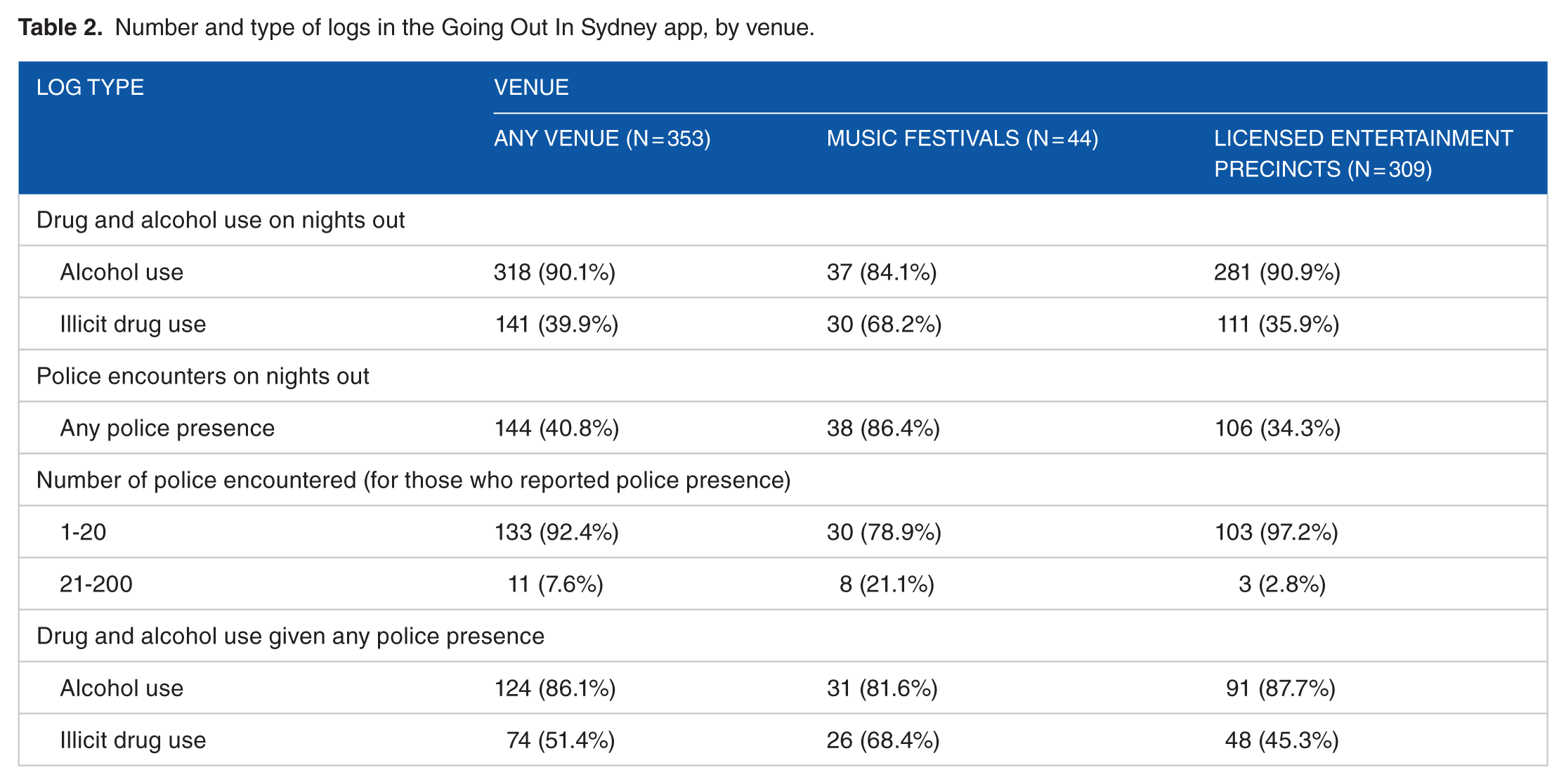

Number of logs in the Going Out In Sydney app by date and type (alcohol use, illicit drug use, and police encounters).
Most importantly, given each log included the presence or absence of police and presence or absence of illicit drug use, a large amount of data have been produced for extending knowledge on how policing may affect drug use on nights out. For example, our earlier retrospective survey suggested that at the last festival attended, 71.2% of patrons encountered police, but 65.3% of patrons nevertheless used illicit drugs. 1 The GOIS app data now enable insight into 44 visits to festivals. Of note, the incidence of police encounters and drug use at festivals was higher than in the retrospective estimate (eg, patrons reported police encounters at 86.4% visits to festivals, as opposed to 71.2% at the last festival). This suggests that the app does reduce recall bias and that the actual incidence of police encounters and drug use at festivals may be higher than suggested in earlier estimates. Equally important, consistent with our earlier estimate, most patrons (68.4%) continued to use illicit drugs irrespective of police presence. Finally, the app data bring to light a number of circumstances under which policing may be more or less likely to reduce drug use. Illicit drug use appears more likely to occur in the presence of police if it is a weekend as opposed to a weekday (56.3%, versus 34.4%, respectively) (χ2(1) = 10.467, P = .001) and if people went out during April, as opposed to in February or May (62.2% versus 43.5%-46.2%) (χ2(1) = 8.806, P = .003). This suggests that the relationship between policing and drug use at festival and licensed entertainment precincts will be more complex than often assumed. Our future study will use the GOIS data to explore the impacts of the incidence, number and type of police encountered on the likelihood, and type of illicit drug use, as well as differences in individual offending trajectories.
Part 3: participant views on the GOIS app
Participants were favourable about the GOIS app. On a 5-point scale of satisfaction with the app, participants rated as ‘extremely satisfied’ the ease of use, time it took to make each log, and confidentiality/privacy afforded for their data, with 87.1%, 87.1%, and 80.6%, respectively. They were less satisfied with the app layout: 67.7% were extremely satisfied. Some noted the layout was a little basic, particularly the logging page, as all the questions were on the same screen, which meant that participants had to scroll down on their mobile phones to complete the log:
The layout is just probably something that needs work because I’d do it and have to scroll through it and then when I’d click on things it would throw itself around. That’s the only thing. (Katy, F, 22)
Participants reported they were very happy logging all forms of activity requested in the app. For example, 100% said they were extremely comfortable using the GOIS app to log police encounters, 96.8% to log alcohol use, and 74.2% to log illicit drug use (16.1% ‘somewhat comfortable’ and 9.7% N/A – for non-users). That said, the comfort about reporting illicit drug use appeared connected to the approach taken: namely, the decision to pseudo-anonymise data collection through the GOIS app. This is apparent as most participants reported that having a pseudonym (nickname) in the GOIS app increased their feelings of confidentiality/privacy about their data. Specifically, 64.5% indicated that it increased their feelings of confidentiality ‘a great deal’ or ‘a lot’, 29.0% said it increased their feelings of confidentiality ‘a moderate amount’ or ‘somewhat’, and only 6.5% indicated that it had no impact. In the follow-up interviews, participants elaborated on this, with participants who had never reported their drug use before finding the pseudonym particularly important for them:
Yeah, it was pretty good that you guys did the nickname, because - I mean, I’ve never done something like this before, confessing my drug use and all of that, so I think it’s good. (Ava, F, 22) I didn’t mind if I used my real name or not. But there is definitely more of a sense of privacy. (Lin, F, 20)
On the whole, feedback on using the app was thus very positive, including that it provided an easy, quick, and viable means to log nights out in Sydney:
Like easiest app ever . . . like it was just all set out. (Bec, F, 19) It’s definitely very easy to use after a night out. (Jeff, M, 19)
Part 4: feasibility of the app over other methods
The GOIS app follow-up survey asked participants to rate each of the commonly used alternative methods to log nights out based on perceived ease of use, confidentiality of data, and overall preferred method.
Ease of use and accessibility of the app over alternative methods
Figure 4 outlines participants’ perceived ease of use and accessibility of methods of logging nights out on a scale of 1 (extremely easy) to 5 (extremely difficult). A 1-way repeated-measures ANOVA showed that there was a statistically significant difference in the perceived ease of use in logging a night out: F4,124 = 66.136, P < .0005. Post hoc analysis with a Bonferroni adjustment revealed that the smartphone app was rated the easiest method for logging nights out, followed by online surveys. In contrast, pen and paper and weekly phone calls were rated the most difficult methods for logging nights out.

Ease of use and confidentiality of smartphone app versus other modes of logging.
Our qualitative interviews backed up these findings, with participants saying the app was the most accessible and easy logging method:
The app would be the easiest, extremely easy, extremely easy. (Owen, M, 19) I’d kill myself if I had to do pen and paper logs. (Bec, F, 19) Phone calls . . . that’s too hard to organise, to work around everyone’s schedules, particularly when you’re doing things all the time. (Lin, F, 20)
Participants highlighted 2 key reasons for why the smartphone app was the easiest method. First, participants always had their phones with them:
I thought the phone app was good because it was always just on your phone. You didn’t have to be like, ‘Oh I’ll go and get my laptop and fill out’. It was just something very easy to do and we always have our phones on us. (Iggy, F, 20)
Second, participants highlighted the portability of the app – noting they could log a night out from anywhere, including at home, on a train, or at a friend’s house:
Once I got the hang of it, it was really easy to log, a quick five minutes on the death train home – like pretty easy. (Bec, F, 19) I would often log my entries on the night bus home . . . I just always thought about it because I was always bored on the bus I remember, because it’s quite a long trip for me to get home from the city so I was like, yeah, just pop it in now. (Zan, F, 18)
Confidentiality of the app over other methods
Figure 4 shows that participant’s views about confidentiality of logging methods differed from views about the ease of use. For example, SMS was rated the least confidential mode of logging, followed by weekly phone calls (see Figure 4). A 1-way repeated-measures ANOVA (with Greenhouse-Geisser correction) showed that there were significant differences in the perceived confidentiality of the 5 different methods of logging nights out: F2.498,74.943 = 24.293, P < .0005, partial η2 = 0.447. Post hoc analysis with a Bonferroni adjustment revealed the smartphone app was perceived to be significantly more confidential than both SMS logs and weekly phone calls; however, both pen and paper and online surveys were perceived as having a similar level of confidentiality to the smartphone app.
Our qualitative interviews reinforced these findings. For example, participants in the follow-up interview strongly asserted that SMS and phone calls offered the least confidential route for data collection. For example, they brought up the possibility that an SMS log or a phone call could be ‘tapped’ or be from a ‘traceable number’ and that talking about illicit behaviour on the phone was very problematic:
Actually SMS are a bit red hot now because they track all of that – red hot. (Sia, F, 20) Phone calls, that doesn’t seem confidential at all to me; that seems horrible. (Owen, M, 19)
In contrast, pen and paper logs that had been rated poorly in terms of ease of use were perceived as one of the most confidential options because it is ‘less traceable’ (Eve, F, 24) and ‘you don’t have to put your name on it’ (Zan, F, 18).
Compared against these options, participants stated that the smartphone app was generally confidential (particularly due to the use of pseudonyms). Regardless, there were still concerns because of the type of information being collected (illicit drug use – an illegal behaviour), which led participants to note they had a low-level paranoia that their information entered into the app could be tracked or fed directly to the police:
Like I find phone apps, they’re going to be pretty much the most [confidential] but you can still track it, I guess, with your iPhone, iTunes, account and everything like that. But the online surveys and phone app were probably the best. (Bec, F, 19) There were times I’d log in what I was doing and I was like can you just imagine if this was a police – there was a running joke with my friends that imagine if you rocked up and it was just police being like, ‘We know what you’ve done’. (CE, F, 22)
Both the qualitative and the quantitative feedback reinforce that irrespective of the mode of data collection, confidentiality and security are always going to be more of a concern in any study such as this that is gathering data on illicit drug use and policing:
The only thing with confidentiality, it doesn’t really matter what kind of medium you use, I think I’d always have an inkling of concern, just because of the nature of the survey I guess. (Katy, F, 22)
Final ranking: preferred mode to log nights out
Overall, when asked to rate on a scale of 1 (least preferred) to 5 (most preferred), the most preferred method to log nights out for a study like this was the smartphone app, followed by online surveys (see Figure 5). Participant rankings were statistically significantly different across the modes of logging, F2.812,87.165 = 89.976, P < .0005, with the smartphone app the most preferred mode of logging and pen and paper and weekly phone calls the least desirable mode of logging. As such, participants strongly supported the smartphone app and recommended their use for future data collection.
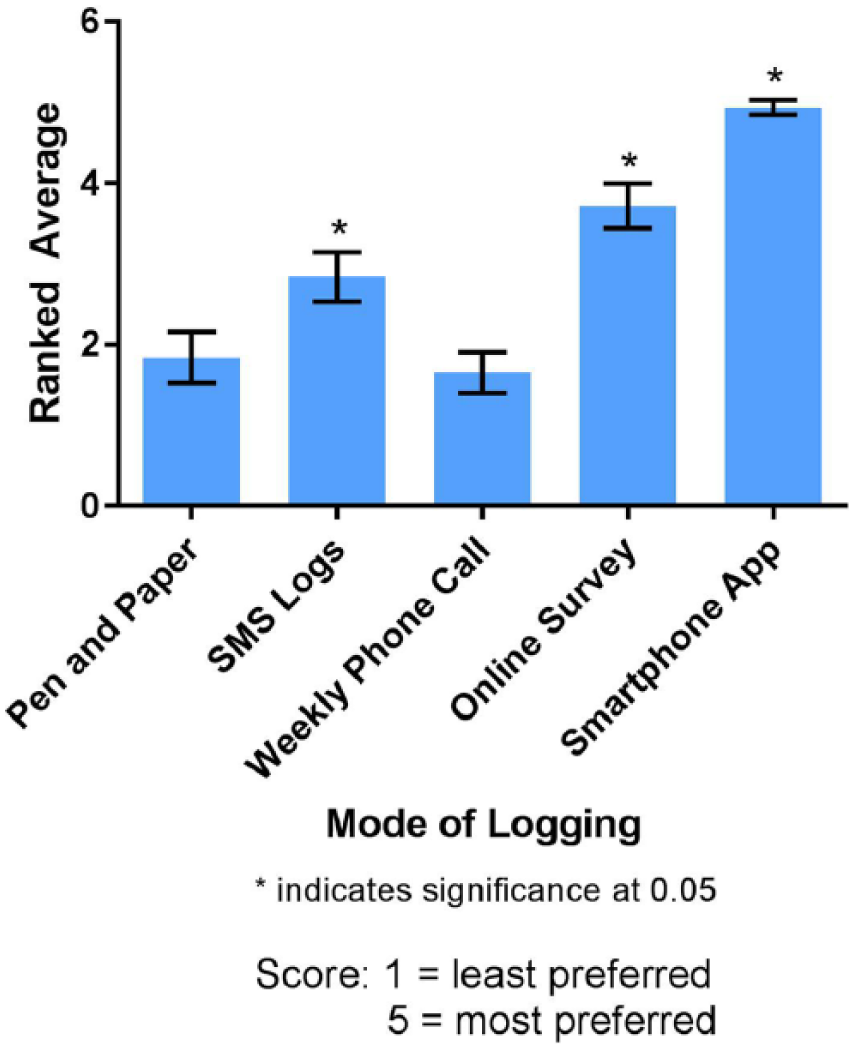
Ranked preferred mode for logging drug use and nights out.
Part 5: future options for a similar app
When asked about additional app features that could be included for future drug-related studies, participants strongly supported inclusion of some features (see Table 3). Of note, participants were very supportive of the use of alerts or SMS to remind them to log their nights out. In all, 90% of participants also supported the option to include more site-specific information, either through the use of GPS coordinates of premises/locations where they used drugs and/or encountered police or logging the names of premises/festivals attended:
It would be interesting because you would probably be able to map where people go when they’re more likely to have a bigger night . . . and to track where police are. (Lexi, F, 24)
Views on inclusion of additional app features in future illicit drug–related research.
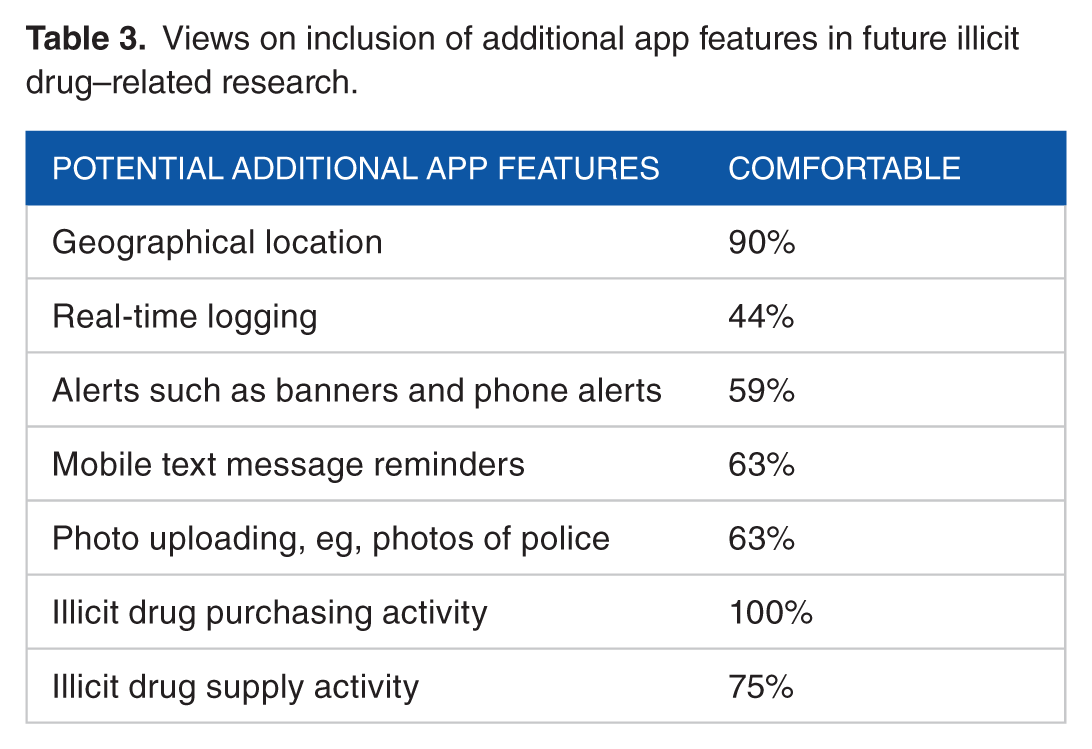
That said, routine use of GPS to track where they went or where they used illicit drugs was not supported as this was deemed to pose a bigger risk to privacy.
Many participants were, however, strongly opposed to real-time logging. Reasons for the opposition included concerns about battery drain because it could be a nuisance and that it was deemed ‘not private enough’ to report drug use and police encounters during a night out:
I don’t think real-time would be that good just because if you’re on drugs especially, you’re like – you don’t want to be preoccupied with something. (Owen, M, 19) I just think I’d give up on doing that. Like, the reason why it was good because you can do it on the Monday or the Sunday or the Wednesday and it doesn’t matter. I think it would be a lot harder to get people to engage with if it was a real time thing. (Lexi, F, 24)
Finally, and importantly for future research in this area, all participants supported future inclusion of questions about purchasing activity. For example, Owen (M, 19) noted, ‘Questions on the app on illicit drug purchasing. Yeah that would be really good, big fan’.
Discussion
This article sought to test the utility of smartphone app (the GOIS app) to gather data on illicit drug use and policing encounters at festivals and licensed entertainment precincts. We conclude that the app had considerable utility. The app enabled rich data collection: a total of 353 logs over the study period and the first set of repeated measures and close-to-real-time data on illicit drug use and policing activity at festivals and licensed entertainment precincts. The app also had appeal to research participants. For example, participants reported that the app was swift to use and that they were very comfortable using the app to report policing encounters and personal drug use on nights out. Compared against other methods of data collection (pen and paper, SMS logs, weekly phone calls, and an online survey), the smartphone app was deemed easiest to use, the equal most confidential to pen and paper and an online survey, and the preferred overall method for logging their nights out. This study has showed that the application of smartphone apps to illicit or criminal behaviours raises unique and special considerations about the privacy/confidentiality of data, but that the steps taken in this research, including pseudo-anonymising app data, can be one useful way to reduce risks and build smartphone apps that have utility and worth for illicit drug policy research.
Our experience using the GOIS app adds to the existing research showing the utility of apps for research data collection on topics as diverse as medicine, engineering, education, time usage studies, and alcohol consumption,22,23,29 suggesting that smartphone apps can also be useful for research data collection on illicit drug use and drugs policing. Given the challenges in getting access to data on such topics, this is welcome news.1,12,13 Consistent with prior research findings, we found that using apps to collect data on illicit drugs offered some clear benefits: enabling data collection that is convenient and unobtrusive for participants (particularly given they can enter data when and where they want), the ability to gain multiple and comparable data points, and the ability to gain richer data on behaviour in real-time or close-to-real-time that can better capture the context of the behaviour of interest.22,23,29,35 More specifically, the GOIS app brings to the fore 3 benefits for drug policy research. First, it has showed that the apps can be used to capture data not only on behaviour (illicit drug use) but also on policy responses to that behaviour (policing). This is important as apps have often been used to monitor behaviour alone (eg, alcohol use).26,27,35 Second, it suggests that apps may advance knowledge about the likelihood and type of policy interventions to which people who use drugs are exposed. Apps have often been suggested as a means to reduce recall bias about behaviour,22,23,29,35 but the GOIS data suggest that apps may hold even more worth for reducing recall bias about the exposure to drug policy interventions. For example, the reported incidence of illicit drug use at festivals was 3.1% higher in the GOIS app than in our retrospective estimate, but the incidence of police encounters at festivals via the GOIS app was 15.2% higher. Third, the GOIS app data have suggested that by bringing together repeated and more accurate data on drug use and drug policy, apps may provide a means to significantly advance knowledge about the impacts of drug policies. For example, our preliminary data indicate that the relationship between policing and drug use at festival and licensed entertainment precincts is more complex than often assumed and that apps may thus offer one vital tool for capturing specificities about the inter-relationship of drug use and policing that can be used to produce better knowledge and policy advice about illicit drug policing policies.1–4
Consistent with earlier app studies, the GOIS app met with 2 challenges.21,29,31 The first was technical hitches/problems with app layout from a basic design. That said, it is also clear that problems in layout were deemed relatively minor: aided in part as participants enjoyed the study and using the app to report on their nights out. The second and bigger issue for this research was privacy/confidentiality. That privacy mattered was not surprising, particularly given the nature of the research (monitoring illegal behaviour). But that privacy/confidentiality remained a concern, despite the multiple steps recommended for reducing privacy concerns,36,42,43 including using pseudonyms in the app and storing data in the cloud rather than in the app, was surprising. It suggests that the study may not have been possible without such steps.
Indeed, one of the most interesting findings from our assessment of the app utility was that it brings to light significant trade-offs in confidentiality and accessibility in the collection of data on illicit drug use. Specifically, there appears to be trade-offs between the perceptions of ‘ease of use’ and ‘confidentiality’ in a logging method. For example, the app was by far the most usable method for data collection, but it was rated equal to pen and paper and online surveys in terms of confidentiality. The generation we interviewed for this study (average age of 21) are hyper-aware not only of policing but also about the traceability, retention, and infinite storage power of online and mobile phone technologies. Although pen and paper is perceived as one of the less accessible means of making logs, there is a sense of ownership and confidentiality that came across in interviews concerning this mode of logging due to its separation from more easily hacked systems. This trade-off between accessibility and confidentiality appears to have less resonance for research in other domains, 23 but has considerable importance for researching illicit drug behaviour. This is particularly when the population in question is one who is acutely aware of the consequences of police detection (even if rare).
The study holds some clear implications for alcohol and drug researchers. First and foremost, we concur with Kuntsche and Labhart 35 that smartphone apps can be a useful technology for alcohol and other drug research. 35 We would thus recommend further use of apps for this purpose. This is good news as it opens up many possibilities for research; particularly we would recommend to build knowledge about the on-the-ground impacts of illicit drug policies (be they drug laws, policing, treatment, or harm reduction) and the lived experiences of people who use drugs. 34 For example, we see particular potential to apply apps in a comparative perspective to compare experiences of drugs policing in different legal and socio-cultural contexts. Second, this brings to light the very specific challenges to the use of apps for drug research: beyond that seen in alcohol app research,26,27,33 most notably issues of privacy and confidentially and security of data, and how research participants themselves are often acutely aware of those risks. In light of these challenges, we urge that designing apps and using apps in ways that recognise and minimises these issues, such as through pseudo-anonymising app data and using close-to-real-time as opposed to real-time data collection, should be important steps in using apps to research illicit behaviour. Importantly, as shown in this study, taking such steps can deliver apps that produce viable data for drug research.
Limitations of the study are that, first, this used a small sample (n = 38) of young smartphone users. Second, the app was also restricted to iPhones which meant that android phone users were excluded. Third, the app was designed to be used after the event: which means there may still be some capacity for recall bias about what occurred on the night out. Fourth, there is a possibility that participants’ views on the ease of use and confidentiality of the app may have been skewed towards app use, as all participants were smartphone users and agreed to participant in a smartphone app study. We do not know whether the broader population would have rated the app as positively. That said, given the very high uptake of smartphones and app technology in Australia 38 and other advanced economies (including Europe, United States, Canada, South Korea), 38 particularly among those aged 18 to 34 who are the population most likely to engage in illicit drug use, 46 we suggest albeit tentatively that apps may have broader appeal. Fifth, positive assessments on the utility of apps versus other methods such as pen and paper and online surveys for further studies may also have been affected by the halo effect: namely that all participants had just used the GOIS app, but not other methods. That said, recruitment occurred from an online survey, which means that all participants had familiarity with 2 different modes of data collection on drugs and policing and nevertheless rated the app the preferred option. Sixth, the app measured patrons’ perceptions of policing, which may differ from what police actually did at any event. That said, in line with criminological deterrence theory whether or not patrons see police is as if not more important as to whether police were actually at an event.14–16 Finally, most of the participants were drug users and not traffickers: we thus have reservations about whether apps could prove a useful tool for studying supply activity or the impacts of policing on supply. That said, inclusion of questions about possession and purchasing (as well as use) could be of significant worth, for better understanding use and purchasing and the impacts of police on such behaviours.
Conclusions
In conclusion, this study has assessed the utility of a smartphone app (the GOIS app) for monitoring illicit drug use and police encounters at festivals and licensed entertainment precincts. It has showed that the app has considerable utility, particularly through enabling the first set of near- to real-time and repeat data on illicit drug use and police encounters across multiple settings and that most participants were satisfied with the ease of use and privacy afforded. Although there remains a clear need to attend to the additional legal and ethical issues raised in application to criminal behaviours, this suggests that smartphone apps such as the GOIS app can be a viable option for gathering data on illicit drug use and policing of drugs. This opens up avenues for future app research regarding illicit drug use and a means to build better knowledge about illicit drug offending in high-use settings and the worth of current illicit drug policing policies.
Footnotes
Acknowledgements
Our sincere thanks to all participants who took part in the GOIS app study.
Peer review:
Five peer reviewers contributed to the peer review report. Reviewers’ reports totalled 2269 words, excluding any confidential comments to the academic editor.
Funding:
The author(s) disclosed receipt of the following financial support for the research, authorship, and/or publication of this article: This research was funded under the Australian Research Council – Discovery Project DP150100910. The National Drug and Alcohol Research Centre receives funding from the Commonwealth Australian Government.
Declaration of conflicting interests:
The author(s) declared no potential conflicts of interest with respect to the research, authorship, and/or publication of this article.
Author Contributions
CEH and VLM-H conceived and designed the experiments. CEH and VLM-H analysed the data. CEH and VLM-H wrote the first draft of the manuscript. CEH and VLM-H contributed to the writing of the manuscript. CEH and VLM-H agree with manuscript results and conclusions. CEH and VLM-H jointly developed the structure and arguments for the paper. CEH made critical revisions and approved the final version. All authors reviewed and approved the final manuscript.
Disclosures and Ethics
As a requirement of publication author(s) have provided to the publisher signed confirmation of compliance with legal and ethical obligations including, but not limited to, the following: authorship and contributorship, conflicts of interest, privacy and confidentiality, and (where applicable) protection of human and animal research subjects. The authors have read and confirmed their agreement with the ICMJE authorship and conflict of interest criteria. The authors have also confirmed that this article is unique and not under consideration or published in any other publication, and that they have permission from rights holders to reproduce any copyrighted material. Any disclosures are made in this section. The external blind peer reviewers report no conflicts of interest.