




Abstract
Kinase enzymes play an important role in cellular proliferation, and inhibition of their activity is a major goal of cancer therapy. Protein kinase inhibitors as benzimidazole derivatives can be applied for prevention or treatment of cancers through inhibition of cell proliferation. To evaluate their protein kinase inhibitory effects, as well as the in silico study for active benzimidazole derivatives. Benzimidazole derivatives has presented significant therapeutic potential against several disorders and known to have numerous biological activities (such as antibacterial, antiviral and anti-inflammatory). Benzimidazole derivatives have shown significant potential in the reduction of viral load as well as in enhancing immunity. To forecast absorption, distribution, metabolism, excretion and toxicity, simply known as ADMET and the Lipinski rule of five parameters of the examined substances, the admetSAR and Swiss ADME were used. The ADMET predictions revealed that the compounds had good and safe pharmacokinetic features, making them acceptable for further development as therapeutic candidates in clinical trials. This study primarily focused on blocking 2 key targets of kinase proteins (CDK4/CycD1 and Aurora B). 2-Phenylbenzimidazole has shown the greatest inhibitory potential (with a binding energy of −8.2 kcal/mol) against protein kinase inhibitors. This study results would pave the potential lead medication for anticancer therapeutic strategies.
Introduction
In the search for new anticancer drugs, several promising discoveries have been used for the class of benzimidazole drugs as potent anticancer agents.1,2 Cancer is one of the leading causes of death worldwide in 2018, and it is estimated that by 2030, cancer mortality rate worldwide will rise up to 12 million annually.3-7 February 4 was declared as the official world cancer day for creating the awareness of cancer and to encourage its prevention, detection and treatment.8,9 Rising problem in this area of medicine has initiated intensive research with a goal to discover novel anticancer drugs including benzimidazole derivatives ones.10-12
In the phosphorylation processes, protein kinase enzymes play an important role in a specific protein substrate, through transfer of the terminal phosphate moiety of adenosine triphosphate (ATP) molecule. The genome of human body contains approximately 538 different protein kinases; they are classified into 3 different families based on their selectivity for protein substrates. To achieve phosphorylation process, a free hydroxyl moiety is required in the protein substrate, which is freely available in serine, threonine and tyrosine residues.13-15 Accordingly, serine or threonine residues has a nature that it can identify and attach a phosphate group, on the contrary, tyrosine and histidine-specific protein kinases can phosphorylate a protein at a tyrosine or histidine moieties. Serine/threonine type including Aurora and CDKs kinases contributes in cell division through regulation of the mitotic progression signalling; deregulation of protein kinases is implicated in tumorigenesis.16,17 Accordingly, one of the major things that is needed to be taken into account of the cancer treatment is depending completely on kinase inhibition. The development and isolation of natural kinase inhibitors has been predicted to be a major object of pharmaceutical growth with more than 135 kinase inhibitors described to be in either phase I or phase II clinical trials, most of these drugs being tested for their potential as anticancer agents. 18
Benzimidazole bases are one of the most significant types of physiologically active ligands owing to the ease with which they can be synthesized and the high solubility with which they are soluble. They form stable complexes which is very important with numerous transition-metal ions. Because of the –NH groups in their structure, benzimidazole bases containing donor atoms (eg, N, O) plays a crucial part in the transformation mechanism of various processes in biological systems. 19
Heterocyclic nitrogen-containing ligand has numerous applications based on their structural diversity and much useful in the pharmaceutical field. Benzimidazole containing compounds are a class of compounds that often exhibit anti-inflammatory, antifungal, antibacterial, antioxidant and antitumor activity. A variety of different transition-metal complex with benzimidazole ligands have been reported in medicinal applications as reported by various researchers.20,21
Benzimidazole derivatives are considered one of the best known anticancer drugs owing to their high potential role as radical scavengers, strong antioxidants, chemopreventive and chemotherapeutic drugs in various types of tumour.
Materials and Methods
Ligand preparation
This study has incorporated benzimidazole derivatives compounds which have been proven for their significant antiviral potential (Table 1). Their 3-dimensional (3D) structure was downloaded from PubChem database and used for assessing their inhibitory potential against protein kinase inhibitors22,23 and standard drug abiraterone acetate (Figure 1B).
List of selected benzimidazole derivatives for docking analysis.


(A) 3D structure of protein. (B) Standard drug (abiraterone acetate).
Protein preparation
The crystallographic structures of CDK4/CycD1 and Aurora B (Figure 1) were obtained from Protein Data Bank (PDB ID: 2W96 with resolution 2.3 Å and 4C2V with resolution 1.49 Å, respectively). Structures of selected targets were downloaded from RCSB database (www.rcsb.org). 31 Subsequently, structure of targets was optimized with BIOVIA Discovery studio and finalized for docking studies using AutoDock Tool.
Drug-likeliness filters
We have selected 4 specific filters including Lipinski (Pfizer) Filter, Ghose Filter, Veber Filter, Egan (Pharmacia) Filter and Muegge (Bayer) Filter for the elucidation of drug-likeliness criteria of benzimidazole derivatives (http://www.swissadme.ch/). 32
ADMET properties
admetSAR was used to investigate the benzimidazole derivatives physicochemical and ADMET characteristics (http://lmmd.ecust.edu.cn/admetsar1). In this study, several factors were such as Ames test, human intestinal absorption, blood-brain barrier and Caco-2 cell permeability. 33
Docking (manual docking) analysis using AutoDock Vina software
Benzimidazole derivatives are having specific inhibitory potential, and these potential targets were evaluated by calculating binding energy obtained from AutoDock Vina as described. 34 Further ligand binding interaction was also identified using BIOVIA Discovery studio Tool and AutoDock Vina tool in the target protein. AutoDock Vina software was utilized in all the docking experiments, with the optimized model as the docking target. Potential antiviral drugs were shown by the effective relationship between molecules and receptor targets. Grid box (126 Å × 26 Å × 126 Å) centred at (152.179, 167.664, 166.985) Å.
Docking analysis using online server (PatchDock)
To further validate manual docking analysis, we have used an online server that can be freely accessed (http://bioinfo3d.cs.tau.ac.il/PatchDock/). PatchDock server is based on several algorithms such as geometry-based docking. Benzimidazole derivatives were docked with all different targets selected in this study. 34
Results and Discussion
Drug-likeliness criteria for benzimidazole derivatives
An additional pharmacokinetic analysis was performed on a total of 8 substances. Tables 2 and 3 show the Lipinski Ro5 criteria for 1H-benzimidazole, fuberidazole, thiabendazole, 2-phenylbenzimidazole, albendazole, nocodazole, N-desmethyl-bendamustine, and mebendazole. Benzimidazole was showing excellent activity and determined to be in violation of 5 of the 6 criteria, indicating that the medicine would pave new strategy improvement in terms of drug delivery systems.
Analysis of the Lipinski Ro5 of the benzimidazole derivatives.

Screening of benzimidazole derivatives using several drug-likeliness filters.

The drug-likeliness criteria of benzimidazole derivatives were assessed using 5 different filters (Lipinski, Ghose, Veber, Muegge and Egan). Apigenin has complied with all drug-likeliness criteria (Table 4). 1H-benzimidazole, on the contrary, has 3 violations and fuberidazole; 2-phenylbenzimidazole has 1 violation out of the 8 compounds (Table 4).
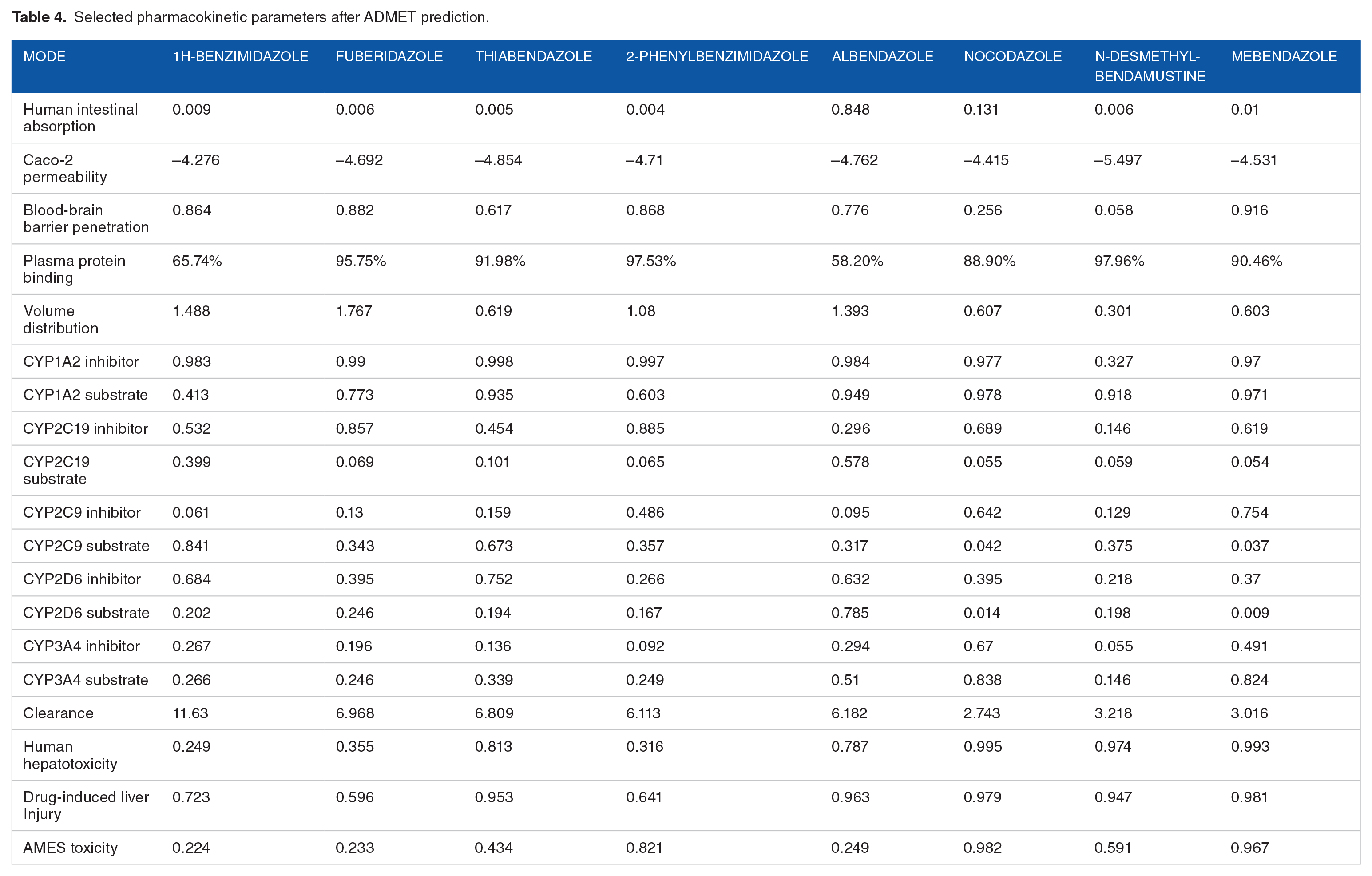
Selected pharmacokinetic parameters after ADMET prediction.
ADMET prediction
Table 4 shows the ADMET profiles of benzimidazole derivatives bioactive chemicals. Due to their strong binding affinity with the target proteins, the putative immunomodulatory chemicals in benzimidazole derivatives were anticipated to have excellent in vitro activity. In vivo and in clinical settings, the binding free energy value, when paired with the ADMET profile, might to useful in predicting the safety and effectiveness of benzimidazole derivatives bioactive compounds.
All 7 compounds had a high rate of intestinal absorption in humans, indicating that they are highly absorbed and may be ingested. The medications distribution was described using the permeability of the blood-brain barrier and their subcellular localization. The high permeability property of the ligands enables it to permeate and spread throughout the brain owing to the blood-brain barriers. The ability of the compounds to spread and permeate at the subcellular level was predicted by their subcellular location. Because none of the substances were CYP2D6 substrates, they were poorly metabolized in the body. On the other side, the human metabolism has the ability to vary a drug’s efficacy in the body. The toxicity parameters are hepatotoxicity and acute oral toxicity. Acute oral toxicity is a proxy for the maximal dosage of the researched substances that the body can tolerate, whereas hepatotoxicity is a proxy for organ toxicity.
Analysis of the inhibitory potential of benzimidazole derivatives with standard drug abiraterone acetate
Cancer is a severe threat (to health and wealth) over the world; there is no effective treatment has yet been discovered. Benzimidazole compounds are used in the treatment of a wide range of ailments, such as with cancer, neurological disorders, gastrointestinal issues, and other inflammatory diseases. As a result, simulation studies have been performed to take advantage of the potential of benzimidazole compounds and in silico methods for obtaining a potent drug molecule that can help not only to prevent the anticancer but also boost the body’s immunity. For the identification of therapeutic targets and inhibitors, in silico approaches provide a safe and cost-effective solution.
Aurora B is a chromosomal passenger protein that is associated with the centromeres in the early stages of mitosis, later localizes to the spindle midzone and the midbody of mitosis cells. It plays a role in chromosome condensation and cytokinesis. The docked compounds 1 and 7, which had the most active inhibitory impact on the chosen kinase with both Aurora B and CDK4/CycD1, were promising and genuine prospective binding mechanisms, similar to the co-crystalline ligands. Our findings indicated that among the benzimidazole compounds tested, 2-phenylbenzimidazole showed the highest binding efficacy against protein kinase targets (Table 5 and Figures 2 to 9). The phenyl form of benzimidazole is represented by ligand (2-phenylbenzimidazole and mebendazole). It has a high binding affinity (−8.2 kcal/mol), and it bind to 2W96 and 4C2V via the free phenyl, as shown in Figures 2 and 3. In phenyl ring feud compounds, 2 distinct sites of protein kinase interaction have the greatest binding affinity.
List of compounds with binding interaction parameter, ie, binding energy with the PDB: 2W96 and 4C2V of Protein Kinase Inhibition (AutoDock Vina).

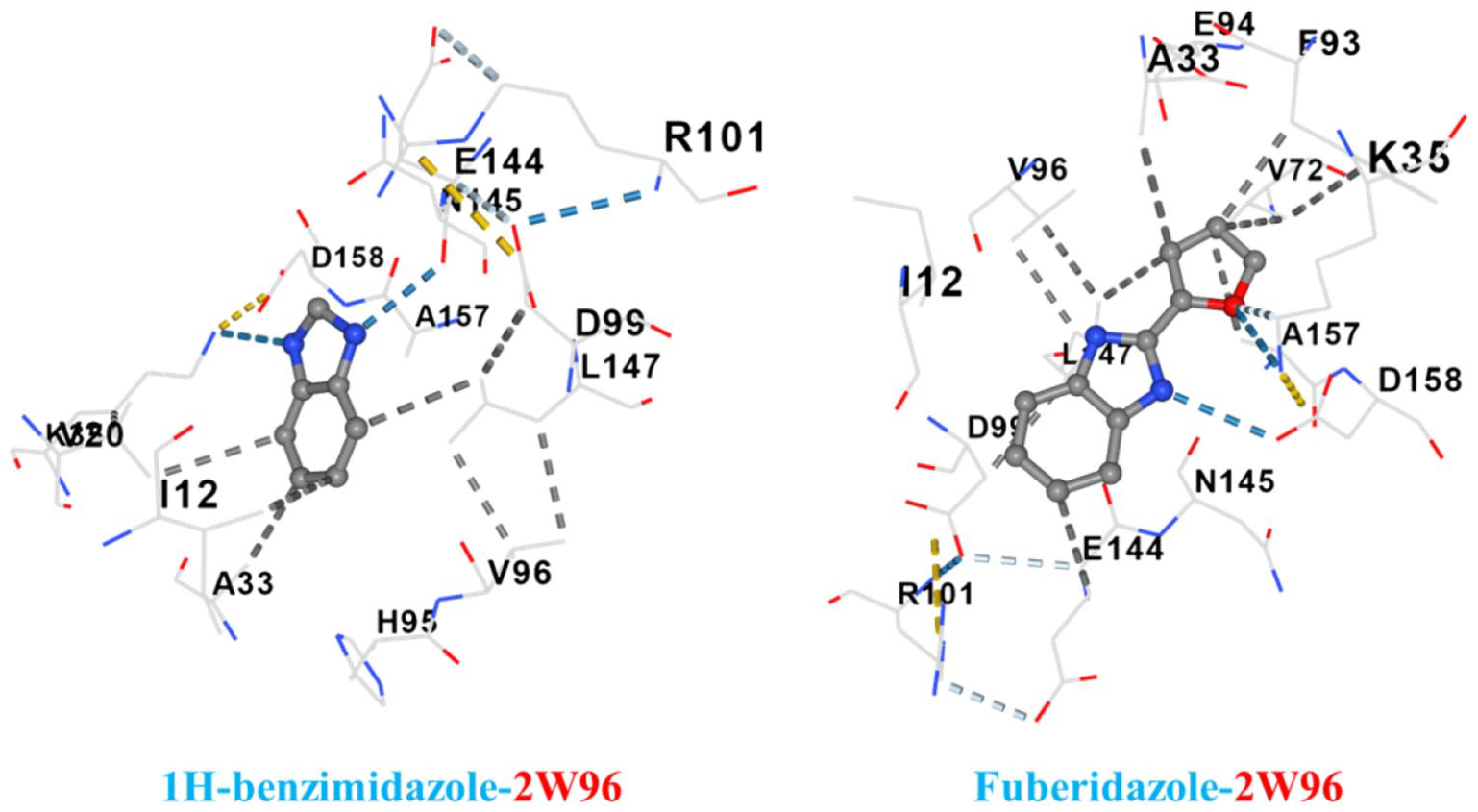
Docking analysis of 1H-benzimidazole and fuberidazole with (2W96) targets of protein kinase inhibition.

Docking analysis of thiabendazole and 2-phenylbenzimidazole with (2W96) targets of protein kinase inhibition.

Docking analysis of albendazole and nocodazole with (2W96) targets of protein kinase inhibition.

Docking analysis of N-desmethyl-bendamustine and mebendazole with (2W96) targets of protein kinase inhibition.

Docking analysis of 1H-benzimidazole and fuberidazole with (4C2V) targets of protein kinase inhibition.

Docking analysis of thiabendazole and 2-phenylbenzimidazole with (4C2V) targets of protein kinase inhibition.

Docking analysis of albendazole and nocodazole with (4C2V) targets of protein kinase inhibition.
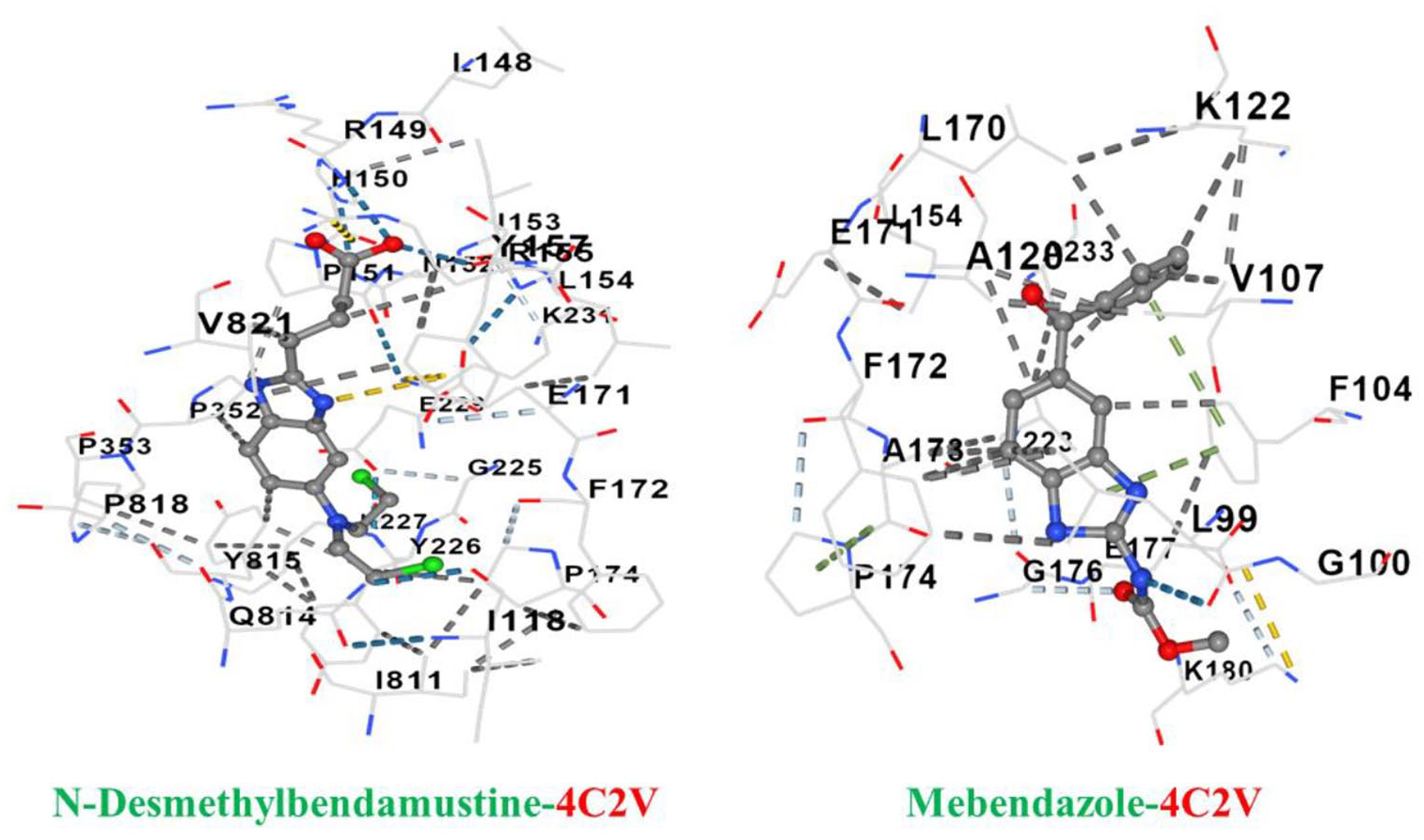
Docking analysis of N-desmethyl-bendamustine and mebendazole with (4C2V) targets of protein kinase inhibition.
Evaluation of docking result by patch docking
PatchDock has been used to accomplish docking interpretation to confirm the AutoDock docking outcomes. Table 6 Binding interaction of different benzimidazole derivatives with the active site of kinase protein. Whereas Table 7 shows the validation of online docking ligand and targets in protein kinase inhibition.
Binding interaction of different benzimidazole derivatives with the active site of kinase protein (PDB: 2W96) (AutoDock Vina) and (PDB: 4C2V) (AutoDock Vina)..

Validation of manual docking results using online docking software PatchDock.
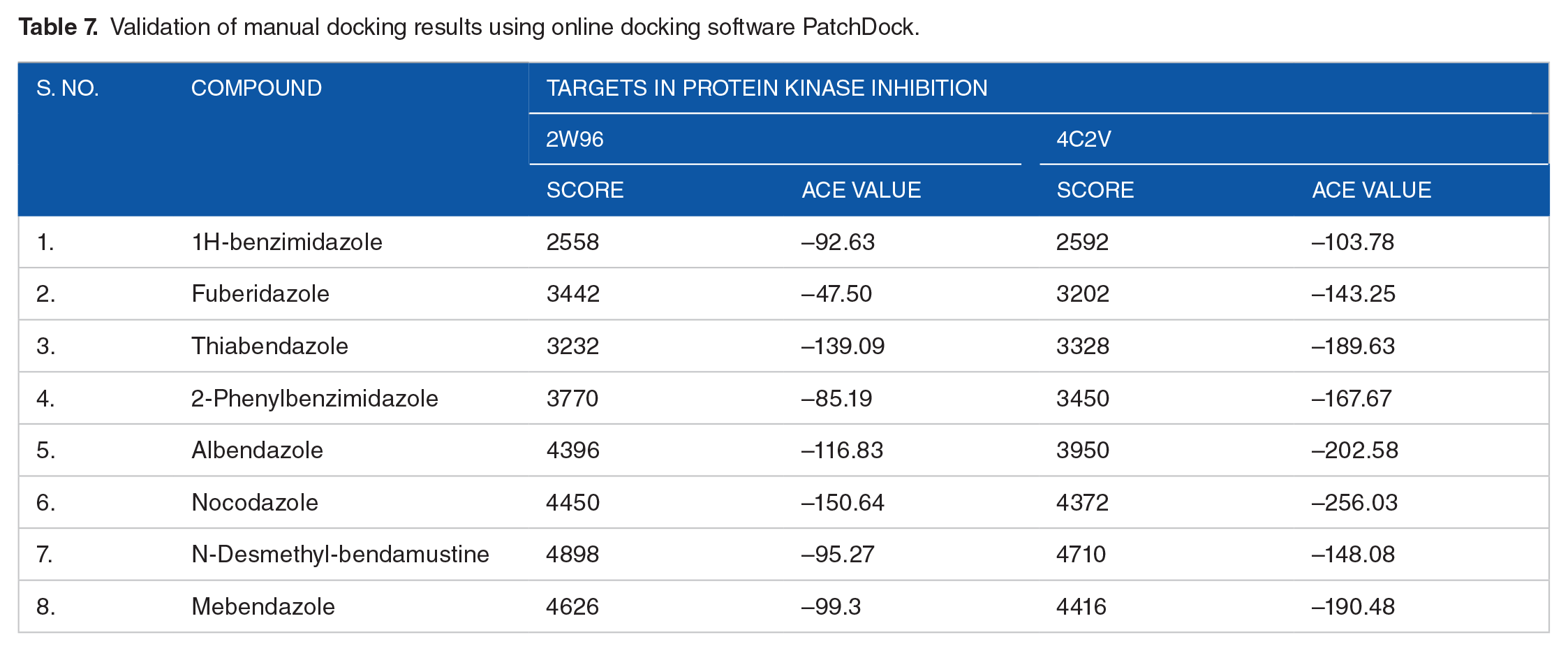
The superior efficacy of fuberidazole over the other 8 benzimidazole compounds was validated by the PatchDock. Fuberidazole showed that significant ligand-receptor interaction with the greatest possible atomic constant energy (ACE) value and patch dock score in correlation to other benzimidazole compounds and selected drug (abiraterone acetate).
Conclusions
In a summary, all simulation studies on both proteins lead to the conclusion that benzimidazole derivatives have the unique potential to inhibit the kinase proteins due to their high affinity with all the targeted proteins. When compared with previous studies, this study discovered that the benzimidazole derivatives compounds have a significantly higher binding free energy to all of the targeted proteins. The Lipinski Ro5 analysis demonstrates that majority of the compounds comply with the criteria and are predicted to be active when administered orally as drugs. The ADMET prediction of the compounds indicates that the ligands have favourable pharmacokinetic properties, implying that they have the potential to be developed as drugs. Hence, benzimidazole derivatives compounds have the potential to treat protein kinase inhibition because of having immunomodulatory effects and suppressing the cytokine storm, and they have the potential to be developed as drugs because of their good and safe ADMET profile. Prevalence of cancer has been raised to an alarming state, and CDKs have been studied extensively as a target for antitumor and anticancer therapy due to their significant roles in cell-cycle. Abnormal expression of CDKs may cause inappropriate regulation of cell cycle, which may provoke the cellular hyperproliferation in lung carcinoma, melanoma, osteosarcoma, ovarian carcinoma, pancreatic carcinoma, and carcinoma.
Footnotes
Funding:
The author(s) received no financial support for the research, authorship, and/or publication of this article.
Declaration of conflicting interests:
The author(s) declared no potential conflicts of interest with respect to the research, authorship, and/or publication of this article.
Author Contributions
K.A. and E.A.J. did the experimental part and designed the work and the Corresponding author, K.K. who is the research team supervisor compiled and corrected the full length article.
