



Abstract
Despite the wide interest toward the impact of antiracism or anticolonial trainings on White and settler peoples, there is a lack of consideration of the experience of racialized or Indigenous trainers. Yet, the few existing studies suggest major negative impacts: stress, emotional labor, burnout. This study explores the experience of 12 Indigenous facilitators raising awareness about colonialism in “Quebec” and the risk of negative effects on them, through participatory research, using qualitative methods and thematic analysis. The results show that the main difficulties are dealing with the participants, namely their questions, comments, emotions, and the ambivalence in navigating the power dynamic between settlers and First Peoples, expressed through various contradicting injunctions. This seems tolerable to the trainers as facing White settlers is worse in their daily lives. The workshops appear as an interpersonal reflection of settler-colonialism and White supremacy, through White and settler fragility and normalization of colonial violence.
Keywords
Introduction
Despite the increase in antiracism training, the experience, or risks, for racialized trainers are rarely considered (Lynch et al., 2017), let alone First Peoples (Erb & Loppie, 2023; Ward, 2018). For instance, the few studies on the experience of the facilitators raising awareness about one of their oppressions highlight how questions and dialogue risk exposing them to microaggressions and resistance (Ward, 2018; Whitney et al., 2022). Yet, what is repeated and practiced most in interventions is the importance of a question period for the people with that privilege (Browning, 2022; Burgess & Harwood, 2023; Douglas et al., 2020; Keliipio et al., 2018; Wylie et al., 2021).
At the risk of reproducing racist oppressions, the scientific literature predominantly focuses on the experiences of White people who receive or give such training. Out of 37 articles identified in our review of literature, only 4 directly address the experiences of racialized people delivering antiracism or anticolonialism training. Among these, the studies of Erb and Loppie (2023) and Ward (2018) focus on the experiences of Indigenous peoples who raise awareness on colonialism.
Consciousness raising, carried out by concerned people, can be profoundly violent, exposing them to racism and microaggressions (Erb & Loppie, 2023; Ward, 2018). The personal nature of the work makes these interactions even more violent, as they attack the facilitator’s personal identities and stories (Ward, 2018), and these violences and their impacts are continuous—they do not start or end with the workshop (Obear, 2007). These exponential violences also imply added demands, such as managing and suppressing their own emotions when facing invalidations of their qualifications, emotions, and identities, such as being called too angry or sensitive (de Bie et al., 2021; Sue et al., 2007; Ward, 2018).
Exposure to and management of such violence can have major impacts on Indigenous facilitators (Erb & Loppie, 2023; Ward, 2018). Moreover, constant immersion in this work can lead to a normalization of these experiences and the stress, even leading to burnout for half the facilitators (Erb & Loppie, 2023). Indigenous facilitators describe this work as deeply personal, painful, and sometimes devastating, physically, mentally, emotionally, and spiritually (Erb & Loppie, 2023; Ward, 2018). Considering the intensity of the demands they face, and the almost total disregard for their experiences, it seems necessary to focus on the experience of Indigenous facilitators raising awareness about colonialism.
Key terms
Settler is used to refer to the privilege conferred by settler-colonialism, as people occupy stolen Indigenous lands as non-Indigenous peoples. Someone might experience racism while still being a settler in Kepek (Lawrence & Dua, 2005). The term White settler refers to people who are also privileged by their whiteness, which intersects with their settler identities, for example, descendant of European settlers—main population of this study (Smith, 2012). This is done through an intersectional understanding of oppression but focusing on colonialism and racism due to their interrelation (Amadahy & Lawrence, 2009).
From a critical and critical realism paradigm, the common mechanisms of oppression will be highlighted. As such, the terms oppression or dominance will be used to refer to these dynamics generally. The term racialized is used when antiracism – not Indigenous only – is discussed. When both Indigenous-specific and antiracism dynamics are addressed, they are named as racialized or Indigenous. Indeed, Indigenous peoples experience both racism and colonialism (Coulthard, 2007; Thobani, 2007). White supremacy is understood as the bigger umbrella under which settler colonialism and racism operate.
Positionality
I, Kai Handfield, am a White settler occupying stolen land in Tiohtiá:ke, aiming to work in solidarity with Indigenous resistances. I offered my research time and skills to Mikana, who wanted to evaluate the impact of their work on the ambassadors giving the workshops and the settlers receiving them.
Importantly, I (Kai Handfield) sought to respect the principles of OCAP and the 4Rs of respect, relevance, reciprocity, and responsibility, at all stages of the project. A key element was that the research emerged from the needs of the organization, ensuring its relevance and reciprocity, which were kept central and updated through ongoing discussions. This was mainly enacted and held to accountability through a relationship, mostly with the coordinator – Elisa Cohen-Boucher – from September 2020 until May 2025.
Another central example of this centering of their needs is that dissemination of the results was done first for Mikana and the ambassadors, including a weekend of presentation or implementation of the results with the ambassadors, for example, meeting with the ambassadors in person, holding a discussion circle among themselves, having a training on White fragility and microaggressions, brainstorming on social change strategies and awareness-raising. In other words, the results of the study were not simply presented, but enacted and responded to, including where the results showed difficulty in identifying microaggressions and White fragility, and the ambassadors named a desire for training on them, infographics and a theater of the oppressed was conducted outside of the research itself.
Method
This study is part of a research partnership with an Indigenous organization since 2020, allowing for a deep immersion and collaboration. Their members come from various nations, including Anishnaabe, Atikamekw, Innu, Inuk, Kanien’kehà:ka, Wendat, Wolastoqey. They are a nonprofit organization in Kepek, known colonially as “Quebec”, Kanata, known as “Canada”, which aims to dismantle racism and colonialism, through (1) education and conscientization, (2) accompanying partners in the implementation of organizational and sustainable change, and (3) the empowerment of Indigenous youth. This study explores the experience of Indigenous facilitators, referred to as ambassadors (How would you describe your experience?), focusing on the negative (What were the challenges and difficulties encountered during the workshop?) and positive aspects (What was easy, enjoyable?). See Supplementary material.
Participants
The ambassadors are Indigenous youth from various communities in Kepek, under 35 years old, who give the consciousness-raising workshops. All ambassadors were invited by email to take part in the various steps, and they were remunerated at all steps. Twelve of the 15 ambassadors participated in at least one data collection, as shown in Table 1.
Data collection: steps and participants.
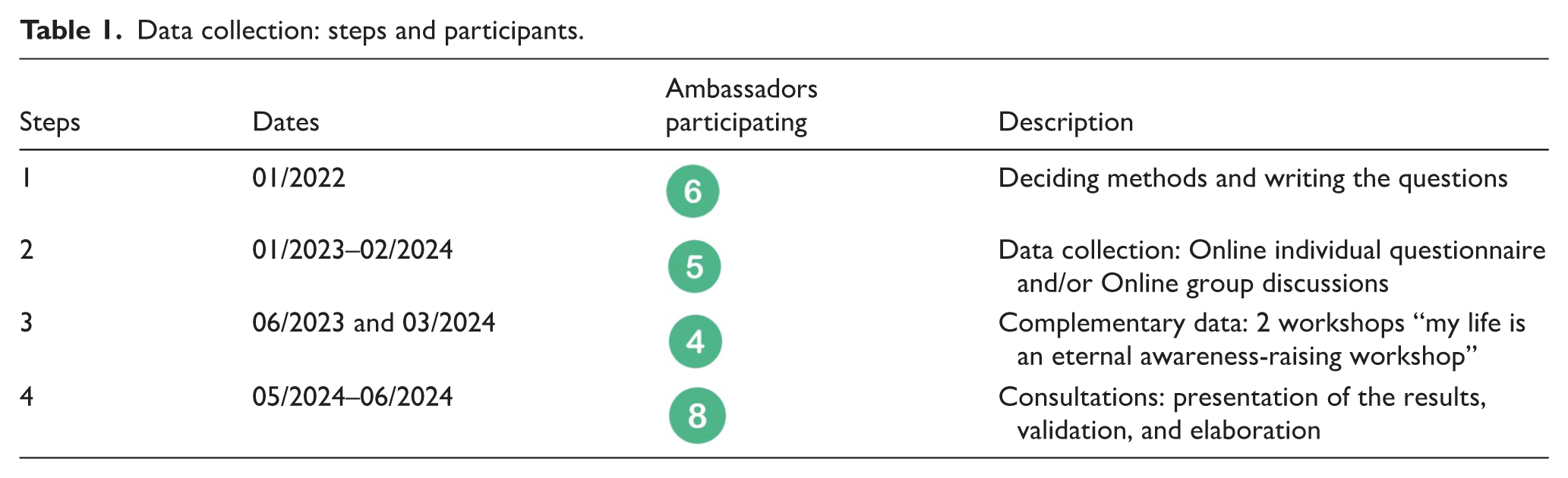
Data collection
In 2022, the questions and method were co-designed with the ambassadors. They chose two options for flexibility: (1) an anonymous online questionnaire and (2) videoconference group discussions between ambassadors – two to three people – for more open questions. The online questionnaire also included the list of discussion questions from the group meetings, if the person wished to write answers. See Supplementary material. Items from the Resistance and Empowerment Against Racism Scale (Suyemoto et al., 2022) and the Kanien’kehá:ka Growth and Empowerment Measure (Gomez Cardona et al., 2021) were used. During the group meetings, which were only between ambassadors, meaning that the main researcher was absent, they had the option of filming or writing down their answers – for greater confidentiality - on Miro, a collaborative online platform. Only the filmed option was chosen.
After the initial data analysis, the main researcher attended two workshops, “My life is an eternal consciousness-raising workshop,” which were recorded, transcribed, and added to the data collection, to complete or validate the themes already identified. Considering the topic was directly related to the study, this addition was part of a deconstruction of epistemic injustices and to avoid further overburdening the ambassadors by asking them to repeat what they already share daily. This was followed by group consultations via videoconference to validate, reflect, and deepen the results with the ambassadors, including some who had not participated in the previous steps. A summary of each theme was presented, followed by discussions. The ambassadors were also asked about any contradictions or ambiguities that the researcher noticed when trying to summarize their conversation, to clarify the meaning. For instance, this led to identifying the subtheme “Interacting with settlers is easier as an ambassador,” which explained how they perceive the negative effects of the workshops on them. This process served as member-checking but was also a part of the data collection itself, where the initial conversations served as the prompts for conversation. Finally, each ambassador had the opportunity to comment and validate the written results and their citations.
Analysis
A thematic analysis was carried out (Braun & Clarke, 2006, 2021). The method was inductive, and the literature on the experience of Indigenous facilitators was consulted in more depth only at the final stages of naming and writing, to allow for a finer analysis, while maintaining its exploratory and immersive nature. The circular or co-reflexive aspect with the ambassadors was guided by the method of Cadman et al. (2023), integrated into the model illustrated in Figure 1. Complementary data from the workshops and consultations were coded separately, then integrated into the existing results, to validate and enhance certain themes. To ensure confidentiality, due to a small and identifiable pool of participants, all identifiers were removed. The citations were translated from French. When quotations come from sources other than the initial data collection, their origin is indicated as such ‘(consultation)’ or ‘(workshop)’.
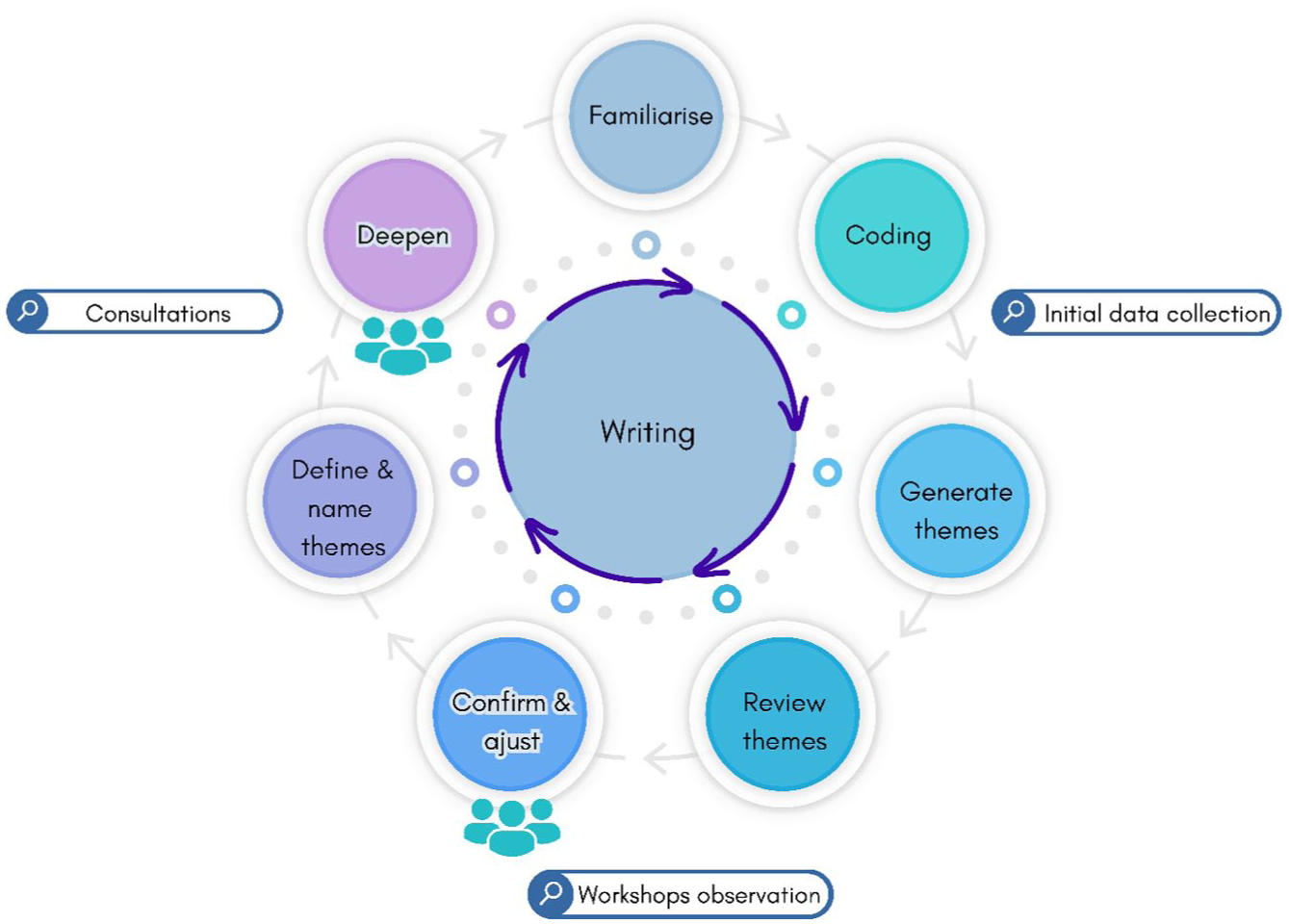
Analysis method.
Posture and paradigm
This research was inductive to center the needs of the ambassadors first and foremost. Thematic analysis was used, while trying not to decontextualize the stories and experiences, for instance, by coding big excerpts, including nonverbal language in verbatim, as well as the responses from the others in the conversation (LaVallie & Sasakamoose, 2021; Simonds & Christopher, 2013), although this still breaks down relationships and stories (Wilson, 2008). Similarly, conversational methods were favored, but not exclusively, according to individual preferences and needs (Kovach, 2010a). This is situated within a critical paradigm, where positionality, power, and oppression are central to understanding social realities (Braun & Clarke, 2021; Taylor & Ussher, 2001).
The analysis method was chosen to balance the desire for deep collaboration and relevance with the ambassadors’ desired level of involvement. For instance, although we aspired to methods such as LaVallie and Sasakamoose (2021), even questioning and stepping away from the notion of analysis, with its inherent power and reproduction of epistemic injustice, it did not, at the time, fit the ambassadors’ interest. However, inspiration from such methods was applied as much as possible, including in honoring the process as community engagement, ceremony, and knowledge mobilization, at all steps (Kovach, 2010b; LaVallie & Sasakamoose, 2021). An example of Reflexive Reflections practice is during the Knowledge sharing weekend (13–14 September 2025) when I shared key comments from the participants receiving the workshops with the ambassadors, by printing and exposing them in the space, then discussing how we understood them, in terms of their reproduction of privilege and bias (LaVallie & Sasakamoose, 2021).
This space of restitution and sharing aimed to answer the ambassadors’ needs and respond to the results of the study, namely better understanding, identifying, and discussing difficulties and solutions concerning microaggressions, White fragility, and their ambivalences. This concords with previous results, highlighting how collective counter spaces of resistance, affirmation, and mutual empowerment counter the isolation and risks of internalizing oppression (Bubar et al., 2022; Handfield et al., sous presse). Speaking truth about their experiences with settler-colonialism allows for further awareness, articulating them within social justice challenges and hopes, and strengthening relationality, validation, agency, and healing (Bubar et al., 2022; Gonzalez et al., 2013; Poupart, 2003). This allowed the creation of a space of collective sharing, understanding, and mobilizing for action, as part of the process and as a result (LaVeaux & Christopher, 2009; Lewis & Boyd, 2012).
For instance, the term White fragility was named by ambassadors, but not all of them. I made a choice to bring that up during the consultations, identifying a need to clarify what is White fragility among the ambassadors, which was done during the knowledge-sharing weekend. The various exchanges with the ambassadors allowed me to summarize what was shared previously, as well as my reflections, bringing intervention and action in conversation. White fragility was kept as a central thread during the work, showing both the inductive, critical, and collaborative approach to the research.
Limits
This study might have been negatively impacted by my identity as a White settler, and our relationship not being as established in the beginning of the project. It is possible that this affected how they discussed their difficulties, and what was named or not. However, many practices were put in place to reduce this effect, for example, discussions between ambassadors without my presence, multiple meetings with the ambassadors at Mikana events, showing my agreement and knowledge about White settler resistances. For instance, during the latest knowledge sharing session, the ambassadors expressed their appreciation of the research process and its outcomes, both the results and the effort and time spent in mobilizing and sharing them.
Beyond relationships, my identity as a White settler, and education in a settler-colonial institution, as well as dominant views of research limited and influenced the methodological choices, such as using thematic analysis. For instance, although the methods were decided with the ambassadors, I should have presented more creative options rooted in Indigenous paradigms and Methods (Wilson, 2008). This lack confines this work to western worldviews, where wholistic interpretations, including intuition, dreams, and ceremony, are absent (Coburn, 2013). Following many Indigenous scholars, I do not believe I can “do” Indigenous research or methods, as I do not have an Indigenous Worldview, but I can strive to be inspired and honor them as much as possible (Kovach, 2010b).
Results
The ambassadors’ experience of the workshops is presented under three themes: (1) Interactions with participants, (2) Ambassadors’ ambivalences, and (3) The effects of the workshops on the ambassadors.
Dealing with participants
Interactions with participants are consequential to the ambassadors’ experience. When participants show that they are receptive, listening, engaged, and that the workshop has an impact on them, ambassadors may feel satisfaction, pride, a “sense of accomplishment and meaning in life” (participant) and making a difference. Conversely, ambassadors may ruminate on their performance or feel bad when they doubt the success of a workshop or an answer they gave.
When you have a group that participates a lot, there’s a lot of discussion, and relevant questions, it also gives you a boost: “Ah well, humanity . . . Not dead [laughs] There’s still hope” (participant).
Difficult interactions
The experiences with participants are generally positive. However, managing participants and interacting with them is systematically identified as the main difficulty. These difficulties relate to (1) attitudes, (2) questions, (3) comments, and (4) participant unpredictability. They arise especially during the question period.
We deliberately put ourselves in vulnerable situations. [laughs] We’re directly under the spotlight to experience aggression and to experience prejudice right in our face because we tell people that this is a space where they can talk and there are no dumb questions (participant).
Attitudes include closure, aggression, questioning the ambassadors or their words, debating, and provoking, which can derail a workshop. Direct resistance and provocation are rarer, but all ambassadors are aware of the risk of facing them. For example: “[they] are super closed-minded, like ‘fuck you, we don’t care about your experience, and you don’t deserve to exist.’” (participant), “Opinions that are very crude, sometimes it’s like the participants are just doing it because they know it’s going to make us react” (participant).
Ambassadors describe five types of difficult questions, which represent around one in three questions: (1) inappropriate questions, off-topic questions, reflecting either (2) prejudice or (3) an expectation of expertise; (4) repetition of the same questions; or (5) no questions. Off-topic questions are reductive of the work, expertise, and diverse identities of ambassadors and put pressure on them to be experts on “everything Indigenous-related” (participant). The connecting issue is that these questions make the ambassadors feel like they were not heard.
It’s not my job to talk specifically about that. And the fact that’s the first question . . . They come in with the bias that Indigenous people are homeless, and that hurt me a bit, because I felt like they hadn’t listened to what I presented (participant).
Participants often use the question period to make comments, tell personal stories or “show off their knowledge” (participant). The repetitive and unsettling nature of these interactions is disturbing for the ambassadors. These comments reflect a tendency to overestimate their knowledge or antiracism levels, which becomes problematic when accompanied by a lack of humility: “It’s caucasity. The arrogance of colonialism. I know what I know, and what I know is true . . . It’s a lack of humility, racial arrogance (consultation).
Beyond the questions, it’s often comments or monologues that we get, where they will talk about their personal experience or their own research, which I’ll often find more burdensome than questions, because it’s like, how do you deal with this? How do you react to that? It’s more difficult (consultation). Even if we say: “We’re going to focus on content-related questions. We want to hear the questions before the comments.” They don’t respect our limit. Someone comes up “Oh, I really wanted to say, I have a great-great-great grandmother who was Indigenous and” . . . And it’s like, what’s the question? [laughter] (consultation).
The unpredictability of interactions with settlers creates stress and anticipation for the ambassadors, in terms of what they are going to say, and how they are going to respond: “We hold our breath a bit: ‘OK, what’s coming next?’” (participant). The ambassadors feel a sense of unpredictability toward the participants (level of openness, participation, knowledge), their remarks, and their reactions to the ambassadors’ statements. A level of unpredictability seems unavoidable, beyond what the organization is already doing.
That’s everyone’s fear: to be caught in a situation where there’s a question that’s unacceptable, where you want to defend your point but you want to stay in good communication and you don’t know. And that’s what creates . . . For me, it creates stress (participant). What’s unpleasant? Well, sometimes the questions you can’t control, that’s all . . . I also want to make it clear that it’s something we can’t control . . . The organization is already doing a good job of doing everything possible to be ready for the unexpected, the uncontrollable (participant).
Ambassadors’ ambivalence: being considerate to settlers
A transversal theme is the ambassadors’ ambivalence on how to act, react, and interpret the words, attitudes, and emotions of the settlers during the workshops. Their uncertainty is heightened by their desire to have the best impact impossible while facing the settlers’ unpredictability. This ambivalence is dictated by the privilege and power dynamic between Indigenous ambassadors and predominantly White, settlers. Ambivalence in their consideration of settlers is examined in three subthemes: (1) Settlers’ discomfort levels, (2) Settlers’ emotional reactions, and (3) The individual versus group identity.
Don’t be too confronting
The ambassadors are ambivalent in how they approach or confront settlers and their level of discomfort. Ambassadors repeat “walking on eggshells” (participants), trying to avoid negative reactions from settlers. This puts them in tension between multiple injunctions to do an effective job: don’t be too confrontational, but be assertive, and don’t be too nice, “sensitive but not people-pleasing” (participant). For instance: “I really take the time to make sure people understand, ‘I’m not bashing you, I’m not attacking you’” (participant).
Many ambassadors explain that these tensions are due to the privilege and power relationship between Indigenous people and the, mainly White, settlers. The ambassadors seek to keep the attention and interest of settlers, without creating resistance or reinforcing prejudices, like Indigenous peoples as aggressive. As Indigenous people, they must be more careful when talking about colonialism, given the settlers’ intolerance to discomfort. This leads to ambivalence and discrepancies between ambassadors. Many specify that they don’t try to reassure or alleviate settlers’ discomfort. Some believe that a level of discomfort is necessary, or that too much reassurance could be detrimental by reinforcing the participants’ White fragility.
We are forced not to be too confrontational so the settlers will listen to us. Because as soon as you start having an accusatory tone or start talking in a negative way . . . some people will shut down . . . We don’t have the right to get angry about it either, because we’re in a position, we’re not dominant in society, so we have to be conciliatory, to convince people (participant). If we feel we have to walk on eggshells and warn people with “I’m not accusing you of being a racist” etc. It’s because White fragility exists and we’re all in the process of making room for it. If it’s like “Oh, I have to make sure they’re comfortable,” that’s what exists, and that we’re accommodating (participant).
Be empathic toward the settlers’ emotions
Ambassadors can be ambivalent about emotional reactions. On the one hand, they may be seen as appropriate, even positive, and necessary for change. On the other hand, certain reactions seem to hinder the awareness process and impose an emotional burden on ambassadors. For example: “It’s there for that, to make them react and live emotionally instead of intellectualizing it . . . but I found it heavy, people were bringing it back to themselves, to their stories, and I was tired of hearing it” (participant).
You can have an emotional reaction, but if you start taking up all the space, it’s not appropriate. And that’s part of the same arrogance . . . it’s not our job to support you. And it’s not to highjack everyone else’s educational experience, so you can deal with your colonial guilt (consultation).
The issue is when settlers appropriate and express strong emotional reactions to colonialism, creating a destabilizing reversal for Indigenous ambassadors, who must reassure or manage these reactions: “What gets me most sometimes is people who take on the pain a bit, who are so emotionally moved by what they learn that . . . It’s as if, sometimes, they take possession of that, of that emotion” (participant). This emotional work is exhausting and frustrating for the ambassadors: “It’s not that we want you to be cold, frozen. But it often happens that we feel almost as if we have to comfort people [laughs]” (workshop participant).
Ambassadors are ambivalent about how to interpret and react to settlers’ emotions. Ambassadors feel like they are walking a tightrope between acknowledging colonial dynamics and their own fatigue and anger, without lacking empathy for settlers. They fluctuate “between benevolence and fatigue” (participant). Central to this ambivalence is the question of the authenticity, and impact, of the settlers’ emotional reaction: “It’s weird. Because there are weaponized tears and people who connect for real like, ‘Oh! I realize I’m part of the problem’” (participant).
It’s super hard as someone in the group who’s oppressed, to give that empathy because you’re like: Really?! [laughs] You’ve had your space forever, and we’ve got a bit of space, so you have to be empathetic and have these emotions, and good if you cry! But, at the same time, no! (participant).
Deal with colonial dynamics, but embrace the individual
The ambassadors’ ambivalence toward settlers is marked by a duality, between a positive view, such as acceptance of ignorance, racism as unintentional, and a more critical view. This comes down to the tension between recognizing the group dynamics linked to social identities that the ambassadors experience, and welcoming settlers as individuals.
We can’t put everyone in the same boat, we don’t want to destroy the settlers too much, but on the other hand, there are still certain things that happen, that keep repeating, and that exhaust us . . . I think ambivalence is normal (consultation).
Once again, there are differences between ambassadors in how they name or recognize these dynamics, and the positive or negative impact of doing so.
I don’t see it as ‘Ah, a White woman is crying’. No, a person feels about it and empathizes . . . But at the same time, I’m not defending the person who’s crying . . . I don’t know. It’s a whole debate in my head (participant).
Some are uncomfortable using terms such as White, worry about lacking empathy toward people, or having a “negative domino effect” (participant) and generalizing bad experiences when discussing difficulties between ambassadors, while others say that terms like White fragility and resistance best explain their experiences. The consultations clarified that this could be explained by differences in familiarity with certain terms, such as White fragility, resistance, and microaggressions. “It came out a lot, the word White. You have to avoid it, because it seems that skin color accentuates our differences even more. Fragility, maybe it’s more the word White that tickles me . . . No, it’s not a concept [White fragility] that I’m familiar with” (consultation).
Tolerating the negative impacts on yourself
The difficult interactions with participants and the ambivalence when managing them entail a mental and emotional burden on the ambassadors. Ambassadors may experience a “succession of feelings” (participant), such as fatigue, anger, sadness, or discouragement. This toll and its impacts extend beyond the workshops, as ambassadors raise consciousness about one of their identities: “We’re sharing things from our personal lives” (consultation).
I wish I could say that every workshop makes me feel empowered and that it feels good [smiles], but more often than not.. I have a lot of moments in the workshops that affect me . . . Sometimes, I have workshops that affect me so much that I find it hard to let go. When I leave the workshops, I get so angry because I’m so destabilized by what happened (participant).
Still, ambassadors repeat that these negative effects are not that important: “Yes, well, negative effect is a big word” (participant), “I don’t think it’s dramatic . . . it’ll be okay” (participant). This can be explained because (1) the negative effects are mainly due to the repetition of interactions that are “not so bad”, for instance, “At the beginning, it was really cool, it was going well, it was new, but now we see behaviours from the participants that come back pretty often”; (2) they are generally short-term; and (3) they are perceived as inevitable.
It’s directly related to our identities, it’s so close to us that I think the reactions we can have are normal. The important thing is that it doesn’t last too long after, and what we put in place: the before and after, to prepare, then debrief, then think about something else (consultation).
Interacting with settlers is easier as an ambassador
During the consultations, the ambassadors confirm this duality toward the workshops, which include several difficult situations, but are generally seen as positive. This is explained by four factors: (1) ambassadors experience more negative interactions in their daily lives, (2) these interactions are easier to manage when they happen during workshops, and (3) The organization’s team and support mitigate and compensate for potential negative effects. Thus, the central reason being an ambassador is a positive experience is because (4) Indigenous peoples are constantly educating in their daily lives.
The ambassadors experience more difficult interactions and microaggressions in their daily lives than during the workshops since the participants are more careful, or already have some awareness. In addition, presenting themselves as ambassadors eliminates the most frequent microaggressions, such as invisibilization or questioning their Indigenous identities.
I feel I’m often, always doing conscientization, because of the prejudices that are raised or the questions. [. . .] people don’t know that I’m an Indigenous person in the group, they’ll sometimes allow themselves to make comments . . . often people will defend themselves, saying: But I’m not the same, I’m different! (workshop participant).
Second, difficult interactions are easier to manage in workshops than in their daily lives. One reason for this is that ambassadors have more control and power over their interactions with settlers: they are in a position of authority, with a framework, a team, and support. They have the context necessary to respect their own boundaries and freedom, for example, being able to leave or choosing not to reply. For all these reasons, they feel safer facing settlers as ambassadors. “The fact that we run the workshop, there is a kind of power relationship that is established, that we have a little control over what we are going to tell” (participant), “Mikana provides a platform to do this work. There is security in having protocols and expectations about how participants can interact. The educational context offers security . . . a form of equal footing that is important” (participant).
Third, the organization, and the ambassador experience, mitigates and compensates for the difficult moments, and the positives of being an ambassador outweigh the negative. Since negative interactions are worse in their daily lives, they are not defining of their work as ambassadors. For example, microaggressions are rarely mentioned because “it comes down to how we prepare for the workshops, how we debrief” (participant), “the support we have before and after the workshop minimizes the potential traumas that could come out of these workshops” (participant), “Everything else is so positive, so we’re like ‘no, it’s going well’ . . . I think Mikana, and our team really balance the whole experience in the positive” (participant).
Therefore, the ambassadors’ experience is tainted with the fact that awareness work is imposed on Indigenous people daily, to the point where “it’s impossible to be Indigenous without doing it” (participant). Ambassadors, as Indigenous peoples, are constantly exposed to settlers’ lack and ignorance, due to colonial invisibilization, particularly in the education system. This imposes an educational burden on them, in addition to feeling responsible to represent their communities and feeling guilt if they don’t. “We were invisibilized because of colonial strategies and assimilation tactics that made us invisible in history classes. And now, we carry it on our shoulders individually, in our daily lives, to compensate” (workshop participant).
The ambassadors point out that this burden is imposed on them anyway, so they might as well do it with the organization’s support and recognition of their work. Moreover, the ambassadors emphasize that they are well paid, and this contributes to their motivation, or being “. . . paid for my activism” (participant). Becoming an ambassador can reduce this burden in their daily lives, by focusing on formal moments of conscientization, and having tools and resources to intervene and redirect. For instance, “After I started working at [the organization], I was like, I’m not going to handle this. ‘Go see them!’” (consultation). Being an ambassador appears as a strategy to manage, as best as possible, the inevitable burden of raising awareness. “We often have conversations about how as an Indigenous person, my life is a conscientization workshop, which never ends. And when I realized, I was like: ‘Oh ok, while I’m at it, I might as well be paid for it!’ (laughs)” (participant), “I’ve accepted that it’s something I’m going to have to do for the rest of my life. [. . .] It’s not something I can escape, so I’m just going to go through it and make it better” (participant).
The ambassadors perceive conscientization as inevitable for Indigenous people. In addition to improving this burden for themselves, becoming an ambassador comes from a sense of responsibility for their peers and community. The main motivation of the ambassadors is to take this burden off Indigenous people in their daily lives, who do not have Mikana’s tools, support, or pay, and in recognition of personal skills or privilege such as being White-passing: “Since, I don’t “look Indigenous.” I felt indebted like, ‘You know what, I’m going to take this burden away from other people who have been carrying this burden since they were children’” (participant).
I do this because I have the tools that allow me to do this with full knowledge. It may help other people who are not in that position—to put themselves on the front line like this, and then receive comments—so that there will be fewer people who will go to see them, and have comments (participant).
Discussion
Summary
This study of Indigenous facilitators raising awareness about colonialism revealed three main results. Despite the positive aspects reported, due to the organization’s support and the feeling of making a difference, ambassadors experience many difficulties and tensions during workshops. The most difficult aspect is the interactions with settlers and their unpredictability, especially during the question period. Ambassadors are under pressure to always be ready, with the best possible answer, while “walking on eggshells.” Being shocked and not knowing how to react is the worst for the ambassadors. This highlights how they tend to feel responsible for the reactions of settlers, despite their reactions being the same across various contexts (Graham & Dadd, 2021; Hollinsworth, 2016; Ward, 2018).
Indeed, the difficulties, ambivalence and types of reactions faced by people experiencing an oppression toward their privileged counterparts is similar across location (Erb & Loppie, 2023; Graham & Dadd, 2021; Ward, 2018), contexts (Brunette-Debassige, 2021) and even identities (de Bie et al., 2021; Lynch et al., 2017; Srivastava, 2020; Srivastava & Francis, 2006; Whitney et al., 2022). This is not a coincidence, but highlights the common mechanisms of oppression, especially settler-colonies established with the same mechanisms. For instance, Hollinsworth (2016) highlights a similar context in Australia (2.5% of Indigenous Peoples), a widespread denial and rejection of personal responsibility in colonialism and White privilege, and avoidance through color-blind ideology.
Second, the ambassadors experience ambivalence in the identification and management of the dynamics with the predominantly White settlers during the workshops, particularly their discomfort and emotions. Aiming to mobilize awareness and anti-colonial solidarity among White settlers leaves the ambassadors on a tightrope, between too much and not enough, without knowing how to (re)act without creating negative colonial effects, for example, inaction or resistance.
This tension is also expressed in the ambassadors’ perception of the effects of the workshops on them. When ambassadors are asked about difficulties, they name many types of difficult interactions with settlers, and the negative effects on them. However, when they are asked if the workshops have negative effects on them, they say no, or very little. Discussing this dissonance, the ambassadors explain that interacting with White settlers is worse in their daily lives, where they experience more difficult interactions, without safety, support, colleagues, and without compensation. This result had not been found previously.
Overall, the difficulties experienced by ambassadors are dealing with participants and their emotions, or White fragility. Yet, this work is trivialized by its daily imposition. This is caused by the daily confrontation with White and settler fragility that Indigenous peoples experience within settler-colonialism, which will be discussed next.
These results show the slow violence of settler-colonialism and its normalization, as well as the daily resistance, activism, and radical care work of First Peoples, which facilitates daily survival (Bubar et al., 2022; Malatino, 2020). Dealing with White and settler people, spaces, and norms involves a multitude of strategies, resistance, and negotiating survival, which involve solidarity, agency, and often isolation (Bubar et al., 2022). These elements of resurgence, intellectual and emotional labor, framed as care work are further discussed in a separate article (Handfield et al., sous presse), but should be kept in mind here. Other work, in restitution to the organization and the ambassadors, focused on their experiences, their strategies, and the meaning they find in this work, as well as answering their needs as they actively resist and fight colonialism.
White fragility
The difficulties experienced by ambassadors are the consequences of White fragility, or the expression of its functions: avoiding discomfort, responsibilities, and emotions. The more subtle forms are more difficult to identify and intercept, leading to ambivalence and negative effects on ambassadors. For example, deviations such as testimonies about settler identities and experiences, rationalizations such as academic comments, or avoidance such as silence during question period. This is consistent with the literature showing that ordinary, hard-to-identify racism, like subtle microaggressions, can be more difficult to experience, identify, and confront (Robinson-Wood et al., 2015; Sue et al., 2009; Sue & Spanierman, 2020).
In particular, the excessive expression of sadness, guilt and shame are part of White fragility which, subtly, diverts attention by centering the experience of White settlers (DiAngelo, 2018). This leads to the reversal identified by the ambassadors, and the mix of empathy and frustration they experience as they feel forced to validate or rescue the participants (DiAngelo, 2018; Helms & Carter, 1990). These can be understood as expressions of the colonial present, the shifting and evolving practices that displace First Peoples, symbolically and materially, to legitimize settlers (Gregory, 2004; Thielen-Wilson, 2012), as well as the settler move to innocence as they seek to establish their settler goodness (Snelgrove et al., 2014; Tuck & Yang, 2012). As a result, exposure to White fragility and its management corresponds to the negative effects reported by the ambassadors.
White supremacy
Ambivalence toward subtle forms of racism/colonialism, especially its implicit and neocolonial forms (Parra, 2025) is a consequence of the constant exposure to colonialism (Browne et al., 2011). Constant exposure to subtle oppressive violence forces the development of a tolerance, through its normalization and the difficulty of identifying and denouncing what is/has always been experienced—which can also be a preservation strategy for the ambassadors (Browne et al., 2011). This tension caused by the subtle reproduction of normalized oppression is a result of White supremacy and settler colonialism; they create White and settler fragility and force its trivialization (Bonds & Inwood, 2016; Mills, 2014; Parasram, 2019; Said, 1979; Veracini, 2010). In other words, settler-colonialism, in contexts like Kanata, is defined by slow, pervasive, and unacknowledged or unchecked violence (Million, 2009; Nixon, 2011, p. 2; Xausa, 2020).
Settler colonies are built on the idea of the superiority of White western people (Veracini, 2010; Wolfe, 2006), or more precisely, on White supremacy, which supports the cultural, political, and economic domination of White people (Mills, 2014) while aiming to erase and eliminate First Peoples and Indigeneity (Elkins & Pedersen, 2005; Hixson, 2013; Veracini, 2010; Wolfe, 2006). White supremacy is not an event, or an extremist group, but the structure and system upon which our settler societies are built (Bonds & Inwood, 2016).
White supremacy, as a structure that underlies and justifies settler colonies (Veracini, 2010; Wolfe, 2006), constructs the White or western superiority and privilege (Frideres, 2015; Ward, 2018). This privilege implies ignorance of racism/colonialism, the presumption of White innocence, the absence of reflections about racism and colonialism, and the presumption of racial comfort (Coulthard, 2014; Frideres, 2015; McIntyre, 2000; Schick, 2000; Srivastava, 2020; Ward, 2018). This is why White people are so uncomfortable with discussions about racism/colonialism, leading to White fragility (DiAngelo, 2018). This is compounded by settler fragility, as identified by Ward (2018), leading to what I’m suggesting as White-settler fragility, in line with Cook’s (2018) notion of White settler ignorance.
The naturalization and the invisible and implicit nature of White supremacy and settler colonialism cause the settlers’ reactions, such as shock, denial, shame, but also the ambassadors’ ambivalences (Browne et al., 2011; DiAngelo, 2018; Neuman, 2019; Parra, 2025). Moreover, for First Peoples, resisting White supremacy and colonialism on a daily basis influences their experiences, their possibilities of resistance, and what they perceive as acceptable and necessary (Alfred, 2010; Simpson, 2011). As such, White settler fragility and, structurally, White supremacy and settler colonialism reinforce and maintain each other (Parasram, 2019).
Indigenous ambivalence with/in colonialism
First Peoples are antithetical to settler-colonialism which is founded on their disappearance, elimination, and dehumanization (Bonds & Inwood, 2016; Mills, 2014; Said, 1979; Veracini, 2010). First Peoples living within settler-colonies face constant tensions; existing among banalized colonial violences, surviving them, and refusing to accept colonialism while nourishing dreams and possible futures (Mignolo, 2014; Simpson, 2011, 2012, 2014). Interactions between First Peoples and settlers expose these intrinsic tensions of settler colonialism. In this way, the ambivalence experienced by ambassadors are the interpersonal reflection of the systemic issues and power relations entailed in facing colonial systems and people, as First Peoples.
This impossible stance for First Peoples with/in settler colonialism is found in the workshops. The ambassadors’ worries about the level and types of emotions, of confrontation and of discomfort they can elicit in the participants reflect a real precariousness in mobilizing settlers in antiracist and colonial struggles (Jasper, 2011; Moyer, 1987). For instance, even when antiracist struggles try to gain support through generally accepted tactics, they are still criticized as too radical (Clayton, 2018; Mayer, 2020; Simpson & Ladner, 2010). Furthermore, just like with the workshops, trying to avoid resistance carries the risk of reproducing racist/colonial dynamics, creating an illusion of change that maintains the status quo (Clayton, 2018; Crenshaw, 1990; Farley, 1985; Marx, 2001).
This illustrates the additional burden carried by First Peoples facing settlers, and how mobilizing settlers who benefit from colonialism to dismantle it is almost impossible (Hiller, 2017). Indigenous sovereignty and rights are inherently threatening to settlers (Beauvais, 2022; Coulthard, 2014; Thobani, 2007; Wolfe, 2006). This will push settlers to resist and even recolonize actions and discourses aiming to be anticolonial (Cook, 2018; Davis et al., 2017; Hiller, 2017), and position First Peoples as walking on eggshells as they try to mobilize settlers.
In other words, First Peoples aiming to mobilize settlers toward anticolonialism will experience the inherent tension of Indigeneity within colonialism, as they have very little margin to express anticolonial resistance without facing the reinforcement of White-settler legitimacy, whether through subtle denial or violent state response (Helferty, 2020). Thus, ambassadors’ ambivalences toward settlers and their strategies for social change can be understood as tied to White and settler fragility, at the individual/interpersonal level, and White supremacy and settler colonialism, at the systemic level.
In summary, settler colonialism, and White supremacy more broadly, create and dictate the ambassadors and settlers’ experiences, as well as the possibilities for action, and risks of inaction. An inherent tension is expressed between First Peoples and settlers, which cannot be answered simply within a colonial system that, by definition, denies the existence and flourishment of First Peoples.
The irony of focusing on White/settlers for anticolonial change
This discussion raises the irony of social change focused on people benefiting from that oppression, in this case settlers, and the constant risk of loss of rights under a system and worldview that perpetuates marginalization or dehumanization of First Peoples. This irony is accentuated by the current loss of rights won by social movements in the USA, such as abortion rights and anti-racist struggles (Farley, 1985; Rothe & Collins, 2019). This underlines the urgency of thinking about strategies for social change and avoiding pitfalls, especially superficial gains. Conscientization trainings that deeply deconstruct the myths justifying oppression, address resistance and instill critical awareness as a new lens to understand the world, could help prevent and respond to backlash and moral panics (Curry-Stevens, 2007; Dupuis-Déri, 2022; Konrad, 2018; Mathieu, 2020).
Conscientization or distraction?
So, what to do with awareness training? While experiencing these colonial assaults daily allows ambassadors to find them tolerable, it is worth questioning whether it contributes to a solution. As settlers, are these the conditions we want to impose on First Peoples? In addition, questions persist about the impact of these trainings: do they reduce questions and microaggressions? What effects on settlers would justify the cost for ambassadors?
Even when conscientization works, taking real action is much harder, creating the awareness-action gap (Hochachka, 2024) especially when it implies dismantling and abandoning your own privilege, comfort, deep settler narratives and worldviews, such as engaging with responsibility, restitution and Land back (Davis et al., 2017, 2018; Denis & Bailey, 2016; Hiller, 2017; Tuck & Yang, 2012).
While the effects on settlers are uncertain, let alone their contribution to a real transformation of colonialism, the effects on ambassadors are clear: in addition to being subjected to colonialism, ambassadors try to correct it through education and accompaniment. This work involves anticipation and stress, responding to inappropriate questions and comments, dealing with the emotions of settlers while managing their own frustrations and emotions during and after the workshops. A risk of counter-productive effect would be to increase the tolerance of the ambassadors to the status quo, or further normalizing colonial violences (Hässler et al., 2020; McKeown & Dixon, 2017; Sengupta & Sibley, 2013).
In fact, the struggle for recognition can have the perverse effect of overacknowledging and centering privileged people, while distancing themselves from their own interests (Voirol, 2020). This seems particularly likely in the case of First Peoples, who represent 2.5% of the population in Kepek (Canada, 2021). Here, focusing on colonial systems and contexts can have a pernicious effect of maintaining colonialism, by keeping on the periphery the struggles of Resurgences, Worldviews and Indigenous Knowledge, which require centering the Land (Alfred, 2005; Simpson, 2014). In other words, focusing on settlers, and their acceptance, risks deradicalizing struggles and transformations, limiting them to the blinders of the established system (Alfred, 2010; Simpson, 2011), in addition to the violence that this consideration implies (Erb & Loppie, 2023; hooks, 2003; Walters et al., 2019; Ward, 2018).
Refusal and alternatives
In this context, Simpson (2014) calls for Indigenous refusals: refusing to fight for mere inclusion or recognition within colonial systems, in order to invest in their own transformative and liberation practices (Coulthard, 2007; Fanon, 1952). This refusal of colonialism is a refusal of one’s own dehumanization through radical self-recognition (Coulthard, 2007; hooks, 2003; Mignolo, 2014), and focusing on the flourishing of First Peoples—mino bimaadiziwin—beyond survival and resistance (Alfred, 2005; Simpson, 2011). hooks (2003) calls for care for the soul, which requires decolonizing the heart and mind, and a revalorization and reinvestment in Indigenous Peoples, Knowledges, Territories, and Ways of being (Alfred, 2005). Not only does this approach have the potential to bring social change but also guarantees positive outcomes for First Peoples, in contrast to attempts at changing colonial systems, which can be futile and discouraging (Simpson, 2011). The margin, as a counter-space, can be reinvested as a space conducive to healing and freedom (hooks, 2003; James, 2013), not simply by moving away from colonialism, but by radically shifting away from a perspective in which colonialism “makes sense” (Byrd, 2011; Harney & Moten, 2013; Mignolo, 2014), like Zapatistas (Forbis, 2015; Khasnabish, 2012; Reyes & Kaufman, 2011).
Conclusion
At the heart of ambassadors’ difficulties is their desire to do good conscientization work and the uncertainty on how to achieve it. A determining factor of the ambassadors’ motivation and tolerance to the workshops despite the difficulties is the omnipresence and heaviness of the microaggressions and ignorance that Indigenous people experience in their daily lives. This is a call to settlers to stop imposing these burdens and microaggressions to Indigenous people (and all people living with oppression), and more broadly, for a collective and institutional ownership of this burden and these solutions.
It is imperative to center the experience of people experiencing oppression with counter-spaces of care and communities for First Peoples (Browne et al., 2011) but also pedagogy of the oppressed first, to facilitate the identification and management of the subtle and hard to name manifestations (Freire, 2021). This could reduce the ambassadors’ ambivalence, emotional, and mental load before, during, and after the workshops.
Finally, conscientization interventions should not be idealized as an end in themselves, nor should they be rejected completely, at the risk of creating negative effects on First Peoples. If conscientization appears as an inevitable part of the work of social change, it should be thought, used, and done critically, and with great care, to prevent negative effects on the people involved, and on social change movements broadly.
Supplemental Material
sj-doc-1-aln-10.1177_11771801261421626 – Supplemental material for Indigenous facilitators raising awareness about colonialism within settler colonies: tensions and ambivalence
Supplemental material, sj-doc-1-aln-10.1177_11771801261421626 for Indigenous facilitators raising awareness about colonialism within settler colonies: tensions and ambivalence by Kai Handfield and Thomas Delawarde-Saïas in AlterNative: An International Journal of Indigenous Peoples
Supplemental Material
sj-docx-2-aln-10.1177_11771801261421626 – Supplemental material for Indigenous facilitators raising awareness about colonialism within settler colonies: tensions and ambivalence
Supplemental material, sj-docx-2-aln-10.1177_11771801261421626 for Indigenous facilitators raising awareness about colonialism within settler colonies: tensions and ambivalence by Kai Handfield and Thomas Delawarde-Saïas in AlterNative: An International Journal of Indigenous Peoples
Supplemental Material
sj-docx-3-aln-10.1177_11771801261421626 – Supplemental material for Indigenous facilitators raising awareness about colonialism within settler colonies: tensions and ambivalence
Supplemental material, sj-docx-3-aln-10.1177_11771801261421626 for Indigenous facilitators raising awareness about colonialism within settler colonies: tensions and ambivalence by Kai Handfield and Thomas Delawarde-Saïas in AlterNative: An International Journal of Indigenous Peoples
Supplemental Material
sj-docx-4-aln-10.1177_11771801261421626 – Supplemental material for Indigenous facilitators raising awareness about colonialism within settler colonies: tensions and ambivalence
Supplemental material, sj-docx-4-aln-10.1177_11771801261421626 for Indigenous facilitators raising awareness about colonialism within settler colonies: tensions and ambivalence by Kai Handfield and Thomas Delawarde-Saïas in AlterNative: An International Journal of Indigenous Peoples
Footnotes
Acknowledgements
The authors would like to thank Mikana for their work and their trust with this project, especially Elisa Cohen-Boucher, who has been the lead collaborator for the past 5 years, and the ambassadors who took part in this.
Authors’ note
Ethical considerations
Ethics approval was granted by the Ethical Research Committee (CERPE FSH) attesting that this project with humans conforms with the policies in place (No 54), with the following ethics certificate: 2023-4526, renewed from December 6, 2022, until December 6, 2024. Ethical considerations pertaining to Indigenous research, such as anonymity, especially in a small community, were discussed and addressed with the participants and research partners.
Consent to participate and publish
Informed consent to participate was written and verbal, in French and English, and repeated at multiple steps: before the meetings, after the meetings, after initial writing, validated during the consultations, before the first report was sent to the organization (Mikana), before academic presentations.
Funding
The authors disclosed receipt of the following financial support for the research, authorship and publication of this article: This research project, from my doctoral project, has been funded by The Social Sciences and Humanities Research Council (SSHRC), doctoral grant 752-2024-1345, and the Joseph-Armand Bombardier Canada Graduate Scholarships-Masters. It has also been funded by the Fonds de Recherche du Québec-Société et culture sector, doctoral grant 341529 (https://doi.org/10.69777/341529), and master’s research grant 313216 ( ).
).
Declaration of conflicting interests
The authors declared no potential conflicts of interest with respect to the research, authorship and publication of this article.
Supplemental material
Supplemental material for this article is available online.
References
Supplementary Material
Please find the following supplemental material available below.
For Open Access articles published under a Creative Commons License, all supplemental material carries the same license as the article it is associated with.
For non-Open Access articles published, all supplemental material carries a non-exclusive license, and permission requests for re-use of supplemental material or any part of supplemental material shall be sent directly to the copyright owner as specified in the copyright notice associated with the article.
