



Abstract
While co-design as a working model in research has been applied extensively, this article explores it in relation to Māori (Indigenous peoples of New Zealand) perspectives and, particularly in transdisciplinary research contexts. The concept of co-design is initially considered in relation to current literature and then how it has been engaged specifically in te ao Māori (the Māori world) contexts. This article outlines the Mobilising for Action research programme, a transdisciplinary research programme co-led by Māori and non-Māori researchers that focussed on the human dimensions of forest health and, more specifically, in relation to the plant diseases kauri dieback, Phytophthora agathidicida and myrtle rust, Austropuccinia psidii in Aotearoa (New Zealand). It presents three case studies from the project that engaged with co-design as a key component to their research design. Drawing from the experiences gained from these case studies and from the wider literature, the authors propose a kaupapa Māori (Māori platformed and shaped) model for co-design.
Introduction
Ko koe ki tēnā, ko ahu ki tēnei kīwai o te kete Māori proverb; You at that and I at this handle of the basket
Co-design, which commonly “refers to a participatory approach to designing solutions, in which community members are treated as equal collaborators in the design process” (Mark & Hagen, 2020), is widely used both in Aotearoa (New Zealand) and internationally for engaging multiple stakeholders across a range of contexts (Roadmap to Informed Communities, 2024). While co-design research processes have recently received significant attention in Western knowledge contexts, that are dominated by colonial institutional and universalist perspectives (Saunders et al., 2024; Weaver, 2023), a collaborative approach to designing solutions has been practised by Māori (Indigenous peoples of New Zealand) and many other Indigenous communities for hundreds of years.
Co-design has often been used as an approach for engaging in Māori contexts, including in transdisciplinary approaches (Barnes et al., 2021). This article reflects on the practice of co-design in research contexts involving Māori and others, contingent to te Tiriti o Waitangi (te Tiriti, the founding legal document of the nation-state of Aotearoa), where Māori maintain, drive and control things that are Māori or impact on them, in partnership with non-Māori (Biological Heritage National Science Challenge, 2024a). It presents a Māori influenced model for co-design drawing on experiences and findings from case studies from the transdisciplinary research programme Mobilising for Action, or MFA, a 4-year transdisciplinary research project from 2020 to 2024 in native forest health, in relation to the pathogens kauri dieback, Phytophthora agathidicida, a soil-based mould, and myrtle rust, Austropuccinia psidii, a wind-spreading fungus (Mobilising for Action, 2024a). These pathogens are often found to be killing many endemic trees, including kauri (Agathis australis), the largest forest tree in Aotearoa and a number of myrtle species like ramarama (Lophomyrtus bullata) and pōhutukawa (New Zealand Christmas tree, Metrosideros excelsa) and their connected habitats.
Mobilising for Action (MFA) was Māori and non-Māori co-led and consisted of 12 projects focusing on the human dimensions of kauri dieback and myrtle rust, as shown in Figure 1. It was funded by the Biological Heritage National Science Challenge as part of its Ngā Rākau Taketake (Strategic Science Investment Fund research platform funded by Ministry of Business, Innovation and Employment) programme (Biological Heritage National Science Challenge, 2024b). By combining and weaving a wide range of approaches to create shared outcomes, MFA sought to support and empower communities to address the impacts caused by the pathogens devastating Aotearoa’s forest ecosystem, particularly to kauri and other native and endemic myrtle tree and shrub species such as ramarama, pōhutukawa and rōhutu (Neomyrtus pedunculata). The projects in MFA drew on a broad range of knowledge, skills and expertise, including from fields of social science and other disciplinary specialities from the creative arts and humanities; Māori iwi (tribe) or hapū (subtribe) members; artists, curators, scientists, educators and journalists. This article has been written from a Māori perspective, in partnership with non-Māori researchers.
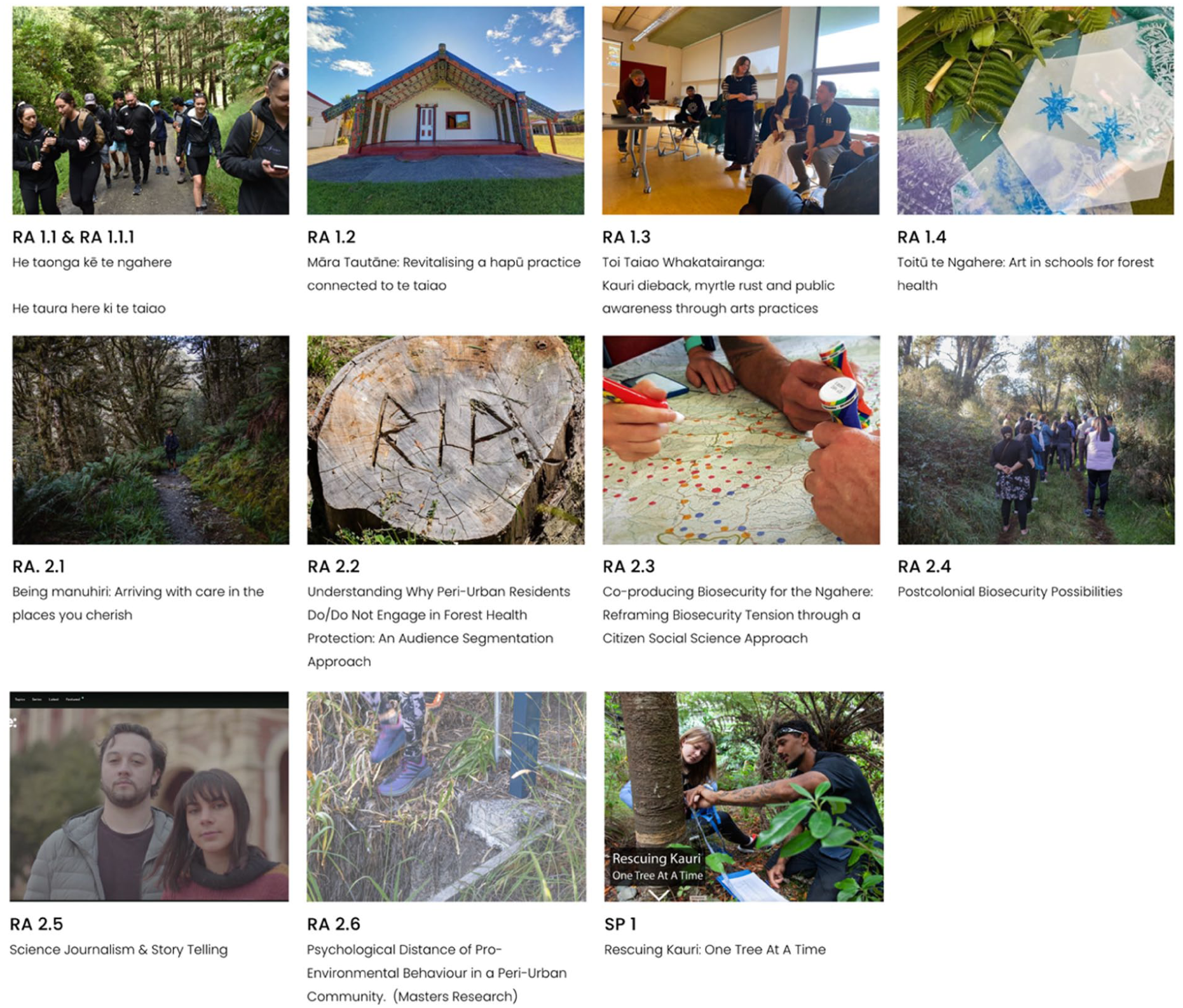
Research projects in Mobilising for Action (2024a).
Thinking about co-design and its application in Mobilising for Action’s research
Co-design can refer to a number of approaches in research and community practices. As Mark and Hagen (2020, p. 7) note, the term has often interchangeably referred to “participatory design, experience-based design, co-production, human-centred design” among other concepts. Duncan and Robson-Williams (2023), focusing on co-design in biosecurity and biodiversity contexts in Aotearoa and citing Vargas et al. (2022), argue that it is a subcategory of co-creation, where specific initiatives of it, like co-production are carried out. They outline that co-creation puts stakeholders at the centre of the project as collaborators identifying issues and creating solutions.
It has been used in a wide range of research both in Aotearoa and internationally, such as environmental and ecological approaches (Dale-Dickson, 2022; Duncan & Robson-Williams, 2023; Lanezki et al., 2020; Robinson et al., 2022; von Korff et al., 2010; Wemyss et al., 2022), public services and policies (O’Rafferty et al., 2016), especially in medicine and health interventions (Kidd et al., 2021; Livesley et al., 2022; McDonald et al., 2021; Verbiest et al., 2018) and even in working with nonhuman lifeforms in ecology (Chayaamor-Heil et al., 2024; Romani et al., 2022). Co-design often features in international Indigenous research (Bradford et al, 2018; Butler et al, 2022; Hayes, 2019; Newton et al, 2024; Trudinger, 2024; Tsai et al., 2024). Co-design has also been used extensively in research that involves mātauranga Māori (Māori knowledge), as a range of authors note (Kidd et al., 2021; Lavender, 2023; Menzies et al., 2017; Oetzel et al., 2024; Rolleston et al., 2022). Several recent studies have found that involving co-design in health care with Māori involving their cultural approaches leads to positive health outcomes for them (Goodwin et al., 2025; Gustafson et al., 2024; Oetzel et al., 2017). This is noted here because in te ao Māori, it is widely considered that ‘if we do not care for ourselves, we cannot care for our environment’ as people are always interconnected with the environment. Looking after the wellbeing of people can therefore be seen to be essential for our research processes in MFA with communities and forest health, in addition to our emphasis on co-design.
Busse et al. (2023) carried out a review of 88 international research publications involving co-design in land-use and sustainability-related science, though it is not clear if they engaged with research involving Māori. They found that the word co-design is generally used intuitively, often with different meanings depending on the context and without clear agreements over what it can be. From their survey, 76 studies aimed to jointly develop “problem-solving interventions for sustainable transformations,” while 12 studies sought “to collaboratively develop research questions or agendas” (Busse et al., 2023, p. 1). The “intervention type” research projects had four subthemes: (1) “researcher-led and model-based,” (2) “social science-driven” interventions that are science-driven and pre-conceived, (3) “design-led and practice-oriented interventions” focusing on practical outcomes instead of science ones and (4) “transformative transdisciplinary interventions and living labs” that Busse et al. (2023, p. 1) argue align with transdisciplinary methodological frameworks and philosophy.
We argue MFA was created through a co-creative process whereby it engaged with a wide range of Māori and non-Māori as key stakeholders to establish its programme of research, and many of its projects then utilised co-design processes in their engagement with their Māori and non-Māori partners. Both its kaupapa Māori (Māori platformed and shaped) projects (Stewart, 2021, p. 26) and mixed Māori and Western knowledge projects had clear goals involving co-design from the outset. Furthermore, the MFA programme had numerous projects that operated according to Busse et al.’s latter two categories. These included its Māori-led projects, which focussed on incorporating Māori and Western knowledge and researchers and addressed what Busse et al. call transformative transdisciplinary interventions and living labs, utilising design-led and practice-oriented interventions. Examples of these included Toitū te Ngahere (the permanent or sustainable forest), which engaged school children in forest health through the creative arts, Toi Taiao Whakatairanga (uplifting the environment through the arts), which partnered with Indigenous artists and He taura here ki te taiao (to fasten the rope of or to the environment), which worked with hapū and whānau (families, extended families). These projects are outlined further below.
Co-design and te ao Māori perspectives
Co-design offers the opportunity to synergise Western and Māori knowledge in approaching community engagement, being well aligned with kaupapa Māori research and with core Māori values, and enabling whānau to take an active role in research and community advancement. (Wakefield, 2024, p. 15)
There is widespread consensus that co-design aligns with notions of collectivity and co-creation in te ao Māori contexts and culture (Barnes et al., 2021; Mark & Hagen, 2020; Wakefield, 2024). It is clear from research that has engaged with co-design in Māori spaces that it results in what can be seen as several positive outcomes for Māori, such as a sense of cultural responsiveness to being Māori; an interface between Western and Māori knowledge with what are often considered to be innovative approaches; ownership in the project; buy-in; a keenness to participate and identification with a sense of pride in the project; feelings of being valued; increased well-being; in addition to long-term participation when this is a desired outcome; such as in health (Kidd et al., 2021; McDonald et al., 2021; Rolleston et al., 2022), public policy (Mark & Hagen, 2020), the arts (Kraus, 2018) and ecology and the environment (Basnou et al., 2020; Dale-Dickson, 2022). Our findings suggest the same in MFA when we engaged in co-design with Māori community, iwi and hapū contexts. Furthermore, we found from our findings in MFA that co-design can have positive outcomes in terms of growing hononga (connection), mahitahi (collaboration) and the well-being of participants. Even if projects only address their intended focus in very small ways, involving co-design can be seen to generate deeper engagement and awareness with hapori Māori (Māori community) by involving them. This is due to how co-design is widely considered to embrace Māori cultural approaches, as it is commonly considered to be something that Māori have done for hundreds of years on a daily basis (Waipara, personal communication, 2022).
However, there are warnings in the current literature around attempting co-design with Māori. Mark and Hagen (2020) and Wakefield (2024) caution against co-design being misappropriated as a buzz-word to claim consultation with Māori, when from a Māori kaupapa and tikanga (Māori protocols) lens consultation has not occurred. Furthermore, Mark and Hagen (2020) and Wakefield (2024) contend that when non-Māori attempt to co-design with Māori they may often slip into colonial modes of extraction and control involving exploitation and hierarchal and nonconsultative decision-making, that ignore Māori cultural values like collectivity, in addition to power-sharing that is te Tiriti-based, embracing Māori sovereignty. This is also a common finding in research undertaken with Indigenous communities in international contexts, such as in Australia, where it is often claimed there has been co-design without evidence of it (Shay & Sarra, 2023). A common observation from our own experience is that sometimes researchers use the term co-design to legitimise their projects, without applying what it means on the ground. A variable in this may be how Duncan and Robson-Williams (2023, p. 164) note that co-design research can be “challenging to execute and resource intensive, with outcomes not always translating into action and change,” perhaps motivating some researchers to take short-cuts in their attempts to apply it.
We attempted to keep such words of warning in mind in MFA’s projects, by engaging in co-design with Māori and within Māori contexts where Māori researchers, artists and community members were co-creators of the projects from the outset. We attempted to provide the necessary space, skills, resources and processes that enable the development of co-design and associated values recommended by Mark and Hagen (2020, p. 5).
For the ‘co’ in co-design to be honoured, there needs to be more than design skills and methods involved. Both the capability and the conditions for a relational and value-based, culturally grounded practice based on reciprocity and shared decision-making need to be in place. Doing co-design involves creating time, space and structures for learning, reciprocity, and power-sharing.
Mobilising for Action: case studies for co-design
MFA was created through a co-creative process whereby it engaged with a wide range of Māori and non-Māori as key stakeholders to establish its programme of research. As described above, many of its projects utilised co-design processes in their engagement with their Māori and non-Māori partners.
Helen Moweka Barnes et al. (2021) argue that co-design can be seen to be both a valuable and an appropriate tool for transdisciplinary research. As such, it was a key approach used in several of MFA’s projects. By transdisciplinarity, we refer to “The meeting point of people and minds” where efforts are synergised, and applied (UNESCO, 1998). However, unlike international definitions of transdisciplinarity, which integrate knowledge, MFA reframed this to instead seek the interweaving of knowledges. For MFA, interweaving of knowledges enabled the identity of contributing knowledges to be evident—rather than integration, which MFA argued problematically suggests a blending of knowledge and hence a loss of identity as new knowledge is created. For many Māori communities that MFA engaged, their previous experience of working with researchers outside of their hapori, hapū or iwi had shown that the processing of knowledge had typically led to the dominance of Western knowledge systems. This subtle change in wording from integration to interweaving was critical for MFA’s Māori collaborators and our processes in relation to upholding Indigenous cultural knowledge systems and values.
Pohl et al. (2021) contend that transdisciplinarity sees the inclusion of multidimensional perspectives, approaches and co-production involving, at times, consensus-based decision-making, with emotional, social and cognitive engagement generating “open-ended learning processes without predetermined outcomes” (p. 118). In environmental research contexts, like MFA, it is often seen to restructure and reshape Western disciplines while revealing and exploring interdependence with systems like socio-ecological processes (Barnes et al., 2021). Barnes et al. (2021), building on a range of literature as well as their own case studies (Barnes & McCreanor, 2019), situate mātauranga Māori and engaging with Māori as aligned with transdisciplinarity and their calls for co-design as a method.
A foundation for MFA’s research was its te Tiriti influenced Waka Hourua (double-hulled canoe) framework (Figure 2). The Waka Hourua framework was introduced to the kauri dieback space by kaumatua (elder) Hori Parata, of Ngāti Wai and Ngāti Hine (tribes from northern North Island of NZ). The framework recognises the role both mātauranga Māori and Western knowledge can contribute to addressing kauri dieback and myrtle rust. One hull represents mātauranga Māori and the other, Western science and related knowledge. The canoe’s centre acts as a metaphor for the space where insights and understandings between the contributing knowledge systems are shared and exchanged. MFA’s commitment to the values of the waka hourua resulted in half of its projects being Māori-led and focused, while the other half focused on Western science, social science and other related perspectives (Mobilising for Action, 2024b).
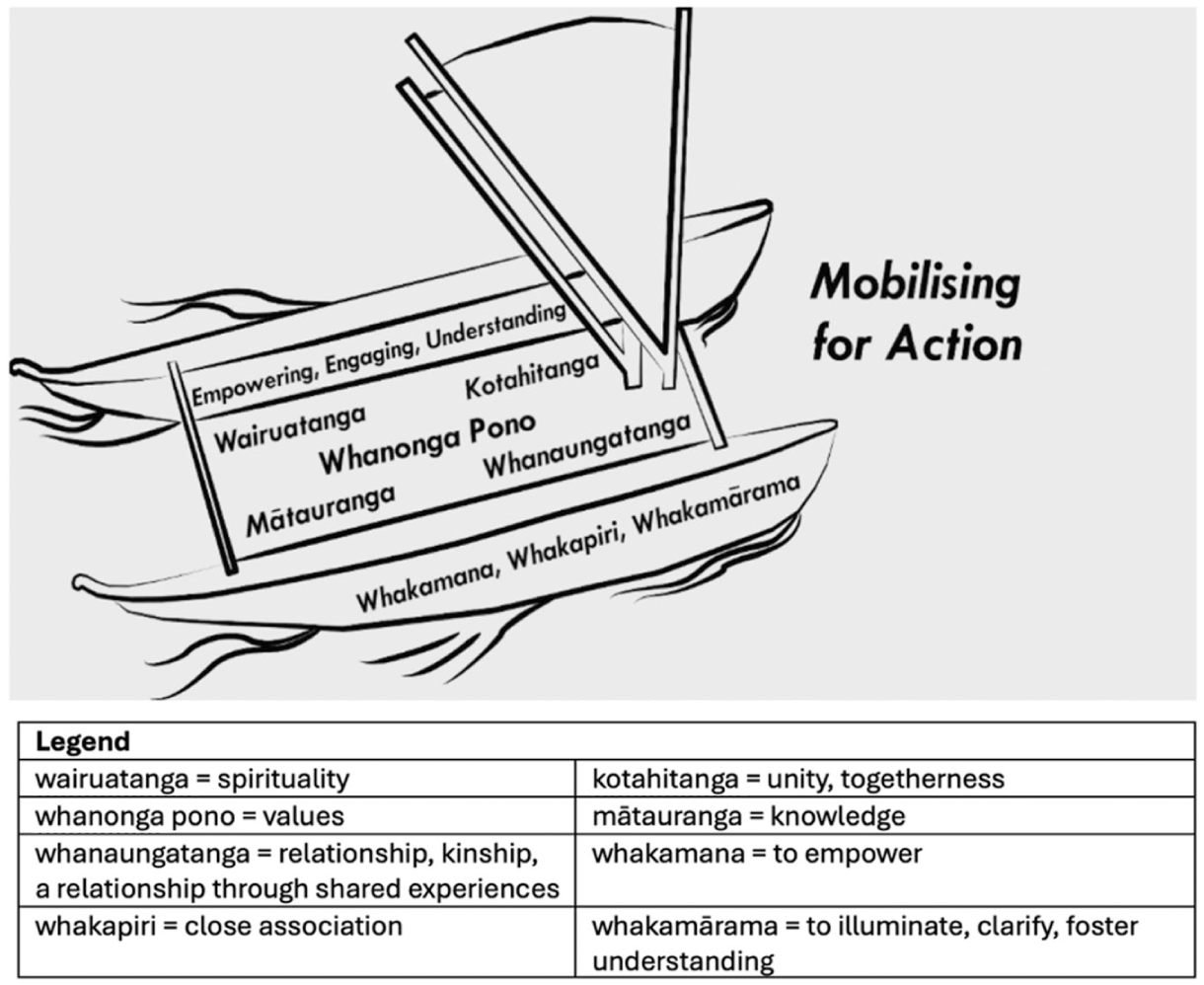
Waka Hourua framework for Mobilising for Action (2024b).
The kaupapa (platform or approach) of MFA’s Waka Hourua framework consisted of, as noted earlier, one hull of mātauranga Māori, with its guiding values written in te reo Māori (Māori language) and the other, Western knowledge, with the same values translated into English. In these hulls are whakamana (to empower), whakamārama (to illuminate, clarify, foster understanding) and the whakapiri (close association) of people around forest health. The platform in the middle is titled whanonga pono, referring to shared values, the structure through which Māori and Western knowledge are shared between researchers, where they can inform each other and co-design together from each hull. The remaining four words on the middle platform of the double-hulled waka were intended to be ways in which co-design would operate across MFA’s project. This was through whakawhānaungatanga (building and establishing relationships and relating well to others), mātauranga (knowledge) and wairuatanga (spirituality). The latter is a key mode of knowledge and engagement in te ao Māori. It framed MFA’s protocols around fieldwork and creative practices such as by employing karakia (spiritual incantations, prayers and ritual chants) and kotahitanga (unity, togetherness) through collaborating, sharing workshops, teaching and learning, co-design in the establishment and implementation of projects and co-writing of publications.
We propose that the Waka Hourua framework fostered co-design. Co-design between the researchers, iwi, hapū and communities was a core design component in most of the projects. Projects operated through a place-based approach and were shaped in response to the contexts they encountered, cultural or otherwise. With this, they applied a te Tiriti framework and a process of ensuring the Māori co-lead guided the mātauranga Māori aspects of the programme. The process of conceiving this was aimed at being empowering for all involved, with mahitahi where the co-leads equally engaged in pāhekoheko (combining) their knowledge and methods. Throughout the process, the co-leads engaged in whakahononga (building connections), including whakawhānaungatanga, with each other and others such as Māori collaborators in the field. They also connected research organisations to the framework to inform the co-design process. The co-leads also had ngā whāinga nātahi (shared goals, with the pursuit of pinnacle goals) that enabled the co-design process to take the time it appeared to need for them via ako torowhānui ai (holistic learning, from a Māori perspective).
In MFA’s kaupapa Māori projects, collaborators reported feeling their mana (power, authority, prestige, status, charisma, spiritual power, and influence) uplifted as people. In addition to this MFA’s collaborators reported being able to operate as what Jessica Hutchings et al. (2020), Merata Kawharu (2000, p. 87) and Māori Marsden (2003) each note as kaitiaki (a guardian or guardians) who care for a place that has physical and spiritual dimensions and assigned through Māori protocols) for their forests and tūpuna awa (ancestral waterways), tūpuna maunga (ancestral mountain or mountains) and ngahere (forest).
MFA’s application of the Waka Hourua framework we found gave space for shared understandings gained through multi-disciplinary approaches and collaborations in kauri dieback and myrtle rust management. For example, some MFA projects involved contributions by plant pathologists who specialise in kauri and their surrounding habitats. They were informed by Western science through experimental research and the tikanga-informed contributions informed by generations of Māori knowledge made by iwi and hapū through rongoā Māori (Māori medicine) and rāhui (a temporary ritual prohibition), such as for kauri forests (Lambert et al., 2018).
We present below three examples from MFA’s projects to illustrate how co-design processes built greater knowledge, understanding and tools for forest protection and health in Māori and te Tiriti-based research contexts.
Case Study 1: he taura here ki te taiao: Utilising wānanga as methodology
The project He taura here ki te taiao (2021–2024; Mobilising for Action, 2024c), referring to fasten the rope to the environment, or, for us to be interconnected with the environment, engaged with Māori and Indigenous ontological perspectives, including the physical, human and nonhuman and the spiritual in relation to te taiao (the environment). This project was part of MFA’s application of tino rangatiratanga (sovereignty) as guaranteed to Māori under te Tiriti, where it was as the saying goes, led by Māori for Māori.
He taura here ki te taiao fostered co-production through their rōpū rangahau (research group), which was embedded in kaupapa and mātauranga Māori, where knowledge handed down from tūpuna (ancestors) was a central pillar to their collaborations (Matamua et al., 2023). This project included learning and teaching in relation to pūrākau (Māori stories of origin, often associated with the gods), as well as researching contemporary understandings.
The researchers in the He taura here ki te taiao project co-designed a methodology towards working collectively in these ways, which they named a wānanga methodology (Matamua et al., 2023). Wānanga has several meanings, including to meet, discuss and deliberate over something, an educational session and workshop, in addition to the passing on of ancestral iwi and hapū knowledge. While co-design may be developed through a process of wānanga, the two concepts of wānanga and co-design are not the same, despite how they can involve each other. In He taura here ki te taiao, a co-design process created a wānanga methodology by holding wānanga. In this sense, they used a co-design methodology to develop a new methodology, framed as wānanga. Their approach contrasts with approaches to wānanga that do not necessarily utilise co-design processes, such as more hierarchal modes of pedagogy, for instance, when teaching and learning waiata (song or songs).
Like the other MFA case studies here, He taura here ki te taiao also employed whakamana (to empower), ngā whāinga nātahi (shared goals, with the pursuit of pinnacle goals), whakahononga (building connections), ako torowhānui ai (holistic learning, from a Māori perspective) and pāhekoheko mātauranga (combining knowledge) by sharing and valuing, combining and including all of their collaborators’ voices in decision-making providing the necessary time that such processes needed rather than being set by a prescribed schedule.
Case Study 2: Toi Taiao Whakatairanga: collaborative engagement through the arts
Toi Taiao Whakatairanga, TTW (2020–2024; Mobilising for Action, 2024d), which means uplifting the environment through the arts, was a 4-year creative arts curatorial project combining various art forms with artistic research, curators, plant scientists, social scientists, mātauranga Māori and publicity. The project aimed to empower hapori Māori and the wider public by supporting their engagement in and understanding of myrtle rust and kauri dieback. The project commissioned and curated nine Māori artists to engage with Māori and non-Māori hapori and, at times, iwi and hapū. The artists were also required to koha (donate) an aspect of their works to their hapori in any form, such as the artworks themselves or via workshops and wānanga. In addition, a tour of TTW’s funded arts works was undertaken around the North Island in collaboration with its partner, The Kauri Project and three participating iwi and hapū at the conclusion of the project (Toi Taiao Whakatairanga, 2024). Like with its parent project MFA, TTW was based in a te Tiriti framework utilising Jones and Jenkins’s (2014) hyphen model, where Māori and Pākehā (New Zealander of European descent) collaborated and co-designed the project and all its public events. Māori had the space to lead and create Māori content with Pākehā researchers and curators providing support towards this.
Many of the arts works in the TTW project were developed through co-design with the artists, curators and the participating hapori, iwi and hapū members. The form of each of these arts works depended on the context, including specific issues and needs of each hapori, iwi and hapū, the geographic and te taiao aspects, the whakapapa (genealogy) and connections of and between the artists and participants involved. Like with many of their MFA Māori-related projects, each arts works we propose resulted from processes of pāhekoheko mātauranga (combining knowledge), ako torowhānui ai, and ngā whāinga nātahi, for all involved, whakamana for all, and applications of te Tiriti. The following two arts works illustrate how this co-design process facilitated MFA’s objectives to enable empower and build understanding within iwi, hapū and other hapori. Both arts works stemmed from collaborations with iwi and hapū on Aotearoa’s East Coast of the North Island and involved engagement around myrtle rust.
Saving our Myrtles (Apanui-Kupenga, 2024), is a documentary commissioned and curated by TTW and produced by Fiona Apanui-Kupenga (Ngāti Porou; Māori tribe from East Coast, North Island of New Zealand), and directed by Kaea Hills (Ngāti Porou). It has focussed on the te taiao mahi (environmental work) of Te Whakapae Ururoa (the white shark driven ashore), a community myrtle rust surveillance project, consisting of a local hapori Māori rōpū (Māori community group) and their focus on myrtle rust in the Raukumara forest ranges and Te Araroa in Te Tai Rāwhiti (the East Coast, region in the North Island of New Zealand). Saving our Myrtles followed on from an earlier documentary Mate Tipu, Mate Rākau (sick, dead or overcome, seedling or growth, shoot, bud, plant or ancestral, sick, dead or overcome, tree; Apanui-Kupenga, 2021), also directed by Fiona Apanui-Kupenga. The documentary recorded the loss of the native myrtle species ramarama in the Raukumara forest ranges and the work of te taiao tohunga (environmental expert) Graeme Atkins (Ngāti Porou, Rongomaiwahine; Māori tribe from the East Coast, North Island of New Zealand) to bring attention to the devastation being caused by the myrtle rust disease.
Saving our Myrtles was also part of a series of co-designed arts works with the same community in collaboration with TTW. This included artwork by Natalie Robertson (Ngāti Porou; Clan Dhònnchaidh). While focusing on the loss of the species and emphasising grief and related feelings, Saving our Myrtles shows how a Māori community who connect through their shared whakapapa can come together and offer and test solutions around myrtle rust as a model for other hapori. This is made more pertinent since the community also whakapapa to the forests and plants they engaged with in this documentary. As is well-known in te ao Māori, tāngata (people) are descended from plants and trees, and this can be traced through pūrākau, stories of origin told through generations, old and often ancient, about how Tāne Mahuta (Māori god of the forest) created people out of the whenua (land).
Saving our Myrtles co-designed processes saw collaborations between all people engaged in the project where they together conceived, filmed and edited the documentary, working in consensus with the producer and the director, who is also a member of the Te Whakapae Ururoa group. The project took several months to develop. It operated holistically, with members working out together what their roles would each be and what the documentary would capture. They sought to show how the community group seeks to enhance the mana of te taiao, each other and the documentary celebrates their efforts. The rōpū (group) drew from a range of approaches and forms of knowledge for the documentary, including Western plant science, mātauranga Māori, applied forest ecology, science communication, script writing, directing, film making and editing and journalism. Saving our Myrtles organically developed through a process of open-ended emergence, typical of artistic research (Slager, 2021), slowly developing over 2 years until all involved were satisfied.
Case Study 3: Toitū te Ngahere: co-designing with schools using the creative arts
Toitū te Ngahere, TTN (2022–2024; Mobilising for Action, 2024e), which means uplifting forests through the arts, engaged tamariki (children) around kauri dieback and myrtle rust through a transdisciplinary approach to empower and educate through the arts. Its approach to transdisciplinarity involved, the creative arts, plant and ecology science, mātauranga Māori in various areas, education, publicity and communication and co-design. It consisted of a team of Māori and Pākehā researchers, educators, curators and conservationists who collaborated with five primary schools across Tāmaki Makaurau (Auckland), with one of them being a partial te reo Māori immersion kura (school). Co-design was a central methodology for TTN, and it included mātauranga Māori as a central component. TTN’s engagement with schools is focused on workshops where students engage with Western science, mātauranga Māori, various arts approaches, social science and rongoā.
TTN combined a range of arts-based practices, including video-making, performing arts, photography, drawing print-making, script writing and game design, with workshops with the children involving Māori and non-Māori artists, in addition to plant scientists, social scientists, guest Māori kaiako (teachers), the schools’ own teachers, kaumātua (elders) and local council environmental staff. The project resulted in two exhibitions, including Toitū te Ngahere (2022) at Te Uru Gallery in Auckland and on Aotea (Great Barrier Island) at the community Ecofest in 2023. Each year, the research team hosted groups of students at Waipapa Taumata Rau (the University of Auckland), where each school presented their projects and learnings in lectures given to environmental science and education students as an extension to their learning and a way of fostering exchange beyond the research project.
A key part of the co-design process in TTN was that students played an equal part with their teachers and the research team in the conception and creation of their arts projects through ako torowhānui ai, not otherwise common in the current school system. Allowing tamariki to fully participate in decision-making is a norm in Māori spaces, especially prior to colonisation. TTN sought to develop children’s voices and agency through their communication of kauri dieback and myrtle rust informed by mātauranga Māori and western science and social science. However, in keeping with a co-design process, the arts making was open and emergent, and the research team brought in approaches, forms of knowledge and techniques depending on the context the children and teachers were focusing on. What each school focussed on was also shaped by school cultures, local contexts—for instance the closure of a local forest for biosecurity reasons—and by their unique geographic contexts.
One example of how TTN developed arts projects with the schools was with Kauri Park School, which was situated in a partially native-forested suburb. In workshops, the tamariki and some of their teachers expressed frustration and bewilderment over how a local forest conservation park, called Kauri Park, had been closed by the City Council to prevent the spread of kauri dieback. This sentiment was believed to be widely shared by many local residents. The TTN research team set up and facilitated a hui (meeting) with the students, teachers and Council environmental staff who are responsible for the park. At the session the tamariki shared their insights, concerns and questions openly with the council staff. Council explained why members of the public are prohibited from entering the forest, a decision which was deemed by scientists they consulted with as best-practice, which was supported by mana whenua (tribe or subtribe with designated legal customary authority over the area), Te Kawerau ā Maki (Māori tribe from the Auckland region, in the north of the North Island of New Zealand), who have declared a rāhui in support of this. Through a sense of hononga (connection), whakamana and shared understanding through this discussion, the participants of the hui, along with the research team, developed a sense of mahitahi, which created a collective goal to support public awareness about why the forest park needs to remain closed in respect of the wishes of mana whenua, applying te Tiriti, and scientists and ecologists. The participants and researchers began a co-design process in brainstorming around possible ideas and public interventions to support their shared goal. It resulted in the creation of a mural through graffiti art on two shipping containers that was conceived and developed by the students, with support from their principal, parents, teachers and guided through a collaborative and facilitated process with the research team (McEntee et al., 2024). The container art subproject of TTN, which took place with 15 children, took one year to complete, although it was fully informed by TTN’s previous year’s work with the school. Like the foundational TTN project, the container art project was guided by a sense of ako and te Tiriti in terms of allowing space for holistic intercultural learning and embracing of kaupapa Māori perspectives, like upholding the rāhui and learning from matua (uncles, fathers, parents) who taught relevant pūrakau and how in te ao Māori forest health is interconnected with the health of people. It also challenged dominant institutional cultures in schools such as timetables that limit facilitating such deeply collaborative co-designed processes of learning.
Another example of co-design for TTN is the creation of a book by the students at Mulberry Grove School on Aotea along with their teachers, the TTN team and a local kaumātua who has guided the children’s learning of mātauranga Māori. This book records the students’ perspectives and artwork around forest health that emerged from their year of learning about ngahere ora (forest health) and particularly kauri dieback and myrtle rust.
Discussion: proposing a Kaupapa Māori approach to co-design
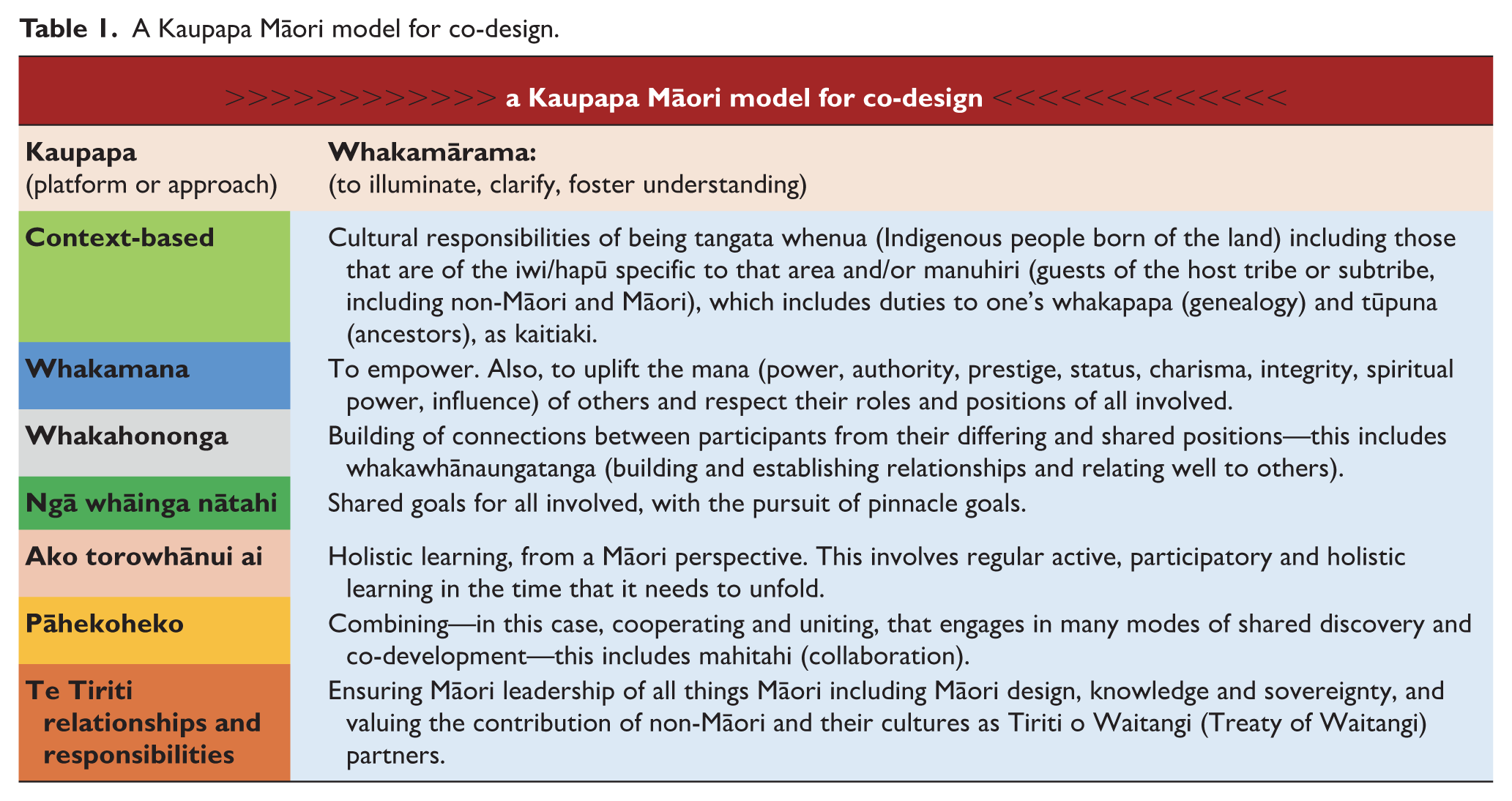
Drawing from our experience and findings in MFA, as illustrated above and others not mentioned here (Harvey & McEntee, 2023), and by also engaging with the literature, we propose a Kaupapa Māori model for co-design (Table 1). Through this, we aim to engage in a decolonising approach (Tuhiwai Smith, 2024). This te Tiriti-structured co-design process sees projects having all aspects of mātauranga Māori and Māori tukanga (methods and approaches) being led and designed by Māori, for Māori, and where appropriate, tangata te Tiriti (non-Māori people in Aotearoa) follow and are guided by this. Wakefield (2024) and Mark and Hagen (2020), drawing from Menzies et al. (2017) and Whaanga-Schollum et al. (2016) all note when there is a led by Māori for Māori approach and Māori tino rangatiratanga through Māori tikanga in co-design projects, it has been widely found that there are more opportunities for Māori including whānau (families and extended families) to “participate in mana enhancing ways and lead change in their own lives” (quote from Mark and Hagen, 2020, p. 5). Our model is one of many possible models and an offering for others researching through related approaches in Indigenous contexts. We present the model below in Table 1.
A Kaupapa Māori model for co-design.
Underpinning our proposed Kaupapa Māori model for co-design are whakapapa and mātauranga Māori, allowing space for iwi-specific knowledge and that which is shared across hapū and iwi. One influence from a more general te ao Māori perspective, for instance, is Mason Durie’s model of “Māori aspirations defined as outcome goals and classes” (cited by Harmsworth & Awatere, 2013, p. 280). Durie’s model incorporates the following (Harmsworth & Awatere, 2013, p. 280):
Te Manawa—a secure cultural identity.
Te Kāhui—collective Māori synergies.
Te Kete Puāwai—Māori cultural and intellectual resources.
Te Ao Turoa—the Māori estate. We note here that the definitions Durie provides in this list are paraphrasing for the ones provided for these terms in our glossary.
Each of these can be seen to outline a sense of collectivity as essential aspects of living in the world as Māori (not including modern Western individual influences on lives in present times). We propose this can be seen to emphasise why co-design is a common approach across te ao Māori.
Another influence are the Te Aranga Māori design principles, calling for applying Māori values and tino rangatiratanga as outlined by Fleur Palmer (2021, pp. 225–226). Te Aranga refers to the rising up. The principles are as follows (Auckland Design Manual, 2024; Palmer, 2021, pp. 225–226):
Rangatiratanga: the right to exercise authority and self-determination within one’s own iwi and hapū realm.
Kaitiakitanga: managing and conserving the environment as part of a reciprocal relationship, based on the Māori worldview that humans are part of the natural world.
Manaakitanga: the ethic of holistic hospitality whereby mana whenua have inherited obligations to be the best hosts they can be.
Wairuatanga: the immutable spiritual connection between people and their environments.
Kotahitanga: unity, cohesion, and collaboration.
Whānaungatanga: a relationship through shared experiences and working together that provides people with a sense of belonging.
Mātauranga: Māori and more specifically mana whenua knowledge and understanding. We note here that the definitions Palmer provides in this list are paraphrasing for the ones provided for these terms in our glossary.
We propose our Kaupapa Māori model for co-design can be seen to incorporate each of these, including the kaupapa of Tino Rangatiratanga, kaitiakitanga (to engage in the process of being a guardian assigned through Māori protocols), wairuatanga and mātauranga: Māori and mana whenua knowledge and understanding under the Pāhekoheko and te Tiriti relationships and responsibilities.
The model also embodies the co-design principles proposed by Norström et al. (as cited in Duncan & Robson-Williams, 2023) for assessing the quality of co-production processes. These include to what extent the project is context-based, pluralistic, goals-orientated and interactive.
In terms of operating as context-based, we propose that this is part of the cultural responsibilities of being tangata whenua (Indigenous people, people born of the land), or manuhiri (guests of the host tribe or subtribe, including non-Māori and Māori). This includes where it is tika (correct, with Māori protocols), duties to one’s whakapapa (genealogy) and tūpuna, as kaitiaki, to whakamana, which is also uplifting the mana of others, whakahononga, in this case building of connections between participants from their differing and shared positions and as part of this, to engage in whakawhānaungatanga. This call for whakawhānaungatanga when working in Māori spaces is described by Wakefield (2024, p. 7) as co-design. Operating in context-based ways we propose also calls for holistically adapting to and addressing aspects around resourcing, wider cultural and intercultural needs, not just Māori, capacity building and practical aspects like how to respectfully manage and prevent misunderstandings and disagreement so that all co-designers’ viewpoints are valued and contributing.
In terms of being goals-oriented, we propose this as ngā whāinga nātahi, as a pinnacle intent for all involved, which includes a sharing of resources equally among participants and collaborators. As Lavender (2023, p. 1) has found in educational research contexts, “without comprehensive sharing of power and resources, the quality of co-design is compromised, and the potential for rangatiratanga” (chieftainship for Māori) “is unfulfilled”. Hence, Lavender’s (2023, p. 1) call to embrace te Tiriti across all educational levels through co-design processes, where the sharing of resources between Māori and tangata te Tiriti occurs.
Interactivity we propose as ako torowhānui ai, active, participatory and holistic learning in the time that it appears to need to unfold and pāhekoheko to cooperate and unite engaging in many methods of researching and mahi (work) using modes of shared discovery and co-development. This includes mahitahi. Our model here calls for consensus based decision processes where decisions are formed through collective negotiating.
Pluralism in co-design we propose pertains to te Tiriti relationships and responsibilities and how Māori ways of doing things can be in negotiation with that of other cultures. This is where for instance Māori are in partnership with the Crown and all non-Māori cultures are represented by the Crown. In this, we recommend the upholding of culture, including mātauranga Māori and values, and allowing Māori to be co-leaders with others and to lead Māori content (Jones & Jenkins, 2014; Mark & Hagen, 2020, pp. 4–5).
While MFA’s focus has not been specifically around health outcomes in relation to Māori, we see our model as being in conversation with research around it, where co-design is a theme, such as Goodwin et al. (2025), Gustafson et al. (2024) and Oetzel et al. (2017). For instance, Goodwin et al.’s (2025, pp. 2600–2614) “Te Whetū Evaluation Matrix” (te whetū referring to the constellation), was used by them to evaluate co-design including “Hononga” (including building relationships and mutual transparency), Mahitahi (including agreed shared values, components and processes), “Tikanga me ngā kawa” (respecting “and aligning with participant’s tikanga and kawa”), or Māori protocols and protocols in marae (the courtyard in front of wharenui or meeting houses), “values contexts and processes”), “Ngā Pukenga” (skills and expertise, sharing them with communities via co-design), “Ngā Hua” (fullness, baring fruit, blossoms, solutions, producing equitable outcomes for all involved in the co-design), and tino Rangatiratanga. Goodwin et al. (2025, pp. 2600–2614) have proposed that projects which achieve these aspects to high levels have done so with a sense of shared governance, involving “the right people” (people with appropriate skills, capacities and matching values), with adequate “resourcing” and “capacity building” of skills and resources. While Goodwin et al.’s framing has some differences to our model in its use of wording, we propose that our one covers the same aspects, while additionally offering a consideration of contexts and place-making, along with processes of holistic learning. Unlike Goodwin et al. our project has not explicitly mentioned capacity building, involving ‘the right people’, accountability and shared governance, but these are aspects we propose our model calls for also, in terms of the concepts of co-design being context-based, whakamana structured, and emphasising te Tiriti relationships and responsibilities. These aspects we propose implicitly require capacity building, the right people and shared governance for them to be established.
While MFA projects have strongly informed the construction of our model, we also see elements of it in some approaches to forest management in Aotearoa, such as in the relationship Te Kawerau ā Maki iwi currently have with Auckland Council in co-designing forest tracks to prevent the spread of kauri dieback. This approach has moved away from the dominant modes of governance where tangata whenua and mana whenua are ignored (Gibson et al., 2023, p. 1; Taua-Gordon, 2021).
Conclusion
In this article, we have reflected on co-design using mātauranga Māori perspectives in transdisciplinary research contexts, drawing on our learning from projects with Māori as collaborators using te Tiriti-based approaches, in addition to recent literature. Mobilising for Action’s projects have enabled us an opportunity for reflection on co-design. This is because co-design has been a significant component of MFA’s research, as it sought to challenge top-down approaches to public engagement around forest pathogens. For many living and working in Māori contexts, co-design and this model may appear rather obvious and as the saying goes, old hat. However, we suggest being conscious of this approach can assist to develop how to design, create and research in Māori and te Tiriti-based contexts.
We recognise the wide range of factors that continually act to inhibit the inclusion of co-design processes. For instance, it is not always possible to have direct mana whenua engagement due to capacity issues, despite our recommendation of it being ideal. Like Goodwin et al. (2025) we call for ensuring Māori leadership in all aspects of projects that engage with matāuranga Māori and capacity building and sustainable resourcing to support it.
We note that co-design processes may take longer than other, more traditional research approaches, but as we have found from feedback in MFA (McEntee et al., 2024; Toi Taiao Whakatairanga, 2024), those involved are widely shown to feel more invested in the process and in the issues and problems the project may be attempting to engage with. Taking the time that is needed to reach a collective desired outcome is widely known to be essential in Māori contexts, along with operating context-responsively and through wholistic learning. Each of these aspects of co-design are sought in the model we propose.
Our Kaupapa Māori model for co-design, drawn from extensive experience from MFA and from an exploration of the literature we propose, provides guidance to those engaging in co-design with Māori communities and can be applied across all contexts where researchers seek to collaborate with Māori. As MFA’s research shows, it is particularly relevant to environmental, ecological and biosecurity issues that Māori iwi, hapū and hapori are connected with, along with other communities, through te Tiriti-based approaches. By utilising the model, teams seeking to engage in Māori contexts will be able to ensure their processes are genuinely co-design by recognising and responding to differing contexts, uplifting the mana of all involved with whakamana, whakahononga, ngā whāinga nātahi, ako torowhānui ai, pāhekoheko and embracing te Tiriti relationships and responsibilities.
Footnotes
Acknowledgements
The authors especially thank the MFA teams whose research is highlighted in the cases presented in this article. We particularly thank and recognise here the other co-leads in MFA including Natasha Tassell-Matamua, Nathan Matamua (MFA) and Te Rā Moriarty (Case 1); and Molly Mullen (Case 3) for their work and guidance in these projects. We also thank the Ngā Rākau Taketake co-leads and Māori leadership team for their guidance in this around te ao Māori concepts, particularly: Nick Waipara.
Authors’ note

Ethical considerations
Human Ethics Approval has been approved for these projects under Mobilising for Action by the University of Auckland Human Ethics Committee, under project numbers: 23279 and 22395.
Funding
The authors disclosed receipt of the following financial support for the research, authorship and publication of this article: This work was funded by the Ministry of Business, Innovation and Employment (Mobilising for Action theme of the Ngā Rākau Taketake programme of the Biological Heritage National Science Challenge in Aotearoa, New Zealand), C09X1817.
Declaration of conflicting interests
The authors declared no potential conflicts of interest with respect to the research, authorship and publication of this article.
Glossary
ako torowhānui ai holistic learning, from a Māori perspective
Aotearoa New Zealand
Clan Dhònnchaidh Scottish Clan Robertson
hapori community
hapori rōpū community group
hapū subtribe
hauora health
He taura here ki te taiao to fasten the rope to the environment
hononga connection
hui meeting
iwi tribe
kaiako teacher
kaitiaki a guardian or guardians who care for a place that has physical and spiritual dimensions and assigned through Māori protocols
kaitiakitanga to engage in the process of being a guardian assigned through Māori protocols
karakia spiritual incantations, prayers and ritual chants
kaumātua elder, elders
kauri Agathis australis, endemic New Zealand tree
kauri ngahere kauri forest or forests
kauri dieback Phytophthora agathidicida
kaupapa platform or approach
kaupapa Māori Māori platformed and shaped
koha donate or donation
kotahitanga unity, togetherness
kura school
mahi work
mahitahi collaboration
mahitahi me te taiao collaboration and the environment
mana power, authority, prestige, status, charisma, integrity, spiritual power, influence
manaakitanga hospitality, kindness, generosity, support—the process of showing respect, generosity, care for others and raising the mana of others
mana whenua tribe or subtribe with designated legal customary authority over the area
manuhiri guests of the host tribe or subtribe, including non-Māori and Māori
Māori Indigenous people of New Zealand
mātauranga knowledge
mātauranga Māori Māori knowledge
Mate Tipu, Mate Rākau Sick, dead or overcome, seedling or growth, shoot, bud, plant or ancestral, sick, dead or overcome, tree
matua uncle, father, parent
myrtle rust Austropuccinia psidii
Ngā Rākau Taketake Strategic Science Investment Fund research platform funded by Ministry of Business, Innovation and Employment
ngahere forest
ngahere ora forest health
Ngā Hua fullness, baring fruit, blossoms, solutions
Ngāti Porou Māori tribe from East Coast, North Island of New Zealand
Ngā Pukenga skills and expertise
Ngāti Hine Māori tribe of the north of the North Island of New Zealand
Ngāti Wai Māori tribe of the north of the North Island of New Zealand
ngā whāinga nātahi shared goals for all involved, with the pursuit of pinnacle goals
pāhekoheko combining
pāhekoheko mātauranga combining knowledge
pākehā New Zealander of European descent
pōhutukawa New Zealand Christmas tree, Metrosideros excelsa, endemic New Zealand tree
pūrākau Māori stories of origin, often associated with the gods
rāhui a temporary ritual prohibition
ramarama Lophomyrtus bullata, endemic New Zealand tree
rangatiratanga chieftainship
rōhutu Neomyrtus pedunculatae, endemic New Zealand tree
rongoā Māori Māori medicine
rongomaiwahine Māori tribe from the East Coast, North Island of New Zealand
rōpū group
rōpū rangahau research group
tamariki children
Tāne Mahuta Māori god of the forest
tāngata people
tangata te Tiriti non-Māori people in Aotearoa
tangata whenua Indigenous people, people born of the land
te ao Māori the Māori world
Te Ao Tūroa The long-lasting, also tūroa, the Māori estate for Durie’s model (2013)
Te Aranga the rising up
Te Kāhui the constellation, collective Māori synergies, for Durie’s model (2013)
Te Kawerau ā Maki Māori tribe from the Auckland region, in the north of the North Island of New Zealand
Te Kete Puāwai the basket of flowers or blooming, for Durie’s model (2013)
Te Manawa the heart or breath, a secure cultural identity, for Durie’s model (2013)
te reo Māori the Māori language
te taiao the environment
te taiao mahi environmental work
te taiao tohunga environmental expert
te Tiriti o Waitangi, te Tiriti the Treaty of Waitangi the founding legal document of the nation-state of New Zealand
te Tiriti-based an approach that applies The Treaty of Waitangi, embracing Māori sovereignty
Te Uru the west wind, for Te Uru Gallery
Te Whakapae Ururoa the white shark driven ashore, community myrtle rust surveillance project, consisting of a local hapori Māori rōpū
te whetū the constellation
tika correct, often with Māori protocols
tikanga Māori protocols
Tikanga me ngā kawa Māori protocols and protocols in marae (the courtyard in front of wharenui or meeting houses)
tino rangatiratanga sovereignty
Toi Taiao Whakatairanga, TTW uplifting the environment through the arts
Toitū te Ngahere, TTN the permanent or sustainable forest
tukanga methods and approaches
tūpuna ancestors
tūpuna awa ancestral waterways
tūpuna maunga ancestral mountain or mountains
waka hourua double-hulled canoe
waiata song or songs
Waipapa Taumata Rau the University of Auckland
wairuatanga spirituality
wānanga to meet, discuss and deliberate over something, an educational session, workshop, in addition to the passing on of ancestral iwi and hapū knowledge
whakahononga building connections
whakamana to empower
whakamārama to illuminate, clarify, foster understanding
whakapapa genealogy
whakapiri close association
whakawhānaungatanga building and establishing relationships and relating well to others
whānau families, extended families
whanaungatanga relationship, kinship, a relationship through shared experiences
whanonga pono values
whenua land