




Abstract
The British Columbia Network Environment for Indigenous Health Research (BC NEIHR) supports self-determination of Indigenous Peoples and Indigenous communities, collectives, and organizations (ICCOs) in health research. Through partnerships with ICCOs, Indigenous and non-Indigenous researchers, and external Indigenous and non-Indigenous partner organizations across BC, the BC NEIHR works closely with research administrators to advance self-determination of Indigenous Peoples and ICCOs in health research. To transform the current research environment and uphold Indigenous self-determination, research institutions and administration must build and strengthen culturally safe and meaningful partnerships with Indigenous Peoples and ICCOs. Through the Indigenous Cultural Safety in Research Framework, the BC NEIHR challenges dominant Western colonial environments of research to advance decolonization of all research systems, including research administration. We share considerations for Indigenous cultural safety in research administration, including recommendations that address power imbalances, bridge capacity, and build culturally safe and meaningful relationships within Indigenous health research.
Keywords
Introduction
Historically, research was conducted on, not with, Indigenous Peoples. Research “on” or “about” Indigenous Peoples is extractive, does not benefit Indigenous Peoples or communities, perpetuates health inequalities, and marginalizes Indigenous Peoples, resulting in harm and trauma (L. T. Smith, 2021). Within historical and current Western research structures and systems, Indigenous knowledge and ways of knowing and doing are considered less valid or dismissed completely (Allen et al., 2020; Saini, 2012; L. T. Smith, 2021). Research “for” Indigenous Peoples remains problematic as it is often excluded or conducted without consultation with Indigenous Peoples or communities (Woods et al., 2023). Western colonial research structures and systems have resulted in a mistrust of research, negatively impacting participation and leadership of Indigenous Peoples and communities within health research. To address the impacts of unethical Western research, these colonial systems and structures must undergo transformation to support Indigenous “led” research, which advances Indigenous self-determination and Indigenous ways of knowing and doing in research (Latulippe & Klenk, 2020; White et al., 2021). This transformation requires partners at community and systems levels of health research to work together for this change.
In response to the 94 Calls to Action from the Truth and Reconciliation Commission (TRC) of Canada released in 2015 (Truth and Reconciliation Commission of Canada, 2015), Canadian post-secondary institutions have or are developing and implementing Indigenous policies. Within British Columbia (BC), post-secondary institutions are also responding to the Declaration on the Rights of Indigenous Peoples Act (DRIPA) (Province of British Columbia, 2019), passed in November 2019, which establishes the United Nations Declaration on the Rights of Indigenous Peoples (UNDRIP) as BC’s framework for reconciliation. Between 1970 and 2015, the focus of Indigenous policy change in post-secondary institutions was Indigenous inclusion, which focused on increasing the presence, participation, and success of Indigenous students, faculty, and staff in post-secondary institutions (Brunette-Debassige, 2023; Gaudry & Lorenz, 2018; Pidgeon, 2016). Following the TRC Calls to Action release in 2015, emerging policies and strategic plans have moved past Indigenous inclusion to Indigenization across the institution including student services, curriculum, governance, administration, organizational plans, councils and committees, data and research, and public statements including land acknowledgements (Brunette-Debassige, 2023; Gaudry & Lorenz, 2018; Pidgeon, 2016; Tamtik, 2024).
According to Universities Canada (2022), 90% of Canadian universities have or are developing a strategic plan for reconciliation. For example, this is observed by the frequency of the term “Indigenous,” which is included 45 times in the University of BC’s 78-page Strategic Plan (University of British Columbia, 2018) and 72 times in the University of Victoria’s 29-page Strategic Planning Phase 3: Internal Engagement (University of Victoria, 2022). Indigenous representation and partnership are increasing in Canadian universities with an increasing number of Indigenous faculty and staff in 90% of universities, incorporation of Indigenous practices or decision-making into governance structures in 50% of universities, and partnership with local Indigenous communities in 72% of universities (Universities Canada, 2022). This movement towards inclusion of Indigenous policies across post-secondary institutions has presented with challenges for Indigenous Peoples and communities within and outside of the institution (Brunette-Debassige, 2023; Gaudry & Lorenz, 2018; Pidgeon, 2016). Therefore, this transformation needs to ensure that not only is there an increased presence and inclusion of Indigenous Peoples and knowledges across the institution but also that this transformation is ethical, respectful, and accountable to Indigenous Peoples, communities, and knowledges.
Network environments for Indigenous health research
The Network Environments for Indigenous Health Research (NEIHR) is a national network of centres focused on capacity bridging and research and knowledge translation, while providing supportive research environments for Indigenous health research led by and grounded in Indigenous communities in Canada (Canadian Institutes of Health Research [CIHR], 2018). Across Canada, the NEIHRs include nine Indigenous-led networks and one National Coordinating Centre.
The BC NEIHR supports research leadership for Indigenous communities, collectives, and organizations (ICCOs), Indigenous and non-Indigenous researchers, and Indigenous trainees (British Columbia Network Environment for Indigenous Health Research, n.d.). To support and promote Indigenous-led health research within BC, the BC NEIHR: (1) develops infrastructure supportive of ICCO-led health research; (2) supports Indigenous-led health research reflective of Indigenous values, priorities, and approaches; (3) provides funding for ICCOs to lead research development and knowledge sharing and mobilization; (4) facilitates ethical and culturally safe research partnerships; and (5) advances objectives and ensures sustainability of the BC NEIHR through engagement with policy and organizational partners at local, regional, provincial, national, and international levels. The BC NEIHR aims to advance the transformation of the current research environment through collaborative partnerships within and outside of the network. Within these dynamic partnerships, the BC NEIHR works closely with research administrators to support self-determination of Indigenous Peoples and ICCOs in health research, which has come with both successes and challenges that are presented in this article.
Indigenous self-determination in research
Self-determination in Indigenous research, a foundational principle of the BC NEIHR, is reflected in the right of Indigenous Peoples and ICCOs to determine and lead their own research priorities, as well as through equitable access to funding and support for ICCOs and Indigenous students and researchers. To support self-determination, ICCOs must hold control, decision-making, and governance in research that is defined, developed, and led by Indigenous Peoples for Indigenous purposes that bear tangible benefits for ICCOs (L. T. Smith, 2021). The BC NEIHR supports ICCO self-determination by shifting control of funding from research institutions directly to ICCOs, who define and determine their research and how research funds will be held and administered (Barry et al., 2024; Erb & Stelkia, 2023). Indigenous Peoples and ICCOs possess capacities to plan, organize, and operationalize research to lead their own initiatives (Erb & Stelkia, 2023). However, within the current research funding landscape, in general, ICCOs are not eligible to hold mainstream research grants (Erb & Stelkia, 2023; Government of Canada, 2024), and therefore, Indigenous-led research is often in partnership with and administered by research institutions, such as universities. Within research partnerships between ICCOs and research institutions, ways that Indigenous self-determination is supported includes ICCOs defining research priorities and methodologies prior to starting research (Canada Research Coordinating Committee, 2019; Newhouse et al., 2023), centring distinction-based Indigenous ways of knowing and doing in research (Allen et al., 2020; Health Canada, 2011; Morley, 2015), guiding research through advisory teams (Barry et al., 2024; Morley, 2015; Tremblay et al., 2018; Woods et al., 2023), employing ICCO members as researchers (Ball & Janyst, 2008; Dudgeon et al., 2017; Kurtz et al., 2024), and returning knowledge to ICCOs to determine how and with whom knowledge is shared (Ball & Janyst, 2008; Datta, 2018; Newhouse et al., 2023; Peltier et al., 2020; L. T. Smith, 2021). Self-determination must be realized throughout the full research life cycle, ensuring Indigenous governance and protocols are respected and followed, which is critical to address historical and contemporary impacts of the colonial Western research structure.
The BC NEIHR follows principles of equity, transparency, and Indigenous cultural safety (ICS) to ensure accountability in Indigenous health leadership and capacity bridging, equitable distribution of resources, and transparency in decision-making processes. The BC NEIHR strives to ensure that research involving Indigenous Peoples in BC is ethical by both Indigenous and non-Indigenous Western standards. Ethical codes of conduct include ICCO-led ethical guidelines, First Nations Principles of Ownership, Control, Access, and Possession (OCAP®) (First Nations Information Governance Centre, 2023), Inuit Qaujimajatuqangit Principles (Nunavut Impact Review Board, n.d.), Principles of Ethical Métis Research (Métis Centre of the National Aboriginal Health Organization, 2010), and Chapter 9: Research Involving the First Nations, Inuit, and Métis Peoples of Canada of the Tri-Council Policy Statement on Ethical Conduct for Research Involving Humans (CIHR et al., 2022). In addition to broader Indigenous principles of research, there are community, nation, or ICCO-specific principles of ethical research. These ICCO-specific principles uphold a distinction-based approach that honours and respects the diversity of ICCOs and their unique cultures, worldviews, rights, and governance. Ensuring that Indigenous principles of ethical research are followed in research administration supports ICCOs in holding a high level of control over research, which advances ICCO self-determination for research, capacity building, knowledge transfer, and assertion of data sovereignty (Erb & Stelkia, 2023; Ermine et al., 2004; Hayward et al., 2021). Research administration that supports the self-determination of Indigenous Peoples and ICCOs in research is a crucial component of reconciliation efforts.
Partnerships between Indigenous peoples, ICCOs, and research institutions
A key to the success of the BC NEIHR is collaborative, respectful, and reciprocal relationships built on trust. Partnerships with Indigenous Peoples and ICCOs require acknowledgement of Indigenous worldviews and knowledges, social and governance structures, and community priorities and capacity and must follow forms of decolonial engagement as well as shift decision-making to ICCOs (Ball & Janyst, 2008; Barry et al., 2024; Erb & Stelkia, 2023; Gittelsohn et al., 2020; Peltier et al., 2020; Sylliboy et al., 2021). The BC NEIHR builds and strengthens relationships through communication, commitment to shared priorities and objectives, participation in each other’s events, and where appropriate, developing relationship agreements or memorandums of understanding. Indigenous and ICCO self-determination in research cannot be supported through working in silos but requires collaborative partnerships on all health research levels to create a safer and more inclusive research administration environment that respects, upholds, and prioritizes Indigenous ways of knowing and doing.
To support ongoing transformation of the current research environment, research institutions and administration must build and strengthen culturally safe and meaningful partnerships with Indigenous Peoples and ICCOs and ensure that Indigenous self-determination in research is upheld. Within research partnerships and the larger research environment, barriers and challenges include, but are not limited to, geographic location of partners, technology, time commitment, lack of knowledge of Indigenous worldviews and governance, lack of readiness or openness to follow Indigenous worldviews and governance, and lack of familiarity by ICCOs of institutional requirements (Gittelsohn et al., 2020; Nadeau et al., 2022). In addition, institutional barriers, pressures, and environment may limit the ability of research administrators to support Indigenous self-determination within the constraints and demands of institutional policies, structures, and systems (Brunette-Debassige, 2023; Díaz Ríos et al., 2018). Within current institutional and funding body research structures, ICCOs cannot realize their full potential as partners and leaders in research when the academic or institution continues to hold the funds and act as a gatekeeper. These structures create a power imbalance, where the institution holds full control over the research funds and their administration, which may not be responsive to ICCO priorities or protocols (Erb & Stelkia, 2023).
Researcher and institutional priorities are often in conflict with Indigenous community priorities. University researcher priorities are centred around promotion and tenure, which are highly dependent on the number of funded grants and peer-reviewed publications, often referred to as publish or perish (Erb & Loppie, 2022; Gittelsohn et al., 2020). Capacity of ICCOs for research varies depending on human resources, access to technology and other resources, geographical location, and community priorities. Therefore, given the historical and present-day contexts and complexities, research administrators must recognize that research capacity will be affected by many factors within ICCOs, and it is important to meet ICCOs where they are and take direction from ICCOs.
Indigenous cultural safety
ICS is a concept developed by Irihapeti Ramsden, a Māori nurse, to create change within nursing policy and education in Aotearoa New Zealand. ICS challenges personal and institutional systematic racism and the historical and ongoing impacts of colonization including economic, societal, structural, and political power relationships that perpetuate social and health inequalities (Kurtz et al., 2014; Yeung, 2016). ICS extends beyond cultural awareness—acknowledging difference, cultural sensitivity—respecting difference, and cultural competence—measuring knowledge, skills, and attitudes of the provider. Furthermore, ICS encompasses power sharing, cultural desire, and cultural humility (Kurtz & Nyberg, 2022). Cultural humility requires a process of self-reflection to understand personal and systemic biases before respectful processes and relationships, based on mutual trust, can be developed. In this process, individuals acknowledge themselves as lifelong learners in the context of understanding another’s experience (First Nations Health Authority et al., 2021). ICS is determined by the person receiving care or service rather than the person providing care or service (National Association of Friendship Centres, 2020; Ramsden, 1993; R. Williams, 1999).
Over time, the concept of ICS has evolved and is now a critical element in Canada’s commitment to reconciliation and included within the TRC Calls to Action (Truth and Reconciliation Commission of Canada, 2015) and the UNDRIP (United Nations General Assembly, 2007). ICS training creates an opportunity to interrogate, disrupt, and address power imbalances and racism that result in violence and harm to Indigenous Peoples. To advance Canada’s commitment to reconciliation, there is a responsibility for non-Indigenous Peoples to face the shared history of Indigenous Peoples to understand and acknowledge the historic and contemporary role that colonial systems and structures have shaped inequalities among Indigenous Peoples (Erb & Loppie, 2022). ICS training must extend past health care to other disciplines including research, where the dominant Western system and structure have resulted in historical trauma and harm to Indigenous Peoples. To uphold reconciliation, there is a responsibility for post-secondary institutions and research institutions, research ethics boards, and funding agencies to implement ICS as a key component of research processes (Erb & Loppie, 2022). It is imperative that all aspects of Indigenous health research, including research administration, are completed through meaningful and culturally safe relationships, practices, and processes. Through ICS training and meaningful relationship-building, research administrators will have greater understanding of the history of colonization as well as the ways in which ongoing power imbalances limit the inclusion of cultural protocol, appropriate engagement with Indigenous Peoples, and support for Indigenous self-determination in research.
Indigenous Cultural Safety in Research Framework
The Indigenous Cultural Safety in Research (ICSR) Framework, developed by the BC NEIHR (Erb & Loppie, 2022), addresses anti-Indigenous racism in research on two levels. On the first level, the ICSR Framework addresses the experience of Indigenous researchers, including the harm, discrimination, and barriers faced by Indigenous researchers related to research funding and ethics review processes, as well as the structural environment including institutional standards for tenure and promotion for research career pathways. On the second level, the ICSR Framework addresses the potential perpetuation of harm by non-Indigenous researchers, who lack cultural safety training and who propose or engage in research with ICCOs. It is undoubtedly a common experience that Western research environments often privilege colonial research over Indigenous research, which challenges and resists ICSR. To advance ICSR, all components of the Western research environment must be decolonized, and research administration has a significant role in this process.
Colonial and decolonized research environments
The BC NEIHR uses a tree metaphor to represent the influence of structural, systemic, and immediate environments on research (Erb & Loppie, 2022). The metaphor starts at the soil, which nourishes the growth of the tree. It moves to the environment, where the roots provide structure for the tree. From this structure, systems develop and further direct the flow of resources. Stem environments influence the production of leaves, fruit, and flowers. Nurtured by the tree, seedlings germinate and grow.
In respect to research, the soil represents research philosophies or worldviews that nourish the roots of research ontologies, epistemologies, and methodologies. These foundations create core institutions and systems, and depending on how the soil is nourished, they will determine the structure of the research enterprise including core beliefs and values including individualism versus community-led and hierarchical versus collaborative. Stem environments represent where researchers are shaped, guided, and resourced including faculty, department, and discipline, as well as research outputs. These stem environments influence the work of researchers and subsequent generations of researchers (Erb & Loppie, 2022). Colonial and decolonized research environments, envisioned by the BC NEIHR and described in detail by Erb and Loppie (2022), are depicted in Figure 1.
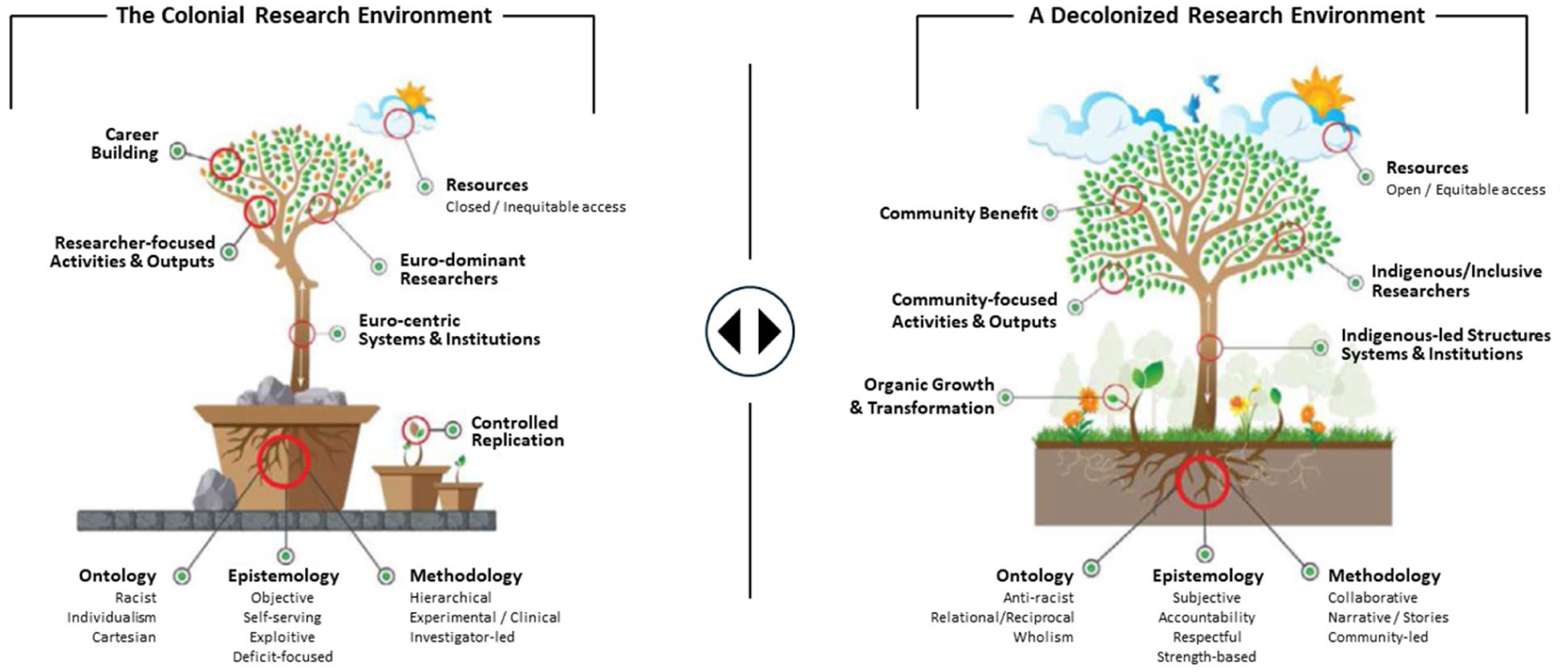
Colonial and decolonized research environments. BC NEIHR tree metaphor represents the influence of structural, systemic, and immediate environments on research within colonial and decolonized research environments (Erb & Loppie, 2022).
Within the colonial research environment (Erb & Loppie, 2022), the colonial tree is isolated and manicured with rigidly controlled products, processes, and practices. The growth is not organic with individualistic environments limiting what the soil can nourish and how the roots can grow, not allowing the roots to support diversity and interconnectedness. The resources are restricted to the immediate environment, pots, to support and produce only what has been planted. Knowledge produced within a colonial research environment is extractive rather than generative and is useful in its own limited context (Erb & Loppie, 2022). Within this individualistic and hierarchical environment, research administration policies, protocols, and practices are informed by and reflect Western ontologies, epistemologies, and methodologies. Research administration is often controlled by research institutions with no inclusion of Indigenous principles or engagement, involvement, or relationships with ICCOs. Established by research institutions, research administration policies, protocols, and practices are often restrictive to comply with controlled institutional standards and conditions and do not consider Indigenous governance or priorities. Policies, protocols, practices, and associated resources that are static have no intention for flexibility or growth and are designed to benefit and meet the priorities of the institution and institutional researchers. Lack of or limited capacity and competency in working with ICCOs and community members results in communication and support that is not relational and often burdensome, confusing, and invasive. Change within colonial research administration environments is controlled by institutions and often occurs when institutions perceive alternative options as more progressive or lucrative. This depiction of the colonial research environment is not universal; however, it demonstrates common challenges within research systems and structures faced by Indigenous Peoples and ICCOs.
In contrast to the colonial tree, a decolonized tree can grow naturally without external restrictions or the need for cultivation. The growth is organic and unrestricted to nourish diverse and interconnected roots. Community knowledge produced within a decolonized research environment transforms and supports community action. The soil is constantly tilled to remove contaminants of colonialism and racism for decolonized roots to grow and flourish (Erb & Loppie, 2022). To support and promote ongoing decolonization, research administration policies, protocols, and practices must consider the harmful impact of colonial systems and structures, and be informed by, respect, and uphold Indigenous ontologies, epistemologies, and methodologies. Research administration within a decolonized research environment is collaborative between research institutions and ICCOs and upholds, respects, and adheres to Indigenous knowledges and principles. Research administration policies, protocols, and practices are accountable to ICCOs and developed to align with Indigenous governance and priorities. These policies, protocols, practices, and associated resources are adaptable, allowing for growth to benefit and meet the priorities of ICCOs and community members. There is a focus on capacity and competency in working with ICCOs and community members, which results in communication and support that is relational, culturally safe, and accessible. Change within decolonized research administration environments occurs through building and nurturing collaborative relationships with ICCOs that support decolonizing research administrative policies, protocols, and practices.
Considerations for ICS in research administration
Research administration, crucial to support the full research life cycle, is a complex system that consists of many components including but not limited to:
Identifying funding sources and customers, preparing proposals, costing, pricing and submitting funding proposals, drafting, negotiating and accepting contracts, dealing with project finance, employing staff on research contracts, reporting to funders, advising on research impact, knowledge exchange, technology transfer, supporting short courses, postgraduate research student administration, research strategy and policy, research assessment, ethics and governance, information systems, audit, statutory returns, and research office management. (Research Administration as a Profession, 2019)
To support institutional reconciliation efforts and several institutional strategic plans that identify Indigenous-specific priorities, all areas within research administration must be considered within a decolonized research environment.
Consideration #1: research administration as envisioned within the decolonized research environment of the ICSR Framework
The ICSR Framework’s tree metaphor and its components from the decolonized research environment, as shown in Figure 1, can be used to envision and inform research administration for Indigenous research. Figure 2 lists questions within each area to consider in the context of research administration of Indigenous research and a decolonized research environment. These questions are not comprehensive but provide a foundation for important considerations within research administration. It is critical for organizations and institutions to collaboratively work with Indigenous Peoples and ICCOs who can provide additional considerations and questions that may inform areas of the decolonized research environment relevant to their specific needs and priorities.
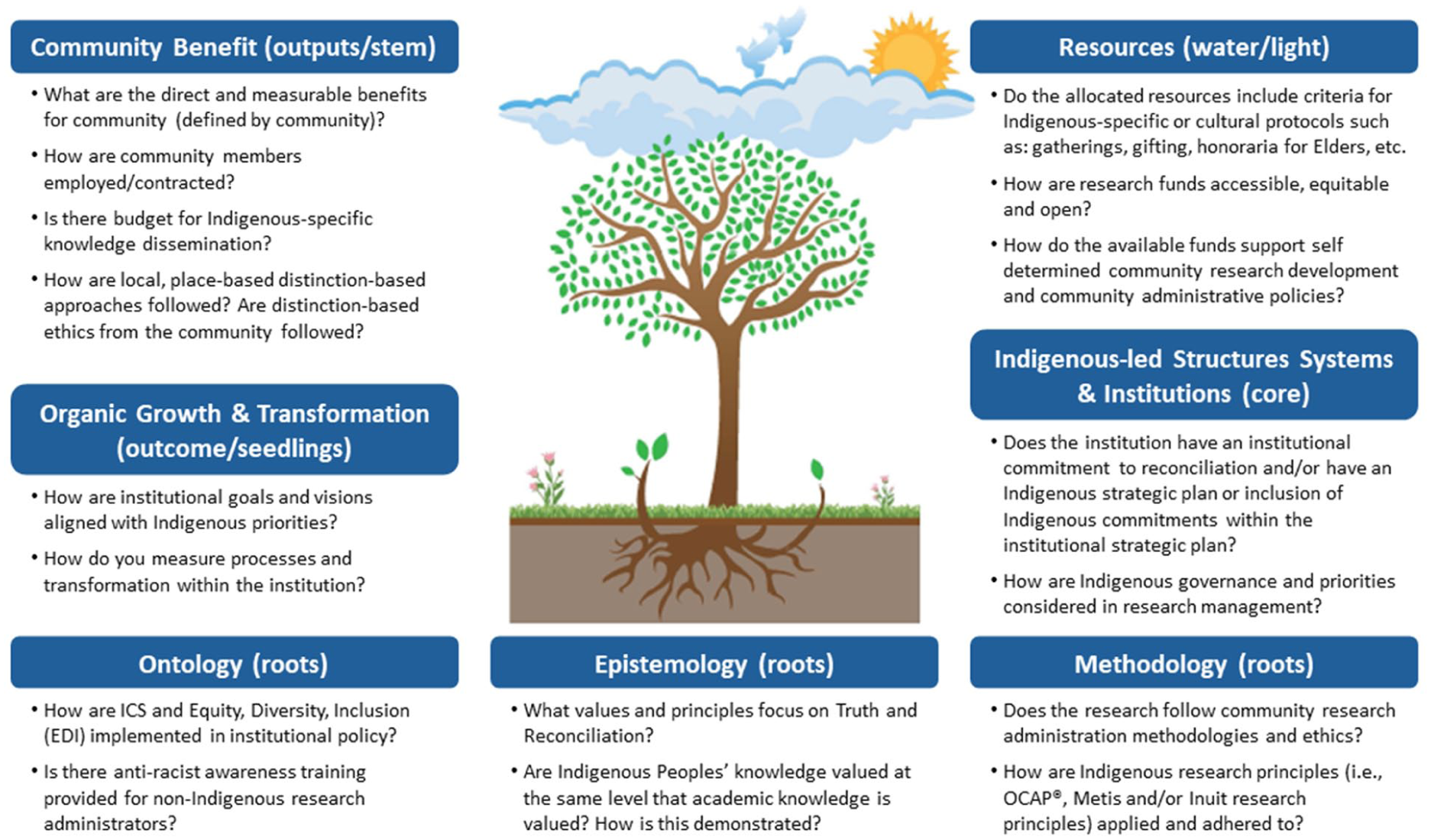
Considerations for research administration within the decolonized research environment embedded in the ICSR framework. Questions to consider for research administration within the decolonized research environment.
Consideration #2: commitment to continuous learning cycles
The questions provided in Consideration #1 inform how research administration can support and uphold the decolonized research environment within an ICSR Framework. These questions provide a foundation for working with Indigenous Peoples and ICCOs; however, this work is an ongoing journey that includes both successes and challenges. Throughout this journey, to uphold ICS, institutional research partners and administrators must commit to continuous learning cycles – as illustrated in Figure 3. Continuous learning cycles include three phases of awareness, action, and change, which are embedded within a cyclical, rather than linear, process of learning and transformation. Awareness to action requires aligning intentions, values, and principles. Between action and change, there is a learning curve required for understanding. Following change, through experience comes further awareness. Continuous learning cycles and similar circular learning cycles are reflective of Indigenous ways of knowing and being that are framed within a relational or cyclical, rather than linear, worldview. Within Māori education interventions, G. H. Smith (2003) critiques and reconfigures a Western linear representation of transformative action, that is conscientization—resistance—transformative action, into a cycle representation reflective of Māori experience. The cycle representation, which can be entered at any position, represents components that are all held in importance, held simultaneously, and held in equal relation to one another. In this representation, the cycle rejects the notion that each component is individual within a hierarchical lineal progression (G. H. Smith, 2003). This aligns with continuous learning cycles within research administration that represent an ongoing journey that is individual to everyone entering the cycle. All peoples hold different knowledges, perspectives, and experiences that determine how the cycle and its components are navigated.
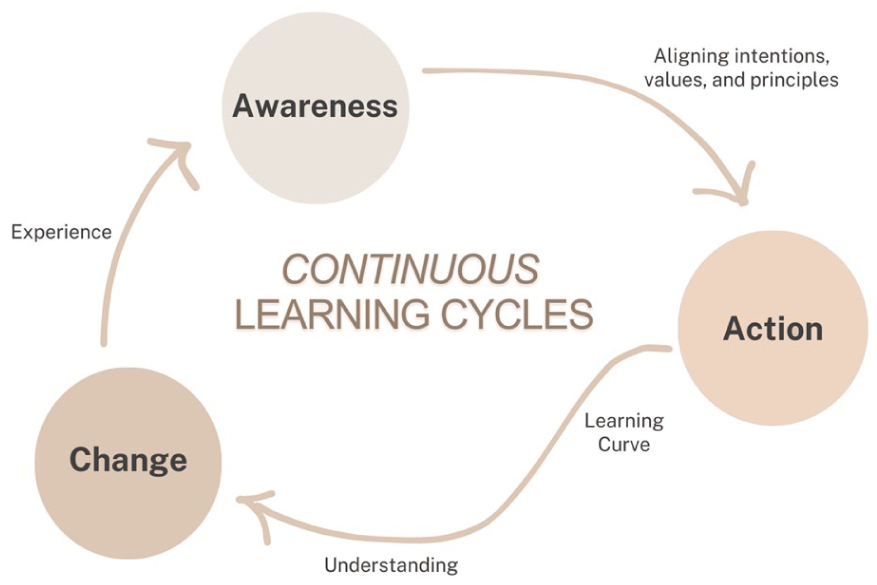
Continuous learning cycles. Continuous learning cycles are a cyclical process of learning and transformation including three phases that can be used by institutional partners to uphold ICS.
Considerations in action: recommendations to support and advance research administration in a decolonized research environment
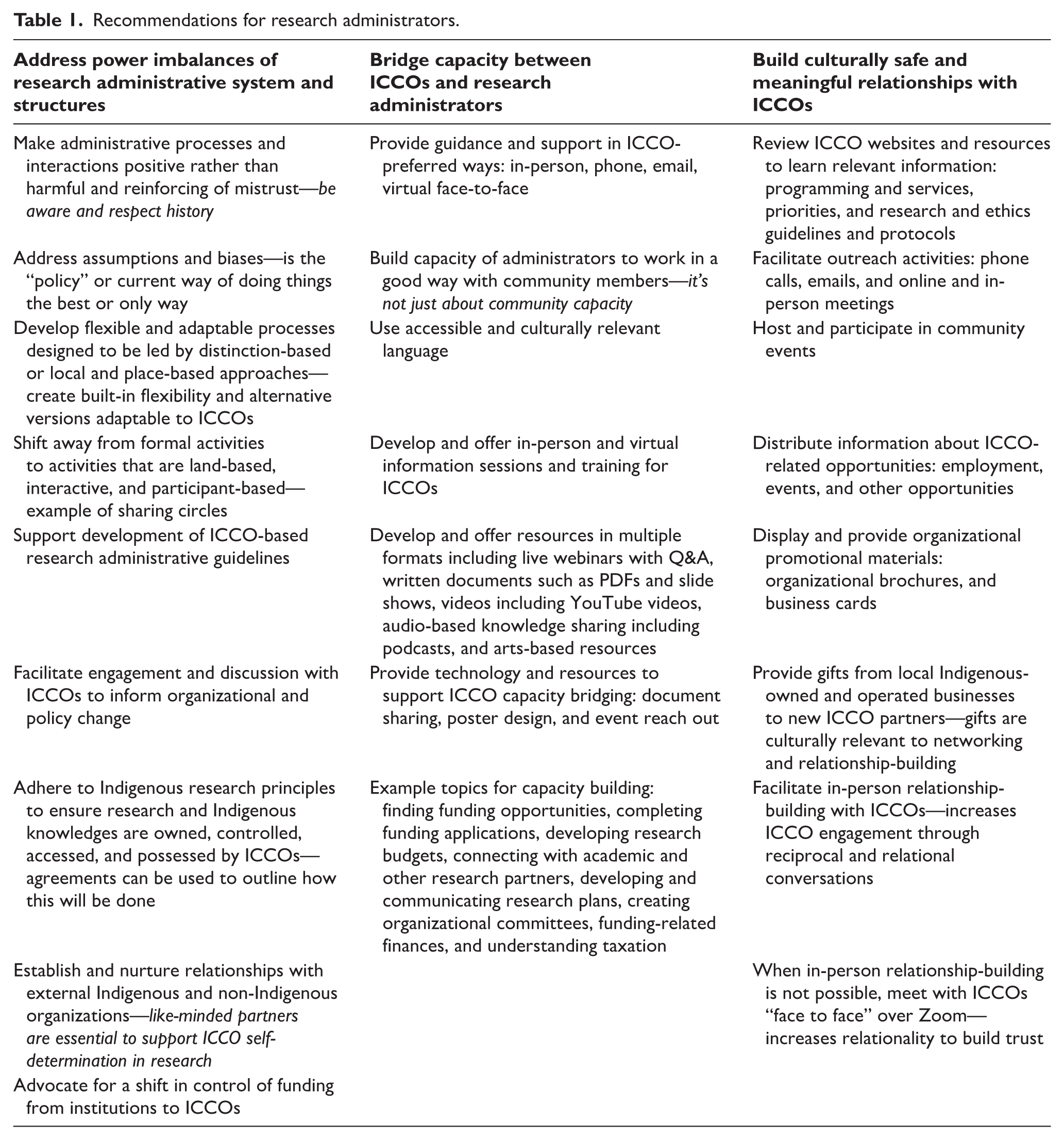
To transform research administration systems and structures, institutional partners must advance ICS in research administration, uphold a decolonized research environment, and commit to continuous learning cycles. Within this journey, institutional partners must (1) address power imbalances of research administrative system and structures, (2) bridge capacity between ICCOs and research administrators, and (3) build culturally safe and meaningful relationships with ICCOs. Recommendations for research administrators involved in Indigenous health research are summarized in Table 1.
Recommendations for research administrators.
Conclusion
To support decolonizing research structures and systems including research administration, drastic changes are needed in research institutions and administration that ensure accountability and responsiveness to community priorities, along with transfer of control of research administration to ICCOs where Indigenous principles are followed (K. J. Williams et al., 2020). Through these changes, institutional research partners would work in alignment with Indigenous principles of research and promote Indigenous priorities. This starts with a deep understanding, without stigmatization, of historical trauma related to research and the role research administrators have in decolonizing the research environment. In following continuous learning cycles, institutional research partners and administrators should respect and advocate for flexibility for change and adaptation based on the priorities and capacity of Indigenous Peoples and ICCOs. ICS in research can inform institutional research partners and administrators in building culturally safe and meaningful relationships with Indigenous Peoples and ICCOs. Within the research journey, decolonizing research environments continue through respecting and honouring Indigenous research principles and Indigenous-specific research ethics including distinction-based frameworks, theory and methodologies, and data sovereignty within research administrative processes, systems, and structures.
Footnotes
Acknowledgements
We respectfully acknowledge the unceded traditional territories of the Coast Salish peoples, including the səlilwətaɬ (Tsleil-Waututh), kʷikʷəƛ̓əm (Kwikwetlem), Sḵwx̱wú7mesh Úxwumixw (Squamish), and xʷməθkʷəy̓əm (Musqueam) Nations, on which BC NEIHR is located.
Authors’ Note
Tara Lise Erb (MA) is of mixed Moose Cree First Nation from Moose Factory and French European ancestry. She completed her Bachelor of Arts in Sociology at the University of Victoria (UVic) and a Master of Arts in Sociology (UVic), with a research focus on facilitating Indigenous cultural safety and anti-racism training. Tara is currently completing her PhD in the Faculty of Health Sciences at Simon Fraser University.
Julianne Cecile Barry (PhD) is of mixed Ojibwe from M’Chigeeng First Nation and European ancestry. She is an interdisciplinary Indigenous health researcher whose research is focused on the wholistic health and well-being of urban Indigenous Peoples through community-based Indigenous-led health research.
Krista Stelkia (PhD) is a Canada Research Chair in Indigenous Health Governance, an assistant professor in the Faculty of Health Sciences at Simon Fraser University, and the director of the Centre for Collaborative Action on Indigenous Health Governance. She is Syilx/Tlingit from the Osoyoos Indian Band in the interior of British Columbia, Canada. Dr Stelkia is an interdisciplinary Indigenous health researcher whose research primarily investigates the structural determinants of Indigenous peoples’ health and well-being. She is the Nominated Principal Investigator for the British Columbia Network Environment for Indigenous Health Research (BC NEIHR), one of the nine Indigenous-led networks across Canada supporting research leadership among Indigenous communities, collectives, and organizations.

Ethical considerations
There are no human participants in this article, and informed consent was not required.
Funding
The authors disclosed receipt of the following financial support for the research, authorship, and publication of this article: This work was supported by the Canadian Institutes of Health Research (MN2-152406) and additional funding from partners including Michael Smith Health Research BC and the BC SUPPORT Unit.
Declaration of conflicting interests
The authors declared no potential conflicts of interest with respect to the research, authorship, and publication of this article.