



Abstract
This article explores how newspaper articles reflect the local authority’s awareness and handling of child sexual abuse challenges for Sámi people in a small community in Norway, as well as the implications of these reflections. We have analysed 58 newspaper articles using document and reflexive thematic analysis. We employ Foucault’s framework and Coordinated Management of Meaning (CMM) to explore power and stories. The findings address the local authority’s long-standing awareness of child sexual abuse (CSA) challenges, and a handling that may have reinforced distrust, and hindered Sámis from seeking help or accessing adequate support. Understanding mechanisms that may hinder help in CSA is crucial, as they create barriers to support and resources.
Introduction
In June 2016, 11 Indigenous Sámi women and men from Tysfjord shared their child sexual abuse (CSA) experiences with a national newspaper, describing their stories and how they had not received adequate help (Amdal et al., 2016). Tysfjord is a rural community with approximately 2000 Sámi and Norwegian residents. In addition to the 11, the journalists had information about 47 more cases involving individuals subjected to sexual abuse (SA) from the past three decades (Amdal et al., 2016). The CSA challenges gained extensive media coverage in Norway, reaching about 540 reports by June 2016 and around 2500 by the end of 2017. The newspapers highlighted the failure of several institutions to provide assistance, particularly the police, the local authority, and the congregation. This article focuses on the local authority, while we also acknowledge the many factors that may have contributed to CSA and CSA in Tysfjord as described by Dankertsen (2025) and others. Rather than offering an objective account of actions taken, this article explores the narratives presented in the newspapers.
Understanding the local authority’s awareness is crucial as it aligns with its potential responsibility. We are interested in how power shapes and limits what is said and left unsaid, and who gets to define the situation through their story. In addition, we are interested in how power can influence what we perceive as reality. The research question is:
RQ1. How do newspaper articles reflect the local authority’s awareness and handling of CSA challenges for Sámi people in a small community in Norway, and what implications can these reflections have?
The term “CSA challenges” reflects the numerous incidences of and warnings about CSA. Still, we acknowledge the severe impacts on each affected child and adult. “Local authority” refers to political leadership, including elected officials, managers, and welfare service leaders.
The study is based on analysis of 58 newspaper articles about the CSA challenges. The theoretical framework, rooted in social constructionism, draws on power theory by Foucault (1972) and Coordinated Management of Meaning (CMM). Foucault’s work has also been applied in other fields to explore various dimensions of CSA (Ashenden, 2016; Bell, 2011; Mooney, 2023). Qualitative studies using a Foucauldian lens on CSA reveal power dynamics, welfare system failures, long-term impacts on victims, and society’s role in sustaining oppressive structures (Pembroke, 2019; Tanaya & Puteri, 2023). CMM has been used as an interpretive theory in various contexts, including enhancing inter-ethnic relations through public communication (Pearce & Pearce, 2000).
Reflecting on our positionality, we acknowledge our backgrounds as White middle-class women. The first author has Sámi ancestry but limited connection to Sámi language and culture due to assimilation policies, while the second author is married into a Sámi family and has Sámi children. Porsanger (2005) uses the terms gaskavuohta (distance and dependency) and oktavuohta (closeness and belonging) to describe Sámi researchers working outside or within their communities. As we are not from the specific community, we place ourselves in a gaskavuohta position. Acknowledging the diversity within the Sámi population and the influence of our backgrounds, we have engaged with community members and prioritized learning from Sámi voices throughout our research.
CSA in Tysfjord
The CSA challenges in the small community, Tysfjord, were by the media referred to as “the Tysfjord-case” due to the numerous CSA cases. The Sámi voices and the newspapers’ massive focus on the CSA challenges prompted a police investigation that uncovered 151 CSA cases from 1953 to 2017. Nearly 70% of exposed people were from Sámi areas in the community and over 30% from Norwegian areas (Nordland politidistrikt, 2017). Despite this, media coverage primarily focused on abuse within the Sámi community. In 2017, the government funded the Jasska (Safe) prevention project, which increased openness, trust, and safety but also revealed structural and relational barriers to reconciliation. The municipal situation was also characterized by a poor economy and internal collaboration challenges (Rønne, 2020). The CSA challenges are today cited in public documents as an example of local authorities’ failure to adequately address CSA (Prop. 36 S, 2023–2024; Truth and Reconciliation Commission, 2023). However, Sámi voices played a key role in driving transformation and raising national awareness about CSA against the Sámis.
CSA challenges have been a recurring topic in various communities with Sámi and Norwegian residents over decades, with reports from the 1980s to 2000s covered in research (Henriksen, 2013; G.-T. Minde et al., 2011). Internationally, similar issues in Indigenous communities have been reported, including Northern Territory in Australia (Northern Territory Government, 2007), Hollow Water in Canada (Cripps & McGlade, 2008), Tasilaq in Greenland (Curtis et al., 2002), and Native tribes in the United States (Bachman et al., 2008).
The Sámi people
The Sámi people are an Indigenous people of Sápmi, a region in Northern Europe, spanning across Norway, Sweden, Finland, and Russia. They are one people but are characterized by linguistic and cultural diversity (Reaidu, u.å). Due to diversity, differences between Sámis and non-Sámis have been highlighted, including the Sámis’ emphasis on indirect communication—particularly regarding health and sickness, strong familial ties, and a worldview rooted in nature and spirituality (Henriksen & Hydle, 2024; Nergård, 2022).
Understanding CSA against the Sámis in Tysfjord requires insight into the assimilation policy they faced. The national assimilation policy’s main goal was to eradicate the Sámi language, culture, and identity (H. Minde, 2005). Values and attitudes became truths and prejudices for the majority, eventually also for the Sámis. For many people, this led to self-loathing and a deep sense of shame about being Sámi, and later a deep pain from having been subjected to assimilation (Nergård, 2013).
The Sámis still face more discrimination than non-Sámi, both in public and within welfare services (Hansen et al., 2016). The repercussions of the assimilation policy are believed to be expressed as difficulties relating to identity, self-esteem, stress, substance misuse, violence, and abuse (Kuokkanen, 2014). Studies show higher rates of violence and abuse among Indigenous populations compared to non-Indigenous populations both in Norway (Eriksen et al., 2015) and internationally (Heidinger, 2021; Larsen & Bjerregaard, 2019). The assimilation policies seem to have not only disrupted traditional ways of life but also inflicted profound intergenerational psychological and social wounds that persist today. Maria Yellow Horse Brave Heart (2003) has conceptualized these effects as “historical trauma,” a cumulative emotional and psychological wounding across generations resulting from massive group trauma. In addition to the effects of historical trauma, CSA can in itself lead to health issues, cognitive weaknesses, behavioural and emotional difficulties, and reduce wellbeing (Felitti, 2019).
The welfare system in Norway
The Nordic countries are often described as “welfare states,” ensuring access to services like health care, education, and child welfare, promoting equality and security for all (Esping-Andersen, 1990). The welfare system in Norway is divided into three levels: state, county, and municipality with separate responsibilities. Despite separate responsibilities, all welfare services are available either locally in municipalities or regionally within counties. According to welfare legislation, the local authority in municipalities holds the overall responsibility for ensuring that welfare services are providing services to residents. This includes preventing and addressing violence and abuse while providing support and protection (The Child Welfare Act, 1992, 2021; The Local Government Act, 1992, 2018). This has been a government priority area for several decades (e.g. Skilbrei & Stefansen, 2018).
The Sámi peoples’ Indigenous status in Norway grants specific rights under international treaties and national laws, which mandate Norway to protect and promote Sámi language, culture, and way of life (International Labour Organization, 1989; Ministry of Children and Family Affairs, 2003). To strengthen Sámi cultural and linguistic rights, certain municipalities in Norway are designated as language administrative municipalities (The Sámi Act, 1987). This includes providing bilingual services, Sámi language education, and fostering the use of Sámi in public life (Sametinget, u.å.).
The encounters between Sámi people exposed to SA and the welfare system
Research highlights that encounters between people exposed to CSA and welfare services can be challenging. Across populations, barriers include guilt, threats, taboo, fear of not being believed, and fear of being ostracized by family or community (Steine et al., 2017). Some Sámis also report a lack of trust in welfare services (Krane, 2021; Thorslund, 2025) and a “culture of silence” regarding CSA. The term “culture of silence” has been used to explain why Sámis tend to keep SA more private compared to others (Øverli et al., 2017; Thorslund & Kiil, 2022). However, Eriksen (2020) found no ethnic differences among women in disclosing abuse to their families, friends, and professionals, although fewer Sámi men disclose abuse to professionals.
Øverli et al. (2017) highlight trust as crucial for effective work on violence and abuse, emphasizing the need for cultural competence and power awareness due to the influence of the assimilation policy on society (Øverli et al., 2017), which aligns with other studies (Midtbøen & Lidén, 2015; Silviken et al., 2014). However, researchers also caution against viewing assimilation as the sole explanation, as it may absolve Sámis and communities of responsibility (Bergman et al., 2025; Dankertsen, 2025; Kuokkanen, 2014). At the same time, ethnic minorities have reported powerlessness when interacting with welfare services (Hedlund & Moe, 2010; Lunga et al., 2021). Across populations, being believed, respected, and shown understanding and trust are essential for seeking help (Grøvdal et al., 2014).
Theoretical framework
Foucault (1972) explored the connections between discourse, knowledge, and power, claiming that power is derived from knowledge and is an effect of discourses. Discourse is a dynamic space that shapes perceptions of the world and influences actions through shared “truths,” forming common beliefs (Foucault, 1972). Foucault argued that power techniques “produce reality,” creating a hegemonic version of truth in society (Foucault, 1991, p. 194). He examined how institutions like prisons, schools, and medical systems categorize and define what is considered normal or deviant (Foucault, 1978, 1991). Resistance is considered a reaction to power, influencing the other. Power and resistance are therefore understood as mutually dependent (Foucault, 1982). In this study, Foucault’s insights highlight how power may shape stories and discourses.
CMM by Pearce and Cronen (1980) provides a framework for understanding how individuals create, coordinate, and manage meaning in communication. The theory emphasizes stories, the rules of communication, and the dynamic processes through which meanings are negotiated and coordinated (Pearce, 2007). To help us be aware of the communication between the Sámis and the local authority, we will use CMM’s Lived stories, Unknown stories, Untold stories, Unheard stories, Untellable stories, Undigested stories, Told stories, and Telling stories (LUUUUUTT) model. Table 1 provides a description of the model from Penman and Jensen (2019, pp. 98–102).
The LUUUUUTT model (Penman & Jensen, 2019).
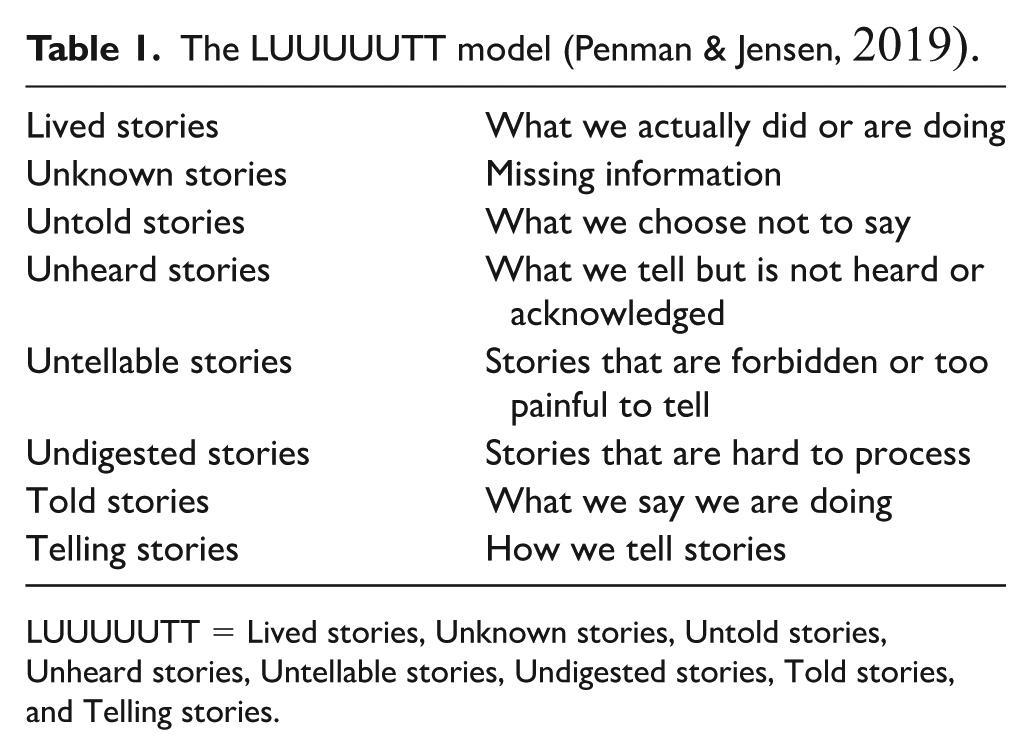
LUUUUUTT = Lived stories, Unknown stories, Untold stories, Unheard stories, Untellable stories, Undigested stories, Told stories, and Telling stories.
The LUUUUUTT model enhances the analysis and understanding of communication complexities by examining various aspects of stories. The model encourages a deeper exploration of how different stories interact and shape our understanding of communication. It helps identify and address tensions between the stories we tell and the stories we live, fostering consistency and coherent relationships (Jensen, 2020).
CMM complements a Foucauldian approach by offering practical tools to analyse how specific narratives create and sustain meaning, something Foucault’s broader focus on power and discourse does not address in detail. Discourses may shape the context and norms for stories, while stories reflect and challenge discourses.
Method
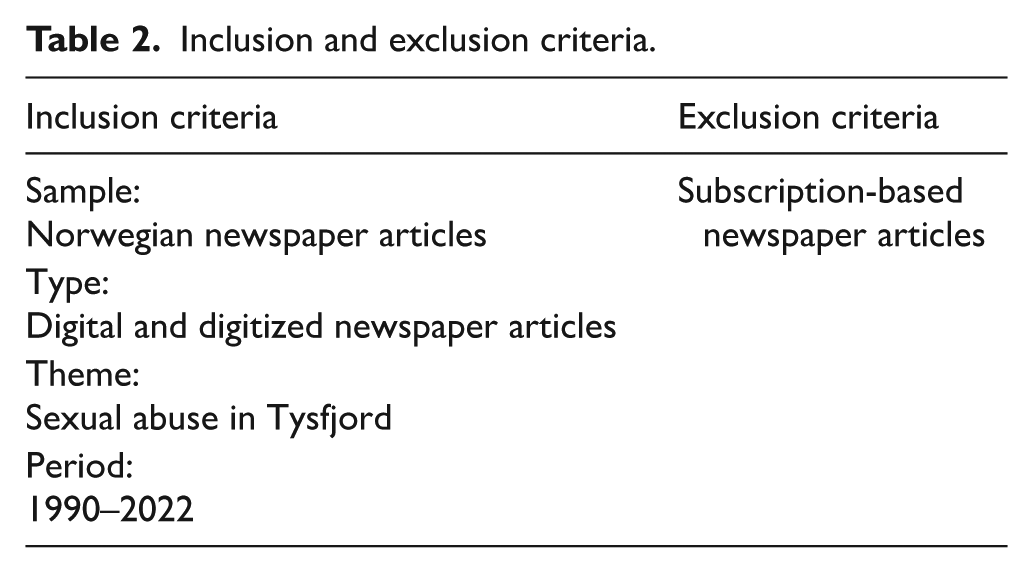
To address how newspaper articles reflect the local authority’s awareness and handling of CSA for Sámis in Tysfjord, a strategic search for newspaper articles in Retriever was conducted twice, covering the period from 1990 to 2022. The inclusion criteria encompassed digital and digitized Norwegian newspaper articles about CSA in Tysfjord. Subscription-based newspaper articles were excluded. Table 2 provides an overview of the inclusion and exclusion criteria.
Inclusion and exclusion criteria.
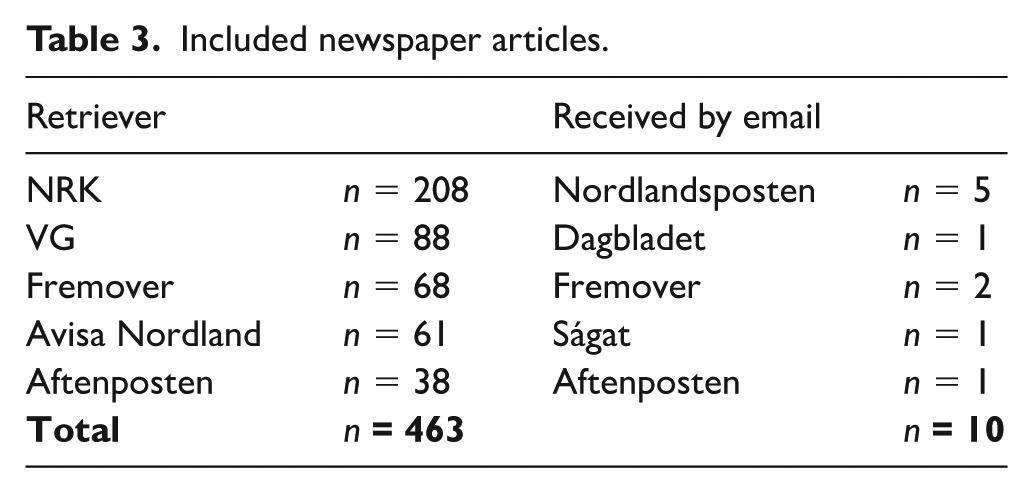
The English-translated search terms “sexual abuse AND Tysfjord” returned 463 newspaper articles. Adding 10 articles received by email gave a total of 473 newspaper articles. Table 3 shows an overview of the included newspaper articles.
Included newspaper articles.
The selection process began by evaluating the titles and introductions of 473 newspaper articles to assess their relevance to the study’s inclusion criteria. Articles that did not meet the criteria were excluded, along with duplicates. This process resulted in a final sample of 58 articles. Figure 1 provides a visual overview of the steps involved in the collection and refinement of the newspaper articles.
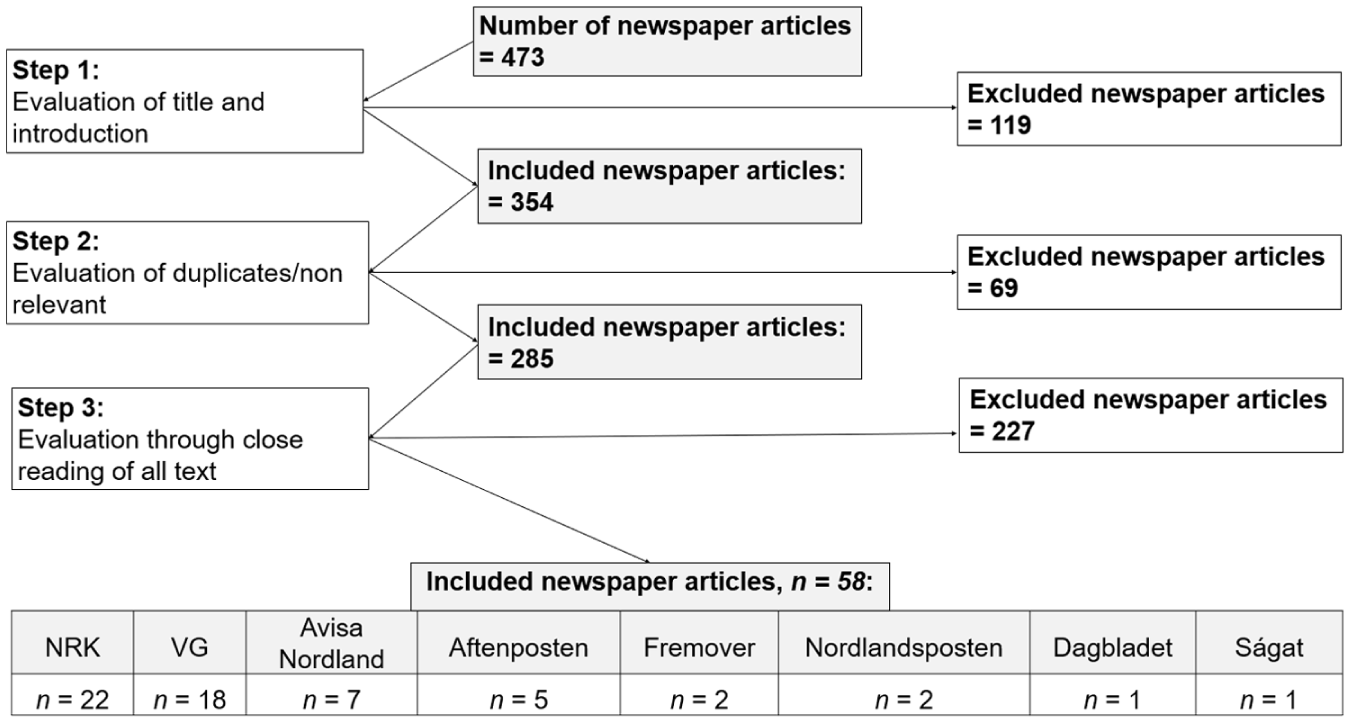
Collection of newspaper articles.
The 58 collected newspaper articles were analysed through document analysis combined with reflexive thematic analysis (RTA) by Braun and Clarke (2022). Document analysis involves collecting, reviewing, and analysing documents. Documents can be seen as sources of power, defining and shaping issues outside themselves. They can provide insights into narratives and storytelling to notice power effects (Asdal & Reinertsen, 2022). The newspaper articles are understood as narratives, emphasizing their constructed nature shaped by cultural and social discourses (Burr, 2024). The six phases of RTA were utilized for its steps and nuances, offering an in-depth approach and understanding of the newspaper articles.
The collected articles reflecting the local authority’s awareness, and handling of CSA challenges were reviewed, organized chronologically in a table, and imported into NVivo for systematic analysis. Coded excerpts highlighted the authority’s awareness and handling of CSA challenges were organized into thematic categories or discarded. The analysis led to a deeper exploration of power and stories, resulting in three main themes: (1) narratives reflecting long-standing awareness of CSA challenges, (2) narratives reflecting an inability to act because of Sámi silence and distrust, and (3) narratives reflecting distrust towards Sámi people in the handling of CSA.
Limitations
Document analysis can be challenging, as documents were produced for purposes other than research, potentially lacking sufficient detail to fully address the research question (Bowen, 2009). To address this, we have emphasized contextualizing and providing detailed information about how the collection process and the specific sample utilized, as outlined above and illustrated in Tables 1 and 2 and Figure 1. Second, as the newspaper articles in this study are secondary sources (Rapley, 2018), and it may potentially lead to discrepancies if interviewees did not review them. To ensure reliability, articles were collected from reputable news outlets with rigorous editorial standards, and broad media coverage helps mitigate biases, offering a comprehensive view of the local authority’s narratives about CSA.
Ethics
The study has been assessed by The Norwegian Agency for Shared Services in Education and Research (Sikt) (reference number: 271431) and is found to be in accordance with legislation. We acknowledge that the local authority has been an integral part of the local community, with several elected officials, including six mayors, serving between 1993 and 2020. The purpose of this study is not to criticize individuals but to explore the narratives of a municipal-level authority responsible for welfare services, focusing on its role in addressing CSA. The study adheres to the Ethical Guidelines for Sámi Health Research (Sametinget, 2019) and Guidelines for Research Ethics in Social Sciences and the Humanities (NESH, 2021).
Results and analysis
The results and analysis are organized into three subchapters that reflect the study’s findings. Figure 2 presents a thematic map summarizing the research question, findings, and key points of the results.
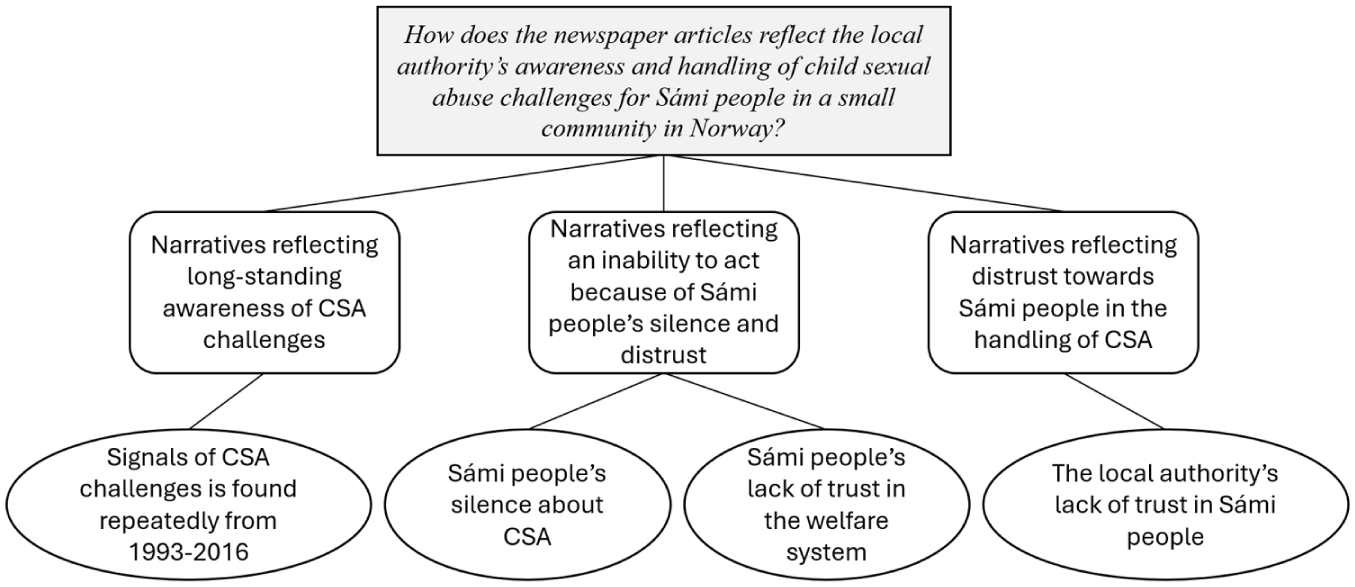
Thematic map overviewing findings and key points.
Narratives reflecting long-standing awareness of CSA challenges
Following extensive media coverage in 2016, the local authority’s narrative reflected surprise and denial of awareness of CSA challenges (Berglund & Henriksen, 2016), despite acknowledging these issues in a local newspaper (Lillebø, 2016). To understand the handling of CSA, it was essential to explore how the newspaper articles reflect the local authority’s prior awareness of the CSA challenges.
The first sign of CSA challenges emerged in 1993 when two Sámi brothers sought help from local and county authorities. They spoke to the press regarding a case involving a man accused of abusing eight girls, bringing attention to CSA challenges:
They expect residents, the local authority, and the county authorities to be aware of their responsibilities and contribute to resolving the issues. “We have an opportunity now, both children and adults need help from the support system, but no one can expect people in [name of local community] to take the initiative.” (Myklevoll, 1993, p. 13)
The brothers’ narrative highlighted CSA as a significant issue, yet there is no indication from the newspapers that the local authority had heard, acknowledged, or responded. In 1998, a volunteer group sought funding from the local authority to support vulnerable people, including people exposed to CSA. The group consisted of women with diverse expertise, including professionals from Child and Adolescent Psychiatry. The local authority’s response was reported in the newspaper:
“Should private individuals actively work with vulnerable groups, including women and children who have been subjected to sexual abuse, violence, and oppression, and provide urgent help? We question this, as the lines of responsibility become blurred,” maintains the Health and Social Manager. (Olsen, 1998, p. 5)
The application could have indicated a need to prevent CSA. Instead, the local authority’s narrative focused on weak structural frameworks and questionable circumstances. The initiative went unheard.
Another indication of SA challenges appeared in a 2007 article, where a Sámi father wrote to the Prime Minister seeking help to stop CSA in the community. The newspaper article referenced the fathers’ narratives: According to him, SA of children, minors, and adults in the Sámi area in the community is widespread and extensive (Aslaksen & Buljo, 2007, para. 13). When the father stated that CSA was a widespread issue, alerting the Prime Minister, the local authority expressed dissatisfaction with the letter but responded by establishing a helpline and an interdisciplinary team (Aslaksen, 2007). However, the initiative had limited use (Berglund et al., 2016), suggesting a failure to address or understand the needs of those affected.
After the abuse challenges gained media attention in 2016, the local authority acknowledged informal discussions on CSA: “We have heard talk around town, but as long as there is nothing tangible, it is difficult for us to do anything,” says the Health and Social Manager [name] (Berglund & Henriksen, 2016, para. 1). This narrative shows some acknowledgement of the CSA challenges but also the perception of inability to act. Several other narratives also indicated the local authority’s awareness of CSA challenges. A Sámi municipal council member noted that CSA had been a recurring newspaper topic, and that the Sámi were not silent. He highlighted the local Sámi centre’s long-term prevention efforts, including seminars, public meetings, conferences, and exhibitions (Andersen, 2016). This highlights the need to address the discrepancy between the local authority’s narratives and the Sámis’ experiences of not being silent.
Given the repeated newspaper stories since 1993, illustrated in Figure 3, the Sámi Centre’s efforts, and residents’ explicit need for help, the narratives suggest that the local authority was aware of CSA being a challenge.
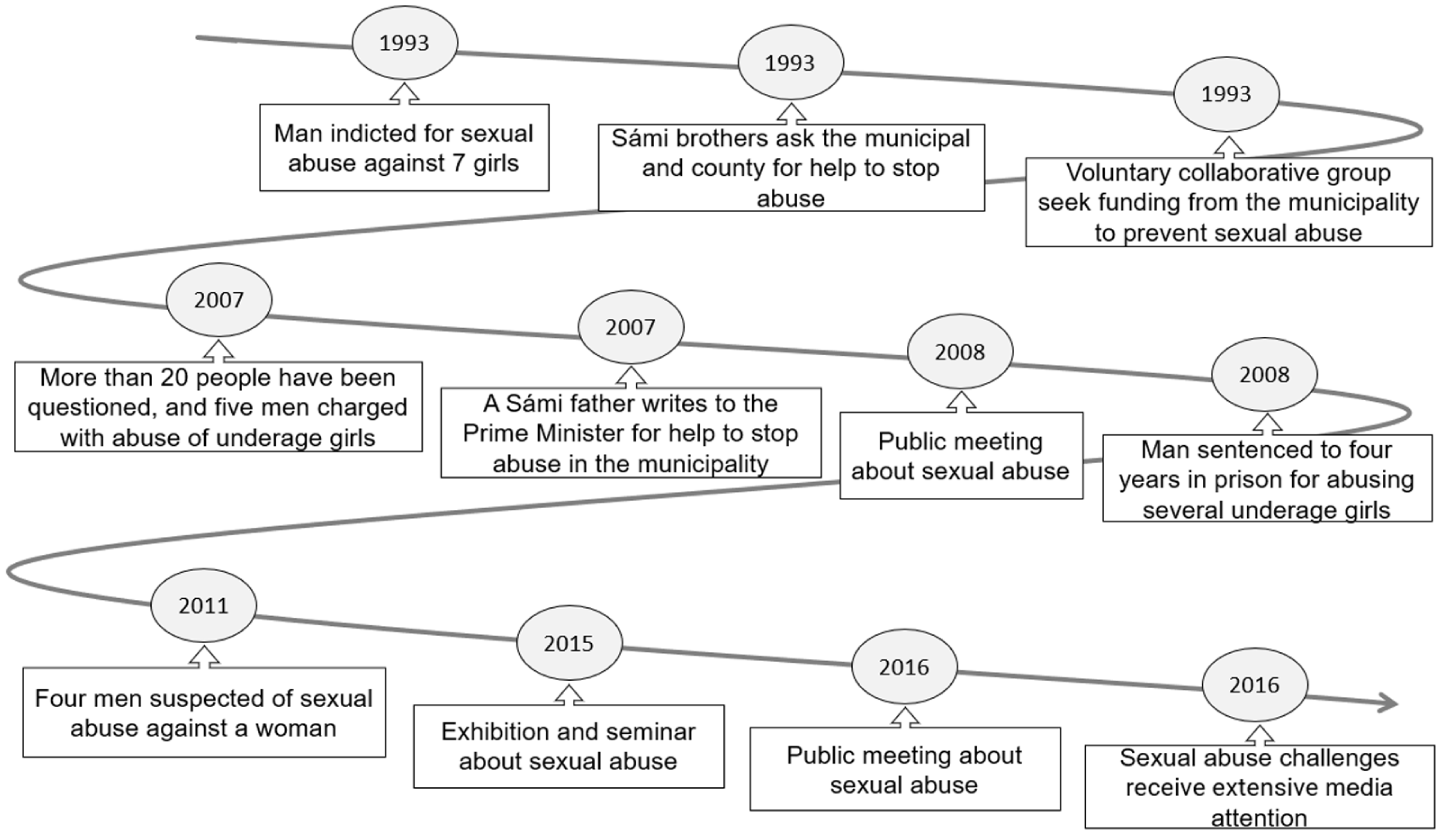
An overview of signals of abuse challenges.
Narratives reflecting an inability to act due to Sámi people’s silence and distrust
When the local authority faced criticism in 2016 for providing inadequate support, the narratives reflected an emphasis on CSA being unacceptable and pledged to take action. However, further narratives consistently implied that they were unable to act because the Sámis were silent and lacked trust. One newspaper wrote about the silence in this way: The local authority of Tysfjord municipality is facing strong criticism for its handling of the abuse cases in the Sámi communities within the municipality. “These communities are very closed and almost impossible to access,” says the mayor (Mikalsen & Lysvold, 2016, para. 1). Later in the article, the mayor added: “We have tried to address this [cultural differences], but the local authority has faced significant difficulties in getting involved in these matters. There has been a lot of silence, and the Sámi communities are closed” (Mikalsen & Lysvold, 2016, para. 7). Another member of the local authority is quoted in the newspaper as saying: “We know that it is a closed community with strong ties. Instead of reaching out to the welfare system, the Sámi help each other” (Berglund & Henriksen, 2016, para. 8). Narratives like these may shape or reinforce a belief that Sámis are more silent and closed than others, relying on helping each other, which hinders the local authority from acting.
A year after the CSA issues gained attention, several people were interviewed by a newspaper. The local authority was reported to the police for failing in its duty of preventing CSA. The mayor appeared to uphold the narratives of being unable to take action but also acknowledge their own limits:
“Today, the Sámis lack trust in the public administration. That is why the silence is so profound. The public administration has not had the knowledge, insight, or resources to intervene or do anything about the matter,” he said last week. (Thonhaugen, 2017, section 5, para. 5)
The local authority’s narratives suggesting that the Sámis lack trust and are silent persisted even a year after the massive media attention in 2016. However, these narratives also reflected an acknowledgement of their own lack of knowledge, insight, and resources to address CSA challenges. At the same time, the narratives about Sámis’ lack of trust and silence may contribute to reinforcing perceptions about the Sámi as a people and that they are therefore unable to act. After three years, the mayor’s narrative reflected that: “. . . he also acknowledges the fact that the local authority still struggles with a lack of trust among parts of the population. . . .” (Fjelltveit, 2019, p. 24). The narratives of Sámis’ silence and lack of trust persisted for years.
Narratives reflecting distrust towards Sámi people in the handling of CSA
The local authority’s distrust of the Sámi people is reflected both explicitly and implicitly in the narratives presented in the newspaper coverage. The handling through lack of response, acknowledgement, and sufficient measures from 1993 to 2007 may reflect distrust to the Sámis who asked for help. In addition, in 2008, during a public meeting about CSA organized by the Sámi National Competence Service on Mental Health and Substance Misuse (SANKS) and the local Sámi Centre. The local authority was present and interviewed:
The mayor looks forward to collaborating with [name of the SANKS leader] but believes that the challenges have been overdramatized. “We need to be careful about stating that it has been exaggerated, but there is nothing to indicate that Sámi communities experience greater challenges relating to sexual abuse than other communities,” says [name of the mayor]. (Gullaksen & Andersen, 2008, para. 11)
The narrative about Sámi communities facing no greater CSA issues might avoid stigmatization but risks trivializing and distrusting those who have spoken out. In 2016, SANKS reported that the local authority in 2007 was dismissive, more than implying that the allegations of CSA were exaggerated, and declined support from SANKS and the Regional Resource Centre on Violence, Traumatic Stress, and Suicide Prevention (Mikalsen & Lysvold, 2016) (RVTS). This can reflect a lack of trust and a discrepancy between what is said and experienced. In 2017, a Sámi individual reported the municipality for having done too little over time to help individuals affected by CSA. The local authority responded, underscoring discrepancy: “It has been said that the local authority has never done anything, but we have access to plenty of documentation of everything that has been done” (Thonhaugen, 2017, section 5, para. 18). This narrative stands in contrast to the Sámi individual’s call for handling and support for individuals affected by CSA.
Furthermore, in 2019, distrust towards the Sámi population persisted as a way to handle the CSA challenges. The local people the journalists spoke to stated that “they did not feel that the local authority has given people exposed to SA in the community the apology and support they deserved” (Fjelltveit, 2019, p. 24). The journalists asked the local authority for a comment: The mayor [name] disagrees. “The local authority was quick to apologize. I believe we have done everything in our power to apologize and clear up the situation” (Fjelltveit, 2019, p. 24). The narratives further highlight the discrepancy between the experiences of others and the local authority on how to handle the CSA challenges.
Discussion
This article aims to explore how newspaper articles reflect the local authority’s awareness and handling of CSA challenges affecting Sámis in a small community in Norway, and what implications these reflections can have. The study identified three key themes: (1) Narratives reflecting long-standing awareness of CSA challenges, (2) Narratives reflecting an inability to act because of Sámi silence and distrust, and (3) Narratives reflecting distrust towards Sámi people in the handling of CSA. The discussion is organized into two sections. Drawing on theory about power and stories, the first section will address stories about awareness of CSA challenges, and the second section will address stories about the handling of CSA challenges.
Implications of stories about awareness of CSA challenges
The first finding highlights that the local authority’s narratives reflect an awareness of CSA challenges long before the 2016 media attention. Despite Sámis’ focus on unmet needs over time, the local authority claimed surprise in a national newspaper. The dominant story presented in the media suggests these challenges came to light in 2016. This constructed narrative, or what Foucault (1972) would call a hegemonic version of truth, carries implications.
One implication is that the narrative about CSA challenges first emerged in 2016 obscures the local authority’s prior awareness. Claiming surprise can be understood as an untold story within the LUUUUUTT model, where untold stories are often those that do not reflect favourably on the storyteller (Jensen, 2020). By omitting earlier awareness, the local authority may have contributed to a dominant discourse that denies accountability. Foucault (1991) argued that power techniques by authorities can shape reality by turning selective narratives into commonly accepted stories. As responsibility requires awareness, denying prior knowledge absolves the local authority of accountability. This may have left many children without the necessary help, as abuse is known to have significant implications for health and wellbeing (Felitti, 2019).
Another implication is the tension created between stories lived and stories told understood within CMM’s framework. Sámis and those who have long raised concerns about CSA have lived with these challenges for years, yet the local authority’s narrative denies prior awareness. This tension reflects a broader pattern of marginalization, where Sámi experiences are dismissed or ignored, perpetuating distrust in welfare services—a challenge highlighted by researchers (Bergman et al., 2025; Thorslund & Kiil, 2022).
Furthermore, the repetitive, unacknowledged signals about CSA challenges (as shown in Figure 3) can be seen as unheard stories within the LUUUUUTT model. This may reinforce the Sámi community’s experience of being silenced or marginalized, as described by Jensen (2020). This marginalization may explain why some Sámis turned to newspapers as a last resort to have their voices heard. Drawing on the concept of resistance by Foucault (1982), we can understand this story as a form of counter-power that emerges within and against the dominant structures of power. The Sámis’ use of newspapers to amplify their voices challenges the hegemonic story about awareness.
Implications of stories about the handling of CSA challenges
The second finding highlights narratives reflecting the local authority’s inability to act on the CSA challenges due to Sámis’ silence about CSA and distrust in the welfare system. When the CSA challenges gained national attention in 2016, the authority initially apologized but later focused on their own efforts, such as launching helplines and prevention actions. Despite these measures, many Sámis continued to report unmet needs.
The local authority narratives reflect a method of handling by shifting insufficient support to the Sámis’ silence and distrust, leaving the call for help as unheard stories. One implication is that the local authority risks perpetuating discourses that shift responsibility away from other challenges and onto the Sámi community. This undermines Sámis’ efforts to raise awareness about CSA and creates stereotypes portraying them as difficult to assist. Le Grice et al. (2022) highlighted how the lack of recognition of Indigenous autonomy, expertise, and structural barriers limits access to resources. Similarly, Sámi individuals exposed to CSA may feel overlooked, reinforcing invisibility and eroding trust in welfare systems. Such stories risk shaping public perception and legitimizing inadequate responses to CSA.
Another implication of stories about Sámis’ silence and distrust is the erosion of trust between Sámis and local authorities. Despite public efforts by Sámis to address CSA, they continue to be labelled as silent and distrustful. The Sámis’ efforts stand in contrast to what is referred to as the culture of silence (Bergman et al., 2025; Thorslund & Kiil, 2022). The tension between stories lived by Sámis and stories told by the local authority may create implications for Sámis’ further trust in the local authority.
The third finding addresses narratives reflecting the local authority’s distrust of Sámis in their handling of the CSA challenges. While Sámis distrust of authorities has been well-documented and linked to the historical assimilation policy (Bergman et al., 2025; Krane, 2021), this study highlights that the local authority’s distrust of Sámis is also a significant factor. This distrust is reflected in dismissive narratives, such as claims that CSA challenges were “overdramatized” and the rejection of support from SANKS and RVTS. These stories trivialize Sámi voices, creating a gap between the authority’s perception and Sámi lived experiences, further deepening divisions and marginalization.
Another implication may be that local authorities’ stories create barriers to help-seeking, as Sámis may feel dismissed or unsupported, and it undermines the development of culturally adapted measures to address CSA. The gap between stories lived by Sámis and stories told by the local authority reflects a broader pattern of marginalization, where Sámi voices are overshadowed by institutional stories.
Conclusion
This article explores how newspaper articles reflect the local authority’s awareness and handling of CSA challenges affecting Sámi people in a small community in Norway and what implications these reflections can have. The findings address that the local authority’s narratives indicate an awareness of CSA challenges long before 2016. However, stories surrounding the 2016 media attention and narratives about Sámi people’s silence and distrust appear to have shaped discourses that deflected responsibility from the local authority. These stories may have reinforced distrust and created additional barriers for individuals exposed to CSA, discouraging them from seeking help. The handling of CSA challenges by the local authority further diminishes the complexity of the issue, portraying them as an institution that does not fully understand. Despite widespread recognition of the local authority’s failure to address CSA effectively, it is crucial to understand mechanisms that may contribute to hindering help in cases of CSA, as they can create barriers to support and access to resources.
Footnotes
Authors’ note
Ethical considerations
The study aligns with the CORE principle for Indigenous research and upholding respect, ensuring reciprocity, acting responsibly, building strong relationships, and recognizing self-determination. A website has been created in collaboration with The Norwegian Agency for Shared Services in Education and Research to provide collective information about the newspaper articles. This allows affected individuals to exercise their rights and ensuring privacy:  .
.
Author contributions
Study concept and design: A.B. and M.S.
Acquisition of data: A.B.
Analysis and interpretation: A.B.
Critical revision of the manuscript for important intellectual content: A.B. and M.S.
Study supervision: M.S. and E.J.
Funding
The authors received no financial support for the research, authorship, and publication of this article.
Declaration of conflicting interests
The authors declared no potential conflicts of interest with respect to the research, authorship, and publication of this article.
Glossary
gaska distance
gaskavuohta distance and dependency
oktavuohta closeness and belonging
Jasska Safe
Sámi Indigenous people of Norway, Sweden, Finland, and are one of the Indigenous people of Russia
Sámediggi The Parliament of the Sámi people in Norway