




Abstract
Culture is a determinant of health for Indigenous peoples, providing a sense of belonging, strengthening resilience, and promoting wellness. Consequently, there is growing interest in exploring the relationship between Métis (distinct Indigenous people, rooted in both First Nations and European ancestry, Canada), culture, and health. A search of scholarly databases and gray literature resulted in 14 records that met inclusion criteria. Articles revealed seven frameworks and three models that applied Métis knowledge to health. Reiterative readings were used to analyze models and frameworks. Results indicated that one or multiple approaches to health were incorporated: (1) Métis symbolism and concepts; (2) social determinants of health and the life course perspective; (3) engagement with Métis government, organizations, and community; and (4) research methods and knowledge translation. These findings can foster the development of culturally appropriate models, frameworks, and strategies that favor Métis culture in health research to more effectively promote Métis health.
Background
Research has shown that connection to culture is a strong social determinant of health among Indigenous peoples, highlighting the role of cultural continuity and cultural connectedness (Auger, 2016, 2021). Métis (a distinct Indigenous people, rooted in both First Nations and European ancestry, Canada) researcher, Dr. Monique Auger (2016), defines cultural continuity as the assimilation of individuals with their cultural backgrounds and the mechanisms by which traditional knowledge is preserved and disseminated. Cultural connectedness, a second concept relevant to the health of Indigenous peoples, is defined as the development of an understanding of Indigenous culture and involvement in its practices (Snowshoe et al., 2017). Both concepts are heavily centered on maintaining knowledge of Indigenous ways, valuing Indigenous identity and spirituality, and engagement with Elders (Auger, 2016, 2021). For example, a metasynthesis of the effects of cultural continuity on the health and well-being of Indigenous peoples reported that culture promotes high self-esteem as well as pride in Indigenous identity and sense of belonging (Auger, 2016).
Cultural continuity is also a source of healing and empowerment for resisting assimilation and cultural dislocation, enhancing skills for coping with stress and grief, and facilitating management of health conditions such as diabetes, cancer, and mental health (Auger, 2016; Iwasaki et al., 2005; Lucero, 2014; Oster et al., 2014). A recent study sought to understand the relationship between Métis culture and health by interviewing Métis community members. The study found that culture could be described as something that connects people, for example, to the community, as well as provides a sense of belonging, increases resilience, and promotes mental health and wellness. Storytelling, that is, sharing Métis stories and wisdom, was also identified to be a critical component of keeping Métis culture alive and promoting stronger relationships between family members. Thus, existing evidence supports further exploration of the role of Métis culture in health and well-being (Auger, 2021).
Initially born of relations between First Nations women and European men, the Métis people are a separate group of Indigenous peoples with unique cultures, languages, traditions, and histories (Prefontaine, n.d.-a). The Métis ethnogenesis first emerged in the mid-1750s in the Great Lakes region in Canada, as Canadienne-Algonquian (an Indigenous group whose ancestral lands are in eastern Ontario and southern Quebec, Canada) created their own communities through marriage and trading alliances (Prefontaine, n.d.-b). By 1816, the Métis in the Red River colony challenged the Hudson’s Bay monopoly of the fur trade and strengthened their political influence and nationhood (Prefontaine, n.d.-b; Rupertsland Institute, n.d.).
Following a long political and legal struggle, the Métis Peoples were added to Section 35 of the Constitution Act 1982, as one of Canada’s three distinct Aboriginal Peoples (Government of Canada, 2022). This federal Act establishes and recognizes Indigenous and treaty rights as well as identifies the Métis as a unique cultural group capable of its own governance. In addition, the Constitution Act stipulates that Métis governments are responsible for independently preparing, maintaining, and managing registries of Métis citizens who claim Section 35 rights. Currently, there is debate about how Métis identity should be conceptualized (Andersen, 2015). We have used the definition provided by Métis Nation-Saskatchewan (MN-S), to account for the complexities of this discourse. MN-S is federally recognized and is the provincial government that represents the Métis in the province and governs the Treaty 6 Territory and Homeland of the Métis where this review was conducted. Specifically, MN-S indicates that for someone to claim Métis citizenship, they must: self-identify as Métis, have Métis Nation Ancestry, and be accepted by a Métis Nation.
Despite being a unique nation, due to the effects of colonization and denial of Métis nationhood, a systematic attempt at erosion of Métis culture has occurred (Auger, 2016; Macdougall, 2017). Consequently, researchers face challenges when conducting culturally safe Métis health research. In addition, research on the health of the Métis population is underfunded and outdated, and there is little disaggregated population-level data. Many studies that include Métis people also fail to stratify the results by Indigenous group, resulting in data that may not be informative or culturally appropriate for Métis populations (Government of British Columbia, 2022; Macdougall, 2017).
To showcase the importance of Métis culture, this narrative review describes existing cultural models and frameworks related to Métis health. This study also serves as a guide for future Métis health research, enabling researchers to identify key cultural components of models and frameworks available in the literature. Moreover, this study has implications for policymakers, as it can inform the development of culturally appropriate health interventions for Métis people.
Methods
This research project is the result of a formal working relationship between the MN-S and the University of Saskatchewan. This relationship was established through direct engagement with Métis Local community leadership, Elders, Knowledge Keepers, cancer patients, caregivers, and youth from a Métis community where traditional practices and cultural connections have been used to improve the health of its members. Consistent with our shared goals, this study was proposed to inform the development of a Métis Cultural Program Framework to promote health and research initiatives.
The narrative review method was utilized to answer the following research question: What are the existing cultural models and frameworks related to Métis health? A narrative review is a comprehensive synthesis and description of existing literature on a specific topic. This method provides a flexible and rigorous approach to analyzing and interpreting the literature, including the author’s interpretation (Sukhera, 2022). As opposed to a protocol-based systematic or scoping review, narrative reviews provide a wider and simpler description of the study findings, aiming to foster debates on a given topic. Consistent with the narrative review method, we provided a description of each study, focusing on the use of Métis models and frameworks used in health and health research (Ferrari, 2015; Green et al., 2006; Munn et al., 2018; Pae, 2015).
The Population, Intervention, Comparison, and Outcome (PICO) search strategy is a practical tool for conducting knowledge synthesis and empowers researchers by aiding the formulation of clear research questions in literature reviews. It also facilitates the identification of the key concepts, thereby streamlining the research process. The goals of using the PICO strategy are to: focus on the crucial issue; identify essential search terms/language; and explicitly state the question, course of action, and results of research addressing a particular health issue. In our review, the PICO strategy was utilized to establish the search terms that most clearly reflected frameworks and models of relevance for Métis health as well as evaluate the applicability and key characteristics of these models and frameworks both independently and in tandem (Eriksen & Frandsen, 2018).
To gather literature related to our research question, we combined several search terms belonging to each PICO section (Huang et al., 2006):
Population: Métis people
Intervention: Frameworks and models of relevance for Métis health
Comparison: not applicable
Outcome: The applicability of models and frameworks for Métis health
To locate as many records as possible, our search strategy was developed following the University of Illinois Chicago Systematic Review Formulas Spreadsheet (University of Illinois, 2025). The search strings can be found in Table 1. The literature search of PubMed, and MEDLINE: Ovid MEDLINE, EMBASE: Excerpta Medica & EMBASE Classic, CINAHL Plus with Full Text: Cumulative Index to Nursing and Allied Health Literature, APA PsycInfo, Scopus, and Web of Science Core Collection was performed between December 2022 and January 2023.
Search strings for each database.
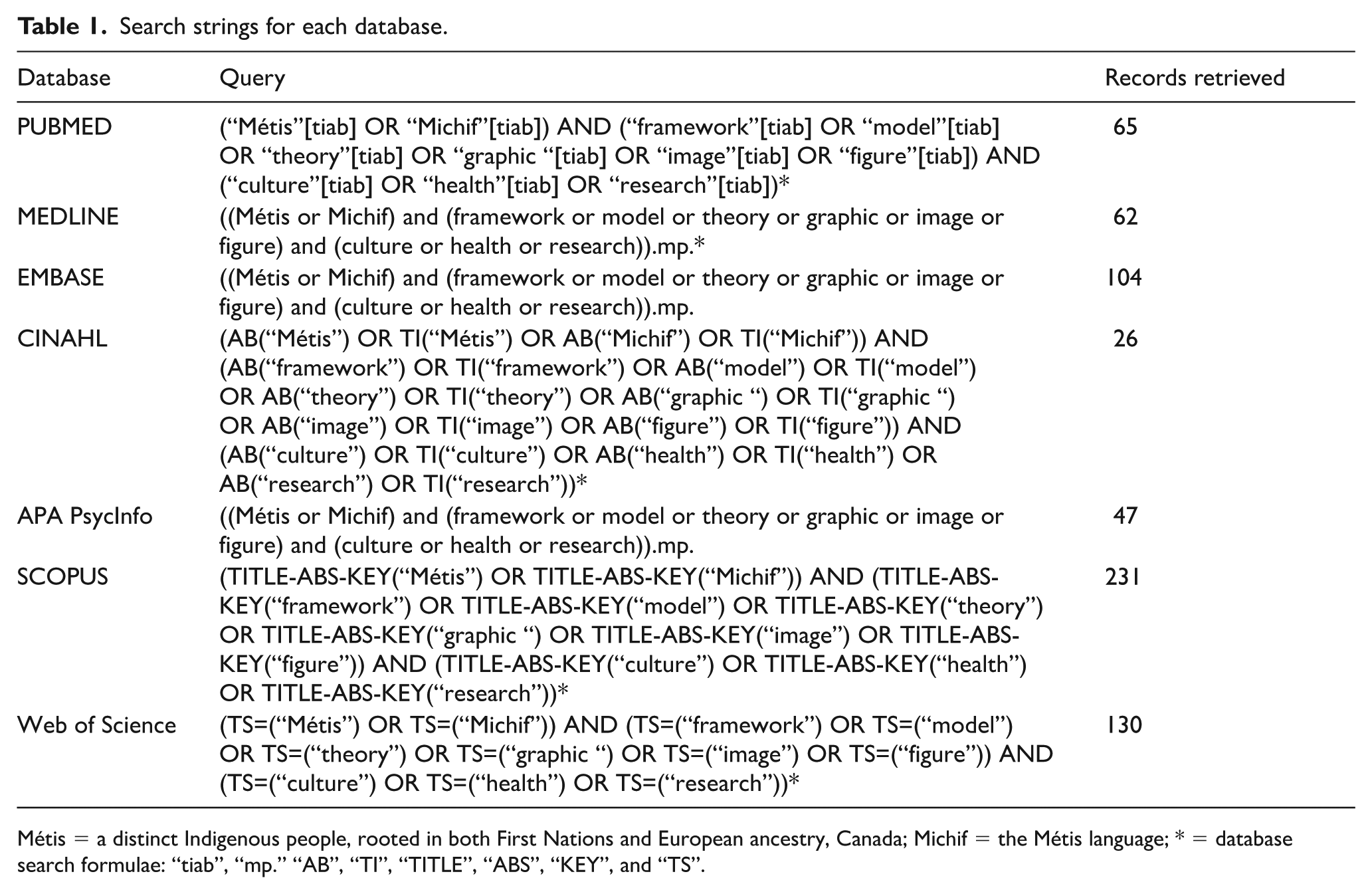
Métis = a distinct Indigenous people, rooted in both First Nations and European ancestry, Canada; Michif = the Métis language; * = database search formulae: “tiab”, “mp.” “AB”, “TI”, “TITLE”, “ABS”, “KEY”, and “TS”.
We also searched the gray literature in Google Scholar and the following websites: the National Collaborating Center for Aboriginal Health, Métis Nation of Alberta, Métis Nation of Ontario, Manitoba Métis Federation, and Métis Nation of British Columbia (Table 2).
Searches from other sources.
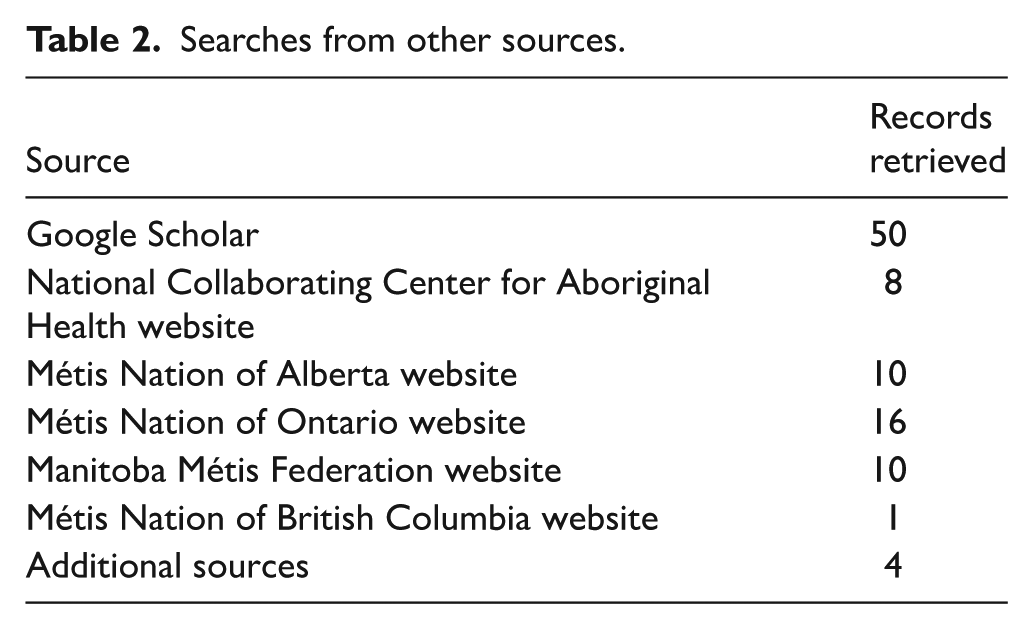
Google Scholar searches were limited to the first 50 records. We only considered records written in English for inclusion. As for publication type, we included research papers, letters to the editor, comments, book chapters, theses, dissertations, and reports. We excluded all records that did not involve Métis-specific research or utilize any health-related Métis models and frameworks. Records that presented a pan-Indigenous approach were also excluded. We did not exclude records based on publication year. Additional sources included materials shared by MN-S, not available online, and publications found using reference screening.
References were collected and logged in Zotero. To provide an overview, we created a table to collect the following information from each study: authors, year, title, location, research objectives, methods, and sample. We also created a table to collect information on the name of each Métis-specific framework or model and their applicability to our study. Finally, we described the components of Métis culture and imagery used in each framework and model. Data were analyzed through reiterative readings by the authors.
Results
As outlined in Figure 1, using adapted Preferred Reporting Items for Systematic reviews and Meta-Analyses (PRISMA), the database and additional searches resulted in 764 records (Page et al., 2021). Following title and abstract screening, 111 records were excluded. Of the 247 remaining records, 233 were eliminated due to their failure to meet the eligibility criteria. These criteria were designed to ensure the inclusion of only Métis-specific studies or those that employed health-related Métis models and frameworks. Most of the records excluded adopted a pan-Indigenous approach, failing to distinguish between Métis and First Nations. As a result, only 14 records met the criteria and were included in the review.
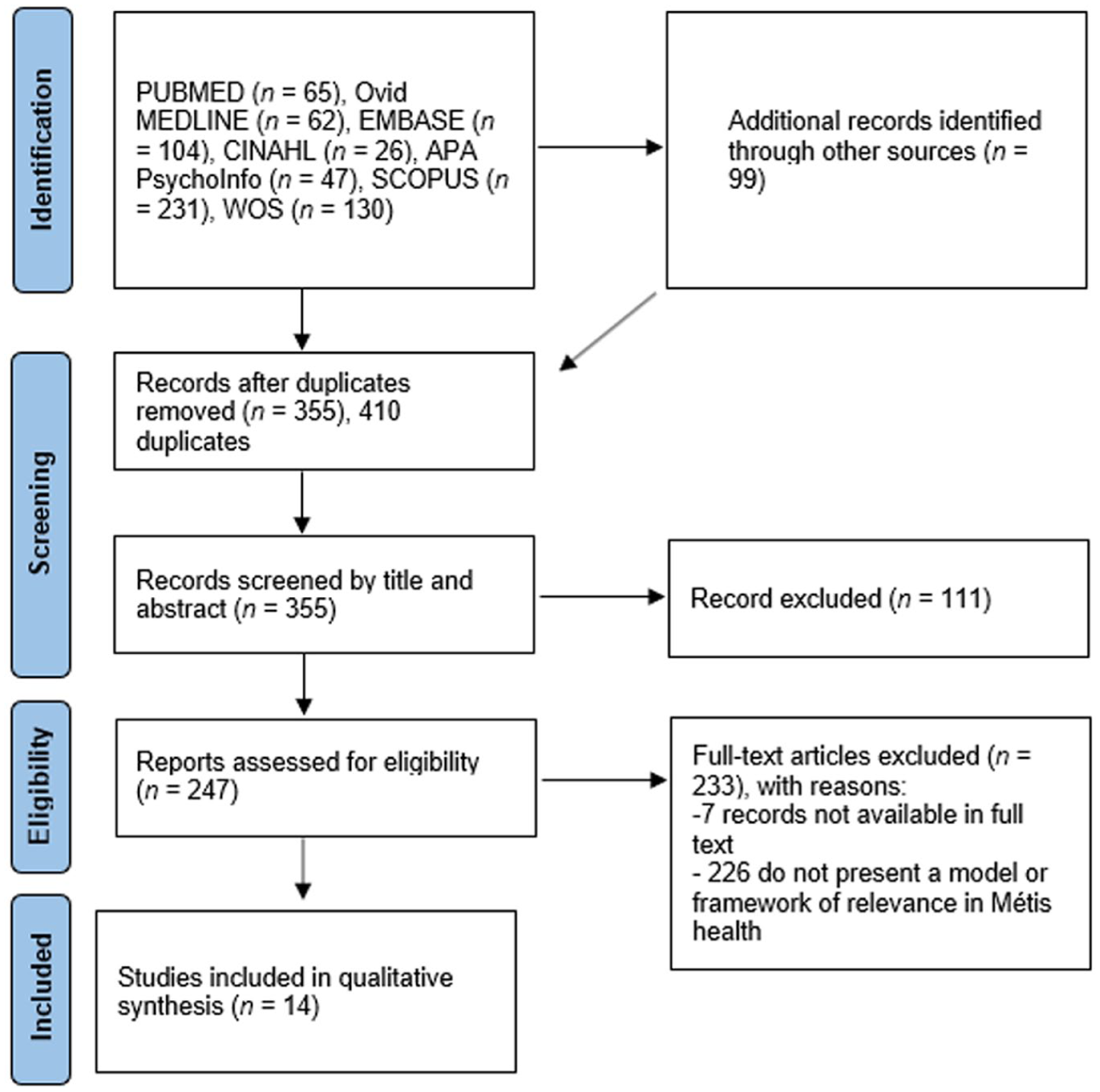
Summary of the screening and selection process.
A description of the 14 selected publications can be found in Supplemental Material 1. A total of four records were published in 2012 and two records were published in 2013. One record was published in each of the years: 2006, 2010, 2011, 2014, 2019, 2020, 2022, and 2023. Most publications were from Manitoba (n = 8), followed by Saskatchewan (n = 3), Alberta (n = 1), Canada (n = 1), and an unspecified setting (n = 1). Of the records retrieved, five were quantitative studies that used provincial health data. A total of seven records were qualitative studies, four that used focus groups or gathering circles, and two that were workshop-based. In the sample, we also identified the use of consensus building, an author’s reflections, and a thesis.
Utilize Métis culture imagery and blends different worldviews
As presented in Table 3, we identified seven frameworks and three models. The frameworks and models in this review use many components of Métis imagery such as the Red River cart, the Métis sash, and the Métis flag, strings, and beads (Atkinson et al., 2023; Burke & Robinson, 2019; MN-S, 2012). In addition to these elements, there is also mention of storytelling and story listening, talking sticks, and Métis fiddle music (Atkinson et al., 2023; LaVallee, 2014). In addition, we observed that some frameworks and models integrated Western and non-Métis perspectives (Bartlett et al., 2011; Bartlett, Sanguins, Carter, et al., 2012; Bartlett, Sanguins, Chartrand, et al., 2012; Burke & Robinson, 2019; LaVallee, 2014; Martens et al., 2012; Oosman et al., 2022; Sanguins, Bartlett, Carter, et al., 2013; Sanguins, Bartlett, Mayer, et al., 2013) For example, the Intergenerational Wellness framework includes the Chinese yin-and-yang symbol of balance (Oosman et al., 2022). Further, the Métissage (blending or mixing of diverse elements; evoking the symbolic act of braiding; interweaving contexts, cultures, and concepts) framework has roots in both foreign colonial contexts and the Canadian Métis tradition (Burke & Robinson, 2019).
Description of Métis cultural components and imagery.
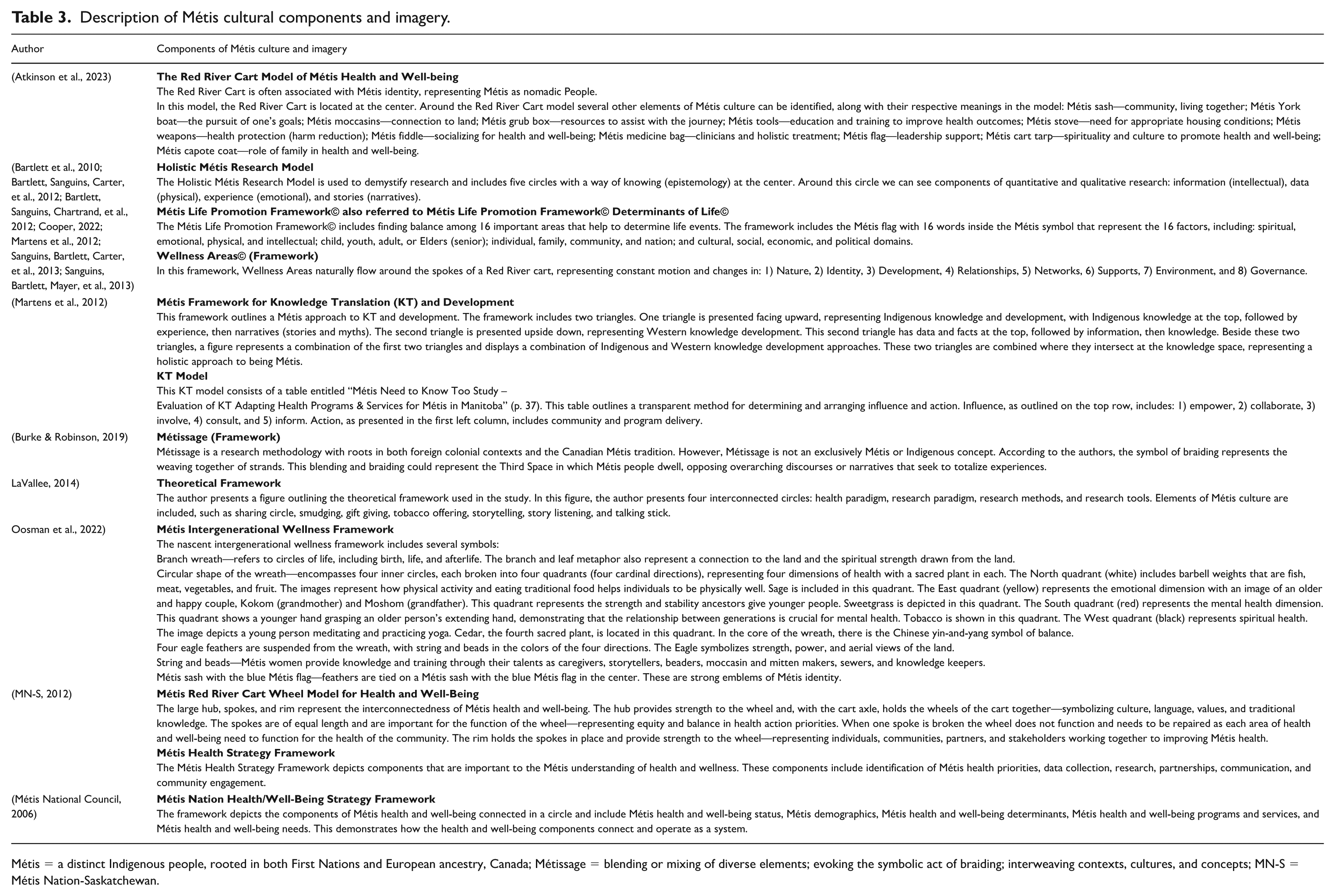
Métis = a distinct Indigenous people, rooted in both First Nations and European ancestry, Canada; Métissage = blending or mixing of diverse elements; evoking the symbolic act of braiding; interweaving contexts, cultures, and concepts; MN-S = Métis Nation-Saskatchewan.
Consider the social determinants of health and a life course approach
The social determinants of health are also prominent in some of the frameworks. For example, the Métis Life Promotion Framework© includes 16 factors: spiritual, emotional, physical, and intellectual; child, youth, adult, or Elders; individual, family, community, and nation; and cultural, social, economic, and political (Bartlett et al., 2010; Bartlett, Sanguins, Carter, et al., 2012; Bartlett, Sanguins, Chartrand, et al., 2012; Cooper, 2022; Martens et al., 2012; Sanguins, Bartlett, Carter, et al., 2013; Sanguins, Bartlett, Mayer, et al., 2013). Likewise, the Intergenerational Wellness framework includes concepts such as healthy eating, physical activity, and aging (Oosman et al., 2022).
Engage with Métis government, organizations, and communities
Engagement with stakeholders and communities was present in most models or frameworks identified in this study. For example, Atkinson et al.’s (2023) study was developed in response to a request by Métis Nation—Alberta. The authors also partnered with Shining Mountains, the only community-based agency offering Métis-specific community services for socially vulnerable individuals who live in Alberta. Moreover, the authors applied a community-based research approach that included Métis community members in the research process, aiming to better understand health issues and integrate findings into the community. The research question and methodologies were created with academic and community partners (Atkinson et al., 2023).
Many studies in this review involved the Manitoba Métis Federation (MMF; Bartlett et al., 2010; Bartlett, Sanguins, Carter, et al., 2012; Bartlett, Sanguins, Chartrand, et al., 2012; Cooper, 2022; Martens et al., 2012; Sanguins, Bartlett, Carter, et al., 2013; Sanguins, Mayer, Bartlett, et al., 2013). The framework and models applied to these studies were in accordance with the MMF—Health & Wellness Department (MMF–HWD). This department sought to improve health by enhancing the utilization of health knowledge from Métis cultural perspectives.
Consistently, Oosman et al. (2022) developed the Métis Intergenerational Wellness framework with the involvement of Métis community members. The research team was engaged in a life-course-focused, intergenerational research initiative on aging well in place in conjunction with a northern Saskatchewan Métis community. The framework was created through consensus-building talks involving two youth Métis artists, two Métis research leads, and two academic leads (Oosman et al., 2022).
Facilitate the research process, including data collection and KT
In LaVallee’s (2014) thesis, the author developed a theoretical framework in which a research paradigm that included Métis methods and ethics as well as honored and valued diverse ways of knowing. This framework provides an overview of the research paradigms, research methods, and research tools, for example, workshops and storytelling, including Métis and Western worldviews (LaVallee, 2014). Similarly, Burke and Robinson (2019) described how Métissage can be used to juxtapose Métis and Western ways of knowing and research methods.
In Atiksons (Atikson et al., 2023) study, the authors worked with members of a Métis community and used a gathering circle to construct the Red River Cart model. The Wellness Areas© framework was utilized to develop and ask a series of questions based on the Wellness Areas associated with aging, that is, nature, identity, development, relationships, networks, supports, and environment. The framework was then used to organize participants’ experiences with services and resources in their communities in a holistic manner (Bartlett et al., 2010, 2011; Bartlett, Sanguins, Carter, et al., 2012; Bartlett, Sanguins, Chartrand, et al., 2012). In another study, the Wellness Areas© framework was used to develop their research questions about health care consumer experiences (Sanguins, Mayer, Bartlett, et al., 2013).
Organize knowledge and support for KT
Martens et al. (2012) described a participatory method for KT influence and action (Martens et al., 2012). Using this approach, the research team was able to reach agreement about how to inform, consult, involve, collaborate, and empower staff from the MMF Region offices and their associated Regional Health Authorities. By clarifying the role of each party, the model helps mitigate potential misunderstandings. This model used discussion tables to review the Métis health data using the Métis-specific holistic wellness perspective. In addition, the authors drew from the Métis Framework for KT and Development to incorporate both Indigenous and Western knowledge-development approaches. For example, holistic Métis knowledge development is thought to include both Indigenous myths & stories—spiritual, and experiences—emotional, as well as Western data and facts—physical, and information—intellectual. Therefore, models and frameworks could be used to organize and promote knowledge dissemination strategies about Métis health. Table 4 presents descriptions of the frameworks and models (Martens et al., 2012).
Description of frameworks or models.
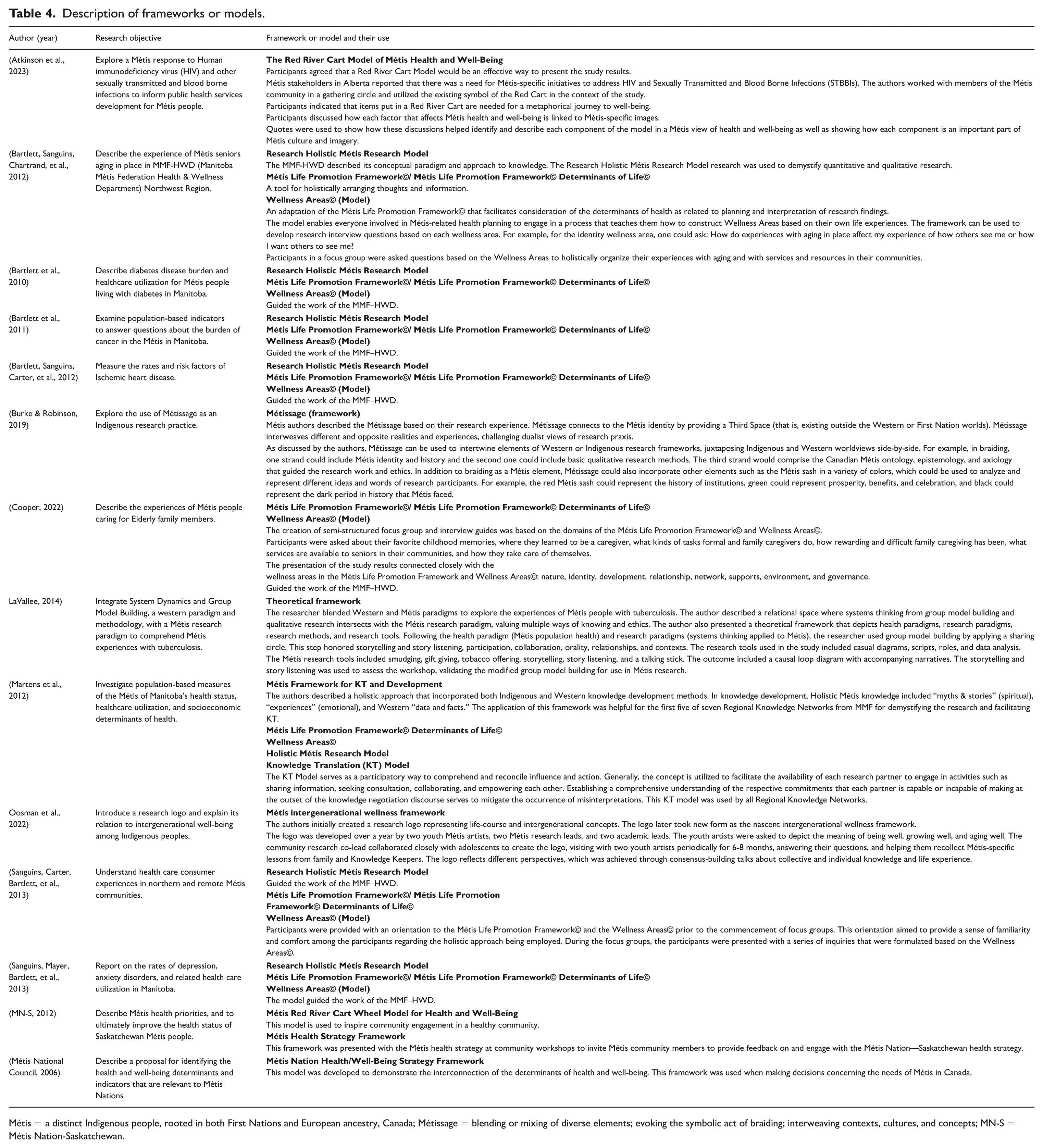
Métis = a distinct Indigenous people, rooted in both First Nations and European ancestry, Canada; Métissage = blending or mixing of diverse elements; evoking the symbolic act of braiding; interweaving contexts, cultures, and concepts; MN-S = Métis Nation-Saskatchewan.
Discussion
This narrative review summarizes the existing cultural models and frameworks related to Métis health and research. We identified seven frameworks and three models that incorporate Métis knowledge and have relevance for health and well-being. We observed that several studies by the MMF have used Métis frameworks and models for research and to guide the work of the MMF–HWD. Some frameworks were used to facilitate the research process and data collection as well as to organize knowledge and support KT initiatives. Métis symbology and concepts were marked by Métis cultural elements, blending different worldviews with consideration of the social determinants of health and the life course perspective. Most frameworks and models incorporated the importance of relationships with the Métis government, organizations, and community, which further stresses the importance of promoting self-determination in Métis health.
The Métis are a nation of Indigenous people who are empowered to govern and decide what is best for their communities. This communal and democratic Métis social organization affirms the Métis as a historic nation. For example, during buffalo hunts, the Métis would gather and organize a provisional government with a president, captains, and soldiers, which helped the hunts to be very organized and disciplined (Chartier, 1994). In this sense, initiatives that are community-led or have substantial community participation when identifying health priorities and outcomes should be prioritized. As Métis organizations, communities, and governments strive to address the health of their Nation, the provincial and federal governments must leverage support and acknowledge that the Métis can determine their own best interests.
We also observed that some Métis frameworks included research methods and paradigms designed to help facilitate the research process. Indigenous frameworks should include Indigenous cultural values and beliefs in their design, methodology, and analysis, along with community-appropriate methods of data dissemination. Lavallée (2009) explored the teachings of the medicine wheel as a framework, combined with sharing circles and Anishnaabe symbol-based reflection. Indigenous research frameworks “rewrite and re-right” Indigenous history and society. In this process, Indigenous knowledge is incorporated into research in place of Western conceptualizations, rewriting and re-righting to decolonize knowledge (Lavallée, 2009).
Interestingly, Métis frameworks or models do not necessarily replace Western knowledge and exclusively utilize Indigenous knowledge. In this review, we found that the Métis frameworks or models included a mixed perspective that blended different worldviews (Burke & Robinson, 2019). For instance, the inclusion of diverse worldviews was observed in the nascent intergenerational wellness framework, which included the Chinese yin-and-yang symbol of balance (Oosman et al., 2022). In addition, the Métis Framework for KT and Development describes a holistic approach to knowledge that combines spiritual myths & stories and emotional experiences with Western data and facts (Martens et al., 2012). In LaVallee’s (2014) thesis, the author’s theoretical framework included Western worldviews in parallel to Métis knowledge. For example, group model building, a Western practice, was employed in tandem with a sharing circle, a Métis practice, to integrate it with paradigms of population health and systems thinking (LaVallee, 2014). Further, as described by Métis researchers Burke and Robinson (2019), the fusion of Western and Indigenous knowledge creates a Third Space that honors diverse realities. The Third Space opposes the pressure to choose a side, First Nations or Western, that many Métis, including Métis researchers experience, as they are Western European in heritage (Burke & Robinson, 2019). The discussion about what represents Métis culture is relevant to showcase its plurality, which is also shown in their symbology.
Our results demonstrate the frameworks and models included many components of Métis symbology, imagery, and culture. A prime example of this inclusion was demonstrated in Atkinson et al.’s (2023) work. In collaboration with the Métis community, the authors created the Red River Cart model as a Métis-specific response to sexually transmitted and blood-borne infections. This Métis model adopts a holistic approach that includes allied health care. The Red River Cart model can be effectively used in health care, as it allows Métis individuals to self-assess their health and wellness as well as used by health care organizations to improve cultural safety for Métis (Atkinson et al., 2023). A systematic scoping review of the Indigenous primary health care service delivery models identified culture as the most significant characteristic, that underlies others such as accessible health services, community participation, and holistic health care. The authors argued that the role of culture in models of Indigenous primary care service delivery is the most significant difference between Indigenous service delivery and other models of care (Harfield et al., 2018). Therefore, it is meaningful to include elements of Métis culture when proposing health care interventions for Métis.
The Métis social determinants of health and a life course approach are pivotal when formulating cultural models and frameworks pertaining to Métis health and research. These two elements serve as a lens through which we can understand the colonial harms that Métis people have endured in Canada, leading to the degradation of Métis identity, loss of historical knowledge, and deprivation of rights and land. Dyck (2008) describes the Métis social determinants of health as a continuum from the past to the future. By reiterating the importance of understanding key aspects of Métis history, such as colonialism, racism, marginalization, deprivation of rights and land, and the loss of culture, Dyck underscores how understanding the past is the central to understanding the present and future conditions experienced by Métis. Thus, political and historical factors must be considered in tandem with social factors, as they are each essential social determinants of Métis health (Dyck, 2008). When considered in the context of this past-to-future continuum, a life course perspective considers how the Métis grow and live over time, which is critical when addressing the complex societal and political changes faced by the Métis Peoples.
The importance of Métis culture also impacts KT initiatives. In this study, we found that KT initiatives for Métis can include holistic Métis knowledge, represented by myths & stories—spiritual, and experiences—emotional, combined with Western knowledge, represented by data and facts (Martens et al., 2012). In addition, effective Métis KT models should be participatory and clearly outline the role of influence and action in the engagement with team members. To avoid misunderstandings, it is important to establish a comprehensive understanding of each partner’s respective commitments. The significance of the connection between stakeholders and research partners when implementing changes based on research findings is paramount, as shown in a systematic review that evaluated Indigenous KT methods (Morton Ninomiya et al., 2022). The authors reported that KT strategies frequently included combinations of imagery, for example, photographs or images, with text. Other audiovisual elements were also integrated, such as Elders’ and Knowledge Keepers’ teachings or storytelling (Morton Ninomiya et al., 2022). Therefore, KT strategies for Métis health could include approaches that optimize collaboration with team members and incorporate Métis culture through imagery. Although beyond the scope of our review, recommendations for Indigenous KT methods could be potentially applied to Métis health promotion. For example, Cooper and Driedger (2018) recommended that Indigenous approaches to KT be designed based on input from the community, consider literacy level, be engaging and creative and, above all else, utilize a strengths-based approach (Cooper & Driedger, 2018)
Limitations
This narrative review has several limitations. Overall, we felt that the publications could have provided more detailed information regarding the development of the framework, such as the origins of the symbology and the sources of the suggestions or applications, as well as their implementation, specifically how the application of these frameworks is reflected in the study results. In these cases, publications tended to focus on presenting the outcomes of the initiative, rather than providing a detailed description of their frameworks or models. In addition, despite our diligence when searching for Métis-specific research in multiple sources and databases, some of the literature may have not been captured. Nevertheless, the information available about the models and frameworks discussed is useful in the further exploration of Métis health and well-being.
Conclusion
This narrative review aimed to identify and describe existing cultural models and frameworks related to Métis health and well-being. We uncovered seven frameworks and three models that incorporated Métis cultural knowledge and could be applied to understanding Métis health. We observed that the models and frameworks: (1) included Métis symbology and concepts; (2) considered the social determinants of health and a life course approach; (3) spoke to the process of engaging with Métis government, organizations, and community; and (4) facilitated the research process and data collection, including KT. We believe that these findings can foster the development of models and frameworks that facilitate Métis culture in health research and guide strategies designed to promote the health and well-being of the Métis.
Supplemental Material
sj-docx-1-aln-10.1177_11771801251374209 – Supplemental material for Frameworks and models that promote Métis health: a narrative review
Supplemental material, sj-docx-1-aln-10.1177_11771801251374209 for Frameworks and models that promote Métis health: a narrative review by José Diego Marques Santos, Tracey Carr, Stacey McHenry, Erin Leeder, Sheila Laroque and Gary Groot in AlterNative: An International Journal of Indigenous Peoples
Footnotes
Acknowledgements
The authors thank the funders and the Métis authors cited in this paper for their valuable contributions to advancing Métis health knowledge.
Authors’ note

Funding
The authors disclosed receipt of the following financial support for the research, authorship, and publication of this article: Canadian Cancer Society 707234; Government of Canada > Canadian Institutes of Health Research 707234; Saskatchewan Health Research Foundation 707234.
Declaration of conflicting interests
The authors declared no potential conflicts of interest with respect to the research, authorship, and publication of this article.
Supplemental material
Supplemental material for this article is available online.
Glossary
Canadienne-Algonquian an Indigenous group whose ancestral lands are in eastern Ontario and southern Quebec, Canada
kokom grandmother
Métis distinct Indigenous people, rooted in both First Nations and European ancestry, Canada
métissage blending or mixing of diverse elements; evoking the symbolic act of braiding; interweaving contexts, cultures, and concepts
Michif the Métis language
moshom grandfather
References
Supplementary Material
Please find the following supplemental material available below.
For Open Access articles published under a Creative Commons License, all supplemental material carries the same license as the article it is associated with.
For non-Open Access articles published, all supplemental material carries a non-exclusive license, and permission requests for re-use of supplemental material or any part of supplemental material shall be sent directly to the copyright owner as specified in the copyright notice associated with the article.
