



Abstract
In this article, we share our teaching and learning reflections by discussing how placing whanaungatanga (relationship and belonging) at the heart of an open entry-level course shaped a teaching and learning model that decolonises, disrupts, and denaturalises the usual transactional mode of Eurocentric university education. As Māori (Indigenous peoples of New Zealand) and Pacific educators, we teach through and with a holistic, connected view of our world and our place in it, even more so at a time when it is urgent that our students understand and act to protect the place upon which they stand. The philosophy of whanaungatanga determined how we connected to each other and our students, holding the goals of the course together. As whanaungatanga determined how we acted and interacted in each facet of the course, it in turn supported students to connect to their place in Aotearoa New Zealand and, significantly, their shared responsibilities to peoples, communities, and environments of the Pacific.
The beauty of our environment is stolen People yelling toitū te tiriti [the Treaty endures], mana tangata [the authority of people], mana whenua [authority of a people over land] Matauranga Māori [knowledge of the Indigenous peoples of New Zealand] is not welcome, Reciprocity lacking, humans impacting our natural landscapes, We are not in harmony, Interconnectedness and togetherness, a natural necessity.
This untitled poem was delivered by Whetu Meihana (2024), a young Māori woman, in front of her peers in a lecture theatre in an activity as part of a session on the environment. This was not the first time Whetu had spoken in class, but it was the most urgent. Her poem is an example of how strongly students felt about the crises they see before them, including climate change, widening social and economic disparities, attacks on Treaty rights, and marginalisation of minority groups, all of which are increasingly becoming issues in Aotearoa New Zealand, hereafter used interchangeably with Aotearoa and New Zealand. It also shows how an Indigenous decolonial teaching and learning space is one of the infinite possibilities for understanding how we connect to each other and to the places upon which we stand, reflecting the responsibility of care that each one of us has to all life on earth and our responsibility as Māori and Pacific educators to foster space that speaks to this urgency. Or in Whetu’s (2024) words, a “natural necessity” (line 6).
Introduction
In 2024, a team of Māori and Pacific educators concluded a pilot of a new, open Arts course, Ko Wai Tātou? (Who are we?). Initially launched in 2022, Ko Wai Tātou? was set to become the Arts version of Waipapa Taumata Rau—a compulsory entry-level course for Year 1 students that the University of Auckland has required all faculties to introduce in 2025. Waipapa Taumata Rau—the name Ngāti Whātua Ōrākei (a tribe associated with central Auckland, New Zealand) gifted to the University of Auckland in 2021—references both the city campus location close to Waipapa, the original shoreline, on Ngāti Whātua Ōrākei territory and the taumata rau (many peaks) of achievement and challenge that are encountered while studying at the University of Auckland (University of Auckland, n.d.). Ko Wai Tātou? was practically abandoned while we were teaching it, overtaken by changes in priority wrought by a university-wide curriculum transformation project and a major restructuring of three faculties: Arts, Education and Social Work, and Creative Arts and Industries. These challenges are not the focus of this essay; instead, we direct our focus to what we learned in the short life of Ko Wai Tātou?
The authors of this article had different roles and relationships within the course. Marcia Leenen-Young and Aroha Harris were the course directors, sharing responsibility for its design and delivery. Ngahuia Harrison, a post-doctoral research fellow in Arts, led a unit on the environment, and Whetu Meihana was an enrolled student who successfully completed the course in 2024. Through this article, we share our philosophy and practice as teachers in our course Ko Wai Tātou? We begin our article by describing the course, in which whanaungatanga (relationship and belonging) is embedded as the heart and philosophy in an approach that treated teaching and learning as a natural site for whakawhanaungatanga (building relationships, relating well with each other). We then turn to two of the 10 major course subjects or themes: “Tāmaki Makaurau”—Auckland, Aukilani—Samoan transliteration for Auckland, and “Te Taiao” (the Environment). Conceptualising each of these big subjects as stories, Tamaki Mākaurau and Te Taiao spoke respectively to what we consider to be the stories beneath our feet and stories of our world. We conclude by reflecting on the ways Ko Wai Tātou? developed whanaungatanga by engaging students in subjects that mattered to them in decolonial teaching and learning spaces.
Our course: Ko Wai Tātou?—whanaungatanga at the centre
The seed that blossomed into Ko Wai Tātou? came from an understanding that students in Arts struggled to develop a sense of belonging in the faculty; instead, they experienced disconnection and isolation, hindering the first-year transition to university study. In response, faculty leadership began to explore the idea of introducing a core course, aimed at all students during their first semester, to better prepare them for their years of study and help them develop a sense of belonging. While membership of the building and teaching team changed and for different reasons, the practice of drawing in learning design and student engagement experts persisted to the final run of the course in 2024. Consistently, the inaugural team easily embraced placing whanaungatanga at the centre of the course. But we asked what that could mean in serious and thorough practice in any teaching and learning environment in the faculty. Furthermore, what would whanaungatanga—which demanded kanohi ki te kanohi (face-to-face) engagement—look like in the context of a global pandemic and heightened demands for asynchronous options? Whanaungatanga could not be simply pinned to a course that was fundamentally the same as the other dominant courses. Whanaungatanga could not be a mere accessory to standard teaching and learning procedure. Poised to transform teaching and learning practice, the new course had to be a disruptive force wherein whanaungatanga was the generator and the essence, and student experience was a priority. Thus, it had to be well-resourced and given the time and space that whanaungatanga needs to come to fruition.
The idea to centralise whanaungatanga in Ko Wai Tātou? reflected a growing positive mood towards Māori values in the Faculty of Arts and in the then-forthcoming University strategic plan. In Arts, staff were already familiar with Ō Tātou Mātāpono, Our Faculty Values, introduced by former Kaiārahi (guide, counsellor, mentor) Dr. Hirini Kaa. These values rest on the primary aspiration kia whakamana i te tangata—to uphold the mana and tapu of people. While we do not detail Ō Tātou Mātāpono in this article or the different ways they are encouraged and implemented, we acknowledge the influence of scholars such as Pā Henare Tate (2021) and—in relation to teaching and learning—Russell Bishop (Bishop, 2012; Bishop & Berryman, 2009). This work was well underway in 2021 when the University of Auckland published Taumata Teitei—Vision 2030 and Strategic Plan 2025, which identifies whanaungatanga as a core Te Ao Māori (Māori World) principle together with manaakitanga (respect, generosity, support, care) and kaitiakitanga (guardianship, stewardship) (University of Auckland, 2021, p. 3). Embedding Māori values in all educational experiences is imperative, especially if the university is committed to decoloniality through transforming itself. As the Waitangi Tribunal (2011a) has written, New Zealand needs to see “a genuine infusion of the core motivating principles of mātauranga Māori—such as whanaungatanga and kaitiakitanga—into all aspects of our national life” (p. 248).
While whanaungatanga drove the development and design of Ko Wai Tātou?, there was never an expectation that it would be taught directly to students as a concept, philosophy, or practice. Rather, the goal was to create a course in which whanaungatanga was an experience, where students would feel welcome and respected in a supportive teaching and learning environment. As a result, the teaching team thought carefully about the meaning and practice of whanaungatanga. Whanaungatanga as connection and relationship in a kin-based world had to be expanded beyond whānau (family group) bonds into contexts that could include, in this case, a classroom environment and a university cohort, many of whom would start the course as strangers to each other. In a whanaungatanga context, individual students could expect support from their classmates and teachers, and the “collective group” could also expect the “support and help of its individuals” (Mead, 2016, p. 28). The Waitangi Tribunal (2011b) also highlights the “epistemological importance” of whanaungatanga in forming “the conceptual basis for the allocation of rights and obligations among people and between people and their environment” (pp.193–194). For the team that built the course, there was no hesitation in aspiring to generate whanaungatanga in any learning environment; several sources had already noted it as central to Māori students’ success (Rātima et al., 2022; Theodore et al., 2017). Other scholars that influenced the course conception, design, and delivery are Garrison et al. (2000), Konai Helu-Thaman (2009), and Teresia Teaiwa (2005).
Operating in tandem with whanaungatanga, manaakitanga became a key feature of Ko Wai Tātou? While whanaungatanga encapsulates the way individuals are connected to one another, manaakitanga speaks to the practical behaviour within those relationships. Manaakitanga is the responsibility to treat others with care and respect, to look after one another, and to acknowledge the duties that come with being part of a larger community. As such, manaakitanga and whanaungatanga are inseparable, with manaakitanga being essential to forming a whanaungatanga environment. Manaakitanga was evident throughout the course, from the whakatau (welcome ceremony) to the students at the first lecture, to the snacks provided during well-attended fourth-hour activities, to the expressions of gratitude to a stellar line-up of guest presenters, and to the shared kai (food, meal), celebration and send-off that closed the course.
Ko Wai Tātou? Whanaungatanga in teaching and learning practice
The course description identified a focus on the simple but often challenging question: Ko wai tātou? Who are we? It explained that this question would be delved into by showing how the diverse subjects of Te Kura Tangata, the Faculty of Arts, study and analyse it by asking, “Who are our people and communities? Where do our ideas about who we are come from? What do they mean for relations of in/equality, or for how different groups experience belonging?” Relatedly, in 2024, as a pilot for the university’s Waipapa Taumata Rau courses, Ko Wai Tātou? also considered how knowledge of place enhances student learning, the significance of Te Tiriti o Waitangi (The Treaty of Waitangi 1840), and how knowledge systems frame understanding. Content was organised around issues addressed through interdisciplinarity, including Te Tiriti o Waitangi, Auckland, Race, Gender, Spirituality, Human Rights, Justice, Well-being, Education, and the Environment.
Although whanaungatanga was not prescribed in the course description, it was created in the course by a teaching team who sought to practice, model, and encourage whanaungatanga at every available opportunity. Whanaungatanga was not set as a learning outcome, although our language of employing a reciprocal, values-based approach to collaborating came close. Whanaungatanga was not directly promoted among students, except for a statement that Week 1 was about whakawhanaungatanga. We did not expressly explain our pedagogical approach to students, nor was whanaungatanga used to label any component of the course, not even the weekly chill hour when students and staff gathered socially in a common area during the hour between the lecture and workshop. Yet, whanaungatanga was planned for, expected, and consciously activated from the design of the course through to its conclusion.
The course was designed to be team-taught, with shared responsibilities for student engagement, assessment, and the weekly programme. Lectures addressing weekly themes involved multiple presenters from faculties and disciplines across campus, and no lectures were solo. We aimed to generate whanaungatanga first within the teaching team by modelling it for students. We also welcomed expert learning designers in assessment design, asynchronous and online activities, who also advised on the overall look and feel of the course. The Arts student engagement staff ensured their services and initiatives wrapped around the course seamlessly, making shared spaces available for academic and social activities, keeping the snacks and games flowing, and connecting Arts+ mentors—student volunteers who mentor first-year students, with the course, particularly during weeks requiring large group movement or activities such as the museum visit in Week 3. The Graduate Teaching Assistant was paired with an Arts Tuakana Mentor. Including Tuakana (a university-wide academic excellence programme for Māori and Pacific students) created a formidable team responsible for facilitating weekly pre-lecture preparation sessions and delivering the workshops. They were important in-person points-of-contact for students. In sum, this was a no-stone-unturned approach to whanaungatanga: even when faced with a mundane question about course policy on extensions and late work, our response was, what is the whanaungatanga response to requests for extensions? As noted elsewhere, “What is the whanaungatanga response?” became something of a mantra, being invoked every time the team hit a roadblock or sticking point (TeachWell Digital, 2022, Ko wai tātou? Who are we?).
As a strategy, we invested heavily in ensuring opportunities for whanaungatanga in the first 3 weeks. Far from being de-prioritised in subsequent weeks, we amplified whanaungatanga in the critical early weeks such that it would grow its own personality and momentum that would carry through the course. We conceptualised this mood and feeling of the course as its vibe. Unsurprisingly, then, the course began with a whakatau at Waipapa Marae (one of two Māori cultural gathering complexes at the University of Auckland), putting Te Ao Māori front and centre of the course with its requisite goal of establishing relationships. Teaching and learning through Weeks 1 to 3 emphasised keeping the cohort together and in person, small-group activities, and posting assessments to shared platforms. For example, everyone in the course got to enjoy each group’s images of campus artworks in Week 1, or their commentary on an item on display in the Auckland Museum’s: Stories of Auckland exhibition in Week 3. The seeds planted in the first 3 weeks grew throughout the course to the point where whanaungatanga, as the heart of our decolonial approach, was also at the forefront of the student experience.
Our focus on place and environment
Weekly course topics were presented through the Indigenous lenses of a core teaching team of Māori and Pacific educators who centred Indigenous interpretations and urgencies in our curriculum, influencing connections and relationalities in our teaching methods and learning priorities. Our decolonial focus on whanaungatanga, coupled with manaakitanga, determined how students experienced this course.
Tāmaki Makaurau: stories beneath our feet
One of the course priorities was place; sharing with students the importance of recognising the land upon which you stand: its histories, contemporary connections, trauma, and future possibilities. For us, this was a core disruption to the standard Eurocentric university curriculum. Place for us meant multiple things:
understanding the colonial legacies of the University of Auckland—Waipapa Taumata Rau built on the land of Ngāti Whātua Ōrākei,
geographic recognition of Tāmaki Makaurau—also known as Auckland, Aotearoa New Zealand, and the wider Pacific region, and
connection, reciprocity, and responsibility to the land upon which we stand, for many of us as migrants to Aotearoa New Zealand but also for tangata whenua (people of the land; local Indigenous people).
Conceptually, whanaungatanga and manaakitanga necessitated recognition of place as a way for students to connect to the world around them. Place was a focus throughout the course but also a specific focus of one of the weekly modules, Tāmaki Makaurau—Stories beneath our feet. This module encouraged students to think deeply about the places they are connected to as students in Tāmaki Makaurau—or Auckland or Aukilani—New Zealand’s biggest city. In preparation for this module, students watched resources that explained the colonial legacies of Waipapa Taumata Rau, including Old Government House and a heritage flame tree in the garden, as well as on the role of Ngāti Whātua Ōrākei in the establishment of Auckland City. Key to this is the inclusion of resources on the Barracks Wall, which was ostensibly built to protect Auckland from an expected attack—which not only never happened but had never been intended—from Ngāpuhi (a tribe associated with Northland, New Zealand), and on Ngā Roimata o Ranginui—a sculptural memorial to the 2019 Christchurch Mosque Attacks; literally, tears of grief of the skyfather (Figure 1). Both these artefacts, as Aroha Harris (2023) has noted, are a response to violence, although one in defence and one in peace, and stand side by side on the city campus of Waipapa Taumata Rau.
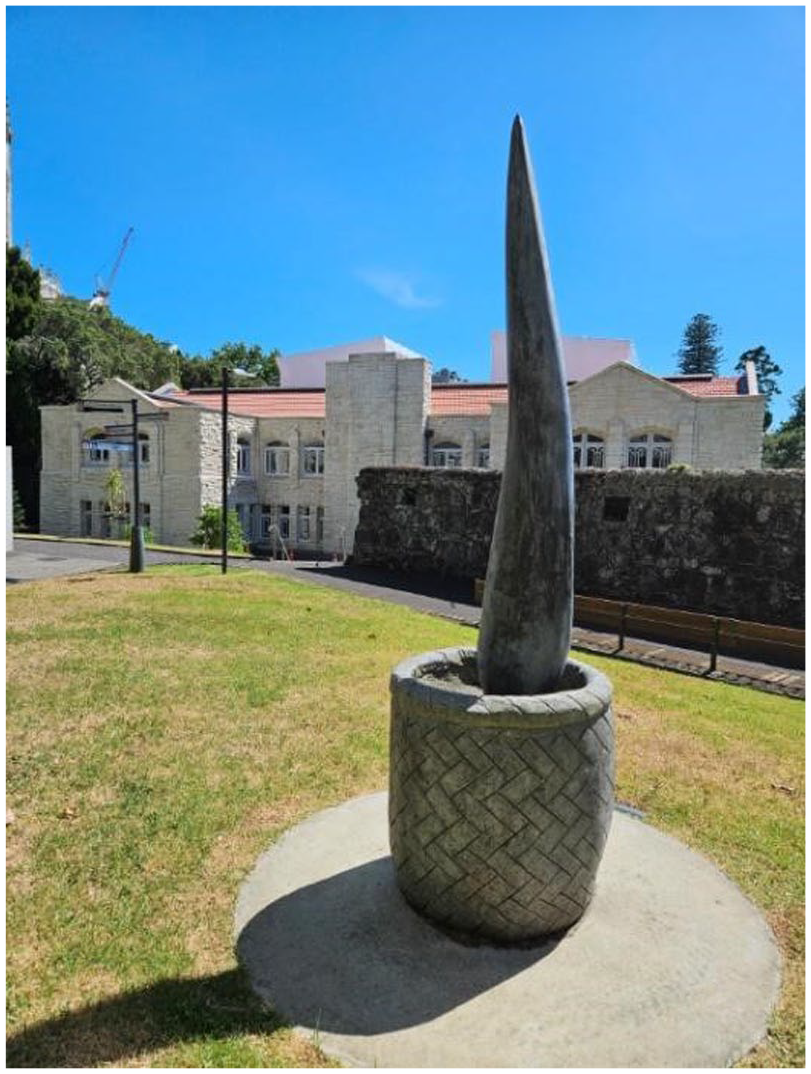
Ngā Roimata o Ranginui next to the Barracks Wall, Waipapa Taumata Rau—The University of Auckland (sculpture by Anton Forde & Ngahina Hohaia; photo by Merle Hearns).
Through this module, our students recognised more clearly than most at the university the legacy of colonialism that surrounds us, connecting to wider discussions that came up in later modules on Indigenous knowledges, justice and human rights. Disrupting the image of our university to shed light on the colonial legacies at Waipapa Taumata Rau and the realities of the memories embedded in the land we occupy was central to student learning, as part of connecting to place is recognition of past trauma.
In this module, our students also experienced different perspectives of Tāmaki Makaurau through visiting and interacting with the Tāmaki Herenga Waka: Stories of Auckland exhibition at the Auckland War Memorial Museum. This exhibition also asks, Ko wai tātou? Who are we, as Aucklanders? Our students saw themselves through this beautiful exhibition showing the different stories of the people of Auckland, including and centred on the experiences of Māori and Pacific peoples, connecting also to the wider Pacific region. We decided to include this exhibition in our module to show the different sides of Auckland-Tāmaki Makaurau-Aukilani and encourage students to show us their Auckland. Pedagogically, we developed a group activity where students had to connect to one another and collectively choose a specific item in the exhibition and explain how it represented their Auckland. They posted an image of the item and their explanation on a shared Padlet, an online type of notice board, so everyone could read what their peer groups were submitting. The groups for this activity were largely the same as the groups formed in the first week, following the whakatau, when students organised in groups to post images of people and spaces they would need to know as Arts students. In other words, by the time the students visited the museum, they were no longer strangers to each other. Indeed, we noticed that groups looked after group mates who were absent, making sure to include them in discussions about their chosen exhibition piece. It was clear that group members were keeping in touch outside of their classes. This kind of group work speaks to a pedagogical technique of inclusion we know works with Māori and Pacific students (Chu et al., 2013) and more deeply aligns with our philosophy of whanaungatanga in this course.
The 2024 cohort of students connected to each other in shared visions of Tāmaki Makaurau, focusing largely on interpretations of place that spoke to connections between diverse communities of people, histories, and environments. Our approach to this module, despite not talking to students specifically about whanaungatanga, demonstrates how our underlying approach meant that students received our learning opportunities in the same spirit—centring connections between people and environment. Students drew attention to pictures of families, art that represented diversity and art that demonstrated issues of race relations, images that showed community outreach alongside stories of historical protests, as well as physical environmental spaces in Tāmaki Makaurau. Many students noted that their experience of Tāmaki Makaurau, including how and why they came to be here, was not uniform. This was true even for students who had lived all their lives in Auckland. Overall, this activity encouraged a connection to place that hinged on deep personal reflections on what it means to be part of the community of Tāmaki Makaurau. Emphasising place as a key component of whanaungatanga led to a wider awareness of responsibility and manaakitanga to the land upon which we stand, an appreciation that students would further refine and explore in subsequent modules.
The final part of the module was a workshop where students delved into their Auckland and shared with the class what made their part of Tāmaki Makaurau the best. Tāmaki Makaurau is one place with many identities, communities, and experiences, and the differences and diversities that students noted played into friendly rivalries among classmates—for example, between West and South Auckland. This enhanced the whanaungatanga already at play, adding nuance, cultures, a sense of fun, and an appreciation for difference in connectedness.
Finally, as part of encouraging our students to connect to the modules, we curated a weekly playlist that aligned to the topic or theme of each module. Music is an important part of how we connect, especially as Māori and Pacific peoples, and is a pedagogical tool to translate the priorities of our curriculum to our students. Our playlist for the Tāmaki Makaurau module included:
He aha te hau—Te Pūpūtarakihi Volume 1 (Ngāti Whātua Ōrākei, 2019)—a waiata (song) that records the prophesy of Ngāti Whātua (a tribe associated with lands and peoples spanning from Hokianga Harbour to Auckland, New Zealand) rangatira (chief) Titahi that unprecedented change would come to Waitematā—now mostly known as Auckland (Taonui, 2009).
Herenga Waka (NGĀTI WHĀTUA—Topic, 2023)—a much-loved waiata by roots-reggae artist Majic Pāora of Ngāti Whātua, Ngāpuhi and Te Aupouri (a tribe associated with Te Hiku o te Ika, north of Kaitaia, New Zealand) ancestry (“Month-of-Māori music”, 2024).
Big Deals—(MELODOWNZ, 2020) featuring Diggy Dupé—poet, rapper, and singer. Melodownz collaborated with Diggy Dupé on Big Deals, a “hood anthem” drawing from their respective suburbs of Avondale and Grey Lynn (McInnes, 2020, para. 1).
Te taiao: stories of our world
Te Taiao, The Environment—Stories of our world provided many potential avenues for engaging our students. A guiding whakataukī (a proverb of unknown authorship) framed our discussion: Kei raro i ngā tarutaru, ko ngā tuhinga o ngā tupuna (under the plants, the teachings of our ancestors). The whakataukī speaks to Polynesian knowledge systems, selves, and the stories we tell about our world as emerging from our bond with te taiao. Conceptualising te taiao or the environment, this way is more encompassing of humans as part of the environment. In describing a holistic relationship to te taiao, we sought to disrupt the default position that the environment is a backdrop for human activity; it is a place with which we are in constant relation.
In this module, we offered an alternative worldview, a holistic approach to storying the environment to counter the colonial idea that separates humans and te taiao. We broadened the idea of environment beyond solely the natural world and considered why the separation between humans and te taiao occurred. Through a series of artworks, we critiqued the mechanisms used to legitimise human control of te taiao. In the spirit of whanaungatanga—a commitment to staying in relation—it was important to follow up the critique with a local story that offered an alternative narrative, which was a brief introduction to the Waitangi Tribunal’s (2011a) WAI 262 inquiry. In the second hour of the class, colleagues Lena Henry from the Faculty of Creative Arts and Industries, and Rhys Jones from the Faculty of Medical and Health Sciences, joined us to speak about Te Taiao from their respective fields.
We first looked at a series of images that resulted in a search for the word Environment: a Google image of an Artificial Intellect’s interpretation of the word Environment; the New Zealand Tourism website image of a lush forest with a Māori person playing a nose flute, prompting reflections on the narratives that historically distinguish, or not, particular groups from flora and fauna; and the Great Walks website, featuring snow-capped mountains and walking tracks (Tourism New Zealand, n.d.). The final image was focused on our context, with a photo of Lecture Theatre 440 where we sat, drawing on insights from the Education module, when Sereana Naepi encouraged the students to consider the influence of their environments on their learning and who shapes this environment (Module 10, May 16, 2025). The introduction ended with an activity using the interactive presentation software Menti, where students were given 30 seconds to upload words associated with the environment. Using tools like Menti and Padlet offers another point of access for students, especially in larger classes where quieter voices may not be heard as often or a chance for visual thinkers to engage with learning in less conventional ways. The resulting Menti word cloud the students made this day about the environment visually represented our collective understanding, and with this shared vocabulary, the students were given 1 minute to create poems using only the words from the cloud.
This is the moment Whetu Meihana shared her poem, which we feature at the beginning of this article. Alongside Whetu, four other students presented their 1-minute poems. A familiar, awkward experience in many courses is the quiet that often follows an invitation for students to contribute. This is especially true in lecture-based courses, where discomfort, uncertainty, or a lack of connection with peers can make speaking up feel too exposing. At this moment, requesting students to share their poems, we would expect to be met by the usual sounds of silence. However, because our course was founded on whanaungatanga, this was not the case. The students were active participants and willing to share their raw, unedited poems. We view this as an example of interrupting the dominant higher education model of top-down knowledge dissemination towards an environment where students are active in their own and their peers’ learning.
In the next section of the lecture, we explored the historical roots of the environment-as-commodity to be dominated and owned and used John Locke’s (1963/1823) theory of private property, themes further brought to life by examining a suite of 19th-century artworks that reflected commonly held conceptions of te taiao at that time—the idea that nature was overwhelming, frightening, and in need of taming, order, and control. The work of local artists like Charles Heaphy exemplified the deliberate severing of humans and nature to create private property or to turn natural resources into commodities for the benefit of a particular group of people. In Heaphy’s case, he was brought to New Zealand by Edward Wakefield and the New Zealand Company to create artworks-cum-advertisements to entice settlers and property speculators to Wakefield’s colonial project. A well-known work of Heaphy’s Mt Egmont from the southward was painted in the same year Te Tiriti o Waitangi was created and signed. The artwork centres Mt Egmont, known more commonly today by the name, Taranaki Maunga. In front of Mt Egmont are rows of trees, filed like infantry guarding the white peak. Beyond the trees is the emptied land, ripe for the pastor, ripe for settlement. Notably, in this painting created to entice settlers living in overcrowded conditions is the purposeful absence of people (Fitzgerald, 1990).
Not all stories about the exploitation of the natural world will be as well-known as those depicted by Heaphy in his artwork; lesser-known stories can be as painful. Thus, recognising the challenges facing te taiao can lead to student despondency, we also highlighted alternatives and moved from critique to presenting a site of resistance that showcases possibilities for different ways of being and acknowledging their advocates. The students were introduced to the Waitangi Tribunal’s (2011a) WAI 262 Flora and Fauna inquiry to illustrate narratives that describe our human lives as entangled with te taiao.
The 262nd claim brought to the Waitangi Tribunal is The Flora, Fauna, and Intellectual Property Claim. Six individual claimants filed WAI 262, representing different iwi (tribes) from across Aotearoa New Zealand. The significance of the claim lies in its broad scope, encompassing not only land and sky but also all the intricate relationships between them, the premises being that Māori never gave away our autonomy over those relationships. The claim is an assertion of Māori sovereignty over our ways of life, and the relationships—material and otherwise—that maintain those ways of life. Artworks were again used to present what underpins WAI 262. Using artworks is particularly fitting given the initial advocacy for WAI 262 from practitioners, such as weavers, seeking access to and stewardship of materials like pīngao (golden sand sedge) and harakeke (flax). One such artwork, Robyn Kahukiwa’s (2012) painting Rūaumoko and Papatūānuku, presents Papatūānuku (earth mother) nursing Rūaumoko (the youngest of the 70 or more children of Ranginui and Papatūānuku). In various traditions, Rūaumoko is depicted either in his mother’s womb or at her breast, as illustrated in Kahukiwa’s (2012) work. Rūaumoko’s movement—whether a burp after feeding or a roll in the womb—serves as a narrative to explain the seismic activity experienced in Aotearoa. As Professor Bruce Biggs (2006) suggested, the age and account of Rūaumoko explain why he manifests only in Aotearoa, unlike other pan-Pacific deities, to articulate environmental phenomena unique to this environment.
The story of Rūaumoko illustrates the concept of knowledge embedded in the land, emphasising the module’s guiding whakataukī. Through observation over time, we cultivate a language or narratives that help articulate our surroundings, enhancing our understanding of both the environment and our place within it. From this knowledge and relationship with te taiao, cultural identities are formed. The visionaries who brought the WAI 262 claim were advocating for this entangled relationship between Māori and te taiao.
WAI 262 Statement of Claim, written by the late Moana Jackson and lodged with the Waitangi Tribunal in 1991, asserts that both the Declaration of Independence and Te Tiriti o Waitangi affirmed Māori tino rangatiratanga, and that Māori sovereignty cannot be usurped by another power. The claim advocated for Māori control or “te tino rangatiratanga o te iwi Māori [Māori sovereignty, self-determination of Māori] in respect of flora and fauna and all of our taonga [treasured possessions]” (Waitai-Murray et al., 1991). The concept of intellectual property was added to the claim in 1993—confirming the holistic, all-encompassing claim that WAI 262 has become known as (Waitangi Tribunal, 2011b). Witnesses gave evidence about hapū (subtribe) and iwi relationships to weaving materials, as mentioned, but also to kūmara (sweet potato), pōhutukawa (a coastal myrtle tree; also known as the New Zealand Christmas tree), koromiko (a shrub used in traditional Māori medicine), and fauna like the pūpūharakeke (flax snails) and kūkupa (native wood pigeon)—also known as kereru. It was also about protecting the articulation of relationships through haka (cultural performance dance), artforms, and language. In other words, protecting the stories we tell about ourselves, a kaupapa (purpose, topic, policy) that aligned with the Stories of Our World that we were interested in for the Te Taiao module.
In reflection, it was both confronting and heartening to realise how prepared our students are to discuss the current state of te taiao. They are armed with not only stories of flooding, species loss, and drought internationally—but are now, after significant weather events such as Cyclone Gabrielle, a major weather event in February 2023 that affected Vanuatu, parts of Australia and ripped through areas of New Zealand, causing death and massive devastation of homes and infrastructure (Radio New Zealand [RNZ], 2024). Due to events like this, our students are personally aware of the toll climate change has had and will have in their own environment here in Aotearoa. However, as Moana Jackson said, in an interview, “There’s a lot of talk about settling the Treaty, but treaties aren’t meant to be settled, they’re meant to be honoured” (as cited in Tukaki, 2022, para. 16). In this spirit, it was important to offer an alternative narrative to te taiao as a ticking time bomb, one that provides hope and therefore a promise of future and further action. The WAI 262 provided a different story, a claim that illustrates the deep ties between culture, environment, and identity. Engaging with these narratives allows us to appreciate the complexities of our relationship with te taiao as we move from critique to understanding and advocacy.
Reflection: whanaungatanga in decolonial teaching and learning spaces
Through our priorities as Māori and Pacific educators to have a holistic syllabus taught through a decolonial lens, we developed a curriculum that fostered social and political awareness while promoting an obligation to fight injustice and advocating for respect for place and our responsibility for our world beyond the walls of the university as well as within them. While terms like global citizenship are a key outcome in the University of Auckland’s Graduate Profile (University of Auckland, 2024) and commonly used by organisations like the United Nations Educational, Scientific and Cultural Organization (UNESCO) and the United Nations (UNESCO, 2016), we did not aim to conform to it. The idea of global citizenship is old, sometimes speaking to collective responsibility beyond national boundaries, although it is more varied than that (Oxley & Morris, 2013). However, global citizenship education has been criticised for failing to address the roots of inequity in power and wealth, which can—dangerously—point people towards a new type of civilising mission as they seek to make a difference and save the world (Andreotti, 2006). We were not teaching our students to be global citizens; our priorities and conceptions move beyond it. We taught our students, through our Māori and Pacific educator lenses, about conceptions of place, connection, and responsibility as intrinsic to how we live, about deep connections to place through the Tāmaki Makaurau module, and the ties between culture, environment, and identity in Te Taiao module. Throughout the semester and based on our experience, we saw a change in our students in terms of heightened collective awareness to the world around them and the responsibility they felt at this realisation, which we believe was a product of our decolonial approach, or of whanaungatanga.
In addition to teaching observations, we often took feedback through student discussions, and in the last module, we spent concentrated time asking students for feedback, although we are unable to share exact feedback here without permission. However, generally they spoke of terms like unity, of understanding different perspectives and learning as a collective to embrace the difference, of the world around us and how we are deeply connected to it, and of whanaungatanga. And this is what we identify as the significant outcome of the course, which is that we observed that our students developed their own type of citizenship that is fluid and specific to Aotearoa and the Pacific region. They co-created a local, place-based acceptance of what it means to stand in Tāmaki Makaurau and embrace our collective connections and responsibilities to the world around us. This local Indigenous citizenship connects urgently to our shared responsibility for Aotearoa and our place in the Pacific, considering climate change, rising sea levels, increased natural disasters, and, in Aotearoa in recent memory, serious flooding of our urban centres. Despite this course no longer being taught, fostering local Indigenous citizenship rather than the problematic global citizenship should be a focus for the future. As Whetu says, “interconnectedness and togetherness, a natural necessity” (Meihana, 2024, line 6). Through disrupting the university spaces in which we sit as Māori and Pacific educators through our philosophy of whanaungatanga, we and our students have also embraced this natural necessity.
Footnotes
Acknowledgements
Ānei ō mātou tino mihi ki ngā kaihāpai o te kaupapa nei. E ai ki te kōrero—ehara taku toa i te toa takitahi, erangi he toa takitini. We acknowledge the many colleagues who helped create Ko Wai Tātou? taking a full range of roles in building and teaching the course. We are grateful to the host of gracious guest speakers, Ranga Auaha Ako learning and teaching designers, Student Engagement staff and mentors, the Arts Kaiārahi, Graduate Teaching Assistants and Tuākana, and Arts leaders who contributed their expertise, time, and mātauranga. E kore e mutu ngā mihi.
Authors’ note

Funding
The authors received no financial support for the research, authorship, and publication of this article.
Declaration of conflicting interests
The authors declared no potential conflicts of interest with respect to the research, authorship, and publication of this article.
Glossary
haka cultural performance dance
hapū subtribe
harakeke flax
kai food, meal
kaiārahi guide, counsellor, mentor
kaitiakitanga guardianship, stewardship
kanohi ki te kanohi face-to-face
kaupapa purpose, topic, policy
kererū native wood pigeon
kia whakamana i te tangata to uphold the mana and tapu of people
Ko Wai Tātou? a new open Arts course; literally, Who are we?
koromiko a shrub used in traditional Māori medicine
kūkupa native wood pigeon
kūmara sweet potato
mana tangata authority of people
mana whenua authority of a people over land
manaakitanga respect, generosity, support, care
Māori Indigenous peoples of New Zealand
matauranga Māori knowledge of the Indigenous peoples of New Zealand
Ngā Roimata o Ranginui a sculptural memorial to the 2019 Christchurch Mosque Attacks; literally, tears of grief of the skyfather
Ngāti Whātua a tribe associated with lands and peoples spanning from Hokianga Harbour to Auckland, New Zealand
Ngāti Whātua Ōrākei a tribe associated with central Auckland, New Zealand
Ngāpuhi a tribe associated with Northland, New Zealand
Ō Tātou Mātāpono Our Faculty Values
Papatūānuku earth mother
pīngao golden sand sedge
pōhutukawa a coastal myrtle tree; also known as the New Zealand Christmas tree
pūpūharakeke flax snails
rangatira chief
Rūaumoko the youngest of the 70 or more children of Ranginui and Papatūānuku
tangata whenua people of the land; local Indigenous people
Te Tiriti o Waitangi The Treaty of Waitangi 1840
taonga treasured possessions
taumata rau many peaks
te ao Māori Māori world
Te Aupouri a tribe associated with Te Hiku o te Ika, north of Kataia, New Zealand
Te Kura Tangata the Faculty of Arts
Te Taiao the environment
te tino rangatiratanga o te iwi Māori
toitū te Tiriti the Treaty endures
Tuākana a university-wide academic excellence programme for Māori and Pacific students
waiata song
Waipapa Marae one of two Māori cultural gathering complexes at the University of Auckland
Waipapa Taumata Rau a compulsory entry-level course for year one students that the University of Auckland has required all faculties to introduce in 2025
whakatau welcome ceremony
whakataukī a proverb of unknown authorship
whakawhanaungatanga building relationships, relating well with each other
whānau family group
whanaungatanga relationship and belonging