




Abstract
This article explores the relationship between healing, weed management and relational ethics in caring for Country. Grounded in Indigenous methodologies, the study incorporates yarning, storytelling, Travels—dreams, and nonhuman relationships, guided by Snake, to reveal the dual nature of weeds as both medicine and poison. It highlights the influence of Grandmother Moon on plant growth and stewardship, weaving spiritual, ecological, and cultural elements into healing practices. Through yarns with Aboriginal knowledge holders and weed managers, the research advocates for a paradigm shift in weed management called Healing on Country. This approach weaves Indigenous and western knowledge systems to nurture sustainable practices that heal both people and Country. By reframing weeds and weaving in relational ethics, this framework invites disciplines like ecology and geography to adopt holistic perspectives. Shifts in governance, policy, education, and funding are needed to support Indigenous-led initiatives and recognise Indigenous knowledge as essential to environmental decision-making.
Keywords
Introduction
Snake and weeds: River Country
Reader, I would like to welcome you into a story as a Gundungurra (Aboriginal peoples in south-eastern New South Wales, Australia) woman, which is presented in the form of a journal article. This article unfolds threads of healing, research, and stories together, guided by Snake, whose movements have shaped this journey. I first encountered Snake during my initial field trip, where her presence in both land and water signalled her role as both a living being and a spiritual guide. While many associate snakes solely with the land, Snake can also swim with grace, navigating rivers as effortlessly as she traverses the ground. Her connection to River reflects the connectedness of life, movement, and healing, flowing through these stories as water moves through Country. Throughout this article, Snake guides the narrative, inviting you to think about the fluidity, cycles, and dualities inherent in both healing and Country. Snake sheds her skin, reminding us of renewal; she moves in sinuous patterns, showing us that healing is not a straight path but a winding journey. Although Snake is a presence I observed at River, I also weave stories from her movements, her transformations, and her deep connection to Country to structure the flow of this article.
I welcome you to my story with Shoalhaven River, New South Wales, Australia, or River as I name her. Removing the to refer to her as River acknowledges River’s spirit, my love for her (Martuwarra RiverOfLife et al., 2022) and asserts her as a living being (Wehi et al., 2021) and sovereign (C. Arnold et al., 2023). All beings in Country are gendered, and I refer to River and Snake as she. This reflects their feminine qualities. For example, according to Rose (2007), gendered entities include Mother Earth, other subjects, and the substances that flow between them. Essentially, she, River, continues to nurture mind, body, and spirit through cultural ceremonies, medicines, songs, food, water, identity, and knowledge as Country.
Country is much more than a physical landscape; she is a living entity that encompasses land, water, sky, and all beings, human and nonhuman. For Aboriginal people, Country is kin, Ancestor, and teacher, imbued with spirit and deep relational ties (Russell et al., 2020). Country is alive, not simply in the sense of ecological systems, but through its spiritual, cultural, and emotional dimensions. She nourishes, sustains, and communicates, inviting those who listen to understand her rhythms, her cycles of life, death, and renewal (C. Arnold et al., 2021; McKnight, 2016). In this sense, Country is not something separate from people; she is boundless reciprocal relationships that include everything; the plants, animals, elements, and spiritual entities that make up the world. Healing Country, therefore, is not just about ecological restoration; it is about healing relationships with all of these elements, listening to the wisdom of Country, and caring for her in ways that honour her sacredness and life.
Within a relational understanding of Country, the way we think and speak about so-called weeds also shifts. The term weed is often framed as a problem, yet its meaning is fluid, shaped by context, worldview, and place. In agricultural discourse, a weed might refer to any plant growing where it is not wanted (Merfield, 2022). In conservation science, weeds are typically portrayed as invaders, disruptive, undesirable, and ecologically harmful (Downey et al., 2010). In contrast, Aboriginal ways of knowing do not frame weeds as out of place, but as beings in relationship. They are not simply to be judged as good or bad but recognised as part of Country (Bach & Larson, 2017). Their presence signals something worth noticing, be it disturbance, resilience, memory, or an unmet need for care. When weeds emerge, they do not arrive alone; they carry stories of colonisation, of survival, of scarred soils and interrupted cycles (Ponsford, 2025). They also offer lessons. In this article, I invite you to see weeds not as intruders but as kin, beings who feel, who remember, and who might belong.
While this article centres on Indigenous relationships with invasive weeds and explores their potential roles in healing Country, it is essential to situate these perspectives within the broader ecological realities in which these species exist. Invasive plants can, and often do, cause serious harm to ecosystems, displacing native plants, altering hydrological processes, and reducing biodiversity (Pyšek et al., 2012; Roy et al., 2023). While I yarn with beings like Narrow Leaf Cotton Bush and Willow Tree, I also acknowledge the absence of native plants, those who once held space in this Country but are no longer present. Their absence is not silent; it is felt, and it, too, speaks. Native plants’ absence, harm and displacement are well-documented and central to invasion biology. This work does not seek to ignore or minimise such concerns. Rather, it aims to widen the frame by bringing Indigenous understandings into conversation with dominant ecological narratives. This is not a defence of invasive species, but an invitation to consider them relationally, to sit with the tension they represent, and to listen for the layered messages they carry, including those of absence. This article also does not argue that invasive species are inherently beneficial. Rather, it calls for a holistic understanding of weed management. Healing, in this view, does not begin with eradication, but with deep attentiveness: to the harm, to the possibility, and to the wisdom of Country herself.
By holding space for complexity, contradiction, and coexistence (Atchison et al., 2024), this work contributes to more holistic and culturally respectful approaches to invasive species management. Approaches that honour both ecological integrity and Indigenous sovereignty (C. Arnold et al., 2023) and that see healing not as a simple task, but as a sacred and ongoing commitment.
Indigenous relationships with weeds
Intricate ecological relationships and vital cultural knowledge, particularly concerning weeds, are evident in Indigenous healing practices and the utilisation of plants in north-western America (Turner, 2021). These practices highlight the interconnectedness of health, environment, and culture, where healing is not just about individual wellbeing but about restoring the balance of Country. For example, Indigenous cultural knowledge holders emphasise the importance of understanding the toxicity concerns associated with certain botanical resources and adhering to cultural practices during harvesting and preparation (D. Arnold, 2013; Yamashita et al., 2010). This holistic approach to healing reflects a deep relational ethic, where caring for the land is synonymous with caring for the community and self.
Recent research also demonstrates Indigenous knowledge of introduced species in land restoration, highlighting the agency of weeds in healing Country (Bach & Larson, 2017; Reo & Ogden, 2018). Contrary to conventional views that often categorise weeds as invasive or harmful, Indigenous perspectives recognise the agency of these plants in ecological rejuvenation and restoration processes. Anishinaabe (Indigenous people in the Great Lakes region, Canada, and USA) believe that all plants and animals, including newly introduced species, have gifts and roles for land and people. They emphasise the need to pay attention to the benefits such as healing or other ecological services that can be provided by these species (Reo & Ogden, 2018). For example, Dandelion (Taraxacum officinale), an introduced weed species in the area, has multiple values and is used regularly by Anishinaabe traditional doctors (Reo & Ogden, 2018). Rather than removing these plants outright, they might work with them to gradually restore Country’s health, using cultural knowledge and practices that complement the plants’ natural functions. This approach not only assists in ecological restoration but also reinforces the cultural significance of living in harmony with all elements of the environment (Reo & Ogden, 2018). Another example is Bach and Larson’s (2017) focus on how Australian Aboriginal Elders and weed managers, particularly rangers from the Kimberley region of Western Australia, discuss and manage weeds. Aboriginal Elders use passive, neutral language, employing metaphors that emphasise health, care, and creation. Their approach significantly influences how rangers carry out weed management, suggesting a potential shift away from combative strategies to ones that focus on nurturing and healing Country (Bach & Larson, 2017). This shift opens up a new emphasis in weed management that prioritises nurturing and healing over destruction. It promotes healing by focusing on relationality and the roles weeds play in local ecosystems (Reo & Ogden, 2018). For example, Bach et al. (2019) in work with Bardi-Jawi (Aboriginal people whose lands are on the northern Dampier Peninsula and includes sea Country and the islands immediately to its north and east, Kimberly, Western Australia), Bunuba (Aboriginal people whose lands span the Fitzroy River and the King Leopold Ranges, Kimberley, Western Australia), Ngurrara (Aboriginal peoples are from the Great Sandy Desert, central Pilbara and southern Kimberley, Australia), Nyikina Mangala (rangers based at Jarlmadangah, whose work focuses around the Fitzroy River, Western Australia) and Wunggurr (rangers who work on Wilinggin Country on behalf of the Ngarinyin—an Aboriginal people, Kimberley region, Western Australia) Indigenous land managers in the Kimberley region of Western Australia detail how Australian Indigenous concerns with securing healthy Country were found to, more often than not, be at odds with the sanctioned approach to weed management, which relied on the universal killing of identified invasive alien plants rather than a place-specific, attentive ecological approach. Head and Atchison (2015) also demonstrate how universal, normative scientific environmental management approaches focused on the control of alien species not only lack the capacity to respond to local contexts but, in doing so, can serve to perpetuate colonial power relations and practices. As such, a paradigm shift that centres and values Indigenous knowledge and practices can transform how we view and interact with so-called invasive species, nurturing a healing relationship with Country.
Through the guidance of Snake, this article explores how Aboriginal cultural knowledge holders and weed managers—people who work with invasive species, such as rangers or noxious weeds specialists, at River work towards a Healing on Country approach to weed management. First, I explore the duality of medicine and poison in healing the land and managing weeds in a section titled medicinal poison to emphasise interconnectedness in the use of plants in Aboriginal practices. Next, I highlight the importance of Grandmother Moon’s role in healing related to weed management. Grandmother Moon holds a significant place, along with all of Country, in weed management, as a guide for people to practice respectful stewardship. Guided by Snake, we come to understand and embrace the two key elements of the Healing Country approach, helping us to see how healing processes are deeply intertwined with weed management on River.
Methods and participants
This research employed a qualitative approach grounded in Indigenous methodologies, with yarning with Country (Hughes & Barlo, 2021) and Travels (C. Arnold et al., 2023) as the primary methods for gathering data. Snake is woven into the methodology and methods through storytelling, symbolising the oneness of life on Country, guiding the flow of the yarns just as River’s movements mirror the way knowledge, stories, and relationships unfold.
As taught to me by Uncle Max, now in Spirit, what many might call dreams are not simply private subconscious events; they are Travels. Uncle Max instructed me to call them Travels to respect their spiritual and cultural significance (C. Arnold et al., 2023). He explained that Travels are not to be dismissed as imagination; they are forms of cultural instruction, visits from Ancestors, and teachings from Country. They are relational experiences that connect us across time, space, and dimension, and often reveal knowledge that must be interpreted with care.
Travels are not a method that can be taken up lightly. They require cultural guidance, respect, and relational accountability. In my case, I was taught to interpret my Travels in the context of community yarns with Elders and cultural knowledge holders. It is through these shared discussions that meaning is made. As such, the use of Travels in research is not a replicable tool in the conventional academic sense, but a lived, spiritual practice that is grounded in Aboriginal ways of knowing and being. It is a method that must be supported by cultural permission and sustained relational commitments.
Yarning with Country is another core method I use (C. Arnold et al., 2021; Bessarab & Ng’andu, 2010; Hughes & Barlo, 2021). For me, this method aligns with the way I have come to learn from the world around me: through observation, intuition, reciprocity, and deep listening. I yarn with the weeds, wind, the soil, River and Snake. These yarns are not metaphorical; they are real relational exchanges, guided by presence, spirit, and embodied attention.
This method was introduced to me through the cultural guidance of Yuin (Aboriginal people, consisting of many clans, whose lands extend from the south coast of New South Wales, to the Victoria, Australia) Elders. These relationships must be cultivated with respect, and the teachings shared must be treated with integrity and humility. Like Travels, Yarning with Country is not a method that can be adopted without cultural instruction. It is not simply a technique, but a way of being and knowing that requires grounding in Indigenous knowledge systems, and support from those with cultural authority.
Eight participants in total, including Aboriginal cultural knowledge holders and weed managers, were selected for their deep connections to Country and knowledge of weeds. Nonhumans, such as specific weeds encountered along River, were also engaged as participants through observation and yarning, acknowledging their role in the research.
Medicinal poison
Narrow Leaf Cotton Bush
Like Snake, weeds present a duality through the attributes of medicine and poison, as well as healing and harm. These attributes are vital for understanding how Aboriginal communities perceive and manage plants on River. For many Indigenous peoples, medicinal practices include the use of plants for healing purposes (D. Arnold, 2013; Turner, 2021), including introduced species (Bach & Larson, 2017). By examining the medicinal attributes of weeds and their role in healing practices, their poison qualities become evident. The term poison here relates to plants containing toxic substances or exhibiting harmful behaviour detrimental to humans, animals, and the environment. Poisonous weeds can pose risks to nonhuman life if accidentally consumed, causing severe health issues or even death. This term also includes the use of herbicide chemicals for weed control, which, while effective, can carry risks of toxic exposure to humans, including all of Country. Therefore, reducing the use of herbicides and poisonous weed exposure is crucial for preserving biodiversity and the health of Country.
During my fieldwork, I spent time observing and yarning with Narrow Leaf Cotton Bush (Gomphocarpus fruticosus). I observed that it is a tall, upright plant with slender, somewhat shrubby growth (Figure 1). Its young stems are light green and covered in small whitish hairs, which turn brown and woody as the plant matures. When any part of the plant is damaged, it releases a milky sap, like Snake releases venom. The leaves of this plant are elongated and narrow, with pointed tips. They grow in pairs along the stems and have shiny, pale green upper surfaces, while the undersides appear paler and less shiny. These characteristics have specific impacts on Country.
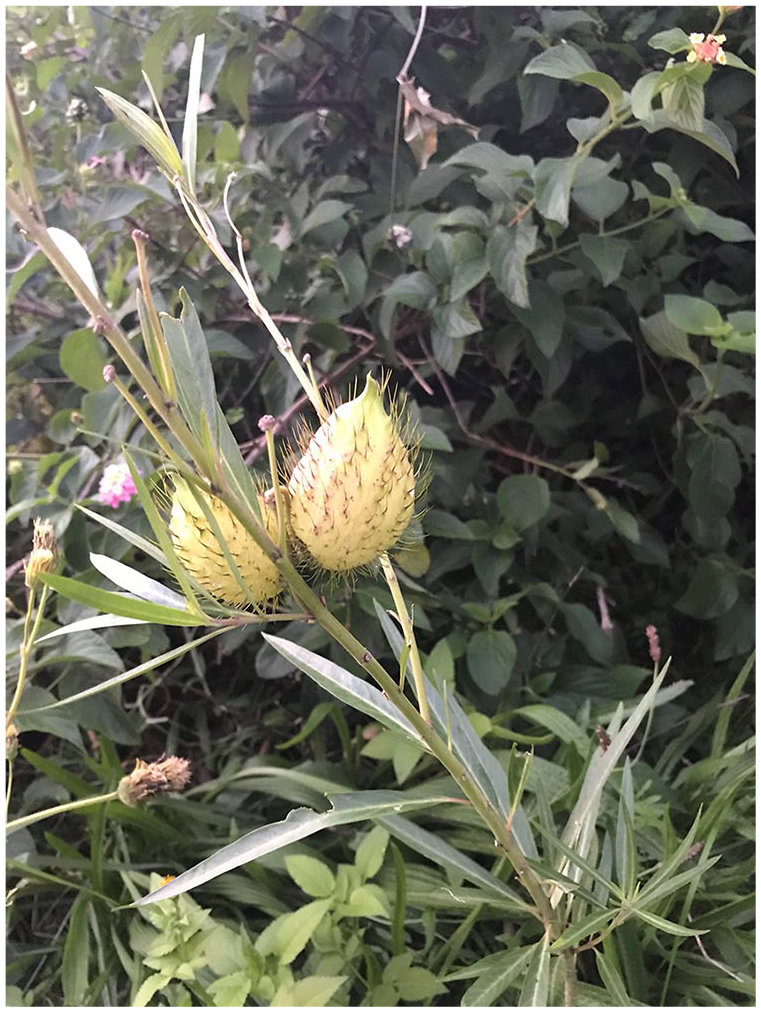
Narrow Leaf Cotton Bush (Gomphocarpus fruticosus) growing near a paddock on the side of the road in the Shoalhaven area, not far from River. It is a small, upright shrub, and its stems and leaves contain a poisonous milky sap (Photo by Crystal Arnold).
The impact of the Narrow Leaf Cotton Bush is significant in terms of both ecological presence and medicinal utility. Born in the landscapes of southern and tropical Africa, Narrow Leaf Cotton Bush has travelled beyond its homeland alongside people, making appearances in north Africa, the Arabian Peninsula, southern Europe, (Goyder & Nicholas, 2001) and all over Australia (James & James, 2019). In Egypt, the Narrow Leaf Cotton Bush thrives in the Nile Delta, gracing the Mediterranean coastal region and the South Sinai. In Egypt, herke (Narrow Leaf Cotton Bush; Gomphocarpus fruticosus) (Muschler, 1912; Tackholm, 1974) has a history steeped in medicine. This resilient plant has been trusted by the people of Egypt for health and healing, just like Snake. In addition, in the heart of tropical Africa, it has been revered for its ability to treat an array of ailments, from malaria and diabetes to asthma, bronchitis, and cardiac palpitations. Furthermore, recent pharmacological studies have confirmed that Narrow Leaf Cotton Bush contains compounds with immunomodulatory and anti-inflammatory effects, particularly in relation to the treatment of inflammatory diseases (Du Preez et al., 2020). It also doubles as a diuretic and has found a place in the treatment of anthrax in cattle (Burkill, 1937/1985). Across the Arabian Peninsula, Narrow Leaf Cotton Bush has become a vital element of Indigenous remedies. It is a valued resource for addressing a variety of health concerns, including tumours, skin diseases, scabies, and itching (Mothana et al., 2014). This remarkable plant, known by various names in different regions, holds a diverse history of medicinal uses. Narrow Leaf Cotton Bush yarns with me to share how it holds gifts, is resilient and adaptable, and has had a profound impact on the wellbeing of the people and animals that share its habitat.
The dual nature of weeds: medicine, poison, and Healing on Country
Plants hold deep medicinal and cultural significance for Aboriginal people (Turpin et al., 2022), often embodying a paradoxical duality, much like Snake. Medicine, when applied correctly, can act like a potent poison, targeting and removing harmful elements in the body, just as venom does in its natural form. This duality, where healing and harm coexist, is fundamental to understanding the nature of plants, particularly weeds, within Aboriginal knowledge systems. Just as Snake embodies both medicine and danger, plants, too, hold the power to heal or harm depending on how they are understood and used. This understanding of duality is key when working with weeds like Narrow Leaf Cotton Bush, which have both beneficial and toxic attributes. After yarning with Narrow Leaf Cotton Bush, I yarned with a Nunji Gurrungutti (Aboriginal peoples from the South Coast of New South Wales, Australia) man, Graham, about weeds and the medicinal properties plants hold. Graham did not have stories about Narrow Leaf Cotton Bush, but he did share a story about how plants from other places can be gifted to people for medical uses.
Aboriginal people have used plants for millennia to heal people (Clarke, 2008). Graham explained that his Ancestors had been gifted Gukwonderuk (Old Man Weed; Centipeda cunninghamii), native to Australia and found on the coast in the north of New South Wales. Gukwonderuk was: Utilised as a medicine, with three other plants. Now when you mix the three other plants, it is going to clean your blood. So, like poison. So, they knew that. (Graham)
In this quote, Graham illustrates the paradoxical nature of medicine and poison. In the context of healing, medicine often operates like a potent poison, targeting and removing infections within the body’s system. According to Graham, it functions as a cleansing agent, purifying the blood and expelling any toxic elements. As for the three additional plants that Graham alluded to, the deliberate exclusion of their names in this article is necessary due to cultural protocol that safeguards Country, Graham, and his people. Graham continues: Other plants, they use that can be good for your heart, for your liver, for your blood. I mean, they are in this together. So, in other words, Lyme disease, there was no such thing here. They knew what to do and how to clean the poisons out of your blood systems.
According to Graham, the Old People had effective treatments for ailments like Lyme disease before colonisation. This does not mean they were never infected, but rather that they knew exactly which plant to use for each specific illness. They understood which medicines were needed to cleanse the body of harmful poisons and maintain health. Within this understanding, illness is not always seen as a separate category from poison. Both can be understood as forms of imbalance, whether physical, emotional, or spiritual, that disrupt the harmony between body, spirit, and Country. The concept of poison carries layered meanings, referring not only to toxins but also to harmful energies or disturbances.
Aboriginal cultural knowledge holders utilise plants both to heal individuals and to heal the land, reflecting a deep cultural knowledge of medicinal applications (Ens et al., 2017). This knowledge includes understanding the ecological impacts of various plant species, such as the Narrow Leaf Cotton Bush, which was considered but ultimately not identified as a weed of national concern in Australia (WoNS). Despite not being classified as a WoNS, it remains a plant of potential concern (Weeds Australia, 2023). This species is invasive in regions like Western Australia, New South Wales, Tasmania, Victoria, and Queensland, where it forms dense colonies that disrupt native habitats. It thrives in grasslands, open woodlands, and disturbed areas, including near River, where it creates thickets that suppress the growth of native plants and encroach upon conservation areas. Thus, the story of Narrow Leaf Cotton Bush includes both its medicinal benefits and its capacity for ecological harm, demonstrating its dual role as both healer and disruptor.
Plants that disrupt ecosystems frequently exhibit protective or toxic characteristics (Maguraushe, 2017). After I looked, and listened, I began to see (Harrison & McConchie, 2015) what Country was sharing about medicine, poison, and ecological damage. I yarned with Narrow Leaf Cotton Bush, and a strong message of protection and defence came through. I could see it had a strong intention to live. The Narrow Leaf Cotton Bush possesses certain characteristics that offer protection. I was called to, that is, felt an urge to, pull them out from River. As I pulled, I saw its milky white substance leak out like the venom from Snake. Like other milkweed species, it contains toxic compounds called cardenolides, which can be harmful. When they attempt to feed on the plant, animals may experience toxicity or digestive disturbances due to these compounds (Maguraushe, 2017). Narrow Leaf Cotton Bush has evolved to mimic the appearance of other less toxic or non-toxic plant species (Maguraushe, 2017). This mimicry can deter herbivores that have learnt to avoid plants with similar appearances. In addition, I observed its physical defences, such as the narrow leaves, that may provide some protection against herbivores as they are less palatable and harder to consume compared to broader, softer leaves.
There are both physical and chemical forms of protection from threats, and through reflecting on my observations, I came to understand the relationship and collaboration between people and the Narrow Leaf Cotton Bush. The latex produced by the Narrow Leaf Cotton Bush acts as a form of protection, containing toxic compounds that deter herbivores, much like how Snake uses venom to defend herself. Snake, as a guide in this journey, teaches us that the dual nature of protection and harm is intrinsic to survival. Just as Snake uses her venom when needed, the Narrow Leaf Cotton Bush defends itself with its toxic latex, embodying the balance between healing and harm. Humans, while not producing latex, employ various irritants like pepper spray, tear gas, or chemical deterrents to fend off threats, mirroring Snake’s venom and the plant’s defences. The narrow leaves of Narrow Leaf Cotton Bush offer additional physical protection against herbivores, just as human defences like skin, skull, and bone structure protect vital organs. Snake’s movements remind us that these defence mechanisms, whether in plants or people, have evolved over time to counteract environmental threats. Just as Snake guides the balance between healing and harm, so too do these mechanisms, which ensure survival and health in both the human and nonhuman worlds.
The disruptive and damaging effects of human behaviours, similar to those of invasive plants, necessitate a deeper examination of our own impact on Country. In a yarn with Ron, a Jerrinja (Aboriginal people whose lands encompass the South Coast of New South Wales, Australia) man, he expanded on this relationship and shared an analogy, equating humans to weeds, and talked further about this relationship. He stated, “Well, we are weeds too! We are. We act as weeds. The damage that we do is probably worse than weeds” (Ron). Ron’s observation highlights the potentially poisonous qualities inherent in human behaviour. In his view, the harm inflicted by humans upon Country may surpass that caused by weeds. Ron’s point underscores the need to reflect not only on the detrimental effects of invasive plants like the Narrow Leaf Cotton Bush but also on our own potentially toxic actions.
However, it is crucial to recognise that the significant decline in medicinal native plants has had a profound impact on Aboriginal cultural practices and medicinal knowledge. I yarned with participant Alex, a Darug Boorooberongal (a clan of the Dharug Nation—Aboriginal peoples of the Hawkesbury and Nepean regions of Sydney, New South Wales, Australia) man who works on Jerrinja Country at River and is engaged in preserving cultural knowledge. There has been a gradual disappearance of Indigenous plants—a loss not only of botanical diversity but also of cultural practices tied to these plants. The waning presence of native plants directly impacts the ancient culture of Aboriginal communities, particularly in their use for medicinal remedies and health care. Alex has been tracking the loss of native plants. Alex explained: I am starting to see a lack of those types of plants, that are supporting cultural practices and remedies that are supporting health and wellbeing.
This quote from Alex underscores the connection between the loss of native plants and cultural knowledge that has sustained health for generations. His research conducted with Elders has documented cultural practices aimed at preventing ailments like colds and aiding diabetes. Alex is observing a concerning decline in the availability of these vital plants, which threatens both the cultural practices and the health-supporting remedies they are tied to.
Grandmother moon
Snake now looks up from River, towards Sky Country and teaches us about the significance of Grandmother Moon. Beyond consideration of medicines and poison, there are additional entities relevant to Yuin understandings of the health of Country and managing weeds. In many Indigenous cultures, the moon is believed to play an important role in plant growth (Balick et al., 2024; Hossain & Begum, 2015) and healing the environment (Kimmerer, 2013). Yuin people know the moon as Grandmother Moon (Harrison & McConchie, 2015), who is in relationship with Mother Earth and the universe at large.
Willow tree
To introduce this relationship and its relevance to healing and weed management, I begin with a poem I wrote to ground you in the connection between Grandmother and a weed, the Willow (Salix spp.) Tree.
Willow tree poem
Beneath Grandmother Moon’s gentle rays,
Willow Tree stands strong during each phase.
Growing within River’s flowing embrace,
Willow is grounded in place.
With drooping branches and leaves so green,
They damage River and make a scene.
Willow knows the knowledges of tides,
As Grandmother Moon pulls with strides.
Once brought to this land,
As an answer to erosion’s expanse.
Willow’s roots sought a new embrace,
In River’s soil, they took their place.
Yet, as time revealed Willow’s truth,
The damage to River was huge.
Shade darkened River’s flow,
Impacting life both high and low.
But Grandmother Moon, does not divide,
She still gifts Willow the tides.
For in the shade, wildlife finds a retreat,
Shelter from Grandfather’s heat.
As Grandmother bathes them in light,
Willow’s branches sway through the night.
In this celestial connection, a dance is spun,
Between Grandmother Moon and Willow, as one.
This poem weaves together elements of Country, history, and spirituality. It emphasises the importance of understanding and respecting the relationships between different elements of Country, with Grandmother Moon as a central guiding force. Grandmother and her connection to plants, water, and the environment are significant in weed management and healing for the self and Country. Grandmother is understood to be in sync with a plant’s growth because of her effect on the Mother—Earth. One of the main ideas behind lunar gardening, for example, is that the moon’s gravitational pull affects the Earth, including its water bodies and groundwater levels. Grandmother’s gravitational pull creates tides in oceans and seas due to the water’s fluid nature. Specifically, lunar weeding recommends removing weeds during the waning moon—the period after the full moon and before the new moon. Proponents of lunar weeding suggest that the moon’s gravitational forces might also influence the moisture levels in soil, impacting plant growth (Kimmerer, 2013). This aligns with some Indigenous knowledge systems, which suggest that working in rhythm with lunar and seasonal cycles can enhance outcomes in land care, including weeding.
Willow Trees help us understand that relationship. Like Snake, Willows are influenced by environmental factors, including lunar cycles, which can impact their growth and development. Grandmother Moon’s gravitational pull tides influence water tables and soil moisture levels, potentially impacting Willow Trees on the riverbanks. During my fieldwork, I observed Willow Trees and yarned with them. I observed their slender leaves and drooping branches. Willow Trees are native to the northern hemisphere and travelled to Australia in the late 19th century (Gehrig, 2010). Initially, they arrived as ornamental plants, adorning the landscape with their branches and foliage. However, people soon observed the consequences of heavy hooved animals on Country, and they were enlisted to assist with a pressing environmental challenge—to help heal the riverbanks and prevent erosion.
Willows, with their robust root systems, were considered a natural healing solution to stabilise the banks of Australia’s waterways (Abernethy & Rutherfurd, 1998). Their arrival held hope in the ongoing issues of erosion. Yet, as time unfurled, Willows revealed a more complex story. Their adaptability and resilience led them to spread along waterways throughout temperate Australia. Their expansive canopies cast shadows over rivers and streams, blocking the sunlight and cooling the water temperature. This alteration of the aquatic environment had cascading effects. One of the well-documented harms of Willows is the shedding of all their leaves into the water at once (Weih, 2009). This habit not only reduces water quality but also decreases the amount of food available for the aquatic inhabitants. In the heat of summer, their dense shading hinders the growth of algae (McInerney, 2016) on River’s surfaces—a crucial food source.
Willows require a lot of water from River and outcompete the local native plants. The very purpose for which they were introduced, to heal an environmental issue, resulted in significant harm due to a loss in biodiversity. Recognising the adverse impacts of Willows on aquatic ecosystems, the government invested in their removal (McInerney & Doody, 2021). However, as the effects of climate change loom, freshwater life faces new and formidable challenges. Rising temperatures pose a threat to the temperature-sensitive animals and aquatic life that have survived among the Willows, leaving them with limited options: migrate upstream to cooler waters or adapt to the warming conditions.
Despite their significant effects on aquatic life, Willows have healing gifts to offer Country, including the people. As the frequency of extreme heat days increases, their capacity to provide shade and mitigate water temperature can cool the warming River which can lead to healing. Snake uses Willows as a refuge from predators and the heat. This story of Willows on River is a reminder that every element in Country, including Grandmother Moon and Snake, has multiple roles and impacts. Thus, addressing the ability of invasive plants, such as Willow, to heal Country requires an understanding of the diverse relationships within Country.
Removing Willow Trees as part of efforts to heal the land presents significant challenges. In Tom’s role as a senior weed manager, he has had to remove Willows: There is no way you could kill a Willow without glyphosate. There’s a technique and how you axe cut a Willow so the poison can go down to the roots and up to the foliage. There’s a certain thing, how you gotta cut the axe into the sapwood and squirt the poison and you have gotta leave an inch and a half gap so that the poison can circulate through the tree. You just can’t ring bark it.
Tom emphasises that eliminating Willow Trees using glyphosate herbicide requires a specific technique. The technique involves carefully axing the tree to allow glyphosate to reach both roots and foliage. The process includes cutting into the sapwood, applying herbicide, and leaving a gap for circulation. Tom contrasts this method with less effective approaches, highlighting the precision needed for successful removal. For true land healing, Tom illustrates how it is essential to align and include all elements, such as environmental and celestial factors, to ensure a holistic and effective approach.
Water
Many Aboriginal people hold true to the idea that celestial forces affect both Country and personal consciousness. During this analysis of healing and weeds, I had a Travel that gave me a strong message about the significance of the moon while I was writing this section: I looked up into the sky, and there were three full moons. The gravitational pull was so intense that it pulled me off the ground towards it. I saw tides moving rapidly but did not feel afraid. When I got too high, I closed my eyes, and I woke up. (Field notes, February 23, 2021)
The Travel recounted here represented the mind, body, and spirit, signalled by the three moons. It was an intense teaching, as I was being awakened by being lifted off the ground and pulled towards Grandmother. The gravitational pull, like the movement of Snake through the water, was smooth yet powerful, and Country told me in the strongest possible way that I needed to pay attention to Grandmother. The intense gravitational pull and water felt within me cemented my observations that water is connected to Grandmother and healing and this research project on weeds.
To heal Country, we must consciously be in a relationship with Country (Taylor-Bragge et al., 2021), including the lunar cycles, water dynamics, and plant growth. The connections with water and weather cycles, reflect the understanding that reconnecting with Grandmother’s influence can help create more connected and culturally respectful weed management that benefits both the environment and human communities. In this way of thinking, it is necessary to prioritise environmental protection and accountability for ecological harm, ultimately healing the relationship between humans and the earth. Tom unpacks further: There is not another creature on earth, not even a water molecule not in tune with the lunar cycle. And yet even our bodies aren’t, cause we are 70 percent water, but for some reason, when it rains, because of the way we live in the western world, have just been turned off to it. And I think that this allows for a lot of crimes to happen against nature. I mean, nowadays, a corporation or whatever can commit horrendous crimes against nature and against Country, and they find that if you commit a crime against a human, then you do time.
As Tom notes, even though our bodies are composed of up to 70% water (Munteanu et al., 2021), we have become disconnected and unaware of this natural rhythm, particularly in the western world. According to Tom, this disconnection is seen to be a result of our modern lifestyle and societal attitudes. Tom’s reference to rain highlights how people in the western world have become turned off from recognising the significance of natural processes like rain. This disconnection from natural phenomena is attributed to how people live, indicating a shift away from an intimate relationship with Country.
An intimate relationship with Country includes recognising that elements such as water, fresh or salt, and Grandmother Moon shape us and all of Mother Earth’s beings. In my yarns with Graham, he reminded me to include everything on Country, including the moon, when considering weeds: Well, you know it has the effects on water and your body as well. Mmm hmm so your moods and changes and everything else happens with the moon. The full moon, blood moons, those extraordinarily large moons, close to the earth et cetera et cetera. But it is also to do with the plant systems. Because you know, and I know, if you put a stethoscope onto a tree, you can hear the water moving up the stems.
Here, Graham underscores the often-overlooked celestial influence on plant life and the profound connection between Grandmother Moon and plant behaviour. Just as Grandmother’s gravitational pull affects tides and can impact water systems, it also plays a role in shaping plant growth and vitality. During my fieldwork, I was reminded how River revealed the impact of tidal forces, governed by Grandmother Moon, becomes most apparent here at Shoalhaven Heads. This experience illuminated the intricate relationships between celestial rhythms, water systems, and the vitality of plant life, demonstrating how these elements contribute to healing.
Weaving together insights for holistic weed management and Healing on Country
Snake has guided this research by reminding us that healing is not a straight path but a winding journey—one that demands attentiveness, respect, and reciprocity with all elements of Country. Her fluid and deliberate movements through land and water reflect the necessary approach to weed management: not linear or combative but adaptive, aware, and responsive. Just as Snake navigates with care and intention, this research illustrates how weed management can become healing when grounded in Country.
Yarning with both human and nonhuman participants reveals that successful weed management requires more than technical expertise. It demands an ongoing, reciprocal relationship with all elements of Country, acknowledging their agency and contributions to ecological well-being. Grandmother Moon, whose gravitational pull shapes the tides of River and stirs the lifecycles of plants, teaches that cycles are part of this ongoing reciprocal relationship. Her influence reminds us that the work of healing must be aligned with the energies and seasons of Country, not imposed upon it. Maintaining a reciprocal relationship with Country means engaging in ongoing dialogue—with plants, with place, and with community—through yarning, observation, and actions grounded in respect, responsibility, and cultural guidance. It is not a fixed method, but a living relational ethic shaped by Country’s needs. These insights acknowledge that Country can guide weed management practices that are attuned, accountable, and grounded in cultural and ecological respect.
This research contributes to the literature by weaving together insights on the dual nature of invasive plants with the role of Indigenous knowledge in environmental management, enriching the conversation (Bach & Larson, 2017; Henri et al., 2021; Johnson et al., 2016; Reo & Ogden, 2018; Wehi et al., 2021). Focusing on species such as Narrow Leaf Cotton Bush and Willow Trees, and working in rhythm with River at Shoalhaven Heads, this study illustrates how plants typically classified as invasive can simultaneously be damaging and medicinal. For example, although Narrow Leaf Cotton Bush contains toxic cardenolides, it is also used in traditional medicine to treat skin diseases and tumours (Maguraushe, 2017; Mothana et al., 2014). This coexistence of harm and healing is mirrored in Snake’s venom. Rather than approaching invasive species solely as ecological threats, this research recognises the relational roles of plants within Country. When managed with care, attentiveness, and respect, even plants deemed harmful can contribute to the broader work of Healing Country.
The key contribution of this research lies in demonstrating that Aboriginal weed management practices are fundamentally about Healing Country, holistically. In practical terms, holistic weed management is relational, reflective, and responsive to the specific context of Country. Rather than focusing solely on control, it involves observing how weeds interact with other entities, what their presence signals about soil health, disturbance, or past trauma, and working with that knowledge in culturally respectful ways. For example, managing Willow Tree might include careful removal guided by seasonal cues, followed by revegetation with culturally significant native plants, and ongoing ceremony or care. However, not all methods of weed removal support healing; practices such as broad-scale mechanical or chemical clearance without restoration can cause further harm to Country. In contrast, the principles of a Healing Country approach—care, oneness, and relational responsibility—offer a more grounded foundation for collaborative relationships between Aboriginal communities, policymakers, and land managers. Rather than prescribing fixed solutions, this approach calls for a paradigm shift to Country-centred ethics and relational accountability. It invites policy and practice to be reshaped by Indigenous ways of knowing, allowing space for community-led restoration and reciprocal research. The proposed paradigm shift is not a new technical toolkit, but a shift in foundational values and approaches, from control to healing, relationship, and co-existence, where appropriate (Atchison et al., 2024).
Conclusion
Snake’s journey teaches us that healing requires fluidity, awareness, and respect for all relationships—human and nonhuman, visible and unseen. For conventional weed managers seeking to incorporate a Healing Country approach, the first step is to build genuine, long-term relationships with local Aboriginal communities and knowledge holders, guided by protocols of respect, reciprocity, and consent. This includes acknowledging Country as a living entity and recognising the authority of Elders and cultural custodians. Managers should approach weed management not as a task of control, but as an opportunity to listen to Country, observing signs, patterns, and changes, and co-design actions that are context-specific and culturally informed. Weaving Aboriginal knowledge requires moving beyond consultation towards co-stewardship, where multiple knowledges are held in relational tension rather than hierarchy (Johnson et al., 2016). This might involve seasonal monitoring grounded in cultural calendars and adopting a slower, place-responsive pace of management. While this article does not prescribe a one-size-fits-all model, it offers a conceptual foundation for shifting weed management to a relationship-based practice of listening, responsibility, and healing. When guided by Healing Country, tending to weeds becomes more than management; it becomes ceremony, reawakening the ancient kinship that binds land, Snake, water, spirit, and story.
Footnotes
Acknowledgements
I extend my deepest gratitude to Country—particularly River, weeds, and Elder Uncle Max, who, though now in spirit, continues to teach me. Their challenging yet enriching lessons have profoundly shaped this paper. I also acknowledge all my mentors who guide me in many ways.
Author’s note

Ethical considerations
This study was approved by the University of Wollongong Human Research Ethics Committee (HREC), reference 2020/438. All research procedures adhered to the ethical standards outlined by the HREC, prioritising the protection, confidentiality, and wellbeing of participants at every stage of the project. Participants consented to participation verbally and/or with a written consent form. Some names have not been disclosed as per requested by the participants.
Consent to participate
I shared four participants quotes in this study.
Graham—a weed manager gave verbal consent that was recorded. He gave permission for his real first name and mob to be shared.
Ron—signed a written consent form. He gave permission for his real first name to be shared and his mob.
Tom—has a pseudonym as requested and gave verbal consent that was recorded.
Alex—gave verbal consent that was recorded. He gave permission for his real first name to be shared and his mob.
Consent for publication
Submissions containing data from Ron, Alex and Graham has some details about their identity such as their clan, mob or Country and their real first names are used. Tom has a pseudonym. I gained verbal consent from participants the information they shared would be published. Non-essential identifying details are omitted.
Funding
The author disclosed receipt of the following financial support for the research, authorship and publication of this article: This research was partially supported by the Australian Academy of the Humanities, John Mulvaney Special Commendation Award.
Declaration of conflicting interests
The author declared no potential conflicts of interest with respect to the research, authorship and publication of this article.
Glossary
Anishnaabe Indigenous people in the Great Lakes region, Canada and USA
Bardi-Jawi Aboriginal people whose lands are on the northern Dampier Peninsula and includes sea Country and the islands immediately to its north and east, Kimberly, Western Australia
Bunuba Aboriginal people whose lands span the Fitzroy River and the King Leopold Ranges, Kimberley, Western Australia
Darug Boorooberongal a clan of the Dharug Nation—Aboriginal peoples of the Hawkesbury and Nepean regions of Sydney, New South Wales, Australia
Gukwonderuk Old Man Weed; Centipeda cunninghamii
Gundungurra Aboriginal peoples in south-eastern New South Wales, Australia.
herke Narrow Leaf Cotton Bush; Gomphocarpus fruticosus
Jerrinja Aboriginal people whose lands encompass the South Coast of New South Wales, Australia
Ngurrara Aboriginal peoples are from the Great Sandy Desert, central Pilbara and southern Kimberley, Australia
Nunji Gurrungutti Aboriginal peoples from the South Coast of New South Wales, Australia
Nyikina Mangala rangers based at Jarlmadangah, whose work focuses around the Fitzroy River, Western Australia
Wunggurr rangers who work on Wilinggin Country on behalf of the Ngarinyin—An Aboriginal people, Kimberley region, Western Australia
Yuin Aboriginal people, consisting of many clans, whose lands extend from the south coast of New South Wales, to the Victoria, Australia