



Abstract
Despite Aboriginal parents and their children being identified as a health priority group, culturally relevant parenting support is scarce, particularly support that is tailored for Aboriginal fathers. This article reports the systematic cultural adaptation of the Healthy Dads Healthy Kids programme for Aboriginal fathers and their children living on Darkinjung Country, Central Coast of New South Wales, Australia resulting in the development of biya yadha gudjagang yadha: Healthy Dads Healthy Mob. This study highlights the need for parenting programmes involving Aboriginal participants to include Aboriginal-led cultural governance, comprehensive codesign with local Aboriginal communities, and for the knowledges, experiences, and values of local communities to be centralised in the development of culturally responsive parenting programmes.
Introduction
In Australia, Aboriginal men are nearly three-times more likely to develop cardiovascular disease than non-Aboriginal men (Australian Institute of Health and Welfare, 2023) and have an average life expectancy that is a decade shorter than non-Aboriginal men (Australian Bureau of Statistics, 2022). Aboriginal children typically exhibit higher physical activity levels than non-Aboriginal children during early childhood and adolescence; however, this trend is reversed in adulthood, where increased sedentary behaviour elevates the risk of chronic disease and contributes to disproportionately poorer health outcomes among Aboriginal adults (National Indigenous Australians Agency, 2017). While health data relating to Aboriginal people is often reported, the sociocultural determinants that impact the health and well-being of Aboriginal people are rarely considered (Stevens et al., 2017), and the important link between culture, health, and well-being is often overlooked (Salmon et al., 2018). In this context, it is unsurprising that Aboriginal people are reporting that they are not receiving culturally appropriate care (Smith et al., 2017).
Despite the Australian Institute of Health and Welfare identifying Aboriginal parents and their children as a health priority group (Australian Institute of Health and Welfare, 2024), there is a dearth of culturally relevant parenting support available (Canuto et al., 2018), particularly parenting programmes that engage Aboriginal fathers (MacDonald et al., 2024). In a recent scoping review of 109 randomised trials that evaluated parenting programmes in Australia (MacDonald et al., 2024), less than 1% of participants were reported as Aboriginal or Torres Strait Islander. Furthermore, only two studies reported consulting with Aboriginal and Torres Strait Islander people in programme design, and no studies reported the involvement of Aboriginal or Torres Strait Islander fathers. The lack of involvement of Aboriginal fathers in Australian parenting studies indicates there is a need for culturally responsive parenting support that is tailored for Aboriginal men (MacDonald et al., 2024). This is particularly important given fathers’ influential role on the health behaviours and outcomes of children (Young & Morgan, 2017).
The health and well-being of children are closely linked to parental relationships (Lamb & Lewis, 2013), with increasing evidence indicating that fathers play an important role in shaping child physical activity behaviours (Young & Morgan, 2017). Co-physical activity between fathers and children is associated with improved child social-emotional well-being among a range of health benefits for both father and child (Pollock et al., 2020). However, a systematic review conducted by Morgan et al. (2017) found that a lack of father participation in parenting trials was a global issue with authors calling for more gender-tailored parenting support that engages men.
Healthy Dads Healthy Kids (HDHK) was the first healthy lifestyle programme specifically designed for fathers and their primary-school aged children globally (Morgan et al., 2011). The HDHK programme has reported weight loss in men (Morgan et al., 2011), increased physical activity levels in children (Morgan et al., 2014), and has reported a positive impact on the father-child relationship (Ashton et al., 2024). During the programme, participants take part in an education and practical session once a week over a 9-week period (Morgan et al., 2011). The education sessions are themed, with a new health-related topic covered each week, while the practical sessions have three components; rough-and-tumble play, sport-skills, and fitness (Morgan et al., 2014). After previous trials confirmed that the programme leads to a host of positive health-related outcomes for both fathers and their children (Morgan et al., 2011), HDHK has now been adapted for a range of unique contexts around the world, including a cultural adaptation for Hispanic families in the USA (O’Connor et al., 2020). However, a comprehensive and systematic cultural adaptation process to meet the needs of Aboriginal families has not been conducted to date.
This study and its methodological approach was informed by previous formative research which involved yarning with Aboriginal fathers and father-figures living on Darkinjung Country, Central Coast of New South Wales, Australia to better understand their roles, experiences, and needs. Findings from this research have previously been reported (MacDonald et al., 2025). Although the roles and experiences of Aboriginal fathers living on Darkinjung Country have been explored, there is still a need to report on a culturally responsive adaptation process that was codesigned with members of the Darkinjung community—the Aboriginal population living on Darkinjung, resulting in the development of this study. Aboriginal people have the right to self-determination, and the right to participate in decision-making in matters which affect their rights (United Nations, 2008). Furthermore, Aboriginal-led cultural governance structures are needed for health research to be adapted for Aboriginal people (Duke et al., 2021), and health education programmes are more effective when they are culturally relevant for the populations they serve (Kreuter et al., 2003), including the evaluation of programmes using culturally appropriate methods (English et al., 2022).
We believe that privileging the voices of Aboriginal fathers, Aboriginal-led cultural governance, and a culturally sensitive framework for adaptation combined with the promising results of the original HDHK programme, can create a programme that is culturally relevant for Aboriginal fathers and their children and produce positive health and well-being outcomes. Therefore, the aim of this article is to report the process, and outcomes of a systematic approach used to culturally adapt HDHK for Aboriginal fathers and their children living on Darkinjung Country.
Methods
Positionality
It is important to identify the relationality of our research team as a fundamental element of Indigenous research practice (Moreton-Robinson, 2017). Authors include Aboriginal researcher leaders JM, NT, and KB, and non-Aboriginal researchers with expertise in family-based health and well-being programmes MY, BB, LA, and PM. Further information on the cultural background of the research team can be found in the Authors’ note section.
Ethics
This research was approved by the Aboriginal Health & Medical Research Council of New South Wales Ethics Committee, Application ID: 32414513, and registered with the University of Newcastle Human Research Ethics Committee (H-2023-0137), and the Australian New Zealand Clinical Trials Registry (ACTRN12623000901606). The cultural adaptation of HDHK for Aboriginal fathers and their children living on Darkinjung Country took place over a 17-month period between 1 April 2022 and 31 August 2023. In order to privilege the voices of Aboriginal fathers and to have Aboriginal-led cultural governance, the cultural adaptation process was guided by two distinct groups.
Cultural affirmation panel
The cultural affirmation panel consisted of eight stakeholders representing the local Darkinjung community, the University of Newcastle, and Eleanor Duncan Aboriginal Services. Eleanor Duncan Aboriginal Services, formally known as Yerin Eleanor Duncan Aboriginal Health Services, is the sole Aboriginal community controlled health service provider on the Central Coast region of NSW, Australia. All members of the cultural affirmation panel were Aboriginal, no participant identified as Torres Strait Islander. Some cultural affirmation panel members were Elders, and there was both male and female representation. The cultural affirmation panel provided cultural governance and informed the research process including the codesign of study methods, adaptation, and programme development.
Community panel
The community panel was recruited from the Eleanor Duncan Aboriginal Men’s Group, who the cultural affirmation panel considered the most appropriate group to engage with to develop a culturally relevant programme for local Aboriginal men. In total, 34 men participated across two community panel meetings. All members of the community panel identified as Aboriginal, no participant identified as Torres Strait Islander. All community panel participants were currently living on Darkinjung Country. All participants in the community panel were presented with a AUD $30 gift voucher per meeting.
Data collection
Prior to community panel meetings, all data gathering methods were codesigned and approved by the cultural affirmation panel. Data were collected using audio recording and field notes by JM and NT, who are both Aboriginal fathers and experienced facilitators. All members of the cultural affirmation panel and the community panel provided written informed consent to participate, consent was also confirmed verbally at the beginning of each meeting. All participants were informed that they could withdraw from the study at any time without having to give a reason and that this would not affect their relationship with the University of Newcastle, Eleanor Duncan Aboriginal Services, or the Men’s Group at Eleanor Duncan Aboriginal Services. It was agreed that data would be shared between the research team and Eleanor Duncan Aboriginal Services and securely managed using REDCap electronic data capture tools hosted by the Hunter Medical Research Institute which is a partner to the University of Newcastle.
Culturally sensitive adaptation
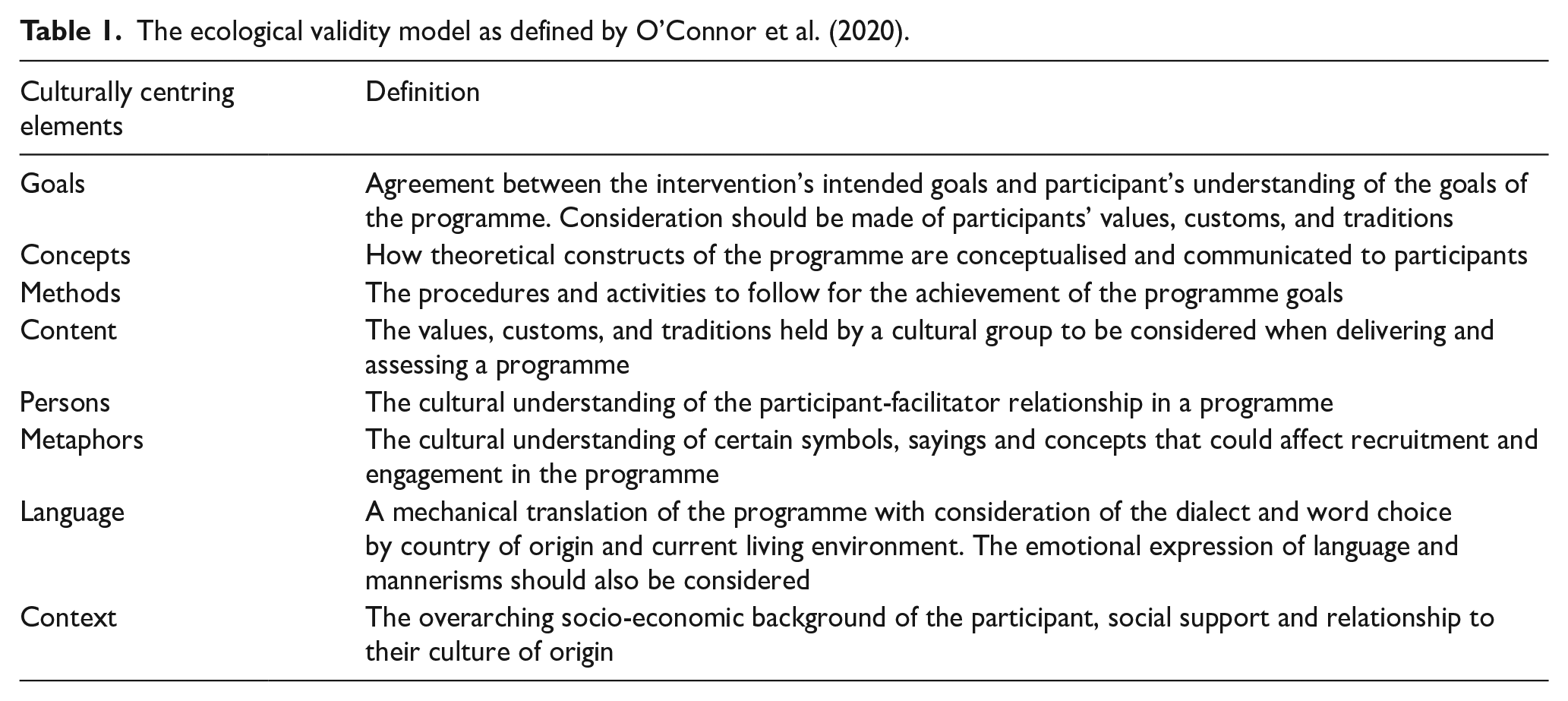
The Ecological Validity Model (EVM) was used to guide the cultural adaptation of HDHK for Aboriginal fathers and their children living on Darkinjung Country. The EVM is a framework used to guide the culturally sensitive adaptation of programmes for new population groups (Bernal & Sáez-Santiago, 2006). Table 1 presents the eight dimensions of the EVM described in a previous adaptation of HDHK for Hispanic fathers and their children in the USA (O’Connor et al., 2020).
The ecological validity model as defined by O’Connor et al. (2020).
Procedures
The cultural affirmation panel formally met three times, and the community panel formally met twice, resulting in five distinct codesign periods. An additional cultural affirmation panel meeting was scheduled post programme implementation to disseminate findings and debrief the research process. Figure 1 presents a flow-chart providing an overview of the codesign process.
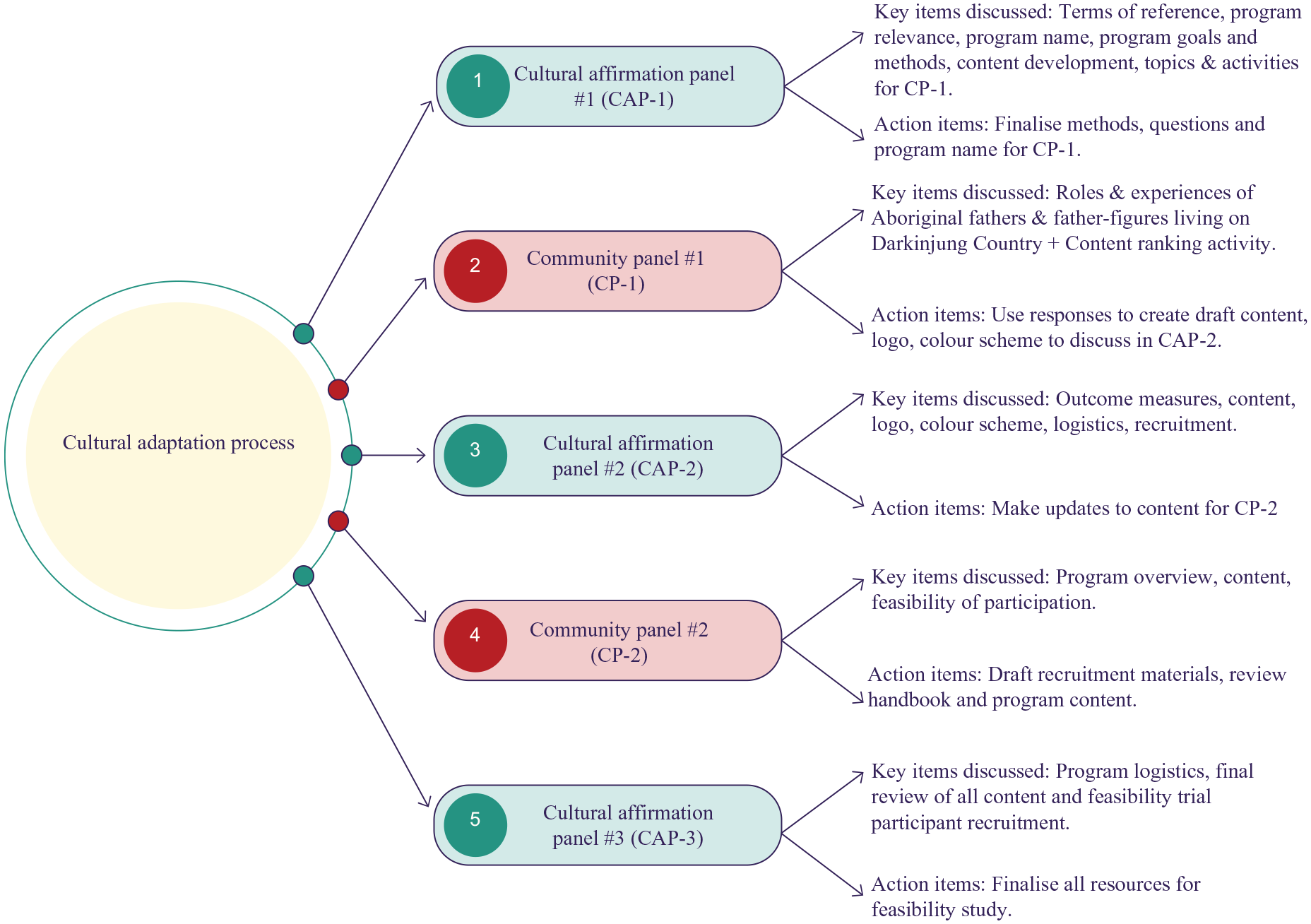
Codesign process flow-chart.
Results
An overview of resulting adaptations are presented in Table 2.
Cultural adaptation of biya yadha gudjagang yadha: Healthy Dads Healthy Mob.
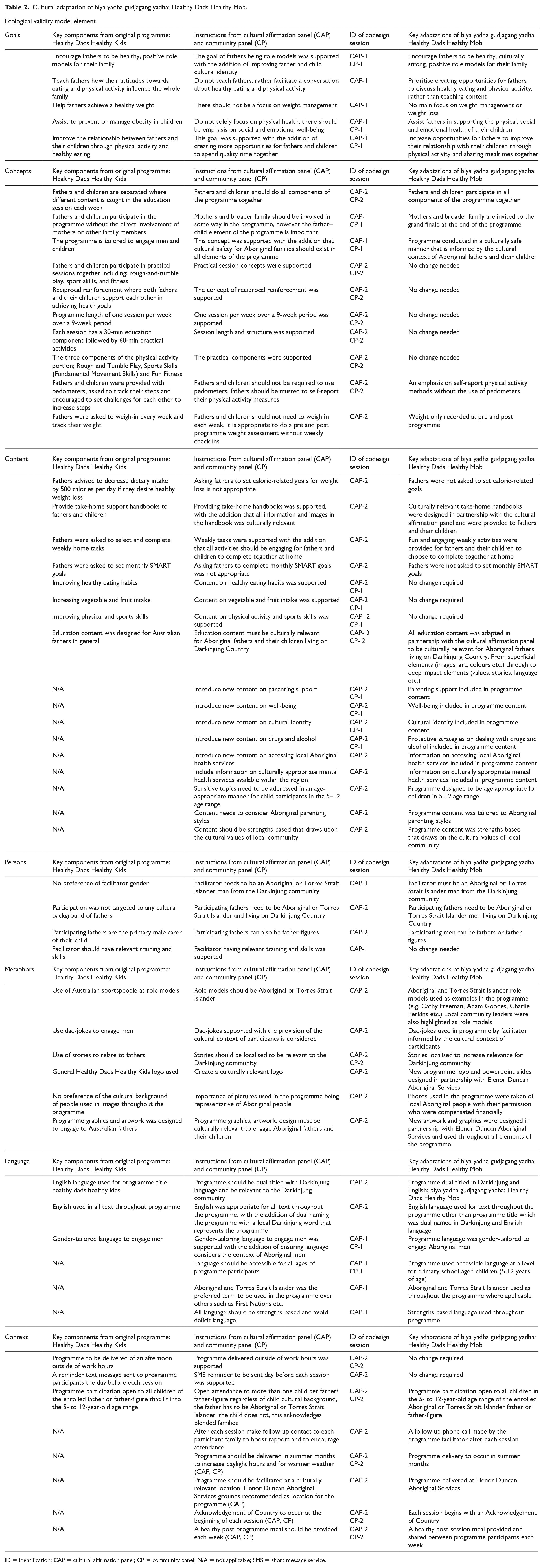
ID = identification; CAP = cultural affirmation panel; CP = community panel; N/A = not applicable; SMS = short message service.
Key adaptations listed in the results table are described with reference to each element of the EVM:
Goals
It was advised that physical goals such as weight loss should not be a focus of the culturally adapted programme, instead social and emotional health, including cultural identity should be prioritised. In the culturally adapted programme, there was no main focus on weight-management goals for fathers and children, however social and emotional health, including cultural identity were emphasised. It was also stated by the cultural affirmation panel it is inappropriate to teach fathers and children about health, rather a conversation on weekly health topics should be held. As a result, the culturally adapted programme included the facilitator hosting a conversation on weekly health topics where key points could be discussed among families.
Concepts
In the original HDHK programme, fathers and children are separated for the education component to learn age-specific information. It was recommended that all participants complete all aspects of the programme together. As a result, the separate education components of the programme were combined and adapted to be appropriate for children aged 5–12 years. The original HDHK programme was gender-tailored to engage men, while this concept was supported, it was advised that the unique cultural context of Aboriginal men needs to be considered throughout the programme. The cultural affirmation panel guided the adaptation process to ensure the programme was culturally relevant specifically for Aboriginal men and their children. Furthermore, in the original HDHK programme, mothers were not directly involved in the programme. It was advised that while it is important to maintain the father–child concept, mothers and the broader family should be included in some way. As a result, mothers and the broader family are invited to attend the last session of the programme where all attendees could participate together and celebrate the programme completion.
Methods
The cultural affirmation panel advised that the physical activities in the original HDHK programme were seen as universal and would apply to the context of local Aboriginal fathers and their children. The elements of rough-and-tumble play, sport-skills, and fitness were retained from the original HDHK programme. The original HDHK programme included take-home handbooks that had supporting information that aligned to information covered in each weekly session. Providing a take-home handbook was supported; however, it was advised that the handbook information needed to be culturally relevant for local Aboriginal fathers and their children. Information such as accessing local Aboriginal health services, Aboriginal specific parenting information, and culturally appropriate activities for fathers and their children to complete at home were designed in partnership with the cultural affirmation panel.
Content
The cultural affirmation panel and the community panel advised that the content included in the programme must be specific to the cultural context of local Aboriginal fathers and their children. Furthermore, it was made clear than an emphasis on reducing screen time was not as relevant in this context. The research team worked with the cultural affirmation panel and the community panel to review programme content and make necessary adaptations to ensure content was culturally appropriate. Furthermore, there were several themes that did not exist in the original HDHK programme that were advised to be included in the culturally adapted programme. Such themes included content on cultural identity, Aboriginal role models, managing the risks of drugs and alcohol, well-being, and specific parenting support for Aboriginal families. Furthermore, it was advised that the cultural values and experiences of local Aboriginal fathers and their children should be reflected in the culturally adapted programme content. As a result, the research team worked with the cultural affirmation panel and the community panel to codesign all content included in the culturally adapted programme.
Persons
In the original HDHK programme, there was no preference on the gender or cultural background of the facilitator provided they had relevant skills to facilitate the programme. It was advised that the programme facilitator had to be an Aboriginal or Torres Strait Islander man from the Darkinjung community. It was made clear that the facilitator had to be able to relate to participants, understand the lived experiences of local Aboriginal people, and able to navigate cultural nuances. As a result, it was decided that the programme facilitator must be an Aboriginal or Torres Strait Islander man from the local community. It was advised that participation should be open to both fathers and father-figures, as doing so acknowledges the communal constructs of child-rearing in Aboriginal and Torres Strait Islander communities which can include grandfathers, uncles, brothers, and Elders, among other kinship relationships. As a result, the culturally adapted programme was open to Aboriginal and Torres Strait Islander fathers and father-figures.
Metaphors
In the original HDHK programme, there was no preference of the cultural background of the people used as role models. It was advised that in order to increase relevance for programme participants, Aboriginal and Torres Strait Islander role models should be used. The research team worked in partnership with the cultural affirmation panel to identify appropriate Aboriginal and Torres Strait Islander role models to be used as examples in the culturally adapted programme. Furthermore, it was identified that local Aboriginal community leaders should be highlighted as role models as well. In the original HDHK programme, there was no preference of the cultural background of people used in programme images, it was advised that all photos in the programme need to be representative of Aboriginal people. As a result, new images were taken with the permission of local Aboriginal families that were nominated by the cultural affirmation panel who were compensated financially for their involvement. Furthermore, it was advised that the culturally adapted programme should have a new culturally relevant logo, design, and colour scheme. As a result, the research team worked with Elenor Duncan Aboriginal Services to create a new programme design, including a logo which was approved by the cultural affirmation panel.
Language
In the original HDHK programme, English was used in all text throughout the programme. It was advised that English language was appropriate to be used; however, the programme should be dual named in Darkinjung language. The cultural affirmation panel advised that the Darkinyung Language Group should be consulted to get advice and permission to use the provided terms. The Darkinyung Language Group consists of local Aboriginal knowledge holders who meet to discuss language-related matters drawing on previous work by (Jones, 2008). The Darkinyung Language Group was supportive of the research and advised that the programme should be titled biya yadha gudjagang yadha: Healthy Dads Healthy Mob. The proposed programme title was approved by the cultural affirmation panel. The original HDHK programme used gender-tailored language to engage men, while gender-tailoring language was supported, it was advised that the culturally adapted programme should use language that is tailored specifically for local Aboriginal men. In addition, it was made clear that all language should be strengths-based and avoid using deficit language throughout the programme. The language adaptation process occurred in partnership with the cultural affirmation panel.
Context
The original HDHK programme was conducted outside of regular working hours to increase participation of fathers who may have employment responsibilities. It was agreed that the culturally adapted programme should also be conducted outside of work hours; however, it was advised that the programme should occur in summer months to increase daylight and warmer weather. In the original HDHK programme, a reminder short message service (SMS) text message was sent to participants to inform them of the upcoming session each week. This process was supported; however, it was advised that an additional follow-up phone call should be made by the programme facilitator after each session to build rapport with participating men. Furthermore, it was advised that the programme location had to be culturally appropriate for Aboriginal fathers and their children, Elenor Duncan Aboriginal Services was recommended as the preferred location as it had appropriate facilities. It was also advised that at the conclusion of each weekly session, participating families should be provided with a healthy meal to eat together to build relationships between families involved in the programme. As a result, a healthy meal was provided each week in partnership with Elenor Duncan Aboriginal Services.
Discussion
The aim of this article was to describe the process and outcomes of a systematic approach used to culturally adapt HDHK for Aboriginal fathers and their children living on Darkinjung Country. This study combined the use of dimensions of the EVM, Aboriginal-led cultural governance, and local Aboriginal community codesign, resulting in the development of biya yadha gudjagang yadha: Healthy Dads Healthy Mob. Key adaptations in the new programme included themes such as cultural identity, well-being, and Aboriginal role models that did not exist in the original HDHK programme. The inclusion of new themes did reduce the focus on some of the original HDHK themes, and in some cases, original themes were omitted if considered inappropriate and replaced by culturally relevant themes as decided by the Darkinjung community. Programme goals and measures were also adapted to be culturally relevant to the Darkinjung community with father and child social and emotional outcomes being prioritised ahead of physical outcomes.
Aboriginal people have the right to self-determination and the right to participate in decision-making in matters that impact their health and well-being. It is important that the cultural affirmation panel was able to shape the research process, including having the autonomy to influence all elements of study design. Cultural governance ensured that community cultural protocols were followed and that all stakeholders involved had the ability to inform the programme. The cultural affirmation panel held the research team accountable to expectations of the Darkinjung community, and were able to mitigate risks that may have been unseen by the research team. Having the guidance and support of the cultural affirmation panel gave researchers permission to codesign with community while having the ability to consult at all stages of the adaptation process. Importantly, Darkinjung community members were partners in the research.
The knowledge and experiences of the community panel ensured that the perspectives of local Aboriginal fathers and father-figures were centralised in the cultural adaptation process. A communal approach to programme development ensures that individuals or small groups do not shape the research based off their own biases. It is important to honour and respect the time it takes to develop relationships with Aboriginal communities, and for local communities to inform the research based off their own values and lived experiences. Codesigning parenting research with local Aboriginal community members mitigates the risk that the programme is irrelevant or potentially harmful, as the community have been involved in the programme design. Furthermore, a codesign approach to Aboriginal parenting research strengthens programme legitimacy, participants of both the cultural affirmation panel and the community panel stated they were excited to share the programme with family and friends when the recruitment phase began.
Given the unique characteristics of this research process, direct comparison with other studies employing the EVM within Aboriginal community contexts in Australia is limited. However, the EVM was previously employed to culturally adapt the original HDHK programme for Hispanic fathers and their children titled Papás Saludables, Niños Saludables (Healthy Parents, Healthy Kids) in Texas, USA (O’Connor et al., 2020). While the same framework for adaptation was used for both studies, the programme development methods are considerably different. It is important to note the cultural context of Aboriginal fathers in Australia, and Hispanic fathers in the USA are dissimilar and require adaptation suiting their unique context, subsequently resulting in different methods and outcomes.
Both projects included a community panel of Aboriginal and Hispanic community members respectively, and a research team, this study also established a cultural affirmation panel to provide cultural governance and support the research team implement the recommendations of the community panel which did not occur in the USA. Research leadership between both studies were also different. In this study the lead author was an Aboriginal father from the Darkinjung community, whereas in the study conducted by O’Connor et al. (2020) in the USA, the lead author was a non-Hispanic woman who was not part of the Hispanic community. Both studies engaged a health service as the location for meeting, in this study, Elenor Duncan Aboriginal Services was utilised, in the USA two Texas Children’s Health Plan locations were used.
There were some unique differences in the adaptation outcomes when comparing biya yadha gudjagang yadha: Healthy Dads Healthy Mob in Australia, and Papás Saludables, Niños, Saludables, in the USA. In this study, themes such as cultural identity, well-being, and Aboriginal role models were included that did not exist in the original HDHK programme. In the USA, there was an emphasis on engaging fathers through machismo which is a type of male masculinity that did not appear in the original HDHK programme. There were also differences in programme goals and measurements, in this study, there was an emphasis on social and emotional health with the father–child relationship being prioritised, in the USA, there was an emphasis on weight-management and weight loss as an outcome, which was retained from the original HDHK programme. There are some core components of the original HDHK programme that are included in both studies which appear to be fundamental elements of the HDHK programme. These elements include gender-tailoring to engage fathers, father–child co-physical activity, practical activities such as rough-and-tumble play, sport-skills, and fitness, and take-home workbooks with supporting information. These core components may contribute to the success of the HDHK programme globally.
While the study methods described in this article have been designed to be culturally relevant for Aboriginal fathers living on Darkinjung Country, it is important to note that this exact process should not necessarily be replicated in any other Aboriginal community, instead this could be used as an example to inform future development of parenting support. Each Aboriginal community is different and while there may be some similarities across communities, there are also significant differences such as cultural protocols, knowledges, peoples, and experiences of colonisation. To develop parenting support that is responsive to the needs of local Aboriginal communities, it is important that meaningful relationships are formed, Aboriginal-led cultural governance structures are established, comprehensive community codesign takes place, and Aboriginal people lead the research.
This study had both strengths and limitations. Study strengths include Aboriginal-led cultural governance, a comprehensive codesign process facilitated by local Aboriginal community members, and Aboriginal leadership within our research team. Ensuring that the study was facilitated by local Aboriginal community members strengthened the research, facilitators were able to relate to the experiences of panel members and could understand and navigate cultural nuances that non-Aboriginal researchers may have been unaware of. Furthermore, as described by Vincze et al. (2021), sociocultural adaptation strategies are considered to have a deep sensitivity level, the use of local stories, values, and knowledges were important elements in culturally tailoring the programme to be relevant for Aboriginal fathers and their children living on Darkinjung Country. This study also had potential limitations. A behaviour change theory was not employed. Not using a behaviour change theory was a decision made based on the advice from the cultural affirmation panel who did not wish to predetermine a behaviour change process, instead opting for processes and outcomes to be entirely local Aboriginal community led. Furthermore, this study took place at only one location; therefore, this cohort may not have been representative of all Aboriginal fathers living on Darkinjung Country.
Conclusion
This article reports the systematic cultural adaptation of the HDHK programme for Aboriginal fathers and their children living on Darkinjung Country. Privileging the voices of Aboriginal fathers, Aboriginal-led cultural governance, and a culturally sensitive framework for adaptation resulted in the development of biya yadha gudjagang yadha: Healthy Dads Healthy Mob. This study highlights the need for parenting research involving Aboriginal participants to include Aboriginal-led cultural governance, comprehensive codesign with local Aboriginal community, and for the knowledges, experiences, and values of local communities to be centralised in the development of culturally responsive parenting support. Key themes such as cultural identity, well-being, and Aboriginal role models were included that did not exist in the original HDHK programme. Programme goals and measures were adapted to be relevant to the Darkinjung community valuing father and child social and emotional health ahead of physical measures such as weight loss. Future research is needed to evaluate the feasibility, acceptability, and preliminary efficacy of the culturally adapted programme biya yadha gudjagang yadha: Healthy Dads Healthy Mob. The next phase of this research is testing biya yadha gudjagang yadha: Healthy Dads Healthy Mob in a feasibility trial.
Footnotes
Acknowledgements
The authors acknowledge Darkinjung Country where this research took place. The authors acknowledge the cultural affirmation panel for their support and enriching perspective. Members of the cultural affirmation panel include Professor Uncle Bob Morgan, Belinda Field, Madelene Davy, Vicki Field, Lindsay Hardy, Kristy O’Sullivan, Ryan Field, and Kjyla Johnson. They also acknowledge the members of the community panel for their time, wisdom, and support of this research. They also acknowledg the Darkinyung Language Group for their support and permission to use Darkinyung language in the ‘biya yadha gudjagang yadha’: Healthy Dads Healthy Mob programme.
Authors’ note

Funding
The authors disclosed receipt of the following financial support for the research, authorship and publication of this article: This study was supported by the National Heart Foundation of Australia Vanguard Grant (award ID—106031).
Declaration of conflicting interests
The authors declared no potential conflicts of interest with respect to the research, authorship, and publication of this article.
Glossary
Papás Saludables, Niños Saludables Healthy Parents, Healthy Kids