




Abstract
Little is known about the knowledge, experience, and insights of pale-skinned Aboriginal men on executive and management boards. This research aimed to draw on these experiences to propose alternative approaches to boardroom practice. A Participatory Action Research approach involving four pale-skinned Aboriginal men with board experience generated themes of connection, shared and distributed leadership, and yarning as foundational guiding principles for influencing the culture of boardroom operations potentially allowing greater connection to the community it serves. These guiding principles have been utilised by First Nations people for centuries, however, are not recognised or validated within the dominant mainstream boardroom environment. A conceptual model for principle-based decision-making was developed to assist with the operation of boardrooms. Elements of the model include principles, the law and technical aspects that are underpinned by respect which influences the decision-making process.
Introduction
As an Awabakal (Aboriginal Australians Indigenous to the coastal Hunter Region, New South Wales, Australia) man, I noticed contradictions in my own participation on boards which led to my interest in investigating the experiences of other pale-skinned Aboriginal men. This study was undertaken to meet the requirements of the Master of Professional Studies Research programme that required me to link my research directly to professional practice in my workplace. This article presents a first-person researcher’s, the first author, view of challenges faced by pale-skinned Aboriginal men in the boardroom. The overarching positioning for this study is that of Aboriginal ontology of “the concept of connectedness to all of creation” (Grieves, 2009, p. 200). As an Awabakal man, and a local government elected representative, I am an insider embedded in the system of local government while simultaneously being an outsider (Sanders, 2008) as a representative of a minority population. Ultimately, I am caught in the middle of representing both community and organisation, negotiating the unique overlay of identity and roles means being constantly mindful of being flexible, “not fixed or frozen as insider and outsider positions must be fluid” (Hurley & Jackson, 2020, p. 45).
Background
As a practitioner with lived experience as a board member in public office and as a pale-skinned Aboriginal man, I am intimately familiar with the competing layers of complexities in these roles. Looking White because of skin colour and identifying as Aboriginal often causes confusion. I often have the uncomfortable feeling of pressure or temptation to ignore my heritage and responsibilities to take the path of least resistance in the process of decision-making, potentially allowing myself to be assimilated as part of the privileged majority. I am often aware of an unspoken uncertainty from board colleagues trying to locate my identity position: “Is he thinking Black or White?” Such experiences engender a feeling of an idealised identity being ascribed to me which may impact on the merit or credibility of what I contribute. Hickey and Austin (2009) refer to this type of identity ascription as failing “to see the racial implications of ‘Whiteness’ itself—it is the way that the racial Other is formulated and ascribed meaning and value” (p. 14). Colleagues and other participants in the boardroom do not quite know where I fit in imagined dichotomies and try to reconcile this in their own minds. This has manifested on occasions with questions such as, “What percentage Aboriginal are you?” Implicit in this question is the need to classify “implicitly re-enforcing a White centre of normality by comparison” (Hickey and Austin, 2009, p. 14). Being pale-skinned can mean finding myself in a position of being overlooked for roles requiring Indigeneity within Western systems with assumptions made about the extent of my cultural knowledge, implying pale-skin is equated with a lack of cultural connection. Pale-skin may not meet the corporate needs of an organisation if it does not fit the quintessential view of what an Aboriginal should look like (Paradies, 2016).
The challenges of not fully belonging or being recognised as an Aboriginal person because of skin colour leads to complexities in board participation not often recognised in literature. In my experience, participation can be a constant battle of evaluation by others and feelings of isolation that can challenge core values. It can seem like a constant erosion of the very integrity of identity. There is mention about Indigenous experience more broadly in the literature. However, there is scarcity of specific mention about this topic in boardroom settings and particularly in relation to pale-skinned Aboriginal men in this environment.
The aim of this research was to not only identify challenges faced by these men but to also explore solutions that recognise the fundamental value and possibilities that Indigenous models offer to improve boardroom operations to assist pale-skinned Aboriginal men and all participants in this environment. Considering some gaps in the literature, there is need to explore the following research questions to better understand the challenges for pale-skinned Aboriginal men in the boardroom.
Research questions
The principal research question for this study was:
What are the challenges faced by pale-skinned Aboriginal men in leadership roles on executive and management boards of Western organisations?
Sub-research questions were:
How do leadership styles used within boards align or conflict with the role of representing local Aboriginal communities?
What strategies/models can be developed to accommodate Aboriginal leadership styles within boards of Western organisations?
These questions assisted in the development of a Conceptual Model for Principle-based Decision-Making.
To seek to understand the inherent challenges for similarly placed pale-skinned Aboriginal males, a conceptual framework to guide the project was developed by examining relevant literature. The framework, illustrated in Figure 1, acted as a provocation for an Advisory Panel (AP) as part of Participatory Action Research (PAR). The framework in Figure 1 has four parts: (1) Aboriginal men in leadership on mainstream Western boards; (2) tokenism and minority; (3) insider and outsider; and (4) assimilation.
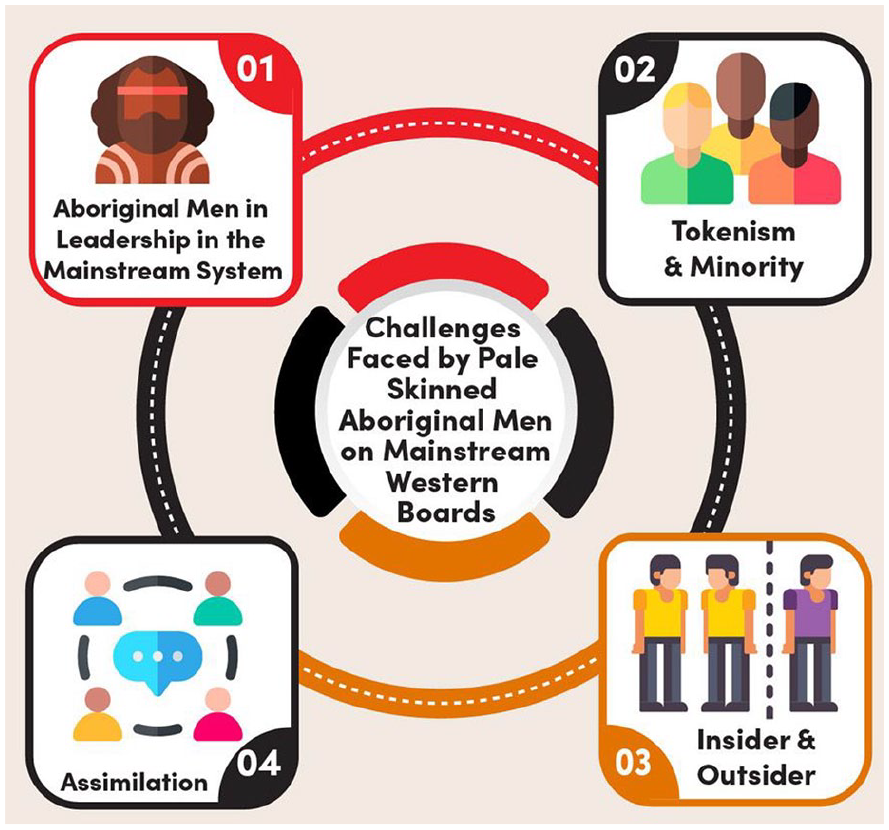
Conceptual framework—challenges faced by pale-skinned Aboriginal men on mainstream Western boards.
Conceptual framework
Aboriginal men in leadership positions on mainstream Western boards
The differences in leadership models between boardrooms and Indigenous society mean Aboriginal people can experience disconnect within the boardroom environment. The boardroom may lack critical understanding of the cultural obligations to broader accountabilities to elders and community (Sveiby, 2011) that is foundational to Indigenous peoples. Traditionally, “Aboriginal circles of knowledge did not allow for a single dominating leader” (Foley, 2010, p. 138) like that identified within hierarchical leadership models that typically form the basis of operations in boardrooms. Hierarchical models imposed on Aboriginal societies, or their representatives in the boardroom, create challenges for Aboriginal leaders operating in the middle (Stewart & Warn, 2017) of these two models of leadership. Sveiby (2011) concurs that hierarchical leadership styles, when imposed, causes problems for collective leadership. In contrast, a shared and distributed leadership model “acknowledges the work of all individuals that contribute to leadership practice” (Harris & Spillane, 2008, p. 31). These types of collective leadership models were developed by First Nation’s peoples (Sveiby, 2011) and are still culturally appropriate.
Such differences can be exacerbated by the complexities of identity for pale-skinned Aboriginal men in the boardroom of being “too White to be Black or too Black to be White” (Foley, 2000, p. 47). The issues of identity projected by the majority non-Indigenous population towards the Indigenous minority as to what Indigenous people should look like, finds “Indigenous people vulnerable to accusations of inauthenticity” (Paradies, 2016, p. 355).
Tokenism and minority
Tokenism and being a minority on a board manifest in several ways. Often superficial appointments of minority members are made on boards to meet a diversity quota. An important issue that presents itself for Aboriginal representatives on boards is the general disregard for the validity of Indigenous governance models (Lee & Tran, 2016). Ignorance of Indigenous models and lack of willingness to explore them to discover potential benefits for governance and operations of the boardroom beyond conventional Western models may be apparent. Moving beyond superficial appointments is often hampered by an absence of desire to understand and place credibility on alternative models. Tokenism displayed either unintentionally or intentionally results in Indigenous people experiencing the feeling of disconnection, being overlooked, or not considered to have valid and equal input with a range of topics surrounding diversity. Lack of focus afforded to such issues in the boardroom can be manifested by tokenistic gestures as well (Abdullah & Ku Ismail, 2017) resulting in the opportunity for inclusion and diversity in the boardroom being lost. To avoid tokenism, intention and action are needed to facilitate engagement in different ways of knowing and doing and explore options, rather than just analysing the information presented (Reynolds & Lewis, 2017).
Insider and outsider
There has been constant narration about and classification of Aboriginal people since colonisation (Dodson, 1994). It is important for Aboriginal people to embrace their positionality and not subscribe to narrow assimilative views of the prescribed titles of insider or outsider within a Western structure. Rather, insider and outsider viewpoints are described as positions that are dependent upon each other and referred to as “complementary leadership styles” (Sanders, 2008, p. 145) which coexist in public life. Taking a narrow view of these positions can impact the way Aboriginal people view themselves and are viewed by others (Bennett, 2015). These positions are fluid (Hurley & Jackson, 2020) and can be viewed as simultaneously dependent upon an individual’s experience in contrast to limiting perceptions ascribed to Indigenous leaders through the prism of assimilative classification.
Assimilation
Conscious and unconscious assimilative practices (Keskitalo, 2020) have been forced upon Indigenous peoples in Australia due to colonisation. Such practices are reinforced by inappropriate use of majority rules in the boardroom. Both Indigenous and non-Indigenous people have subscribed to mainstream assimilative thinking regarding the topic of Indigeneity (Paradies, 2016) and boardrooms need to move beyond projecting bias upon minorities and the propensity to classify Aboriginal people in essentialised ways.
Neo-colonialist assimilationist thinking that Aboriginal people need to conform to the dominant majority beliefs (Hart, 2018), is still present in mainstream society. These assimilative paradigms need to be resisted (Keskitalo, 2020) in the board room. Many Aboriginal people, and more specifically pale-skinned Aboriginal men, may not have the knowledge of their lineage, which is a direct result of colonialist policies and interventions.
Methods
This research was conducted within an Indigenous context and ontological position of being connected to all and everything (Grieves, 2009). The methodology of PAR was chosen, allowing me as the researcher to be embedded in the research as a co-creator of knowledge (Evans et al., 2009). PAR facilitates knowledge generation collaboratively and “participants’ diverse experiences and skills are critical to the outcome of the work” (Brydon-Miller, et. al., 2011, p. 387).
PAR was implemented with an AP who collaborated across multiple cycles by questioning, testing, and refining the developing data (McIntyre, 2008) via yarning where everyone’s input is relied upon, equally weighted, and respectfully contributed (Bessarab & Ng'andu, 2010). The attributes of PAR highlighted here reinforce the Indigenous ontological position of connection, according to Grieves (2009). PAR facilitated a platform for the research which was in keeping with Indigenous principles of knowledge creation and connection.
The AP consisted of four pale-skinned Aboriginal men with boardroom expertise, including me as the researcher. Focus on the lived experiences of the panel members allowed them to narrate the research consistent with the objectives of PAR (Evans et al., 2009). The AP met three times preceded by initial individual interviews. The AP agreed to de-identify participants due to possible sensitivities with previously held board roles. The AP members, excluding myself, are all respected elders and referred to as Uncles. The first letter of their first name was used to identify their individual voices in the data.
The participants’ broad range of experience and skills were valuable, adding depth and richness to the research. Experiences spanned across different sectors including the not for profit sector, (all panel members), education, Uncles W, R, N, Universities, Uncles W, R, N, health including Aboriginal Medical Services, Uncles W, R, Author 1, primary health networks, Uncle R, Tribunal Review Panels, Uncle R, Aboriginal arts, Uncle N Ministerial Advisory Boards, Uncle N, Author 1 local government, Author 1, Commonwealth Regional Development Board, Author 1. Alongside these sectors there exists experience in associated career paths covering considerable periods of time.
The method of yarning was used to facilitate PAR through initial interviews and three research cycles. Yarning is readily adaptable and protocols and procedures can be designed for different settings (Bessarab & Ng’andu, 2010). The method of yarning was chosen as it privileges being part of the research and not being isolated from it. Yarning in the circle format allows for equality and connectedness (Barlo et al., 2020). Yarning involves equally valued input (Bessarab & Ng’andu, 2010) which encourages participation, contribution and connection by cultivating “a relationship of respect and accountability” (Hughes & Barlo, 2021, p. 361).
Ethical approval was provided by the regional university HREC (H21REA279) and provisions included a participant information sheet and consent forms. Consistent with the Australian Institute of Aboriginal and Torres Strait Islander Studies (AIATSIS, 2020), ethical research was conducted respectfully of the knowledge, expertise, and experiences of all participants.
Data collection and analysis
The method of snowballing was used to recruit participants. They could be from outside or the same region and were from different First Nation Groups. The first participant was known to the researcher and in turn made referrals to other potential participants (Sadler et al., 2010). Another two participants were selected who met the central research questions’ criteria of pale-skinned Aboriginal men with board experience.
Interviews and Yarning were all conducted face-to-face. Collection of data from initial participant interviews was via audio recordings. Initial thematic analysis was conducted and summarised into spreadsheets prior to the first AP session. This was consistent for all sessions and applied to all AP members including myself as the researcher being transcribed both verbatim at times and in themes. Data were analysed using Braun & Clarke, (2012) six phases of thematic analysis. There is an intrinsic link between Braun and Clark’s thematic analysis, PAR with it iterative cycles, Yarning facilitating discussion and reflection, the use of spreadsheets to examine the data. These methodologies and tools were enhanced by the participants being established as an AP conducting face-to-face sessions and in keeping with Indigenous ways of developing knowledge.
Summary spreadsheets of the data were submitted as provocation for the first AP session, in Cycle 1 of the PAR. Consistent with the cycles of PAR, subsequent collection, development, and analysis of the data were captured and presented the same way. The summary data were then resubmitted at the next PAR panel session along with a statement of learnings to assist the AP to validate emerging themes as the data were developed and refined within the PAR cycles. These statements were a brief summation of the main topics or themes of discussion of the previous AP session to provoke the assessment and further refinement of the data within the spreadsheets presented to the panel.
Results
The data collected from the PAR AP highlighted differences between the societal structures and their influence on decision-making between Western and First Nations peoples. These differences were agreed to be the cause of some of the issues that present themselves in the boardroom for pale-skinned Aboriginal men. The decision-making process within the Western boardroom setting can often overlook or be ignorant to the engagement required within Indigenous community, compared to single points of contact and decision-makers within a hierarchical structure. This difference can cause challenges for Indigenous board members, creating questions about the integrity of engagement as part of the decision-making process. “The extended family model is not understood in a Western setting” (Uncle W). This statement is a reminder of the broader accountabilities that a pale-skinned Aboriginal board member will be considering.
The emergent themes of connection, shared and distributed leadership and the yarning circle and the importance of their inclusion in the boardroom to mitigate the challenges faced by pale-skinned Aboriginal men operating in this environment were the focus of AP discussions. These AP discussions were conducted applying the methodology of yarning. As this article has focused on the principles of yarning and the development of models that could be applied in boardrooms only limited exemplar quotes have been included. Full details of the voices of participants from the yarning are included in the Master thesis Cahill (2024).
Key emergent themes: theme 1 connection
Exploration of the connection theme by boardrooms and leadership could usher in greater awareness and accountability, potentially influencing the culture, behaviours and decisions of boardrooms and leaders. Awareness about the importance of connection can be built upon in layers by exploring the idea that we are all co-dependent and reliant upon each other. “Building levels of awareness about connection can start to change the tone and culture of the boardroom” (Uncle W). The AP discussed that an individual board member is not the board and there can be no boardroom without the group of members who are dependent upon each other to function as a board. While this concept seems basic, it is a fundamental position from which to start to create awareness of the importance of good relationships, motives, and agendas. Connection is the platform to build awareness that we do not exist outside of all and everything around us. “Country is not just physical it is everywhere, it owns everyone” (Uncle R). We are not above but part of everything. When contemplating this position, a shift in our thinking, actions and participation is moved from a position of self or agency to collaboration.
Personal testimonies and life experiences of panel members highlighted that Indigenous awareness of our connection to all around us is vastly different to hierarchical workplace structures. The connection to Country/everything and the lack of awareness thereof in a Western boardroom setting appears to be a cornerstone to the challenges faced by these pale-skinned Aboriginal men in leadership and boardroom positions within the mainstream Western environment.
The AP considered Connection to be the foundation upon which all else is built. Nothing happens outside of connection as we do not exist separately. Connection is based on respect for our co-dependency on everything around us. “See an organisation as a living thing, respectful design” (Uncle N). Uncle N indicates that connection is seen as not just superficial in nature but more, a wholistic connection based on respect for the world in which we live. “Respect involves a generationally deep observation of relations between humans and the movement of natural systems” (Sheehan, 2011, p. 69). “I am totally into the fact that to run a boardroom etc., connection is your number one process that needs to be understood” (Uncle W).
Theme 2: shared and distributed leadership
The AP discussion highlighted that shared and distributed leadership models foster collaboration and a willingness to participate. “Good leadership is where parity is demonstrated, where all are treated as equals” (Uncle W). In contrast, dependence on the skills of individuals and the consequence of deficit in these individual’s skills that can lead to a “crisis of governance” (Bailey & Peck, 2013, p. 144) within a hierarchical structure of leadership. This can be displayed by behaviours of “transactional thinking or trade-offs” that can be “entrenched in the boardroom” (Author 1) with a tiered leadership structure. “Shared leadership promotes trust and is tried and proven” (Uncle W). The central focus of “respect should be the heart of the whole organisation” . . . and the . . . “boardroom a safe environment for inclusion and collaboration” (Uncle R) in the context of shared leadership. The shared and distributed leadership model was considered as the way to influence the tone, culture, decision-making and operation of the boardroom. Such models create opportunities for greater levels of participation from Indigenous members to operate in a setting more akin to an environment they are familiar with. Shared and distributed leadership is not exclusive to Indigenous people but fulfils basic need for all to trust, be trusted and co-exist.
Theme 3: the yarning circle
The AP determined the “yarning circle structure was always agreed upon by all participants as to the protocols and that it is to be beneficial and relational” (Uncle N) and agreed the yarning circle could be the flux or enabler operationally for a more inclusive boardroom. It is how a boardroom could enact shared and distributed leadership. Each member of the circle is given an opportunity to contribute to the discussion as time to speak moves around the circle without interjection from other members. Utilisation of a talking piece or yarning stick can facilitate this progression in a respectful manner, recognising the only person to speak is the one who holds the yarning stick as it is passed around the circle. This was highlighted by Uncle R that “the use of a yarning stick helps with orderly progression.” Collective knowledge is developed and built upon respectfully. “Yarning promotes equal input” and “the process is underpinned by respect” (Uncle R). The rotation of the speaking order may continue more than once around the circle. Participants find that their questions or input may alter during this progression as answers have already been provided before it is their turn to speak. Listening actively with respect is an integral part of the successful outcomes and deliberations of the yarning circle. This method “helps to build confidence of boardroom members” (Uncle R).
Model development: principle-based decision-making model
AP discussions regarding the three Indigenous guiding principles of connection, shared and distributed leadership, and yarning, were developed collaboratively leading to recommendations for these to be utilised as guiding principles for boardrooms to help overcome some of the challenges for pale-skinned Aboriginal men, and to be inclusive of all board members. In addition, a conceptual model for principle-based decision-making illustrated in Figure 2, was developed based on emerging PAR results that highlighted the synergies with the three guiding principles to potentially enhance boardroom operations. Collectively, the AP endorsed the model as being representative of the group’s work.
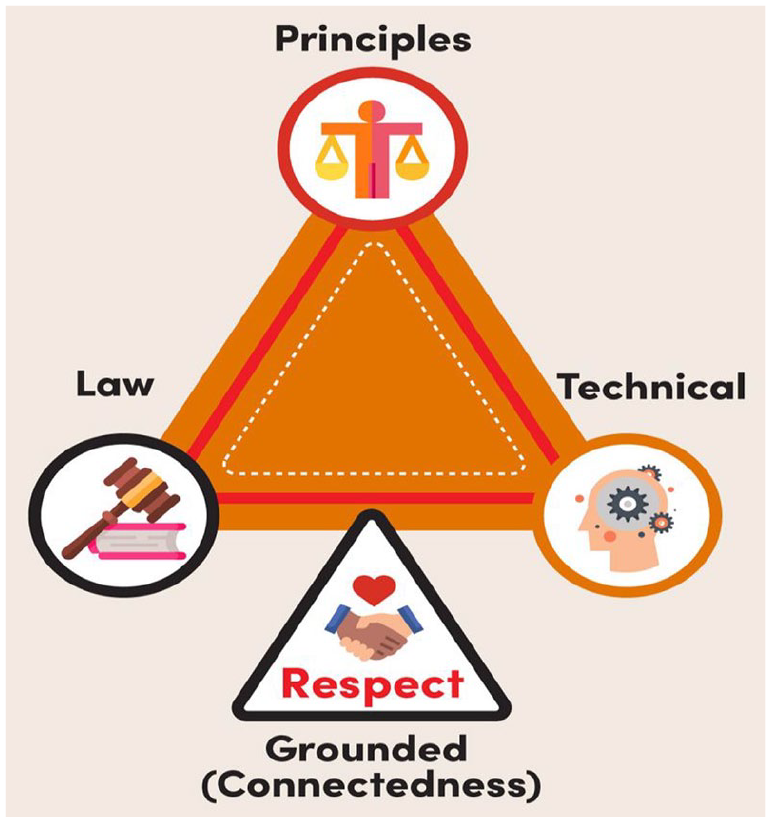
Conceptual model—principle-based decision-making developed from this research.
The critical focus for a boardroom is the ability to understand the principles of connection which governs why they, the board, exist, hence the position at the top of the model. Elements such as legal and technical reasoning were identified as primary factors for consideration. Both the legal and technical elements were mentioned in AP sessions from the perspective of having an “overreach” (Uncle N). in the boardroom decision-making process. This is explained in more detail later in the results. Both are presented in the model to show that they are agents who, while not exclusive, influence the process and demonstrate that balanced decision-making consists of multiple influencing factors.
It was clear that the first or main reference point should always be the principles of connection to why the boardroom exists and the purpose it serves. The AP believed that understanding of the recommended guiding principles could facilitate relevant and connected board outcomes. The model is congruent and balances on a position that is grounded on respect for connection to all about us (Grieves, 2009). There will always be multiple factors that weigh in on the boardroom’s decision-making. However, as highlighted by Uncle W a board needs to be “remembering the key principle of respect.”
The concept of principle-based decision-making
The model represents my analysis of the data to produce an artefact that can be used to guide future boards. Each aspect of the model was identified from the AP’s collective experience and knowledge which included over-reach and consideration given to both legal and technical arguments in boardroom decision-making. These elements were considered to cloud the importance of aiming at a principle-focused emphasis for setting strategic direction in the boardroom. This was perceived to arise from either passiveness by the members to investigate or risk aversion to several influencing factors such as finance or reputational risk. It is recognised that the pressures experienced in boardrooms as part of the decision-making process are far more expansive than those suggested in the model which should not be viewed as exclusive. In addition, careful balanced consideration of the elements collectively should be normal practice.
This triangle balances on a fulcrum of respect. Respect in this sense is much more than a stated set of values presented at a boardroom meeting. Respect should have its foundations linked to an understanding of the Indigenous themes where respect refers to connection to all around us. Uncle R stated that “respect should be at the heart of the whole organisation and that respect is not just for each other but for everything around us.” In practice, the legal and technical arguments can often be permitted to over-reach and add imbalance to how decisions are made within the boardroom. Furthermore, the triangle balances on a fulcrum of respect which is grounded or connected to Country as the AP believed that the way a boardroom operates cannot be separate to the environment it serves. The degree of understanding of this connection to everything will have a direct bearing on the effectiveness of any boardroom’s functioning.
The principles focus
In reflecting on why boards exist, the following questions are reasonable for boards to consider: Are we in tune or connected with our surroundings and each other? How do we move beyond transactional interaction to genuine collaboration and partnership? These questions are foundational for trust and relationships to be built between each other and the community the board serves. The themes of connection, shared and distributed leadership and yarning that emerged from the research and their potential to promote good relationships within boardrooms were stimulus for these questions. Hughes and Barlo (2021) elaborate on this by asking the question, “What might it mean for you to cultivate a relationship of respect and accountability with the places you live and work and research?” In contrast, the AP members’ experiences and observations indicated these foundations have not existed in most boardrooms they have been involved in. Within a hierarchical model of leadership, they have often seen the other corners of the triangle, such as the law and technical arguments, outweighing decision-making based on core principles.
The balance of the triangle is often destabilised through adversarial debate. This is described by Uncle N as a “lack of integrity that can be manifested in different ways by the over-reach of experts or dollar driven or the fear of publicity.” This statement was made when the AP commented on the principles-based decision-making conceptual model. Mention was made of hierarchical structure as “setting people up to debate opposites, you don’t get any truths from it when you’re debating you are just trying to win the debate, you get a hierarchy” (Uncle N). In this operating environment, board members may not feel safe or confident to present new ideas or ways of thinking. The model indicates that this can be caused by the members feeling polarised by legal and technical arguments presented in the boardroom. The AP discussed how this can become the status quo. In such cases, when the emergent themes recommended as guiding principles for boardroom operations are not considered, it is unlikely that the full potential of the conceptual model can be realised. Principle-based decision-making requires all members to be able to decipher these competing arguments and contribute collaboratively to focus on potential outcomes and how problems may be reframed to achieve the best path forward.
The legal argument
The legal focus often heavily influences the course of decision-making, debate, or discussion in boardrooms, due to legitimate concerns around risk and litigation. Passive involvement on the part of board members can potentially result in over reliance on the legal view to solve issues confronting the boardroom. The level of active engagement in solving problems can also depend on the risk appetite of the boardroom and how much influence the legal argument has bearing on the outcome. Legal experts are engaged to protect the interests of the board/organisation and can lead to a narrow decision-making focus where solutions focus on this perspective to the exclusion of other possibilities.
Passive board members may succumb to the path of least resistance or effort to achieve the desired outcome from a legal perspective. However, just because legal advice is given does not necessarily make it the best principle-based position for a board to take. Uncle N referred to legal? themes swaying decision-making and “little appreciation for other determinants or benefits in arriving at a decision.” Allowing over-reach of the legal perspective to dominate discussion can result in a minimalist position of doing only what must be done.
The technical argument
The opposing corner of the triangle, the technical argument, is also capable of over-reaching to heavily influence the decision-making process in a boardroom because of passive participation in problem solving, or the desire for someone to present the easy solution (Dervin, 2016). The ability to think critically is essential for the boardroom. To engage in reflective and independent thinking, construct and evaluate arguments, prioritise the relevance and importance of ideas are highly dependent on confidence of the individuals in the boardroom to present a view that differs from the technical expert. Dervin (2016) highlights that it “takes courage to question this narrative” when referring to the majority view position indicating that it is preferable “to question assumptions, things taken for granted and to shake habits” (Dervin, 2016, p. 92) which is both relevant to the boardroom and critical for board members to take courage and be reflective about participation. The shared collective experience and discussions of the AP raised the potential for hierarchical leadership styles to facilitate the tendency for experts to weigh in on the discussion outside of their area of expertise.
Hierarchical leadership models and meeting formats were noted as not necessarily conducive to exploring the best options or solutions, with various ways to arrive at the same point utilising collective knowledge and problem solving often being overshadowed by the experts’ view or interpretation as part of a rigid Westminster-style meeting format. Rotation of task experts reinforces the practice of valuing and treating others with respect (Sveiby, 2011). Indigenous frameworks such as shared and distributed leadership, yarning and connectedness are essential to facilitate a higher degree of good decision-making and active participation from board members, Indigenous, and non-Indigenous alike. Exploring these modes of operation from a principles-based approach could add value to the boardroom setting.
Discussion
This research identified themes of connection, shared and distributed leadership, and yarning as guiding principles that can be applied to aid the functionality of boardrooms. The recommended guiding principles and the conceptual model for principle-based decision-making, when coupled together, can potentially revitalise the boardroom’s operations and relevance. There are obvious synergies of connection to, and respect for, each and all around us as described earlier and are referred to by Grieves (2009). These guiding principles and the model may be beneficial to other working environments and are foundational to connection in boardroom relationships and the relevance of the board to community they serve.
Connection
Connection is the fundamental platform which all else is built upon. Grieves (2009) says that we are not above but part of everything and do not exist separately outside of this connection. Awareness about connection can be built in the boardroom environment by setting aside time to explore the concept that we are all connected, co-dependent and reliant upon each other, providing opportunity for positive improvement to be realised.
The relationship between connection and the model of principled-based decision-making could enhance, and be enhanced by, a board’s clear understanding of their connection to their purpose of why the board exists. The extent of focus devoted to connection could help mitigate the tendency for boardrooms to take the easy option and succumb to other pressures of the law and technical positions as illustrated in the model (Figure 2) that contribute to decision-making processes. Connection with and understanding of environment and how they relate to these is essential for a foundation of respect to build trust.
Shared and distributed leadership model
There is need for further contributions to the literature regarding awareness and application of potential benefits to boardrooms that choose to explore this model that has been used extensively by First Nations people around the world for centuries (Sveiby, 2011). Shared and distributed leadership models are a vehicle that potentially allow a boardroom to more freely unpack different ways of operation and decision-making rather than just analysing information. This is directly attributable to the trust that can be built by respecting each member’s input as valuable and equal and not qualified by biases such as seniority, former experience, or perceived lack of experience among other concerns that may be manifested around the table. A conventional hierarchical structure of leadership can encourage board members to be risk averse to bringing forward ideas, not wanting to rock the boat or be seen to be unpopular among their peers. Potentially within a shared and distributed model, participants are more likely to feel safe to bring forward ideas, present an opportunity or solution. Cultivation of this environment has the potential to turn passive members into active contributing members that display cognitive diversity to solve problems in a safe place.
Furthermore, topics covered in the literature, including tokenism, assimilation, abyssal thinking, cognitive diversity, and the degree to which these are displayed, are influenced by the leadership style or model employed in the boardroom. Beyond tokenism is the potential for the Indigenous principles of shared and distributed leadership and yarning to facilitate a safe and respectful environment that fosters a diverse contribution which is valued as equal by all participants (Bessarab & Ng’andu, 2010 ; Hughes & Barlo, 2021). These principles are likely to mitigate the effects of tokenism and cultivate conditions for cognitive diversity where participants feel safe to contribute and bring forward different ideas within a boardroom that is willing to explore leadership and decision-making beyond normal methods of operation (Reynolds & Lewis, 2017). The boardroom can be constrained or otherwise by the degree of rigidity of the leadership model they operate under to adequately address these topics.
The proposed leadership model facilitates openness and trust and is built on the respect for all having equal standing as leaders and decision-makers. There is greater potential for focusing on principle-based decisions and not settling for second best when dealing with the business of the boardroom. Participants are less likely to be second guessing agendas of others in the boardroom under shared and distributed leadership, than in an adversarial environment of debate within a hierarchical structure. De Sousa Santos (2007) describes this as distinctions and predispositions in a Westminster system with the pecking order of seniority and hierarchical leadership.
The yarning circle
There is a gap in the literature regarding the consideration and application of the principles and potential benefits of the operation of yarning specific to the boardroom environment. There is a need for greater enquiry into this Indigenous methodology in this setting. Inclusion of some of the operational elements highlighted in the data could help complement the boardroom environment rather than the dominant hierarchical operating model. Yarning is multilayered and protocols and procedures can be designed and utilised in different settings (Barlo et al., 2020). This research highlighted that “the yarning circle structure was always agreed upon by all participants as to the protocols and that it is to be beneficial and relational” (Uncle N). The versatility of this methodology could be readily utilised by the boardroom. The functioning of the yarning circle is conducive to participation, where everyone’s input is relied upon and equally weighted, and each person must wait their turn for contribution (Bessarab & Ng’andu, 2010). Yarning may cultivate a willingness for a boardroom to explore new approaches and ideas rather than just analysing information. In addition, knowledge can be built in layers respectfully and collectively by the normal rotation of speakers around the circle. The research highlighted the yarning circle was seen as the flux or an enabler operationally for a boardroom to be more inclusive. It was how a boardroom could compliment the way it conducted the meeting.
The model of principle-based decision-making has direct links to yarning given that in Aboriginal culture yarning connects us with Country, which encompasses the physical, spiritual, ancestors, beings, stories, and knowledges held and alive within (Terare & Rawsthorne, 2020). Yarning is inclusive, respectful and “the protocols are to be agreed upon and beneficial” (Uncle N). The principles of yarning allow for the boardroom to focus on the objectives of why they are there which is aided by a safe environment rather than being distracted by the mechanics of a dysfunctional meeting structure. Alongside the principles of the shared and distributed leadership model this framework could allow focus on the strategic intent and the boardroom’s connection to their purpose to yield better outcomes. Hughes and Barlo (2021) invite us to hone our skills “to cultivate a relationship of respect and accountability with the places you live and work and research?” (p. 361).
Conclusion
Boards, whether ASX (Australian Securities Exchange) listed, government, not-for-profit or other, collectively influence nations by the very nature of the business conducted and the communities they serve. The findings arising from this research project looked at Indigenous principles that may be utilised as guiding principles for boardrooms. The synergies with the model for principle-based decision-making contribute potential to influence how boardrooms impact their community. Such influence is dependent upon the board’s willingness to openly investigate the principle-based decision-making model and the intent of the guiding principles that this research has presented.
The sceptic may view these principles as utopian and fail to be able to think outside of the dominant mainstream operations of the boardroom. Boardrooms who choose to be open minded, on a journey of self-improvement may well find the true intent of the tried and proven Indigenous principles suggested as guiding principles to be utilised in boardroom practice which are not recognised or validated in a Western boardroom setting. Opportunity is lost when leadership has no desire to explore outside of familiar convention resulting in “conscious or unconscious assimilation practices” (Keskitalo, 2020, p. 23).
This research contributes to a body of knowledge from a workplace perspective and the perspective of a practitioner’s lived experience as pale-skinned Aboriginal man in boardroom positions. The challenges that these men face when viewed through this lens are unique and their reality is further complicated by positions of feeling isolated between and within two worlds (Foley, 2000). Further research is required given the deficiency in the literature about this topic. This research could be utilised to compliment the operations and strategic deliberation in a boardroom and assist in the longer term to help refocus the culture and tone of the boardroom to assist pale-skinned Aboriginal men in leadership roles on executive and management boards of Western organisations. The above points should be considered in the context that boards influence the broader community collectively and influence the tone and culture for society in general.
Footnotes
Acknowledgements
The authors thank all First Nation People and pay respect to Elders past and present for the foundations they have set down for them to build upon. To always be mindful of the connection and have respect for country around us as we pass through on our journey. The authors also acknowledge and respect the three Uncles’ participation as part of the advisory panel contributing to this body of knowledge. These three men are long-standing tireless advocates for advancing the wellbeing and recognition of First Nation people.
Authors’ note
Declaration of conflicting interests
The authors declared no potential conflicts of interest with respect to the research, authorship and publication of this article.
Funding
The authors received no financial support for the research, authorship and publication of this article.

Glossary
Awabakal Aboriginal Australians Indigenous to the coastal Hunter Region, New South Wales, Australia