




Abstract
The article investigates Indigenous belonging and presence in urban areas by focusing on Indigenous experiences of urban settling, homemaking, mobility, and place-naming. Particular attention is given to the role of human–environment interactions in these processes. The empirical data derives from interviews, cartographic records, and long-term research with urban-dwelling коми | Komi (the Indigenous people of the Komi Republic, Russia). The article reveals significance of urban-to-rural mobility for people’s well-being while also highlighting the equal importance of human–environment interactions in fostering Komi belonging and homemaking in the city. It underscores the importance of Indigenous toponyms and the potential of non-Indigenous place names in asserting Indigenous presence. Additionally, it addresses the challenges surrounding the use of Indigenous place names in the context of changing people-place relationships and language shift.
Introduction
In this article, I examine Indigenous belonging and presence in urban areas through experiences of urban settling and practice of homemaking, that is, the creation of a sense of home, and urban place-naming. Since human–environment interactions are central to the knowledge systems of many Indigenous peoples, I am particularly interested in understanding what role they play in fostering well-being and belonging of urban-dwelling Indigenous residents. Additionally, I explore how human–environment interactions are reflected in both Indigenous and non-Indigenous urban toponyms and how these can promote Indigenous presence in the city.
This study focuses on the коми | Komi (the Indigenous people of the Komi Republic, Russia) and Syktyvkar, the capital of the Komi Republic, located in the northeast of European Russia. Both Russia-specific Indigenous context and the Komi people have remained largely overlooked in international scholarship. Komi, recognized as Indigenous in international academia, do not qualify for Russia’s Indigenous small-numbered peoples’ status, limited for groups under 50,000 people. However, Komi are the titular people of the Komi Republic, a non-legal category for Indigenous peoples of Russia’s ethnic republics, state-like territorial-administrative units lacking state-like sovereignty and heavily dependent on federal authorities. The article draws on long-term research with urban Komi and my own experiences growing up in Syktyvkar in a Komi-Russian family.
In recent decades, scholarly representations of urban Indigenous experiences have transformed from a view of loss and inauthenticity to a focus on the resilience of urban Indigenous communities (Peters & Andersen, 2013). In Russia’s context, for a long time, such studies either focused exclusively on the experiences of Indigenous small-numbered peoples or were dominated by the narratives of adaptation and cultural survival, but this situation is slowly changing there as well (Ferguson, 2019).
Urban-dwelling Indigenous residents can be attached to multiple places simultaneously (Darnell, 2011). For this reason, urban-to-rural mobility is important for supporting their well-being and sustaining human–environment interactions (Wilson & Peters, 2005). Simultaneously, for fostering belonging in the city meaningful connections with urban natural areas are equally important (Hatala et al., 2019).
Studies of Indigenous toponymies and toponymies of Indigenous places tend to prioritize non-urban locations (Berg & Kearns, 2009; Hercus & Simpson, 2009). In this article, I adopt a contrasting approach and analyze urban place names. Previous research highlights the significance of Indigenous place names in Indigenous land stewardship and transmission of traditional, particularly environmental, knowledge (Hercus & Simpson, 2009; Oliveira, 2009).
I showcase that in the city Komi toponyms can help both acknowledge Komi presence and highlight the importance of the human–environment interactions, especially with forests and rivers, to the Komi people. Simultaneously, they can also be strategically employed by non-Indigenous city administrations to promote ecological and green images of certain places. As some studies have shown (Hercus & Simpson, 2009), this practice can be seen as essentializing. However, I observe that in localities undergoing language shift, even this approach can contribute to fostering the presence of Indigenous peoples and their languages.
In my discussion, I highlight challenges surrounding Indigenous toponyms in urban areas with the prevalence of non-Indigenous populations and in times of language shift and loss, incomprehension of toponyms’ original semantic meaning, and changing human–place relationships. Furthermore, along with Komi place names, I study non-Komi street names. In my investigation, I pay particular attention to how such names refer to the local environment, which is typical for Komi toponyms, and examine whether they can contribute to the promotion of Komi presence in Syktyvkar.
Background
Syktyvkar, the capital and the largest and oldest city of the Komi Republic, was first mentioned in historical records in 1586 and obtained city status in 1780 (Rogachev, 2010). Until the latter half of the 20th century, its predominant ethnic group was Komi, a Permic Finno-Ugric group and the Indigenous population of the Komi Republic (Fauzer et al., 2001). According to the 2010 Russian Census, slightly over 200,000 Komi resided in the Republic, constituting 22.45% of the regional population (Rosstat, 2013). In the 2020 Census, only 127,000 Komi, 17.22%, were registered (Komistat, 2023), although, the accuracy of this figure is questionable due to flawed data collection. Before the Soviet period, the Komi amounted to over three-quarters of Syktyvkar’s population; according to the 2010 Census, a quarter of its 250,000 residents identified as Komi (Fauzer et al., 2001; Fedina, 2024; Rosstat, 2013).
Komi, a Finno-Ugric language, holds a state language status in the Komi Republic, alongside Russian. Historically, Komi was the mother tongue for the absolute majority of the Komi population, many of whom were also proficient in Russian (Rogachev, 2010). Nowadays, despite its state status, due to policies promoting Russification (Zamyatin, 2014) and ongoing language shift, Komi is considered endangered (Ethnologue, n.d.). 62.78% of all Komi, 40.86% of urban and 82.07% of rural, consider Komi as their native language, while the rest list Russian as such (Rosstat, 2013). Despite the lack of available official data, it is reasonable to speculate that less than half of Syktyvkar’s Komi population are native Komi speakers.
Syktyvkar lies at the confluence of two rivers, the Syktyv, Sysola in Russian, and the Ezhva, Vychegda in Russian, and is surrounded by forests. Forests are integral to the Komi Republic, covering approximately 87% of its territory and contributing significantly to regional and city economies (Tourism Development and Komi Republic Promotion Agency, n.d.). The image of forest is utilized by the city authorities in city promotion (Leyman, 2023) and employed in local cultural projects and events, which simultaneously highlight regional and local features and address Komi culture and traditions.
Although Komi are the Indigenous population of the Komi Republic, their experiences are rarely explored within the framework of Indigenous studies. Existing scholarship primarily encompasses linguistic, historical, and folkloristic research, largely overlooking contemporary experiences, especially those of urban-dwelling Komi.
Methodology and positionality
For this article, I have utilized data from interviews conducted with Komi interlocutors during my fieldwork in Syktyvkar in 2021–2022. Reviewing these interviews, I selected those that dealt with urban settling and homemaking, human–environment relationality, and urban–rural and urban–natural dichotomies. As a result, this article focuses on the perspectives of rural-born Komi, although my fieldwork otherwise involved both rural- and urban-born Komi. I acknowledge this limitation and identify the need for similar research with urban-born people.
My interlocutors are first-generation urban-dwelling residents from diverse age groups, genders, and professional backgrounds. Many relocated to Syktyvkar for education, attended university, and later settled in the city to pursue their careers. I knew some interviewees beforehand and with others I became acquainted through my mother’s connections. Such direct and indirect familiarity helped establish rapport. Furthermore, being born and raised in Syktyvkar in a Komi-Russian family and connected to my mother’s northern rural Izhma Komi family, I was aware of both urban and non-urban Komi experiences, which enhanced my understanding of the interlocutors’ stories.
To study urban place names, I examined contemporary maps, toponymic directories, and online sources. I identified two groups of urban toponyms typical for Syktyvkar and used both by city’s authorities and residents: (a) non-Indigenous street names, and (b) settlement and area names, almost half of which are of Indigenous or mixed origin.
Subsequently, two datasets of urban place names were created. The dataset of street names is based on the city administration’s list of streets and squares, which I cross-checked with Yandex.Maps (https://yandex.com/maps/), Russia’s most popular map service. This comparison revealed 55 additional streets, which were added to the final dataset. Adapted data from this dataset is presented in Supplementary material 1.
Yandex.Maps also proved useful in creating the dataset of settlement and area names. The Charter of the Syktyvkar urban municipality (Garant, n.d.b.) defines only eight settlements that constitute the Syktyvkar urban municipality and does not provide any comprehensive list of the sub-level urban areas. Contrariwise, Yandex.Maps indicate urban administrative units of all kinds. This cartographic data was additionally verified using my and my mother’s knowledge of urban toponymy and the Komi language, as well as literature and online sources, and is presented in Supplementary material 2. As both datasets were compiled manually, the possibility of human error cannot be entirely ruled out.
The role of human–environment interactions in Indigenous belonging and well-being in urban areas
Urban experiences of Indigenous peoples become increasingly represented in academic research (Berg-Nordlie et al., 2022; Peters & Andersen, 2013; Virtanen, 2012). At the same time, in some geographical contexts, such as Russia, they remain largely overlooked. One reason for this is the persistence of the narrative that confines Indigenous populations to non-urban areas, dismissing their resilience and potential to uphold cultural identities in cities (Nursey-Bray et al., 2022).
Interdependent human–environment interactions are central to Indigenous lives, worldviews, and well-being (Hatala et al., 2019; Miltenburg et al., 2023). They remain vital even in urban settings, even though their form and content often change significantly: for example, Berg-Nordlie et al. (2022) discuss that instead of remaining an economic activity they can turn into recreation.
Practices supporting the maintenance of human–environment relationships in urban areas may include participation in pan-Indigenous ceremonies honoring Mother Earth and the creation of culturally safe places, where Indigenous residents can uphold physical and spiritual interactions with the land and the environment (Wilson & Peters, 2005). These practices act as extensions of rural lived experiences (Hatala et al., 2019), and thereby, I argue, blur the boundaries between the urban and the rural, as well as the urban and the natural.
Urban-to-rural mobility represents another strategy for sustaining human–environment interactions. Mobility has been repeatedly identified as a characteristic of urban Indigenous experiences (Wilson & Peters, 2005). It is believed to enforce belonging to multiple localities and communities and help urban Indigenous residents to overcome “out-of-placeness” (Dankertsen, 2022, p. 125) and the stereotypes of unauthenticity of urban Indigenous identities and their ways of living (Hatala et al., 2019; Peters & Andersen, 2013). While supporting the importance of urban-to-rural mobility for maintaining connections with the land and the natural environment, I maintain that such mobility is insufficient for fostering a sense of belonging in urban areas. Based on my fieldwork data, I emphasize that finding a meaningful way to connect with the natural environment in cities is equally essential.
The power of place names: asserting presence and preserving ancestral knowledge
Toponymy, the study of place names, is vital for understanding historical narratives, languages, and relationships between people and their surrounding environments. Studies have shown that place names can commemorate events or individuals, index valuable species and landscapes, transmit certain meanings and images, and differentiate communities (Berg & Kearns, 2009; Shackleton, 2018). Beyond labeling, place names validate or exclude certain worldviews and identities (Yeoh, 1992). Place naming is thus a form of norming, a particular kind of relationship between place and the identity politics that legitimizes and normalizes those in power (Berg & Kearns, 2009).
The naming of places is associated with the assertion of ownership over them (Oliveira, 2009). For example, the imposition of European names on Maori places reinforced the Europeanization of the local landscape (Berg & Kearns, 2009). Conversely, toponyms can help local and Indigenous communities to affirm their historical presence in local landscapes (Basso, 1988). Names and stories associated with particular places can act as foundations for community identities and evidence of community rights (Kahn, 1996) and thus can be strategically utilized by Indigenous peoples for self-determination and decolonization.
Place names can encapsulate local knowledge, reference local biocultural heritage, signify past and present biodiversity, and showcase local and Indigenous populations’ perceptions of and interactions with natural environments (Shackleton, 2018; Whitridge, 2004). Furthermore, they help Indigenous people stay connected with their ancestors, transmit traditional knowledge, and interpret local landscapes (Hercus & Simpson, 2009).
The natural and the rural in Komi homemaking and belonging in urban areas
The bond with the environment plays a pivotal role in shaping the worldviews of many Komi. Humans, non-human beings, and natural landscapes are seen as integral interconnected parts of a complex ecosystem. Вӧр-ва | vör-va (nature) signifies the fundamental elements of the local natural environment, namely вӧр | vör (forest) and ва | va (water), embodied by rivers. Human–environment interactions form the foundations of Komi traditional knowledge and are, for example, eloquently expressed in the Komi lore about ас пу | as pu (own tree), each person’s sacred twin tree (Konakov et al., 1999). On a more material level, nature-related activities, such as foraging and fishing, remain a source of livelihood for some Komi, especially in rural areas.
For my interlocutors, the natural is always intertwined with the rural. This connection is so strong that often it is difficult to distinguish between the two. Such connection was especially vivid in interlocutors’ memories of their rural homelands. Asking my interviewees what they missed most about their homelands, I encountered a consistent set of responses: parents and relatives, forests and rivers, пывсян | pyvsyan (a steam bath), and a sense of calmness, tranquility, and controllable pace of time that one can “hold and feel with the fingertips” (male, 29 years old). Natural environments and landscapes continually beckon many interlocutors back to their rural homelands and influence their sense and perception of home.
Many of my interlocutors, regardless of the length of their residence in Syktyvkar, view their rural homelands as their homes or own places. This opinion is illustrated by the account of the following interlocutor: Even though I’ve been living in Syktyvkar for half my life, I still say, “I go to Lesozavod [an urban area in Syktyvkar], I have an apartment in Lesozavod.” But when I go to the village, I say, “I am going home.” And even my Syktyvkar friends, those who are Russian, ask me, “What do you mean, go home? Are you not home here? You already have an apartment here, you have friends here, work, everything. Why not?” I reply, “I don’t know, because my home is there [in a rural district], and here [in Syktyvkar] is my work, my friends, and my apartment.” (Female, 31 years old)
Own, in this context, although directly related to the concept of ownership, does not address mere possession. Rather, it emphasizes the connection established with a place, imbued with a profound sense of responsibility and care. This connection is often verbalized in statements like “being an owner in one’s own house on one’s own land.”
When comparing living experiences in the city with such from rural areas, urban-dwelling Komi often described the city as draining, whereas rural and natural areas were seen as rejuvenating. Remaining connected to rural homelands through frequent urban-to-rural mobility is thus one of the strategies employed by urban-dwelling Komi to maintain their well-being. As another interlocutor shared, “you go [to a rural settlement], sit, drink spring water, and go back [to the city]. Your own place gives you energy and strength” (female, 46 years old).
It was common for interlocutors, who similarly contrasted rural and urban living experiences, to question the presence of nature in the city. This skepticism primarily stems from the belief that urban green spaces, such as parks, do not constitute proper natural areas, as they are human-made or significantly affected by human activity. This viewpoint is further reinforced by a lack of awareness of those urban spaces that might qualify as proper natural areas. A rather rigid understanding of what constitutes Syktyvkar as a city contributes to this perception. This view excludes not only distant urban settlements, which indeed can have their own place identities and are not always seen as parts of the city, but also certain quite central urban areas. Coincidently, many of the urban green and blue spaces that could be classified as proper natural areas are located in these excluded localities.
While skepticism about the presence of natural environments in the city is widespread, it is not universal. This is evident in another strategy adopted by urban-dwelling Komi to enhance their belonging and well-being. In their efforts to reconnect with their roots and forge a closer bond with nature, they deliberately seek out and discover natural—and rural—elements within the city. Below is a detailed but illustrative account from one interlocutor describing her experience of relocation to the city and her quest for natural areas within it: When I came [to Syktyvkar] after graduating from school, I was seventeen years old, and I had a real breakdown. How can I, that same [interlocutor’s name], who could somehow anticipate tomorrow’s weather, who always checked the direction of the wind according to the river flow . . . how can I live here, in urban space? . . . And I had to get on the bus and go to the districts where we had village buildings, this is Kochpon or Parizh, as a rule. I went there on Saturdays . . . and smelled this bathhouse smell, the smell of stoves and all that. That is, I calmed myself down with this involvement in village and natural life. It was necessary when I was a student. It seems to me that now I also have such quirks. (Female, 37 years old)
This excerpt illustrates the deep intertwining of natural and rural elements in living experiences of my interlocutors. Namely, the smell of burned wood and the scent of bathhouse fumes evoked in the interlocutor simultaneous memories of both rural and natural environments. Her example, however, also shows that elements strongly associated with one place can be consciously sought and appreciated in other localities as well.
Recalling her rural life, the same interlocutor reminisced about her intimate and spiritual connection with the local river. Later in our conversation, she shared that to recreate this connection, she decided to buy an apartment near one of the city’s rivers and even built a special raised floor in one of the rooms to observe its seasonal changes. Already writing this article, I came across a similar story of another urban-dwelling Komi who emphasized the importance of the proximity of the river to her urban home both for her mental and spiritual well-being and mere choice of place of residence (Telekanal Jurgan, 2023).
In the next section, I continue my exploration of Komi belonging and presence in Syktyvkar by focusing on urban place names. Following my observation that human–environment connections often shape the Komi sense of home, I am particularly interested in examining how Syktyvkar’s place names emphasize local nature and what this means for urban Komi presence.
Syktyvkar’s place names: evolvement through time and changing linguistic landscape
Throughout its history, Syktyvkar has been associated with various names, both Russian and Komi. All these names, however, have consistently underscored the city’s geographical proximity to the local Syktyv River, known as the Sysola in Russian. Upon attaining city status in 1780, Syktyvkar was bestowed with the Russian designation Ust-Sysolsk, a place at the mouth of the Syktyv River (Rogachev, 2010). Concurrently, the Komi-speaking population referred to it as Syktyvdin, which carried a comparable meaning, a place next to the Syktyv River. Alongside Syktyvdin, Syktyvdinkar, a city next to the Syktyv River, was used both officially and unofficially. In 1930, the city adopted its current name, Syktyvkar, a city on the Syktyv River (Roshchevskiy, 2010).
The urban layout of Syktyvkar is organized on two levels. The first consists of an extensive network of streets traversing the entire inhabited space of the city. The second encompasses distinct settlements that collectively form the Syktyvkar urban municipality. These settlements are sometimes further subdivided into smaller urban areas. Unlike the standardized street network, the division of settlements and areas is less uniform, leaving parts of Syktyvkar unassigned to any specific settlement or area.
Streets
In 1782–1783, the All-Russian Commission of Buildings in St. Petersburg, the capital of the Russian Empire, devised a master plan for the urban development of Syktyvkar (Rogachev, 2010). The plan disregarded the historically established system of settlements and instead followed the linear street development principle (Rogachev, 2010). The city’s first 12 streets were named after Orthodox holidays, saints, local churches, and the cardinal directions. Most of these names remained unchanged until 1918.
During the early Soviet period, streets were actively renamed, signifying elements important for the new authorities: industrial development, army, and ideological unity. Up to this day, most Syktyvkar streets carry names assigned during the Soviet era, denoting professions and industries, abstract ideological and non-ideological concepts like communism, peace, or freedom, and specific people, most of whom had no local connections. About 30 Syktyvkar streets are named after the local residents, half of which bear the names of Komi poets, writers, scholars, artists, and soldiers.
Nowadays, there are over 400 streets and squares in the Syktyvkar urban municipality. As stipulated by Article 33 of the Charter of the Syktyvkar urban municipality, the naming and renaming of the city’s streets and squares fall under the purview of the Syktyvkar Council, comprised of 30 deputy members elected by city’s residents every 5 years (Garant, n.d.b.).
Seventy of the city’s streets are named after topographic features, natural environments, and natural species (Table 1). Of these, 44 street names denote local topographic and natural features, exemplified by such streets as Lesnaya—from Russian лес | les (a forest), Ozyornaya—from Russian озеро | ozero (a lake), and Lugovaya—from Russian луг | lug (a meadow). Six streets refer to the local rivers, namely the Syktyv, the Ezhva, the Emvalʹ, and the Pechöra. Finally, 20 streets are named after specific plants; their official Russian names are presented in Supplementary material 1, and species names are given in Latin, English, and Komi. Notably, there are no streets named after animal species.
Syktyvkar street names referencing natural environments (Adapted from Garant (n.d.a.) and Yandex.Maps (n.d.).
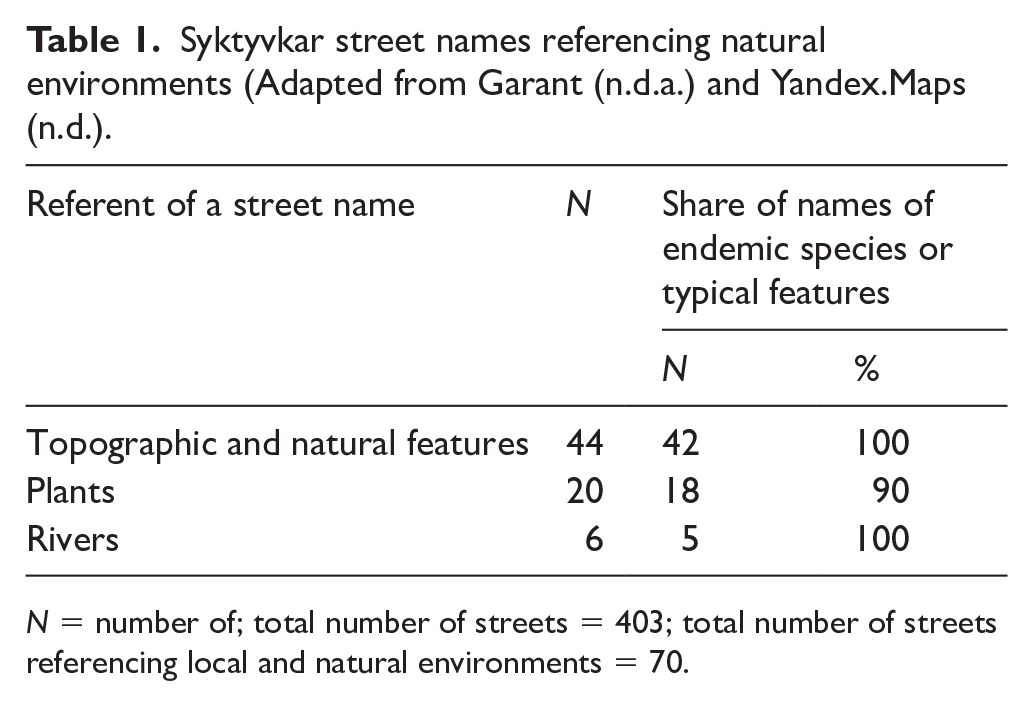
N = number of; total number of streets = 403; total number of streets referencing local and natural environments = 70.
Twenty plant-named streets reference 16 species, 14 of which are native to the region. Names of two streets reference cherry and lilac that grow in the southern parts of the Komi Republic, including Syktyvkar, but were otherwise introduced (Bolotova et al., 1962). Notably, all 14 local plant species have Komi names, while the 2 non-native species are referred to by their Russian loan-names in the Komi language.
Four of the plant-named streets are named after пожӧм | pozhöm (a pine), a staple tree in the Komi Republic. Forest-founded species, in general, are the main referents in this category, with 16 of the plant-named streets referencing such species. Forest-related names are also prevalent among streets indicating topographic and natural features; 14 of them refer to forests in general or specific types of local forests, such as boreal forests.
Settlements and areas
Pre-Soviet Ustʹ-Sysolsk was a dispersed city, consisting of numerous villages and settlements that extended beyond the central quarters and where the biggest portion of the urban population resided (Rogachev, 2010). The names of most of these settlements were Komi and followed the Komi tradition of naming places after distinctive features of the local environment and landscape or first settlers. With their absorption into the city area, many of these settlements lost their original names or were renamed (Shabaev et al., 2012).
Nowadays, the city of Syktyvkar together with urban-type settlements Verkhnyaya Maksakovka, Krasnozatonskiy, and Sedkyrkeshch, as well as rural-type settlements Verkhniy Myrtyyu, Vylʹtydor, and Tryokhozerka form the Syktyvkar urban municipality (Garant, n.d.b.). The main differences between these types of settlements are the population size, the level of infrastructure development, and economic activities. Additionally, the Charter of the Syktyvkar urban municipality (Garant, n.d.b.) distinguishes Ezhva as a special district, raion, of the city of Syktyvkar. Raion is the closest equivalent to a city, as it possesses all the necessary urban infrastructure and its own administration.
Most of these eight settlements consist of several smaller areas (Figure 1). These areas include quarters, местечки | mestechki (minor city areas), hamlets, territories, and микрорайоны | microraions (microdistricts). Quarters signify the smallest unit of urban area, usually developed around a certain urban institution. Hamlets and territories are areas consisting of individual houses and summer cottages. Mestechki and microraions are the most common types of urban areas. Usually, mestechki are remnants of former Komi villages absorbed into Syktyvkar, while microraions are a Soviet form of residential area organization. The difference between mestechki and microraions is not always clear: some mestechki can develop into microraions, while an urban area can be designated both as a местечко | mestechko (minor city area) and a микрорайон | microraion (microdistrict).
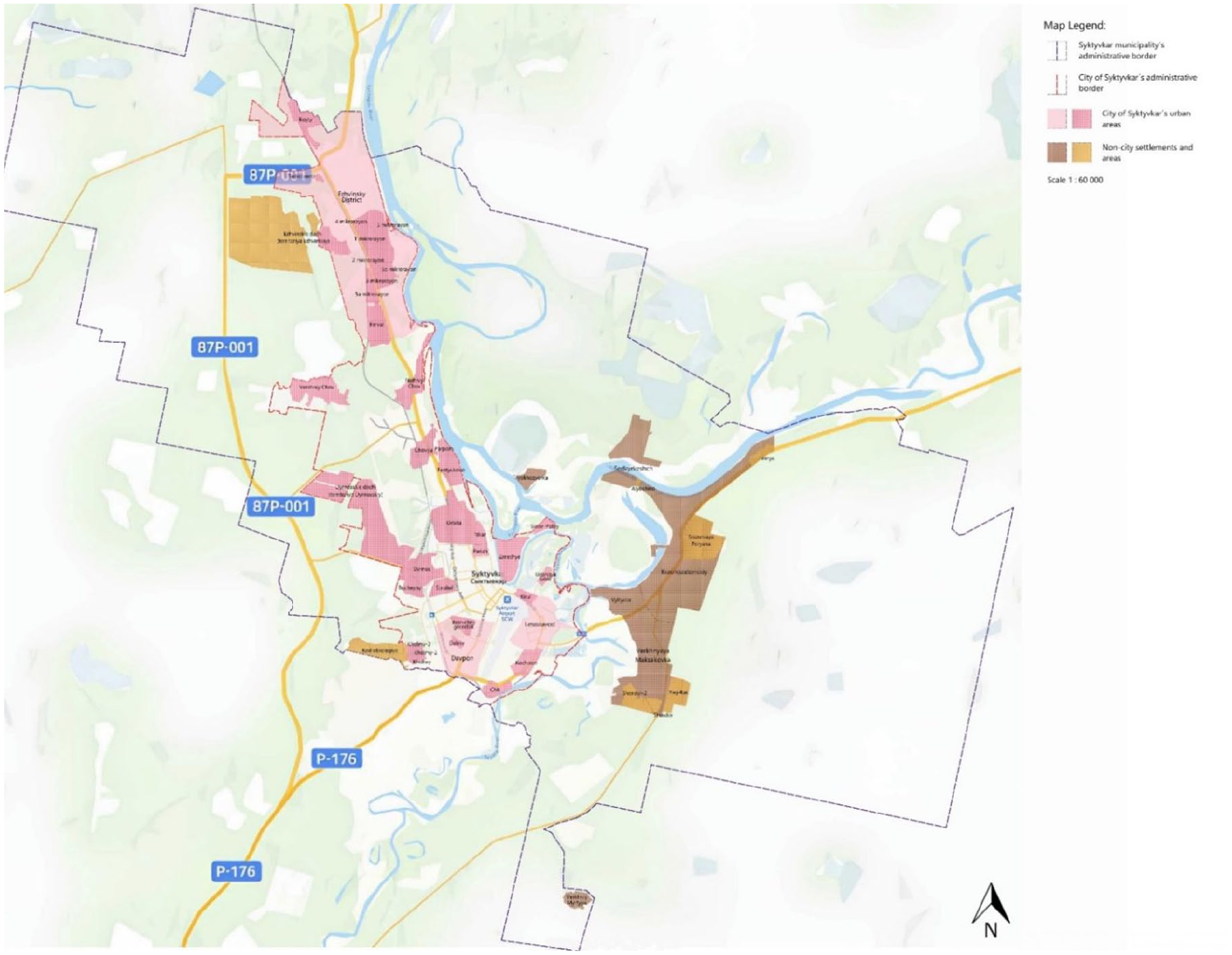
Map* of the Syktyvkar urban municipality with indicated settlements and areas (Map by Anastasia Fedina, based on Yandex.Maps, n.d.).
Divided periodically, Syktyvkar’s settlements and areas form three settlement traditions: old Komi, Soviet, and modern, with the latter emerging in the 1990s. Urban areas that belong to the first group are located either centrally in Syktyvkar or, contrariwise, on the margins of the city. These areas are remnants of old Komi villages, the heritage of which has been preserved in their names, such as Dyrnos. The second group, the Soviet-era urban areas, are settlements developed around specific industrial sites. While these areas are typically newly built, some, such as Ezhva, have been built on the sites of former Komi settlements. Such areas usually possess Russian names—for example, Krasnozatonskiy or Bol’nichnyy gorodok—that frequently reference industry-related phenomena, such as Lesozavod—literally, lumber mill, and either have no alternative Komi names, or such names are calques of the Russian ones. Interestingly, some of such newly built areas—for example, Shordor—bear Komi names and are named according to the Komi tradition, referencing environmental signifiers. Finally, modern urban areas are almost exclusively residential areas consisting of apartment buildings, individual houses, or summer cottages. The naming of these areas is mixed, with both Komi and Russian names being used.
There are 52 settlements and areas indicated in Supplementary material 2, accompanied by linguistic and historical information. Twenty-nine of them bear Russian names, 16—Komi, 6—mixed Russian-Komi, and 1 area, Emvalʹ, has an allegedly Mansi (the language of the Mansi people, the Indigenous people primarily residing in the Khanty-Mansi Autonomous Okrug, Yugra, Russia) name. Among the Komi-named places, six sustained their traditional prerevolutionary names, five received their names during the Soviet period, three were named in the post-Soviet period; periodical origins of two more names were impossible to identify. Most of the prerevolutionary Komi names were slightly Russified, either by omitting Komi spelling or altering pronunciation. For example, Kyruv became Kirulʹ. Four mixed names were introduced in the Soviet period, while two were preserved from an earlier period. Out of 29 Russian settlement names, only one has an alternative Komi name, 10 have modern Komi calques, and the remainder have only Russian denominations.
Thirty-one settlements and areas in Syktyvkar bear names that reference local and natural environments. Twenty of these localities, including Ezhva, Chovʹyu, and Vylʹtydor, are named after water bodies such as rivers, river parts, streams, and lakes. Ten of them are Komi, five—Russian, and five—mixed. Three place names, two Komi—Yag-kar and Davpon—and one Russian, depict forests. Finally, eight place names signify local topographic features, four being Russian, three, including Shödkyrkötsh, are Komi, and one—Mansi.
Discussion
Previously, I have illustrated that physical and spiritual interactions with natural areas can shape Komi sense of home and belonging and their perception of well-being. The urban-dwelling Komi sustain these interactions through two primary strategies: engaging in urban-to-rural mobilities and identifying and establishing connections with natural areas within urban space. These strategies bear resemblance to the practices employed by other Indigenous peoples living in urban settings (Hatala et al., 2019; Wilson & Peters, 2005).
Based on my data, first, I suggest that these strategies are not mutually exclusive: people who find suitable natural areas within the city also enhance their well-being through continuous returns to their rural homelands. That said, I maintain that people who associate natural areas exclusively with rural settings risk limiting the sense of home to rural areas as well, thus reducing cities to mere workplaces rather than spaces for a fulfilling life. It is through identifying such areas in the city and nurturing intimate and spiritual relationships with them that people embrace urban space, carve out their place within it, imbue urban space with a meaning, and make it their own.
Importance of natural environments and local landscapes is particularly vivid in place-naming practices, one of major approaches to place-making and homemaking historically employed by the Komi and other Indigenous peoples (Basso, 1988). Unlike previous studies preferencing rural localities, I have chosen to focus on urban place names. I have analyzed two major sets of urban place names in Syktyvkar, street names and settlement and area names, and have found that references to natural species, landscapes, and areas, namely forest and rivers, are prominent in both groups, but are more common in settlement and area names than in street names.
The nomenclature of all 70 Syktyvkar streets that reference natural environments emerged during the Soviet and post-Soviet periods. Without access to official naming decisions, it is challenging to speculate on the exact timing and rationale behind the adoption of these street names. While some of these street names indicate features typical of Syktyvkar’s physical landscape, such as streams, lakes, or forests, they are otherwise rather typical denominators found in other cities in the Komi Republic and across Russia. Nonetheless, the presence of locally specific street names referencing species and landscapes endemic to Syktyvkar and the Komi Republic suggests intentional efforts to incorporate local features into local toponyms.
Street names, often serving to commemorate specific people of events, are a phenomenon typical of urban areas but rather recently introduced in rural areas. As such, street names are not a significant part of Komi place-naming traditions that typically commemorate natural environments and landscapes or first settlers. For this reason, I posit that environment-referencing street names do not overtly reflect the Kominess of Syktyvkar. At the same time, however, they contribute to the city’s image as being integrated in the surrounding environment. The abundance of such street names in recently developed areas, dominated by individual houses and summer cottages, may indicate deliberate naming decisions aimed at cultivating a more ecological, safe, calm and down-to-earth image for such areas.
Nevertheless, Kominess of Syktyvkar’s street names can be reflected in other ways. First, as I already mentioned, there are streets that reference distinguished Komi people. Although the number of such streets is small and their analysis is beyond the scope of this article, they, nevertheless, contribute to the perpetuation of the memory of the Komi people and recognize their heritage and contribution. And second, since, not always but as a rule, Syktyvkar’s street signs are bilingual, the Komi language, thus, remains a constant part of the city’s visual linguistic landscape, signifying the presence of the Komi people and delineating Syktyvkar also as Komi territory.
I have demonstrated that over half of Syktyvkar’s settlement and area names reference local natural environments with most of such names being Komi or mixed. Notably, natural environments appear to be the almost exclusive referents in all urban Komi-language area names. The earlier use of the Komi language in place names referring to local natural and topographic features persisted into the Soviet period, despite Russification efforts in other linguistic domains. Unfortunately, due to a lack of available data, the motivations behind the naming decisions by the city authorities of that period remain unclear. Meanwhile, this tradition endures in present-day Syktyvkar as well. I hypothesize that the modern use of Komi areas names primarily serves to create an image of more ecological and locally embedded settlements, an approach observed elsewhere (Hercus & Simpson, 2009). At the same time, even if the modern use of the Komi language in local toponyms serves primarily other purposes, it still, albeit unintentionally, captures the features of the local environment in the linguistic landscape and memoryscapes (Whitridge, 2004) of the city.
It should be highlighted that understanding the semantic meaning of Komi place names requires both knowledge of the Komi language and familiarity with the local landscape and the environment. While the referents of many such names have remained mostly unchanged, it is the language barrier that can hinder comprehension. Not only does the literal meaning of area names remain accessible to only a small portion of the city’s population possessing some knowledge of Komi, but even this population may find certain toponyms challenging to interpret due to vocal or graphical Russification. Nevertheless, it is exactly the place names that are perceived as one of potential catalysts of language revitalization and appreciation of Komi heritage, as evidenced by the growing number of educational initiatives led by the local museum and libraries.
In addition to limitations stemming from incomprehension, it is essential to recognize that perceptions of places and people’s relationships with them evolve over time, even as place names endure. Settlements and areas in Syktyvkar embody different narratives from various historical periods. Often it is exactly these images, connections, and narratives that shape the sense of place, especially for non-Komi speakers, reducing the significance of the semantic meaning of Komi toponyms.
Conclusion
In this article, I have studied Komi experiences of urban settling and homemaking and urban place-naming and examined how they foster Komi belonging and presence in Syktyvkar. I have paid particular attention to the role played by human–environment interactions and the ways in which natural environment’s referents are reflected in urban toponyms, and how both of these aspects can contribute to promoting Komi belonging to the city.
By focusing on the underrepresented case of the urban-dwelling Komi people from the Komi Republic in Russia, I have affirmed key findings of previous research with urban Indigenous communities. I have highlighted the significance of both urban-to-rural mobility and the establishment of bonds with urban natural areas in fostering the well-being of Komi people living in urban areas, which is consistent with similar findings elsewhere (Darnell, 2011; Hatala et al., 2019; Wilson & Peters, 2005). Furthermore, I have amended previous research by emphasizing the importance of engaging in both strategies to foster the senses of belonging and home in urban environments.
Furthermore, I have illustrated the importance Indigenous place names in asserting Indigenous presence (Hercus & Simpson, 2009; Whitridge, 2004). I have also observed the similar potential of non-Indigenous toponyms if they embed locally relevant referents and are multilingual. Simultaneously, I have emphasized the need to critically evaluate the significance of Indigenous place names, recognizing the diverse historical narratives imbued in specific places, language loss, and consequent incomprehension of the semantic load encapsulated in Indigenous toponyms.
Finally, I have also highlighted the Komi toponyms’ potential as an area for language revitalization. From this perspective, every use of urban Komi toponyms, whether organically developed or officiated by the city administration’s decision, is valuable, despite the varying intentions behind the use of such toponyms.
Supplemental Material
sj-docx-1-aln-10.1177_11771801251334702 – Supplemental material for Indigenous presence and belonging in urban areas: the case of the urban Komi homemaking and place-naming
Supplemental material, sj-docx-1-aln-10.1177_11771801251334702 for Indigenous presence and belonging in urban areas: the case of the urban Komi homemaking and place-naming by Maria Fedina in AlterNative: An International Journal of Indigenous Peoples
Supplemental Material
sj-docx-2-aln-10.1177_11771801251334702 – Supplemental material for Indigenous presence and belonging in urban areas: the case of the urban Komi homemaking and place-naming
Supplemental material, sj-docx-2-aln-10.1177_11771801251334702 for Indigenous presence and belonging in urban areas: the case of the urban Komi homemaking and place-naming by Maria Fedina in AlterNative: An International Journal of Indigenous Peoples
Supplemental Material
sj-pdf-3-aln-10.1177_11771801251334702 – Supplemental material for Indigenous presence and belonging in urban areas: the case of the urban Komi homemaking and place-naming
Supplemental material, sj-pdf-3-aln-10.1177_11771801251334702 for Indigenous presence and belonging in urban areas: the case of the urban Komi homemaking and place-naming by Maria Fedina in AlterNative: An International Journal of Indigenous Peoples
Footnotes
Acknowledgements
I thank the Komi residents of Syktyvkar for sharing their stories with me. Furthermore, I acknowledge Docent, Dr Marina Fedina for her assistance in collecting and analyzing Syktyvkar’s urban toponyms, Prof. Pirjo Kristiina Virtanen for providing feedback that helped develop this paper, and Anastasia Fedina for creating the map of the Syktyvkar urban municipality included in this paper.
Author’s note
Declaration of conflicting interests
The author declared no potential conflicts of interest with respect to the research, authorship, and publication of this article.
Funding
The author disclosed receipt of the following financial support for the research, authorship, and publication of this article: This work was supported by Koneen Säätiö (project’s name: Biokulttuurinen perintö ja ei-lineaarinen aika).

Supplemental material
Supplemental material for this article is available online.
Glossary
ас пу | as pu own tree
ва | va water
вӧр | vör a forest
вӧр-ва | vör-va nature
коми | Komi the Indigenous people of the Komi Republic, Russia
пожӧм | pozhöm a pine
пывсян | pyvsyan a steam bath
лес | les a forest
луг | lug a meadow
Манси | Mansi the language of the Mansi people, the Indigenous people primarily residing in the Khanty-Mansi Autonomous Okrug, Yugra, Russia
местечки | mestechki minor city areas
местечко | mestechko a minor city area
микрорайон | microraion a microdistrict
микрорайоны | microraions microdistricts
озеро | ozero a lake
район | raion a district
References
Supplementary Material
Please find the following supplemental material available below.
For Open Access articles published under a Creative Commons License, all supplemental material carries the same license as the article it is associated with.
For non-Open Access articles published, all supplemental material carries a non-exclusive license, and permission requests for re-use of supplemental material or any part of supplemental material shall be sent directly to the copyright owner as specified in the copyright notice associated with the article.
