




Abstract
Human consciousness remains an uncontested space. Listening and learning as an Aboriginal researcher to First Nations, Indigenous, African and Pacific Islander Peoples, it became apparent at a philosophical level that there is a shared view of reality. Relational ontology and connected key concepts from various international authors are presented. Demonstrating that despite the dominant Western cultural systems of thought, the earth also holds a loud roar from relational peoples, as they declare their ways of knowing in a world continually experiencing environmental loss and a lack of humanity between people. These voices come from unique and sovereign cultures, but they are also all people groups who position humans, nature and the spirit world as equal entities in their view of reality. However, to begin, this article first shifts the sociological lens onto Western cultural hierarchal thought, to understand how the Western mind became the apex entity.
There is a communal ideology and unique worldview between the Indigenous peoples of the world.
I am a First Nations Yorta Yorta (an Aboriginal people of northeastern Victoria, Australia) woman, raised to see reality through relationships, with people, nature, with the spirit world. Slowly over time, listening and learning from different people, a sound which was previously fragmented, became loud to me. At a philosophical level, I heard a roar. While all around me Western culture, defined for this article as belief systems originating from Europe, was asserting universalism, uncontested. I decided to try and amplify this beautiful roar. I decided to challenge the belief that ontology, which positions human beings as an apex entity in knowledge construction, is held by most people. Relationality is a worldview in which all entities, plants, animals, elements, seasons, skies, waterways, the land, the spirit world, Ancestors and humans, are in relationship, interdependent and connected through oneness. For this discussion, I state relationality does not belong to a particular people group, skin colour, or landscape, so I am using the inclusive term relational peoples.
The second purpose is to hold space and celebrate concepts and processes derived from relational thought, from sovereign cultures, which hold unceded Ancestral ties to their landscapes (The Uluru Statement, 2017). Moreton-Robinson (2006) and Walter et al. (2011) through their discussions about Whiteness articulate the importance of shifting the sociological lens to Western systems of thought. Without this process, dominant worldviews are not challenged, critically analyzed or historically understood. The process of analyzing this uncontested space creates an opportunity for relational thought in a colonized world. Relationality creates epistemologies, each holding unique cultures, languages and knowledge, in relationship to their landscape of origin across the globe. As Boaventura de Sousa Santos (2016) states, the diversity of the world is infinite. It is a diversity that encompasses very distinct modes of being, thinking and feeling, ways of conceiving time and relations among humans, and between humans and non-humans. I concur by strongly suggesting that this roar is not just a celebration of relational ways of knowing but also a heart cry, against continued intolerable harm to both humans and non-humans, to the detriment of the delicate balance our lifeworld requires.
Consciousness
From my understanding, which includes my feelings, consciousness or my ontology is the living, active, changing, knowing interface; between myself and the world around me at any moment. As an entity standing at this interface, I think and feel which other entities I am connected to, creating this moment of knowing. Is it only other humans; or is it also the birds, the tree beside me, the soil I stand on, the wind on my face, the water I hear, or the Ancestor I feel? Worldviews or ontology are our relationships with the world around us, and like any relationship is constantly changing in nuanced ways. Even this definition is obsolete now, as an entity of this world I know nothing, but through relationships I can continually learn and be connected. Some ontologies assert their ways of knowing to hold applicability further than their environment or the moment they were birthed from, while others are deeply embedded in a relationship to a moment, to an environment. Ontologies through their ways of learning or their epistemologies construct our cultures, languages, knowledges and social systems. Epistemologies are what we experience day to day as we were taught from books, the land, science, watching the stars or our own experiences. Epistemologies are built from ontological beliefs; however, discussing who are the entities of our ontologies, or the limits of ontological applicability in different landscapes, remains uncontested.
Ontology is an important discussion; just as one people group can dominate another, through war, invasion, or blocking representation during decision-making, one understanding of ontology can silence or subjugate another. Smith (2003) explains hegemony occurs when oppressed groups accept dominant group thinking and ideas uncritically and as commonsense. It is the ultimate way to colonize a people; you have the colonized colonizing themselves. Ontological subjugation was the case in Australia through the false British doctrine of terra nullius, which stated Australia was the land of no one (McMahon, 2017) despite First Nations people holding sophisticated systems for knowing for thousands of years. However, British colonization did not cease Australian First Nations ontologies or processes for creating and holding knowledges. The reason for this, I believe, is because of the complexity of our relational beliefs of reality and the breadth of entities, human and non-human, seen and unseen, included in our knowledge construction, meant our ontological consciousness, based on philosophies of interrelationships between people, land and the sacred spirit world (Foley, 2003), was beyond Western cultural capability of even seeing. However, epistemologies, cultures, languages, societies, resources and landscapes of First Nations, Indigenous, African and Pacific Islander Peoples were and continue to be directly attacked, othered, massacred, stolen and destroyed, despite the continuing movement of resistance, from relational people groups.
Hierarchal thought
One of the poignant differences I discovered between ontologies is the entities involved in knowledge production. Through Western cultural worldviews such as positivism, humans discover absolute knowledge and through relativism; humans construct knowledge from their personal experiences (Scotland, 2012). For knowledges derived from positivism and relativism, only humans are positioned as active entities during the process of knowledge construction, either through human measurement or lived experiences. Entities of nature and the unseen sacred, spirit world are not included as equal participants in knowledge construction, and many entities such as rocks are thought to be inanimate. Some environmental epistemologies (Mathews, 2022) strongly position relationships between humans and nature, as constructing ways of knowing. However, within environmental epistemologies, rivers and trees for example do not hold equality with humans during knowledge construction, and the unseen Ancestral spirit world is not mentioned. Environmental epistemologies are beneficial however remain human-centred without the triad of Indigenous relationality; the natural world, the human world and the sacred spirit world described by Foley (2003).
Historically, Western cultural thought has held hierarchical views of reality with humans at the pinnacle of knowing, positioned just beneath a spiritual realm. Knowledge derived from hierarchal ontologies has been positioned as universal (Henry & Pene, 2001). Hierarchal ontology holds the view of reality known as scala naturae, its formalization is attributed to Aristotle (300 BC). The Scala Naturae, also known as the Great Chain of Being (Figure 1), places humans at the top of an order of complexity, intelligence and value (Diogo, 2017). This ontology describes the order of living beings and the inferiority of animals and plants to humans.
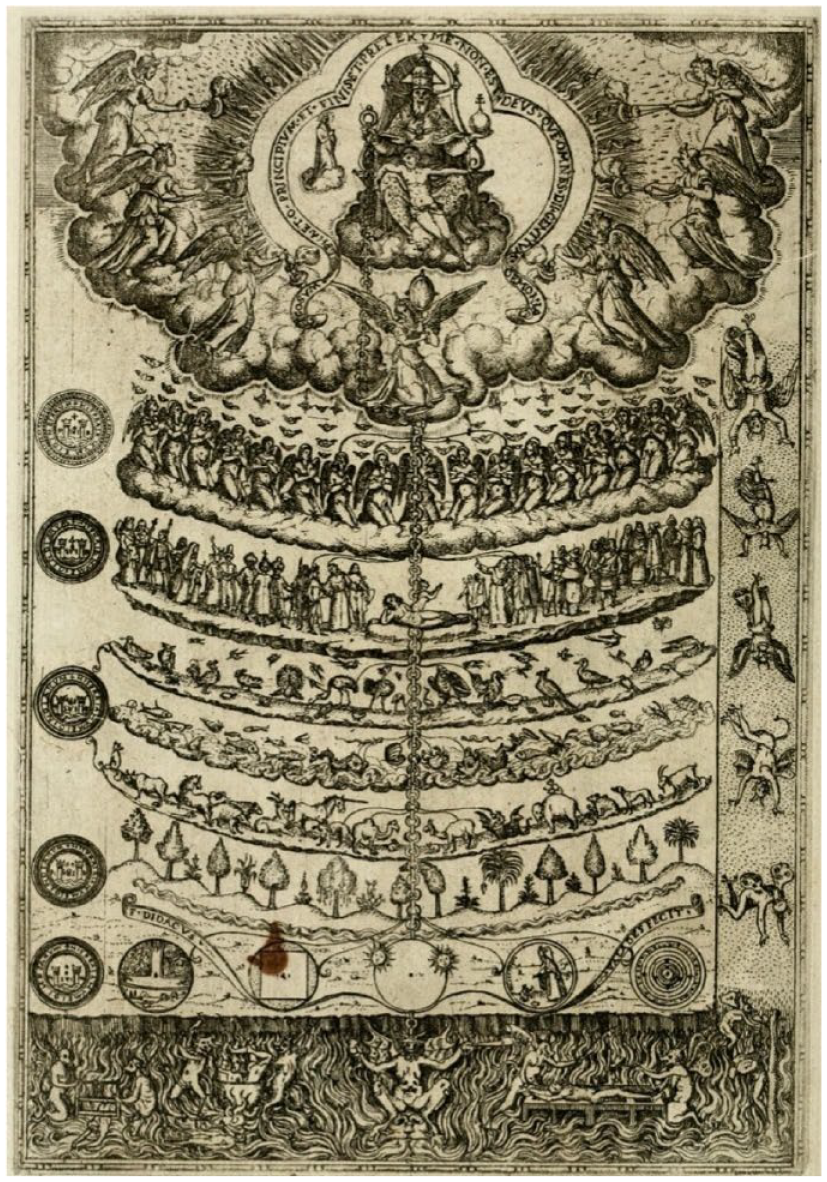
Scala Naturae (the Great Chain of Being) (Valades, 1579, n.p.).
The ordained vocation of European humans was to follow the links down the Great Chain of Being until all the secrets, of all entities below were accessible to the European mind, and their works or resources were advanced or imitated by European hands. This ontology enabled Europeans and later the Western cultural mind to believe they were destined to command the world. Then, the European man standing on the top of this hierarchy, governed all that was below, making all other humans, animals, land, plants and minerals serviceable to the enjoyment and abundance of his life (Lovejoy, 1936). The Great Chain of Being enjoyed dominance throughout the history of Western thought, from classical antiquity, Middle Ages, and Renaissance and into modernity, also becoming the philosophical backbone of the European invented concept of race, leading to historical and current experiences of slavery and racism (Ogunnaike, 2016). The European hierarchal view of reality endowed Europeans and later people from Western cultures with the power of ordering and governing all living creatures (Stephan, 1982).
European medieval authors defended that humans were different from animals, arguing that humans were made in the image of God and could, therefore, use all non-human organisms, including primates as they pleased (Lovejoy, 1936). Ogunnaike (2016) explains that during the 13th and 14th centuries, the Roman Catholic Church in Europe reached the height of its political power and established its hegemony over European intellectual tradition, through the institution of the centralized Papal Inquisition in 1233 and the rigid enforcement and adoption of Aristotelianism hierarchal order as official Church doctrine on matters philosophical and natural. Later the European Age of Reason, during the 17th and 18th centuries did not end the Great Chain of Being prominence (Lovejoy, 1936). Instead, European man or now the mind of the European man was atop the Great Chain of Being. The knowable, perceivable, intelligible universe was apparently only held by the reasoning mind of the European man, now at the summit. During this period Europeans as ordained as the apex entity ventured across the globe to explore, categorize and govern through murderous regimes of imperialism and colonization (Ogunnaike, 2016). Boaventura de Sousa Santos (2016) explains colonialism as a system of naturalizing constructed hierarchies that justify continental domination. When people groups are positioned low in a hierarchy and experience domination, this experience needs to be considered the product of their own inferiority, believed to be the natural order, they must be dominated. The Western-centric conception of humanity is not possible without sub-humanity, or human groups without full humanity, be they slaves, women, Indigenous peoples, migrants or Muslims (de Sousa Santos, 2016).
Hierarchal order of humans
Within dominant Western cultural thought, there have been historical connections between the discipline of comparative anatomy which looked at humans and non-human primates, and discussions regarding humans’ position in nature, their position in the Great Chain of Being and differences between human groups (Diogo, 2017). In 1778 and 1782, Petrus Camper provided the first detailed anatomical descriptions of orangutans, which then led to heated discussions in Europe defending that European humans were both mentally and morphologically more ideal than primates (Diogo, 2017). From my review of European authors, predominantly during the 17th century, scholars Carl von Linne (1735)—Swedish, George Buffon (1749)—French, Johann Blumenbach (1775)—German and David Hume (1753)—Scottish (as cited in Hudson, 1996), and Petrus Camper (1778)—Dutch, Edward Tyson (1699)—British, Carl Linnaeus (1735)—Swedish, discussed by Lovejoy (1936) as cited in Diogo (2017) and Ogunnaike (2016), debated human positionality, prompting the necessity to update, conceptually, the Great Chain of Being.
A new hierarchy was inserted within the Great Chain of Being, but this time ordering humans, politically constructing the term race to stabilize European power. The notion of truly civilized humans was established. This update to hierarchal ontology meant humans were now sorted into varieties based on simplistic, continental thinking, Caucasian, Mongolian, Ethiopian, American and Malay (Hudson, 1996). Highlighting how much the European imagination had become dominated by the picture of continental land masses (Hudson, 1996). Cornel West’s (2002) term, the normative gaze, described how all human forms were now assessed. Groups of people globally were judged based on their conformity to or distance from the Western cultural physical ideal. The degree to which one differed mentally or physically from this ideal determined that people groups place in the hierarchy, and thus their level of humanity or lack of (Ogunnaike, 2016).
Race then became the major term of ethnographic scholarship, while the term nation was reserved to describe the political and social divisions of Europe. Tribe was increasingly used to replace nation in descriptions of savage peoples outside of Europe. People groups outside of Europe were stripped of their collective identities and were instead bands of individuals without government or laws equal to Europe, so did not merit the honorific title of Nation. The European terms of race, tribe and nation within an ordained hierarchal ontology moved across the globe, spawning many political barbarities, violence and destruction of environments and societies outside of Europe, within global history (Hudson, 1996).
The Great Chain of Being updated with European racial thought, created racism and the idea that human identity could be understood through skin colour, instead of a person’s cultural and social consciousness, their Ancestral memories, lived experience, spirituality and their relationships with land, waterways, seasons, plants, animals and the big sky. Steve Larkin (2011), a Kungarakany (an Aboriginal people from Northern Territory, Australia) man, states the process of racialization declared that his people’s minds, intellects, knowledges, histories and experiences were irrelevant, and Aileen Moreton-Robinson (2015), Goenpul (an Aboriginal people from Stradbroke Island, Queensland, Australia) woman, explains racialization is the process by which Whiteness operates possessively to define and construct itself as the pinnacle of its own racial hierarchy. To conclude with, Dr Steve Biko (1978), a Xhosa (an Indigenous people from South Africa) man, thoughts that around the world there are false discussions that different communities are faced with a Black, Hispanic, coloured, Indigenous or an Aboriginal problem. There has never been anything inherently deficit with these communities, the problem has always been racism, originating from European hierarchal thought. Race as a scientific term was later debunked through the Human Genome Project in 2003, which found that all humans are genetically 99.9% identical (National Human Genome Research Institute, n.d.).
Relational thought
Relational consciousness is predominantly the ontological, philosophical system First Nations, African, Pacific Islander and Indigenous people groups use to create and continue intellectual processes and knowledge for every facet of life, for thousands of years. Entities of relational worldviews include human communities, all entities of nature, and the unseen spirit world, which includes our Ancestors (Figure 2). This triad of humans, nature and the spirit world (Foley, 2003) is the definition of relationality for this work, different from definitions only including humans and the environment. Nature includes entities such as land, seas, seasons, waterways, skies, weather, animals, plants, the elements such as wind, fire and the solar system. As Armando Marileo Lefío (2003), a Mapuche (an Indigenous people from Chile and Argentina) man, explains the term mapu (land) for the Mapuche people encompasses everything that exists: trees, animals, insects, birds, water courses, fountains, volcanoes, rocks, mountains, persons, spirits and air. The mapu is all of them together. Oscar Kawagley (1995), a Yupiaq (an Indigenous people from Alaska) man, explains the Yupiaq worldview; is also the interrelationship between humans, nature and spirit, established on an understanding that there must be constant communications between these three realms to maintain the delicate balance.
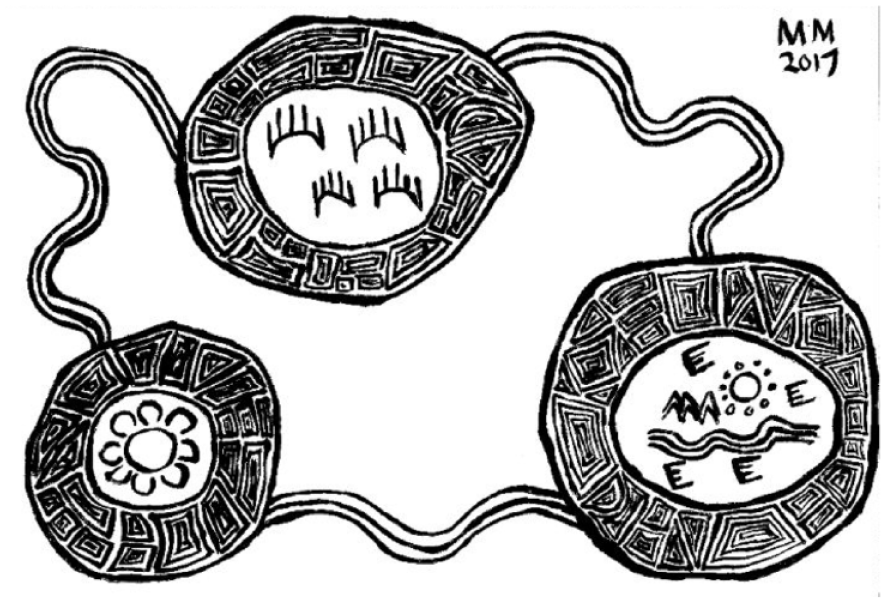
Relational drawing (McMahon, 2017).
Beliefs of reality from a relational worldview differ greatly from Western cultural views of reality which position humans alone atop a hierarchal structure for creating ways of knowing. Leroy Little Bear (2000, p. 2) of the Kainai Nation, First Nations people in Alberta, Canada states “If everything is animate, then everything has spirit and knowledge. If everything has spirit and knowledge then they are all like me, if they are all like me then they are all family.” All entities in motion, connected by relationships, requiring balance create a holistic, cyclical relational worldview.
A scientific term that explains relational thought derived from the interconnectedness of human community, nature and the spirit sacred world, is synthesis. This term explains what occurs when entities connect through a relationship and create something new; however, for synthesis to occur entities need to maintain a relationship to be able to create (Merriam-Webster, 2017). The synthesis of relational ontology creates new knowledges and maintains old knowledges, cultures and languages; it is fluid and changing. In very nuanced ways, relational peoples learn and adapt to change through maintaining relationships, within their lifeworld. Knowledge comes only from relational synthesis; humans alone cannot create or find knowledge as in hierarchal ontologies. The infinite localized land-based epistemologies of relational peoples, informed through relational ontology hold unique knowledges, governance systems, social systems, languages, science and cultures; it is each community’s intellectual sovereignty. It is each community’s continued inheritance, responsibility and source of wellbeing.
Karen Martin (Martin & Mirraboopa, 2003, p. 208), a Noonuccal (an Aboriginal people, North Stradbroke Island, Queensland, Australia) woman in Australia, explains through relationality, “You no longer know yourself as a ‘person,’ you’ve become an Entity among other Entities.” Kawagley (1995) adds: “This we know: the earth does not belong to man; man belongs to earth. All things are connected, man did not weave the web of life; he is merely a strand in it” (p. 3).
As relational people we are dependent on everyone, and everything around us is our relations. We need each other to survive. Graveline (1998) explains further: “That which the trees exhale, I inhale. That which I exhale, the tree inhales. We live in a world of many circles; these circles go out into the universe and constitute our identity, our kinship, our relations” (p. 56). Lefío (2003) explains that because humans, land, nature and spirits have been interacting, coexisting and sharing the habitat, for a millennium, the Mapuche have endeavoured to maintain harmonious and reciprocating relationship with all these different actors. From an African, Ghana perspective, George Sefa Dei (2012) explains that the values of wholeness, connections, and the interrelationships of self, group and communities exist, as well as the nexus of body, mind, soul and spirit. A Ghanaian worldview sees society, nature and culture interface in constant union; this interface connects the material and non-material, the social and cultural, as well as the physical and the metaphysical. Manulani Meyer (2001), a Hawaiian woman, speaks from a Hawaiian perspective; “we were never like the people who colonized us” (p. 125). If others understand what is unique about Hawaiians as cultural people. They would realize the Hawaiian building blocks of understanding, their epistemology and their empirical relationship to experience are fundamentally different, Hawaiians simply see, hear, feel, taste and smell the world differently. From Aotearoa (New Zealand), collective interdependence exists across the past, present and future between humans, the Gods and the cosmos and the environment (Henry & Pene, 2001).
As evidenced through this article, relational peoples around the globe have held relational worldviews for thousands of years. This ontology, because it is land-based, creates an infinite number of epistemologies, entities change from landscape to landscape, thus creating different identities, cultures, languages and knowledges. These infinite epistemologies from all the different landscapes have investigated for thousands of years correct concepts for, astrology, agriculture, governance, health, communication, law and science. From this localized context, a relational worldview produces different ways of knowing from one area to another. Hence, for relational people our knowledges, languages and cultures are different from one community to another, from one landscape to another. However, these epistemological differences stem from the relational consciousness or philosophy we share.
Relational concepts
Spirit
A central concept of a relational view of reality is spirit, the idea that all entities are animate, infused with spirit and in constant motion or change (Little Bear, 2000). From this concept, relational people in different ways are spiritually orientated communities. All other concepts or processes are based on a physical world which is infused by spirit. Meyer (2001) states, “we don’t believe the concrete world is the only reality” (p. 130). Between all entities in both the spiritual and physical worlds, balance needs to be monitored and maintained. Humans study the world around them and make necessary, localized nuanced adjustments to maintain balance and harmony between entities. This includes harmony within our physical bodies, our spiritual self, our relationships with others, our relationships with nature, and with our Ancestors. It’s an understanding that everything is sacred, and all entities are respected and held as family. Human beings must maintain balance, and not disturb the delicate relationships between entities. Kathy Absolon, an Anishinaabe (First Nations peoples from Canada and the USA) woman, explains that holism implies a balance between elements of the whole, which is achieved through interconnections, interdependence and interrelationships (Absolon, 2010). Lefío (2003) discusses further, people, land, nature and powers from the natural and the supernatural dimensions coexist, producing harmony and equilibrium in the gag mapu (the space of interrelations between people, land, nature and energies). The concepts of balance, harmony and oneness mean making decisions from a holistic perspective; a person’s health, an animal’s health or health of nature is understood within the broader context of the whole lifeworld, the seen and unseen.
Knowledge
Knowledge is learnt, observed and experienced but it is also revealed through dreams, visions and intuition from ancestors or the spirit world, and through a relationship with nature. Revealed knowledge is another concept of relationality concerning how humans obtain knowledge. Diana Steinhauer (2002), a Cree (a First Nations people from Canada) woman from Saddle Lake Cree Nation, region of central Alberta, Canada, explains that for humans, knowledge is gained not only through learning, experiencing and observation but also through revealed knowledge. Revealed knowledge is sourcing information through Ancestral memories, dreams, visions, stories we hear, intuitions and through relationship with entities of nature such as plants, waterways, weather and animals (Steinhauer, 2002). Revealed knowledge enables our participation as humans, within a relational worldview. As Sefa Dei (2012) states, our emotions, intuitions and spirituality constitute legitimate knowing and are not anti-intellectual. Castellano (2000) says, “the knowledge valued in Aboriginal societies derives from multiple sources including traditional teachings, empirical observations, and revelations” (as cited in Steinhauer, 2002, p. 74). Empirical knowledge is gained through watching and listening, and revealed knowledge is understood to be spiritual in origin (Castellano, 2000, as cited in Steinhauer, 2002).
Lefío (2003) describes that through the cyclical seasons, messages are constantly being delivered by birds, rivers, the rain and wind, leaves and insects such as crickets. These messages guide our actions, to the extent that we are able to decode them. Lefío (2003) further explains that these messages were “decoded by our Ancestors, this communication is called Mapudugun [language of nature], a language which belongs to the land and not to people, because it was not us who created its sounds, but nature itself” (p. 9). Sefa Dei (2012) adds,
Knowledge is socially and collectively created through the interactive processes among individuals, groups, communities, and their natural worlds. Knowledge comes from individual, family, and community interactions, as well as through the interactive processes with nature. Humans are part of the natural world. We do not stand apart and neither are we above the natural world. (p. 831)
Creating knowledge and holding knowledge is a relationship with all of creation. “It is with the cosmos, it is with the animals, with the plants, with the earth that we share this knowledge. It goes beyond the idea of individual knowledge to the concept of relational knowledge” (Steinhauer, 2002, p. 71). Meyer (2001) quoted a Hawaiian leader from a community meeting who defined ancestral memory further, “I’m deeply connected to my mother and Ancestors and all the Hawaiians that came before us. In me I have some of that cellular, molecular structure and memory of long ago” (p. 127). Steinhauer (2002) concludes, “our Ancestral memories are in our blood, they’re in our muscles, they’re in our bones, they’re in our hair” (p. 76). Many of us do not pay attention to these memories because we are busy interacting in the modern world, and this is why when we hear the drum, our spirit is moved. The vibrations of the drum or didgeridoo stir old memories, our Ancestral memories. These memories ignite and come out of the molecular structure of our being.
It is also important to consider how humans hold knowledge, from a relational perspective humans will not know everything, there is knowledge beyond the human mind (Moreton-Robinson & Walter, 2010), and all entities have the capacity to hold knowledges, not just humans. Humans can only know or hold certain knowledge, and they may be restricted by their gender, age or by their lack of experience to hold certain knowledge. Relational communities develop new knowledge for contemporary challenges through cyclical, cultural governance processes, which combine new knowledge with tried and tested ancestral principles, concepts and processes, for each landscape.
Listening
Hearing or seeing revealed knowledge requires a type of listening, described by First Nations communities in Australia as deep listening. Deep listening is when we listen and feel with our spirit, our hearts and our intuition to the spirit world, to entities of nature and to our Ancestors (Ungunmerr, 1988). We receive teachings, meanings and lessons through deep listening. Knowledge is revealed through deep listening from our Ancestral memories, dreams, silence, visions, ceremonies, stories and intuitions. Deep listening enables us to hear revealed knowledge and participate in our own relational world. Absolon (2010) says that the doorway to the inner space, where the Ancestral knowledge sits, is through dreams, ceremonies, vision quests and rituals. The Ancestors are there waiting to share their knowledge. Meyer (2001) states that there is Ancestral prompting and an art of paying attention to culturally specific, deep, internalized knowledge.
The concept of deep listening may require waiting a little at times, you may need to sit, wait or spend time alone or in nature before making a decision; you may need to listen to an Elder, hear a story, wait for a dream or a particular animal come into your day before you know how to proceed. Kawagley (1995) explains, “careful observation is made of animal behavior, their inner qualities and the genius of a particular animal, with a view of deriving spiritual and moral lessons from that animal” (p. 3). There is a belief that animals have much to teach humans concerning wisdom and regarding human inner nature. The process of waiting a little to enable space for deep listening, to hear revealed knowledge, has been misunderstood by Western European societies for centuries. Kawagley (1995) summarizes this by saying that the universe requires constant communication between the three realms of nature, spirit and humans. This reciprocity of conversations is an essential element of the relational worldview. It allows for constant monitoring to make sure the balance is maintained.
Renewal
All entities exist in a narrow gap of ideal conditions, humans included, if these conditions are not maintained disaster follows. Renewal as a concept is maintaining these ideal conditions or balance for all entities, so all entities continue to exist. Renewal necessitates the study of flux, observance of patterns, understanding of the interdependent relationships between all entities, and knowledge stored by relational communities through ceremonies, art, dance and story (BanffEvents, 2015). Renewal ceremonies, the telling and retelling of stories, and the singing and re-singing of the songs are the process of maintenance, creation and continued existence (Little Bear, 2000). Solomon and Wane (2005, in Absolon, 2010) describe the concept of renewal,
Indigenous peoples the world over follow the rhythm of the cosmos with distinct relationships to the sun, moon, stars, animals, plants, sound, wind, water, electrical and vibrational energy, thunder, lightning, rain, all creatures of the land and water, the air, and the rhythm of the land itself. (p. 79)
Renewal necessitates nuanced awareness and study of each localized environment. Little Bear (2000) states, “if creation manifests itself in terms of cyclical patterns and repetitions, then the maintenance of those patterns is all-important” (p. 4). The sum of Indigenous knowledge and the continuing processes which create and re-create relational knowledges reveal the underlying and interconnected order of a vulnerable biosphere. This corpus of knowledge is a part of the collective genius of humanity (Battiste & Henderson, 2009).
Time
Time as a phenomenon is not linear but cyclical, understood through cyclical events. Seasons are central to this cyclical concept of time and to a person’s own journey of selfhood. From a relational understanding of overlapping time, in any moment, a person exists, their Ancestors are present and their unborn great-grandchildren are also present. This understanding of time greatly impacts how a person acts and the decisions they make or don’t make. Murove (2007) explains through the term ukama (an African philosophy for relationality between humanity, the divine and nature, across time, the past, present and future) from the southern African Shona (an Indigenous people from Zimbabwe, Mozambique and South Africa).
Also, within a relational understanding of time, relational people belong to living cultures, they are not frozen within an anthropological understanding of culture. Battiste and Henderson (2009) explain that the European corpus of knowledge held the belief that only European consciousness counts as progress and that Indigenous peoples’ consciousness becomes frozen in time or possibly diluted once interfaced with Western cultural thought. Relational ontology informs each unique living land-based epistemology, and the key tenets of this philosophy will never cease to exist. As each relational people group maintains a relationship with all entities of their landscape, including new experiences of colonization, the knowledges, cultures and processes of each landscape may need to change in nuanced ways, to hold continued balance between all entities. This means that relational cultures are living and dynamic and will change over time to maintain renewal.
Community
The concept of community is worldwide. For relational people, it means each person develops both an individual and collective identity by engaging and growing relationship with people, nature and Ancestors (Martin, 2007). Biko (1978) states that African people hold an easiness to communicate openly with each other and can develop a sense of belonging to each other quickly. Close relationships with people are not just with friends and family, but with people who we share space. “No one is an intruder into someone else’s business, we all hold a deep concern for each other” (Biko, 1978, p. 41). This definition of community means it is inclusive, fitting adults and children into a network of belonging, love and support. Biko (1978) also explains, “Africans do not view each other as agents of a particular function, example, what can you do for me or what is the reason for our conversation,” instead, Biko explains we are a community of brothers and sisters jointly involved in the quest to answer the varied problems of life (p. 42). From this, we act as a community orientated for joint action rather than individualism. Also, from the African context song and rhythm in African culture is an expression of our joint emotional state as a community, and it is not simply an artistic expression but a type of group communication, music grows and holds our collective identity. “Our feeling of togetherness is our sustenance which makes us strong” (Biko, 1978, p. 43).
Within Indigenous communities, while the individual self is affirmed as important, it is correspondingly maintained that the individual makes sense only in relation to the community she or he is part of. The principle of community requires a collaborative self rather than a competitive individual, who will prioritize the interests of the community (Sefa Dei, 2012). Lawrence Ogbo Ugwuanyi (2014) from Nigeria explains the prioritization of the community over the individual, means that the community is the basis for the conceptualization of the individual, and personal values can only be derived from the values of the community. According to Ugwuanyi (2014, p. 518), ubuntu (an African philosophy for collective self) states “I am because we are and since we are, therefore, I am” (Ugwuanyi, 2014, p. 518), which is in sharp contrast to Rene Descartes (2006) philosophy, I think, therefore I am.
Ugwuanyi (2014) also explains the African concept of vitalism. Whatever an African does or does not do is geared towards acquiring a vitality, or glowing up, within themselves. This vital force is desirable, both for the collective and for the individual because they re-enforce each other. Vital force is an interaction that leads to the increase of vitality within the group. Increasing the vital force of others demands development of positive relations with others through care, humanness and empathy, increasing their will to live, or in Ugwuanyi (2014, p. 519) words “adding life to other lives.”
Self
Through the Western concept of development, the growth of self is linear, from conception to death. Alternatively, many relational people groups conceptually understand the self through the cyclical concept of selfhood. Bame Nsamenang (2006) of Cameroon explains the concept of selfhood, which includes the understanding that all humans have an Ancestral self from the spirit world, a spirit self, which transitions from nature or waterways, through conception, pregnancy and birth, to social self, a period which begins when a child’s community introduce themselves to the baby through ceremony or gatherings. The time when a child is introduced to their community marks the beginning of their social self, or collective identity, becoming an active member of a community. The relational understanding of selfhood demonstrates each person’s complex relationship to Ancestors, nature and community.
Through selfhood, self does not sit at the centre, because people hold both a collective and individual identity. Growth of self is through interdependence and interrelationships with all entities of the lifeworld. From conception attachment is relational, meaning many entities, seen and unseen, human and non-human become significant attachment for growth of self (McMahon, 2017). Sefa Dei (2012) explains coming to know the self is to begin to act responsibly and relationally with all entities of the lifeworld: “It is about coming to a humanhood as a whole being” (p. 830). This wholeness is a nexus of body, mind and soul, and interrelations of society–culture–nature, connecting the physical, metaphysical, social, material, cultural and spiritual realms of existence (Sefa Dei, 2012). While the individual self is important, the individual only makes sense in relation to the community they belong to. Biko (1978) states that African people do not separate natural and supernatural, and they experience a situation rather than solve a problem, letting both the rational and non-rational elements impact their self. Africans accept that life will have its enigmas which are beyond our power to perceive or resolve.
Relatedness
Relatedness is a term which describes how the self grows identity in a relational word. It is a reciprocal relationship between a person and entities of their lifeworld (Martin, 2007). An individual grows relatedness through learning knowledges about an entity in their lifeworld, and then through holding increasing responsibilities to this entity. Relatedness grows during a person’s lifetime, the more you learn about a person, a plant, an animal, a landscape, a waterway or an Ancestor, the more you are accountable and responsible to that particular entity. From birth, a child is taught their connection to the whole lifeworld, so a child understands their identity as a part of a whole lifeworld, not as an individual that the world revolves around (Martin, 2007). Martin (2007) explains that relatedness extends across time to include Ancestors, a child’s knowledge of their Ancestors becomes part of their identity. Through relatedness between all entities, there is a spirit of inclusiveness, where children, neighbours, friends, animals and family are fitted in.
Equality
Within relational ontology, all entities are equal. Kawagley (1995) re-states this saying that Yupiaq thought holds that all creatures, including humans, are born equal. From Australia, Martin and Mirraboopa (2003) also state that we believe that “one entity should not be raised above another, as all entities live in close relationship with one another. People are no more or less important than the other entities” (p. 207). All are weaved together in a cyclical relationship. Equality informs the process and styles of communication between humans, so indirect or gentle communication techniques are used to demonstrate equality (McMahon, 2017). Gentle talking enables trust to be built; it is respectful and includes deep listening during communication. Communication informed by equality enables strong mutual trust, power imbalances addressed, and individuals feel free to speak from their heart and to hold their own self-agency. Gentle communication techniques include teasing, body language, humour, sharing stories, loaded questions and silence (McMahon, 2017).
Regarding knowledge construction human and non-human entities are all equal in creating and holding ways of knowing. Steinhauer (2002) explains humans are neither above nor below others in the circle of life. This interconnectedness introduces the concept of kinship held by many relational communities. From Chile, Lefío (2003) describes this concept, saying everything in nature is our kindred
the Mapuche know that we belong to the earth and the earth belongs to us. That is why we, as inhabitants of the Mapu, we call ourselves Mapuche, meaning people of the land. Our powerful kinship with the environment generates a permanent search for a sense of equality, reciprocity and harmony, which constitutes our main endeavour in life. (p. 2)
Equality offers Hawaiians the opportunity to practice reciprocity, balance, develop harmony and generosity with all entities (Meyer, 2001). The survival of each life form is dependent on the survival of all others (Steinhauer, 2002).
Conclusion
I hold imagery of the origins of dominant Western culture; far across the ocean beneath a grove of olive trees in a place called Academia outside the city of Athens, about 387 BC, men and women of the School of Plato discussed reality and consciousness. Roar of relational peoples is a drumbeat, a message, as Rigney (2001) declares, thinkers as great as Plato, Einstein and Marx existed and continue to exist, in Indigenous communities. Consciousness has always existed globally within academies of thought, connected to different landscapes and societies. Biko (1978) reminded us decades ago that people without a positive history are like vehicles without an engine. The continued absence of relational consciousness within our societal decision-making processes is detrimental to our environment, and our humanity. Absolon (2010) states that if Indigenous worldviews, values and beliefs are foundational to living a good life, then the absence of Indigenous worldviews has created imbalance and dis-ease.
Graham Hingangaroa Smith (2003), a Māori (Indigenous people of New Zealand) man from Aotearoa, discusses the politics of distraction as part of the process of continuing Western cultural hegemony. Relational peoples are kept busy by the colonizer, always on the back foot to dominant uncontested Western cultural knowledge. This position means we always need to argue, defend and explain our existence and our intellectual validity. The politics of distraction is soul-destroying and exhausting. Smith (2003) states we need to move to consciousness-raising, where relational thought from infinite epistemologies, are positioned for our communities and environment. Shiva (1993) argues that Western cultural knowledge hegemony creates a monoculture of the mind. Innovation, creativity and localized relational initiatives for each unique landscape are suppressed.
Sefa Dei (2012) tells us the work is not to undo Western ways of knowing, but rather to undo the hold they have on what is considered legitimate knowledge. Biko (1978) during the apartheid era suggested that liberals should realize that the place for their fight is within their own communities, against racism and educating everyone that the history of one’s country needs to be rewritten. This sentiment is true for multiple landscapes. As space is created for continuing, ancient relational philosophies, it is hoped the politically constructed concept of race is discarded with other European ideas such as archaic notions of a flat earth. It is also hoped to paraphrase Biko (1978) once all groups have asserted themselves to the point that mutual respect exists, then there is the provision for each man or woman to rise and attain their envisioned self. I would add now, in the era of environmental loss, that mutual respect for relational consciousness will also hopefully enable nature to attain a level of healing. For the continuing environmental and human cost of Western cultural expansion, fuelled by the hierarchal belief that the human mind alone constructs knowledge, the roar of relational people is loud. Let us converse as people, let us agree and disagree. Let us sit under a tree and talk and create new academies of thought. The only option not viable is to leave human consciousness an uncontested space.
Footnotes
Acknowledgements
The author acknowledges the sovereign lands of the Djaara people where I live, the Yorta Yorta community and landscape of my Ancestors, and family and friends who encouraged this article. The author also acknowledges and expresses gratitude to the First Nations, Indigenous, African and Pacific Islander communities, landscapes and authors whose sovereignty and spirit are the fabric of this article.
Author’s note
Declaration of conflicting interests
The author declared no potential conflicts of interest with respect to the research, authorship, and publication of this article.
Funding
The author received no financial support for the research, authorship, and publication of this article.

Glossary
Anishinaabe First Nations people from Canada and the USA
Aotearoa New Zealand
Cree a First Nations people from Canada
Goenpul an Aboriginal people from Stradbroke Island, Queensland, Australia
Kungarakany an Aboriginal people from the Northern Territory, Australia
Māori Indigenous people of New Zealand
mapu land
Mapuchean Indigenous people from Chile and Argentina
Mapudugun language of nature
nag mapu interrelations between people, land, nature and energies
Noonuccalan Aboriginal people, North Stradbroke Island, Queensland, Australia
Scala naturae the Great Chain of Being
Shonaan Indigenous people from Zimbabwe, Mozambique and South Africa
ubuntu an African philosophy for collective self
ukama African philosophy for relationality between humanity, the divine and nature, across time, the past, present and future
Xhosa an Indigenous people from South Africa
Yorta Yorta an Aboriginal people of northeastern Victoria, Australia
Yupiaq an Indigenous people from Alaska