




Abstract
The Sámi are the only recognised Indigenous peoples in Europe. The traditional homeland, Sápmi, stretches today over the countries Norway, Sweden, Finland and the Kola peninsula in Russia. The aim of this article is to pinpoint critical issues related to special educational support for Sámi children and youth in Norway. Research on this topic is scarce. Research conversations were held in 2022 with 10 Sámi special education teachers. The Sámi special education teachers’ narratives reveal how their language proficiency, cultural and subject knowledge, and special educational competencies allow them to bridge the paradigmatic disharmonies and dilemmas in special educational practices in Norway to various extent. To illustrate the results the article presents three scenarios depicting the Sámi special education teacher as a strong instrumentalist bridging between paradigmatic disharmonies; as a frustrated player constantly improvising to find the harmony; or playing an instrument that is not included in the symphony.
Keywords
Introduction
Hirvonen and Keskitalo (2004) compare the Sámi (the only recognised Indigenous peoples in Europe) curriculum for the 10-year primary and lower secondary school with Schubert’s unfinished symphony, launching the query: “Has this reform become like some symphonies, it is fully composed, but it lacks some parts to be complete?” (p. 201). The question refers to the milestone of Norway implementing a Sámi curriculum in 1997 after almost a century of demands for a specific Sámi school and that the curriculum, similarly to a symphony, needs to be interpreted. In this article, we argue that although it appears that the rights to inclusive equitable special education provision currently are in place in legislation for Sámi pupils, not only is the symphony unfinished, but some interpretations and implementations are dissonant, create tension and discomfort, thus revealing the paradigmatic disharmonies between Sámi and Norwegian worldviews.
Assimilation of Indigenous children through dominant colonial education systems was common globally, and still has a devastating impact on the lives of many Indigenous individuals, peoples and communities worldwide (Kahakalau, 2018; Kuokkanen, 2000; The Truth and Reconciliation Commission of Canada, 2015). The Norwegian Truth and Reconciliation Commission has investigated the Norwegianization policies against the Sámi, Kven (Norwegian Finn) and Forrest Finn peoples and presented their report 1 June 2023 (The Truth and Reconciliation Commission of Norway, 2023). The Commission states that the Norwegianization processes have had and still have great human consequences, specifically school experiences told to the commission show how encountering the mono-lingual Norwegian school made it necessary to turn their back on their own language, which has created great grief but also a struggle for “their own or their children’s identity, language or dignity” (The Truth and Reconciliation Commission of Norway, 2023, pp. 440–441). The Sámi storytellers report joy due to the flourishing of Sámi languages and culture their children experience, which strengthens the language and culture in the home with the family (The Truth and Reconciliation Commission of Norway, 2023).
In a report, the expert group found that there is a lack of screening tools in the three Sámi languages; Davvisámegiella (the North-Sámi language), Julevsámegiellaj (the Lule-Sámi language) and Åarjelsaemien gïele (the South-Sámi language). The report concludes that there is little research done on this topic, but there have been a few investigative reports conducted, one in 1990 (as cited by Sorkmo, 2011) and one in 2014 (Nygaard & Nylund, 2014). Sorkmo (2011) reported a lack of Sámi-speaking professionals throughout the Norwegian educational system, few opportunities for professional development within the field of special education in Sámi founded in ways of teaching and learning adjusted to the diverse needs of Sámi pupils, and inequalities in the education provided for Sámi pupils in comparison to that of other Norwegian children. Nygaard and Nylund (2014) found it difficult to determine exactly how many Sámi pupils receive special education support and identified two challenges: (1) Sámi pupils live all over Norway and not only in areas where Sámi languages are strong; (2) it is difficult to find professionals proficient in Julevsámegiellaj and Åarjelsaemien gïele. In their report on the health of young Sámi, Hansen and Skaar (2021) stressed that Sámi youth may be affected in their education by the historical trauma of the Norwegianization that led to the loss of language, culture and knowledge. According to the Kunnskapsdepartementet (Ministry of Education, n.d.), those working with Sámi children and youth in the need of special facilitation must have both Sámi and special educational competencies, which means it is not enough with one or the other to address Norwegianization processes. It is apparent that there is a need for research about special educational provision for Sámi children and youth in Norway.
In Norway, Sámi and Norwegian languages are equal languages in public administration in the municipalities in the administrative areas for Sámi languages. This means that everyone has the right to be served in Sámi when they contact public agencies. In 2023, the municipalities were divided into three different categories. The categories are (1) language development municipalities, (2) language vitalisation municipalities, and (3) language stimulation municipalities. Language development municipalities and language vitalisation municipalities have the highest level of rights, and language stimulation municipalities are where the Sámi population is mainly displaced and do not have the same connection to the Sámi language (Kommunal-og distriktsdepartementet, 1987/2023). Language development municipalities are only in Finnmark county, the other municipalities are language vitalisation municipalities, and in addition, a selection of some metropolitan municipalities which have many Sámi inhabitants (Sámi Allaskuvla, 2021).
In Norway, the State Special Education Service has a special unit, Sámi Special Education Support (SEAD), which achieved a historical milestone on February 1, 2024, when the Norwegian Ministry of Education and Research along with the Sámi Parliament approved its final mandate (Statlig spesialpedagogisk tjeneste, 2024). SEAD shall contribute so that municipalities and county municipalities have Sámi and special educational competence available for Sámi children, youth, and adults in need of special educational support (Statlig specialpedagogisk tjeneste, 2024). According to SEAD, the specific rights of Sámi as Indigenous peoples in Norway are stipulated in the Constitution Section 108 that was amended 15 May 2023 (Ministry of Justice and Public Security, 2024), the Convention on the Rights of the Child, Article 30 (United Nations Children’s Fund [UNICEF], 1989) and the ILO Convention No. 169 (International Labour Organization, 1989). Seen together with the legislation on Sámi languages equality to Norwegian, it would seem that national and international policies and legislation form a stable foundation for inclusive, equitable special education services for Sámi children and youth.
Clashes of paradigms
Language is important for the identity of Sámi (Hirvonen & Keskitalo, 2004). In their analysis of the Sámi curriculum of 1997, they conclude that several variations in the organisation of Sámi schools and their language practices were apparent in Sámi as a first language, Sámi as a second language or as a combined subject comprised of Sámi language and culture. The Norwegian language was still dominant in some areas, which could be attributed to a lack of Sámi teachers and teaching materials, resulting in hidden Norwegianization. Furthermore, people outside of the school such as family members and others in the community had little involvement in the school, which resulted in teacher background shaping the Sámi schools (Hirvonen & Keskitalo, 2004). If every teacher is interpreting in their own way with no guidance, surely disharmony will be the result.
In 2006, another Sámi curriculum, LK06S, was introduced and evaluated by Solstad et al. (2009, 2010, 2012): results highlighted that there are big differences between the administrative municipalities. The teaching should ideally take place in Sámi, but it requires teachers that are able to teach in Sámi. Furthermore, if classes consist of both Sámi and Norwegian speaking pupils, it has an influence on language use. There is a shortage of Sámi teaching materials, especially in Julevsámegiellaj and Åarjelsaemien gïele, and Norwegian textbooks must often be used even if the teaching is to take place in Sámi. The challenges for the Sámi language teaching situations are particularly great for Julevsámegiellaj and Åarjelsaemien gïele, but the situation for Davvisámegiella can also be very difficult.
Interestingly, almost 20 years later, the Official Norwegian Report 2022, regarding a comprehensive system for competence and career development for professionals in kindergarten and school, states that Sámi perspectives and culture are unclear to many professionals in early childhood education and schools, and these topics are not prioritised in professional development courses (Kunnskapsdepartementet, 2022). Sámi languages are in danger of extinction in combination with difficulties in finding and recruiting teachers with competence in Sámi language and culture. This clash of paradigms still complicates the everyday schooling of Sámi children and youth in need of special educational support in Norway.
Aim
The overall objective of this article is to unravel the current state of special educational support for Sámi children and youth in Norway, fill the gap in the field, and identify strengths and struggles in the provision of inclusive, equitable special education support in Sámi contexts.
Theoretical framework
Our developed theory of Indigenous and Indigenist models of inclusive equitable education is the theoretical framework for this article (Figure 1) (Lindblom & Jannok Nutti, 2022). The models are based on Indigenous philosophical assumptions and are child-centred. Indigenous models are tribally or nation-specific, which means they are founded on the traditional ways of knowing, being, and doing of the Indigenous Nation that the child is a part of. In Indigenist models, non-Indigenous practitioners and/or researchers work with Indigenous practitioners and/or researchers in special educational contexts. The term Indigenist is used as by Shawn Wilson (Adams et al., 2015, p. 20), where he explains that “This emphasizes that it’s a philosophical issue, not a claiming of ownership by one group of people. You can be a white [as written in original work] Indigenist just like you can be a male feminist.” Chilisa (2020, p. 21) uses the metaphor of paradigms in concert on the dancefloor to describe how harmony is relevant in research “On the dance floor, paradigms may dance with rhythm, different steps to the same song.” We envision special educational provision and research as partaking in such rhythmic harmonious dance.
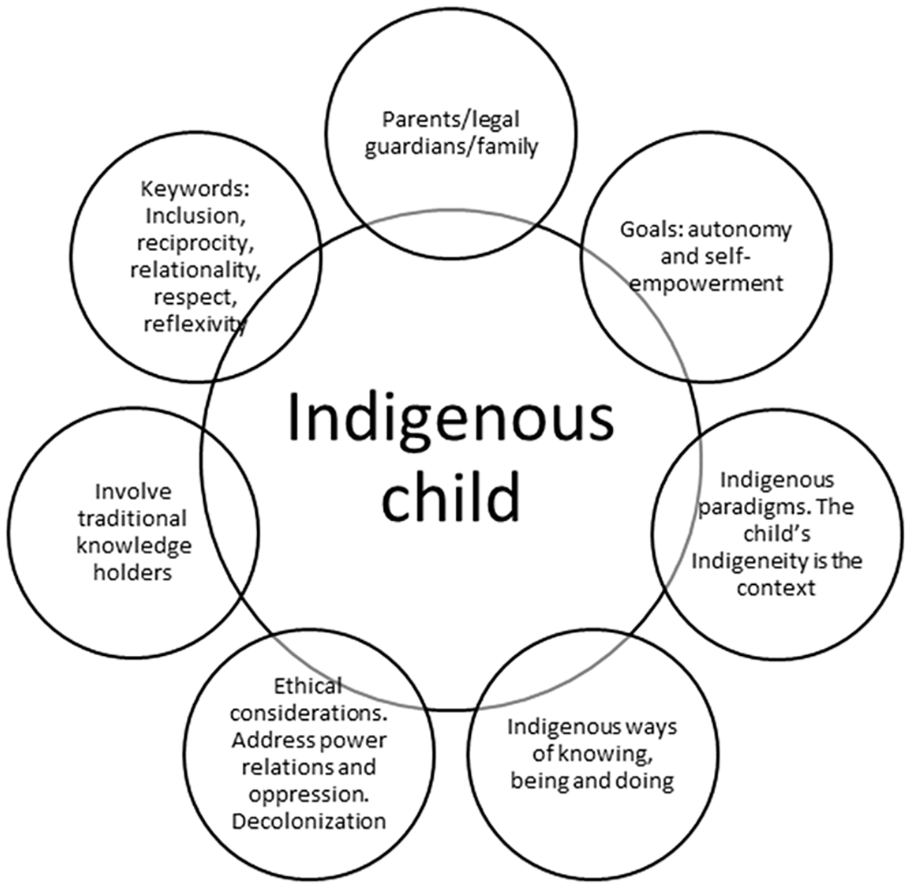
Framework of Indigenous and Indigenist special educational support design, provision and research; design inspired and further developed from Lambert’s (2014) Spiderweb conceptual model and Lindblom’s (2017) pan-tribal research framework (Lindblom & Jannok Nutti, 2022).
In the Indigenous and Indigenist models of inclusive, equitable education (Lindblom & Jannok Nutti, 2022), the Indigenous child is centred and the child’s indigeneity is the context. In Sámi settings, this would mean that the child’s language and cultural identity is the foundation for the culturally specific, Indigenous special educational services. Special education and other pedagogical personnel without language and cultural knowledge will collaborate with those who have the competence, but also with the child or young person, their parents and extended family, so the services would then be culturally relevant and sensitive and based on an Indigenist model. Relationality is essential within Indigenous paradigms (Chilisa, 2012; Porsanger et al., 2021; Wilson, 2008), and the special education professionals and/or researchers must build reciprocal, respectful relationships with all in creation. Inclusion has deeper dimensions than just relating to the educational contexts. Indigenous paradigms are inclusive regarding all in creation, the living, non-living, nature, ancestors, and generations to come. When the Sámi child in need of special support is receiving services in their language, hearing and speaking words relevant to their interests and everyday lives, singing songs from their culture or making crafts like their parents and grandparents before them, they are connected in reciprocal relationships. The Sámi ways of knowing, being and doing harmonise with the special educational support provided. Traditional knowledge holders can be involved, and in some cases, the Sámi special education teacher and/or parents or extended family or community members can be the bearers of traditional knowledge in the special educational setting. The goals of autonomy and self-empowerment can be facilitated when worldviews do not clash. Merian (2024) refers to the works of Berth (2019) in the field of Black Feminism, and the concepts of individual and collective self-empowerment. In Sámi special educational contexts, this could mean that self-empowerment is fuelled by culture. Ethical considerations are important not only because the Sámi child in need of special support can be vulnerable but also in regard to power relations between pedagogues, children and parents. The Sámi communities are small, and individuals can easily be identified which also makes ethical considerations of utmost importance. Power relations need to be addressed as well as historic and current oppression against Sámi. Decolonising special educational support services and research needs to be considered throughout all processes. Porsanger et al. (2021, p. 146) state “In research Indigenization takes place when Indigenous language is used in the construction of research tools.” Similarly, in special educational contexts, we declare that Indigenization takes place when the Indigenous language of the child is used in the support provision, including materials and screening tools as stipulated in the theory of Indigenous and Indigenist models of inclusive, equitable education. This addresses power imbalance and can stimulate decolonisation. In this article, we specifically mean the Sámi languages Davvisámegiella, Julevsámegiellaj and Åarjelsaemien gïele.
This project focuses specifically on Sámi contexts in Norway, including the Norwegian part of Sápmi, the traditional homelands of the Sámi. In an Indigenous model of inclusive, equitable education, Sámi ways of knowing, being and doing are in reciprocal relationships with the specific Sámi language of the child, parents and the immediate family, and extended family as well as of the special education teacher or researcher. Due to Norwegianization processes that still are in active play, the first language of the child and their family may be Norwegian, which can cause ethical and special educational dilemmas.
Methods
It was decided that Sámi special education teachers would be the research partners (participants) in this study, and we wanted to have speakers of the Sámi languages; Davvisámegiella, Julevsámegiellaj and Åarjelsaemien gïele, as well as special education teachers from diverse areas both inside and outside of language management areas, urban and rural areas. The project description was sent to the Norwegian Centre for Data which is now called the Norwegian Agency for Shared Services in Education and Research, and the researchers were given the comment to remind the special education teachers not to mention any sensitive or confidential issues or provide information about specific pupils or families. The researchers also discussed ethics regarding Sámi contexts that are often small, and people are well acquainted with each other. They also participated in seminars and webinars on Sámi perspectives on research ethics and anonymity in small local communities.
Individual research conversations were held with the research partners in this study during 2022. We use the terminology research partners instead of the term participant and research conversations instead of the term interview to address the power imbalance embedded in the relationship between the researcher and the participant. This is extra important in Indigenous contexts, and specifically in this project, in which the researcher leading the conversations is non-Indigenous and all the research partners were Sámi, keeping in mind the on-going Norwegianization processes.
Procedure
Relationality is extremely important in research within Sámi contexts. There is a shortage of Sámi special education teachers in Norway. A considerable amount of time was spent building relationships with Sámi special education knowledge holders. When reciprocal respectful relationships were developed, Lindblom was introduced to the Sámi special education teachers by three of these knowledge holders. The research partners all spoke at least one of the three Sámi languages, Jannok Nutti speaks Davvisámegiella. However, as Lindblom is a researcher in the field of special education and also has done special education research in First Nations contexts in Canada, the research conversations were conducted by her in Norwegian. Some of the conversations were held in person and others in Zoom. The conversations in Zoom were digitally recorded with audio only, so all the material was in the same format.
Analysis
The transcribed conversations were analysed using an inductive thematic analysis approach inspired by the six-step model developed by Braun and Clarke (2006). The first phase involved Lindblom transcribing the 10 research conversations consisting of 8 hours and 48 minutes of recorded material resulting in 171 pages of text. All the names of research partners, cities and such were anonymized in the transcripts. Gender of the research partners was not disclosed for further anonymity purposes. In the second phase, Lindblom conducted an initial coding process of two conversations. In a co-coding session, the researchers came up with four broader themes which they used to individually code three other conversations in a third phase. During the inter-rater coding session, paradigmatic disharmonies and dilemmas stood out as an overarching theme. Two sub-themes emerged: (1) language and culture and (2) competence and a new coding scheme were developed with the theme. In the fourth and final phase, Lindblom coded all the conversations using the final coding scheme (Supplemental Material 1).
Results
To avoid recognisability of research partners, we summarise the different qualifications held within the group of 10 Sámi special education teachers. Teacher qualifications are pre-school education, general teacher education. Some have the first and second levels of special education which are the courses from the old system before it became necessary to have a master’s degree in special education, or other courses in special education, some with Sámi focus. Other academic trajectories are acquiring a bachelor’s and master’s degree in special education. Although they may have specialisations within their Master’s of Special Education such as audio pedagogy or speech therapy, they must also keep updated and take professional development courses in other areas such as autism, complex learning difficulties and acquired brain injury. Several have additional competence in for instance counselling methods and bilingual development.
The work experience of the Sámi special education teachers is extensive. They have worked with special education in different ways before their formal education, during their education and after their education at various levels. The length of their special educational experience ranges from 8 to 38 years. In some cases, they already had an interest in special education and in others, a lecture or course, or their work with for instance bilingualism or language difficulties sparked their interest. To avoid recognisability of research partners, we summarise the experiences. Within the school system, they have experience from work with counselling, being a special education teacher, leading distance education, and as a teacher. Some have only worked with Sámi children in Sámi settings while others have also worked with non-Sámi children. Experience comes from educational levels from early childhood education to higher education. Experiences include working within the educational and psychological counselling service (PPT), doing expert evaluations, testing, speech therapy and counselling and at SEAD as senior advisor. Several have alternated back and forth between positions in different settings, for instance, special education teacher to the Educational and PPT to SEAD and then back to the PPT.
Even in the best cases when Sámi special education teachers describe positive and beneficial factors in their work, in all scenarios, there is a lack of teaching and mapping materials in the Sámi languages, and too few special education teachers who are proficient in the Sámi language of the pupil, have subject knowledge, and are culturally and special educationally competent. There are more materials available in the Davvisámegiella language than Julevsámegiellaj and Åarjelsaemien gïele. In addition, Sámi language and cultural competence among other professionals such as the PPT is low. Another obstacle can be that a diagnosis is required for the right to certain aids such as digital supports or personal computer, but there are no standardised Sámi language tests.
Language is an area in which the Sámi special education teachers report to have many cases, but there is still a need for capacity building on typical monolingual, bilingual and multilingual language development, as well as literacy development among Sámi pupils. There is little course content about special education and Sámi culture in the regular teacher education programmes. It can be difficult for the Sámi special education teacher to have competence spreading over many special education categories. Feelings of not having adequate or sufficient expertise in all areas often leads to experiences of stress and loneliness for the Sámi special education teacher. The current shortcomings cause dilemmas and extra workload to different degrees. When anonymizing the results, we were inspired by the work of Fylling and Melboe (2019) and their presentation of results through stories. Thus, we created three narratives drawing on the metaphor of music in the introduction (Hirvonen & Keskitalo, 2004), in which we depict the Sámi special education teacher as a strong instrumentalist bridging between paradigmatic disharmonies; as a frustrated player constantly improvising to find the harmony; or playing an instrument that is not included in the symphony. All the participating Sámi special education teachers were invited to give their feedback on this article and the narratives, as well as some knowledge holders we had discussed the project with previously. Six of the 10 participants accepted the offer of an individual digital meeting. In addition, the project and narratives were presented at a conference on Sámi education. Everyone has supported and been appreciative of the music metaphor and said they found the results recognisable.
Bridging between paradigmatic disharmonies
In areas where Sámi language and culture are strong, the Sámi special education teacher does not think much about the fact that the children are taught in their language. The language and culture are self-evident, incorporated in their daily work and fundamental in the community. The special education teacher in Sámi contexts has a combination of Sámi language and cultural competence, specific subject knowledge and special educational competence. Speaking the language and having cultural competence is not enough. Here possibly all the special educational professionals, special education teacher, the PPT and SEAD have this competence to various extents and in different capacities. They make mapping and teaching materials that contain stories from Sámi cultures, with pictures that align with the text that the children can identify themselves with. Not all Sámi cultural contexts include reindeer, for example, so the materials must reflect the specific cultural context and language of the child. There is a need for digital aids and communication tools that are culturally relevant. Language is the key in building trust with parents and often the Sámi special education teacher must guide Norwegian professionals in cultural sensitivity and translate both the language and the culture. There can be a lot of distrust towards the dominant Norwegian system. It is essential to know the meaning of family and extended family in Sámi contexts. One must not be too direct in communication and pay attention and pick up if a parent for instance becomes quiet. There is also less focus on diagnoses in Sámi contexts. This cultural approach to diversity is inclusive and reflects a collective, relational and reciprocal way of being. The Sámi special education teacher acts like a bridge between the Sámi and dominant Norwegian paradigms when the PPT speaks Norwegian but also in relation to Norwegian teaching and mapping materials. The Sámi special education teacher in this narrative is a confident instrumentalist who plays the same tune as the child, parents and extended family. They are a strong bearer of Sámi language and culture who are able to use their competence to acknowledge the child’s culture and identity to bridge the paradigmatic disharmonies and dilemmas they encounter with the dominant system in their daily work life.
Improvising to find the harmony
In this scenario, the Sámi special education teacher is a frustrated instrumentalist constantly improvising and feeling a bit behind in their endeavour to keep up with the rhythm and play in the same key as the rest of the orchestra. The Sámi language and culture is important in this setting as well, but the Norwegian society and system makes it difficult to uphold Sámi language competence, and Norwegianization is apparent in daily work life. The language is compared to having a master key to the culture. Language and cultural competence matter to parents when seeking special educational support for their child, and there are cases in which parents never would have sought help if there had not been a Sámi special education teacher at the school. The PPT often lacks knowledge about bilingual development and parents of children with special needs from bilingual homes can get the advice to consistently use Norwegian, so the child is prepared for the national language in case they live in a place where Norwegian is the dominant language. The Sámi special education teachers do not want to directly contradict the PPT, but they have good experiences and research that backs up their knowledge that is fine to learn two languages even if you have special needs. The PPT is the formal authority in these cases, and the Sámi special education teacher helps strengthen the parent’s position, constantly improvising and picking up harmonies that will go well with both paradigms.
Excluded from the orchestra
In school contexts in areas where the Sámi culture and language are less visible, Sámi issues are not automatically or systematically put on the table and the culture of the child’s family may not be explicit. The Sámi special education teacher then uses subtle ways of showing that they are Sámi, and it is possible to speak Sámi if the child or parents so wish. Despite parents of Sámi children and youth in need of special support knowing that the special education teacher is Sámi, it is rare for them to mention Sámi issues at all in meetings, which makes it inappropriate for the special education teacher to bring it up. Lack of language and cultural competence is also problematic if and when Sámi support is recommended. Even if the Sámi pupil has the right to education in their first language, in some geographical areas the competence does not exist. Furthermore, it is often up to the individual Sámi special education teacher to find materials or culturally competent teachers to deliver support. This is a deficit at the systemic and formal level and affects both how the pupil is viewed and the special educational support that is provided. Support provision becomes random and informal depending on who the special education teacher is and which teachers they know. Perhaps the pupil has moved for education in high school and encounters difficulties in for instance maths if they previously had all their teaching in Sámi and now have it all in Norwegian. In summary, the Norwegian school system does not protect or advocate Sámi special educational needs and interests despite formal rights. Being a Sámi special education teacher is described as being a bearer of culture that tries to understand the situation between people against the system and needs to constantly bring up Sámi issues in special educational contexts. In this third story, the Sámi language and culture are not included in the sheet music nor is the piece written for the instruments played by the Sámi special education teachers. They are not included in the band and stand at the sidelines hoping for the best.
Discussion
Although the SEAD works on filling the gap, there is still a need for screening and testing tools and special educational teaching materials in the Sámi languages, something noted earlier by Nordahl et al. (2018) and in Official Norwegian Report 6 (Kunnskapsdepartementet, n.d.). Similarly, the need for more special education teachers with Sámi language proficiency previously reported by Nygaard and Nylund (2014) is still apparent in the results of this study. Historical trauma due to Norwegianization processes as described by Hansen and Skaar (2021), and the Truth and Reconciliation Commission of Norway (2023) comes through in the results of this study as distrust against the Norwegian school system and in the paradigmatic disharmonies and dilemmas. Equal education opportunities for Sámi children and youth becomes problematic when professionals are not competent in their specific Sámi language, and there is a lack of awareness and acknowledgement of Sámi issues in special educational practice in Norway. There is an agreement among the Sámi special education teachers in this study that to work in the field of special education in Sámi contexts, you need Sámi language and cultural competence, subject knowledge such as maths and English, and special educational competence to have adequate capacity. This shows a more complex picture of necessary competencies than previously presented by the Official Norwegian Report 6 (Kunnskapsdepartementet, n.d.) in which it was stated that Sámi and special education competencies are needed. In the following text, we discuss the results using concepts from the theoretical framework of Indigenous and Indigenist models of inclusive, equitable education (Lindblom & Jannok Nutti, 2022).
The first narrative presented in the results is: bridging between paradigmatic disharmonies. In this story, the special educational support is child-centred and based on the child’s indigeneity, and parents and extended family share the Sámi language and culture with the Sámi special education teacher. The special educational support is naturally founded in Sámi ways of knowing, being and doing as language, cultural values and traditions are incorporated in the community. Cultural specificity is shown in the teaching materials, for instance boats will be the specific river boats used by the Sámi in the area, or in reindeer husbandry areas, reindeer and associated things will be in the materials. The Sámi special education teacher also has adequate topical and special educational knowledge. The Sámi special education teacher is a bearer of Sámi language and culture—traditional knowledge holder, when they encounter the PPT and other professionals without language or cultural competence and bridge the paradigmatic disharmonies and dilemmas by adhering to Sámi indirect modes of communication and less focus on diagnoses, thus reflecting the Sámi cultural inclusive, collective, relational and reciprocal ways of being. The Sámi special education teacher makes ethical considerations from their position in the community and knowledge of the family, addressing power relations with reflexive thought given to their contribution in the special educational work. The child’s autonomy and self-empowerment is facilitated through this respectful approach. The Sámi special education as a confident, skilled instrumentalist bridging paradigmatic disharmonies and dilemmas creates pleasurable and productive melodious special educational atmospheres. This story aligns with an Indigenous Sámi model of special education with support of Indigenist models.
The second scenario presented in the results is: improvising to find the harmony. The work is child-centred, but adapting the special educational support to the child’s indigeneity is complicated by difficulty to uphold the vital Sámi language competence. In meetings with the PPT who most often do not speak Sámi and may not have cultural competence, the Sámi special education teacher will address power relations by strengthening the parents’ position as they for instance may have difficulties having the discussions in Norwegian and would possibly not have sought help if there had not been a Sámi special education teacher at hand. In this story, cultural competence or sensitivity is not high with the formal authority, PPT, who assesses the child’s needs. Due to Norwegianization processes, language loss or not being able to use their Sámi language, can be a sensitive topic which requires ethical awareness. PPT might advise parents of children from bilingual homes that they should be consistent in the use of one language, Norwegian, so they are prepared for life in a dominant Norwegian setting. The PPT are possibly thinking about the child’s opportunities to be included in the dominant setting, thus disregarding the deeper more complex Indigenous Sámi understanding of inclusion as being included in all in creation. In this regard, instead of decolonisation, Norwegianization processes are continued. Improvising under such conditions leaves the Sámi special education teacher with a feeling of frustration over seldomly, or never, finding the right key, rhythm or melody required for paradigmatic harmony.
The third and final narrative is: excluded from the orchestra. Although the Sámi special education teacher in these settings obviously strive to have the child’s best interest in focus, Sámi issues are not systematically addressed in special educational contexts. The child or young person and/or their parents might not explicitly show their indigeneity or culturally express themselves in special educational contexts. This makes it unethical and inappropriate for the Sámi special education teacher to bring up the topic. In some geographical areas, it is possible to find competent personnel to provide special educational services in the Sámi language of the child, but in others, there is a dearth of such competence. Special educational support provision that is Sámi specific or culturally sensitive and relevant is randomly provided in cases where the Sámi special education teacher knows of materials or personnel that are available. Lack of systematic indigenization and decolonisation of the special educational services, and the fact that Sáminess is not disclosed by the child or family can be colonial and Norwegianization residue such as described in the Truth and Reconciliation Commission of Norway (2023) report, inhibiting autonomy and self-empowerment. Interaction can be respectful, but inclusion, reciprocity and relationality as understood and practised within Indigenous worldviews is difficult or sometimes impossible under such conditions. The Sámi special education teacher has their hands tied in this story and unable to play their instrument in whatever piece is being played. The harmonies, timbre and essence of the music does not resonate with Sámi ways of knowing, being and doing, causing disharmony in cacophonic clatter.
The most paramount obstacles to equitable inclusive special education provision for Sámi children and youth in Norway are systemic and stem from the Norwegianization processes that are still implicitly and explicitly in place in the everyday lives of Sámi.
It’s fine to learn two languages if you have special needs and it is also fine to have extra focus on Sámi which is a minority language. The Norwegian language will develop regardless. At the systemic level, Sámi pupils end up in the Norwegian system. We don’t manage to support everyone. (J, special education teacher)
Although prospects are at times grim, none of the Sámi special education teachers have lost hope, and they see that progress has been made which aligns with the mindsets displayed by informants to the Norwegian Truth and Reconciliation Report (2023). There appears to be a need for more systematic work to be done before we can hear perfect paradigmatic harmony in special educational provision for Sámi children and youth or see “paradigms in concert on the dancefloor” in the manner Chilisa (2020) writes about (p. 21). Until then, everyone has to keep on playing their instruments to the best of their abilities.
Final remarks
The Sámi special education teachers’ narratives reveal how their language, cultural and subject knowledge and special educational competencies allow them to bridge the paradigmatic disharmonies and dilemmas in special educational practices in Norway to various extent. This is a valuable asset, but it also is time-consuming and puts immense responsibility on the very few special education teachers who are competent in all areas. Sometimes their bridging skills lead to a more completed paradigmatic symphony, but in light of results in this study, it is a lonely job with a heavy workload. This calls for systemic change and Indigenization of special educational practices for Sámi children and youth in Norway, and possibly reflects the situation across Sápmi, the traditional homelands of the Sámi, and beyond. We believe that this article can inspire and contribute with insights in the transformation of current practices towards Sámi specific, inclusive, equitable education for all Sámi children and youth, as well as to the body of knowledge on global Indigenous education.
Supplemental Material
sj-docx-1-aln-10.1177_11771801241309817 – Supplemental material for Paradigmatic disharmonies and dilemmas in special educational practices for Sámi children and youth in Norway
Supplemental material, sj-docx-1-aln-10.1177_11771801241309817 for Paradigmatic disharmonies and dilemmas in special educational practices for Sámi children and youth in Norway by Anne Lindblom and Ylva Jannok Nutti (Sámi) in AlterNative: An International Journal of Indigenous Peoples
Footnotes
Acknowledgements
The authors thank and acknowledge the Sámi special education teachers that participated in this study, sharing their Sámi special educational knowledges. We are grateful for the reciprocal relationships developed during the study and the shared knowledges contribution to the knowledge gap regarding special education in Sámi contexts in Norway.
Correction (January 2025):
Article has been updated to reflect correction affiliation of the second author.
Authors’ notes
Declaration of conflicting interests
The authors declared no potential conflicts of interest with respect to the research, authorship and publication of this article.
Funding
The authors received no financial support for the research, authorship and publication of this article.

Supplemental material
Supplemental material for this article is available online.
Glossary
Åarjelsaemien gïele the South- Sámi Language
Kunnskapsdepartementet Ministry of Education
Kven Norwegian Finn
Davvisámegiella the North-Sámi Language
Julevsámegiellaj the Lule-Sámi Language
Sámi the only recognised Indigenous peoples in Europe
Sámi Allaskuvla Sámi University of Applied Sciences
Samisk spesialpedagogisk stotte Sámi Special Education Support
Statlig spesialpedagogisk tjeneste State Special Education Service
References
Supplementary Material
Please find the following supplemental material available below.
For Open Access articles published under a Creative Commons License, all supplemental material carries the same license as the article it is associated with.
For non-Open Access articles published, all supplemental material carries a non-exclusive license, and permission requests for re-use of supplemental material or any part of supplemental material shall be sent directly to the copyright owner as specified in the copyright notice associated with the article.
