



Abstract
By referring to the White settler post-racial imaginary of the USA, this article examines the slippage, transferability, and political interplay of racial representations into an analysis of the character of Ruth Langmore, a White adolescent woman portrayed in the Netflix series Ozark (2017–2022). Establishing the history of popular culture in the USA as emergent from Blackface, I argue that Ruth is coded, through an eschatological association, fashion styling, and ambient sound, as Black at various points throughout the series. I analyse screengrabs from pop culture and quotes from the showrunner, executive directors, and musical director to demonstrate that the destruction of the Black body is inherited, restricting the survival of Black and Indigenous peoples. Readers are advised that this article contains spoilers about the series Ozark (2017–2022).
Introduction
Ozark (Bateman et al., 2017–2022) is a popular television crime drama series hosted on Netflix. On the surface, it is a story about a White couple Marty and Wendy Byrde and their two children who flee from Chicago to the Ozarks after becoming implicated in money laundering for a Mexican drug cartel. During the series, the Byrde family takeover and escalate cartel operations, outwit and outrun government and law enforcement, and involve Ozark locals in their crimes and operations—many of whom betray their own kin to gain the family’s favour. Under the surface, it is a story about the impunity and affordances of Whiteness. This is exemplified in a conversation in Episode 1, Season 4, during a conversation between Wendy, played by Laura Linney, and her son Jonah, played by Skylar Gaertner (Mundy & Bernstein, 2022). Grappling with his family’s new criminal lifestyle and querying a charity established to launder their fortune, Jonah tells his Mother Wendy “People will find out where the money came from,” to which Wendy replies, “you need to grow up. This is America. People don’t care where your fortune came from and in two election cycles it’ll be just some myth, some gossip” (Mundy & Bernstein, 2022, 41:55). The exchange suggests that in America, if you are White and affluent, no one asks or cares how you became so.
In the final scene of the series, a White private detective named Mel, played by Adam Rothenberg, confronts the Byrdes with evidence of their crimes. When the Byrdes offer to buy his silence, Mel says, “You don’t get it do you? You don’t get to win. You don’t get to be the Kochs or the Kennedys or whatever fucking royalty you people think you are. [The] World doesn’t work like that” (Mundy & Bateman, 2022, 1:7:14). Wendy replies, “since when,” and the series finishes with Jonah pointing a shotgun at Mel and the sound of a shot firing (Mundy & Bateman, 2022, 1:7:32). The murder of the private investigator implies that in America, White people like the Byrdes do, in fact, get away with exuberant wealth and privilege at the expense of others without consequence or culpability.
The power and privileges of Whiteness are explored in Ozark (Bateman et al., 2017–2022) in complex and nuanced ways. While the show has a majority White cast, it does include multiple Latinx characters. Some have praised the show for showcasing a more complex power dynamic between characters who are American and Mexican drug dealers compared to its predecessors like Breaking Bad (Gilligan et al., 2008–2013) and The Sopranos (Chase et al., 1999–2007) who prioritised empathy with a downtrodden White man archetype, as well as for nuanced representation of rural Whiteness in America (Thornton, 2017). However, the complex coding of race in the series requires greater attention. Particularly, the unique way in which the series codes White characters as Black and Indigenous. Representations of locals in Ozark (Bateman et al., 2017–2022) are particularly poignant. White characters, for instance, discuss their connection to land as both long and ancestral (Zhou & Abraham, 2018). This framing, which naturalises local White settlers on Indigenous lands they have colonised, has been theorised by Tuck and Yang (2012) as settler nativism and invites further commentary from Native American scholars, researchers, and media critics. Given that I am a Black American person and Indigenous to elsewhere, I have reserved my commentary in this article for how Blackness is coded onto the White character of Ruth Langmore, played by Julia Garner.
In this article, I use Regina Bradley’s (2012, 2013, 2014) sound studies, Catherine Squires’ (2014) work on post-racial imaginaries, Toni Morrison’s (1992) literary studies, and Matthew D. Morrison’s (2017) work on Blacksound to examine the use of Black masculine coding in American and Americanised representations to foreshadow death. First, I provide some background to my thinking and a theoretical framing of Black coding of White characters in American popular culture based on Saidiya Hartman (1997). In my findings, I analyse memes and screengrabs of Ruth and quotes from the showrunner, executive producers, and musical director. I conclude with Ta-Nehisi Coates’s (2015) assertion that American destruction of the Black body is heritage and that in the case of Ozark (Bateman et al., 2017–2022), White violence and impunity is eventually brought down upon Ruth, who is coded increasingly as Black both sonically and visually while the series progresses towards her death. Inadvertently, the series obliterates the Black body in the name of White wealth via a post-racial imaginary and through the destruction of a White character coded as Black.
Background
As Hartman (1997) has shown, America has a long history of coding White performers as Black for the entertainment of White audiences. Blackface, Hartman (1997) argues, was the first form of “popular” entertainment and was an important tool of the antebellum era and into the 1950s where “sounds, performances, and imagery improvised by mostly White men in Blackface effectively silenced and restricted the sentient black bodies through which these expressions were imagined and created” (p. 26). Similarly, Toni Morrison’s Playing in the Dark (1992) established how American literary traditions use language and performance to code Blackness even in the absence of Black characters. Nebulous and almost invisible reference to Blackness, she argues, operates in the American literary imagination as a metaphor for death and decay. Toni Morrison (1992) maps this across widely read texts written by White American men including Poe, Melville, and Hemmingway. Ultimately, she demonstrates how the White literary imaginary forges Whiteness and White American values, including individualism and freedom, against and in relation to Black peoples who have been coded into the collective White imaginary as manifestations of projected fears of being enslaved or oppressed—a condition White Americans imposed on Black peoples. Matthew D. Morrison (2017) has articulated the way this has transferred into contemporary popular cultures and music as Blacksound and explains that for music like hip hop, “the concept suggests the scripting, commodification, and embodiment of these sonic performances by both black and non-black bodies as a vehicle for self-imagination and the construction of race” (p. 13). Blacksound, he argues, carries traditions of Blackface into contemporary American popular culture and music and provides “a stage for a (white) performer to freely express oneself via the embodied process of consuming and performing blackness through an imagined black ‘other’” (M. D. Morrison, 2017, p. 18).
Regina Bradley (2012) also shows how Blackness is conflated with coolness in popular culture through hip hop aesthetics and sonics. Hip hop sonic cool pose (Bradley, 2012) was theorised by Bradley (2013) following her observation that “Black masculinity is frequently framed within the context of visual culture. In other words, discourses about Black masculinity often consider questions of what Black men’s bodies look like; what their experiences look like; and what their identities look like” (para. 1). Bradley notes how the increase in Black adolescent male death accompanied in news reporting and criminal proceedings by various sonic instruments such as videos, 911 calls, and the 2012 killing of 17-year-old Jordan Davis who “was brutally murdered for loud music” has “pushed [her] to think about black manhood outside the realms of visual discourse” (Bradley, 2013, para. 1). Reflecting on the use of hip hop sonic cool pose (Bradley, 2012) and Black masculine posturing as an advertising technique utilised to position products as cool, Bradley (2014) reflects on a Chase commercial wherein a White suburban woman, “after pumping gas . . . hops into her car, puts on a pair of shades, and bounces to the beat like a ‘cool mom’” (para. 1). She states: I think about the frivolity of the suburban mom in the Chase commercial and her enjoyment of loud music. The overlap of her whiteness, gender, and status as a suburbanite protect her from any inclinations of being a menace. She uses loud music as a sense of liberation—a premise for the Chase Freedom card being promoted in the commercial. Unlike Chase’s suburban mom, Jordan Davis’ use of loud music is not freeing—it contextualises him in a rigid space of hypermasculinity and pathology that is all too often associated with hip hop culture. . . the traumas associated with black bodies that cannot be literally articulated take place in nonliteral spaces like sound. Utilising sound is particularly useful in situating blackness in privileged white spaces like suburbs that displace their agency and significance because of racial anxieties associated with space and class. (Bradley, 2014, para.12)
Bradley demonstrates Blackness is coded into American popular media primarily through signifiers typically associated with Black masculinity, which operate to articulate coolness in the form of a kind of danger—the danger of doing things like loudly listening to hip hop while driving. In this way, White characters may be encoded with a kind freedom to live dangerously that is not afforded to Black people in America who are pathologised, vilified, and targeted by the carceral settler nation state.
Bradley’s work speaks to Tommy J. Curry’s (2017, p. 141) work which argues that Black men and boys are “to be problematised and deconstructed but never presented as a subject through which we can or should see the world.” Curry describes how Black masculinity is caught in a state of stasis in the White imaginary, in association with poverty, incarceration, and ultimately, death. He articulates the problem of associating Black men and boys with not only death but also with death via anti-Black racism as an eschatological dilemma for Black researchers. Curry (2016, p. 479) argues that theorising Blackness itself contributes to eschatological dilemmas and positions Black academics as beneficiaries of “anthropological histories/post-racial possibilities of white humanity” while attempting to transcend the conditions of White supremacy. As Curry’s claim suggests, representations and analyses of Blackness in American popular culture are increasingly complex and require some engagement with post-racial discourses.
In The Post-Racial Mystique: Media and Race in the Twenty-First Century, Catherine R. Squires (2014) shows that while Black characters have increased visibility in contemporary media, Black people are often used to signal a utopian post-racial society. These characters are visible and cast in background or menial roles but still lack agency or full development which would incur empathy from the viewer. Combining Squires’ theory with Bradley’s aforementioned work, we can see how post-racial representations are still operating in the audio-visual popular imaginary, as an extension of Toni Morrison’s (1992) White literary imaginary, to construct America as having overcome issues of race while simultaneously coding those very issues onto White characters. In the following parts of the article, I demonstrate how Ozark (Bateman et al., 2017–2022) contributes to eschatological associations with Black masculinity (Curry, 2017) by encoding Black masculinity onto the White adolescent character of Ruth using hip hop sonics, fashion aesthetics, and personality defects, thus flagging her demise and forecasting her death.
Findings
Ozark (Bateman et al., 2017–2022) does have a handful of Black extras in the background, and two Black FBI agent characters—a gay man in the early seasons and a woman in the final seasons who is described by the actress who plays her as “a workaholic” (Hughes, 2022, 6:47). Although the series has few Black characters, it makes use Black male invocations to foreshadow death, trauma, and stagnation for the White main character of Ruth Langmore.
As Bradley (2014) posits in the aforementioned quote about the suburban mom bumping music, when White women assume a hip sop sonic cool pose (Bradley, 2012), they are generally free from the accompanying criminal or violent consequences Black men might incur in the same circumstance. However, I argue that the racialised coding of Ruth in Ozark (Bateman et al., 2017–2022) functions as the opposite in this instance, with Ruth ultimately being coded as Black in the lead up to her death when she is sacrificed in the service of White wealth.
In the A farewell to Ozark (Hughes, 2022) documentary, showrunner, writer, director, and executive producer Chris Mundy states: The decision to kill Ruth was by far the hardest thing in the entire course of the show. There was a point where, all of a sudden, it’s where the story was going. There couldn’t be no consequences [emphasis added]. And in some ways the Byrdes have been this invasive species. They came in, and they wiped out—all the Langmores are gone. I think it would have been untrue if Ruth didn’t go. (13:34)
Here, we hear Mundy frame Ruth as a victim of a colonisation narrative, whom outsiders have eliminated. Why, precisely, would it have rung untrue for Ruth’s character to survive? After four seasons of kidnappings, murders, betraying large-scale drug operations with impunity, outsmarting both the Mexican and US governments while travelling between the two nations, and leaving a trail of dead bodies in their wake, why does it ring true in the White settler imaginary that Marty, Wendy, Jonah, and Charlotte Byrde all survive and go on to legitimate empire? Could it be the positioning of Ruth as local and by proxy Indigenous? Here we can observe a settler nativist (Tuck & Yang, 2012) mapping of Indigenous experience on to local Whites, and particularly, the Langmores. There is already an element of racialisation at play here; however, I elaborate on the Black racialisation at play in Ruth’s character (and note Black and Indigenous identities are different but not antithetical). I argue there are four main elements that invoke Black racialisation in Ruth: her personality, aesthetic fashion styling, the use of sonics to evoke an association of Blacksound (M. D. Morrison, 2017), and a visual and conversational association with Black masculinity which is utilised to foreshadow Ruth’s death.
Personality
Ruth’s personality exhibits the traits of hip hop sonic cool pose, which changes frequently as a response to political and commodifiable participation and resistance (Bradley, 2012), but can generally be observed in Ruth through an air of being cool, aloof, and dangerous as she exhibits a very tough demeanour, commits regular acts of crime, and engages in physical altercations with men. Her character is framed as a pathologised criminal with no manners. In essence, Ruth is the opposite of Bradley’s (2014) suburban mom who invokes hip hop sonic cool pose (Bradley, 2012) while enjoying impunity. Her survival behaviours, including crimes she commits with her family members, result in a constant threat of incarceration, and she occupies a proximity to the carceral system through regular visits to family members in prison. Ruth has a sharp tongue and a straight to the point attitude, which quickly won her a place as a beloved pop culture icon from the celebrated show, which boasts 25 award wins and 198 nominations (IMDB, n.d.). Witty quotes such as “I don’t know shit about fuck” are featured on merchandise such as posters and t-shirts, and popular memes of Ruth trended upon seasonal releases of the show (NSF Magazine, 2021).
Figure 1 shows Ruth holding a shotgun at the ready, created from Episode 5, Season 1, where Ruth says to Marty “If you’re a killer, then I’m fucking Snow White. And I don’t see any dwarves around” (NSF Magazine, 2021, para. 2).
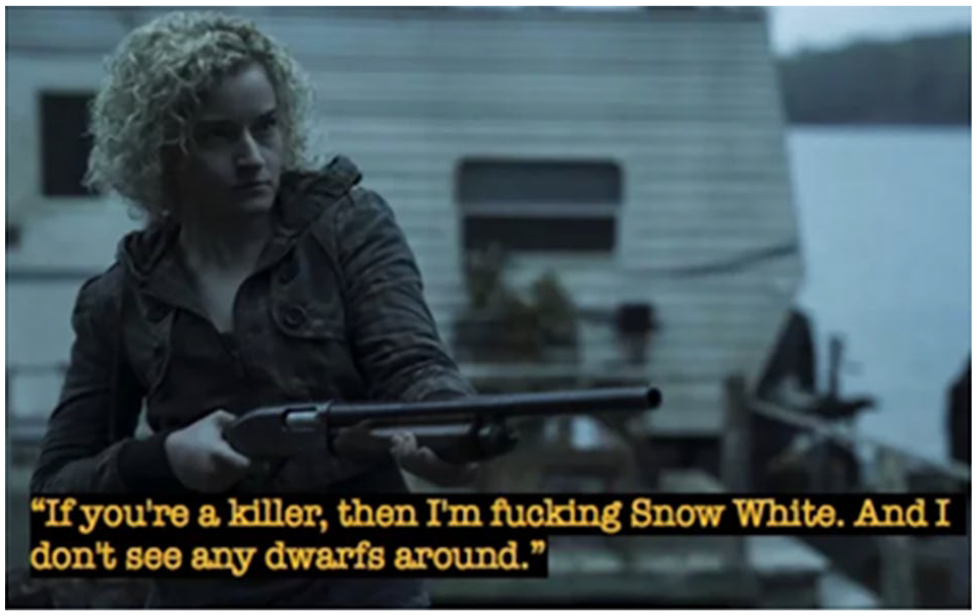
Ruth holding a shotgun at the ready (NSF Magazine, 2021, para. 4).
The aforementioned meme demonstrates Ruth’s iconic wit and intelligence paired with quick, dry humour and consistent display of strength. Julia Garner, the actress who plays Ruth Langmore, stated in the A Farewell to Ozark documentary (Hughes, 2022, 5:21): The first season of Ozark was very hard for me, because I’m not aggressive, you know. I don’t have the confidence that Ruth has . . . I’m not super tough like that . . . But the thing about Ruth that’s interesting that I could connect with her, is she’s very sensitive.
These sentiments about Ruth performing an aggressive, tough exterior yet remaining inwardly sensitive mirror observations about the personalities of famous Black artists, and particularly rappers. For example, those who knew Tupac Shakur personally described him in the same way (McQuillar & Johnson, 2010).
Early in Season 1, we are introduced to Ruth as a thief. Episode 3, Season 1, shows Ruth working as a dishwasher in a restaurant kitchen, wherein her vulnerability slips through her tough exterior as we see her look longingly at half a cheeseburger that has been left on a patron’s plate (Farley & Sackheim, 2017, 42:51). She shamefully takes a bite and is interrupted by a colleague, who does not seem to notice or react to her transgression. To dissolve the tension, Ruth recovers and masks her momentary vulnerability by asking him “You ever listen to old school hip-hop? Tupac, Eazy, shit like that?” (Farley & Sackheim, 2017, 43:23). This moment directly juxtaposes Ruth’s life of rural poverty, in which she lives in a trailer with numerous family members, with the urban poverty and experiences of material lack associated with Tupac and rap music. In the next episode, we see Ruth wearing a Tupac t-shirt (Figure 2).
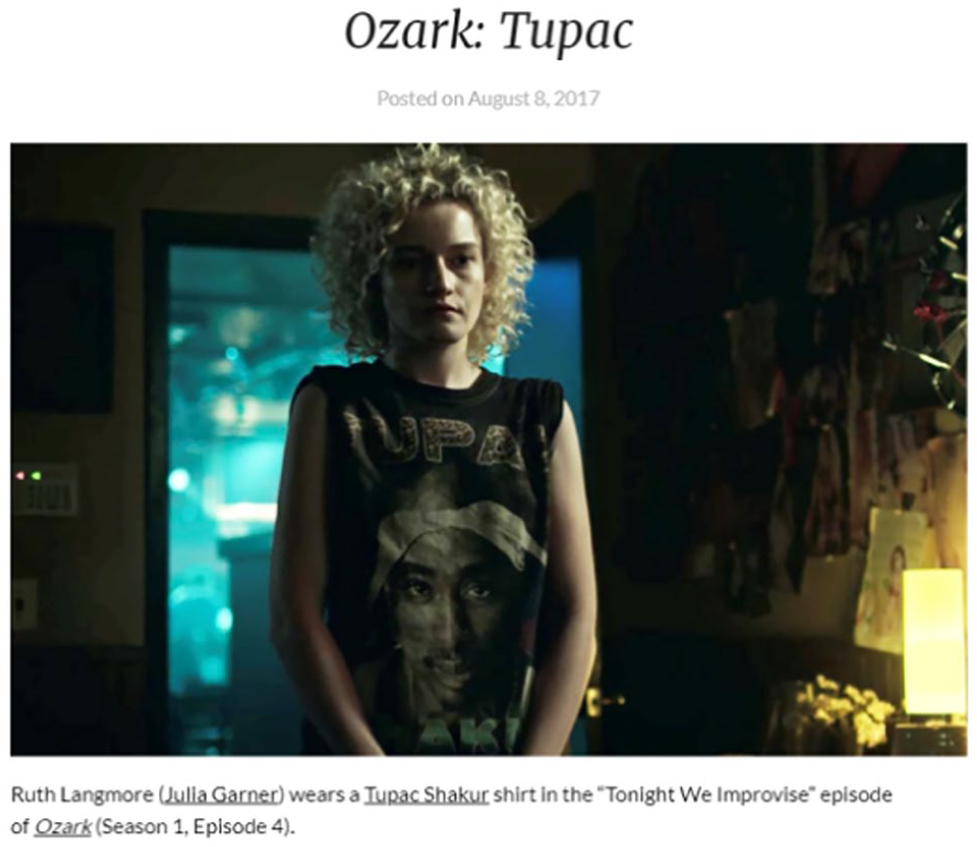
Ruth wearing a t-shirt that says “Tupac” above a photo of the deceased rapper (T-Shirts On Screen, 2017).
Of particular interest to my argument here is that Ruth’s family, the Langmores, operate in the same way the Byrde family do. They commit crimes together and lie or carry out violent acts for one another to alleviate potential consequence. The Byrdes, unlike the Langmores, evade incarceration. The Langmore family live in overcrowded trailers and lounge outdoors, while the Byrdes, in contrast, sit down and speak over the dinner table every night. In the A Farewell to Ozark documentary, executive producer Patrick Markey describes the Langmores as “the kind of low-rent version of the Byrde family” (Hughes, 2022, 5:09). The Langmore family function as antagonist and opposite characters to the Byrdes—a bunch of abusive criminals who end up dead or in prison where they belong—while the Byrdes evade consequence and profit from similar behaviours. So, if we reconsider the question of why Ruth’s death rings true and the death of a Byrde would not, I argue here it is association with Blackness through faulty personality. Both White families are criminal enterprises unto themselves, yet consequence does not ring true for them in the same way. Ruth’s personality is coded with criminalised Blackness, making her the sensical scapegoat for the pop culture viewer.
Fashion
The styling of Ruth’s character also reflects Black masculine imagery, such as the Tupac t-shirt above (T-Shirts On Screen, 2017). Ruth is also styled in hoodies (Figure 4)—hooded sweatshirts which are widely known as political items in the USA and typically associated with White racial profiling and criminalisation of Black men and boys (Ford, 2021). This association was exasperated by the murder of Black adolescent Trayvon Martin by a man named George Zimmerman who cited the child’s hooded sweatshirt as cause for suspicion during questioning from the police after the incident (Elan, 2021). We also observe Ruth rejecting clothing typically associated with White femininity, donning t-shirts and jeans unless it is a formal occasion, or she is engaged in employment activities which require a professional appearance.
Ruth’s hair is also imbued with political and cultural significance. While Ruth is blonde, she wears curls kept short. We don’t see Ruth engaging in rituals that typically communicate White femininity to audiences such as grooming, shopping, or other cultivations of the idealised White feminine body (McIntosh, 2018). This also indicates that Ruth’s curls are natural rather than a perm—a hairstyle where waves or curls are set into hair using chemicals or heat. Over the four seasons, Ruth’s hair changes subtly—in Season 1, her hair is longer, and occasionally the top and sides are pulled back into a more feminine style that is half up. By the end of Season 4, Ruth’s hair is cropped into a tight halo of curls, reflecting a short and potentially racialised traditionally Black hairstyle, as she digs a grave in Figure 3 (Gallagher, 2022).
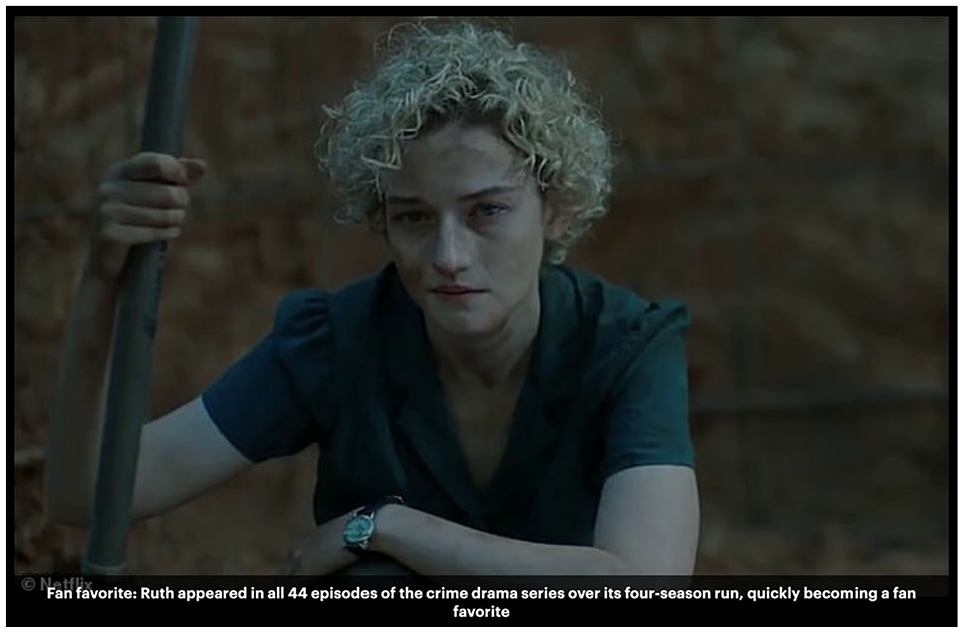
Ruth holding a shovel she is using to dig a grave (Gallagher, 2022).
Blacksound
Utililsing Blacksound (M. D. Morrison, 2017), Ozark (Bateman et al., 2017–2022) makes use of hip hop music to racialise Ruth throughout the show. Journalist Peter Berry (2022) makes a direct link of sound with criminality following a conversation with showrunner and Executive Producer Chris Mundy and music supervisor Gabe Hilfer (para. 7), stating: 90s rap throwbacks became the sonic template for Ruth Langmore (Julia Garner), a burgeoning criminal mastermind (whether she wants to be or not) . . . While the rural trappings of the Ozarks don’t conjure images of the concrete jungle, Ruth’s criminal activities and her quest to rise above them offer an obvious parallel to the works of aspirational drug dealers turned rappers, speaking to a lived experience she can identify with.
While this sonic theme carries across the four seasons, it was very strong in Seasons 1 and 4, while reticent in Seasons 2 and 3 wherein: the sounds of Notorious B.I.G. and Wu-Tang Clan were confined to her headphones when she wanted a reprieve from the outside world of the Byrde family’s money-laundering operation, one that wiped out most of her family and had her tortured at gunpoint. Hip-Hop was an escape in previous episodes; it’s a memory cocoon in episode 8 of Season 4. (Nelson, 2022, para. 1)
In Seasons 2 and 3, while the Byrde family was escalating their criminal operations, Ruth was established as a witty fan favourite who elicited empathy from the audience. The aforementioned quote implies the hip hop soundtrack heavily relied upon in Season 1 returned predominantly in Season 4 as a “memory cocoon” (Nelson, 2022, para. 1); however, I argue this is also an instance of Blacksound (M. D. Morrison, 2017) which was utilised frequently in the latter part of Season 4 to foreshadow Ruth’s death through Black eschatological association (Curry, 2017).
Association with aspiration and doom
To supplement the use of Blacksound (M. D. Morrison, 2017) and fashion styling, Ozark (Bateman et al., 2017–2022) visually associates Ruth with Black masculinity in the lead up to her death by featuring her in conversation with a famous Black rapper. In Episode 8 of Season 4 (Mundy & Marsalis, 2022), while Ruth is in the midst of making the decision that will lead to her demise, she encounters rapper Killer Mike at a café (Figure 4; Ngimbi, 2022).
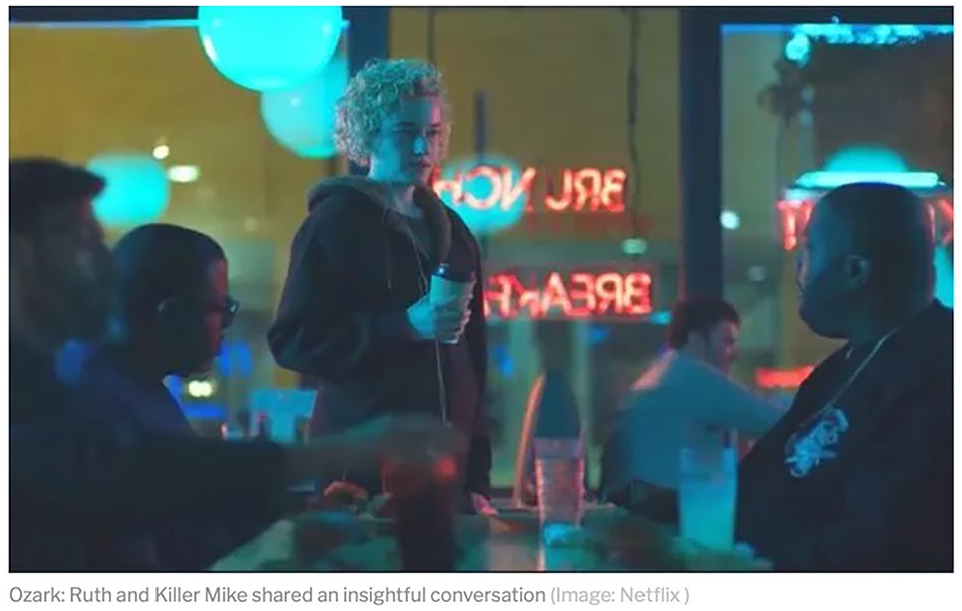
Ruth standing in front of a diner table, conversing with three Black men who are sitting in front of their meals (Ngimbi, 2022).
As they casually converse about the music playing in Ruth’s headphones, Nas’ 1994 song New York State of Mind, Ruth contemplates Nas’ relationship to place and age when he wrote the song, saying, “It always feels to me like he hates it and misses it all at once. I mean, he was only fucking 20,” to which Killer Mike responds, “You know, when I listen to that record, I think about his projects in Queens where you can kind of see Manhattan. I always thought it was so hopeful and fucking cruel at the same time” (Mundy & Marsalis, 2022, 24:32). Drawing on the previous conversation with the series’ showrunner and music supervisor, journalist Keith Nelson (2022) elucidates the purpose of the scene, which I argue highlights the intentionality of the association of Black masculine aspiration with doom and futility: Mike’s scene dealt with breaking down the hopeful despair Nas paints on Illmatic, a feeling Ruth knows all too well. When Ruth says Nas sounds like he “hates it and misses it all at once,” she’s also speaking about herself, a young woman raised in a dysfunctional family who she still dreams about spending time in a trailer park that no amount of money can make her leave. This one conversation explains why a White woman in the middle of nowhere America listens to hip-hop music made hundreds of miles from where she grew up and years before she was born. Through Mike’s hip-hop connection with Ruth, viewers learn about a character who doesn’t typically invite people into her thoughts. (para. 10)
Showrunner and Executive Producer Chris Mundy said of the episode soundtrack and Killer Mike cameo, “it was just contextualising for her this kind of big, deep past that she’s going into” (Berry, 2022, para. 11). This quote indicates the music and scene projected an intentional suspension of time, a stagnation associated with the loss of a forward momentum. The music and scene therefore invoke the imagery and language of cyclical trauma and doom by use of Black masculine presence and sounds, as does the previous quote about the scene functioning as a “memory loop” (Berry, 2022, para. 1).
I argue the exchange between Ruth and Killer Mike serves two additional functions, neither of which conflict with the aforementioned reflections from the series’ musical director, showrunner, or journalists. First, it is a visual association of Ruth with Black masculinity—seeing Ruth alongside Killer Mike—which foreshadows her death by invoking an eschatological association. Second, it also holds a conversational function which demonstrates the futility of Black aspiration in the White settler nation state. Although she is discussing a young Black man, Ruth’s acknowledgement of Black masculine limitation and stagnation resulting from a relationship with time and place reflects her own impending doom. Ruth, in her early twenties, is the same age as Nas was at the time of the song they are discussing.
At the time of this exchange with Killer Mike and up until her death in the series finale, Ruth is doing well financially and professionally. She has amassed financial wealth through her association with the Byrdes; however, this wealth has come at the cost of most of her family’s lives. Just prior to her death, Ruth has had her criminal record expunged, is in direct competition with Marty and Wendy Byrde who have become her adversaries, and is on the path to legitimate enterprise (Mundy & Bateman, 2022). She is revamping the land which settler nativism (Tuck & Yang, 2012) allows locals to consider theirs ancestrally, removing the trailers and building houses—literally digging up the earth to build upon—but also digging graves, as shown in Figure 3 from the final episode of the series (Mundy & Bateman, 2022). In this scene, Ruth’s hair is worn in the aforementioned short curly fashion often associated with Blackness and her posturing takes a weary masculine stance.
Conclusion
Ruth is coded at various points over the four seasons of Ozark (Bateman et al., 2017–2022) to represent tragedy and stagnation through an eschatological association with Blackness which culminates in her death. Hip hop sonic cool pose (Bradley, 2012), Blacksound (M. D. Morrison, 2017), fashion, a visual association with Black men, and a faulty personality code of Ruth as a manifestation of Black criminality, and therefore her death, while devastating, rings true for audiences. It feels accurate. In this way, Ozark (Bateman et al., 2017–2022) demonstrates how post-racial imaginary functions as an allegory for the inherent destruction of the Black body within the settler nation state. It resonates with Toni Morrison’s (1992) and Catherine Squires’ (2014) assertions that media can subtly encourage identity with and empathy towards some and disidentification with others. Ruth’s coding also demonstrates Curry’s (2016, 2017) theory that eschatological association can evaluate or devalue certain lives through assumptions about life expectancy, moralism, and an unconscious association with death. Bradley’s (2012, 2013, 2014) hip hop sonic cool pose helps us observe how Black masculine posturing or association can be deadly for some, yet not for others.
If we already associate Black people with disposability and death, however subtly or subconsciously, how does that affect our reactions to their deaths? How do these subtle eschatological associations with Black masculine posturing affect the acceptability of Black death within the post-racial imaginary? And why should a post-racial projection of Black death on to this White adolescent fictional character matter? It matters when we return to the concept of empathy, Blackface in pop culture (Hartman, 1997), and the ways in which post-racial imaginary can limit the palatability of Black and Indigenous survival in mainstream pop culture.
This scholarship demonstrates a tiny cog in the wheel of how cultural alleviation of responsibility for the death of Black peoples functions in the White settler nation state. As Ta-Nehisi Coates (2015) asserts, “in America, it is traditional to destroy the Black body—it is heritage” (p. 103). Ruth’s curated eschatological association with Black masculinity is an example of a complex formula which alleviates White settler guilt for the destruction of Black peoples—it rings true, it feels right—it is almost inevitable. After all, there can’t “be no consequences” (Hughes, 2022, 13:45)—even if those consequences are palatable to the audience of popular culture in the form of the deaths of the inconsequential. Ozark (Bateman et al., 2017–2022) matters because it demonstrates that the survival of Black and Indigenous peoples does not feel sincere within the post-racial pop cultural imaginary.
Footnotes
Acknowledgements
I acknowledge the Gadigal, Gweagal, Ojibwe, and Dakota peoples whose lands nourish me even as an uninvited settler. I acknowledge Distinguished Professor Carlson and M Day for their support and guidance. I acknowledge the Tigrayan people during a difficult time, my recently passed sister Azeb Bekele, our mother Alganesh Tessema, and our grandmother Demekech Teferi. Thanks to L Wallace for assisting in the early conceptualisation of this piece.
Author’s note
Declaration of conflicting interests
The author declared no potential conflicts of interest with respect to the research, authorship and publication of this article.
Funding
The author received no financial support for the research, authorship and publication of this article.
