



Abstract
Indigenous methodology is a living methodology of doing research in a good way that honours respectful relationships with Indigenous Peoples and communities in which knowledge is co-created and ownership is shared. Guided by Indigenous methodologies, the Urban Indigenous Collective Governance Circle was co-developed for urban Indigenous health research. The Collective Governance uses approaches that stay true to the connectedness of Traditional Knowledges, Indigenous protocols, and relational processes. Relationality ensures guidance from knowledge, experiences, and wisdom of community members participating in, leading, and benefitted by the research. The Governance Circle ensures that self-determination and self-governance is realized through Indigenous health research; research responsive to community-identified priorities, leadership, control, approval, and community ownership. The Collective Governance embraces ethical, respectful, and reciprocal research through a shared process to address health equity for urban Indigenous Peoples. We share insights and recommendations on how to support meaningful urban Indigenous-led community health research.
Keywords
Introduction
In this article, we share how Urban Indigenous Collective Governance ensures that Indigenous community-led health research is grounded in cultural safety, self-determination, ethical relationality, and decolonization. Indigenous Peoples or Aboriginal Peoples, is a collective name for the original peoples of North America and their descendants. The Canadian Constitution refers to three distinctive groups of Indigenous Peoples each having unique and diverse histories, heritage, languages, cultural practices, and spiritual beliefs: First Nations people, historically referred to as Indians, reside across Canada on- and off-reserve, where a reserve is defined as “land held by the Crown for the use and benefit of a First Nation” (Place, 2012, p. 6); Inuit who live in or away from Inuit Nunangat, including the Northwest Territories and Yukon, Nunavut, Northern Quebec and northeastern Newfoundland and Labrador; and Métis people who are of mixed European and Indigenous ancestry, who identify with the distinct Métis culture, and live in or away from Métis settlements (Government of Canada, 1982, 2024; K. Wilson, 2018). Urban Indigenous Peoples are from all three of these distinct groups that live off-reserve and away from their First Nations and Inuit communities, or Métis settlements, in large urban centres, towns, rural communities, and isolated or remote communities (British Columbia Association of Aboriginal Friendship Centres, 2020; Missing and Murdered Indigenous Women [MMIWG] National Action Plan Core Working Group, 2021). The setting for this Urban Indigenous Collective Governance is in British Columbia where Indigenous Peoples primarily are First Nations and Métis (Statistics Canada, 2023). This article illustrates how these diverse communities work together to create systems of governance that support and strengthen urban Indigenous healthy communities.
Since 2008, Friendship and Métis Centres, community members, Elder Advisors, University researchers and students, and health providers within the province of British Columbia, Canada have worked together as a community-led Urban Indigenous Collective promoting Traditional and Western approaches to wholistic health and wellness (Kurtz et al., 2008, 2014). Through Indigenous-led community health research and guided by Indigenous methodologies, the Collective has formed a Governance Circle that addresses and acts on community health and wellness priorities. These priorities align with recommendations from the Royal Commission on Aboriginal Peoples (1996), Truth and Reconciliation Calls to Action (Truth and Reconciliation Commission of Canada, 2015), United Nations Declaration of Rights of Indigenous Peoples (United Nations General Assembly, 2007), Declaration on the Rights of Indigenous Peoples Act (Government of British Columbia, 2019), and provincial health authority and postsecondary institutional Indigenous Strategic Plans and Equity and Diversity strategies. The Collective has led several research projects that have strengthened community and organizational partnerships and built new meaningful and culturally safe collaborations. Within the research projects, the Collective has co-developed, co-delivered, and co-evaluated health and wellness programmes that respond to the unique needs, priorities, and contexts of urban Indigenous communities. In this article, we describe how processes that are led and governed by Indigenous Elders, Knowledge Keepers, youth, young adults, and community members create critical community-led, culturally safe and responsive health research.
Urban Indigenous collective governance leads the way to wellness
Knowledge and Traditional approaches in population health, health services, and health research are beneficial to the health outcomes of Indigenous Peoples (First Nations Health Society, 2010; Hole et al., 2015; Kurtz et al., 2008). Further, Indigenous community-developed health programmes are more effective on their own, or when combined with Western approaches, than Western approaches alone (Allen et al., 2020; Kurtz et al., 2014; Murdoch-Flowers et al., 2019). Traditional Knowledges are grounded in balance and wholistic wellness—the mental, emotional, physical, and spiritual well-being of all people (Hole et al., 2015; Kurtz et al., 2008). Traditional healing includes practices, approaches, knowledge, ceremonies, medicines, therapies, and physical approaches critical in promoting wholistic well-being (First Nations Health Society, 2010; National Aboriginal Health Organization, 2008; Royal Commission on Aboriginal Peoples, 1996). Health and well-being are viewed as being interwoven across these aspects of oneself and interconnected between individuals, collective community well-being, and the land. Indigenous Knowledges and healing practices have been passed down through generations since time immemorial (Redvers & Blondin, 2020; Robbins & Dewar, 2011), and continue to contribute to improving health outcomes.
Colonial and contemporary impacts on Indigenous Peoples’ health and wellness
The United Nations Declaration on the Rights of Indigenous Peoples asserts that “Indigenous Peoples have the right to their Traditional medicines and to maintain their health practices, including conservation of their vital medicinal plants, animals and minerals. . .and have the right to access, without discrimination, to all social and health services” (United Nations General Assembly, 2007, p. 18). However, for some Indigenous Peoples, Indigenous Knowledges are not easily accessible due to systemic racism and discrimination as a result of contemporary colonization (Greenwood, 2021) that ignore self-determination in health care. Furthermore, within colonial systems, it is not well understood how Indigenous perspectives of well-being fit within the local and broader contexts of the everyday lives of Indigenous Peoples and their communities (Ungar et al., 2008; Usher et al., 2021). Although some health providers in Canada are beginning to understand the importance of Indigenous self-determination and cultural safety (Interior Health, 2014), the majority of settler-colonial health systems in Canada continue to exclude Indigenous Knowledges and have limited success in providing effective health care for Indigenous Peoples.
Western health systems fail to address the historic and ongoing impacts of colonization. The resulting oppressive and racist colonial structures and systems contribute to socio-economic disparities, health care gaps, and higher mortality (King, 2010), and as a result, Indigenous Peoples continue to die unnecessarily. Between 61% and 85% of Indigenous Peoples in Canada live in urban settings (National Association of Friendship Centres, 2021). Urban Indigenous Peoples experience access barriers, systemic racism, structural violence, and lack of culturally appropriate and safe care (Bachar et al., 2006; Fleischhacker et al., 2012; Place, 2012; Willging et al., 2006). Furthermore, due to ongoing discrimination and historical and contemporary colonization, many Indigenous Peoples choose not to seek mainstream health services. Perpetuating policies and practices based on historical and contemporary acts of destruction, genocide, and racism promote lack of trust, and refusal to access health systems for fear of being ignored and silenced (Greenwood, 2021; Kurtz, 2011; Kurtz & Nyberg, 2022). The result is poorer health and disparity (National Collaborating Centre for Aboriginal Health, 2014; Reading, 2013, 2014).
There is an increasing shift from colonial systems of care to Traditional perspectives of health and wellness for Indigenous Peoples (Dion Stout, 2012). While dominant colonial health research tends to focus on deficit and harmful stereotypical approaches profiling despair (Walter et al., 2020), Indigenous-led research often celebrates strengths, balance, and harmony. Indigenous-led health research must include “substantive, agreed-upon involvement” (Murphy et al., 2021, p. 2) of communities to ensure they retain sovereignty over their health, identities, and territories. In this time of reconciliation and decolonization, rhetoric suggests that radical measures are underway aimed at improving health experiences and outcomes for Indigenous Peoples in Canada. However, progress remains slow, and more urgent action is needed within health systems. Hence, the need to share the collective journey of co-developing, honouring, and experiencing the success of the Urban Indigenous Collective Governance Circle is necessary.
The urban Indigenous collective
Urban Indigenous wholistic wellness centres
Friendship and Métis Centres in Canada provide culturally relevant programmes, supports, and services specific to the needs and priorities of urban Indigenous Peoples on their journey of health and wellness. The Centres are governed by Indigenous individuals, families, and community members, who live in urban areas (British Columbia Association of Aboriginal Friendship Centres, 2020; Métis National Council, n.d; National Association of Friendship Centres, n.d.).
Within the Collective, each Centre has a Community Research Liaison and Community Advisory Team members who are known and trusted within their community. The Community Research Liaison is hired by each Centre through the research funding. They are co-researchers who work with Centre staff and management, community members, and the university-health region research team to coordinate and facilitate local research activities and ensure transparency and continuity of the project. Community Research Liaisons facilitate respectful community engagement; strengthen community-university-health-region collaborative team relationships; share experiences; identify necessary priorities, supports and guidance; and plan, organize, and co-facilitate research activities. Community Research Liaisons receive initial and ongoing mentorship, training and support from the university team through ongoing meetings, workshops, and online training modules on community and university ethical research protocols, processes, and approval, sex and gender, Indigenous Methodologies, unconscious bias, cultural safety, protection of Traditional Knowledges, and community engagement. Community Research Liaisons also receive ongoing support from research project Elder Advisors and their local Community Advisory Team on cultural safety, protection of Traditional Knowledges, and community engagement.
Each Friendship and Métis Centre Community Advisory Team is made up of community members across the generations, from youth to Elders. The Team provides guidance on local and culturally distinctive Traditional protocols and processes, to ensure that all research activities are relevant and beneficial to their communities. They ensure reciprocity is honoured regarding protection and sharing of knowledge and research insights including recommendations, successes, and outcomes. The Community Advisory Team also provides ongoing wisdom and support for the Community Research Liaison and other research team members. Bringing together diversity across disciplines, knowledge, and experience, Community Advisory Team members include Elders, Knowledge Keepers, Traditional Healers, youth and young adults, Centre staff, and health providers, recommended by Community Research Liaisons and Executive Directors.
Elder advisor
An Elder with expertise in health research methodology, health care delivery, Talking Circle and Sharing Circle facilitation works closely with the research team to advise on cultural protocols and to ensure the inclusion and protection of Traditional Knowledges. Elder Advisors provide teachings on culturally relevant and safe ways of knowing, being, and doing, including language, terminology, meaning, understanding, and relationships within research contexts, thereby helping to dismantle Western research paradigms and thinking.
University researchers and trainees
Indigenous and non-Indigenous ally researchers and trainees are multidisciplinary and add additional knowledge and lived experience to the research process. Student trainees complete a comprehensive research orientation and participate in ongoing training. Learning is individual and tailored to each student trainee’s needs and research interests. Trainees are supported by research team members through formal and informal discussion, including tea time visits, meetings with Elder Advisors, and regular meetings with research team members. Training consists of workshops, online training modules for ethics and sex and gender-based analysis, readings and discussions of critical and antioppressive approaches, Indigenous Methodologies, unconscious bias, cultural safety, and other related topics.
Health providers, partners, and collaborators
The Collective also includes health and wellness providers, partners, and other collaborators, such as health authority health professionals, nurses, dietitians, research staff, and Centre-invited Elders, Knowledge Keepers, Healers, community members, and wellness service providers. Partners and collaborators also include regional, provincial, and national Indigenous and non-Indigenous organizations identified by the Collective.
Honouring traditions of doing research in a good way: using the Urban Indigenous Collective Governance Circle
To decolonize research, self-determination, the right of Indigenous Peoples to freely choose political, economic, social, and cultural development (United Nations General Assembly, 2007), must be emphasized and prioritized (Smith, 2021). These rights include leadership, governance, control, approval, and ownership of all research processes to ensure research is responsive to community-identified priorities (Kurtz, 2013). Research done in a good way (D. Peltier et al., 2020) includes processes that respectfully benefit the community, while acknowledging that the process is as important, and often more important than the outcomes or knowledge created and shared within the research (Ball & Janyst, 2008; Kovach, 2005; D. Peltier et al., 2020; S. Wilson, 2008). Relationships, community ownership, acknowledgement, and understanding of multiple perspectives are critical in decolonizing research and partnerships with Indigenous Peoples and communities.
Indigenous methodology is a living methodology of doing research in a good way (Kurtz, 2011) that honours and respects Indigenous Peoples, Indigenous Knowledges and ways of knowing and doing. Indigenous Methodologies are aligned with critical and anti-oppressive approaches that challenge power relations and systematic oppressions within the dominant society (L. A. Brown & Strega, 2005; Hutchinson et al., 2014; Kovach, 2018; Kurtz, 2013; Smith, 2012; S. Wilson, 2008). Anti-oppressive ways of life value Sacred and Traditional teachings within Indigenous cultures (Thomas & Green, 2007). The journey of walking within Indigenous Methodologies, as a living methodology, ensures research methodologies—research activities, data collection and analysis—are grounded in Indigenous Knowledges. This approach proclaims, protects, and preserves Traditions, customs, and protocols to honour local language. This approach decolonizes colonial ways that continue to impact the spiritual, physical, mental, and emotional wellness of individuals, families, and communities (Kovach, 2010; Kurtz, 2013; Smith, 2012; S. Wilson, 2008). The methodologies foster equity-oriented research in which individual experiences are acknowledged and understood within the complexities of the historical, colonial, and broader determinants of health (Browne et al., 2016; Cooper et al., 2019; S. Wilson, 2001). Indigenous Knowledges are shared through stories, experiences, dreams, and visions in Traditional Talking Circles and at Community Gatherings (Struthers et al., 2003). This sharing illuminates common understandings of ceremonies, protocols, and ways of knowing and doing, which deepen and weave together collective understandings (Hallett et al., 2017) and relational accountability (Cooper et al., 2019; S. Wilson, 2001). Indigenous Methodologies also initiate, foster, and hold accountable Indigenous-led, reciprocal, long-term relationships that ensure mutual benefits (Kurtz, 2013) and community ownership of the knowledge and outcomes of the research (Bartlett et al., 2007; L. A. Brown & Strega, 2005).
Talking Circles were chosen by the Collective of Friendship and Métis Centres as their preferred way to offer a safe and Traditional space. This space was open for community member co-researchers and participants to discuss and share knowledge and lived experience during the research. Throughout the evolution of the research within the Urban Indigenous Collective Governance Circle, the term Sharing Circle has now become used alongside Talking Circle to encompass the diversity of the Urban Indigenous communities. Researchers need to be cautious and ensure they adhere to community protocols because Traditional Talking Circles are considered ceremonies and Sacred (Kurtz, 2013). The teachings and ideas shared in Talking Circles are passed from generation to generation, usually by Elders who have been chosen explicitly by other Elders or the community and are gifted from the spiritual world as keepers of the teachings of Traditional culture (D. D. Wilson & Restoule, 2010). Talking Circles are embraced as an ancient customary cultural way to encourage people to share their stories, make collective decisions, solve problems, and carry out group processes (Becker et al., 2006; Kurtz & Nyberg, 2022; Loppie, 2007; Struthers et al., 2003) and heal (Kurtz, 2011). Talking Circles create supportive, confidential, culturally appropriate, and safe environments that can teach culture, Traditions, history, and health education and promotion (Hodge et al., 1996, 2002). The personal nature of the knowledge shared is unique to the individual and, therefore, not disputed nor externally validated (Brant Castellano, 2000). Each participant, regarded as an expert (M. A. Brown & Di Lallo, 2020), shares their stories, some of which are, as Kurtz (2011) described, deeply profound and intimate life experiences and knowledge. Knowledge shared and generated within Talking Circles can shape policy, programming, and practice (M. A. Brown & Di Lallo, 2020). Talking Circles are also considered a research methodology and a culturally responsive evaluation method (M. A. Brown & Di Lallo, 2020).
Talking Circles in the Urban Indigenous Collective Governance support relationship development and collaboration through open, truthful communication, including personal lived experiences, research topics and shared goals, objectives, and methods. An Elder facilitator guides the planning and preparation of safeguards for community members participating in such Traditional Talking Circles. The Elder leading the Talking Circle asks research questions co-developed by the community co-researchers and university researchers. Each speaker in the Talking Circle is encouraged to share only what they feel comfortable talking about and are invited to speak for as long as they want. Talking Circle members respect the protocol of listening, not interrupting when someone is speaking, and honouring, and not questioning what each person has to say. Talking Circles are preceded or followed by a shared feast. This provides an opportunity to socialize and build respectful relationships and trust (Kurtz & Nyberg, 2022). Sharing one’s own or hearing other people’s life experiences within the Talking Circle can be difficult, and at times, uncomfortable. If a Talking Circle member becomes uncomfortable or feels unsafe, the Elder stops the Talking Circle discussion and provides support to the Talking Circle member in a private space, away from the Talking Circle. A co-facilitator research team member holds the Talking Circle space while the Elder and Talking Circle member step away. The Talking Circle member that left the Talking Circle may leave or rejoin the Talking Circle and is also offered free access to a counsellor within the local Friendship or Métis Centre (Kurtz & Nyberg, 2022).
Two-Eyed Seeing—is to “see with one eye, the strengths of Indigenous Knowledge and ways of knowing, and from the other eye, the strengths of Western knowledge and ways of knowing. . .to use both these eyes together, for the benefit of all” (Bartlett et al., 2012, p. 335). Two-Eyed Seeing acknowledges and connects multiple knowledges, philosophies, and strengths (Marsh et al., 2015). This multiplicity of thought, relationality, and research creates a space in which together we are “navigating white, Aboriginal, and in between places to include understanding of historical, socio-economic, political, and generational impacts” (Kurtz, 2011, p. 262), from which we can learn from each other for the benefit of all. The Collective research team of community members, university and health region members discussed their interpretation of Two-Eyed Seeing and the principles that resonated with each partner. This collaborative project is grounded in ways to remove power imbalances by promoting mutual respect, honouring of individual wisdom, perspectives, values, and beliefs along with continual community and Community Advisory Team involvement. This is critical as research groups often do not have knowledge of Traditional practices or beliefs. Advisory committees provide cultural context and protocols to ensure community members are heard (Jeffery et al., 2021).
In honouring the guiding principle of Two-Eyed Seeing and multiple perspectives, community-based participatory research approaches guide the co-development of collective processes in which community members are acknowledged as equal partners in the planning, delivery, and evaluation of the research (Caxaj, 2015; Evans et al., 2009; C. Peltier, 2018). Community-based participatory research provides opportunities for authentic, respectful understandings in which communities act as co-researchers and lead the way in idea generation, methodologies, ways of doing research and all other research processes based on shared decision-making. Indigenous Peoples’ everyday experiences and knowledge direct priorities and recommendations, creating action for change (Castleden et al., 2012). This research methodology is grounded in long-term reciprocal relationships built on trust, challenging conventional colonial research paradigms and developing strong ethical guidelines to support bi-directional co-learning in “the creation of an organic research relationship; one that has the ability to operate with the community’s priorities for research that is meaningful and useful” (Castleden et al., 2012, p. 176). New knowledge is co-created and shared in a way that is beneficial for both communities and researchers. Within the context of working with and, if appropriate, for Indigenous communities, Traditional Knowledges and lived experiences are prioritized.
A 4Rs approach aims to build relationships between communities, individuals, partners, and stakeholders through respect—valuing diversity and cultural and community knowledge; relevance— acknowledging community cultural needs and experiences; reciprocity—ensuring mutual benefit for all; and responsibility—empowering ethical engagement in research leadership, collaboration, decision-making, and knowledge sharing (Kirkness & Barnhardt, 1991; Pidgeon & Riley, 2021). The 4Rs provide a mutual and power-sharing position ensuring reflective processes, inclusivity, voice, and shared decision-making. Indigenous governance and honouring of protocols are included in forming relationships. The diverse knowledge of Indigenous community members is treated with respect and is deeply valued, particularly about their health and the health of their community. The research process maintains relevance from Indigenous community self-determination, which grounds the research in the local distinctive Indigenous community and culture, such as use of the medicine wheel and Seventh Generation teachings. This ensures reciprocity, in which the research approach aims to continually give back to and benefit the community rather than taking, for the benefit of the research team. The responsibility of the Collective is to share leadership and protect knowledge and research outcomes.
Indigenous Elders provide culturally relevant education from “a whole different perspective” in which storytelling and realities of social, economic, physical, emotional, and spiritual determinants of health are shared (Kurtz et al., 2014, p. 20). As recognized teachers of Traditions and protocols, Elders offer teaching and mentorship, and are critical to developing culturally appropriate programmes (Stiegelbauer, 1996). Elders “promote peace, kindness, acceptance, and respect” (Anonson et al., 2014, p. 6). Elders fulfil special roles within Indigenous communities and within the Urban Indigenous Collective Governance Circle as respected role models by living what they have learned and demonstrating how to apply these learnings to life. Knowledge, shared through stories and ceremonies, helps others better understand the history and current contexts of colonization, racism, discrimination, stereotypes, and biases. This sharing of Indigenous Knowledges includes teachings about relational ethics and ethical research protocols. Researchers must respect these protocols while navigating academic, university and funder ethical research protocols and committing and being accountable to the Indigenous Peoples they are working with (Kurtz, 2013).
The four research approaches used by the Collective—Indigenous Methodologies, Two-Eyed Seeing, Community-Based Participatory Research and the 4Rs – provide safe spaces for collaborative decision-making, ensure research processes that are equity-oriented and gender-relevant, engage community member co-researchers and researchers as equal partners, and acknowledge both Traditional and Western perspectives. These approaches include protocols that guide the research process in a good way.
Collective governance, protocols, and ethics
Local Traditions, university and health authority policies, including the Tri-Council Policy Statement: Ethical Conduct for Research Involving Humans, specifically Chapter 9: Research Involving the First Nations, Inuit, and Métis Peoples of Canada (Canadian Institutes of Health Research, Natural Sciences and Engineering Research Council of Canada, & Social Sciences and Humanities Research Council of Canada, 2022), Ownership, Control, Access, Possession (OCAP) (Schnarch, 2004), and Métis Research Principles (National Aboriginal Health Organization Métis Centre, 2010) guide research processes. The Native Women’s Association of Canada Culturally Relevant Gender Application Protocol (Native Women’s Association of Canada, 2020) and Métis-specific gender-based analysis frameworks for health (Barron-McNabb, 2009) are used for gender balance. Together, these practices and policies acknowledge and uphold Indigenous Peoples’ right to determine how Indigenous Knowledges are gathered, shared, and translated (First Nations Information Governance Centre, n.d.). Within the context of the Urban Indigenous Collective Governance, local refers to the individuals who are within and connected to the urban Indigenous communities served by the Friendship and Métis Centres. These individuals come from different Nations and Homelands, and Indigenous Knowledges, teachings, protocols, are diverse across, and differ between, the Urban Indigenous Collective communities.
Urban Indigenous collective governance
Urban Indigenous Collective Governance (Figure 1) acknowledges Traditional and Western perspectives, Indigenous Methodologies, Two-Eyed Seeing, Community-Based Participatory Research, and the 4Rs approach. Within this Collective Governance, all members are honoured for their unique knowledge and are equal partners in the decision-making of all research activities and processes. The Urban Indigenous Collective Governance was first developed during urban Indigenous-led research in collaboration with a Friendship Centre from 2008 to 2011 (Kurtz, 2011). The governance approach continues to evolve based on ongoing collaborative research, local distinctiveness, and collective relevance. The Collective grew to include two additional Friendship Centres in 2015 to 2016 and then two more Friendship Centres and a Métis Centre from 2018 to 2023. The current Collective includes five Friendship Centres and one Métis Centre.
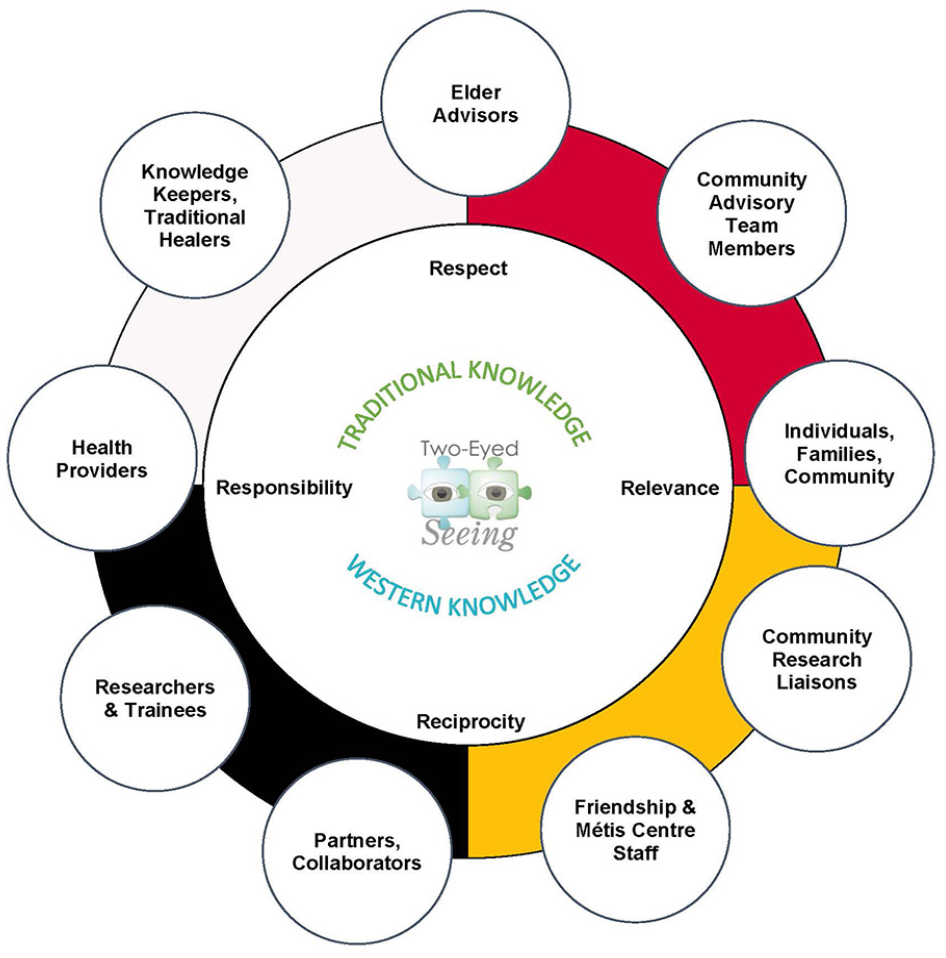
Urban Indigenous Collective Governance Circle, 2016 (Adapted from Kurtz (2011)).
Walking together in collective governance
Ethical relationships for community engagement guide Collective Governance. Ethical relationships include co-developed Community Research Agreements adapted from previous Indigenous-led community research (Hutchinson et al., 2014). Agreements are reviewed annually by Friendship and Métis Centres and detail: research purpose, methods, procedures, expected outcomes, benefits, risks, obligations, responsibilities, funding, ownership and sharing of information, protection of Traditional intellectual property, and communication processes and terms. The agreements respect Indigenous ethics, co-developed goals, and desired outcomes while ensuring adherence to community, university, and health authority protocols regarding privacy, confidentiality, and power inequities.
All research protocols–Community Research Agreements, university, health authority, and funding agency – are based on urban Indigenous community knowledge, experience, and priorities. This ensures that the research protocols provide supportive environments for Indigenous health research. The research is driven by individual and collective rights while informing and shaping university and health authority ethical requirements. Methodologies that are Indigenous-led and respectful, purposeful, intuitive, organic, fluid, and living cannot fit within a step-by-step framework (Kurtz, 2013). The research journey is relationship-based and shaped along the way by local Indigenous Knowledges and Traditions and acknowledges Indigenous Peoples’ life experiences and stories as authentic ways of knowing. Urban Indigenous community partners choose and know the protocols within their Traditional and local context of Indigenous Knowledges, including who will share, and how this will be shared. Elders, Traditional Healers, and Knowledge Keepers known in the community share their unique and specific gifts, Knowledges, and experiences. The relationship between researchers and community members is grounded in honouring a long-term, respectful, and ethical relational commitment to ongoing knowledge development and sharing that benefits the lives of Indigenous Peoples (Castellano, 2004; Kovach, 2005; Kurtz, 2011; Porsanger, 2004; Smith, 2005).
For research to be done in a good way, as a living methodology, community members and researchers sit together on a bench as human beings. This ethical space creates openness for multiple worldviews and peoples to engage in respectful dialogue. Ethical space challenges power relationships through critical and anti-oppressive reflexivity while sitting together in a cooperative spirit to reconcile and “create new currents of thought that flow in different directions and overrun the old ways of thinking” (Ermine, 2007, p. 203). This newly constructed inclusive partnership pathway guides to a deeper understanding of ethical, and moral principles and brings together Indigenous and Western perspectives.
Our collective journey
Weaving methodologies together through relational collective research planning
Indigenous Friendship and Métis Centres approve funding applications inclusive of research protocols, ethics, and all other processes. At the beginning of a project, Friendship and Métis Centre Executive Directors and staff, Elders, Knowledge Keepers, youth, young adults, and university and health authority research team members come together for a Collective Research Orientation Gathering. This Collective Gathering builds and strengthens relationships by facilitating a collaborative review of all aspects of the research and renews consensus for research planning. Knowledge sharing, exchange and discussions result in changes to research processes, including more detailed community cultural protocols, clarity on research questions, reduction of research questions, and establishment of realistic timelines to ensure community leadership and consultation. Urban Indigenous Collective Governance and university-community-health authority research ethical agreements are also discussed, adapted, and approved.
Urban Indigenous collective governance and knowledge exchange
Indigenous Peoples’ ways of sharing and generating knowledge include Talking Circles, learning from the land, and wisdom passed on through generations of individuals, families, friends, allies, and communities. This knowledge comes from multiple sources, including oral, written, and experiential, as well as from academic teachings. Integrated knowledge mobilization is a fundamental methodological approach within Indigenous health research because of its ability to act as an interface between two distinct ways of knowing that often seem in opposition (Estey et al., 2010; Sherwood & Edwards, 2006; Smylie et al., 2004, 2009, 2014). With integrated knowledge mobilization, both the knowledge user and the research partners bring valuable expertise to the research processes. Integrated knowledge mobilization is a transformative method that nurtures the emergence of research environments in which all collaborators can benefit from applying research in ways in which they may have had little experience (Tobias & Richmond, 2016). Sharing of Traditional Knowledges, including its creation, discovery, development, and transmission, is at the discretion of local Community Advisory Teams, and Elders and Knowledge Holders of the specific knowledge. All research information or data is provided to each Friendship and Métis Centre, who decide how and for what purposes the information is used and shared.
Sharing learnings from our collective journey
Indigenous and Western research can be navigated in a good way by using the Urban Indigenous Collective Governance. It situates Indigenous Methodologies, Two-Eyed Seeing, Community-Based Participatory Research, and the 4Rs approach at the forefront and to stay true to Traditional Knowledges, relational processes, Indigenous and research ethical protocols, and kinship. Western methodologies colonize research practice and neglect crucial components of Indigenous research methodologies that require a long-lasting relational commitment to Indigenous Peoples and communities and that respect their culture, ethical protocols, values, and behaviours. This neglect has resulted in two of the most important concerns of Indigenous Peoples—the protection of Indigenous Knowledges and the right to self-determination (Kurtz, 2011). The philosophical foundation of Indigenous research acknowledges “Indigenous cultural systems as almost instinctive in knowing that we must take care of each other and that we are accountable to each other, our communities, clans, and nations” (Kurtz, 2011, p. 144).
Urban Indigenous Collective Governance as a process in Indigenous research methodologies provides connectedness to everyone within the Circle through life experiences, receptivity, openness, and respectful relationships with one another. Our collectivity is the act of knowing and practicing reciprocity as human beings within the world and Spirit (Kurtz, 2011). This honours us in ways in which “reciprocity and accountability. . . create a sense of belonging, place and home” (Kovach, 2005, p. 30). Belonging to this Collective requires accountability to those within the Circle and diligence within the work because colonial research approaches cannot provide spaces and places to collectively define the research question, determine participant eligibility, or direct and determine how, with whom, and when to share research findings.
Within the Urban Indigenous Governance Collective, research methodologies, approaches and Indigenous ways of knowing and doing continue to be honoured. Cultural practices and respectful, ethical governance create an ethical space for All Peoples, as in the mandate and governance of Friendship and Métis Centres. The knowledge, experiences, and wisdom of community members guide future research priorities.
Sharing recommendations from our collective journey
As a Collective, we have learned the importance of Urban Indigenous Collective Governance for Indigenous-led community research. The research is grounded in cultural safety and decolonization and guided by Indigenous Elders, Knowledge Keepers, youth and young adults. This reciprocal approach has resulted in the co-creation of successful community-led pathways for the implementation of Indigenous community-led health research. Friendship and Métis Centre communities led the way by identifying the following five recommendations on how to conduct Indigenous-led community health research:
Respectful and trusting relationships must be developed prior to, and remain ongoing throughout, the research journey using a strengths-based approach;
Indigenous Peoples are, and must be recognized as, experts and decision-makers regarding their own health and wellness;
Elders, Traditional Healers, and Knowledge Keepers facilitate healing by providing their unique expertise and knowledge within wellness activities and programmes delivered in urban Indigenous communities;
Local, provincial, and federal Western and Indigenous power holders, leaders, organizations and governing bodies need to provide funding for Indigenous Peoples and communities, including urban Indigenous communities, for establishing processes to identify, develop, implement, and evaluate health promotion programmes and research; and
Urban Indigenous communities need to be recognized as leaders in prioritizing, designing, and delivering wellness services and programmes for urban Indigenous Peoples in respect to self-determination, which includes local leadership, governance, control, approval, and community ownership of all research processes.
Conclusion
Through sharing our journey, we offer insights and recommendations from a research collective guided by ethical, respectful, and reciprocal research methodologies. As a Collective, we demonstrate that Indigenous and Western research can be navigated in a good way through Indigenous Methodologies, Two-Eyed Seeing, Community-Based Participatory Research, and the 4Rs approachs. As a living methodology, Indigenous methodology supports meaningful Indigenous-led community research and movement towards closing the health equity gap for Indigenous Peoples. The lessons learned and recommendations provided from the co-creation of successful community-led pathways within the Urban Indigenous Research Collective have implications for health care professionals, educators, clinical practice, research, and public policy. The Urban Indigenous Collective Governance Circle guides Indigenous-led research that stays true to Traditional Knowledges, relational processes, Indigenous and research ethical protocols, and kinship, for the benefit of all.
Footnotes
Acknowledgements
The authors honour the leadership, and cultural and guidance provided by several Elders that joined the research. In particular, urban Indigenous Research Advisor Elders including the late Elder Jessie Nyberg, Secwépemc Nation and co-founder of the research, followed by Elder Jayne Taylor, Vuntut Gwitchin First Nation and Elder Diana Moar, Berens River First Nations who shared their wisdom and ongoing support for the research and all community and research team member and advisory teams. They gratefully acknowledge the community member co-researcher Executive Directors, Community Research Liaisons, and Community Advisory Teams, including Elders, Knowledge Keepers, Traditional Healers, youth, young adults, and Centre staff, who shared their knowledge and guided our collective work. They honour community members, families, and relations who shared their wisdom. They thank all past and present health authority partners, health providers, researchers, and trainee team members who have contributed to the work and Dr. Penny Cash for scholarly insights. The also respectfully acknowledge that the Friendship and Métis Centres are located on the Traditional Territories of the Syilx, Secwépemc, St’at’imc, and Tsilhqot’in Nations located in the south-central region of present-day British Columbia.
Authors’ note
Declaration of conflicting interests
The authors declared no potential conflicts of interest with respect to the research, authorship, and publication of this article.
Funding
The authors disclosed receipt of the following financial support for the research, authorship, and publication of this article: This work was supported by the Canadian Institutes of Health Research Grants (grant nos. FRN#337688; FRN#389623; FRN#41530 5); Michael Smith Health Research BC (grant no. S2R04093); and AGE-WELL (grant no. AWCRP-2020-01), and the University of British Columbia Undergraduate and Graduate Work Study Program, Indigenous Programs and Services Undergraduate Research Mentorship Program, Multidisciplinary Undergraduate Research Projects in Health Scholar Program, and Faculty of Medicine Summer Student Research Program.

Glossary
Inuit one of three culturally distinct groups of Indigenous Peoples in Canada, who live in Inuit Nunangat, including the Northwest Territories and Yukon, Nunavut, Northern Quebec and northeastern Newfoundland and Labrador
Métis one of three distinct groups of Indigenous Peoples in Canada, with mixed history and culture of European, primarily French, and Scottish or English, and Indigenous ancestry