




Abstract
Enacting a research project that is beneficial and meaningful for Indigenous communities and agencies in Australia remains a challenge in both the research and nutrition fields. This article describes how the Mums and Bubs Deadly Diets project is embedding Indigenous ways of knowing and doing and partnering with Indigenous communities to co-design mobile health technology. Each step in the process of developing and implementing this project has been actively conscious of the intentions of the Australian Institute of Aboriginal and Torres Strait Islander Studies Code of Ethics and the National Ethics Standards for working with Indigenous Australians. Describing the project’s approach, methods of negotiation and responses to challenges, administering institutions and Indigenous communities, including coronavirus disease-19, provides the opportunity to reflect and forward plan for future projects.
Introduction
This is a discussion article of the path down which a team of researchers and community research partners went to conceptualise, co-design, commence and revise a mobile health technology mHealth, project with predominantly Aboriginal communities with the goal of appropriately identifying and integrating an array of Indigenous axiology and epistemological concepts into the research design. Mobile health technology is the use of digital tools such as mobile applications or websites to aid the sharing of medical knowledge (Noorbergen et al., 2021). The research team included academic researchers from multiple institutes in three different states of Australia and included several Aboriginal Community-Controlled Health Services as research sites and research partners. Much of the processes described here were driven from the central research team based in Brisbane, Queensland. In this article we will examine the philosophical challenges the team faced and ultimately how they influenced the research design including the practice and maintenance of culturally safe governance. It is important for the reader to note that this article was created from within an Indigenist perspective thus utilising a style informed by this perspective. In this article the context and background to the project and the project foundations and values will be discussed. A series of questions that continue to underpin the reflexive processes the investigatory team undertake throughout the project will also be shared. We have incorporated our discussion throughout the body of the article using the community-based language of the co-researchers and community who participated in the project to ensure our learnings from this project are clear.
Background
Factors impacting the nutritional needs and food intake of Aboriginal and Torres Strait Islander people are complex and closely associated the dispossession of land, culture and traditional practices as a result of colonisation (Shannon, 2002). The continuing effects of colonisation on the poor health outcomes for Indigenous Australians are reflected in the abundance of research that attributes diet-related chronic disease to the social determinants of health (Healey, 2022). A recent systematic literature review identified food priorities and influences of eating habits of Aboriginal and Torres Strait Islander people across each level of an ecological framework; “macro,” “meso” and “micro” (Christidis et al., 2021, p. 13). These factors were carefully considered during the literature review and preliminary stages of the project and will be revisited during data analysis to examine correlations with other research. There is however, disproportionately less literature available on the dietary intake and needs of Aboriginal women during pregnancy, and particularly research that explores the world views of their nutritional priorities and needs.
Of the available literature, one of the most relevant to this research is the Gomeroi Gaaynggal (Babies from Gomeroi Lands) study (Ashman et al., 2016) that explored the nutritional adequacy of maternal dietary intakes during pregnancy of a small group (n = 56) of rural residing Indigenous women. The study found that none of the participants met the Australian Guide to Healthy Eating food groups serving recommendations (Lee & Ride, 2018). Furthermore, the five key nutrients required for optimal health during pregnancy, folate, iron, calcium, zinc and fibre, were identified in significantly reduced nutritional values in this group (Lee & Ride, 2018). These findings have serious implications for the unborn child as these are critical nutrients for growth and development (Ashman et al., 2016). 123
Access to culturally safe health care services is limited for many Indigenous Australians who live outside major urban areas. mHealth technology has been successfully introduced in some Indigenous communities to increase access to general health care knowledge and mental health (Eyles et al., 2016). There has been an under-utilisation of mHealth tools for nutrition and pregnancy. When designed and developed alongside Indigenous people, using co-design principles, such tools can be effective in increasing health knowledge and support positive behaviour changes (Hobson et al., 2019). Research also suggests that when Indigenous participants are leading the development of such tools and co-design principles are applied, the uptake of mHealth tools increases (Ashman et al., 2016; Banna & Bersamin, 2018; Eyles et al., 2016).
Context
A funding application for this project was submitted to the National Health Medical Research Council (NHMRC) in early 2019 under a Targeted Call for Research that specifically addressed the nutritional needs of Aboriginal women and children. Funding was awarded late in the same year. Prior to grant submission the Gomeroi Gaaynggal Aboriginal Steering Committee and lead investigators had jointly agreed that this project would be an important project for pregnant women in their community. A multidisciplinary team of both academic and community researchers comprised the chief investigators (CIs) at the time of its submission, several of whom had been previously connected to the Gomeroi Gaaynggal study (Ashman et al., 2016). These team members came from disciplines that included Indigenous knowledges, Indigenous maternal infant health, nutrition, software engineering, biomedical research, sociology and mental health.
Significant changes occurred in circumstances at a project, community and national level between time of grant submission and award. First, the longitudinal study initiating this research had ceased by the time of grant award. This cessation meant that four of the CIs had moved to different roles with different organisations or institutions and had re-located interstate.
Second, the cessation of the longitudinal project, included the closure of the centre in which it had been operational within the local Indigenous community, and led to a breakdown in the relationship with the lead investigator. The research team undertook a process of consultations to determine if it was possible to progress this proposal within that geographical community. The research project’s connection to this community came to an end with the instigation of coronavirus disease (COVID)-19 and the community’s decision to focus their resources on other activities.
Third, as this programme was to be established across three different states, new relationships with Indigenous communities needed to be established and border closures made this difficult.
Project foundation and values
Our approach to developing the foundation of this project was to envision it as a bird’s nest. We collected sticks—those being the different values and ideals from relevant literature—to build a theoretical framing or the nest. This nest would support the project team and collaborators undertake the project in a way that benefitted and protected Indigenous communities and their knowledges. Like birds creating a nest, each piece is considered carefully before remaining within the structure and using ongoing communication and reflexivity our investigatory team has done the same when forming the project foundations and values. Creating tangible benefits for First Nations people through research is possible where cultural principles and values are embedded throughout the research design (Griffiths et al., 2016). Ideals such as ganma (genuine two-way knowledge sharing), making meaning together, acknowledging shared history, developing a future where everybody is together going forward, and looking after family and community were all important for the project and reflect Indigenous research principles (Johnston & Forrest, 2020).
A paucity of literature about the inclusion of cultural methodologies in research design with Aboriginal people led the research team to explore Indigenous-led research more broadly. kaupapa Māori principles, an approach that considers Māori (Indigenous peoples of New Zealand) principles and ideas which act as a base or foundation for action functioning as an ideology incorporating knowledge, skills and values of Māori society, was recognised by the research team as being closely aligned with Australian Indigenous ways and values (Te Morenga et al., 2018). Central to this approach is the principle that the research benefits the Māori people (Wilson et al., 2022). Embedding Kaupapa Māori principles positions the project within a research paradigm of epistemic self-determination (The Tangata Whenua, Community & Voluntary Sector Research Centre, n.d.). Indigenous values, knowledge and voices influence all aspects of the project. Indigenous participants and other community members who may benefit from the research are empowered to make changes that draw on cultural and traditional ways, histories and contemporary worldviews (Wilson et al., 2022). All aspects that resonated with the research team.
The foundations of this project were developed with focus on social justice guided by the Australian Institute of Aboriginal and Torres Strait Islander Studies (AIATSIS, 2020) Code of Ethics, the NHMRC (2018) Australian Code for the Responsible Conduct of Research and University of Queensland (2022) design principles and collaboration with community members and thorough and ongoing team reflections. Likewise, this project methodology and its methods aligns with that of the CONSIDER statement (Huria et al., 2019).
Drawing upon each of these protocols six questions of integrity were developed based on our core values to reflect upon at every stage of the project (Table 1). In practice, the team undertook regular reflective discussions following community conversations, readings, current pandemic status, development of ethics applications and project methods. Project methods and acts of reciprocity were changed to incorporate new knowledge and individualised for community needs.
Questions of integrity used by the deadly diets research team to develop project approach.
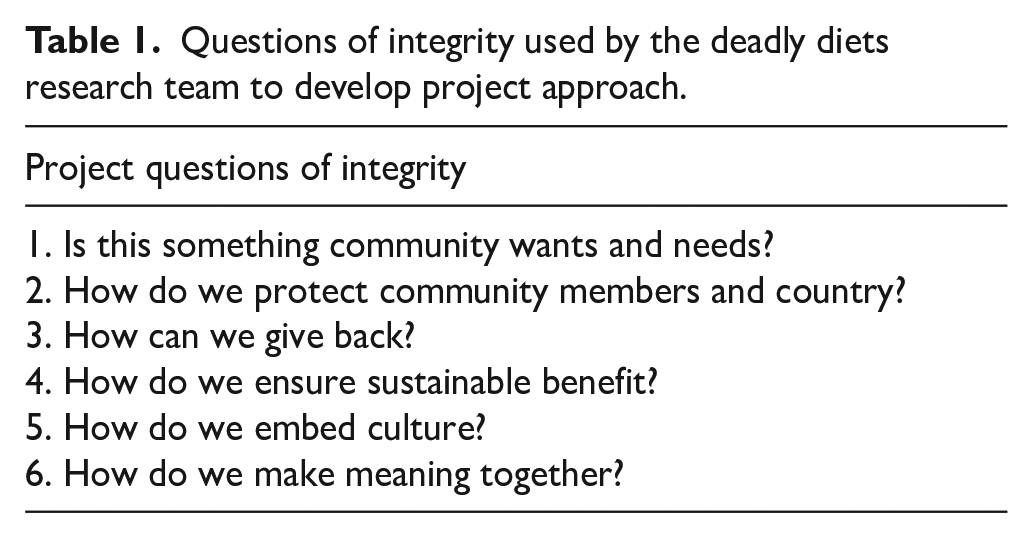
As highlighted in Table 1 the research team have reflected upon six primary questions throughout the project establishment.
A socio-ecological framework has enforced additional levels of consideration in everything that we do (Laycock et al., 2011). Figure 1 shows our project foundations, or foundational nest, adapted from the values of each of the different theoretical underpinnings we continue to use. This model is not confined by borders or barriers. Each layer of the nest identified in Figure 1 is highlighted to explicate how certain values can overtly impact the questions we ask ourselves, yet these values are not confined to one layer, but can seep into the others in an iterative and dynamic framework.
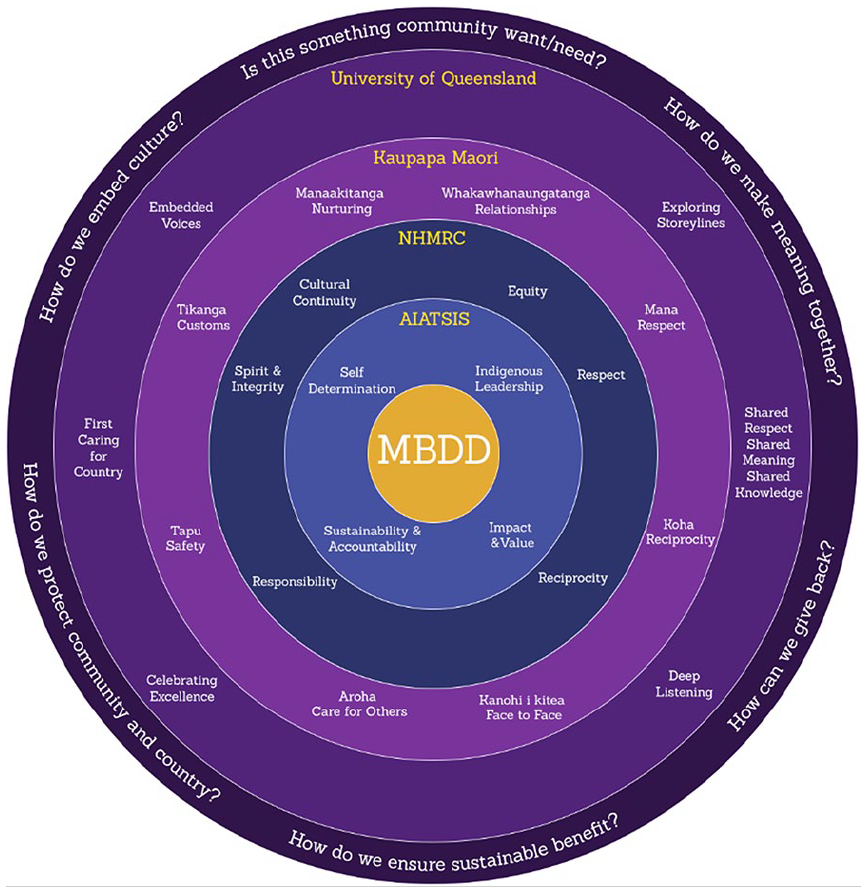
Mums and Bubs Deadly Diets (MBDD) core values form a foundational nest for the project design. These have been derived from kaupapa Māori principles, NHMRC values and AIATSIS Code of Ethics principles and Indigenous axiology including the CONSIDER statement.
Is this something community wants and needs?
This project has been developed across multiple geographical areas, and therefore multiple Indigenous nations of Australia to ensure that Indigenous women from diverse communities will be represented within the project. Each community has its own unique composition that includes cultural practices, language, geography, climate, as well as access to transport, health care, education and food.
The actioning of mana (respect) was also and continues to be, central to the formal partnerships negotiated with each of the Indigenous communities involved in the study and the interaction with all participants (McGregor & Marker, 2018). We agreed that our project processes needed relational accountability, making sure each community knew that they have a voice to suggest adjustments to any aspect of the project methodology and that these were valued, listened to and acted upon by the research team as an important aspect of the co-design process. As highlighted in Figure 2, multiple variations were submitted to ethics to ensure that modifications suggested by individual sites were incorporated to study design. For example, the original method of data collection was to utilise focus groups. Following discussions with our partner agencies it was determined that accessing pre-existing social groups would be far more effective in engaging participants.
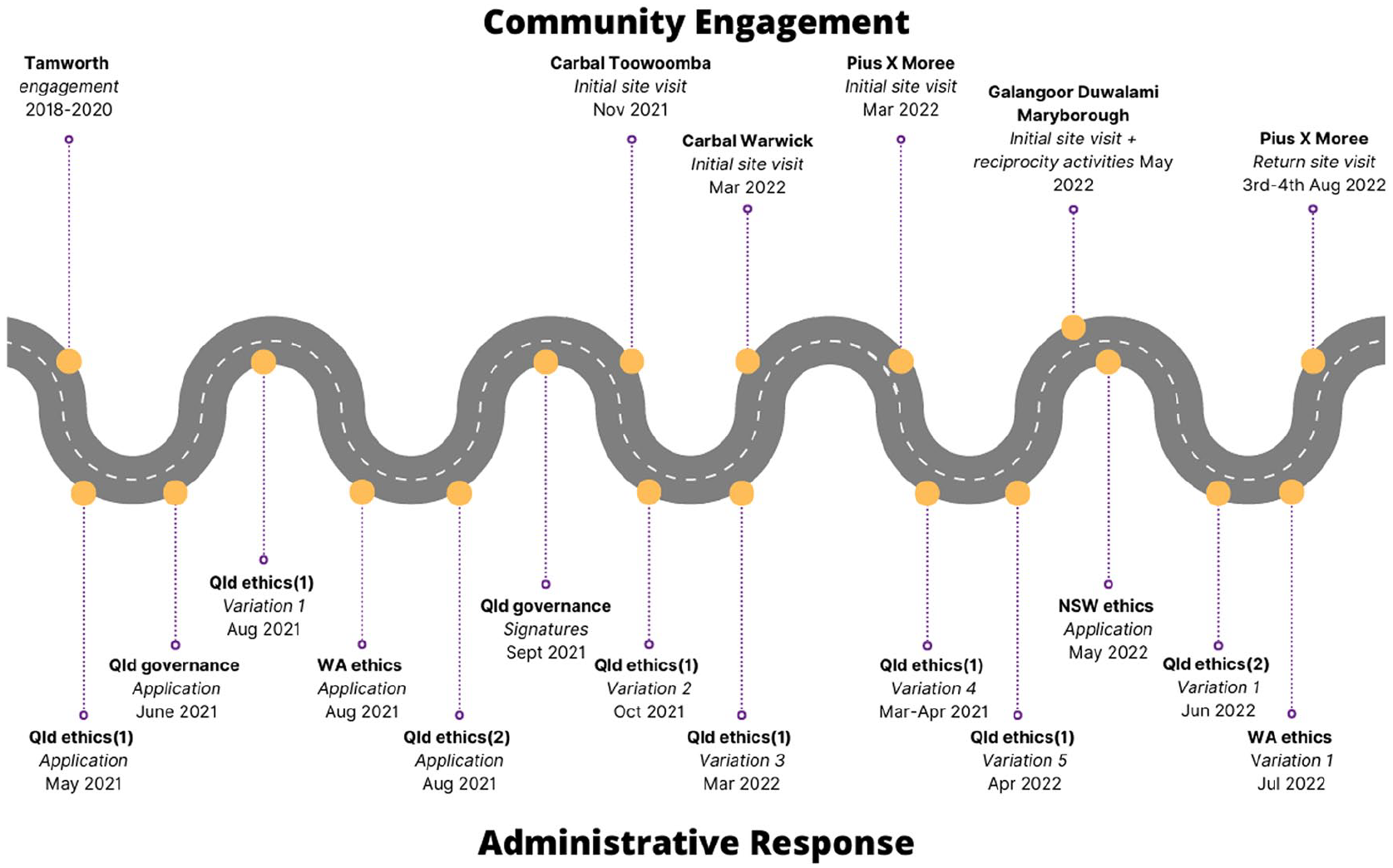
Timeline of community engagement and relationship to administrative activities.
The research team constructed the project as centralising to both Indigenous and non-Indigenous perspectives, strategies and actions. It was pivotal to create safe spaces for all to share personal experiences and expertise with every decision that was made. Utilising existing social groups for data collection ensured this occurred.
How do we ensure research processes honour the intentions of all ethical guidelines?
It was important we hold ourselves accountable and affirm our ethical approach through defined actions across the term of this project, ensuring culturally safe governance prevails. The mechanisms we have implemented to date to uphold this included the development of a considerable CI team with two Indigenous researchers leading their respective coasts, and an Indigenous Steering Committee (ISC) to guide and support as an active and authentic partner. We also worked extensively within our institutes to re-imagine their standard legal agreements such as the Multi-Institutional-Agreement (MIA) to incorporate the Indigenous epistemologies, ontologies and knowledges.
One of the early decisions taken by the research team was to enact the cultural protocols into the MIA and not only into the ethics processes. By this, we mean that the MIA signed by the academic institutes for the study agrees that an ISC is an essential component of the project and the powers of this committee have been written into the MIA agreement. In part this was a decision to have a high level of responsibility for the decisions taken in the project, ensuring culturally safe research governance, and that the communities would have a high-level recourse if they were unhappy with any aspect of the project. During this process, it was indicated that there was little precedent regarding the management of Indigenous knowledges within institutional agreements. This project does sit in more general Indigenous knowledges rather than secret and sacred knowledges. Indigenous knowledges as defined for this project are those knowledges which include such insider knowledges as how to network and negotiate access to community, how people are related to each and knowledge which may include cultural knowledges related to specific cultural groups and geographical locations. All knowledge shared in this research project was understood to belong to the community or individual and as such all agreements centralise them as the knowledge holders of the research. These principles and actions align with those of the CONSIDER statement, and specifically, Criterion 17 which states the process for knowledge translation is defined within research that involves Indigenous people (Huria et al., 2019).
How can we give back?
“Reciprocity is complicated, and it depends on local understandings of respect, responsibility, benefit, and other principles associated with research” (McGregor & Marker, 2018, p. 327). MacGregor and Marker (2018) identify two recurring themes in reciprocity: knowledge sharing and long-term acts. We considered the range of ways the research process, activities, products and staff could provide direct and meaningful benefits to communities. It remains important to deliver physical and active reciprocity or koha, guided by each community and based on community needs. This could have been in the form of a physical gift to community, active involvement in community such as assisting with academic educational workshops or providing relevant resources, facilitating outreach programmes from the University partners to the local community, or supporting the development of strategic plans or funding submissions for the organisations. At all times the team reflected that any acts of reciprocity provided were to be based on genuine community want or need. The team actively sought additional funding to ensure that funds were available to support any acts of reciprocity for organisational partners.
One act of reciprocity that was embedded from the beginning was encouraging a mechanism for participating organisations to suggest changes to the methodology and study design. The reciprocal arrangements culminated as including financial reimbursements, or gifts, co-authorship for academic publications and access to the digital tool prototype once available. In the case of participants themselves, polo shirts with the Mums and Bubs Deadly Diets branding were chosen as a gift of appreciation for some community’s involvement in data volunteering, while other locations preferred a financial reimbursement. During discussions with partner organisations, each organisation shared what would be of greater value in their community so that the team individualised this for each site.
How do we ensure sustainable benefit?
Our commitment also included building relationships that provide long-term circular and continuous benefits. It was important to have conversations to commit to presenting any information back to community in which ever way each site and participant would like. By developing relationships in this way, the research team didn’t limit reciprocity acts to once off or short-term acts that occur during the project period alone.
The research team also must be able to be held to account. This has involved a commitment to ethical behaviours as well as actively pursuing the development of the final product and making it accessible to all stakeholders.
How do we embed culture?
Having Indigenous culture at the forefront of the research has been a priority of this research team. Every component of the project was carefully considered and crafted to respect Indigenous culture, knowledges and worldviews in an authentic way. We decided that it was important that the project have its own visual and brand identity relatable to Indigenous communities (Figure 3). This brand identity used colours with meanings relevant to the project and Indigenous peoples. Yellow reflects the gift of life from the sun (Karntawarra, 2010), and in some Dreamtime stories the healing nature of the female serpent who turned yellow to avoid being sunburnt (Karntawarra, 2010). Blue reflects the colour of water, often representing its importance as a sacred water of pregnancy, and in childbirth to many communities. Purple is connected to maternal health and represents the strong women in Indigenous families (Queensland Health, 2019).
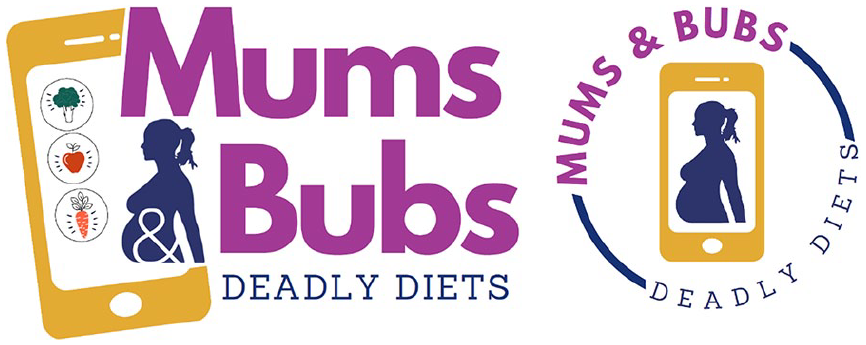
Mums and Bubs Deadly Diets branding elements. Left: overall project logo. Right: reduced size logo to support for social media use. Logo highlights that the project is related to pregnancy, food and nutrition and mobile applications.
It also felt pertinent to, from the beginning of the project, understand the meanings of words and how those meanings affected our communication, our engagement and even our data collection tools. This was of particular importance when referring to cultural terms, languages and community specific names and terms as well as general health terminology (New South Wales Government Health, 2019). Health has a holistic meaning to Indigenous Australians that incorporates both the individual and community, and not only physical but emotional, social, cultural and spiritual wellbeing (Australian Indigenous HealthInfoNet, 2023). Ensuring that all team members have deep understanding of terms being used and their use was crucial, and this has influenced the decision not to use terminology like healthy foods, that could imply judgement and lack of contextual understanding. Instead, we replaced this with foods that support a baby to grow and develop in pregnancy. The team have made a conscious effort to use non-judgemental and strengths-based language that are more specific to health in pregnancy and what that encompasses.
How do we make meaning together?
Perhaps the most important and challenging of the six questions the research team has reflected upon is “how do we make meaning together?” Research led by Indigenous voices supports the co-construction of meaning making, focusing on the issues strengths and strategies for change as they are experienced by participants in each of the sites (Dudgeon et al., 2020). Having research participants as active researchers and designers within a project has resulted in a range of approaches and shared learnings, which are discussed further in our approaches and learnings sections below. Making meaning together required a safe space for all involved for true co-design and we endeavoured to include tikanga (customs) and culture in every activity. For this project to have spirit and integrity as an Indigenous study, it needed to be created as a collaboration with those who it endeavours to benefit. We intended to do this in the most nurturing manaakitanga (nurturing) way possible for both the person and culture (Te Morenga et al., 2018). We began this project with a commitment to encouraging and sustaining cultural continuity through the outcome and its future accessibility.
Approach
Each of these values and principles that guided the project were also considered through a second lens, the socio-ecological framework (Christidis et al., 2021). The application of the socio-ecological framework explores how the individual, the community and the society as different levels each require their own consideration. Christidis et al. (2021, p. 13) defines these concepts as “macro”: the cultural and societal level, where we recognise community as expert knowledge holders, with self-determination; “meso,” the community where we acknowledge a pivotal aspect of Indigenous Australian culture is family and community; “micro,” the relationship and individual where building safe and reciprocal relationships becomes a priority. Again, these encouraged us to develop a series of reflective questions to consider our approaches and what we learnt from this that could assist others.
Macro: how did we consider culture and society?
This project was initiated during the early stages of the COVID-19 pandemic in Australia. We committed to thoroughly embed the knowledges, actions and involvement of Indigenous peoples in the communities we work with, so the approach varied across states due to differing health, research policies and approvals and the needs of the individual communities the project partnered with. The lead chief investigatory team were positioned in Queensland where state border closures meant that negotiation with sites in New South Wales remained a challenge for many months. Furthermore, the research team in Western Australia faced similar challenges where regions of their state were closed to reduce risks related to COVID-19 spread. This meant the team needed to consider grant aims, funding goals and timelines and re-shape our project to speak to them and ensure an achievable approach was developed.
It was essential the research team commit to an ongoing process of learning and deep listening to build their cultural competence. It was the responsibility of the research team to access core cultural online learning modules and take ownership of the creation of a safe space. These skills across a diverse research team supported interprofessional engagement as well as building relationships in culturally diverse communities. As a safe space, the research team had respectful and frank discussions to aid learnings for all team members.
Maintaining culturally safe governance throughout the project was critical and utilising reflexivity was a key factor to achieving this. Reflexivity is considered a critical component of Indigenous research practice as it encourages shared understandings between team members as well as with collaborators, both Indigenous and non-Indigenous (Bainbridge et al., 2015) and centrally positions the needs and perspectives of Aboriginal participants in the research (Wilson, 2014). Much self and team reflection has occurred among the small research team based in Queensland and with the broader CIs’ team. Honest and open conversations have taken place, sometimes which were uncomfortable, but always with the key aim to remain culturally safe, transparent and respectful of Aboriginal people and their culture in presenting their voices in our research. The Aboriginal CI within the team has played a pivotal role in holding the non-Indigenous team members accountable. Individual team members have been responsible for considering their own values and beliefs and extending their knowledge through shared discussions and reading.
Considering specific health behaviour instruments that could be used within the project also occurred within a cultural lens and factored in a hyperawareness that traditional health programmes do not consider the impact of generational trauma, institutionalised racism and socio-economic discrimination present within Indigenous Australian communities. A review of literature in food sovereignty, security and culturally safe behaviour change processes such as Christidis et al. (2021) and Waterworth et al. (2015) informed how we would facilitate conversations and activities with participants.
Supplementary Material 1 incorporates the main Macro Learning areas, initial methods and how these changed based upon community feedback. These include those related to COVID-19, choice of study sites and site negotiations, data collection methods and data retention approaches for the study. Like many researchers globally, the pandemic meant that the team, the paid staff and particularly the junior staff, were often working via distance, and this resulted in difficulties in enacting all the training elements we had committed to develop in them.
Meso: how did we genuinely engage Indigenous community as partners?
The project team have been and continue to be committed to a best practice approach to working with Indigenous communities. We continue to aim to build authentic relationships that give back in a meaningful way and ensure that communities are engaged as true partners and co-workers and as such can actively participate in decision-making and influence the project at all points. Such engagement has required that time be committed to meeting with community members and affiliated health care service staff to establish trusting and enduring relationships. The end goal of the project is to create a prototype of a digital tool focused on nutrition that meets a need identified by diverse Indigenous communities. Effective relationships are relied upon for the team to understand these needs, and co-design a response with Indigenous communities in a way that is purposeful and culturally appropriate. Open-ended questions and a conversational approach, utilising dadirri (deep listening of one another to grow a shared understanding and vision together) was adopted in the data collection phase, ensuring the voices of the participants was heard. The application of dadirri, in a research context is known to have the potential to enhance the depth of understanding of a topic (Miriam Rose Foundation, 2022; Stronach & Adair, 2014). This was particularly relevant given the team comprised non-Indigenous members. The following outlines the engagement approach we have undertaken to date, which is informed by our project values (Figure 2) and the AIATSIS Principles for engagement in projects concerning Aboriginal and Torres Strait Islander peoples (AIATSIS, 2020).
Establishing research governance that honours Indigenous peoples’ self-determination
Project governance structures have been established to hold university institutions through the MIA, and academic and project staff accountable to a research model with Indigenous communities as partners and co-workers. The CIs chose a participatory co-design approach to ensure the methodological scaffolding around the project-embedded processes of collaboration, capacity building and engagement. Importantly, the process of co-design used in this project placed value on the expertise of those not typically trained in mHealth or design, that is, the end user (Noorbergen et al., 2021).
An ISC was established to provide community members from the geographical areas the project is partnered with to actively participate in activities that shape and guide the project. Partner organisations nominated one or two staff or other experts such as dietitians, and chefs, to join the Committee. The research team could nominate other members if so desired. In addition to a governance role, the ISC will have a voice in all matters related to the project and be involved in data analysis and publication authorship. Committee members and their knowledge and expertise are appropriately recognised and reimbursed for their contributions.
Negotiating respectful access to sites for the research team
Our approach to negotiating access for the research team into the identified communities was to utilise the unique capabilities of the CIs that determined possible pathways into each site. Across the various states of the study, different CIs and research team members had a variety of knowledge, connections and experience that could assist with negotiations to meet and discuss the study with sites. Once access for a visit had been negotiated for the research team, the two lead CIs, in some instances also including the research manager and research assistant, would attend a meeting with the representatives and key contacts of each health service we hoped to partner with. Where possible, these discussions would be in-person which allowed for an easier discussion about the proposed study and methods. Once each organisation had considered the project and indicated they would like to become a project partner, a letter of support confirming the terms of the partnership were provided from each community-led health organisation for ethical and governance arrangements.
Once a partnership had been formally established, the team would commit the allocation of time and project funds towards site visits to build trustful relationships with community partners, developing working relationships, undertaking any reciprocity actions as they come about and creating pathways for project partners to shape the project’s decision-making.
Community consultation and feedback
Following on from a partner’s agreement to be a host site for the study, early stages of consultation involved meetings with organisational managers and staff to discuss and receive feedback on the project and to begin to develop a plan for how the project would best be undertaken in each community. Potential sites could provide input to study design, recruitment materials and consider appropriate reciprocity acts for their organisation, and discuss community members who could participate on the ISC for the study. Each organisation was generous in sharing their local insights, many of which prompted us to amend our methodology or processes in some way (Supplementary Material 1). Feeding back how community insights had shaped the project demonstrated that we valued community expertise and working in a partnership. Learnings in this area included embedding of reciprocity as part of the project deliverables, recruitment approaches, inclusion of health care workers as participants and considerations for mHealth application and design.
Micro: how did we manage complexities of individual knowledges, team relations, community relations and ontologies
Utilising multidisciplinary team collaboration as a research approach can be extremely valuable in undertaking complex studies (Bramley & Ogilvie, 2021). However, creating a functional approach that allows the diverse knowledges held by team members to intersect is not always easy. The challenges faced at the outset of this project regarding strained community relations at the site of the original grant funding application, had a ripple effect across the entire team. There were doubts across the chief investigatory team about how this project could move forwards that at times led to tensions within the team. Unlike many funded research programmes, the two lead investigators, one Indigenous theorist and Indigenous knowledge expert and one non-Indigenous biomedical researcher with expertise in Indigenous maternal infant health, made a commitment to jointly lead the project.
This leadership pairing worked hard to enact Dadirri: deep listening of one another to grow a shared understanding and vision together (Miriam Rose Foundation, 2022). This encouraged all team members to engage in reflective practices that continued to come back to the core questions of integrity at project foundation (Table 1). This project also enacted a strong commitment to building capacity of all team members, valuing the two-way learning approaches that allow all contributors to the project to build each other’s capacity. Dadirri within the entire multidisciplinary team has grown the knowledge of each of the team members across a range of knowledges essential to the project. The recruitment and collaboration of Aboriginal research staff throughout the study has also provided an opportunity to incorporate cultural representation and the learning approaches at the core of this project.
In some ways, what could have been a significant challenge related to timelines during the pandemic, became an opportunity for the research team to use additional time to truly engage in learning together, to re-engage with the project aims, and methods, and to strengthen the academic skills of more junior team members. As a result of the (a) pandemic, (b) need for new study locations and (c) new shared knowledge the research team spent considerable time re-thinking and re-writing the project scope, timeline and feasible and achievable outcomes. This was done through meetings, email correspondence and short online workshops. Supplementary Material 1 highlights the learnings and adaptations to the project based upon the project foundations for the project team.
There is a duality in the development and maintenance of relationships within this study. While the relationships and capacity building between team members have been and continue to be important in setting the culture of this project, it has been important to consider the individual relationships between the research team, research participants and participating organisation staff.
Conclusion
Constructing a bird’s nest requires wisdom, knowledge, strategy, stamina and the ability to be reflexive. This is very much how the research team has viewed this project. The base comprised Indigenous axiology and epistemology and embedded throughout are Kaupapa Māori principles, all of which ensure the nest is safe and structurally sound. The Aboriginal voices of all those involved in the project has provided the wisdom and knowledge. Stamina has been required to ensure the project continued through a world-wide pandemic, with the need to review, re-evaluate and re-position many aspects. It became clear that with reflective practices based upon solid project foundations and values, the research needed to be iterative and constantly adapting to meet the unique community and individual needs of all stakeholders involved.
Exploring the worldviews of Aboriginal and Torres Strait Islander women during pregnancy and their nutritional priorities and needs contributes to limited existing research. The inclusion of Indigenous methodology and research co-design principles makes this project unique. Undertaking this during a pandemic has provided further learnings. Phase 2 of the project will continue to see the nest strengthened using the same values, beliefs and principles of Phase 1, in an effort to develop a mHealth prototype.
Supplemental Material
sj-docx-1-aln-10.1177_11771801231189346 – Supplemental material for Working with Indigenous Australian communities designing a nutritional mHealth tool during the Covid-19 pandemic
Supplemental material, sj-docx-1-aln-10.1177_11771801231189346 for Working with Indigenous Australian communities designing a nutritional mHealth tool during the Covid-19 pandemic by Stephanie Gilbert, Rachel Irvine, Melissa D’Or, Kym Rae and Nicole Murphy in AlterNative: An International Journal of Indigenous Peoples
Footnotes
Acknowledgements
The authors acknowledge the ongoing and forever relationship of Aboriginal and Torres Strait Islanders to the continent and its islands in the land now known as Australia. This research acknowledges their knowledges and their preparedness to share both with the Indigenous and non-Indigenous researchers involved with this research. They include Badtjula (QLD), Kamilaroi (NSW), Gamilaroi (NSW), Jagera (QLD), Giabal (QLD) and Jarowair (QLD) and in Western Australia they include all the people with relationships to Whadjuk country (Perth) including Whadjuk Boodja (people).
Authors’ note
Declaration of conflicting interests
The authors declared no potential conflicts of interest with respect to the research, authorship and publication of this article.
Funding
The authors disclosed receipt of the following financial support for the research, authorship and publication of this article: The National Health and Research Medical Council.

Glossary
kaupapa Māori Māori (Indigenous peoples of New Zealand) principles and ideas which act as a base or foundation for action functioning as an ideology incorporating knowledge, skills, attitudes and values of Māori society
koha reciprocity
mana respect
manaakitanga nurturing
Māori Indigenous peoples of New Zealand
tikanga customs
dadirri deep listening of one another to grow a shared understanding and vision together
ganma genuine two-way knowledge sharing
Gomeroi Gaaynggal Babies from Gomeroi Lands; the name of a study
Supplemental material
Supplemental material for this article is available online.
References
Supplementary Material
Please find the following supplemental material available below.
For Open Access articles published under a Creative Commons License, all supplemental material carries the same license as the article it is associated with.
For non-Open Access articles published, all supplemental material carries a non-exclusive license, and permission requests for re-use of supplemental material or any part of supplemental material shall be sent directly to the copyright owner as specified in the copyright notice associated with the article.
