



Abstract
This article explores the development of an Aboriginal basket-weaving theoretical-methodological framework developed as part of a doctoral study that explores Aboriginal and Torres Strait Islander teachers’ aspirations towards school leadership in Australia. Aboriginal basket weaving framed as theory-methodology is positioned through the cultural lens of Indigenous and post-structural theoretical frameworks. Connected and relational ontology is woven through the methodologies of storying and yarning that are held by the basket-weaving theoretical framing yet to be enacted in the fieldwork and analysis. This article is a first look at the framework developed by the lead author in concert with her doctoral supervisors.
Orientation
This article explores the assembling of an Aboriginal educational research theoretical framework-methodology for the purposes of the doctoral study of the lead author. The research is situated in the critical-transformative paradigm and draws from several theoretical stances. The narrative of this article is partially and necessarily told in first person, ethically foregrounding the voice of the lead author, the doctoral student. The I, me and we of this work is Kelly, the first author of this article.
The theoretical framing focusing this study is situated in Aboriginal ways of knowing and doing, discussed through the cultural metaphor of basket weaving. The five elements of basket weaving connect paradigms, spanning Indigenous research of Indigenous standpoint theory, decolonising mythologies and post-qualitative inquiry through a basket-weaving cultural metaphor. The ontology and epistemology of this research are one of relationality. Aboriginal ontologies are ways of being and knowing what is real. Relationality is real for the researcher; it is the connections between the yarning partners, community, family, culture and research paradigms. One cannot work without the support of the other.
Kelly’s story
I come to this research as a Gomeroi (Aboriginal peoples from northern New South Wales and southern Queensland, Australia; also known as Gamilaroi) Aboriginal woman, daughter, mother, wife and educator. I also acknowledge that I come to this research from a position of privilege. My parents always encouraged me to strive to achieve a little more than they did, to try to see different points of view and be a person of integrity. My guni—my mother—grew up in rural New South Wales (NSW) in a family exposed to alcoholism and domestic violence. She achieved a year 8 level of education. My father came from a working-class family, and he completed a trade qualification. My parents make a powerful team and are my examples of lifelong learners. Both went on to complete other certificate and diploma-level courses as I was growing up. I spent most of my school years educated in Catholic schools in rural NSW. It is there that I developed a passion for social justice and honouring the dignity of each human being. I am the first person to achieve a university-level qualification in my family. I am privileged to be supported and championed by my husband and family as I pursued my postgraduate degree and now this research.
I understand that positioning oneself can be dynamic and changing and shape one’s research design and practice (Williamson-Kefu, 2019). I am an Aboriginal researcher; I come to this research because I have experienced a problem, like Eddo-Lodge, that angers me. I come to this research with my eyes wide open, and I acknowledge my bias towards my culture, community and social and racial injustices I have experienced in the education profession. Hence, I position myself in this research.
Basket weaving as an Aboriginal theoretical framework
The making of the basket, the business of women, fibrous in its nature, cellular walls evolving, has metaphorically stood as the space from which Sistas have held themselves, held each other, with data, to make our stories, to make ourselves. Our making methodology in story mirrors the fibres, weaving the cellular, touching the essence of our desires on and under our skin, to be our skin, to know ourselves through ancestral data—stitching, threading, imaging, dancing, painting—to being. (Bunda et al., 2019, p. 176)
Kelly’s journey with theory
Martin and Mirraboopa (2003) challenge that Indigenist research must consolidate the core structures of Aboriginal ontology as a framework for research. Otherwise, it is “western research done by Indigenous people” (Martin & Mirraboopa, 2003, p. 206). Aboriginal ontologies are ways of being and knowing what is real. This inquiry, aligned with Aboriginal ways, affirms a relational ontology. A relational ontology is an ontology that theorises the human as either cause or effect while at the same time remaining accountable for the role the human plays in the interconnected practices of knowing, doing and becoming (Barad, 2003). Within Indigenous standpoint theory, a relational standpoint, the role of explicitly stating axiology juxtaposes the “default ways of valuing and being in the academy to remain Anglo and colonial” (Yunkaporta & Shillingsworth, 2020, p. 3). In relationally responsive standpoints, at the core is the relational process of respect for the other for their way of being (Yunkaporta, 2019). In my Aboriginal worldview, nothing can exist without a relationship with something else.
This inquiry is connected to the critical-transformative paradigm that encompasses post-structuralism. Post-structuralism challenges the structural understanding of human interactions through a decentred subject. The identity of this subject is influenced by the relationships constructed through language and actions. This paradigm aims to challenge dominant ideologies and issues of equality in this study concerning career progression for Aboriginal teachers (Leavy, 2017). Qualitative data collection can shine in the critical or transformative paradigm as the intersectionality of inequality can be explored (Leavy, 2017; Ledesma & Calderón, 2015). Crenshaw coined the term intersectionality in 1989; the concept explores how oppression and racism are experienced across divergent and intersectional planes (Crenshaw, 1991; Leavy, 2017; Ledesma & Calderón, 2015). This inquiry seeks such intersectionality.
I am an Aboriginal researcher, influenced by the underrepresented group of Aboriginal teachers, researching from an Indigenous standpoint. How I explain the theoretical framework in which I inquire comes from the intersecting planes of my guni, my culture, and my privilege in exploring my understandings of theory and scholarship.
This article shares the theoretical terrain of this inquiry. By defining key concepts relating to Aboriginal ways of knowing and being, it explores connective, intertwined and relational standpoints underpinned by a personal paradigm and cultural metaphor of Aboriginal basket weaving. The weaving of a basket is an Aboriginal cultural practice created in Aboriginal ways of knowing, being and doing. This basket is constructed throughout this article to reveal the theoretical framework on the authentic foundations of Indigenous research methodologies and Indigenous standpoint theory. To contextualise the doings of the theoretical framework, the discussion also weaves between theory and methodology, back and forth, and in and out, to create the basket.
A rationale for Indigenous standpoint theory
Indigenous standpoint theory does not attempt to substitute the lived experiences of Aboriginal people but rather to expose how Aboriginal people are positioned in the construction of colonial knowledge (Ardill, 2013; Nakata, 2007). Indigenous Standpoint theories investigate power relations from the perspective of the marginalised, and while analysis of a group is valued, it is not at the expense of individuals (Ardill, 2013; Nakata, 2007).
Feminist theory is the progenitor of Indigenous standpoint theory (Foley, 2003), which emerged in the 1970s and 1980s, allowing women to express their experiences of problems and issues in their world. Standpoint theory from feminist perspectives helped to influence power structures when conceptualised into the reality of women’s everyday lives (Foley, 2003; Nakata, 2007). Standpoint theory could then be transferred and utilised to understand other intersectional and marginalised groups’ experiences of their reality.
When a researcher starts from the perspective of the marginalised, they are more likely to recognise the importance of standpoint and produce critical, articulate, and personified research (Borland, 2020). When an Aboriginal researcher uses Indigenous standpoint theory to explore structures or power imbalances, they undertake a distinct form of analysis. This analysis, broad in its construction, is employed to persuade others and elevate foci that may not have had the attention of others (Nakata, 2007). Indigenous standpoint theory lays a “basis for which a range of arguments can be purposeful; these arguments must be balanced, reasoned and answer to the assumptions on which they are built” (Nakata, 2007, p. 214). Indigenous standpoint theory sets the requirements that the practitioner and supervisor be Indigenous, as is the case in this study. The researcher understands social theory, and the research must benefit the community in which it is conducted (Foley, 2003).
Rigney (1999) states, “Indigenist research is research by Indigenous Australians whose primary informants are Indigenous Australians and whose goals are to serve and inform the Indigenous struggle for self-determination” (p. 32). Green et al. (2018) encourage Aboriginal researchers to listen to their stories of the colonised world of academia as a place in which Indigenous word has been theorised. They encourage Aboriginal researchers to draw on their own ways of doing, ways of being and ways of knowing, to produce research (Green et al., 2018; Smith, 2012). Yunkaporta and Shillingsworth (2020) suggest that when working with an Indigenous research paradigm, work with a cultural metaphor, and the tools we have been given to know, learn and grow with are cultural metaphors (Yunkaporta, 2019). These metaphors are words, images, actions and objects that carry meaning, perhaps layers of contextual meaning, that we can co-create systems and events in the existence of our spiritual history (Yunkaporta, 2019). Therefore, the theoretical framing of this research and its conceptualisation and theorisation will be unpacked through the metaphor of weaving a basket. This story, the story of the theory, is unpacked below.
Weaving a basket: Kelly’s theoretical framework
I grappled with applying Indigenous data collection methods of storying and yarning to this study. Wilson (2008) states that methods are usually built for the paradigm they sit within (p. 39). Todd (2016) explains that a personal paradigm shift has a way of sneaking up on you (p. 4). My shift happened as I watched my guni weave a basket and read the work of Engeström, who coined the phrase knotworking (Engeström, 1999). Knotworking is defined as “tying, untying and re-tying of separate threads of activity” (Kerosuo et al., 2015, p. 129). I watched my guni pulling fibres through, knotting, and connecting them and continuously adding more. It was at this moment that my personal paradigm was revealed.
My guni is a weaver. She has taught the art of weaving to many Aboriginal and non-Aboriginal people, including her granddaughters and me. In her lessons, she provides the equipment one needs to learn and practice weaving to create a dilly bag or small basket (Figure 1).
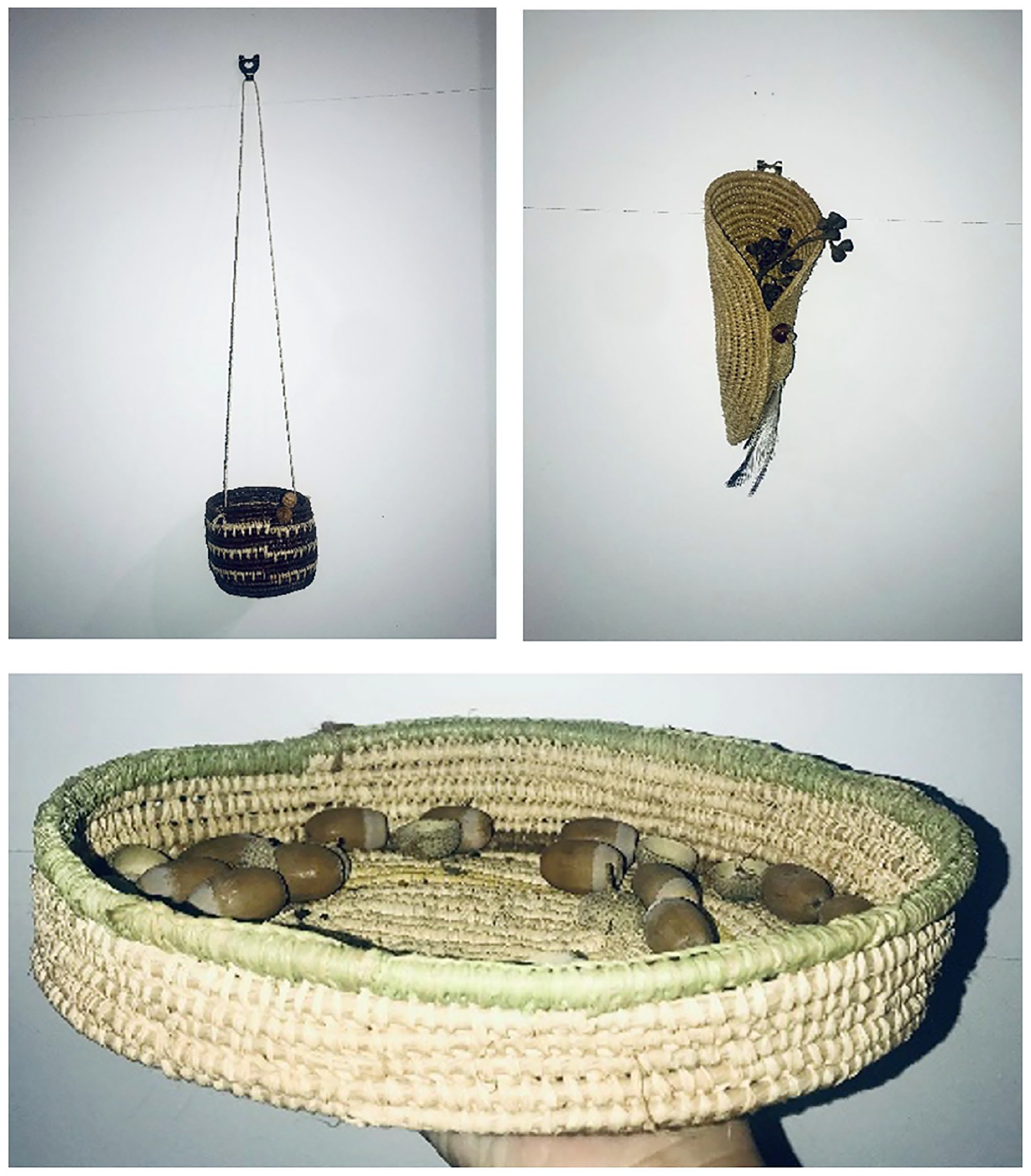
Dilly bag (upper left), scoop (upper right) and flat container (bottom). (Weaving by Debbie Wood; Photo by Kelly Humphrey).
As I weave with my guni, we yarn, share challenges, laugh, and collect each other’s stories. This is a sacred time, a sacred place, and the basket is a sacred creation. My guni talks of the five elements necessary to weave a basket. The first element is the core. The core is a stiffer material that provides structural integrity to the basket. The second element is the grasses. They are used to weave around the core, interlocking to create beauty in the basket’s layers. Third, weaving requires steady hands to keep the tension and mould the form. The fourth element relates to the mind. The mind allows the patience to sit, repeat the weaving pattern and relax into the stories that may come. Finally is the needle. The needle is the connecting tool as it provides the vehicle to pull the grass around to be hinged to the core.
When weaving the basket, the core is the foundation. The grasses are of different lengths and, at times, need to be overlapped and interwoven into the basket together. This creates a continuous fibre to weave with. It is seamless; you cannot tell when one grass finishes and the next starts. While a foreign tool in the traditional art of weaving, the metal needle shows the adaptations and innovations to continue to practice an art form that has been alive in this country for over 65,000 years.
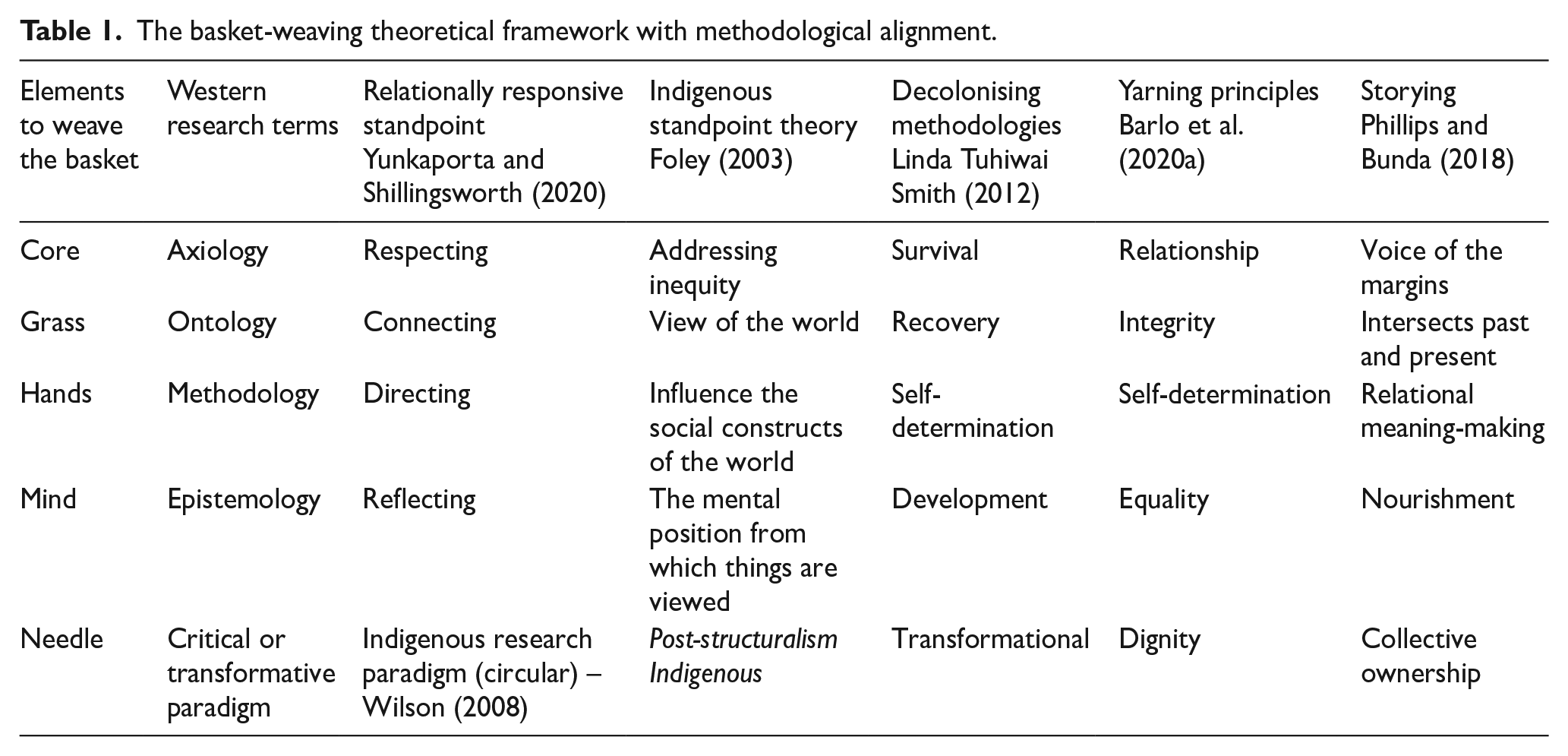
The theoretical framework for this research is explored as a metaphorical basket weaving. It forms my way of sharing the challenges and complexities of this research. It is firmly situated in Aboriginal ways of knowing, being, and doing as it spans paradigms, theories and stances. It is a way of presenting Aboriginal research and personal stories through decolonising methods of western paradigms. Table 1 shows the relationship across theories that help to weave the basket. Figure 2 is a conceptual diagram showing the circular, connected and non-hierarchical structure of the basket-weaving theoretical framework. It is a draft representation to show the non-linear nature of the basket-weaving framework. This framework is dependent on each of its elements and threads to create a basket that will capture and hold the stories and yarns of the research. Each element of the basket will be explored in the following section.
The basket-weaving theoretical framework with methodological alignment.
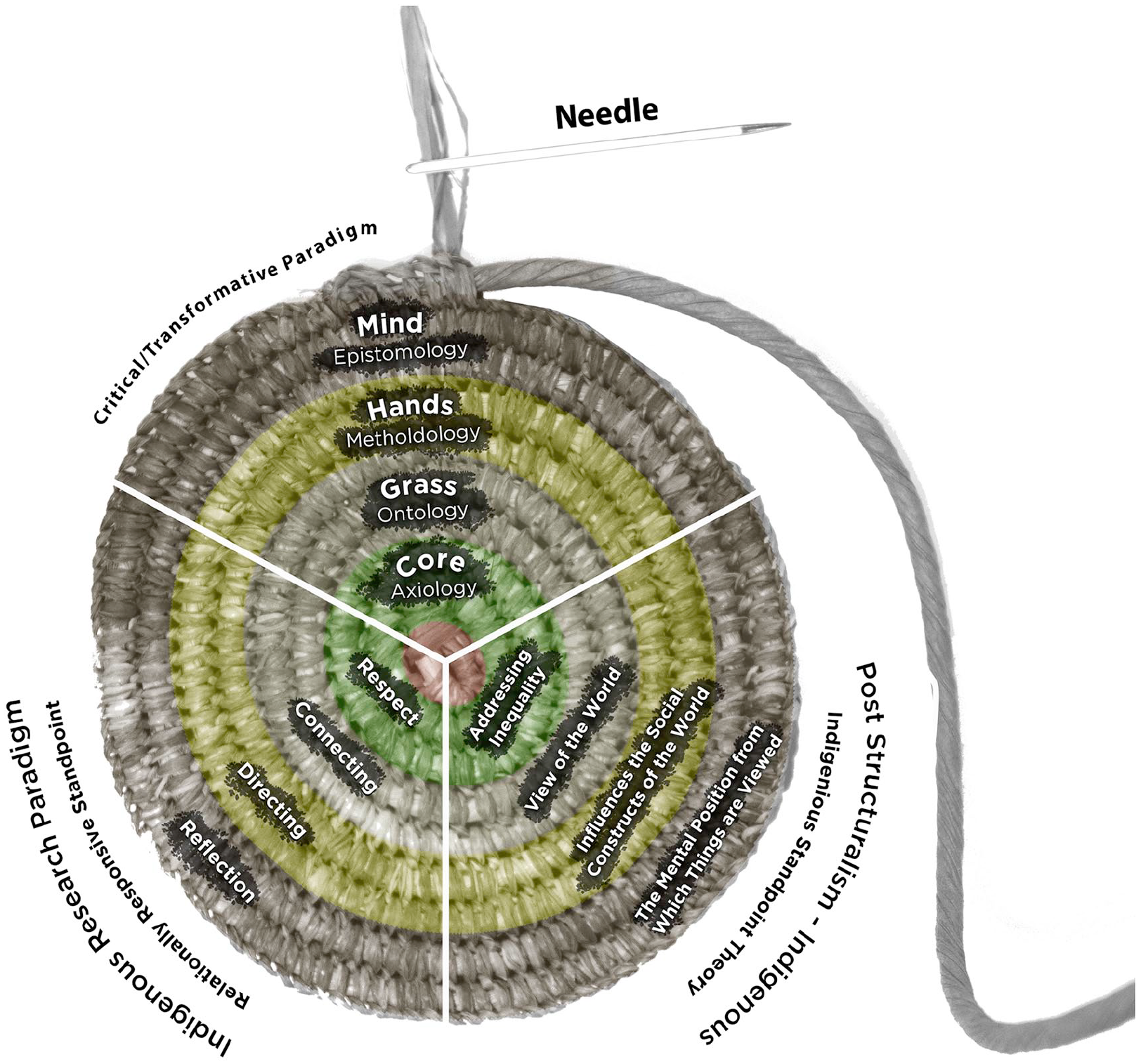
The basket-weaving theoretical framework, a conceptual diagram (weaving and photo by Kelly Humphrey).
The core
The core of a basket is its strength. The fibrous material creates the skeleton’s stability to allow the basket to build as it is weaved together. The core of the theoretical framework represents the ethics or morals that guide this research. At the core of Indigenous standpoint theory is the need to address inequality (Foley, 2003). These research explorations are at the core of the basket.
Wilson (2008) suggests when undertaking research in an Indigenous paradigm, it is essential for an Indigenous researcher to “consciously consider what knowledge one hopes to uncover” (pp. 38–39). The knowledge-seeking that is “consciously considered” in this research is the need to understand better how career determination in education for Aboriginal and Torres Strait Islander teachers will enhance comparable diversity in school leadership. In turn, this may have an intergenerational impact on Aboriginal student outcomes and Aboriginal teacher underrepresentation (Santoro, 2013, 2015; Santoro et al., 2004).
The axiology of this research is ethical in the critical or transformative paradigm, as respect and relationships are at the core (Leavy, 2017; Yunkaporta & Shillingsworth, 2020). In positioning myself in this research, I acknowledge my personal experience in this study. I acknowledge that I am an Aboriginal researcher. I recognise my experience with and knowledge of my culture, community and social and racial injustices I have experienced in the educational profession.
Within this theoretical framework, I am weaving a basket. It will never become a reality without its connection and relationship with each element and how it is understood in the world, my way of being (Wilson, 2008; Yunkaporta & Shillingsworth, 2020).
The grass
The grass used to weave around a core is harvested from the earth. The earth has nourished these grasses to grow from tiny seeds. My Guni’s hands collect the grass, only what she needs, to create a basket. When a basket is no longer required, it is returned to earth to nourish new growth. There exists a relationship between the land and the hands. Wilson explains that Indigenous ways of knowing are constructed out of relationships (Wilson, 2001, 2008). How I exist in this world is a complex and intricate web of connection through relationships; my ways of knowing and being are connected to culture, people and time. The basket that weaves into being, which becomes in this theoretical framework, is a relational device, not only for the elements to create it but the relationship between my guni, myself, the participants and my research (Todd, 2016; Wilson, 2008). This is a connection embedded in my culture, my family, Australian history and relationships to confront social oppression.
To hear a voice requires a person to listen, to listen deeply. Deep listening is also referred to as dadirri (Clague et al., 2018). Dadirri derives from the Ngangikurungkurr language of the MalakMalak people of the Daly River region of the Northern Territory. In Kamilaroi language, the word is winanga-li: to hear, listen, know and remember. Dadirri is inner deep listening and quiet, still awareness. Listening also requires someone to speak. This is a dependent relationship, just as the grasses in the basket require ways of knowing that are dependent on a connection—a circular, seasonal rotation, a connected way of knowing (Wilson, 2008).
The hands
When weaving a basket, our hands are the instruments that conduct the process. The hands in this theoretical framework represent the methodologies used to achieve the research aims and objectives. The Aboriginal methods of storying and yarning chosen for this research will explore ways of knowing and ways of being through ways of doing (Martin & Mirraboopa, 2003; Wilson, 2008). Storytelling has always been spaced across time and place; stories carry meaning (Bunda et al., 2019). Yarning “relies primarily on storytelling and the use of oral narratives to convey information” and allows for a structured process “giving participants control over the direction and the content of the yarn” (Barlo et al., 2020a, pp. 91–92). The use of yarning and storying methodologies is grounded in relationality’s connectedness reality (Yunkaporta & Shillingsworth, 2020).
The mind
I grew up in a large extended family. My way of knowing was taught to me in my context. I learned from my guni that no matter where we find ourselves, we always rise to the occasion, never discounting who we are. My guni also taught me to weave. My knowledge of weaving has developed by watching, experiencing, knowing and doing. Knowledge can be taught and learned in contexts, in specific ways, at certain times (Martin & Mirraboopa, 2003). Martin and Mirraboopa (2003) challenge that knowledge is purposeful only when used; if it is not used, it is unnecessary (p. 209).
Knowledge is experienced through connection. My way of knowing is dependent on the social-political, historical and experiences that have been shaped by peoples, places, social movements and opportunities with and through others, and therefore, this is the epistemology of this study. Wilson (2008) explores ways of knowing as to how we “come to know” something, and it is intricately related to how we are in our being or our ontology (p. 33).
This research seeks to understand what is real for Aboriginal and Torres Strait Islander teachers in their aspirations and journey to school leadership. My Aboriginal epistemology acknowledges the limitations of my knowledge (Foley, 2003). It is firmly based on relationships for connection to grow knowledge. Understanding what is real for Aboriginal and Torres Strait Islander teachers in seeking school leadership careers requires yarning around the primary research question. When weaving a basket, reflection, questions, stories and yarns build my understanding. This knowledge is made through an intricate relationship by creating with hands, listening and questioning and relating this to what I know to be real in the world (Wilson, 2008).
The needle
A needle is a tool that pulls the threads of the basket together. The needle in this theoretical framework pulls together all the components that encompass this research. That is, it stitches together the paradigms and theories of Indigenous, post-structural inquiry and critical or transformational paradigm. The needle that my guni uses is a manufactured metal tool not traditionally used in the practice of weaving. It is the metal needle that is considered a new tool used in contemporary weaving practices. Metaphorically, the needle provides a different way of doing research informed by an Indigenous worldview that could provide a way to disclose new ways of doing research (Le Grange, 2018). Wilson (2008) informs that “knowledge cannot be owned or discovered but exist merely as a set of relationships that can be given a visible form” (p. 127). The relationship between post-structural, transformational and Indigenous paradigms in this study is that they are allied by the connection to discover what is “real” for Aboriginal and Torres Strait Islander teachers (St. Pierre, 2019).
Deleuze (1998) suggests that raising perceptions on a subject “means to render sensible, sonorous (or visible), those forces that are ordinarily imperceptible” (p. 72). Educational research is interlocked with colonial education systems. Critical, transformative theories focus on the injustices of the lived experience of marginalised groups (Creswell, 2018), while post-qualitative inquiry “makes it relevant to engaging challenges of a contemporary world” (Le Grange, 2018, p. 270). The needle here pulls this study entangled in paradigms that promote social action to think, feel and act differently to ensure a different future is found in a relationship of inquiry (Leavy, 2017; Le Grange, 2018). The needle is integral to the basket. The basket is dependent on it to be created; therefore, the needle represents the relationship between time, paradigm and theory.
The broad theoretical terrain to be used in this study has critically argued for the connective, intertwined and relational standpoints of Indigenist research underpinned by a personal paradigm and the cultural metaphor of Aboriginal basket weaving as a theoretical framework. The next section will explore the hand in the basket-weaving theoretical framework as the methodologies and research design.
Enacting the theoretical framework
I recognise the importance of relationships with my culture, land, family, Australian history and the knowledge of the participants of this research. Therefore, it is critical to use Aboriginal methodologies within a post-qualitative inquiry, that Indigenous and transformational paradigms, which in turn support Indigenous voice. This section, therefore, identifies the methods of storying and yarning and the phases for the generation of information. Furthermore, it weaves an ethical responsibility into the research design.
In a post-structural paradigm, Indigenous standpoint theory recognises the importance of and produces critical, articulate and personified research addressing inequity and influencing social constructs (Borland, 2020). In the colonising of Australia, the silencing of Aboriginal voices and stories was endorsed, in some cases physically and cruelly enforced, in favour of the dominant “white” worldview (Geia et al., 2013, p. 13). Mooney et al. (2018) note the dominant white worldview when discussing the authority of mainstream or non-Aboriginal methodologies that “dominate the way research is conducted” across Australian universities (Mooney et al., 2018, p. 274). However, it is essential to note that they acknowledge the sluggish ways in which the Aboriginal ways of knowing, being and doing are finding acceptance in the academy within Australia (Mooney et al., 2018). In a post-qualitative inquiry such as this, the innovation and implementation of Indigenous standpoint theory has and continues to seek methodologies that privilege Indigenous voice (Geia et al., 2013).
From metaphor to reality
The chosen methods of storying and yarning support the generation of evidence. Participants are referred to as yarning partners and storying and yarning will be explored in the following section. Within the basket-weaving theoretical framework, the hands are an essential part of the framework. They represent the methodologies, the doing of research; they assist in generating evidence and influencing social constructs. The doing of research is through storytelling. The methods that will be directed through the hands, while each is distinctly different, are two essential elements in generating evidence within a decolonised methodology and Indigenous research paradigm.
In the traditional healing practices of the Ngangkari peoples of Central Australia, healers use their gifted hands in a process to aid healing and health. Incorporating touch and movement, the healer’s hands work with their mapanpa (sacred tools) to work on the spirit to provide a healing touch (Ngaanyatjarra Pitjantjatjara Yankunytjatjara Women’s Council Aboriginal Corporation, 2013, p. 269). In Aboriginal culture, our hands are essential in connecting, healing, gathering and creating. When weaving a basket, our hands are the instruments that conduct the process. The hands in this theoretical framework represent the methodologies used to achieve the research, aims and objectives. Figure 3 demonstrates the conceptual framing of the relationship between decolonised methodologies and the methods to be engaged.
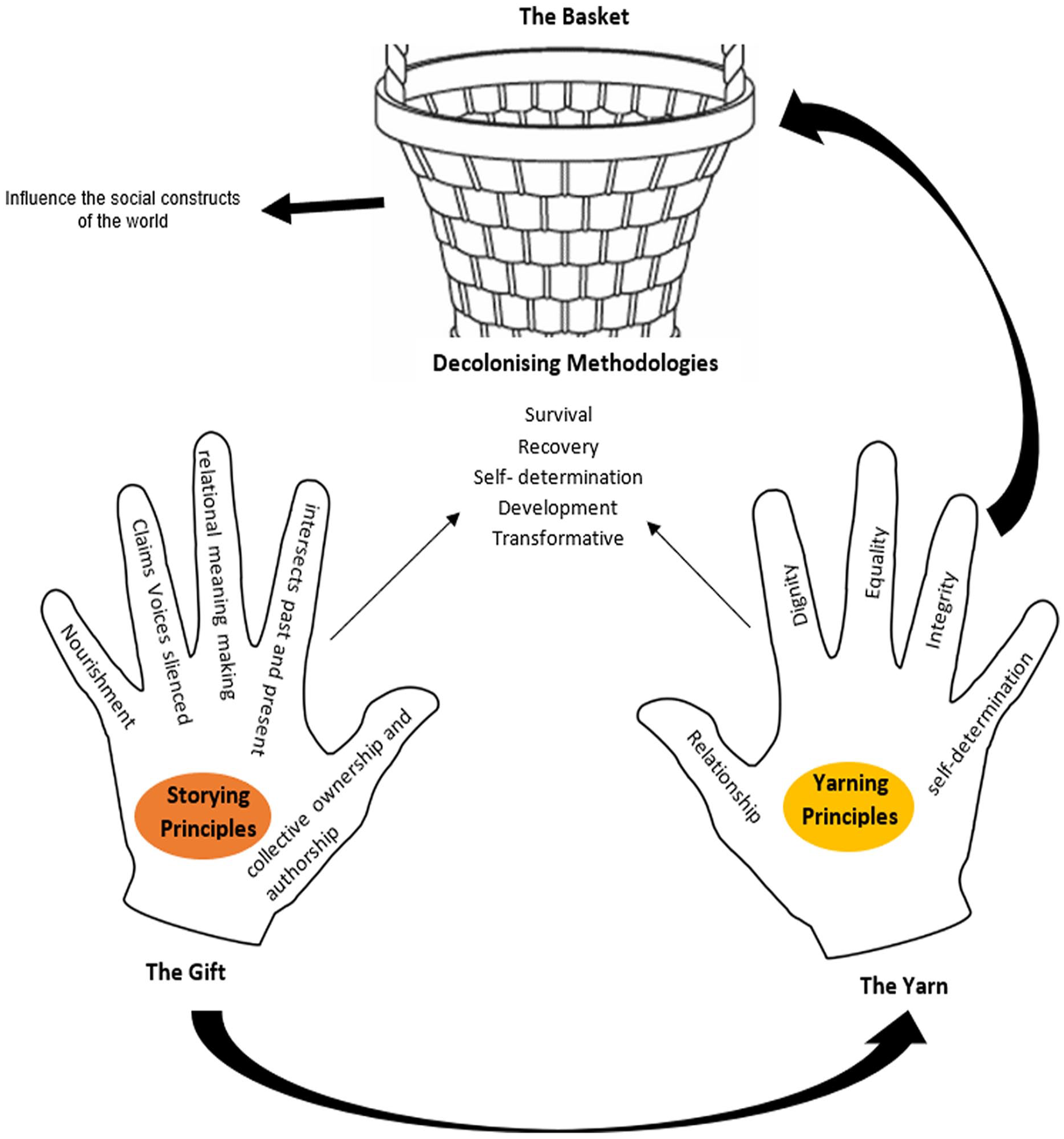
The hands.
Storytelling is a practice that has been used for thousands of years by Indigenous persons and cultures to teach, entertain, inform and communicate across all spheres of life (Geia et al., 2013; Phillips & Bunda, 2018). Yarning, engaged by Australian Aboriginal peoples, is a process and exchange; it is built on respect and maintains principles and protocols for engagement in individuals’ relationships (Fredericks et al., 2011; Martin, 2008). How storying and yarning will be engaged to generate evidence will be explored below. It is important to note that the yarnings become storying through the gaze and analysis of the researcher.
Yarning
Yarning is a process and an exchange (Fredericks et al., 2011; Martin & Mirraboopa, 2003). The yarning method “brings together several topics in several layers—or threads—for a particular purpose” (Martin et al., 2016, p. 50). The purpose of yarning is to gather more information through the yarning partners related to their stories. Bessarab and Ng’andu (2010), foundational in identifying yarning as a research method, likens the yarn to a semi-structured research interview through a relaxed and purposeful conversation. In yarning, Indigenous people can talk freely about their experiences, which explores information emerging from the topic (Bessarab & Ng’andu, 2010). Building from Bessarab’s and Ng’andu’s understandings, Barlo et al. (2020a) argue that yarning is highly structured, guided by six protocols and seven principles outlined below, which provide participants control over their stories and the process itself.
The six protocols of yarning form the relational accountability within the yarn. These are as follows: (1) Gift, the knowledge offered is accepted and valued to be received; (2) Control, the participant determines the yarn, directions, length and in what form it will take place; (3) Freedom, the participant shares only what they wish to; (4) Space, physically comfortable and culturally suitable area is provided; (5) Inclusiveness, everyone is welcome in the space; and (6) Gender specificity, personal characteristics may determine the yarn topic (Barlo et al., 2020a, p. 93).
As the protocols guide the yarning process, the principles protect the stories and data gathered through the research process. Barlo et al. (2020a) argue for seven principles in yarning. Reciprocity and responsibility are the first two principles. In this inquiry, reciprocity and responsibility are established in the researcher’s moral ethics and personal commitment. The third principle is the relationship. It is here that the researcher becomes a part of the story through the exchange (Barlo et al., 2020a; Bessarab & Ng’andu, 2010). The fourth principle demands treating each other with the utmost respect and honouring each person’s dignity in the space for who they are and what they bring to the yarning circle. Equality, the fifth principle, means everyone has rights and responsibilities in the yarning circle. This is not determined by age, gender or position (Barlo, 2020a). The sixth principle is integrity, which calls each member to be honest in the yarning space and to be trusted with the stories told. The final principle, self-determination, allows each participant to choose to share and to end their participation at any time (Barlo et al., 2020a).
Paying attention to the “participant’s story and exploring the participant’s story from their telling and not according to a research plan based on specific research language” is fundamental (Bessarab & Ng’andu, 2010, p. 41). The use of yarning, its protocols and principles, allows yarning partners to use different languages to describe their career experiences when responding to a prompt borne of their story. The experiences shared will continue to build each yarning basket. Analytical outcomes will be shared with the yarning partners after analysis to ensure an opportunity for yarn withdrawal or further additions.
Storying
The embodiment of stories from the oral to the written, performed or artistically expressed is according to Phillips and Bunda (2018) “respectful acts of remembering teachings” and a way of linking living oral archives with the past with the present (p. 112). Phillips and Bunda (2018) argue that storying as a way of research does exactly this. The yarns that are shared in this research are teaching the researcher, and these yarns will become stories through their co-creation and analysis. The embodiment of stories from the yarning to the written, performed or artistically expressed are according to Phillips and Bunda (2018) “respectful acts of remembering teachings” and a way of linking living oral archives with the past with the present (p. 112). Phillips and Bunda (2018) argue that storying as a way of research does exactly this. The yarns that are shared in this research are teaching the researcher, these yarns will become stories through their co-creation and analysis. A story, a new way in which knowledge is carried forward. Stories can provide a way for humans to frame their understandings of themselves, the world and their connection with others (Fisher, 1987). In short, “our stories are the common ground that allows people to communicate, overcoming our defences and our differences” (Wyse, 2016, p. 2). Throughout time, there is evidence of preserving ways of encoding, communicating and distributing knowledge and practice through myths, legends and folk stories (Berkes, 2018; Phillips & Bunda, 2018). Storytelling honours a legacy with ancestors and connects people across cultures, times and countries (Phillips & Bunda, 2018).
Phillips and Bunda (2018) are leading the advocacy for storying as research; they define storying as “the act of making and remaking meaning through stories” (p. 7). Furthermore, they suggest that storying is an invitation to tell a story and is not the same as narrative research. While acknowledging the narrative as legacy work, Phillips and Bunda (2018) suggest that narrative implies a specific genre and structure usually delivered in a written form. Barlo et al. (2020b) argue that “narrative is a process” and “story is an artefact” (p. 91). Storying can embody song, story, dance and art (Phillips & Bunda, 2018). While storying can be found in different mediums and modes, Phillips and Bunda suggest five storying principles.
The first principle, storying nourishes thought, body and soul, explains stories’ power. We make meaning through the story; stories we encounter stick with us. They make us think, challenge our assumptions, make new meanings and develop a deeper understanding of phenomena (Phillips & Bunda, 2018).
The second is storying claims voice in the silenced margins. Storying has the power to counter metanarratives (Phillips & Bunda, 2018). As a research tool, storying seeks the underrepresented perspective, the voice that has not been heard over the dominant narrative. It pushes back against oppression and exclusion by providing a counter-story to the presented discourse (Bunda et al., 2019, p. 50).
Principle three, storying is embodied relational meaning-making, explains the connection of story or lived experience on the other. Stories invoke a set of shared understandings, a connection through emotion and response, a receiver of an account may weep, taste, hear and laugh with the protagonist of the story (Bunda et al., 2019; Smith, 2012).
Storying intersects the past and present as living oral archives
This fourth principle explains how a story created in past generations can connect to the present moment. Stories encourage solidarity. They allow us to walk with others in the intersecting of past and present (Phillips & Bunda, 2018). Smith (2012) suggests that storying is a “culturally appropriate way of representing the ‘diversities of truth’ within which the storyteller rather than the researcher retains control” (p. 146).
The fifth principle is storying enacts collective ownership and authorship. Stories are works that can educate the heart, the mind, the body and the spirit, and they are a collective process. The knowledge of a “story is not owned by one, but many,” as stories resist the effects of time (Phillips & Bunda, 2018, p. 65). A storyteller usually starts with sharing or demonstrating circumstances and their learning within this (Benjamin, 1992) when sharing their story with others.
Analysis
I am aware of my role as the researcher and my lived experience, values and attitudes towards my culture my advocacy for career determination for Aboriginal people and the plight of Aboriginal people in education. Leavy (2017) suggests that pure objectivity can never be reached because of my own life experiences, attitudes and beliefs. Figure 4 is a diagram of the conceptual analysis engaged in the basket-weaving theoretical framework.
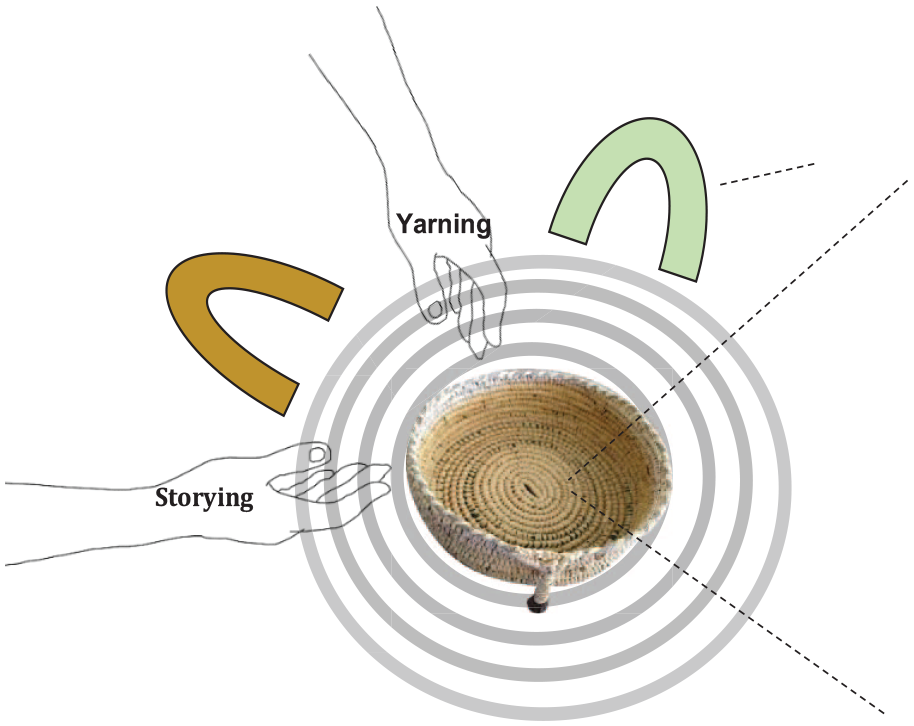
Evidence analysis conceptual drawing (weaving and photo by Kelly Humphrey).
I have two roles in this conceptual drawing: the researcher—the eyes—and the participant in the yarning circle—the green arch; there is the participant—the brown arch. The arches are commonly used Aboriginal symbols for a seated person; the shape is the impression they leave on the earth when cross-legged. I read the yarns and share these through the story, which becomes woven baskets. The yarning circle is portrayed as the concentric circles, another common symbol that might mean a meeting place. The hands are weaving the basket through yarning and storying. Storying is on the yarning partner’s right side. This is placed here as the yarning partner is the only one who brings their story to the circle. The yarning happens between both people; therefore, the yarning hand is positioned in the middle of the two of us. My eyes watch the basket as it is being weaved. I analyse the basket and then share the emergences produced by the yarn as a story in the basket.
As a researcher, I am aware that my ethical obligations do not end once the evidence has been generated (Leavy, 2017). In this study, data as a research term in this study are “peoples’ stories, experience, and knowledge given as a gift” to better understand the research aims; therefore, the term used in place of data collection is “evidence generation” (Barlo et al., 2020b, p. 9). At the end of each phase, I share emergent findings with each yarning partner to ensure they can add to or withdraw representations that may present in their story.
Ethics
Research with Aboriginal people must be centred around the Australian Institute of Aboriginal and Torres Strait Islander Studies (AIATSIS) research four principles: (1) Indigenous self-determination; (2) Indigenous leadership; (3) Impact and value; and (4) Sustainability and accountability (Australian Institute of Aboriginal and Torres Strait Islander Studies [AIATSIS], 2020).
At the centre of these principles are the core ethical value of integrity and acting in the right spirit, as outlined below in the moral foundations. Concerning justice with Aboriginal participants in research, and that Aboriginal and Torres Strait Islanders should have equal opportunities to be involved in the process of research (Australian Institute for Teaching and School Leadership [AITSL], 2020), the yarning partner’s story is their own. AITSL (2020) explains that as a researcher, I must advance the interests of the yarning partners and base “findings on local knowledge and wisdom” (p. 7). The building of relationships and beneficence sees benefits and knowledge generated in understanding of Aboriginal and Torres Strait Islander people’s perspectives will always be shared fairly with participants and researcher.
Conclusion
This article shares an early iteration of a basket-weaving theoretical framework, developed for a doctoral study in progress. This article disrupts the metanarratives of finding or using another’s theoretical framework to fit research conducted within the academy. The basket-weaving theoretical framework demonstrates the struggle to find culture and identity in the academy and shares how this was overcome for one Aboriginal doctoral student. This is a celebration of the use of cultural metaphor to support Aboriginal ways of knowing, being and doing educational research.
Footnotes
Acknowledgements
The authors acknowledge to strength and resilience of the Aboriginal and Torres Strait Islander old people, the Elders from the time before and the time now, for their continued guidance, custodianship and connection to country, rivers, waterways, communities and culture. The authors also acknowledge that the ink on this paper has been written on the unceded, sovereign lands of the Wiradjuri, Yuin and Yugembeh peoples of the island continent known as Australia.
Authors’ note
Declaration of conflicting interests
The authors declared no potential conflicts of interest with respect to the research, authorship and publication of this article.
Funding
The authors received no financial support for the research, authorship and publication of this article.

Glossary
dadirri deep listening
Gamilaroi Aboriginal peoples from northern New South Wales and southern Queensland, Australia; also known as Gomeroi
Gomeroi Aboriginal peoples from northern New South Wales and southern Queensland, Australia; also known as Gamilaroi
guni mother
MalakMalak an Aboriginal language group from the Daly River catchment, Northern Territory, Australia
mapanpa the powers traditional healers are given; these powers heal spiritual as well as physical ailments.
ngangkari traditional healers of the Ngaanyatjarra, Pitjantjatjara and Yankunytjatjara lands in the remote western desert of Central Australia
winanga-li to hear, to listen, to know, to think and to remember
Yuin Aboriginal peoples from the South Coast of New South Wales, Australia