




Abstract
States have long used protected areas to consolidate control over Indigenous Peoples’ territories, undermining community-based governance and access to resources. Despite this history, Indigenous Peoples around the world are increasingly designating their own protected areas to defend ancestral territories and assert self-determination. This paper examines Indigenous conservation politics in the Salween Peace Park in Kawthoolei, an autonomous territory of the Karen (Sino-Tibetan language-speaking peoples living primarily in Burma and along the Thai-Burma border). Local villagers and the Karen National Union envision the park as a grassroots initiative for peace in an area that has suffered decades of armed conflict between the Burmese military and the Karen movement for self-determination. Using the Salween Peace Park as a case study, we engage Indigenous scholarship on politics of recognition, resurgence, and refusal. We explore intersections and tensions between these political strategies, highlighting ways that Indigenous protected areas mobilize different forms of power to advance self-determination.
Keywords
Introduction
Conservation policy and protected areas have long played a role in displacing Indigenous communities from their ancestral territories. Study after study, alongside the lived experiences of Indigenous Peoples, attests to the alienation of local communities from important food sources, cultural sites, and livelihood activities (Brechin, 2003; Roth, 2004; Stevens, 2014; Zaitchik, 2018). Protected areas and other forms of area-based conservation have often functioned as a colonial tool of dispossession, disrupting Indigenous Peoples’ relationships with their lands and marginalizing their governance and knowledge systems (Agrawal & Redford, 2009; Moola & Roth, 2019). Inclusion of other effective area-based conservation mechanisms (OECMs) and global efforts to conserve 30 percent of the planet by 2030 may suffer similar problems if not done in partnership with Indigenous Peoples (Alves-Pinto et al., 2021; Cariño & Ferrari, 2021).
Over the past two decades, the international conservation community has begun to recognize the harm done by conventional state-led conservation; it is both socially unjust (Brechin, 2003) and ineffective in preventing the sixth mass extinction in Earth’s history (Díaz et al., 2019). Meanwhile, growing scientific evidence indicates that Indigenous-managed landscapes can be at least as successful in achieving conservation outcomes as state-regulated processes (Dawson et al., 2021; Garnett et al., 2018; Schuster et al., 2019).
The International Union for the Conservation of Nature (IUCN) now recognizes areas and territories conserved by Indigenous Peoples and local communities, also known as Indigenous and Community Conserved Areas (ICCAs) and Territories of Life (ICCA Consortium, n.d.; Kothari et al., 2012; Stevens, 2014). Likewise, the New Paradigm for protected areas defined at the Vth World Parks Congress in 2003 includes targets to ensure that existing and future protected areas uphold Indigenous Peoples’ rights (International Union for the Conservation of Nature, 2003). The Convention on Biological Diversity has called for the inclusion of knowledge, innovations, and practices of Indigenous Peoples and local communities into all aspects of the Convention (Convention on Biological Diversity, 2020, Aichi Target 18). More recently, the Intergovernmental Platform on Biodiversity and Ecosystem Services stressed the importance of recognizing Indigenous knowledge and supporting Indigenous conservation efforts to safeguard life on earth (Brondizio et al., 2019). This emerging framework has provided Indigenous Peoples around the world with leverage to advance their own conservation visions (Corrigan et al., 2018; Indigenous Circle of Experts, 2018; Ramos, 2022).
These international policy gains are the product of decades of advocacy by Indigenous Peoples. Recognition of Indigenous-led conservation has provided an opportunity for Indigenous Peoples and local communities to reject the historical role of protected areas in dispossession and rather use protected areas to make visible their traditional practices, protect ancestral territories, and resist dispossession by state and corporate interests—including in Burma, also known as Myanmar. Establishing an ICCA can be a political act to simultaneously advance conservation and Indigenous self-determination.
This paper engages Indigenous scholarship on recognition, Indigenous resurgence, and sovereign refusal to understand the politics of Indigenous-declared protected areas. The growing literature on ICCAs focuses most commonly on their conservation outcomes (Schuster et al., 2019) and the characteristics of Indigenous knowledge and governance that give rise to their declaration (Berkes, 2018; Stevens, 2014). Our work builds upon the few examples of political analysis of ICCAs (Artelle et al., 2019; Carroll, 2014; Garcia, 2015; Murray & Burrows, 2017; Youdelis et al., 2021). Drawing on a case study from the Salween Peace Park in Kawthoolei, an autonomous territory of the Karen (Sino-Tibetan language-speaking peoples living primarily in Burma and along the Thai-Burma border), we analyse ways in which Indigenous-declared protected areas mobilize both internal and external sources of power to uphold Indigenous sovereignty.
Power in Indigenous politics: recognition, resurgence, and refusal
Some Indigenous scholars have emphasized power as something inherently embedded in reciprocal relationships and responsibilities between Indigenous Peoples, their lands, and more-than-human social beings, including spirits (Lindberg, 2007; McCue, 2007). These relationships represent an inherent source of power, authority, and legitimacy and constitute the foundation for Indigenous resurgence as explained below.
Power may also refer to the ability to exercise agency in a context of unequal power relations. Although a fulsome analysis of power is beyond the scope of this paper, we draw on Murray and Burrows’ (2017) tripartite distinction between material, institutional, and discursive sources of power in Indigenous conservation. Material power is the ability to access, control, and mobilize material resources, including funding. Institutional power denotes the rules and social structures that differentially empower and constrain various actors. Finally, discursive power refers to ways in which notions of the social good may confer legitimacy upon certain actors vis-à-vis others in contentious situations. Moreover, power is pluralistic and always contested (Murray and Burrows, 2017).
There is also a rich literature on Indigenous sovereignty (Barker, 2005; Shrinkhal, 2021). In this paper, we refer to sovereignty and self-determination, not in a Westphalian sense, but, consistent with the United Nations Declaration on the Rights of Indigenous Peoples (UNDRIP), as the ability of Indigenous Peoples “to freely determine their political status and freely pursue their economic, social and cultural development” (United Nations (General Assembly), 2007, article 3). Kuokkanen (2019) defines self-determination as a rejection of all forms of domination while Reyes and Kaufman (2011) remind us that the Zapatistas reject sovereignty as being too closely tied to conquest and advance a notion of autonomy instead. Corntassel (2012) also advocates moving beyond a rights-based framework to one focused on sustainable self-determination: life-giving reciprocal relationships with Indigenous homelands, cultural vitality, language survival, food sovereignty, and so on.
As Indigenous Peoples struggle for self-determination amid ongoing occupation of their territories by colonial nation-states, there is an increasing tendency for previous regimes of genocide, exclusion, and forced assimilation to give way to negotiations over Indigenous Peoples’ rights. In his essay on the subject, Taylor (1995) writes of the ways that subaltern groups such as Indigenous Peoples seek recognition of their right to maintain unique cultural identities. The quest for recognition may include demands for distinct political rights necessary to ensure a marginalized group’s survival.
Many Indigenous scholars have questioned the ability of such politics of recognition to transform oppressive relations between state societies and Indigenous Peoples (Coulthard, 2014; Eisenberg et al., 2014). These critics point out that seeking recognition is disempowering when one party, usually the state, unilaterally defines the terms on which recognition may be granted or withheld (Williams, 2014). For example, Thai scholar Pinkaew Laungaramsri (2002) warns against the risks of attempting to fit Indigenous Karen practices into state definitions of conservation as such discourses often pit ostensibly authentic, past, good traditions against supposedly inauthentic and tainted current practices that are no longer seen as capable of protecting the forest. Similar arguments are advanced by Berkes (2018) and Li (2001). In contrast, an emancipatory politics of recognition “might lie in the multiplication and diffusion of the sites around which struggles for recognition are carried out” (Markell, 2003, p. 188). Especially critical for our analysis, such diffusion of recognition may allow Indigenous Peoples to draw on sources of material, institutional, and discursive power that originate beyond the confines of the state that claims jurisdiction over their territories (Figure 1).
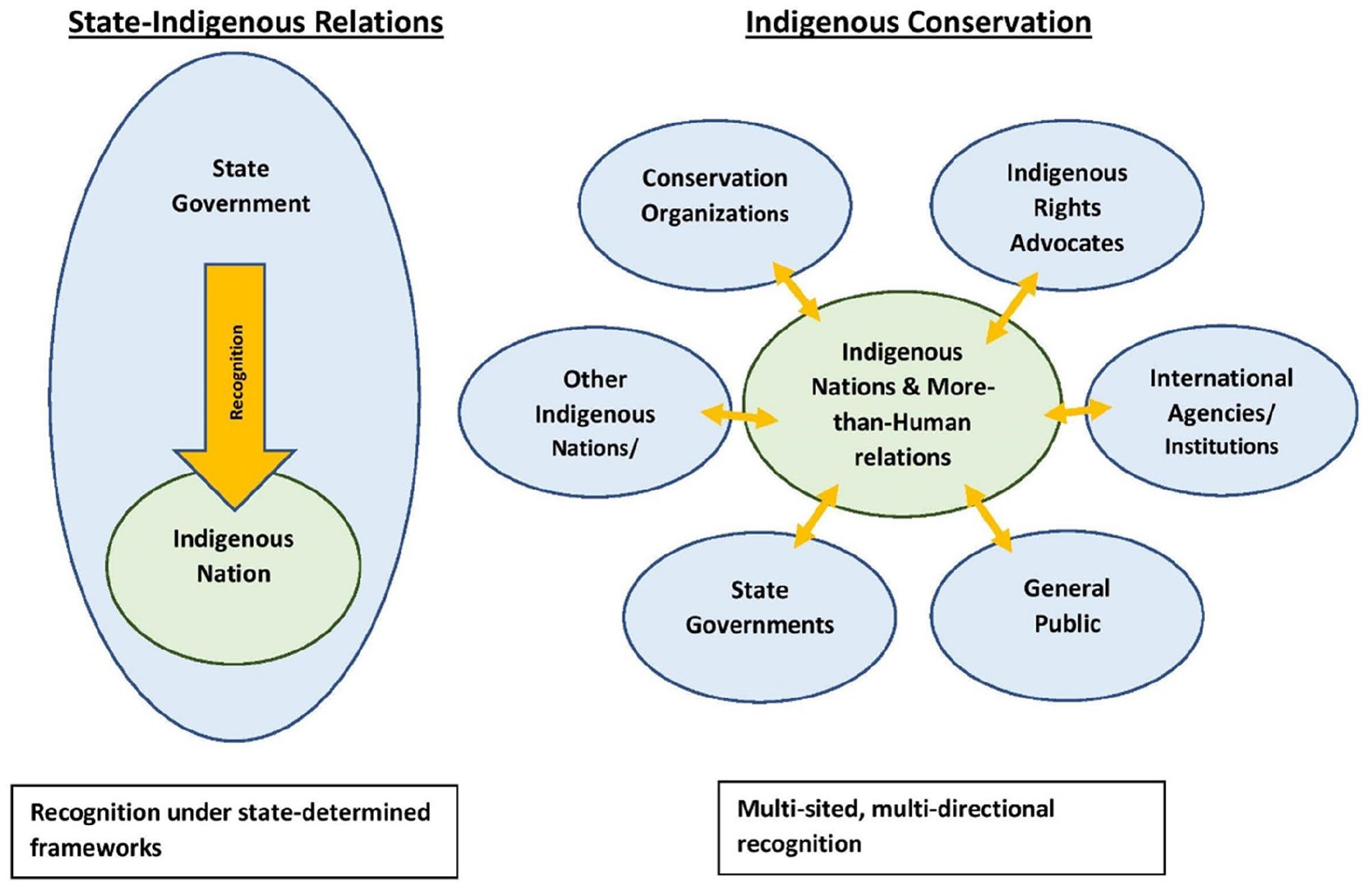
Recognition under state governance frameworks versus multi-sited and multi-directional recognition in conservation initiatives led by self-determining Indigenous nations.
Perceiving that struggles for recognition on the state’s terms are ultimately incapable of achieving Indigenous self-determination, many scholars and activists have advocated for Indigenous resurgence as a strategy to strengthen and rebuild Indigenous Nations (Alfred, 2009; Corntassel, 2012; Nirmal & Rocheleau, 2019; Simpson, 2011, 2017). Rather than seeking legitimacy from the state, resurgence focuses on revitalizing Indigenous Peoples’ cultural and political traditions, asserting inherent rights and responsibilities that flow from Indigenous Peoples’ relationships with the land, each other, and more-than human social beings which co-inhabit their territories (Simpson, 2011). This is a movement for self-determination from within an Indigenous relational ontology (Muller et al., 2019; Paul et al., 2021).
Indigenous resurgence forms the basis for sovereign refusal as a political turn away from the state, a repudiation of the state’s claims to authority and legitimacy (Alfred, 2009; Corntassel, 2021). This approach centres Indigenous Peoples’ self-recognition “as a mechanism for nurturing and strengthening internal relationships” (Simpson, 2017, p. 182). Indigenous Peoples may simultaneously draw on both resurgence and a multi-sited politics of recognition. The former is a source of internal power, while the latter offers opportunities to mobilize external sources of material, institutional, and discursive power to mount a sovereign refusal of state domination. In this paper, we explore these political strategies in the context of Indigenous-declared conservation areas.
Case study and methodology
As an ICCA, the Salween Peace Park has emerged amid decades of armed conflict. Since 1949, the Karen National Union (KNU) has resisted Burmese military attempts to seize and control Karen lands. This conflict has been marked by destruction of villages, forced displacement, forced labour, torture, rape, and murder of Karen villagers by Burmese soldiers (International Human Rights Clinic at Harvard Law School, 2014; Karen Human Rights Group, 1998; Maclean, 2018). Tens of thousands of Karen refugees remain in camps along the Thai-Burma border (The Border Consortium, 2019). Burmese military operations gradually forced the Karen resistance into the mountains along the Thai border, where the KNU set up its autonomous government over a territory eventually comprising seven districts. Karen people call this territory Kawthoolei. KNU departments oversee health, education, a judicial system, forests, natural resources, and land administration (Karen National Union, n.d.).
The KNU’s decision to sign a preliminary ceasefire in 2012 and the so-called Nationwide Ceasefire Agreement (NCA) in 2015 met with strong disapproval from Karen civil society (Karen Civil Society Organizations, 2015). At the time, Mutraw District in northern Kawthoolei remained one of the last KNU strongholds (Jolliffe, 2016), albeit heavily occupied by more than 70 Burmese military camps (Karen Peace Support Network, 2018b). In 2018, despite the Burmese military’s ongoing violations of the ceasefires, the Salween Peace Park was formally declared by Mutraw District KNU and local villagers, with the support of the Karen Environmental and Social Action Network (KESAN) and other Karen civil society organizations (“Karen Indigenous Communities in Myanmar Have Officially Launched the Salween Peace Park”, 2019). Rather than accepting peace on the Burmese government’s terms, the Salween Peace Park articulates a local vision for peace. Developed by and for Indigenous Karen communities, the initiative charts a radical alternative to the militarized resource extraction ambitions of the Burmese military.
The Salween Peace Park is a vast ICCA, covering 5,485 square kilometres in a forested, mountainous region of global significance for biodiversity (Paul et al., 2021) (Figure 2). Camera trap surveys have identified 23 mammal species of global conservation concern, including some of the most significant tiger and leopard populations remaining in Southeast Asia (Greenspan et al., 2020). The park is also home to about 70,000 people in more than 340 villages (Clingen, 2019). Many communities continue to practice the Karen land institution of kaw (country), which refers both to a community territory and a governance system based on Karen Indigenous laws (Paul et al., 2021). Villagers practice a subsistence agricultural economy, tending irrigated rice paddies and diversified upland fields, or swiddens, that are rotated with forest fallow. They also hunt, gather, and fish in the forests and streams.
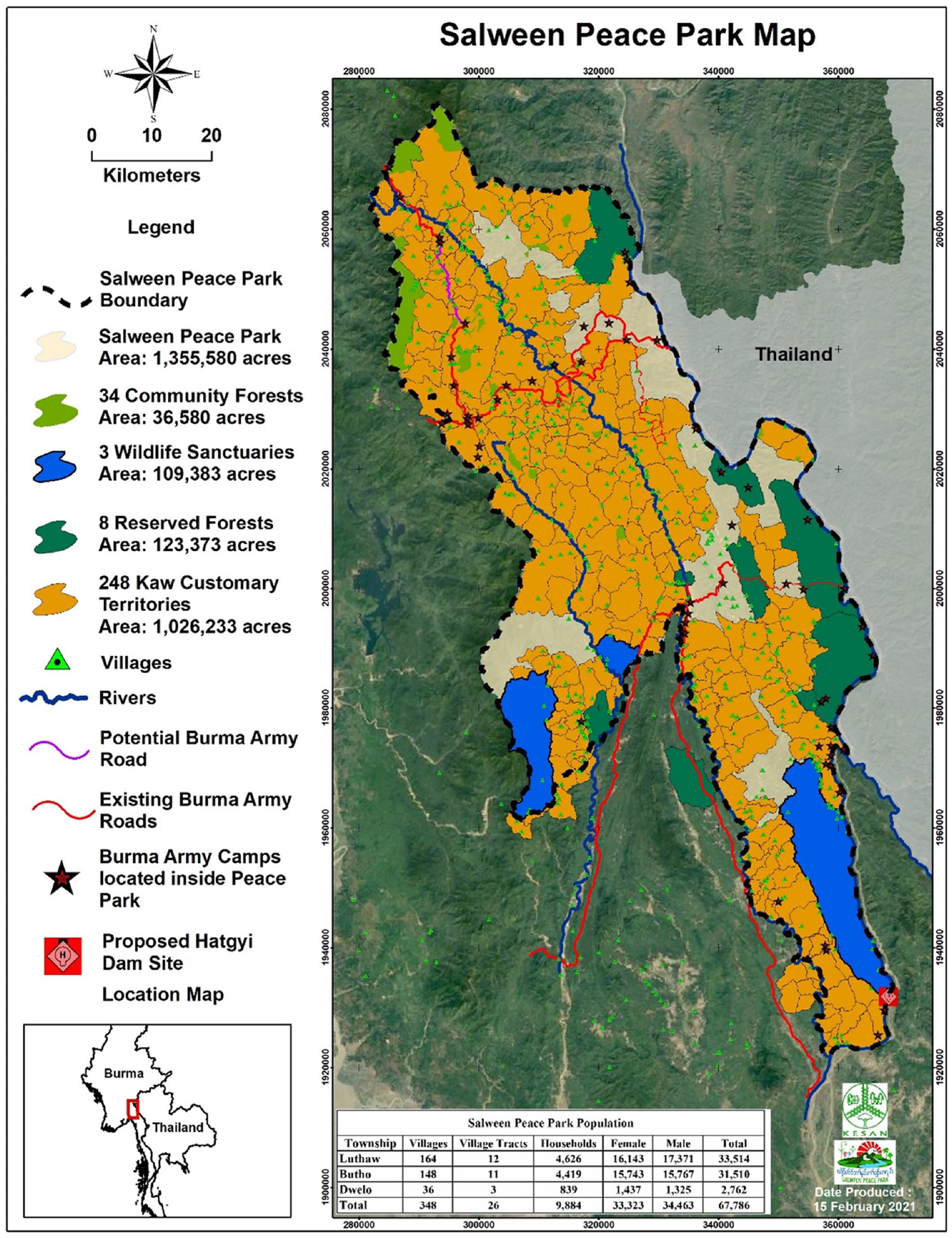
Map of Salween Peace Park (Karen Environmental and Social Action Network, 2017).
As in Southeast Asia more generally, articulation of Indigeneity is complicated in Burma, where the government has refused to recognize the existence of Indigenous Peoples (Morton, 2017). Nevertheless, thanks in part to the development of international human rights instruments such as UNDRIP, Indigenous Peoples such as the Karen are increasingly articulating their right to self-determination and relationship with ancestral territories using the language of Indigeneity (Conservation Alliance of Tanawthari, 2018, 2020). In so doing, they are “linking themselves to a global [Indigenous Peoples] movement with local emancipatory potential” (Morton, 2017, p. 1; Morton & Baird, 2019).
In 2014, the first author collaborated with KESAN on a community-led research project to articulate Karen land and resource governance. Close working relationships and language competency in the Sgaw Karen (largest sub-group of Karen peoples) dialect, established during this project, facilitated subsequent collaboration. Field research in the Salween Peace Park between November 2016 and February 2017, for which ethics approval was obtained from the Human Participants Review Committee at York University in Canada, consisted of both an in-depth ethnographic study of traditional Karen environmental governance (Paul et al., 2021) and a political analysis of the ways these traditions are being mobilized in the Salween Peace Park. Research included intensive participant observation with community members and local conservation leaders, including participation in ceremonies and community conservation events. This approach fostered a bottom-up understanding of the Salween Peace Park from the perspective of local people. The first author also participated in two public consultations where he witnessed the initiative’s development firsthand. The second and third authors served as advisors and collaborators on the work. We opt to use the plural pronoun to indicate the collaborative nature of the work but distinguish the first author when specific to his experience.
We supplemented observation, participation, and impromptu conversation with seven key informant interviews with community activists, KESAN staff, and KNU leaders involved in the Salween Peace Park initiative. Embodying a commitment to Indigenous research ethics (Kovach, 2009; Smith, 1999; Wilson, 2008) and participatory action research (Kirby & McKenna, 1989; Koster et al., 2012; Pain, 2004), data gathering was conducted in collaboration with KESAN and Karen villagers. We also conducted an analysis of media and Salween Peace Park promotional materials. Dialogue with KESAN colleagues played an instrumental role in developing our theoretical analysis of the Salween Peace Park (Ball & Janyst, 2008; Kirby & McKenna, 1989; Swancutt & Mazard, 2016).
Indigenous politics in the Salween Peace Park
Karen leaders have long envisioned a Karen-run protected area in Mutraw District. However, it was only when the preliminary ceasefire in 2012 brought a measure of relative stability that the people of Mutraw could begin implementing this vision. Although the Salween Peace Park was recently established, prior foundations were laid over many years of community conservation efforts, including establishment of community forests, demarcation of wildlife sanctuaries, and documentation of Karen customary kaw territories, all of which are recognized under KNU policy.
The Salween Peace Park consolidates these efforts and presents them as a coordinated initiative dedicated to peacebuilding, landscape-level habitat conservation, and preservation of Indigenous Karen culture and way of life. The peace park puts this all into context allowing Karen leaders to communicate their bold vision and build alliances both regionally and internationally. It is a strategy for recognition.
In the quest for international recognition, Salween Peace Park leaders emphasize three themes. First, calling the initiative a peace park affirms its role in articulating a Karen vision for peace and self-determination. A promotional video opens with scenes of war fading to forested mountains, Karen villagers, and iconic wildlife. The narrator poses a rhetorical question: “Can a battlefield be turned into an Indigenous-run protected area for scores of endangered species like tigers, gibbons, and wild cattle? The answer is ‘Yes’” (Karen Environmental and Social Action Network, 2017, 0:10-34). The Salween Peace Park is presented as a grassroots initiative for peace and interethnic cooperation in the face of ongoing Burmese military attacks and human rights depredations.
The second theme is biodiversity conservation. Proponents present the Salween Peace Park as a grassroots approach to landscape-level habitat conservation, in contrast to top-down, state-controlled projects in southern Kawthoolei’s Mergui-Tavoy District (Chandran, 2018). The Salween River is the longest free-flowing river remaining in Southeast Asia, and the peace park thus presents an alternative to the Burmese government’s dam-building schemes (Moo, 2017). While the government might be silent on the Karen people’s accomplishments, the Salween Peace Park has attracted the attention of international conservationists. Dr. Mitchel of the World Wildlife Fund stated in 2016 that “It would be a big win for conservation if wildlife conservation protection is part of the larger peace agreement between the Government of Myanmar and the Karen” (Fawthrop, 2016, para. 34).
The third theme of the Salween Peace Park is protection of Indigenous Karen culture, including environmental stewardship traditions. A local research collaborator explained that the Salween Peace Park is like a dining table: without food, the table is bare. Similarly, without Karen culture and traditions, the Salween Peace Park cannot succeed. Public consultations have emphasized the importance of formalizing Karen villagers’ traditional kaw governance systems, both to attract conservationist support and attain recognition of Karen people’s rights as Indigenous Peoples under international frameworks such as UNDRIP.
Recognition in Salween Peace Park
So far, the Salween Peace Park has refused to seek recognition as a gazetted protected area with the Burmese government, which remains hostile to Karen aspirations for self-determination. As armed clashes intensified even before the military coup in February 2021, the people of Mutraw never trusted the Burmese state’s intentions. International conservation, on the other hand, offered an arena for the Karen to build legitimacy beyond state power structures. Unlike state authorities, conservation organizations do not claim ultimate jurisdiction over Indigenous Peoples and their traditional territories, and they increasingly depend on collaboration with Indigenous Peoples to achieve conservation goals. These organizations also have material, institutional, and discursive resources to support the Salween Peace Park vision. Organizations such as the Rainforest Foundation Norway provide funding, while Australian non-governmental organization (NGO) Wildlife Asia has supported camera trap surveys and advised wildlife sanctuary establishment. Salween Peace Park actively engages with the ICCA Consortium and is considering registering as an ICCA with the United Nations Environment Programme’s World Conservation Monitoring Centre. It has been presented at the IUCN World Conservation Congress, the Convention on Biological Diversity, and the United Nations Permanent Forum on Indigenous Issues, among others. In addition to media outlets in Burma, the Salween Peace Park has been featured in Mongabay (“Karen Indigenous Communities in Myanmar Have Officially Launched the Salween Peace Park”, 2019), Australia’s ABC News (Miller & Trevithick, 2017), Reuters (Chandran, 2018), and Al Jazeera (Kantar, 2019). The initiative is also increasingly attracting the attention of academic researchers.
As debates around politics of recognition attest, dependence on recognition is politically risky. In the quest for recognition of Indigenous conservation, Indigenous Peoples might be compelled to conform to essentialized identities (Forsyth & Walker, 2008; Laungaramsri, 2002; Li, 2001) as “ecologically noble savages” (Berkes, 2018, p. 239). The people of Mutraw are determined to control the terms of recognition. As an international consultant advised, it is essential to “articulate the Peace Park vision, then decide where the outside donors and their funds can fit—not the other way around” (J. Rutherford, personal communication, June 5, 2016). Through multiple rounds of public engagement, Karen villagers and administrators formulated the Charter of the Salween Peace Park, with provisions for governance, peacebuilding, environmental protection, cultural heritage conservation, and more (Salween Peace Park Steering Committee, 2018). Although the Salween Peace Park is building alliances to gain access to funding, legitimacy, and institutional support, the park’s governance and management remain in the hands of the KNU, local communities, and Karen civil society, including KESAN. Importantly, the Karen control their own representation: most media pieces about the Salween Peace Park are either produced by or mediated through Karen civil society.
Even during the ceasefire, the people of Mutraw remained wary of collaborating with any institution that might facilitate Burmese government access or administration in Karen territories. Some villagers and local KNU officials also worried about the Salween Peace Park’s ability to defend itself from Burmese military attacks. However, since the Burmese military’s attempted coup in February 2021, the junta has faced both widespread civil disobedience and a proliferation of armed resistance across the entire country (Arnold & Jolliffe, 2022; Loong, 2021; Special Advisory Council for Myanmar, 2022). The KNU has thus been able to take advantage of the junta’s declining military strength to take back more administrative control in its territories. Mutraw District KNU authorities estimate that only 10 percent of the Salween Peace Park remains under Burmese military government control.
Although the peace park idea was originally articulated by KNU Mutraw District leaders and KESAN staff, the park’s details, including the boundaries and governance structure, have been discussed and debated during multiple rounds of community engagement. Despite many obstacles, including increased fighting, leaders succeeded in collecting signatures of support from 75 percent of all Salween Peace Park inhabitants aged 16 and over (Karen Environmental and Social Action Network & Karen National Union Mutraw District, 2018a). These signatures document the self-recognition of the Indigenous Karen people of Mutraw District (Coulthard, 2014; Simpson, 2011).
Indigenous resurgence: governance in Salween Peace Park
Figure 3 provides an overview of Salween Peace Park governance, which is shared between the KNU de facto government, villagers, and civil society. Note that of 11 people on the Salween Peace Park Governing Committee, only four are KNU, while five are local community representatives and two are from Karen civil society. The Salween Peace Park is an innovation in grassroots democracy by and for Indigenous Peoples, on a grand scale.
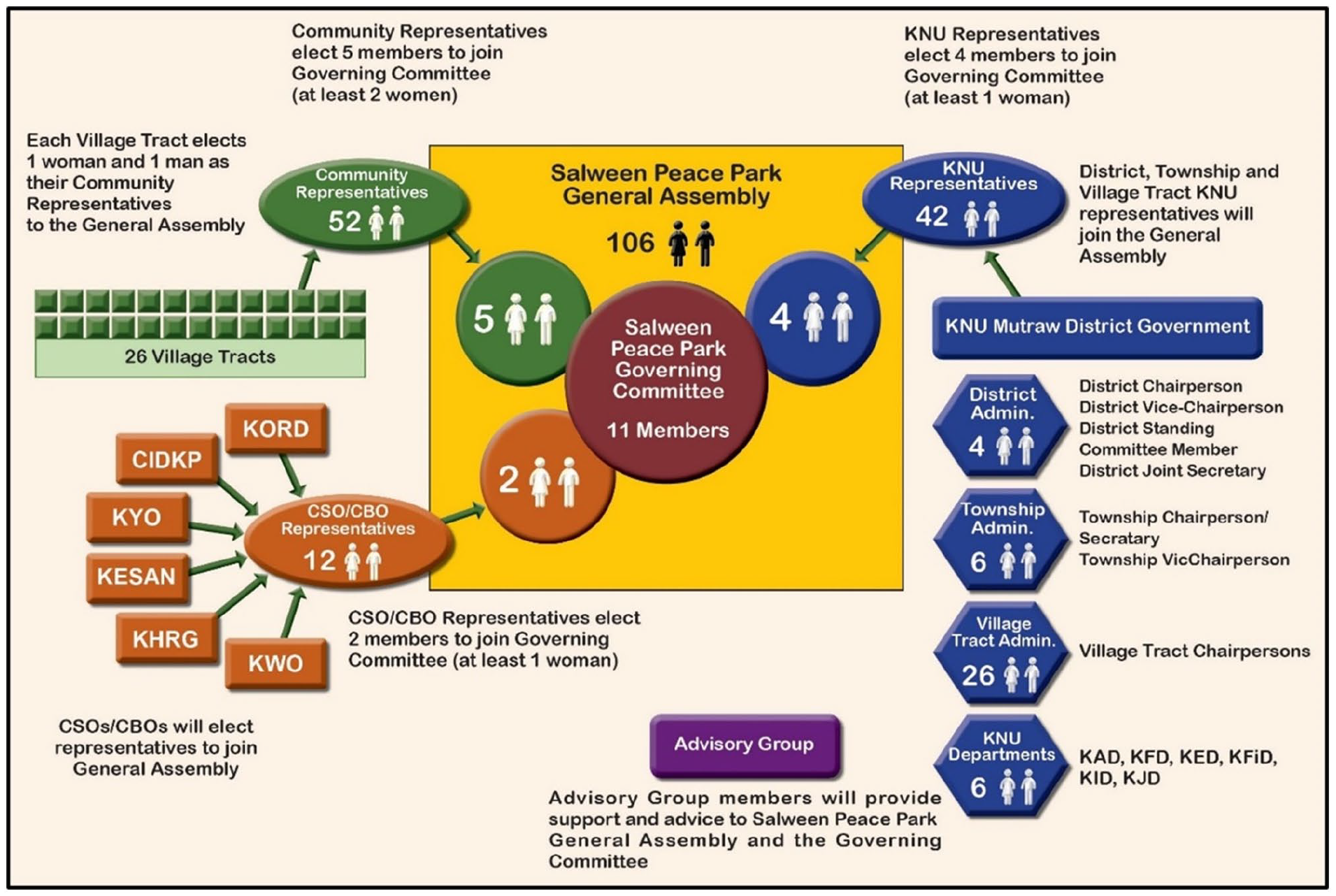
Governance framework of the Salween Peace Park.
Most fundamentally, the Salween Peace Park derives internal power by strengthening Karen communities’ cultural and political traditions for governance. Eighteen elders comprise the Salween Peace Park Advisory Council, and the Charter explicitly empowers kaw and village-based governance: Each village, group of villages, kaw or administrative unit, as freely determined by the members of those communities, shall be responsible for establishing and implementing rules and regulations, which include customary and/or community codes of conduct, to govern and manage the use of natural resources in their bounded area of ownership or socially legitimate tenure. (Salween Peace Park Steering Committee, 2018, article 52)
The Charter thus establishes a system of counter-governance rooted in what it calls a “modern formulation of the Indigenous Karen environmental ethic” (Salween Peace Park Steering Committee, 2018, p. 4). So far, 248 kaw communities in the Salween Peace Park have demarcated their territories. Kaw communities are also formalizing traditional protocols into land codes. These protocols constitute the foundation for environmental governance in the Salween Peace Park, an assertion of Karen communities’ inherent rights and responsibilities that flow from their relationship with their land and the more-than-human beings of the land (Paul et al., 2021).
The Salween Peace Park is more than an ICCA: it is a movement. As villagers and community leaders discuss the Salween Peace Park at informal community gatherings and over traditional rice wine, the initiative has taken on a life of its own, beyond the control of KESAN and KNU leaders who originated it. Villagers frequently refer to the Salween Peace Park to affirm their rights as Indigenous Peoples and to promote cultural revival, sustainable agriculture, ecotourism, and local community development.
In late 2016 and early 2017, local businessmen and Karen soldiers began dredging for gold in the Bwe Lo Klo River before being stopped by Mutraw District officials. At a peace park consultation, district administrators stressed the need to protect the waters, lands, and natural resources of the Salween Peace Park. Villagers and community leaders also invoked the peace park vision to promote alternative development strategies focused on improving local agriculture and community forest management.
The Salween Peace Park thus represents much more than a no to mining, logging, and hydropower dams. As a consultant noted, the initiative functions as a reference that empowers villagers and local leaders to articulate community development visions that promote peace, maintain Indigenous Karen culture, and uphold Karen people’s sacred relationships with their lands and waters. This resembles Indigenous protected areas around the world, from the Himalayas in Nepal (Stevens, 2014) to the Pacific Coast of North America (Murray & King, 2012). Although many remain unrecognized by state societies that claim Indigenous territories, these designations nevertheless do important discursive work to uphold Indigenous law and environmental governance such as the Karen kaw system.
Thus, the Salween Peace Park mitigates potential risks of depending on recognition—risks such as control by international conservation organizations, control by the Burmese government, or attack by the Burmese military—by strengthening local governance institutions and making the park a radically grassroots project. Engaging local communities is therefore not only a moral imperative; it is also vital for the Salween Peace Park’s survival.
However, Mutraw District KNU and local villagers realize that, on their own, they cannot withstand the Burmese military’s onslaughts indefinitely. Thus, while the Salween Peace Park focuses on strengthening local institutions and articulating a community-based vision for Mutraw District, it simultaneously engages international discourses of conservation and Indigenous rights, drawing on sources of legitimacy and power from far beyond Burma in the ongoing struggle against military oppression. The twin strategies of grassroots movement-building and international alliance-building can inform ongoing debates in Indigenous politics around recognition and resurgence. Challenging the apparent dichotomy between these approaches, Indigenous conservation projects such as the Salween Peace Park strategically engage both types of politics in the struggle to protect ancestral lands.
Salween Peace Park and sovereign refusal
The Salween Peace Park also represents a sovereign refusal of the Burmese state’s claims to Karen lands (Alfred, 2009; Corntassel, 2021). For the Burmese state, Mutraw District is an empty space, a frontier for resource extraction subject to the Vacant, Fallow, and Virgin Lands Management Law 2012 (Gelbort, 2018). During a public consultation event on December 19, 2017, Saw Paul Sein Twa, a local leader and third author of this paper, demonstrated the Salween Peace Park’s countermapping project. Beginning with an empty Google Earth image, he asked the rhetorical question, “Is this empty land?” He then successively added layers to the map, including KNU-defined district boundaries, villages, community forests, wildlife sanctuaries, and kaw territories, as well as Burmese military infrastructure and the government’s proposed Hatgyi Dam on the Salween River. Finally, he added the Salween Peace Park boundaries and asked the assembled villagers again, “Now who can say this is empty land?” The Salween Peace Park affirms Karen relationships with this territory.
Recognition by the Burmese government has never been a priority for the Salween Peace Park. During a public consultation on December 26, 2016, a Mutraw District KNU leader noted that some people may ask . . . what about the Burmese government? Will they recognize [the Salween Peace Park]? And I say, don’t worry about that. We have our territory, our resources, our land, our waters, our forests, and we can govern, manage, and protect them ourselves. The most important thing is that we work together in harmony, with one mind, and we will certainly achieve [our goal].
Similarly, Mabu Htoo, KESAN’s land and forest programme director, emphasized that the most important task is empowering communities to revitalize traditional practices and manage their own natural resources. Mabu argued that lack of government recognition ultimately does not matter, because they have started a movement in Mutraw. This movement to strengthen Karen environmental relations and engage international Indigenous conservation discourses provides a basis for governance and legitimacy so diffuse it will be difficult for the Burmese military government to destroy. Whatever the future holds for the Salween Peace Park as a physical entity, it seems likely that the movement the park represents will, in one form or another, continue.
This movement is consolidating kaw territories, community forests, fish conservation areas, and the entire autonomous governance framework that local villagers, the KNU, and Karen civil society have developed in Mutraw. As the promotional brochure proclaims, “the Karen are not waiting idly for [democracy]: the Salween Peace Park is federal democracy in action. It is Indigenous self-determination and community protection of natural and cultural heritage in action” (Karen Environmental and Social Action Network & Karen National Union Mutraw District, 2018b, p. 2).
Since 2015, central KNU leaders have tried to attain recognition of Karen rights under Burma’s so-called nationwide ceasefire agreement. However, the Burmese military dominated this process, refusing to compromise or respect the aspirations of Karen and other non-Burman ethnic peoples (Karen Peace Support Network, 2018a). Stalled negotiations and escalating military violence even before the February 2021 coup underscore the futility of seeking recognition on terms dictated by colonial power structures.
The Salween Peace Park, in contrast, is a sovereign declaration of self-determination rooted in Karen people’s political traditions and relationships with their ancestral lands. With the Charter of the Salween Peace Park and ongoing efforts to strengthen kaw administrations, the people of Mutraw are asserting Karen nationhood in the face of the Burmese military government’s “false claims to authority, legitimacy, and sovereignty” (Alfred, 2009, p. 202). The Salween Peace Park has also garnered international attention, winning the United Nations Development Programme’s Equator Prize in 2020 (Salween Peace Park, 2020).
Meanwhile, Burma’s central government and military have remained hostile to Karen aspirations. The Burmese military remains ultimately committed to constructing the Hatgyi Dam on the Salween River against the wishes of Karen communities. Since 2018 and in violation of existing ceasefires, the Burmese military has tried to expand its road network through the Salween Peace Park (Karen Peace Support Network, 2018b), provoking armed clashes with the Karen National Liberation Army, which is the KNU’s armed wing. Since the attempted coup in February, violence has exploded, including bombing by the Burmese Air Force (Salween Peace Park, 2021). Most of the Salween Peace Park’s inhabitants are either hiding in the jungle or ready to flee their homes at a moment’s notice. Yet amid ongoing conflict, the Salween Peace Park continues to offer a vision for building true peace, protecting the land, and maintaining Indigenous Karen culture. In December 2021, at the third annual General Assembly of the Salween Peace Park, delegates debated and approved Salween Peace Park’s expansion to include additional villages and kaw territories.
The Salween Peace Park is also inspiring similar Indigenous-led conservation initiatives across Kawthoolei and Burma. Indigenous Peoples from both sides of the Thai-Burma border attended the launch ceremony in 2018 (Karen Environmental and Social Action Network, 2018). Salween Peace Park has organized exchanges with Karen communities from southern Kawthoolei’s Mergui-Tavoy District, bolstering their efforts to articulate the Tanawthari Landscape of Life in opposition to top-down large-landscape conservation schemes (Conservation Alliance of Tanawthari, 2018, 2020). Bordering Salween Peace Park to the north, two similar initiatives are underway: Thawthi Taw Oo Indigenous Park in Kawthoolei’s Taw Oo District and Thaw Thee Phgaw Ghaw Peace Park in neighbouring Karenni State (Karen Environmental and Social Action Network, 2020; Thawthi Taw-Oo Indigenous Park, 2021). Together, these initiatives will become a contiguous ICCA complex dedicated to inter-ethnic cooperation, protection of Indigenous territories, and biocultural conservation.
Conclusion
Indigenous Peoples around the world are strategically engaging conservation discourses to defend ancestral territories and assert self-determination. However, recognition of ICCAs is not a panacea: as Stevens writes, “[t]here is great concern that increased international policy and funding emphasis on ICCAs may spark action by states and NGOs that may co-opt, undermine, or destroy ICCAs by inappropriately recognizing them” (Stevens, 2014, p. 295). For example, new forms of recognition might attempt to constrain or standardize Indigenous environmental governance systems in ways that undermine the dynamism, diversity, and cultural rootedness that make these protected areas successful expressions of Indigenous sovereignty and environmental governance in the first place.
Thus, the question facing ICCAs is how to engage conservation politics in emancipatory ways, while remaining in control of the terms of recognition. In the Salween Peace Park, the risk of being co-opted by external conservation actors has so far been avoided by building a collective movement of Indigenous resurgence. Although the Salween Peace Park, like many ICCAs, refuses to seek recognition on the state’s terms, it pursues a different kind of recognition by engaging discourses of conservation and Indigenous rights, allowing Karen communities to draw on multi-sited sources of power, legitimacy, and material resources as they build alliances while establishing a system of counter-governance rooted in Indigenous laws—all in sovereign refusal of state domination in one of the world’s most intractable conflict zones.
Although forced displacement in the name of conservation continues in many parts of the world (Tauli-Corpuz et al., 2020), the Salween Peace Park contains some hopeful lessons as an alternative global conservation paradigm emerges. Late Secwepemc activist Arthur Manuel called the growing collaboration between Indigenous Peoples and non-Indigenous conservationists “one of the most hopeful Indigenous/non-Indigenous alliances we have had in any sphere” (Manuel, 2015, p. 180). As non-Indigenous conservationists grapple with the colonial legacy of protected areas, conservation may yet be transformed from a tool of environmental dispossession into a tool to defend ancestral lands and advance Indigenous self-determination. Notwithstanding the political risks and challenges, ICCAs and other Indigenous-led conservation initiatives have enormous potential to chart a more just relationship between Indigenous Peoples, state societies, and the land we must all steward together.
Footnotes
Acknowledgements
The authors thank the people of the Salween Peace Park for sharing their time, knowledge, and insights that shaped the analysis presented in this article. The authors dedicate this paper to the many brave Karen men and women who have lost their lives in the ongoing struggle for Karen self-determination and freedom from tyranny. May their sacrifices not be in vain.
Authors’ note
Declaration of conflicting interests
The authors declared no potential conflicts of interest with respect to the research, authorship, and publication of this article.
Funding
The authors disclosed receipt of the following financial support for the research, authorship, and publication of this article: Social Sciences and Humanities Research Council of Canada: Joseph-Armand Bombardier Masters Scholarship; Insight Grant #435–2014-1916: Canadian Conservation in Global Context: Intersections with Asia and Africa; Conservation through Reconciliation Partnership Grant # 895-2019-1019.

Glossary
Karen Sino-Tibetan language-speaking peoples living primarily in Burma and along the Thai-Burma border
kaw country, referring both to a community territory and a governance system based on Karen Indigenous laws
Sgaw Karen largest sub-group of Karen peoples, speaking their own dialect