




Abstract
This article considers the terms culture and healing, critiques perpetuation of colonizing perspectives in conventional trauma-informed mental health approaches, and introduces Gathering Our Medicine, an innovative community framework created by Sḵwx̱wú7mesh (Squamish; Coast Salish Peoples Indigenous to the lands of Southern British Columbia, Canada) practitioner Denise Findlay in response to the need for decolonial approaches to mental health for Indigenous communities throughout British Columbia, Canada. The framework encourages re-imagining healing and mental health practices through values such as lateral kindness that draw from distinct traditional Indigenous philosophies, ontologies, and epistemologies. By revitalizing and centring distinctive traditional knowledges about actualization, transformation, and healing, the framework provides a role for allies that disrupts the impulse to deny culpability that Indigenous scholar Susan Dion calls the perfect stranger position. Findlay provides an alternative—the imperfect friend—drawing on kinship practices as effective indirect praxis for collective healing and well-being, transforming the distanced expert into engaged community member.
Introduction
This article describes the Gathering Our Medicine framework, developed by the article’s author, Denise Findlay, a Coast Salish (Indigenous to the Pacific Northwest, in British Columbia, Canada, and Washington and Oregon, USA) Indigenous practitioner of Sḵwx̱wú7mesh (Squamish; Coast Salish Peoples Indigenous to the lands of Southern British Columbia, Canada) ancestry, in collaboration with advisory and working groups comprised of community members, helping professionals, elders, youth, and knowledge carriers from throughout British Columbia. Gathering Our Medicine began in 2019 as part of an Indigenous parenting programme created in response to communities asking for culturally distinct programming for parents of Indigenous youth experiencing mental health challenges. Gathering Our Medicine has since evolved into a framework informing community and family healing programming beyond parenting interventions with consistently positive results. Practitioners referred to throughout this article include educators, social workers, counsellors, early childhood educators, youth workers, psychiatrists, psychologists, leaders, and administrators.
This article provides an overview of the framework, existing research, and knowledges informing its development and its revitalization of kinship ties through creating safe, relational, culturally affirming spaces. A discussion follows about how the framework disrupts colonizing perspectives by centring pedagogies of place within philosophical worldviews of Indigenous Peoples and redefining terms such as healing and culture. The author and programme developer then describes the way the framework can be used to create healing ecologies that promote psychosocial transformation and healing through family and community integration. The article concludes with the current application of Gathering Our Medicine and future directions for the framework as it continues to evolve in collaboration with community partners across Canada and to promote healing through revitalized kinship ties in Indigenous communities.
Existing research and knowledges
Gathering Our Medicine was initially piloted in 2019 and has since evolved into a core aspect of community programming in a growing number of communities throughout British Columbia and other parts of Canada. Although this is not formalized research, the project is resulting in knowledge creation that has informed this article, emerging from community-based participatory learning through close working relationships with communities implementing the programme. Feedback about the programme has been collected in the form of learning and programme evaluations, observations by mentors and the programme developer, community and participant testimonials, and increased community engagement and demand for decolonized, indigenist projects.
The framework was developed with reference to the A Pathway to Hope report, as part of the Government of British Columbia’s Mental Health Roadmap identifying the need for distinctions-based approaches that ensure the rights, interests, and needs of Indigenous Peoples are met (Province of British Columbia, 2019). The programme developer and author also prioritized insights from The Aboriginal Policy and Practices Framework in British Columbia (Ministry for Child and Family Development (MCFD), 2013), The United Declaration of Rights of Indigenous People (United Nations, 2007), The Truth and Reconciliation Calls to Action (Truth and Reconciliation Commission of Canada, 2015), and the MCFD Policy 1.1 Working with Indigenous Children, Youth, Families and Communities (MCFD, 2021).
The programme developer and author has also been influenced by and endeavours to situate the programme within the field of indigenist thinkers committed to the processes of decolonization and indigenization. In particular, the programme developer and author reviewed the extensive reports produced by The Aboriginal Healing Foundation in order to situate the framework within the vast amount of research and writing that exists in the area of Indigenous Peoples’ healing, reconciliation, and the legacy of residential schools in Canada.
Publications and research in the fields of transcultural and developmental psychology, attachment theory, complex trauma treatment, and the neuroscientific study of primal emotions were also reviewed to better understand exactly how healing can and should be culturally situated within distinct place-based systems of knowing for Indigenous Peoples. Despite extensive research on the mental health of Indigenous Peoples, most research has been undertaken using western scientific methodologies that tend to perpetuate existing colonial systems as the answer. Gathering Our Medicine has been developed to challenge this thinking and to promote community, kinship, and traditional knowledges as sources of healing and well-being for Indigenous Peoples.
The Gathering Our Medicine framework
In a 2003 article about mental health in Indigenous communities, Kirmayer et al. (2003) conclude that mental health problems demand social and political solutions and explore the definition of culture using an ethnographic perspective to address the importance of cultural continuity. Two decades later, there is no doubt that Indigenous cultures and continuity of traditions must be protected and preserved; however, as Indigenous practitioners working with community members, we must go further than this through the process of indigenization, to combat evidence of trauma, or what Sḵwx̱wú7mesh Úxwumixw (Squamish Nation; an amalgamation of Coast Salish Peoples Indigenous to Southern British Columbia, Canada) hereditary Chief Ian Campbell refers to as “cultural distortion” (personal communication, June 15, 2022). Cultural distortion describes the contamination of Indigenous thought and practice by colonialism, resulting in cultural instrumentalism, reductionism, and essentialism that sets up polarizations and dichotomies of insiders and outsiders, and haves and have nots. Cultural distortion can render cultural practices superficial, performative, and used as a tool of social dominance, individual gain, materialism, and personal gratification. Cultural practice has been imposed as a means of punishment and discipline, not unlike the cruel behavioural methods practised historically by abusers in residential schools. The manifestations of cultural distortion take both subtle and overt forms, including a phenomenon referred to as lateral violence (UBC Learning Circle, 2015), a form of displaced aggression and social dominance among Indigenous Peoples that communities face daily as part of the legacy of colonization.
Even in its conception, Gathering Our Medicine challenges cultural distortion and contamination by being located on unceded S
The schematic that illustrates the Gathering Our Medicine framework is illustrated in Figure 1.
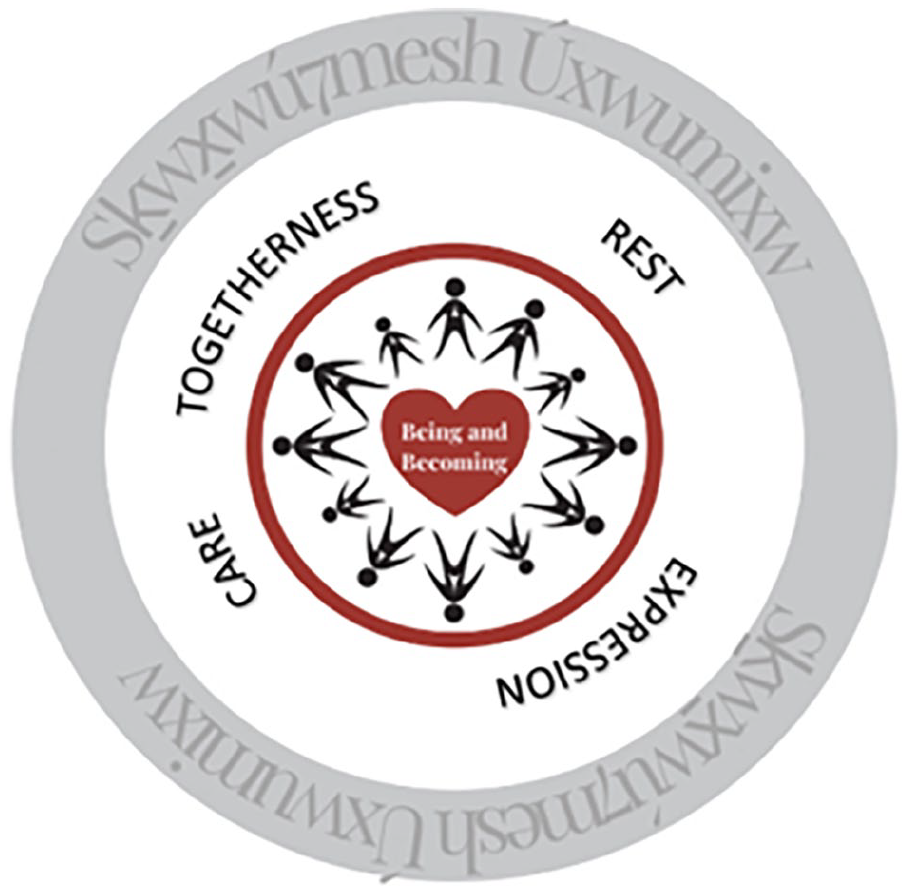
The Gathering Our Medicine framework (created by Aaron “Splash” Nelson-Moody).
Created by Coast Salish, Sḵwx̱wú7mesh artist Tawx’sin Yexwulla, Aaron Nelson-Moody, also known as Splash, the schematic resembles a traditional spindle whorl, used for creating and weaving wool by Coast Salish women, who were unrivalled in their ability to create beautiful textiles of social and spiritual significance. The spindle whorl was known to have a mesmerizing effect on its user, creating a trance-like state in the weaver (Cedar Hill Long House Native Art Prints, 2021). The image is a contemporary representation of a Coast Salish tool that can be used for social and spiritual transformation, illustrating areas requiring exploration and critical consideration when planning and implementing community healing and prevention programming.
For instance, the programme developer and author designed the framework to promote cultural humility (First Nations Health Authority, n.d.), and indigenist approaches (Brydon-Miller & Coghlan, 2014) that privilege Indigenous voices and lived experiences, and recognize Indigenous worldviews, knowledges, and realities as vital to the continuity of Indigenous lifeways. This focus has led to the use of the framework as a community development model that is revitalizing kinship ties, definitions of kinship, and concepts of well-being while helping communities re-imagine possibilities for healing processes as part of everyday community life, as opposed to a narrowly defined activity led by experts whose knowledge often eclipses traditional wisdom.
Another important aspect of the framework is the use of the word culture, which the programme developer and author defines phenomenologically and anthropologically as being complex, evolving, fluid, multi-layered, and needing to be contextualized within specific geographies (Kirmayer et al., 2003; TED, 2008). Within Gathering Our Medicine, the terminology of culture is included to encourage community members’ engagement in collective, post-colonial, re-imagining of what it means to be an Indigenous person from distinct, sacred places, containing long histories of spiritual, ancestral memories and life worlds. Many communities are now innovating cultural protocols in response to contemporary social, political, and environmental challenges as part of their transformation journeys.
Unfortunately, many mental health practitioners seek cultural and decolonizing knowledges as a means of legitimizing their practice to be better able to enact them upon Indigenous Peoples in the name of healing. Gathering Our Medicine was created to disrupt this potentially dangerous movement that can recapitulate epistemic violence and colonial harm. The programme developer and author aims to illuminate an ethical alternative by posing a different question: How can distinct Indigenous traditional knowledges, ontologies, and epistemologies inform healing-centred pedagogies (Ginwright, 2018) that trouble settler colonial perspectives on healing and mental health and which are transformative for Indigenous Peoples?
Foundational to disrupting the role of the expert—experts also often being settlers—is examining the role of the settler. Susan Dion, a Potawatomi-Lenapé (descended from the Potawatomi and Lenapé Peoples, and Indigenous to the northeastern woodlands of the USA and Canada) scholar and professor at York University, describes the denial of culpability by settlers upon learning about the violence of colonization, a reaction she describes as the perfect stranger position (Marchiggins, 2013). The author and developer of Gathering Our Medicine responded to Dion’s critique by considering ways in which a Sḵwx̱wú7mesh worldview would address relationships within communities and interculturally between Indigenous and non-Indigenous settlers. Perfect stranger positionality objectifies and creates distance and feelings of alienation. In response, Gathering Our Medicine promotes transformation from perfect stranger to imperfect friend through the process of humility and walking alongside communities, and all our relatives and kin, with a willingness to learn and be transformed.
In one case, a residential Indigenous land-based treatment centre established over 40 years ago has adopted and customized the framework as a practice model in which all staff are now trained. The result is a strong focus on providing culturally affirming spaces through the prioritization of safe intersubjective relating, distinctive forms of Indigenous aesthetic practices that facilitate emotional expression, and the exploration and valuing of Indigenous traditional knowledges along with the de-prioritization of dominant narratives about mental health. The treatment centre is now reporting a significant reduction in patient absent without leaves and the highest graduation rates since the centre’s inception. A counsellor working at the treatment centre stated that Gathering Our Medicine . . . is beautifully arranged and touching. . . . The relational aspect of the program is exactly what our families have been asking for. They want to be met where they are at, and not pushed into a western model of service . . . my team is now better prepared to sit with their clients and follow their lead!
Gathering Our Medicine engages people in cultural revitalization and re-imagination within the context of community participation in collective, emplaced learning, love, and warmth—all necessary conditions for Indigenous Peoples’ healing (Kirmayer et al., 2003). Indigenous teaching, learning, and healing have historically been integrated into the day-to-day lives of the people, in contrast to these being separately established fields of expertise, as in the dominant settler colonial paradigm. It is through being together, caring for each other, on the land, situated in relational ontologies that the conditions for being, becoming, and healing are present. As those in leadership positions desperately search for ways to ameliorate community members’ injurious behaviour towards each other, it is becoming apparent that an Indigenous framework that values togetherness, caring, safety, dignity, respect, and generosity—in other words, lateral kindness—is needed. As it becomes better known, requests for lateral kindness training abound across Canada.
The need for re-imagining wellness through indigenist narratives
The need for Indigenous frameworks has only increased in recent years. Gathering Our Medicine was created in response to and in the midst of intensifying, critical circumstances. The impacts of COVID-19, fires, floods, and the continued discoveries of mass unmarked graves across Canada are leaving the current system completely taxed. Many practitioners are facing burnout, unable to respond to the demand for services that meet the needs of Indigenous communities facing challenges that impact the mental health of their families. The Canadian Broadcasting Corporation aired an interview recently, during which an Indigenous parent spoke openly about the impacts of stress on her family, and how difficult it is to access meaningful, culturally relevant mental health services. Despite this family’s access to a broad spectrum of fully funded mainstream mental health services, this parent clearly stated that the majority of practitioners do not understand the lived experience and worldview of Indigenous Peoples, rendering the support unhelpful (Edwardson, 2022). The parent interviewed expressed immense frustration with mainstream services and their inadequacy in responding to her family’s needs; in particular, supporting her as a parent to help her own children in culturally specific ways.
Gathering Our Medicine is being embraced by Indigenous mental health practitioners from throughout the province who are adopting the framework as a practice model to inform community-centred kinship circles run by elder facilitators alongside practitioners. The circles aim to provide a safe, culturally affirming space for families, parents, caregivers, and extended family members who are caring for youth with mental health challenges. One elder who participated in Gathering Our Medicine shared emotionally that “this is a healing experience for me too, this program is pure love, and exactly what is needed” (Elder in Residence, Gathering Our Medicine co-facilitator).
In contrast to established mental health approaches, Indigenous healing processes are generally culturally distinct, collective, and relational. Richardson et al. (2021), authors of Healing and Rebalancing in the Aftermath of Colonial Violence: An Indigenous-Informed, Response-Based Approach, describe healing as being culturally and socially embedded. One’s culture defines what it means to be well or unwell. Kirmayer and Sartorius (2007) refer to a looping effect, whereby cultural narratives of wellness and unwellness contribute to symptomatology that contribute to negative self-perceptions of oneself being the causality of unwellness. Messages about wellness and unwellness within the field of mental health have been imposed upon Indigenous Peoples, creating what Gregory Cajete (1994) refers to as ethno-stress. Ethno-stress results from a psychological response to disruption of a cultural life and belief system affecting self-image and perspectives on oneself in relation to their world. Gathering Our Medicine encourages reflection on what it means to be an Indigenous person connected to place, tradition, and ancestry with unique languages to describe various states in culturally distinct ways, to ameliorate the effects of dominant mental health discourse.
Alicia Elliot (2019), Tuscarora (an Indigenous band of the Iroquoian family, the Iroquois Peoples being comprised of six Indigenous nations with traditional territory in present-day Southeastern Canada and Northern New York State, USA) writer from Six Nations of Grand River and author of A Mind Spread on the Ground, introduces the Mohawk—the easternmost Indigenous tribe of the Iroquois People—word wake’nikonhra’kwenhtará, meaning a mind fallen to, or spread out over the ground, as a way of reimaging mental health disorders through an indigenist lens that is socially and culturally constructed (Kirmayer et al., 2003). Re-imagining health and wellness, through revitalizing Indigenous languages, disrupts the use of medical diagnostic terminologies that contribute to dichotomous narratives of wellness and unwellness perpetuating positive feedback loops (Kirmayer & Sartorius, 2007) of suffering.
Revitalizing kinship ties and safe relational spaces
A defining aspect of Gathering Our Medicine is the way it questions the value of the inclusion of settler partners who insist they are perfect strangers to the history of Indigenous suppression, and yet experts on and judgmental of community dynamics such as lateral violence. Instead, the Indigenous-led programme supports communities in building and reinforcing sustainable community-centred processes that take the complex effects of residential schools into consideration (Brant Castellano et al., 2008). The circle of bodies at the centre of the framework illustrates the importance of revitalizing kinship, or what Leroy Littlebear describes as a complex “spider-web of relations” (Carriere & Richardson, 2009, p. 55). This intergenerational web of relations can be a source of nourishment and survivance for Indigenous Peoples when understood as complex, intersubjective, fluid, and always evolving (Kirmayer & Sartorius, 2007). Gathering Our Medicine asserts that kinship is the context in which transformation and healing are possible; however, recovering complex Indigenous concepts of family—and Sḵwx̱wú7mesh-specific concepts in particular—extend far beyond the static colonial construct of the nuclear family (Brant Castellano et al., 2008). Kinship, revitalization, and togetherness require a receptivity to vulnerable emotional and psychological states of intimacy that should not be assumed nor taken for granted, but often are. Cultivation of safe spaces, in which the parasympathetic nervous system can be activated (Porges, 2004), and in which people can experience emotional and psychological rest (G. Neufeld, personal communication, December 15, 2019), is necessary for healing and easier said than enacted. Consistently creating and inviting people into safe, culturally affirming spaces where they experience a sense of belonging, care, and warmth often is often eclipsed by colonial agendas focused on strategies, problem solving, and changing the cognitive and emotional states of group members.
Creating safe healing ecologies, in which the recovery and expression of feelings and emotions lead to collective grieving processes, requires insight, compassion, and determination (Brant Castellano et al., 2008). Mainstream outcome-based programmes underestimate conditions needed to engage people in transformative processes, rendering practitioners and clients frustrated with time-constrained approaches that manufacture the same results. Gathering Our Medicine encourages communities to explore and centre their distinctive traditional concepts of healing, time and space, ceremonies, rituals, and rites of passage to facilitate collective emotional expressions, such as grief. Participants share their experiences of becoming receptive to each other when safely situated in the kinship circle and their unique relational ontologies and epistemologies. Becoming more receptive to vulnerable, intersubjective relating leads to regaining the capacity to feel, grieve, experience joy, and form deeper connections, while experiencing greater fulfilment and reduced stress. Many programme participants share that after years of working at healing themselves, without success, their participation in this programme has been transformational.
A delegated child and family services agency in British Columbia adopted and customized the framework for use as a practice model and to guide the creation and implementation of a residence for youth soon to age out of foster care and in need of support to transition to independent living. Informed by the Gathering Our Medicine framework, elders live in residence with youth and are encouraged to focus on relationship building with youth first and foremost, while sharing their practical wisdom and cultural teachings along the way. The residence is not relying on mental health expertise or wholly on trained professionals, although professionals are present and accessible for support as needed. With elders as the focal point for support, youth with trauma and deep defences are developing relationship with elders, who then become a powerful lifeline for them.
Indigenizing healing
Another important aspect of the framework is how it encourages community, family, and kinship—factors strongly linked to the well-being of Indigenous Peoples (Richardson et al., 2017)—to explore their own traditional understandings of healing, within their distinct worldviews and ways of knowing and being. For instance, in this article, the framework features Sḵwx̱wú7mesh cosmology, ontology, and epistemology, to invite exploration of what stélmexw (being human, being an Indigenous person) means for the Sḵwx̱wú7mesh Peoples by encouraging discussion and reflection into Sḵwx̱wú7mesh understandings of human struggle, concepts of well-being, and definitions of healing that emanate from relationality and encompass caring for all our relatives—human, land, animal, ancestral, past, and future generations. This is intended to challenge colonial definitions of healing, and to protect traditional teachings from becoming subsumed and distorted within the fields of mental health and education, where evidence-based practices, that are often incongruent with Indigenous worldviews, continue to be the gold standard (Kirmayer, 2012).
The author and developer of Gathering Our Medicine contests the established definition of the word healing—to make whole again, to put the pieces back together (Merriam-Webster, n.d.)—as being an outdated, modernist definition that serves to reproduce states of being intended to uphold unsustainable, colonial, static systems (Akomolafe, 2022). Gathering Our Medicine holds that Indigenous aesthetic expression (Ahtone, 2019), which is a foundation of Indigenous ontologies and epistemologies, offers powerful praxis for transformation through transcendence of linguistic limitations that often reify static, outdated ways of being. The world is undergoing rapid and unprecedented change. The solid ground of modernity is necessarily giving way to an ontology of uncertainty and groundlessness, leaving many fearful and grasping for healing as a means of returning to outdated forms of being that are no longer possible nor sustainable (Akomolafe, 2022). Gathering Our Medicine troubles (Acosta Institute, 2022) outdated definitions of healing by inviting exploration of local Indigenous knowledges that perceive transformation as an ontologically necessary process of adaptation, change, and transmutation that continues across the lifespan—a journey most are more willing to take when supported relationally, with love, and in culturally affirming spaces.
Healing-centred pedagogies of place
Indigenous Peoples emanate from worldviews that are innately relational and from which knowledge is seen as emerging from intersubjective (Bai, 2001) relational processes. These epistemologies are informed by ontologies of reciprocity and what it means to be all related. In other words, knowledge emerges from emplaced relational praxis, which sustains the relational ontologies of Indigenous Peoples upholding worldviews in which taking care of all our relations defines existence. Knowing is relating, and teaching, learning, and healing are fully integrated, intertwined processes. Gathering Our Medicine promotes the reconstruction, re-imagination, and re-integration of these processes which have been severed and separated through the process of colonialism. Leanne Betasamosake Simpson (2014) is a Canadian Nishnaabeg (an Ojibway First Nation on the northern shore of Lake Superior, Canada) scholar, poet, and author. In Simpson’s article, Land as Pedagogy, storytelling is situated as theoretical in its power to explain phenomena through Nishnaabeg intelligence. Simpson describes learning contextualized within community, family, and in relation to place. Simpson narrates the journey of a Nishnaabeg child discovering the sweetness of maple syrup for the first time on the land, in safe relations with the animals, her family, and the spirit of the maple tree. The child comes to know much more than how to extract maple from the tree. Through warm interactions with family and community, the child learns she is a loved, believed in, and supported member of the community. Simpson paints a vivid picture of the many ways that emplaced ecological teaching and learning that is collective, spiritual, respectful, and reciprocal promotes conditions that contemporary science asserts underlie healing and development. Togetherness is in the context of safe, warm relationships that foster emotional expression, rest, and regulation in the nervous system (Fosha et al., 2009; Marriott & Kelley, n.d.; Neufeld, 2015; Porges, 2004; Schore, 2000; Van der Kolk, 2014).
In another case, a community health department responsible for providing services to over 12,000 members where community engagement has been a massive challenge has adopted the framework as a practice model and is using it to revitalize traditional approaches to community-centred healing. For this community, the most measurable and significant success has been the disintegration of silos among staff and areas of health. Working relationships and general feelings of satisfaction among health department workers have increased. This community has implemented a weekly community condolence fire that happens rain, snow, or shine which community members from every direction consistently attend. They come together for the sake of togetherness, to pray, grieve, sing, drum, and share stories and troubles. The community reports that Gathering Our Medicine provided a process for thinking beyond dominant narratives and that kept something like a condolences fire from being subsumed into the dominant approach. A community member and health worker shared that “Gathering Our Medicine is helping us learn how to be together again. The silos are being broken down, we are talking and connecting. Establishing relationship is medicine” (Community Health Department employee, Gathering Our Medicine participant).
Being and becoming: a philosophical querying
A question central to the development of programming aimed towards facilitating teaching, learning, and healing as integrated processes with the potential to unfold across multiple contexts of Indigenous life is at the heart of the framework. Gathering Our Medicine poses the question, What is it to be and become as an Indigenous person? Maslow originally used the term becoming to describe the actualization process, something he learned from the Blackfoot Peoples (Ravilochin, 2021), a North American Indigenous tribe comprised of the Blood, Peigan, and Siksika Peoples. Within Gathering Our Medicine, this is a crucial, philosophical site of inquiry and longing, intended to facilitate transcendence of dominant narratives constructed within colonial teaching and mental health paradigms, which problematize Indigenous Peoples (Million, 2014). Akomolafe (2022) describes dominant narratives about being as colonial in that they seek to solidify predictable, predetermined, outdated ontologies; in other words, being is what is known, familiar, and usual. Posing the question, What is the experience of being as an Indigenous person? is intended to inspire critical exploration of past and present realities, considering the impacts of colonization and the need for transformation to meet contemporary circumstances. Querying becoming, on the other hand, invites one into aspects of self in relation to others in the context of what is unknown, evolving, uncertain, and always in motion. Becoming is co-creative, dynamic, intersubjective, emergent, alive, messy, and spacious. Transformation happens in this tension between the processes of being and becoming for Indigenous Peoples with philosophies that have evolved from an understanding of spirituality, constant flux, paradox, and a long history of evolving and growing with others through transformative culturally grounded processes. Becoming asks us to remain awake to the way modernist, colonial ideologies continue to contaminate our thinking and acting. If being is about current and prior states and what is and has been, then becoming has to do with evolving and sensing unknowable, emergent life worlds as part of growth and transformation. Gathering Our Medicine endeavours to facilitate discourse and increased awareness regarding ideas of healing, adaptation, transformation, and being and becoming to trouble and disrupt existing realities. Throughout the remainder of this article, healing and transformation are used interchangeably, defined by the primal-emotional, adaptive, transformative, biological, and spiritual capacities that underlie the universal and ongoing processes of evolution through becoming.
Disrupting the perpetuation of colonizing perspectives
The impacts of colonization on Indigenous psychosocial well-being are thoroughly researched and documented, revealing that it continues to result in higher incidences of mental health diagnoses in Indigenous populations the world over (Gone & Kirmayer, 2020). For example, work by Canada’s Truth and Reconciliation Commission, the United Nations Declaration on the Rights of Indigenous People, national reports about missing and murdered Indigenous girls, women, and two-spirited people, and the recent uncovering of unmarked graves of residential school students have led to an increased recognition of the urgent need for decolonization and indigenization of services (Battiste, 2013). Despite this evidence and a wide array of government-funded programmes and services for Indigenous Peoples—intended to treat the mental health of Indigenous children, youth and families—most programmes fail to fully comprehend the need for cultural safety and affirmation (Episkenew, 2009). Most approaches have been established by so-called experts who have little understanding of the lived experiences of Indigenous Peoples (Edwardson, 2022) and focus on integrating cultural knowledges into mainstream models leading to the dilution and erasure of Indigenous intelligence and identities (de Sousa Santos, 2007; Gone, 2011), creating a positive feedback loop of escalating mental health problems.
There exists a strong tendency, in the field of education and mental health, to perpetuate colonizing perspectives that centre scientism as the answer while failing to acknowledge Indigenous traditional knowledge systems. Despite research and literature in favour of traditional knowledges and cultural practices, the time-tested traditions of Indigenous Peoples are still placed in question by the standards of western forms of scientific research designed to prove efficacy (Kirmayer, 2012). While the author and programme developer sees value in the western scientific method, they also feel it is important to maintain a critical position. Indigenous Peoples have long standing, complex, traditional knowledge systems that have evolved slowly over time and that have been empirically measured using Indigenous methodologies of close observation across generations. These methods and knowledges are continuously eclipsed by colonial knowledge systems that privilege western scientific methods of evidencing. Traditional knowledges should be regarded as equally—if not more—capable of responding to the need for healing for Indigenous Peoples, independent of the criticisms of western science.
Jo-Ann Episkenew (2009) makes an important distinction between healing and curing, stating that “healing does not imply that Indigenous people are sick, to be sick is one thing, to be wounded another; the latter requires healing, the former a cure” (p. 11). Episkenew cites Terry Tafoya, who talks about Indigenous perspectives on medicine stating that stories and words are like medicine, which can both heal or poison if given in incorrect dosage. Tafoya refers to colonialism as a poison fed to Indigenous Peoples through stories, language, and narratives that are injurious to the Indigenous spirit (2005, as cited in Episkenew, 2009). If colonialism is a sickness to be cured, why should Indigenous Peoples continue to look to a sick system for healing? The wounding effects of colonialism can be traced back to a worldview based on progress, exploration, exploitation, wealth accumulation, and technological advancement. Although science has made many important advances that we all benefit from today, Cartesian dualism is at the heart of scientism on which the fields and practices of mental health have been constructed. Ruptures from the natural and supernatural worlds, the animal and plant worlds, and between nations, families, and generations is the pathogenesis of all suffering. Dualistic narratives that privilege and attempt to sediment one way of being, thinking, looking, speaking, feeling, and acting over others serve to deepen the already-existing psychic wounds that oppressed, marginalized, Indigenous Peoples are suffering from. It is a vicious cycle that calls for disruption through kinship, cultural revitalization, and re-imagination.
Holistic Indigenous teaching, learning, and healing processes (Absolon, 2019) offer indirect cultural and identity affirming disruptive praxes for healing collectively, while eschewing harmful colonial narratives and perspectives that perpetuate subjugation. When Indigenous Peoples speak their own languages back into existence, draw on Indigenous symbolism to interpret their life experiences, are provided stories as traditional distinctive explanatory constructs, and participate in aesthetic expression, healing happens in a rich cultural context that is liberating and restores Indigenous sovereignty. This is the medicine that needs to be gathered to heal and revitalize the kinship circle, which requires transformation of policies leading to more funding with fewer colonial strings attached.
Creating intergenerational healing ecologies
Gathering Our Medicine asserts that Indigenous Peoples wounded intergenerationally through violent and racist policies of assimilation must be supported to look to their own communities and kinship relationships to heal their spirits. Warren Cariou’s (2020) critical humility describes a way carrying oneself in the world, humbly, without needing to call attention to what one knows through the continuous centring of one’s knowledge, the quality of many wise Indigenous elders. Gathering Our Medicine attempts to help shift the locus of control back to families and communities so that they can begin to perceive themselves—as opposed to trained experts and expert knowledges—as the ultimate answer to each other. Intergenerational healing-centred ecologies become a site through which personal and collective integration neurobiologically, psychologically, and socially becomes possible. According to the field of developmental psychology (Fosha et al., 2009; Neufeld, 2015; Porges, 2004; Schore, 2000; Van der Kolk, 2014), being and becoming an integrated member of community and society is a long developmental process beginning at birth in the context of a child’s closest attachment relationships with primary caregivers. Indigenous Peoples have long-standing traditions that honour this process across the life span beginning in childhood which ultimately leads to harmonious integration into the community (Cajete, 2016). Whole person development of integrated heart, mind, and spirit is a shared goal of Indigenous holistic education in which teaching, learning, and healing are intended to support community harmony through social integration.
Social integration is what Neufeld (2014) refers to as the last phase of development which synchronizes with neurobiological and psychological integrative processes that are relationally dependent. In the dominant paradigm, social integration is conflated with social conditioning and consequently, the primary aim of Canada’s residential schools’ assimilation of Indigenous Peoples into dominant culture. True social integration is a process in which the developmental stages of individuation and actualization lead to what Neufeld calls the capacity to do togetherness and separateness simultaneously (G. Neufeld, personal communication, December 15, 2015). In cases of trauma, the nervous system is focused on surviving and not available to orchestrate the stages of becoming a socially integrated being. Healing is essentially recovering these processes through providing optimal relational conditions. Indigenous wisdom traditions, when informed by Indigenous relational cosmologies, ontologies, and epistemologies, and practised with relational intentionality, can provide the conditions for healing, growth, and transformation.
These conditions for intergenerational healing and transformation have been evidenced throughout implementation of Gathering Our Medicine, which supports the revitalization of generational kinship ties through togetherness, restoring caring relationships, and providing safety, healing, and culturally affirming ecologies. Practitioners and community participants consistently share stories attesting to their immense feelings of gratitude at being witness to the sacred process of vulnerable reconnection and expressions of deep grief, paradoxically mixed with fulfilment and joy within the kinship circle.
Conclusion
Gathering Our Medicine continues to demonstrate profound practical implications for community-centred, transformative processes in various areas of community development, including health, social services, child and youth mental health, education, administration, and land rights and title throughout British Columbia. The framework is now being utilized as a practice model by Indigenous mental health practitioners from throughout the province of British Columbia and other parts of Canada, who are seeking to indigenize and decolonize their approaches with Indigenous communities, families, children, and youth experiencing mild to moderate mental health challenges. The framework promotes cultural humility and indigenist approaches by disrupting the perpetuation of colonizing perspectives and creating intergenerational healing ecologies that foster lateral kindness and invite imperfect stranger intersubjective communication and relationship. The programme continues to evolve in collaboration with community partners throughout Canada who are supporting each other through knowledge sharing and capacity building cross-culturally. Gathering Our Medicine continues to build capacity in Indigenous communities to heal through revitalization of kinship ties, intergenerationally, in their own unique ways.
Footnotes
Acknowledgements
The author thanks Dr Heesoon Bai, Professor, Faculty of Education at Simon Fraser University, for her guidance and generous contributions to earlier versions of this article. The author also thanks Dr Deanna Reder, Indigenous Studies, Simon Fraser University and Justine Taylor for their editing work.
Author’s note
Declaration of conflicting interests
The author declared no potential conflicts of interest with respect to the research, authorship, and publication of this article.
Funding
The author received no financial support for the research, authorship, and publication of this article.

Glossary
Iroquois six Indigenous nations with traditional territory in present-day Southeastern Canada and Northern New York State, USA
Mohawk the easternmost Indigenous tribe of the Iroquois People
Nishnaabeg an Ojibway First Nation on the northern shore of Lake Superior, Canada
Potawatomi-Lenapé descended from the Potawatomi and Lenapé Peoples, who are Indigenous to the northeastern woodlands of the USA and Canada
Sḵwx̱wú7mesh Squamish; Coast Salish Peoples Indigenous to Southern British Columbia, Canada
Sḵwx̱wú7mesh Úxwumixw Squamish Nation; an amalgamation of Coast Salish Peoples Indigenous to Southern British Columbia, Canada
stélmexw being human, being an Indigenous person
Tuscarora an Indigenous band of the Iroquoian family
wake’nikonhra’kwenhtaráa mind fallen to, or spread out over, the ground