



Abstract
Masewal (Indigenous people who live in the Huasteca region, Mexico) associate Chikomexochitl (seven flower or corn-child) to a ritual practice and also with the five stages of the development of corn, from seed until the harvest is completed. Just as corn grows, the five stages of the development of corn provides us with a framework to centre the importance of building relationships of trust that grow over time when doing research with Indigenous communities. First, we provide a description of the Huasteca region. We then engage in a critical discussion to challenge the dominant western positivist approach in research, which has historically served to undermine Indigenous perspectives as less valid forms of knowledge. Masewal people’s narratives give meaningful insight into the Masewal worldview and the importance of corn and the corn plant. Finally, we propose the use of Chikomexochitl as an Indigenous research methodology rooted in the Masewal worldview.
Keywords
Introduction
This article is informed by our professional and personal experiences working with Indigenous communities in the Huasteca region, Mexico. We position ourselves as Indigenous scholars. Hector’s ancestors are connected to Totonaco (Indigenous people who live in central and southeastern Mexico) people and Jesús to Masewal (Indigenous people who live in the Huasteca region, Mexico). First, we will provide a description of the Huasteca region, a multicultural area where diverse Indigenous groups have developed relationships of reciprocity and cultural exchange over millennia. Next, we will focus on the Masewal people’s connection to corn as a central component of their worldview, and Chikomexochitl (seven flower or corn-child) as a metaphorical and practical representation which encompasses relationships of reciprocity with the land and with the community. We will then engage with literature that provides discuss the need to centre Indigenous ways of knowing and being in research. Our literature review provides a critical and decolonial lenses to engage with the work of Indigenous scholars based in the Global North and Global South. In this article, we propose Chikomexochitl as an Indigenous research methodology, which, at its core, holds the importance of fostering relationships of trust and reciprocity between Indigenous communities and researchers. Chikomexochitl also serves as an allegory in which the corn plant requires time, patience, care, and the personal relationships between the researcher and the Indigenous communities when engaging in research. We use the five stages of the development of the corn as a framework to provide guidance for future research projects with Masewal people. The literature, methodology, and empirical components of this article can serve as a point of reference for researchers to reflect on the potential responsibilities of embarking on a research journey of collaboration with Indigenous communities in their own given context.
The Huasteca region and its cultural diversity
Mexico is a country with vast cultural and linguistic diversity. There are currently 68 spoken languages and 364 dialectal variations in Mexico (Instituto Nacional de Lenguas Indígenas, 2009). The Huasteca region is located between the Gulf of Mexico and the Sierra Madre Occidental, and it covers parts of six different states: Veracruz, Tamaulipas, San Luis Potosí, Hidalgo, Puebla, and Querétaro (Camacho, 2008; Güemes, 2016) (Figure 1).
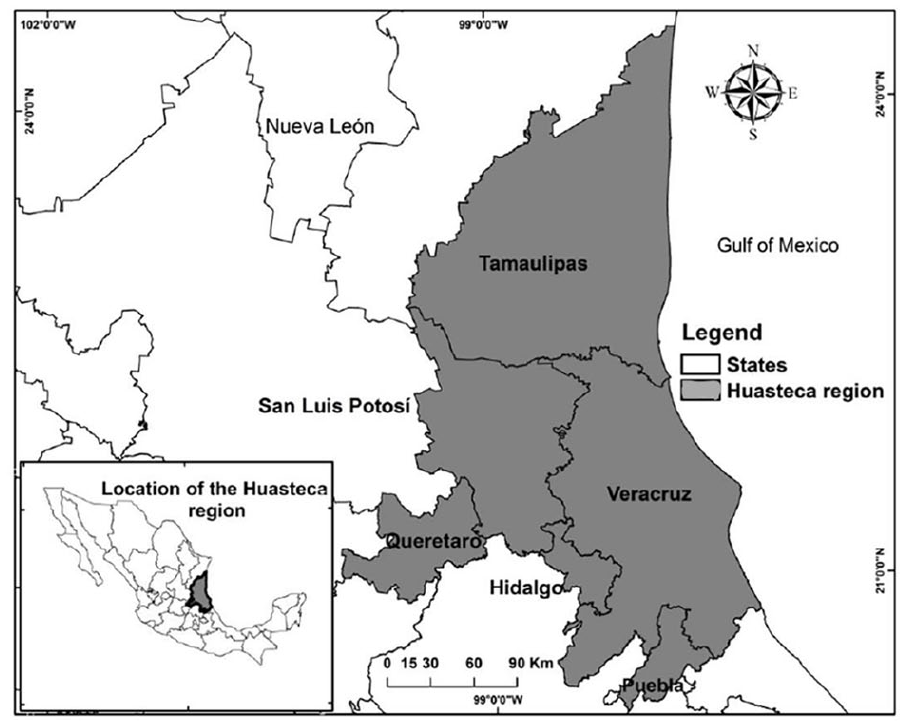
Huasteca región, Mexico (Peralta-Rivero et al., 2014).
The Huasteco people are also known as Teenek. The Huasteco people were the most prevalent Indigenous group living in the Huasteca region before colonial time; therefore, the region adopted the name Huasteca (Ramírez et al., 2008). Currently, the term Huasteco is used to refer to all people living in the Huasteca region, despite their ancestry. The Huasteca region is home to a diverse Indigenous population that includes groups such as Masewal, Otomíes (Indigenous people who live in central Mexico), Tepehuas (Indigenous people who live in southeastern Mexico), Totonaco, Teenek, and Pames (Indigenous people who live in central Mexico), peoples who have coexisted since time immemorial. Over the centuries, conquest attempts from both precolonial forces and during colonization have shaped the current social, cultural, and linguistic features of the people who live in the Huasteca region. Mestizo (born from the mix between Indigenous peoples, Europeans, and people from Africa) people have also played an important role in what is currently understood as the Huasteca region. In the region’s history, oral traditions have been the primary means to keep cultural practices in place and alive. Diverse ethnographic studies have addressed the complex dynamics of Indigenous groups in the Huasteca region (De Vidas, 2009; Galinier, 2017; Ramírez et al., 2008; Stresser-Péan, 2016; Williams García, 2004).
The place where our studies and experiences are located corresponds to the Huasteca Veracruzana, the part of the Huasteca region located in the State of Veracruz. In this study, we address the case of Masewal people. For the purpose of this study, we will refer to Nahua people as Masewal people, as this is how the Masewal people have chosen to be identified (Escalante et al., 2008). The term masewalli means humble person in Masewaltlahtolli (Masewal people’s language). The Masewaltlahtolli language is also known as Nahuatl. According to Questa (2017), there is not an absolute consensus about where the Masewal ancestors migrated from. The Masewal worldview is a central point of reference in our study, where agriculture, and particularly corn production, is key. It is crucial to understand that the Masewal world “is intrinsically animated, willful and multi-planar. It allows for people and things to be all potentially and closely interconnected” (Questa, 2017, p. 10).
Sacred places and rituals are central in Masewal worldview, and directly connected with agriculture cycles. According to Questa (2017), landscapes have agency, places “are also persons to a certain degree” (p. 9). One of the most important symbols and places for Indigenous groups in the Huasteca region is the Postektli Hill (Figure 2). According to the local Indigenous groups’ worldviews, the Postektli Hill represents the axis mundi, the centre of the universe where Apanchaneh, the Goddess of Water, lives. Therefore, this hill becomes a sacred place to pilgrimage to ask for rain. In exchange, people offer Apanchaneh prayers, sacrifice animals, dances, and music (Broda, 2002). Masewal people believe that there was a time where Postektli Hill was as high as the sky, which allowed them to reach the place where the Gods lived (Báez-Jorge & Gómez, 2000).
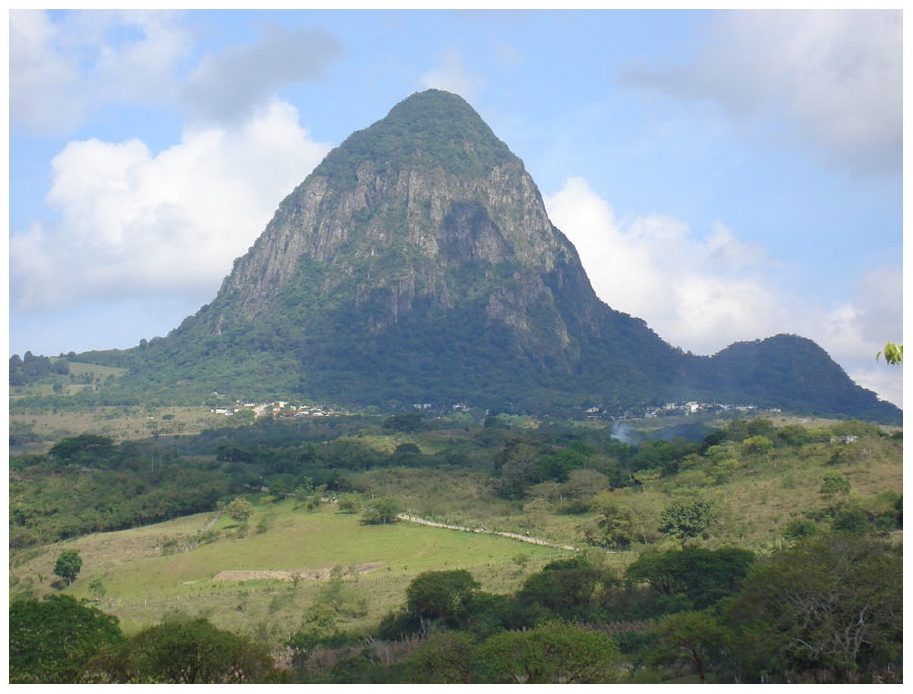
Postektli Hill, Ichcacuatitla, Chicontepec, Veracruz, México (Photo by Arturo Gómez Martínez).
Methodology
For the purpose of this study, Jesús used an ethnographic-participatory approach (Berraquero-Díaz et al., 2016). This approach enabled an open dialogue between all parties. Jesús used unstructured interviews so that participants could share their stories and experiences. According to Kovach (2009), unstructured interviews, as well as the use of story and life story, “allow participants to share their experiences on their terms” (p. 82). Jesús interviewed community members in Masewaltlahtolli then transcriptions were translated to English. This study also incorporated an autoethnographic approach (Ellis et al., 2011) since Jesús is a member of the Masewal community. The field work took place in Reyixtla and Lomas del Dorado, Municipality of Ixhuatlán de Madero, Veracruz, Mexico and La Esmeralda, Municipality of Chicontepec, Veracruz, Mexico. We are grateful to community members who took part in this project. All of the testimonies and pictures are published with the consent of our community collaborators. The community fully supports using this information to share the knowledge of Masewal people in a responsible way.
Masewal people way of living
Corn, corn plant, and the importance of agriculture rituals
For Mesoamerican Indigenous peoples, the corn plant is not just a way to produce food, but rather, it is a metaphor for campesinos’ (people who work the land) way of living, thinking, and feeling. In the context of Mexico, the corn plant paradigm is a way of life associated with resistance and struggles of Indigenous peoples and campesinos. I (Jesús) am currently developing a research framework that I call the Corn Plant Paradigm, which refers to the way of living for Masewal people. Corn is a grain that along with other goods is an integral part of a polyculture known as the corn plant system.
Since time immemorial, the corn plant has set the rhythm of work, for rural life and for many of the everyday activities in the Indigenous communities. During my field work (Jesús) working alongside corn planters in the Huasteca region, one planter told me, “The corn plant is everything for us. If we lose corn plants, we will disappear as well” (Alejandro Olguín, Masewal campesino (a male who works the land), 68 years old). Another corn planter mentioned, “the corn plant is connected to everything that we do. It is connected to the knowledge of our grandparents, the corn plant is everywhere, it is the way in which we work together” (Eneida Hernández, Masewal campesina (a female who works the land), 50 years old).
The Masewal campesinos in the Huasteca region use the word milli to refer to the corn plant as a space where polyculture takes place (Figure 3). They also use the concept of millah to refer to other activities that they do in the land, beyond the milli, which is the area designated for polyculture. In the milli grows the sintli (corn), along with the ayohtli (pumpkin), etl (black bean), chilli (type of spicy pepper), wahtli (amaranth), ichkatl (cotton), kakawatl (peanuts), kuatlahkayotl (squash), aholi (sesame), kolantoh (cilantro), alahueno (peppermint), kuaxilotl (bananas), ochonehtli (papaya), xochimeh (flowers), and xiwipahtli (medicine plants), among others. Masewal people plant twice a year: xopamilli (corn plant of the rainy season) and tonalmilli (corn plant of the dry or warm season). According to the knowledge of local campesinos, the planting for xopamilli season needs to take place between 12 and 20 June, while the planting for tonalmilli season takes place between 20 October and 20 November. It is crucial for Masewal people to plant during these specific times to have a better chance of having a plentiful harvest.
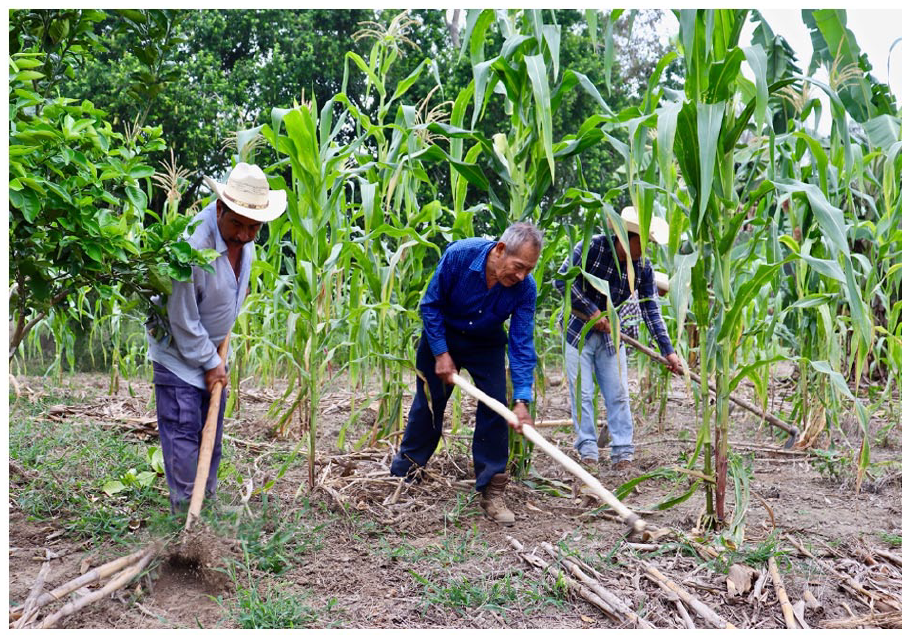
Masewal (Indigenous people who live in the Huasteca region) campesinos (people who work the land) working in the milli (the area designated for polyculture), Carlos Bautista (left), Alejandro Olguín (centre), and Adrián Giménez (right) (photo by Jesús Alberto Flores Martínez).
Communal rituals connected to the corn plant are currently practised in Masewal communities in the Huasteca region (Hooft, 2008). The rituals typically take 2 days. The first day is dedicated to the preparations for the offerings. The xochichiwanih (florists) take care of the maxochitl (bouquets of flowers). The tlakualchiwanih (ritual chef) cooks the food that will be part of the offering. While these elements take place, the tlatzotzonanih (musicians for ritual ceremonies) play xochitlatzotzontli (ritual music) at all times. The wewetlakameh (wise person, the guardian of the ancient and sacred) coordinates all these activities. During the second day, the offering ceremony takes place to thank Tonanatlalli (Our Mother Earth) and Totatatlalli (Our Father Earth) for providing the food (Figure 4). During this ceremony, people ask for a good harvest season and for the protection of the corn plants against disease. People ask for protection against hurricanes, floods, and droughts. Amatlatekmeh (paper figures), symbolizing Chikomexochitl, tlitl (fire), atl (water), tlalli (earth), ehekatl (wind), tlakatekolotl (owl man), metztli (moon), and tonatih (sun), among others, are placed in the four corners of an altar. An offering of chickens is provided so that their blood can be used to humanize the amatlatekmeh. The ritual music is present throughout the entire ceremony. Ehekameh (nefarious winds) are placed on the soil. People ask the ehekameh to not harm the corn plants and any other crops. People pray and provide incense to the guardians so that they protect the corn plants. Finally, people make a toast with the land. In regard to this ritual, Carlos Bautista (Masewal campesino, 52 years old) comments, You need to put a cross, some candles, food, and one egg. You put everything in the middle of the corn field. This is an offering so that the corn plants grow well and that the mice do not eat the little plants. You need to make a toast with the land. These are the ways our grandparents taught us; they did it this way.
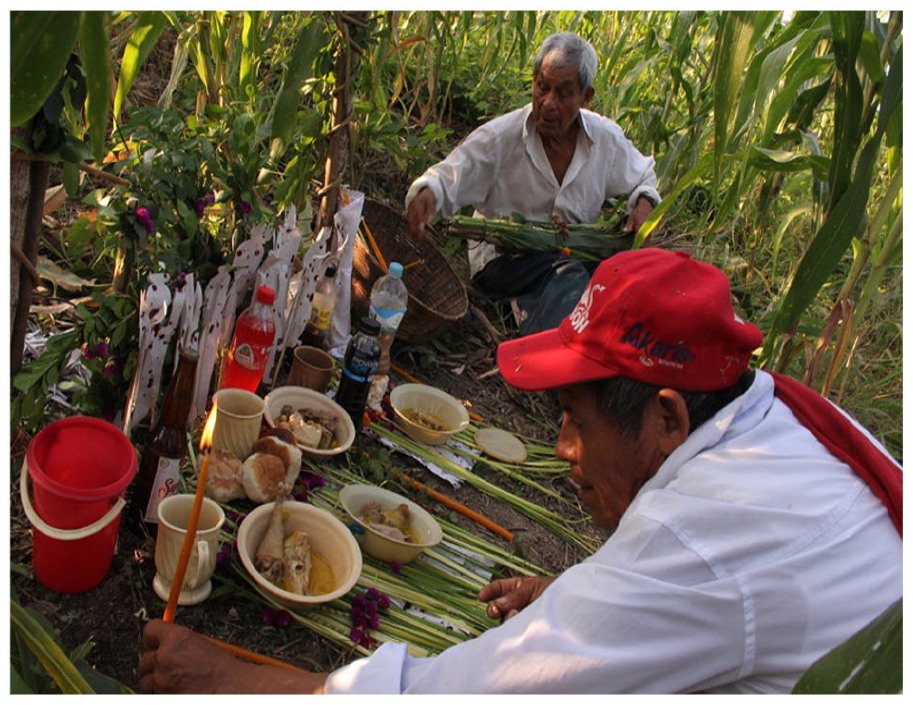
Miltlakualtilistli (the moment when the plant is growing but the spike has not emerged yet): Two ritualists during the ritual to give thanks for the corn plant. Masewal (Indigenous people who live in the Huasteca region) campesinos (people who work the land), Celerino Hernández (left) and Juventino Hernández (right) (photo by Jesús Alberto Flores Martínez).
Chikomexochitl, Xochikalli (Chikomexochitl’s house), and the ceremony connected to Chikomexochitl
Chikomexochitl is a word in Masewaltlahtolli constructed from chikome (seven) and xochitl (flower). Chikomexochitl is a central part of the Masewal worldview as it represents the stages of the development of the corn and the corn plant (Hooft, 2008; Nava, 2009). It is also a metaphor for the diversity of goods that emerge from the land (Camacho, 2008; Hernández, 2010; Pérez Apango, 2016). The ceremonial cycle is divided into five rituals, each connected to a stage of the corn’s development:
Xinachtlakualtilistli: The time when the corn is planted.
Miltlakualtilistli: The moment when the plant is growing but the spike has not emerged yet.
Miawatlakualtilistli: When the plant is blooming.
Elotlamanalistli: When the corn cob is ready to be picked and offered for the ceremony.
Sintlakualtilistli: The time when the harvest has concluded.
Figure 5 contains the five moments connected to the growth of the corn and the corn plants. In the middle of the diagram, we have placed seven principles connected to Masewal culture: stories of creation and being, interconnectedness, centredness of cycles, community work, rituals, syncretism, and orality.
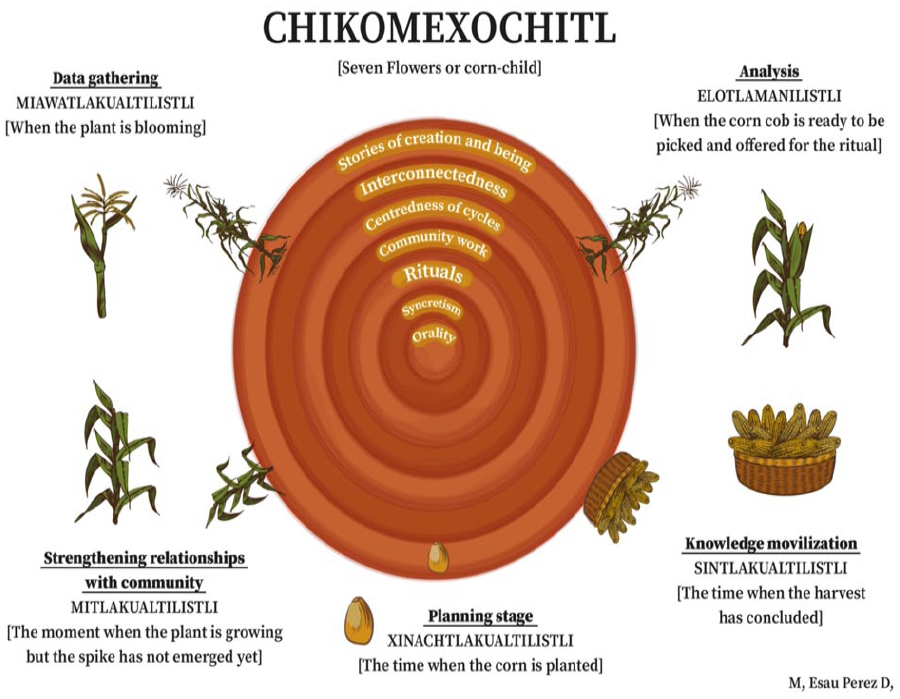
Chikomexochitl (seven flower or corn-child) as a research methodology (designed by Esau Perez; digitalization by Genaro Martínez).
The Xochikalli is the house of Chikomexochitl. The Xochikalli represents the sacred place where agricultural rituals take place, and it is a symbolic and sacred space for Masewal people. The Xochikalli is guarded by the wewetlakameh, the tetiotah (godparents), and the tetionah (godmothers). According to Eneida Hernández (Masewal campesina, 50 years old), Xochikalli is not just a sacred space. The little house is a concept that refers as well to the sacred hills, the corn plant, and the community. Xochikalli comprises all our knowledge, all the pillars that uphold our community organization, education, and our food systems. When we have ceremonies, we enter a place full of brotherhood, care, mutual understanding, and collaboration. It is like if we all carry together all the work, and because of that it is not heavy anymore. This is the communal meaning of the ceremony. Our sacred words bloom through the prayers, the music, and the offering that we give when our bodies and feet move while dancing.
An Indigenous critique towards a dominant western paradigm and its influence on the current state of Indigenous peoples and cultures in Mexico
Historically, Indigenous peoples have been analysed through filters and theories that represent the dominant paradigm of western science, which in many ways is a continuation of relationships between the colonizer and colonized, leading to forms of cultural extraction and appropriation (Ramos, 2018). From a capitalist point of view, Indigenous knowledges are a commodity that can be exploited (Álvarez & Sebastiani, 2020), which in many cases, has led to what De Sousa Santos (2014) describe as epistemicide, or the death of the subordinated culture’s knowledge. We seek in Chikomexochitl a path for Masewal’s ways of knowing and being to resist and challenge epistemicide and to reframe the colonizer–colonized relationships in research.
Indigenous communities continue to face the effects of so-called modernity, which upholds the values of a dominant western paradigm, rooted in European and Anglo-American positivist perspectives (Mignolo & Walsh, 2018), by which all cultures are dissected and studied. Masewal people have not been exempt from the challenges associated with the ideas of modernity and progress. Therefore, in Masewal worldview, we seek a way to understand and develop collaborative relationships between researcher and local Indigenous community members, and decentering the process of knowledge extraction in many cases associated with academic practices. We argue for the need to centre ways of knowing, being, and sharing knowledge rooted in Masewal worldview as a path forward for Masewal people to produce knowledge from their own desires and aspirations, on their own terms.
Anthropology as a discipline can serve as an example of a science shaped by the vision of a western modern white man. In the context of Mexico, the Mexican state supported the emergence of anthropology as an academic discipline in Mexican universities for the express purpose of fostering national unity and identity The Mexican state sought to use the study of anthropology as a tool to build a bridge between the pre-Hispanic cultures and the Mexican nation-state to assimilate Indigenous cultures in the national imaginary. The design and execution of such goals left out Indigenous peoples’ needs and aspirations (Stavenhagen, 2015). Indigenous cultures were romanticized and portrayed in a way that did not represent them as people living in constant change and adapting to contemporary times.
In the case of anthropology in Mexico, efforts have been made so that Indigenous peoples are no longer seen as subjects of study, and instead see themselves as central actors who shape their own narratives and realities. One of the changes that is shaping the narratives in academia are emerging Indigenous scholars who are envisioning new research paradigms that align with local protocols. The ongoing changes in the relationship between Indigenous peoples and the diverse areas of knowledge in academia continually highlight the need to critically analyse how their knowledge is studied without dissociating it from their worldviews. In Mexico and internationally, important questions still remain around the use of Indigenous perspectives in research. Some of those questions are as follows: has research been produced in collaboration with Indigenous peoples or is it about Indigenous peoples? Who has benefitted from this research information? Has this information been used for the sake of humanity as a whole or for profit?
Meaningful relationships of collaboration in research: towards a new path for conducting research on Indigenous land
It is important to acknowledge the role that Indigenous communities are playing in new approaches to research where collaborations between researchers and communities are built on principles of trust and reciprocity. Following Martínez (2010), we understand community as a historic and political network by which local Indigenous peoples, in this case Masewal, found ways to resist colonial attempts to disrupt their social fabrics. For the last three decades, scholars around the world have advocated for the need to centre Indigenous worldviews and aspirations at the core of research, with a particular emphasis on building horizontal relationships through the lenses of decolonial and Indigenous research paradigms. In the context of Masewal emerging scholars, such aspirations are framed around being able to name the way in which they understand the world and their interconnectedness with nature and spirituality. Some of the scholarly production that guided our research to reflect on the possibility of envisioning an Indigenous methodology rooted in the Masewal worldview is literature that has addressed topics such as decolonizing research methodologies (Smith, 2012), horizontal collaborations in research (Kaltmeier & Corona, 2012), decolonizing Indigenous ways of thinking (López, 2016), centeredness in orality (Rivera, 1990), critical ethnography (Guber, 2001), dialogical research (Bastian & Berrío, 2015), Indigenous storywork (Archibald, 2008), and Indigenous methodologies (Chilisa, 2012; Kovach, 2009; Wilson, 2008).
We acknowledge the work that Indigenous and non-Indigenous scholars have done to create the pathway to envisioning ways of horizontal and reciprocal relationships when working with Indigenous communities. It is our goal that Chikomexochitl aligns with the emerging body of Indigenous methodologies, which have at the core components such as relationality—knowledge can emerge through the relationships that inform it, reciprocity—it is important that the research addresses Indigenous peoples’ needs, accountability—the researcher needs to be accountable to the relationships that are formed through the study, ways of knowing directly connected to the land, and orality (Archibald, 2008; Chilisa, 2012; Kovach, 2009, 2010; Smith, 2012; Styres, 2017; Tuck & McKenzie, 2015; Wilson, 2008).
We propose Chikomexochitl as a methodological approach that centres Masewal people’s aspirations and their ways of knowing and being. It is critical that researchers seek reciprocal relationships that enable horizontal collaborations, where Indigenous communities are no longer the object of research that is analysed through a dominant western paradigm. Research can better support the needs and goals of communities when studies take place through meaningful relationships and collaboration. Indigenous communities are not simple, as some romanticized narratives aim to portray. Instead, Indigenous communities, as is the case of Masewal people, are complex and often hold conflicts and contradictions. To create idyllic representations of what Indigenous peoples must be and to simplify the struggles that they face in their everyday lives is yet another form of racism and discrimination (Vazquez-Cordoba, in press). As researchers, let us walk side by side with our community partners and let us do our best to open the necessary space for their stories and realities to be shared through their own lenses.
Chikomexochitl as Indigenous research methodology
Kovach (2010) states that Indigenous methodologies are a paradigmatic approach that emerges from the epistemology and ontology rooted in particular cultural settings. For Wilson (2008), a strong Indigenous research paradigm is one that celebrates the uniqueness, history, and worldviews of Indigenous cultures. A paradigm that leads to a better understanding of Indigenous perspectives needs to be one that centres acknowledgement of the past, the present, and the future of Indigenous peoples, while “neither demonizing nor romanticizing the past” (Wilson, 2008, p. 19). Following Wilson’s (2008) recommendations, we acknowledge that ancient teachings are not static objects for Masewal people; rather, teachings are a crucial part of Masewal people’s everyday lives. We adopt Kovach’s (2009, 2010) and Wilson’s (2008) approach as a framework to bring Masewal people’s perspectives into research in a way that is meaningful for the communities that we work with.
We have developed this methodology as a tool for Masewal and non-Masewal researchers to engage in research with Masewal communities. The framework that we describe in the following subsection provides a description of the stages of Chikomexochitl as research methodology, using as an allegory, the five moments connected to the growth of the corn and the corn plants. In each subsection, we reflect on our given experiences and positionalities when working with Masewal community members. It is important to note that the recommendations that we make are not rules, but rather an opportunity for the researcher to reflect on their own positionalities when engaging in research with Masewal communities. The experiences in research with Masewal people led us to envision Chikomexochitl as a research methodology. We are following Chikomexochitl as a research methodology in our current postdoctoral research project—Hector, and doctoral research project—Jesús. We are also in the initial phases of Chikomexochitl in a joint research project.
Xinachtlakualtilistli: the planning stage
An initial reflection: a seed is planted in the land, and the land with its ancestral knowledge will host the seed. Will the seed grow? It is up to the land, and the care that is given to both the seed and the land. Respect the land and perhaps the seed will flourish—be patient, observe, and learn.
In our journey as researchers working in collaboration with Masewal people, over the years, we have developed relationships of trust with local communities. An important part for this dynamic to work properly is to always be humble, respectful, and attentive to the local protocols that are in place.
I, Jesús, position myself as a Masewal scholar who actively critiques dominant theoretical and methodological paradigms that reproduce and nurture extractive epistemological practices from Indigenous peoples. I advocate to acknowledge research methodologies that incorporate Indigenous community protocols and voices. When I was about to start my doctoral research project, Eneida asked me the following: We need to organize. We need to establish a plan of action that works well for you and us. We are in favor of your research project to go forward, but first we need to ask some grounding questions: How is your research benefiting our community and our people? What kind of support would you need from us? (Eneida Hernández, Masewal campesina, 50 years old)
Eneida’s comments made me reflect on further crucial questions for the academic community: What to research? Why research? Who researches whom? What are the procedures to share findings? Who is in charge of validating the results of the research process? To whom do the research results belong? Which outcomes are meaningful for the community?
I, Hector, a person with Totonac and Spanish ancestries, and a person of colour, am a non-Masewal person trained in the classical music tradition. According to Styres (2017), “the only place from which any of us can write or speak with some degree of certainty is from the position of who we are in relation to what we know” (p. 7). I frequently revisit Styre’s statement to reflect and frame my ongoing decolonizing process as a researcher trained both in the Global South and Global North. The classical music discipline at its core has the belief that the western-European form of music is the most desirable, as it is portrayed as the pinnacle of human musical creativity (Rosabal-Coto, 2016); through this paradigm, all other musics are viewed and studied with the assumption that they are minor or lesser forms of music-making. In my journey, learning and researching the diverse uses of music-making in the Huasteca region in both ritual and secular contexts, it has been crucial to question and acknowledge the colonial constructs of the music discipline in which I was trained. Before planting a seed with community members based on trust and reciprocity, I need to decolonize my own perspective and self. Part of the action that I have taken over the years to plant my seeds and foster trust among community members has been to volunteer for projects, attend cultural events, learn about local protocols, and learn the local Indigenous language to show a commitment to a long-lasting personal relationship with people who I now proudly call teachers.
Miltlakualtilistli: strengthening relations with community
An initial reflection: you start noticing that the plant has emerged from the land. Perhaps, you have done something right, but the plant is still fragile—constant care is required to make sure that it keeps growing.
When relationships of trust have been planted, we reach out to community members with whom we have developed a relationship of trust and collaboration over the years and begin to talk about potential ideas for research projects in which all parties might be interested. This requires coming to agreement about what the direction of the project is going to be and in which ways the project will benefit the given community or collective. We put our knowledge and expertise to the service of the community or collective.
This point in the process is where the community or collective takes ownership as they shape what the outcomes of the project are going to be and how people in the community or collective are going to actively participate in the initiatives. In several cases, community members have expressed that, at times, researchers have come to their communities on a one-time basis to collect data and have not been seen after that. To see our plant growing, reciprocity and accountability are key to nurturing our relationships with the community. Gregorio Cortés (Masewal campesino, 68 years old) shared experiences of researchers who are interested in Masewal knowledge, but not in nurturing relationships of trust and reciprocity with the Masewal community: There have been a lot of people, a lot of researchers from the city coming here because we have the Xochikalli. When we do our rituals, they come and want us to tell them how we do our rituals and what we use. We just tell them that we use a lot of things. Then, they ask us if we can tell them what we know, and we tell them no. We tell them that they need the necessary time and interest to learn and be willing to participate in everything we do.
Castleden et al. (2012) have discussed the importance of devoting time to actively listening as an essential component of building relationships of mutual trust with Indigenous communities. It is through devoting time that community members recognize that we are seeking long-term relationships and collaborations, rather than one-time extractive initiatives.
Miawatlakualtilistli: data gathering
An initial reflection: the corn plant has started blooming, and soon the corn cob will emerge. Make sure that you have all the necessary equipment to be ready to pick the corn cobs. Remember to be patient, wait for the right time to pick the corn cobs, and do not rush.
This is the phase in the research process where the community members and the researcher, as a collective, mobilize to establish the necessary space or activities for research to take place. Some of the research initiatives might take place during community-led activities such as festivities, rituals, or daily life work. It is crucial to have the support and guidance of community partners to avoid unexpected disruptions during secular and ritual practices. We have participated in cultural, secular, ritual, and everyday activities in the communities where we have collected information for our field work, while not disturbing or compromising the carrying out of activities of community daily life.
Part of decolonizing research requires that the researcher takes a more vulnerable role in the research process. An important shift in the balance of power between the researcher and participants occurs when participants’ voices are heard on their own terms (Archibald, 2008; Chilisa, 2012; Kovach, 2009, 2010; Smith, 2012; Tuck & McKenzie, 2015; Wilson, 2008). We encourage participants to use their mother tongue during interviews and conversation. It then becomes our responsibility to find a way of understanding what the participants have expressed rather than the participant using their second language to accommodate our needs. When Indigenous people share their stories in research, it facilitates ways for “healing associated with decolonization” (Kovach, 2009, p. 15). Therefore, the story becomes a tool for decolonization. Kovach (2009) affirms that “[W]hen asking Indigenous people for their stories in research, a researcher must be aware that the choice of this method opens a door for healing associated with decolonization” (p. 15). This is one of the main reasons for which I, Hector, have started to learn Masewaltlahtolli, to be able to communicate in this language and to take a step to show my ongoing learning commitment to leaving my privileged comfort zone as a visitor and researcher. The opportunity for people to share orally in their preferred language enables participants to share the way they see themselves and their community, instead of an external party taking full charge of representing Indigenous perspectives. As a Masewal scholar, I, Jesús, consider it very urgent to move towards new methodological paradigms that centre Indigenous knowledge systems, Indigenous languages, and methodological processes that fit those components. It is crucial to do research with the communities, respecting their protocols, and do the work with commitment and ethics. Eneida told me the following at the beginning of my doctoral project: It is necessary for the corn planters to listen to you, and they will decide how to go about what you want to do for your project. It is important that they know your feelings and what you bring in your heart. Because it is possible that when they hear you, they notice that your word is empty and that you are not saying the truth. This is why you are here, so that people get to know your heart as well. The Elders will be in charge of saying if they accept [to participate in the project] or not. (Eneida Hernández, Masewal campesina, 50 years old)
Elotlamanalistli: analysis
An initial reflection: it is time to harvest the corn, but you have been patient. It is also time to prepare the corn so that it lasts for many months. Take the kernels off of the corn cob and clean them before the corn is transformed into masa (corn dough).
We link this phase of the methodology to the analysis of information. In our analysis, we use thematic analysis to identify the main trends found in the different narratives and experiences of our participants (Braun & Clarke, 2006). Even though we code the interviews to identify themes, we are cognizant of the importance of not dissecting narratives into very small fractions, as otherwise the voice of participants might get lost in the fragmentation of codes. The idea of keeping narratives less dissected and as complete as possible becomes crucial when some of the participants speak an Indigenous language, and their narratives are eventually translated into another language, for example, Spanish or English, when information is mobilized through academic publications or presentations.
In this phase, it becomes relevant to go back to participants to make sure that the transcriptions and analysis of the information truly reflects their statements. Once again, because of the need for translation between an Indigenous language and another language, it is important that participants are aware of how the translation might have affected their original intentions. The support of a fluent Indigenous language speaker is important. In my case (Jesús), I am a native Masewaltlahtolli speaker. Since I was raised in a Masewaltlahtolli-speaking community, I am able to understand not only the language but also the cultural context in which the language operates.
Sintlakualtilistli: knowledge mobilization
An initial reflection: the corn dough has been transformed into tortillas (a flat bread made from a corn-based dough mixture), tamales (a dish made with a corn-based dough mixture that is filled with various ingredients), and pikis (a dish made with a corn-based dough mixture that is filled with various ingredients specifically from the Huasteca region). It is time to share the food with everyone that was part of the process of planting and harvesting the corn. But most importantly, be thankful to the land: without the land, you would not be enjoying these delicious meals.
From the academic perspective, the final product can be a thesis or dissertation, a paper, a report, or a conference proposal, among others. However, it is important that the outcome of the project goes beyond contributions to academia. For the knowledge dissemination phase, we seek academic and non-academic ways of presenting the findings of our research. We have opted to produce short films, which allow for academic and non-academic parties to access the findings of the research projects. The community films are a meaningful tool by which community members can better represent their organization process and represent themselves and their worldviews in the manner in which they feel the most comfortable.
Final reflection
To engage in research with Indigenous peoples and their communities is a political act regardless of the discipline of study. It is crucial that as researchers, we constantly question the responsibilities that we have to the communities that actively participate in our research projects in order that they have a clear picture of what their participation entails, their aspirations shape and are represented throughout the entire research process, and they control and can access the outcomes of the studies.
Chikomexochitl as a research methodology to work with Masewal people centres the need for collaborations, dialogue, consensus, as well as patience and care among all people involved to build strong personal relationships. If a corn plant needs time to grow, and all the stages of the growth journey are acknowledged and celebrated, why do research processes need to be expedited and fast-tracked? We as researchers need to celebrate that at each stage our research process is moving forward, not because we are closer to generating findings, but rather, because this means that the roots of our collaborations with our given communities are getting stronger as we grow with the care and support of our community partners.
Footnotes
Acknowledgements
The authors acknowledge the support of Masewal community members from Reyixtla, Lomas del Dorado, and La Esmeralda. They are particularly grateful to Alejandro Olguín, Carlos Bautista, Eneida Hernández, and Gregorio Cortés, who participated in the interviews. They also acknowledge Dr Anita Prest for her helpful feedback.
Authors’ note
Declaration of conflicting interests
The authors declared no potential conflicts of interest with respect to the research, authorship, and publication of this article.
Funding
The authors disclosed receipt of the following financial support for the research, authorship, and publication of this article: Hector Vazquez-Cordoba received funding from the University of Victoria Aspiration 2030 Postdoctoral Fellowship.

Glossary
aholi sesame
amatlatekmeh paper figures
Apanchaneh Goddess of Water
atl water
ayohtli pumpkin
chikome seven
Chikomexochitl seven flower or corn-child
chilli type of spicy pepper
ehekameh nefarious winds personified
ehekatl wind
Elotlamanalistli when the corn cob is ready to be picked and offered for the ceremony
etl black bean
ichkatl cotton
kakawatl peanuts
kolantoh cilantro
kuatlahkayotl squash
kuaxilotl bananas
masewalli humble person
Masewaltlahtolli Masewal people’s language
maxochitl bouquets of flowers
metztli moon
Miawatlakualtilistli when the plant is blooming
Miltlakualtilistli the moment when the plant is growing but the spike has not emerged yet
milli the area designated for polyculture
millah other activities that Masewal people do in the land
Nahuatl another name for the Masewaltlahtolli language
ochonehtli papaya
pikis a dish made with a corn-based dough mixture that is filled with various ingredients specifically from the Huasteca region
Sintlakualtilistli the time when the harvest has concluded
sintli corn
tetiotah Godparents
tetionah Godmothers
tlakatekolotl owl man
tlakualchiwanih ritual chef
tlalli earth
tlatzotzonanih musicians for ritual ceremonies
tlitl fire
tonalmilli corn plant of the dry or warm season
Tonanatlalli Our Mother Earth
tonatih sun
Totatatlalli Our Father Earth
wahtli amaranth
wewetlakameh wise person, the guardian of the ancient and sacred
Xinachtlakualtilistli the time when the corn is planted
xiwipahtli medicine plants
xochichiwanih florist
Xochikalli Chikomexochitl’s house
xochimeh flowers
xochitl flower
xochitlatzotzontli ritual music
xopamilli corn plant of the rainy season
campesina a female who works the land
campesino a male who works the land
campesinos people who work the land
masa corn dough
mestizo born from the mix between Indigenous peoples, Europeans, and people from Africa
tamales a dish made with a corn-based dough mixture that is filled with various ingredients
totillas a flat bread made from a corn-based dough mixture
Masewal Indigenous people who live in the Huasteca region, Mexico
Otomíes Indigenous people who live in central Mexico
Pames Indigenous people who live in central Mexico
Teenek another name for Indigenous Huasteco people
Tepehuas Indigenous people who live in southeastern Mexico
Totonaco Indigenous people who live central and southeastern Mexico