



Abstract
This article reports on the outcomes of an Aboriginal and Torres Strait Islander community–led project which sought to build a pathway to reconciliation through formulating a localised community response to the Uluru Statement from the Heart. The research follows a phenomenological research design which collected qualitative data from lived experiences of the participants. Phenomenological analysis was conducted iteratively on the data where themes were identified as integral to achieve self-determination and reconciliation locally: respect, voice, truth, treaty and unity. Each theme comprised interconnected sub-themes where a Local Response to the Statement of Commitment was hewn from these results. This response will be used as a local charter to promote Memorandums of Understanding across the Fraser Coast region, Queensland, Australia, to improve life choices, control decision making and self-determination for all Aboriginal and Torres Strait Islander peoples in the region, enacting the vision of the Uluru Statement.
Keywords
Introduction
The true essence of reconciliation is more than making friends with non-Indigenous people . . . a united Australia is one that respects the land and the heritage of its Indigenous peoples and provides justice and equity for all. (Huggins, 2017, para. 8)
Australia’s journey towards reconciliation has been a long and arduous one for Aboriginal and Torres Strait Island peoples and one that will continue into the future for generations to come. Reconciliation in Australia is about mending the relationships among the people in the context of gaining historical understanding, recognition and reparation. Reconciliation in Australia has evolved as a performative notion and over time lost traction for the critical structural change that is needed with shifts in government leadership. Although slow, change has occurred within education through prioritising embedding Aboriginal and Torres Strait Islander perspectives within the curriculum, but educators still struggle to hear the voice and truths of First Nations peoples. Voice and truth within the education system alone cannot achieve recognition and reparation in Australian society; crucial structural change is needed to address inequalities encountered on a daily basis by Australia’s First Nations people (Appleby & Davis, 2018).
The Uluru Statement from the Heart (Uluru Statement Organisation, 2017) calls for urgent structural change that enables self-determination to build hope for a more equitable future for Australia’s First Nations people (Davis, 2022). Education is a crucial factor in reconciliation since developing an awareness of and appreciation for Aboriginal and Torres Strait Islander ways of knowing, being and doing can give rise to greater understanding where communities can work together towards reconciliation. Reconciliation involves all levels of Australian government and its departments, corporations, industries, businesses, media and most importantly, the Australian public.
Real reconciliation is hampered by traditional and inherent inequalities in Australian society, brought about by the colonial manipulation of historical events such as the myth of Terra Nullius, land dispossession, violence, massacres, separation and racism. The absence of truth-telling is evident in our education system and curriculum which pay scant attention to these segments of Australia’s history. The impact of colonisation on Aboriginal and Torres Strait Islander peoples can manifest itself in complex intergenerational trauma and the breakdown of family and kinship groups, thereby perpetuating the cycle of cultural destruction, inequity and disadvantage experienced by Australia’s First Nations peoples. The absence of recognised structures which give voice and value to truth-telling and the impact this has on all facets of Australian society can lead to the minimisation and desensitisation of past injustices. The call for structural change through the Uluru Statement outlines a process of truth-telling so that reparations and future relationships can be negotiated and provides for a two-way discussion of the inherent rights of Australia’s First Nations peoples (Appleby & Davis, 2018).
Reconciliation in Australia seeks to achieve equitable life choices for Aboriginal and Torres Strait Islander peoples through the Closing the Gap initiative, to improve access, opportunity and provision for all First Nations peoples across key target areas including health, education, employment, housing and justice, with a particular focus towards families and children. To elaborate, for Indigenous peoples, there has been no improvement in school attendance rates, no improvement in employment rates, no reduction in youth incarceration, and a small but not significant increase in life expectancy rates, although this reduces with increasing remoteness (Australian Department of the Prime Minister and Cabinet, 2020). To date there has been a much-needed, top-down approach to changing policies and processes to promote equity and inclusion in the aforementioned key target areas, but these gains have been slow to filter down into practice.
Primarily, reconciliation is about strengthening relationships between Aboriginal and Torres Strait Islander peoples and non-Indigenous Australians for the betterment of Australian society. The call for structural change through the Uluru Statement empowers local communities to add their voice and call for truth through localised agreements to effect positive change for First Nations peoples. If we wish to effect real reconciliation through structural change, then relationships must be strengthened from the grassroots level of society and weave upwards and outwards into all levels of education, health, employment, policing, family and child welfare, so that all people can contribute to improving relationships and work towards a truly reconciled Australian people.
Literature review
Reconciliation in Australia
Reconciliation within Australia is an ongoing journey for meaningful change towards a just and equitable Australian society, regardless of racial background. Many Aboriginal and Torres Strait Islander people suffer enduring economic and social disadvantage as a result of past injustices, dispossession, violence and racism. Reconciliation Australia, an independent, not-for-profit organisation, highlights five dimensions on which reconciliation is composed of: historical acceptance; race relations; equality and equity; institutional integrity and unity (Reconciliation Australia, 2001). To achieve a society where Aboriginal and Torres Strait Islander children have the same life chances and choices as non-Indigenous children these five dimensions need to be met. Furthermore, strengthening relationships between Aboriginal and Torres Strait Islander peoples and non-Indigenous peoples must occur at local grassroots contexts and be supported and championed at all levels of governments for the benefit of all Australians (Reconciliation Australia, 2001).
When examining historical acceptance as the first dimension of reconciliation, it is paramount that the truth of Australian history, including colonial conflict and dispossession be told. Furthermore, in the telling, it is crucial to acknowledge the strength and resilience of Aboriginal and Torres Strait Islander peoples and cultures, their histories, lores and stewardship of country as traditional owners of this land and the injustices and persecution they endured as a direct result of colonisation. In 2008 Kevin Rudd, the Australian Prime Minister at the time, issued an official apology to Australia’s Indigenous Peoples (Rudd, 2008) for “the laws and policies of successive parliaments and governments that have inflicted profound grief, suffering and loss on these our fellow Australians” (para. 6). This apology was an integral step in truth-telling and moving the country towards historical acceptance, as it not only raised the consciousness of the Australian public but led to state and federal governments establishing Closing the Gap targets built around six core areas: life expectancy, infant mortality, access to early childhood education, reading, writing and numeracy, high school completion and employment outcomes (Council of Australian Governments, 2008). These core areas influenced the agendas of state policy specifically in health, family, housing, education, training and employment whose relevant departments were to become key stakeholders in policy and practice to achieve the Closing the Gap targets. The apology and the Closing the Gap policy provided some hope for reconciliation in Australia, and highlighted target areas for reform, but the impact of both have been vastly reduced because neither were accompanied by structural reform that recognised the inherent rights of Australia’s First Nations people and empower them to achieve self-determination.
The second dimension regarding race relations calls for improved relationships between Aboriginal and Torres Strait Islander people and the general community as it is the foundation stone on which reconciliation can be achieved. The Australian Reconciliation Barometer report (Reconciliation Australia, 2020) found that 95 percent of all Australians felt relationships between Aboriginal and Torres Strait Islander peoples and the general community were important. However, this does not seem to translate to practice since 52 percent of Aboriginal and Torres Strait Islander people have experienced at least one form of racial prejudice in the past 6 months, an increase of 9 percent since 2018 (Reconciliation Australia, 2020). Clearly further support through public campaigns against racism which promote Aboriginal and Torres Strait Islander culture and histories is needed to raise public awareness and enhance race relations.
The Uluru Statement from the Heart focused on improving race relations through actively appealing to the Australian public to hear their voices and seek to understand the critical issues regarding the inherent rights of First Nations people. The Uluru Statement calls for these rights to be recognised structurally rather than performatively. The symbolic rhetoric that overshadowed reconciliation in Australia had little impact on closing the gap in health, education, youth justice and employment outcomes for Aboriginal and Torres Strait Islander peoples (Davis, 2016). Indeed the voices raised through the regional dialogues which were combined together in the Uluru Statement, advocate for inclusion, equality and equity, the third dimension of reconciliation, to be substantive and actionable. The regional dialogues overwhelmingly saw the voice to parliament as their priority for constitutional amendment which would lead to positive change and provide hope for the future (Davis & Williams, 2021). The structure of the dialogues was deliberately contrived to enact the principles of Indigenous leadership, to ensure decisions were made by those who had cultural authority (Davis & Williams, 2021). Truth-telling about Indigenous history is seen as essential for real change to occur (Reynolds, 2021) alongside the need for a voice to parliament. The principles of the Uluru Statement were encapsulated in the slogan, voice, treaty, truth and reflect the need for agreement making through the Makarrata (peace after a dispute) Commission (Davis & Williams, 2021).
The Uluru Statement from the Heart (Referendum Council, 2017) seeks the support of all levels of government and community to establish genuine partnerships with Aboriginal and Torres Strait Islander people and the broader community. The Uluru Statement from the Heart was a national Indigenous consensus position and the culmination of regional dialogues held across Australia with First Nations peoples in 2017 to call for Indigenous constitutional recognition through structural change. The statement comes after many decades of struggle for First Nations people to have a voice in their own affairs enshrined in the constitution. Through the statement, the people call for the establishment of a Makarrata Commission which would supervise agreement making and truth-telling between governments and Aboriginal and Torres Strait Islander peoples (Referendum Council, 2017).
By calling on governments, corporate organisations and civil society, the statement connects to the fourth dimension of reconciliation, that of institutional integrity, as a means to further reconciliation in Australia. Having a voice and being politically heard establishes the foundations for agreement making between First Nations people and all levels of government. The establishment of a Makarrata treaty begins the process of self-determination and political and cultural empowerment of Indigenous colonised peoples (Larkin, 2018).
In terms of unity then, the fifth dimension of reconciliation, it seems that all of the previous issues arising from the other four dimensions: historical acceptance; race relations; equality and equity; and institutional integrity, need to be addressed through some key actions by stakeholders in government and corporate sectors. Fundamental undertakings relating to education, health, media, policing, housing and the general community are required to actively promote public awareness about Aboriginal and Torres Strait Islander peoples’ history, culture and achievements. A contextualised and targeted approach at local levels where all of the stakeholders are represented is needed to facilitate a way forward that is planned, achievable, practical and committed to by all if there is to be real progress in achieving reconciliation in Australia. Examples of these key actions at local levels may include but not limited to: embedding local truths, knowledge and language into school curriculum and learning experiences; improving the provision of health services within the community; developing opportunities to build relationships between law enforcement and youth; prioritising housing and employment and improving access to traditional lands for cultural practices.
Reconciliation in Queensland
As a consequence of the Rudd (2008) apology and the National Indigenous Reform Agreement (Council of Australian Governments, 2008), six core action areas to close the gap between Aboriginal and Torres Strait Islander peoples and non-Indigenous Australians were identified. These areas pertained specifically to health, family, housing, education, training and employment. State governments were encouraged to develop an actionable plan to address these inequities across their states.
In Queensland, amendments to the preamble in the Queensland constitution were made in 2010 to include honouring Aboriginal and Torres Strait Islander peoples. Further to this, numerous programmes within health, education, employment and housing were developed to address the inequities within these institutions in the hope of closing the gap in social and economic outcomes (Department of Aboriginal and Torres Strait Islander Partnerships, 2008).
Since the Uluru Statement from the Heart, the Queensland Government has responded with a Queensland Statement of Commitment. The Queensland Statement similarly acknowledges past acts of injustice which has led to enduring economic and social disadvantage that many Aboriginal and Torres Strait Islander peoples have experience and continue to experience across all facets of their lives. (Department of Aboriginal and Torres Strait Islander Partnerships, 2019, p. 1)
Further to this, an Eminent Panel of experts was formed along with a working party to report on the way forward to treaty. The panel’s advice formed the core of the Tracks to Treaty programme which is underpinned by the principle of self-determination that calls for structural reform to enable truth-telling, empowerment, agreement making and high expectations relationships. The key issues as identified by the panel were around acknowledgement, truth-telling, negotiating treaties, engaging young people, capacity building and mechanisms for representation at all levels of engagement (Department of Aboriginal and Torres Strait Islander Partnerships, 2019). The bipartisan acknowledgement form both federal and state governments within Australia is significant since it marks a turning point in government rhetoric. The demand for action is palpable to support these much-needed and justifiable changes within Australian societal institutions so that they operate from a strength-based approach for the betterment of Aboriginal and Torres Strait Islander peoples and to enrich the lives of all Australians.
Significance
In Australia each July, the history, culture and achievements of Aboriginal and Torres Strait Islander peoples is celebrated by all people across Australia. The week-long activities were organised by the National Aborigines and Islanders Day Observance Committee (NAIDOC) whose acronym has since become the name of the week itself. Every year the event has a theme which is relevant to the struggles facing Aboriginal and Torres Strait Islander people at that time to raise awareness across the whole Australian community. In 2019, the theme was Voice, Treaty and Truth (NAIDOC Organisation, 2019), which echoed the reforms set out in the Uluru Statement from the Heart, and doubled as a call to action for all Australians to listen to the voice of Aboriginal and Torres Strait Islander people, hear their truths and their histories, and together establish a way forward, a treaty to establish equity for Aboriginal and Torres Strait Islander peoples across Australia. The NAIDOC 2019 theme of voice, treaty and truth, combined with the Uluru Statement from the Heart, gave rise to the opportunity to demand and inspire real change at the grassroots level. It was time to formulate a localised response with a call to action from local Aboriginal and Torres Strait Islander communities to local stakeholders to take measurable steps to turn their words to deeds.
Words and deeds arise from one’s beliefs which are politically and socially constructed by the world in which one lives. Venturing into new realms of beliefs can often produce a feeling of discomfort, since one’s beliefs are called in to question. This state of disequilibrium is called Cognitive Dissonance (Harmon-Jones & Mills, 2019) and refers to experiencing a situation involving conflicting attitudes, beliefs or behaviours. Festinger’s (1957) seminal work on the cognitive dissonance theory suggests that we have an inner drive to hold all our attitudes and beliefs in harmony and avoid disharmony. It is imperative that we are challenged and experience cognitive dissonance, as this can lead to an alteration in our attitudes, beliefs, or behaviours to reduce the cognitive discomfort and restore balance. We learn and grow from experiencing cognitive dissonance, and these opportunities enable one to connect words to deeds to restore cognitive balance.
The disparity between words and deeds is not something new, but the need to reduce the discrepancy between the two and walk the talk never becomes old. Paulo Freire’s Theory of Praxis (Freire, 1996) involved the need for people to match their beliefs to actions. Freire espoused that it was not enough for people to come together in dialogue to gain knowledge of their social reality. They must act together upon their environment to critically reflect on their reality and so transform it through further action and critical reflection.
The Uluru Statement is a united voice of Australian First Nations people to the Australian public. The truth spoken within it can create conflicting understandings and beliefs and lead to misconceptions. This research sets out to engage community in critically reflecting on reconciliation in Australia in the local context and calling a halt to the ongoing historical, economic and social disadvantage experienced by Aboriginal and Torres Strait Islander people and the detrimental effect this cumulative inequity has on local communities within Australia. As noted by Davis (2022), ultimately truth-telling must come from local communities and from there develop local Makarratas to make a positive difference to the lives of all people with the community.
The goal of this project was to develop a culturally responsive agenda that epitomises reconciliation through local community by drawing heavily from the Uluru Statement. Acting to turn words to deeds at the grassroots level enables actions to be transmitted up into local, state and national levels of government, corporations and businesses to effect positive change for all Australian communities.
Aims
The aim of this research is to develop a localised Statement of Commitment which captures the spirit and intent of the national Uluru Statement from the Heart: Voice. Treaty. Truth. The Hervey Bay Central Queensland Indigenous Development Office (CQID) in partnership with the University of the Sunshine Coast united to listen to the voices and hear the truths of Elders and Aboriginal and Torres Strait Islander local community members to develop a localised response to the Uluru Statement from the Heart. From these voices, truths would emerge, and treaties could be developed with local stakeholders that were specific to the needs of the local community. This research aims to operationalise makarrata at a local level. It seeks to bring the community together to acknowledge past injustices and charts a course to make things right within the local context.
Methodology
Research design
The research design occurs at the nexus of theory and practice and seeks to establish a focal point for action (la Velle, 2019), to bring stakeholders together to achieve reconciliation at a local level.
The creation of a local Statement of Commitment by Aboriginal and Torres Strait Islander people living on the Fraser Coast, Queensland, followed a phenomenological research design as it sought to describe and interpret First Nation peoples’ perspectives of voice, treaty, and truth through the Uluru Statement of the Heart and how this is experienced and enacted within the local community. The research design was underpinned by an a posteriori ontology where knowledge was explored and understanding emerged through sharing lived experiences and understandings. The research was conducted across three phases where qualitative data were collected and analysed iteratively and generated a rich tapestry of outcomes that described and validated the perspectives of Aboriginal and Torres Strait Island peoples towards the process of reconciliation at a local level.
Context and participants
The Fraser Coast is recognised as a low socio-economic region, with unemployment at 12 percent (Australian Bureau of Statistics, 2017) compared with a 6.9 percent national average. Aboriginal and Torres Strait Islander peoples within the Fraser Coast comprise 4.2 percent of the population, which is higher than the national population average of 3.3 percent for Australia’s First Nations people (Australian Bureau of Statistics, 2017).
All stakeholders were invited to be participants in the project at different phases of the research and included local Elders and Community, along with local representatives from Education, Health, Policing and Welfare institutions, local, state and national Government representatives, businesses, industries and local residents.
Ethical considerations
In 2009, the United Nations Declaration on the Rights of Indigenous Peoples (United Nations General Assembly, 2007) was endorsed by Australia. To address their human rights and cultural recognition, Australia’s Aboriginal and Torres Strait Islander Peoples advocated for the articles in this declaration to be integrated throughout Australia in government policies and programmes. This research actively promoted the right to self-determination, by inviting Aboriginal and Torres Strait Islander Peoples within the community, regardless of their place of birth or kinship connections, to participate in the research.
This research observed all of the Australian Institute of Aboriginal and Torres Strait Islander Studies (2011) Guidelines for Ethical Research in Australian Indigenous Studies. In particular, the study respected, protected and maintained the rights of all participants and the traditional knowledges and cultural expressions they held, through providing an avenue for their voices to be heard through surveys and focus groups. All phases of the research involved prior and informed consent with all Indigenous people involved in the research, benefitting from, and not disadvantaged by their involvement.
It should be noted that local Elders were part of the research team and integral in the design, data collection and analysis of results. Furthermore, the focus group responsible for data interpretation in Phase 2 of the research were all respected members of the local Aboriginal and Torres Strait Islander community. As such, the research has considerable cultural validity and authenticity through its community-led approach, with high levels of cultural safety and responsiveness deeply employed at every stage of the research.
Procedures
This research was conducted in two phases, the first phase involved initial data collection from the whole community and the second phase involved focus groups. The analysis of the data in Phase 1 informed Phase 2 in the creation of the localised response to the Uluru Statement from the Heart and resulting plan of action.
Phase 1
A public, local, community NAIDOC event was held, where all attendees were invited to anonymously complete a survey on the back of postcards which contained information about the project. The survey comprised three questions, two requiring closed-ended responses and one requiring an open-ended response. The closed-ended responses were to determine whether they supported the Uluru Statement and if they supported a localised response to the statement. The open-ended response asked participants for key words which should be considered when formulating a localised response statement.
Data collected from the closed questions with categorical variables (yes or no) were analysed quantitatively using descriptive statistics which calculated frequencies from the responses. The data from the open-ended responses were analysed qualitatively through an iterative approach to identify themes and concepts that arise through the information that was gathered. The collection and analysis of this subjective data followed a phenomenological approach, since the impact of the Uluru Statement of the Heart and the NAIDOC 2019 theme was examined through the eyes of the participants (Ary et al., 2010). Phenomenological analysis was conducted by examining significant statements iteratively, where specific themes emerged and then were tagged with a meaningful code and ascribed to a sub-set within each theme (Bassett, 2012). Percentage rates of responses were included within each theme and subset to identify how often these words were used as an indication of the relative strength of response within each grouping. Perception checks were conducted on the qualitative data to ensure the original context of the participants’ statements was maintained.
Phase 2
After the Phase 1 data analysis, a focus group was formed consisting of invited representatives from the local Elders, Aboriginal and non-Aboriginal stakeholders and community who met three times over the course of the research. During the focus group sessions, the findings from Phase 1 were presented and discussed from which a localised statement was drafted and further refined during the subsequent focus group sessions. The iterative analysis of focus group discussions resulted in the final wording of the localised statement which was derived from data in both phase 1 and phase 2 of the research.
Results
Results from each phase of the research informed the subsequent phase so that there was a progressive development of ideas, concepts and strategies that were drawn from earlier findings within the research.
Phase 1
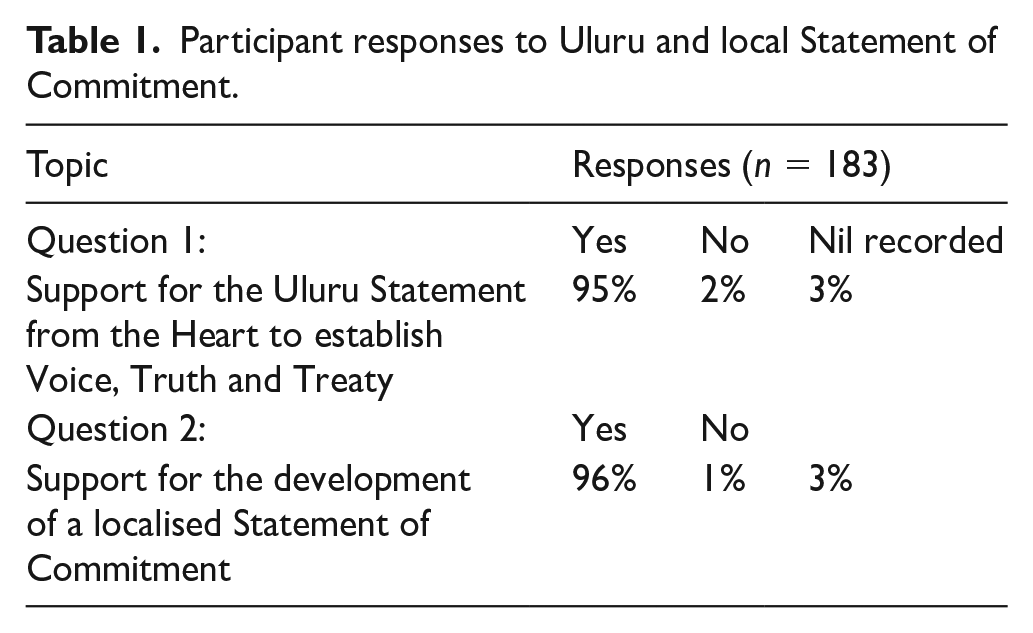
The local community NAIDOC event was held and approximately 250 adults attended the event. Of these, 183 attendees participated in the research and completed the survey postcards. The results of the quantitative data for the two closed-ended questions indicate overwhelming support both for the Uluru Statement from the Heart to establish First Nations Voice, Truth and Treaty about Australia’s history; and for a local Statement of Commitment (Table 1).
Participant responses to Uluru and local Statement of Commitment.
For the open-ended question, participants were asked to list three things they wanted to see included on the localised statement. A total of 167 responses were gathered for this question, and the strength of response has been indicated by the percentage of respondents who were included in each theme and sub-theme.
The phenomenological analysis of the third open-ended question developed clusters of meanings and themes which followed five broad topics: Respect, Voice, Truth, Treaty and Unity. Within each of these themes there emerged sub-themes which gave further meaning and clarity to the main theme, thereby creating an in-depth understanding of what voice, treaty and truth might look like for the Fraser Coast community.
Respect
Respect was a dominant theme across the data which emerged as a stand-alone category that encapsulated the notion of voice, treaty and truth. Approximately 45 percent of respondents indicated respect needed to be written into a local statement of commitment.
Voice
A second theme to emerge from the research to demonstrate what action was needed was that of giving voice through awareness and integration of three sub-themes: Culture through Education; Tradition and Lore; and Land Value and use. As these areas grow in voice, then it further develops respect for and within the local community. The Voice theme and its sub-themes were addressed by 87 percent of respondents.
Truth
The third theme to develop from the findings as a call for action was to know local truth. This theme for action is broken into three sub-themes: Knowledge and Understanding; Recognition of Past Histories; and Impact on Families and Communities. As the truth is told and shared, it further develops respect for and within the local community. As knowledge and understanding grows through the truth-telling, it connects with Culture through Education and gives greater Voice to the process. The Truth theme and its sub-themes were included by 75 percent of respondents.
Treaty
The fourth theme is to implement a local treaty and is sub-divided into three sub-themes: Inclusion into decision making; Commitment and support of local society and its Institutions; and Involvement of the Wider Community. As the treaty is enacted, it further builds respect for and within the local community. As the wider local community becomes involved with treaty through Memorandums of Understanding, it generates a deeper connection to families and communities within the local area where the truth about impacts on family is further told and shared. The Treaty theme and its sub-themes were addressed by 62 percent of respondents.
Unity
The fifth and final theme is Unity both within the First Nations People and across the Fraser Coast community. There are four sub-themes that arise and said to be outcomes of Unity: Pride and Empowerment for First Nations People; A Connected Community; Healing and Caring within Fraser Coast; and Reconciliation in Action. As the outcomes are achieved, it further develops respect within and across the local community. The Unity theme and its sub-themes were cited by 100 percent of respondents.
Summary
The themes of Respect and Unity relating to First Nations People are clearly a priority for people living on the Fraser Coast. There are overlaps within sub-themes that relate to other main themes which all stem from Respect and Unity, as these are the main drivers of Giving Voice, Truth-Telling and developing a local Treaty in the form of a Statement of Commitment. The above findings are demonstrated visually in an infographic (Figure 1).
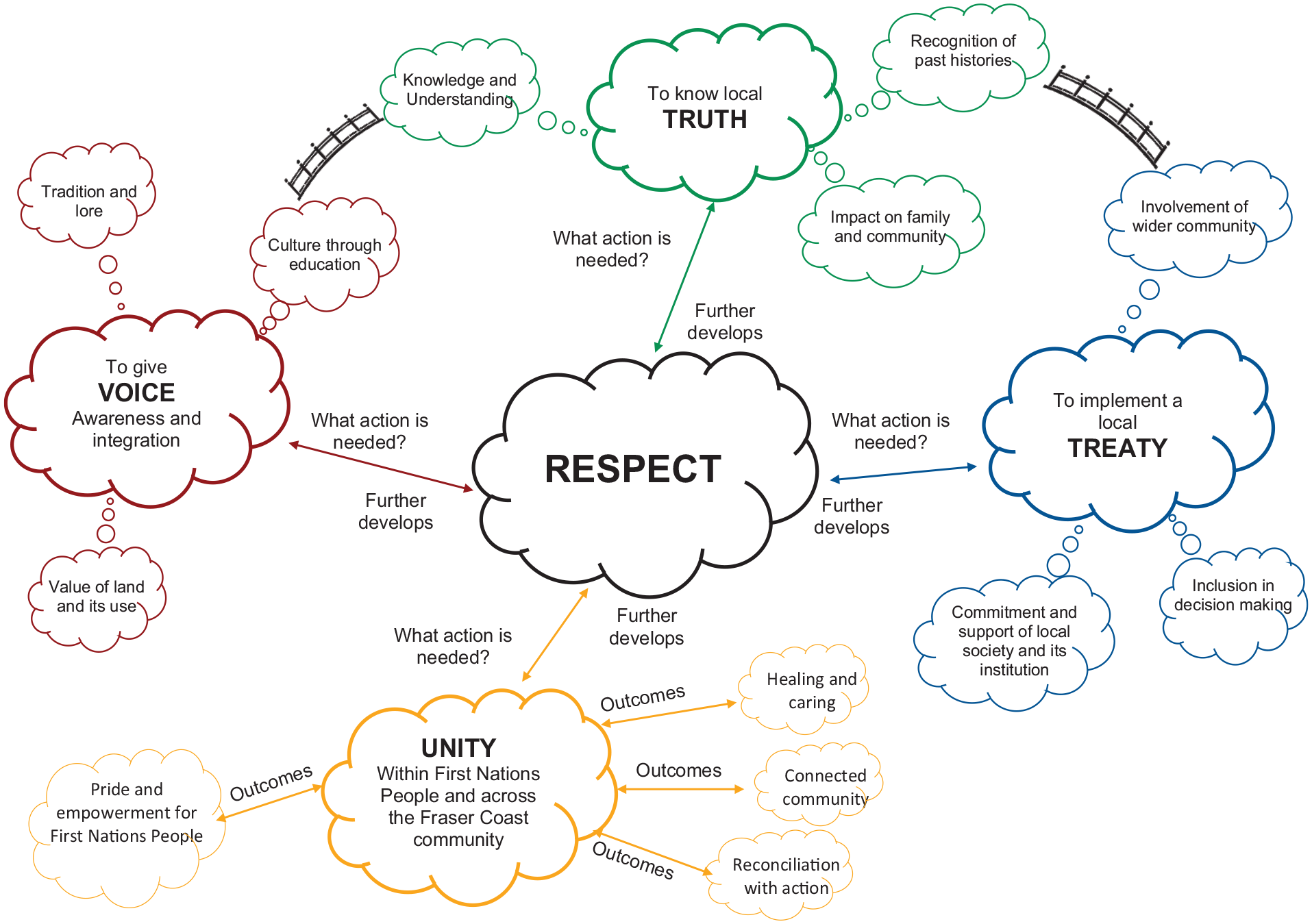
Local statement of commitment infographic.
Phase 2
The findings from Phase 1 were tabled and discussed within a community focus group alongside the Uluru Statement from the Heart where commonalities were identified through key words and phrases that emerged from the data. These commonalities and key words were highlighted to form the basis of a localised Statement of Commitment in partnership with the Central Queensland Indigenous Development and Fraser Coast Education University of the Sunshine Coast staff, Elders and representatives from throughout the community. The final statement was then endorsed by the focus group, the CQID board and the local Elders and community members (Figure 2).
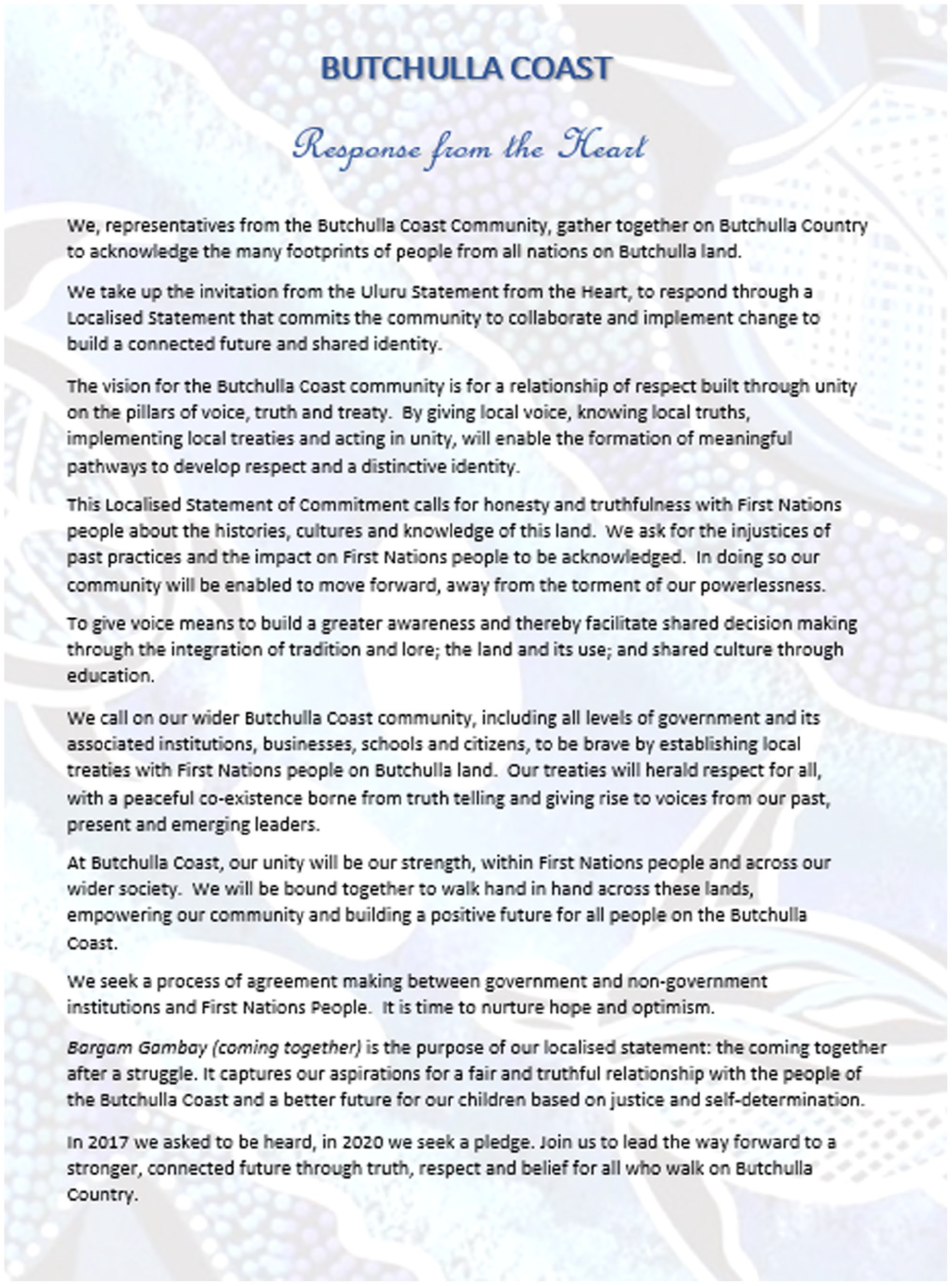
Butchulla Coast response from the heart statement.
Discussion
The aim of this innovative research was to develop a Localised Response to the Statement of Commitment which captures the spirit and intent of the national Uluru Statement from the Heart through establishing Voice, Treaty and Truth. The purpose of a localised response to the statement was to acknowledge the rhetoric of all levels of government around reconciliation and develop a strategic plan of action that could be achieved within a local context. The response would also act to raise the awareness of the general public to effect change in attitudes, behaviours and actions within the local community.
In terms of raising public awareness, the Local Response to the Statement is a flagship document that is seen as the local people’s united position on reconciliation and tied to actionable outcomes that actively promote reconciliation in the local context. For example, Memorandums of Understanding will be based on the Local Response to the Statement and used in collaborations and partnerships between CQID, the University of the Sunshine Coast and all other stakeholders so that they work together to further the best interests of Aboriginal and Torres Strait Islander peoples, families and children in the Fraser Coast region. Services and programmes can be specifically tailored to the needs of Aboriginal and Torres Strait Islander people in the region so that their voices are included in the decision-making process. Being part of the treaty process will instil in Aboriginal and Torres Strait Island peoples a sense of ownership and control over their lives in matters relating to health, education, employment, housing, justice, media, businesses, families and children. Furthermore, having a voice that is heard and acted on through a treaty will promote cultural connectedness, and the truth-telling will engender pride in the rich cultural heritage Aboriginal and Torres Strait Islander peoples bring to the Australian nation. Acting to turn words to deeds at the grassroots level through a culturally responsive agenda guided by the Local Response to the Statement is a defining element of reconciliation within the local community.
The stakeholders within the local community including health, education, employment, housing, justice, media, businesses, families and children can use the Local Response to the Statement to establish and maintain meaningful collaborations to incorporate cultural knowledge and active participation into their processes and practices. When stakeholders invest in strategies and actions which arise from the Local Response to the Statement, it will lead to a more inclusive and empowering approach and demonstrate each stakeholder’s commitment to reconciliation in their local community. When stakeholders actively incorporate the Local Response to the Statement, they will demonstrate their understanding of the impacts of colonial processes on Aboriginal and Torres Strait Islander peoples, including experiencing intergenerational trauma and the long-term effects of child removal. For effective collaboration between government and non-government agencies and Aboriginal and Torres Strait Islander communities, it is necessary for these agencies, and individuals who work within them, to have a meaningful understanding of the truthful history and experiences which impact the communities they serve. When working with Aboriginal and Torres Strait Islander people, it is important to consider how to recognise the needs of specific individuals while fostering a communal identity whose knowledge, culture and beliefs are valued and respected across the wider community. The processes and product of this research which lead to the Local Response to the Statement reflect and uphold this communal identity.
One of the limitations involved in researching and creating this Local Response to the Statement is the changing nature of community and society. As the local community develops over time and begins to transform into a reconciled Australia, it will be necessary to update the voice of the people so that their changing needs are heard, valued and acted on by the whole community. Since the response was developed in consolation with community, there is an element of researcher bias, since the aim was to respond to the Uluru Statement from the Heart and was based on lived experiences of local Aboriginal and Torres Strait Island peoples.
Future directions
The Local Response to the Statement of Commitment will be incorporated on to canvas depicting artwork created by a local Artist. Representatives from all stakeholder agencies will be invited to sign the canvas to demonstrate their support for reconciliation in the Fraser Coast region—a replica representation of the Uluru Statement from the Heart but nurtured and fostered by the local community.
The Local Response to the Statement will be used for CQID’s Cultural Camps and Youth Summit on K’gari, Queensland, to build identity and esteem of Indigenous young people in the Fraser Coast and empower them to take an active role in deciding their future. The Local Response to the Statement will be used as the charter to promote CQIDs Memorandum of Understanding in the Hervey Bay and Maryborough district, Queensland, for effective Aboriginal and Torres Strait Islander child and family welfare and education strategies. The employment of these strategies will empower Aboriginal and Torres Strait Islander communities, stakeholders and the wider community to work together to provide equitable life choices for all Australians, independent of heritage.
Conclusion
The research leading to the development of the Local Response to the Statement of Commitment was a vital and meaningful strategy which engaged with all members of the local community and supported reconciliation at a local level. The research process was one of inclusiveness and cultural sustainability and highlighted the importance of partnerships within the wider community to effect positive change.
The development of the Local Response to the Statement of Commitment furthers the Queensland Government’s aspirations towards achieving self-determination, agreement making and high expectations relationships which underpin the principles of the government’s policies aimed at Closing the Gap. This project enacted and reinforced self-determination for Aboriginal and Torres Strait Islander people by facilitating a pathway of action that would provide choice, participation and control over decisions that affect their lives and provide them with the opportunity to achieve their full potential.
The research project occurred at the nexus of theory and practice and is an example of reciprocity and consultation between the researchers and Australia’s First Nations People in the spirit of reconciliation. The outcomes of this research culminating in the Local Response to the Statement of Commitment demonstrate the power of voice, treaty and truth when grassroots communities are empowered by words to accomplish great deeds. The design of the research resulting in the Local Response to the Statement of Commitment provides a blueprint for other local Australian communities as a praxis for reconciliation and a way to move from words to deeds.
Footnotes
Acknowledgements
We acknowledge the traditional custodians of the land where we work and live: the Butchulla peoples of Australia. We honour the wisdom of Elders past and present across all First Nations people of Australia & the Torres Strait Islands, and seek to walk together in the spirit of reconciliation.
Authors’ note
Declaration of conflicting interests
The authors declared no potential conflicts of interest with respect to the research, authorship, and publication of this article.
Funding
The authors received no financial support for the research, authorship, and publication of this article.

Glossary
Butchulla Australian First Nation traditional owners of the Fraser Coast region whose Country extends from K’gari, Double Island Point, Tin Can Bay, Bauple Mountain and north to Burrum Heads, Queensland, Australia
Makarrata peace after a dispute