




Abstract
Despite sharing different cultures, customs, and pasts, Indigenous peoples in Latin America often face similar problems such as eviction from their ancestral lands, persecution, cultural genocide, and loss of their livelihoods. Yet, their knowledges and socio-cultural practices persist and have a lot to contribute to social work theory and practice despite being largely overlooked in Eurocentric and western social work curricula and formal education. Even though Indigenous social work has become a more popularized topic, the mainstream literature on the subject has often ignored the experiences of Latin American countries. Considering that, the aims of this article are at exploring, mapping, and presenting a synthesis of main concepts, trends, and values that could orientate social workers in their practice with Indigenous people and communities in the region of Latin America.
Introduction
Eurocentric and western social work curricula have dominantly focused on clinical practice—with the individual client being the main recipient of welfare services—and failed to properly address structural challenges posed by colonialism and the global capitalist expansion, which may reproduce inequalities and pose obstacles to radical social transformation. To create effective social change, social workers are required to engage in social policy practice and politics. Nonetheless, the gatekeepers of academia often silence or marginalize more critical and radical voices within the social work and social policy domains that engage with knowledge outside the Global North, especially traditional and Indigenous knowledges.
Despite sharing different cultures, customs, and pasts, Indigenous Peoples in Latin America often face similar problems such as eviction from their ancestral lands, persecution, cultural genocide, and loss of their livelihoods. Yet, their knowledges and socio-cultural practices persist and have a lot to contribute to social work theory and practice despite being largely overlooked in social work curricula in the Global North. Therefore, there is an urgent need to decolonize social work, which means not only incorporating post-colonial theory and approaches into the profession but questioning and calling out the reproduction of colonial practices through welfare and social assistance programs. A central argument of this work is that Indigenous knowledge and experiences are paramount to a critical, post-colonial approach to social work practice. Even though Indigenous social work (INSW) or social work with Indigenous Peoples has become a more popularized topic, see, for example Gray et al. (2010), the mainstream literature on the subject has virtually ignored the experiences of Latin American countries.
Considering that, the aim here is to explore, map, and present a synthesis of main concepts, trends, and values that orientate social workers in their practice with Indigenous peoples in the region of Latin America. The Indigenous population of Latin America is comprised of around 50 million people, who belong to 500 different ethnic groups, and the largest populations are located in Mexico, Guatemala, Peru, and Bolivia (de Dios, 2020). Yet, they disproportionately represent 14% of the population living in poverty and 17% of the population living in extreme poverty (The World Bank, 2016); therefore, they are very likely to require social assistance and specific social policies. Nonetheless, little is known about social work intervention with these peoples and the principles or values that guide these interventions.
Research design and methods
Academic works exploring Indigenous or traditional philosophies in social work such as the African concept of Ubuntu (Mayaka & Truell, 2021), theories in Māori social work from New Zealand (Hollis-English, 2015), and Aboriginal social work education in Canada (Sinclair, 2004) have contributed to the emergence of a new whole body of literature on INSW worldwide. Latin American countries, on the other hand, have largely been excluded from this conversation, having not centrally appeared in INSW scholarship published in English. For that reason, concepts originating from Latin American nations such as the Buen Vivir (good living) social philosophy (Acosta & Abarca, 2018), among others, will be presented and discussed, alongside their roles in guiding intervention with Indigenous Peoples in that region of the world.
This is an exploratory research article that adopts a qualitative approach, which involves data collection from multiple sources, including documents, journal articles, newspaper sources, and so on, with inductive analysis, and a holistic account of the issue under exploration (Creswell & Creswell, 2018). This will lead to a theoretical exercise—based on the existing literature on INSW in Latin America—that aims at mapping and suggesting the praxis and values of social work interventions with Indigenous peoples.
Mind, body, and soul is an analogy used throughout this article to pursue the foundations of INSW in Latin American countries. The mind corresponds to Epistemology—knowing—but also Ontology—being—and the connection between physical and spiritual worlds, which means the architecture of Indigenous knowledges and lived experiences to be considered and embraced by social work theory. The body speaks to Methodology—doing—and the practical aspects of INSW in Latin American countries. At last, the soul is related to Axiology, that is, the values and moral systems and spiritual relations cultivated by different Indigenous communities which will be encountered by social workers. These core features of Indigenous approaches to social work were first introduced by Rowe et al. (2015) and were adapted to the context of this research.
Background
Decolonizing social work, building Indigenous social work
Social work as a profession was born out of voluntarism and the necessity to address the social issues and the consequences of industrialization in Europe and North America during the late 19th century (Stuart, 2013). Since then, social work both as a profession and academic discipline has expanded globally and considerably widened its field of action and intervention. International and transnational social work, for example, is a result of the internationalization of the social work praxis which aims at collectively addressing the global challenges of poverty, inequality, and other structural challenges that transcend national boundaries (Wallimann, 2014).
However, even though social work and its idioms have also been practiced and theorized about in the Global South, the mainstream and most influential literature on social work continues to be produced in and for the Global North. This becomes particularly pervasive when knowledges from previous white settlers and colonial empires are uncritically applied to social intervention strategies with Indigenous and other traditional peoples. Therefore, there is a need to unveil the colonial roots of modern social work theory, reject the attempts of cultural genocide inside our profession, and build a culturally sensitive practice that embraces knowledges from the other side of the line including Indigenous and traditional knowledge and traditional cultural expressions. Boaventura de Sousa Santos has referred to modern western thought as abyssal thinking—a dichotomous, colonial way of thinking that divides the world into two sides: this side of the line, and the other side of the line. Whereas the first defines the content and debates of scientific knowledge, and the latter—usually popular, traditional, or Indigenous knowledges from former colonies—is made invisible, unacceptable and unapplicable (de Sousa Santos, 2007).
Postcoloniality is one of many avenues to reach a true ecology of knowledges. On that note, postcolonial theory and studies is a diverse field “concerned with accounting for the political, aesthetic, economic, historical, and social impact of European colonial rule around the world in the 18th through the 20th century” (Elam, 2019, para. 1). Postcolonial theories and movements have not only confronted the colonial past, but they are also worried about the persistency of a colonial mentality, that is, the perception of ethnic and cultural inferiority and internalized forms of racial oppression (Decena, 2014), which—among other things—contribute to maintaining the western, Global North’s monopoly on what it is valid knowledge, and particularly in this case, what counts as social work knowledge. A central task for postcolonialism, therefore, is also to beget the diversity of cultural experiences and counter-knowledges, aiming to dismantle the western monopoly on knowledge by taking other knowledges and other perspectives as seriously as those of the west (Young, 2003). Similarly, postcolonial social work can be understood as: a movement from within the social work profession, aiming at critically looking at social work education, research, and practice with the objective to decolonise the system of social work. It includes, for example, concepts linked to critical whiteness, anti- racism, indigenisation, “learning to un-learn” Euro- American logic (imposed over centuries on non- Western cultures) [as written in original work] as well as more recently intersectionality. (Kleibl, 2020, p. 9)
As previously demonstrated by Ranta-Tyrkkö (2011), even though the relationship between social work and colonialism has been largely understudied in academia, her findings suggest that social work practices across the Northern Atlantic were indeed connected with the colonial project through its civilizing mission. The past and present cultural, political, and economic aspects of colonialism within the field of social work and social policy, requires both academicians and practitioners to constantly confront and denounce oppressive and domination structures often reproduced through social work practices and welfare programs. This is particularly true when social workers are engaged with Indigenous peoples and people of Indigenous ancestry.
As a result of the dominant western paradigms and practices in the social work profession, many social workers contributed, for example, to the forced removal of Indigenous children from their communities, which led to the reproduction of culturally destructive practices around the world—according to Gray et al. (2008). Nonetheless, “this is not surprising given that social work is essentially a modernist western invention which has a history of silencing marginal voices and importing, into diverse cultural contexts across the world, western thinking primarily from the UK and the USA” (Gray et al., 2008, p. 1). Indigenous social work emerges then as a movement toward the rediscovery and valorization of the diversity and uniqueness of local Indigenous and traditional cultures and knowledges and how they can guide the construction of culturally appropriate social work practice (Gray et al., 2008; Rowe et al., 2015).
In sum, despite its inherent diversity, INSW aims, among other things, at dismantling the often-harmful architectures of Eurocentric, Anglo-American social work knowledge and values applied to social intervention with Indigenous people, to build a culturally relevant practice that takes into consideration and valorizes the voices and experiences of Indigenous Peoples (Gray & Coates, 2010; Weaver, 1999). INSW has gained more attention in the last decade or so, especially in countries such as Australia, Canada, New Zealand, China, Malaysia, and India, where “Indigenous voices are finding some expression in the mainstream literature, notably in the areas of spirituality and environmental social work” (Gray et al., 2007, p. 55). At the same time, Latin American experiences with INSW have been largely excluded from these debates, which raises the necessity to further explore the topic.
Latin America and social work in and of the South
The term Latin America is historically inaccurate (American Historical Association, 1945; Espinosa, 1918)—given the continent’s highly diverse cultures and populations who are not of Latin origin but rather a mix of multi-ethnic groups of Indigenous origin, descendants of African slaves and other ethnic compositions (Wade, 2010). The popularized Indigenous term for the Americas, Abya Yala, will be used interchangeably throughout the article. For the sake of convenience and sufficient abstraction, this article adopts the terminology Latin American countries without assuming that the region is homogeneous either politically or economically speaking. The term Indigenous is a problematic one as well, even though it is largely used in scholarship and legal documents, given its homogenizing effect harmful to first nations, and aboriginal or tribal peoples, which are also contested terms (Peters & Mika, 2017). However, taking into consideration the enormous ethnic diversity among the Native groups of Latin America—and the counter-productive activity of addressing at least 826 different Indigenous peoples by name—the term Indigenous will be employed throughout the manuscript minding its controversies.
Latin American nations indeed share many commonalities, however, which include but are not limited to a past of colonization, slavery, and looting of their wealth and natural resources by European and North American powers, as well as common contemporary challenges such as inequality, violence, and a disadvantaged position in the international division of labor. Therefore, the practice of social work in Latin America cannot ignore the history and ongoing effects of colonial and imperialistic violence which includes the genocide of Indigenous peoples and their cultures. Similar to the famous pen and ink drawing América Invertida (Inverted America) (1943) by Joaquín Torres-García (1874–1949) (Figure 1), social work scholars and practitioners need to flip their mindsets to visualize South America and Latin America from a counter-hegemonic perspective while acknowledging the importance and validity of anthropophagic knowledge (Islam, 2012) produced in the Global South and on the other side of the line.
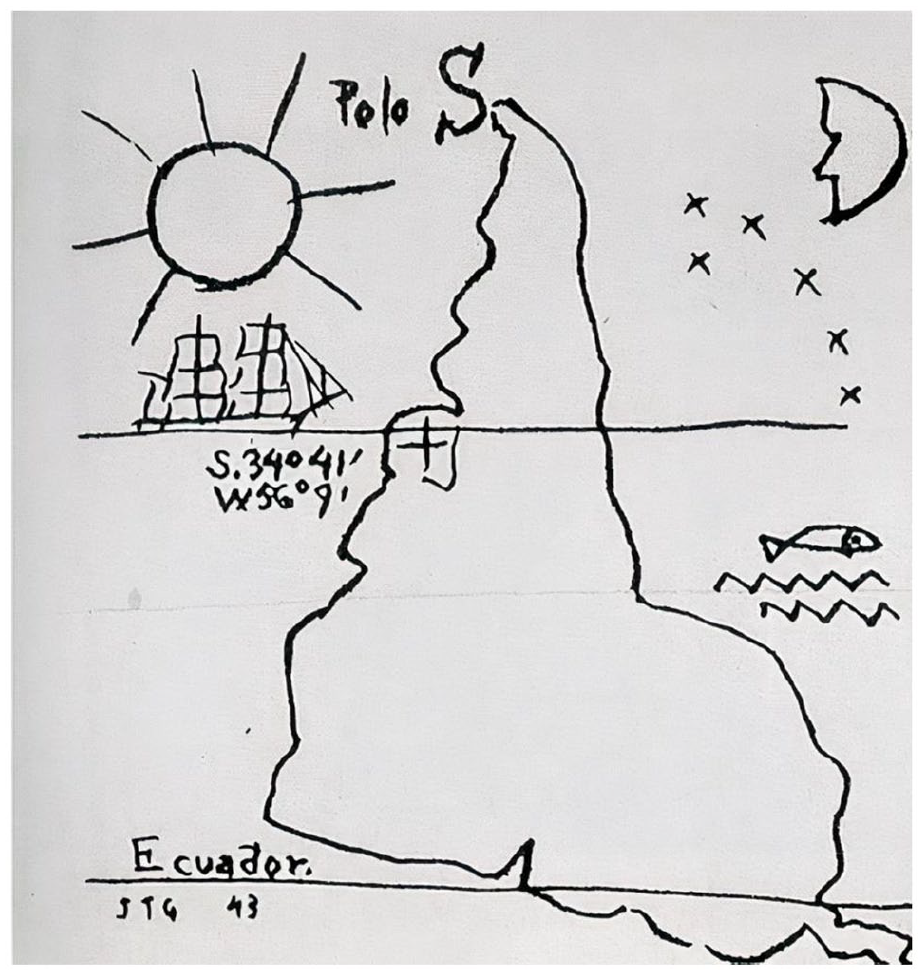
América Invertida (Torres García, 1943) [pen and ink on paper]. Retrieved from https://worldhistorycommons.org/america-invertida-inverted-america.
After analyzing 10 of the largest social work journals, Roche and Flynn (2020) recent findings suggest an absence of knowledge from the Global South in mainstream social work research and theory, which reveals a pattern of global inequities in knowledge production and dissemination in the field of social work. In response, Social Work of the South or Southern Social Work rises as a theoretical and political movement that aims at showcasing “the efforts of social work in the South to achieve independence by processes of indigenization and authentization, to escape from the colonial clutches of the North” (Lutz et al., 2021, para. 2). Accordingly, social work as a highly localized and contextualized profession, demands knowledge and practices that are culturally relevant and sensitive to knowledge structures from outside western science and academia, which include faith and spirituality, Indigenous and traditional knowledge, and other systems of beliefs relevant to social intervention.
The mind map of social work theory and practice is not completely flipped, and the knowledges from the other side of the line remain somewhat peripheral and subalternized. The task of indigenization—central to Social Work of the South—does not aim at ignoring or invalidating the bulk of social work knowledge produced in and for the North, it consists rather in translating that knowledge to local realities, advocating for culturally relevant social work education, and calling for Indigenous experiences and approaches to integrate social work research agendas across the globe (Gray & Hetherington, 2013). In this context, indigenization is referred to as a movement “to expand the academy’s still-narrow conceptions of knowledge, to include Indigenous perspectives in transformative ways” (Gaudry & Lorenz, 2018, p. 218).
In this instance, social work in Latin America often reflects the cultural and historical trajectories of the region and is marked by a diversity of practices and interventions, thus making a valuable contribution to advancing social work theory in and of the South. A great deal of studies has already dived deeper and longer into the history of Latin American social work; therefore, this paragraph attempts only to briefly describe some of the common challenges and trends in this area. The first school of social work in Latin America was established in Chile in 1925, soon followed by Argentina, Uruguay, and Mexico (Resnick, 1980). According to Resnick (1980), at its beginning, Latin American social work education was highly dependent upon concepts and methodologies from the industrialized countries of Europe and North America, and borrowing these conceptual bases was inevitable at the time. Not too long after that, in the 1960s a reconceptualization movement started aiming at distancing the social work curricula in Latin America from the North American clinical-oriented model, to address the conditions of underdevelopment and promote social change in the region (Campfens, 1988).
Even though each nation in Latin America came across re-conceptualization differently (Parada, 2007), the movement, in general, sought to reconceptualize social work education according to the particular socioeconomic circumstances of Latin America, with a focus on political and class struggles. In the late 1990s and early 2000s, Latin American social work was generally focused on denouncing and rejecting the adoption of neoliberal agendas—which included the privatization of social services and a decrease in public social spending—as well as the side effects of globalization (Parada, 2007).
Nevertheless, the bulk of literature concerning social work in Latin America is, of course, very diverse; it touches upon different themes and socio-political agendas, as much as it is influenced by a myriad of theoretical traditions. Gómez Hernández (2008), for example, explores the role of community development and its impacts on the social work profession. According to her, social work and community work can continue to promote and support the colonizing process of Western Europe and North America through the implementation of the development models they advertise, or it has the possibility of reinventing itself through more intercultural perspectives, in which local knowledge, collective action and the construction of subjectivities will trump universal models produced in and for the Global North (Gómez Hernández, 2008). On the other hand, Silvana Martínez and Juan Agüero build a religious account of ethical values in social work, drawing from experiences in Argentina. They reconstruct the history of Argentinian social work, exploring its close ties to Christianity, and more recently Pope Francis’ philosophy, among other things (Martínez & Agüero, 2019).
Furthermore, Maria Eugenia Hermida (2020) presents the genealogy of Latin American social work, with a focus on what she calls the third wave or third interruption in the discipline. According to Hermida (2020), in this new line of scholarship, epistemology is tied to political action, and it is driven by decolonial and anti-patriarchal practices in social work. To the author, there are no protocols, only clues, and a heuristic capacity to reinvent the profession and find alternatives to neoliberalism, neofascism, patriarchy, and coloniality (Hermida, 2020). On the same path, Muñoz-Arce and Rain (2022) further explore the need to decolonize community social work by bringing forward the principles from Mapuche philosophy. In opposition to neoliberal perspectives, they place the struggle of Indigenous peoples in Latin America, in particular, the Mapuche people in Chile, at the heart of community social work practice (Muñoz-Arce & Rain, 2022).
More recently, social work in Latin America seems to continue on the reconceptualization path but is now focused on bridging the theoretical and practical aspects of the discipline, strengthening the profession against new trends of austerity and precarity, including minority and marginalized groups on the larger mandate of social justice, and integrating Indigenous worldviews onto social work curricula (Saracostti et al., 2012). To sum up, Latin American social work has a lot to contribute to social work theory despite the marginal position it currently occupies in the discipline.
The next section explores ways in which to further indigenize social work in Latin America, and it presents key aspects of Indigenous worldviews in that region and how they can be applied to social work theory-practice.
Discussion
Latin American perspectives on Indigenous social work
As demonstrated before by Cox et al. (2021), Indigenous research and theory usually derive from actual lived experiences rooted in Indigenous and ancestral knowledges and not from predetermined categories usually found in western positive sciences. Therefore, the aim here is not at introducing a metatheory or grand theory of INSW in Latin America, instead, we advocate for Indigenous knowledges and epistemologies to be incorporated into Latin American social work research envisioning the creation of better practices through the indigenization of mainstream approaches to welfare studies, which may lead more successful social work interventions in this particular field. Some of what we believe to be key aspects of Latin American Indigenous theories and philosophies relevant to the social work profession are discussed below.
Mind
When it comes to the rich ecology of Indigenous knowledges in Latin America, there are many lessons to be considered and embraced by social work theory and social theory in general. First of all, it is necessary to point out that “Indigenous peoples around the world have preserved distinctive understandings, rooted in cultural experience, that guide relations among human, non-human, and other-than human beings in specific ecosystems” (Bruchac, 2014, p. 3814), and these understandings and experiences make up what is broadly defined as Indigenous knowledge. Second, it can be very difficult to identify the bulk, or the trajectory of these knowledges given the outstanding linguistic diversity among the Indigenous peoples of Latin America and the historical whitewashing attempts driven by colonizing forces in and outside academia. Even though some systematization efforts have been done, the literature on Indigenous knowledges in Latin America remains largely scattered or confined to local and national realities (Pérez Ruiz & Argueta Villamar, 2011).
With that said, there are still efforts to document these knowledges, and they are described going forward. For social work students, scholars, and practitioners interested in learning more about the history of Indigenous peoples in Latin America prior to but also after the European invasion and settlement, they can consult the book A History of Indigenous Latin America: Aymara to Zapatistas (Horst, 2020). In this book, Horst (2020) provides a postcolonial account of Latin American Indigenous history and addresses the major historical and cultural events affecting the people who originally settled in Abya Yala. Even though the volume is not particularly centered around Latin American Indigenous knowledges, it provides a deep understanding of Indigenous issues in the continent from a historical perspective, which can contribute greatly to a critical, postcolonial social work education.
Notwithstanding, Intelectuales Indígenas Piensan América Latina (Indigenous Intellectuals Think Latin America) is another book of utmost relevance for understanding Latin American Indigenous worldviews (Silva, 2007). Edited by Claudia Zapata Silva (2007), this book brings together several Indigenous public intellectuals from different Latin American countries to think about a Latin American identity from an Indigenous perspective, writing in Spanish and in Indigenous languages. This work reflects both the diversity and complexity of Indigenous thought in Latin America as a form of manifesto against modernizing forces in higher education that wish to erase Indigenous knowledge systems from formal education and training in various fields. Authors are from different Indigenous ethnic groups and some of the recurrent themes explored by them include Indigenous identity projects and its critiques and tensions, as well as political and social movements toward cultural revindication, authentization, and self-determination (Silva, 2007).
In Intelectuales Indígenas Piensan América Latina, the chapter written by María Eugenia Choque Quispe, Indigenous historian and social worker—as well as some of her other writings and speeches—are of particular significance for Latin American INSW education and practice. Quispe (2007) talks about a need to (re)write history from the unique perspective of Indigenous peoples. She introduces the concept of Qhip Nayra (past and future) as a native Andean principle that asserts that the future of the Indigenous collectivity lies in its ancestral past (Quispe, 2007). According to the author, the recent written memory of colonization cannot supersede the ancient oral memories of Indigenous cultures represented in their myths, traditions, history, and poetry. Therefore, social workers engaging with Indigenous peoples of Latin America must base their interventions not only on the knowledge of the present but especially on the collective knowledge that precedes social work theory. It is not about abandoning social work values and methodologies but recognizing that Indigenous understandings are of equal importance when designing intervention strategies. For instance, Quispe (2007) recognizes the validity of human rights when interpreted through Indigenous categorizations; the Andean saying Jiwas pachpa amuyañani thakisa katxatañataki (We ourselves will take on our future) speaks directly to the right to self-determination. Therefore, INSW in Latin America consists of a constant process of (re)adaptation, self-reflexivity, and negotiation between different knowledge systems.
Of all the Indigenous philosophies in Latin America, the Buen Vivir has certainly gathered more attention from scholars. The term found in at least three Indigenous languages—Suma Qamaña in Aymaran (language spoken by the Aymara people), Sumak Kawsay in Quechua (language spoken among several Indigenous peoples in South America), or Küme Mongen in Mapuche (Araucanian language spoken in Chile and Argentina by the Mapuche people)—refers to an alternative path to that of western capitalism (Acosta & Abarca, 2018), it speaks to the idea of good and balanced coexistence, a good society for all in sufficient harmony between human and non-humans and with particular respect for the Pachamama (Mother Earth, Mother Nature) (Tortosa, 2011), a revered goddess of Indigenous peoples in the Andes, which represents the Planet as a sentient being with its own desires and power to destroy or give life. More generally, “for Buen Vivir, the questions of justice and of the good life are linked, suggesting that what causes injustice and destruction of nature and human life is a certain conception of the good life which submits nature and human relations to profits” (Gerlach, 2019, p. 117).
The concept has not only been incorporated in Indigenous movements throughout South America in special, but it has also been introduced in the text of the Bolivian Constitution of 2009 and that of Ecuador in 2008 (Altmann, 2016). As argued before by Gerlach (2019), social workers can make use of the concept and incorporate it into their practice by promoting and supporting relations of cooperation between individuals and different socio-political systems, with such cooperation being underlined by community values. In addition, as Buen Vivir speaks to the notion of harmonious, collective socio-environmental development, social workers oriented by that philosophy are able to address and advocate against exploitation-based policies which are harmful to the environment and the lives of present and future generations in Abya Yala and beyond (Acosta & Abarca, 2018). It “describes a way of doing things that is community-centric, ecologically-balanced and culturally-sensitive” (Balch, 2013, para. 1).
Across Latin America, nations and cultures have different relationships with Indigenous and traditional knowledges. Costa Rica is a good example of how these non-western knowledge systems are not only valued but sometimes even prevail over positive science. For instance, traditional medicinal herbs are preferred by the general population instead of standard forms of medicine (Ortega-Rodríguez & Solís-Sánchez, 2019). Nonetheless, although medicine is an important aspect of Indigenous knowledge in Costa Rica, the social organization of the Bribri Indigenous people—the country’s largest one—is even more interesting and provides valuable insights to the social work profession. According to Ruiz Fernández et al. (2019), in the Bribri culture, women are the only ones allowed to transmit clan membership; furthermore, they are also the ones that have the right to land ownership, whereas the men have the legal right to use the land but not to own it. Therefore, Bribri women are seen as the agents of their own destinies and more than capable of managing their resources (Ruiz Fernández et al., 2019). It does not mean they enjoy full equality—as the burden of child care and domestic work, for example, still falls mostly upon the women—however, the active role they take in society can contribute to a unique perspective on Indigenous feminist theory (McGuire-Adams, 2020) in Latin America and to integrating these views into the social work profession. This is particularly important given that the feminist critique in social work is still mainly dominated by western discourses and liberal theories (Hicks, 2015).
Indigenous philosophies and systems of knowledge in Latin America are important sources to social work educators, scholars, and practitioners in their task to indigenize the profession. In Mexico, the wisdom of the Nahua people has been recently explored by González Romero (2021) in her doctoral dissertation and provides important insights into intercultural practices and Indigenous land rights. She brings to light the often silenced worldviews of Indigenous communities and scholars, empathizing with how Nahuatl (qualifying adjective used to refer to the Nahua people) philosophy can be useful in providing alternatives to make sense of the world we live in (González Romero, 2021). There is also an emphasis on participatory methodologies whereas Indigenous peoples and their viewpoints are at the center of the investigation process. In her findings, she also mentions something called altepeamatl (land papers; a book-keeping system) in the Nahuatl language, which are documents that allow us to understand how Nahua communities sought to defend ownership of their lands in the years after the establishment of the colonial regime in Mexico (González Romero, 2021). The Nahua wisdom and philosophy are also intimately linked to the concept of Buen Vivir, or cualli nemiliz, which can help establish a type of relationship with nature other than the one that prevails under global capitalism.
From these reflections, Latin American social workers in close partnership with Indigenous people can advocate for (a) redress to historical injustices that are products of (neo)colonialism in Abya Yala, (2) demarcation and registration of Indigenous lands and territories, (3) the involvement of Indigenous communities and scholars in the decision-making process of social work intervention strategies, and (4) introducing Indigenous philosophies and worldviews into their practice. The concepts and epistemologies here presented are not exhaustive though, they represent only one part of Indigenous knowledge systems in Latin America. Social work is highly influenced by local praxis, and we hope that for future research more and more social work and Indigenous scholars feel encouraged to speak and write about their own experiences in different socio-geographic contexts.
Body
The question of how social workers can apply Indigenous theories and worldviews to their everyday practice and interventions is of great relevance given the practical aspects of the profession. First of all, social work with Indigenous people requires collaboration and cooperation by allowing the construction of collective ideas and participatory processes, which is why the term intervention—so common to the profession in the western world—should be avoided in INSW practice (Uribe Cardona, 2016). As mentioned before, the Indigenous peoples of Abya Yala are strongly guided by the ideas of autonomy and self-determination, by using the term intervention therefore may sound like the social worker is interfering undesirably in their affairs. Other terminology such as participation and collaboration should be encouraged instead.
Furthermore, there is not a single way or methodology to work with Indigenous peoples, what social workers should aspire to do is, advocate for the visibility and recognition of the meanings of life and worldviews of Indigenous peoples, raising awareness within the profession of the aspects that are relevant for the Indigenous communities they are working with, which might include issues around education, health, food sovereignty, self-determination, legal recognition, discrimination, among other things (Uribe Cardona, 2016). In this sense, social workers should avoid taking a deductive approach to INSW practice, instead, an inductive one should be preferred. That means starting from a contextual situation, such as the conditions and beliefs the Indigenous person or people are subjected to at that time and place, and subsequently, the social worker(s) and their team will come up with solutions and strategies in partnership with the individuals and communities they are serving (Figure 2).
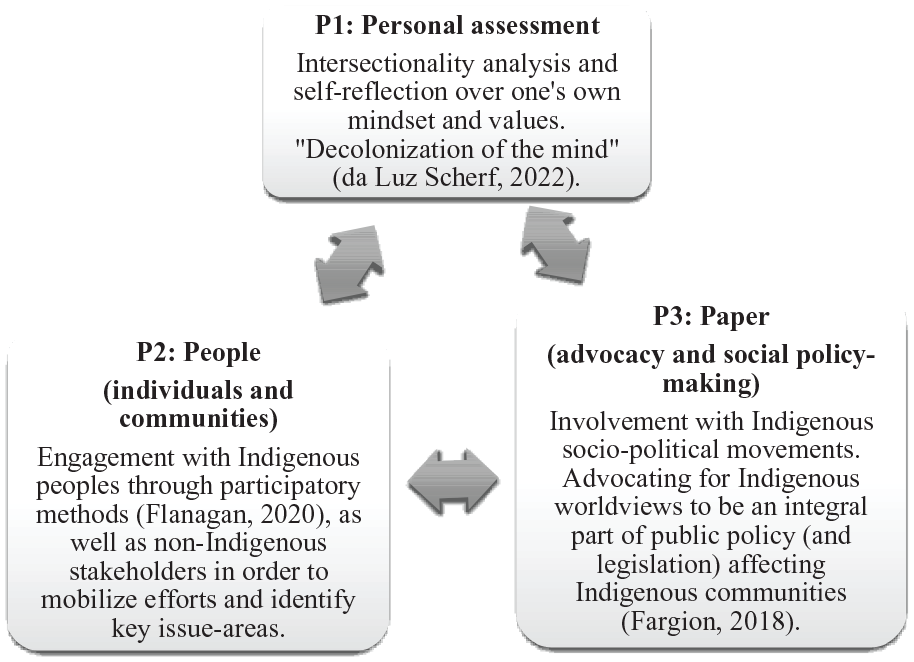
Indigenous social work in Latin America, a framework for practice (elaborated by the author, based on Pawar’s (2019) 3 Ps model for practice).
In Latin America, where “the adoption of the World Bank’s guidelines has produced a new scenario where social workers’ interventions are guided by neoliberal principles—individualism, competition, privatization and commodification of all domains of life” (Muñoz Arce, 2020, p. 166), it is of utmost importance for social workers to promote values and perspectives that are opposite to the neoliberal ideology, such as the notion of Buen Vivir, community ties, collective rights, self-determination, and decommodification of social life (Muñoz Arce, 2020).
Even though it might be hard for social workers alone to subvert hegemonic approaches in social work practice, it all starts by returning to Indigenous traditions as a source of useful knowledge, which requires learning to unlearn the Eurocentric reason that is often printed in our subconsciousness (Muñoz Arce, 2020). This is what da Luz Scherf (2022, p. 144) refers to as the decolonization of the mind in the context of critical social work practice with vulnerable groups. In Latin America, social workers have also joined and formed Indigenous social movements to advocate, in the political sphere, for Indigenous rights and to denounce State violence against Indigenous peoples (Muñoz Arce, 2020; Soto-López, 2018), this is another strategy to foster counter-hegemonic practice in our field.
Soul
For the past 20 years or so, social work practice has been at odds with religion and spirituality, as suggested by Gardner (2020), ever since the profession has tried to distance itself from its religious roots. Even though social work is a values-led profession, in recent years social work theories, especially in western social work education, have focused a lot on positive methods, clinical interventions, and more recently systemic approaches, but little on spiritual practices and how they could contribute to both professionals and service users. On that note, the recent The Routledge Handbook of Religion, Spirituality and Social Work (2017) and some other works have attempted at providing a comprehensive account of contemporary issues around religion and spirituality in social work research and practice (Crisp, 2017b). Crisp (2017a) mentions, however, that the majority of the literature on the subject still reflects the experiences of North America and the United Kingdom, which still dominate the international social work debate. Consequently, evidence of spiritual practices in social work often refers to well-known western religions, with virtually no mention of Indigenous spirituality and religions for example.
In the Latin American context, where Catholicism was a key aspect of colonialism, it is extremely important for social workers involved with Indigenous peoples to understand and advocate for the protection of Indigenous beliefs and spiritualities because they are at the core of Indigenous value systems in the region (Tomaselli & Xanthaki, 2021). Therefore, truly post-colonial social work practice in Latin America needs to acknowledge the validity and importance of Indigenous spiritual practices and how much they have to contribute to collaboration between social workers and Indigenous groups. In Central and South America, what Opas (2017, p. 79) refers to as “Indigenous Theology” is intimately related to self-identity, the collective nature of humanity, and the connection with the Pachamama.
These values are not in opposition to the social work profession, they can be found—although in a different grammar—in practice guidelines, on the global definition of the profession, as well as in the global statement of ethical principles (International Federation of Social Workers, 2014, 2018). Nonetheless, it is important to understand and interpret these values through Indigenous viewpoints and social workers can do that with the help of Indigenous leaders, scholars, and other community members. Religious healing is also another common expression of Indigenous spirituality in Latin America, according to Hendrickson (2014). These, and other spiritual practices and rituals constitute a crucial part of Indigenous identities in Abya Yala and should be integrated into collaboration strategies in the context of INSW.
Conclusions
The quest for Indigenous social work in Latin America cannot be dissociated from the region’s past and present struggles with colonization and imperialism or current political movements demanding recognition of Indigenous rights and lands. The daily genocides attempts at Native and traditional peoples of Latin America have not been met passively by Indigenous communities (Clavero, 2011; da Luz Scherf et al., 2021), on the contrary, resistance is at the core of Indigenous movements in Latin American countries (Altamirano-Jiménez, 2021; Debelo, 2011). It is this same spirit of resistance and activism that should guide Latin American social workers in their practice and collaborations with Indigenous people and communities against neocolonial violence. The adoption of Indigenous methodologies in welfare programs alongside auto-reflexive exercises is crucial to ensure culturally sensitive social work practices with the Indigenous peoples of Abya Yala.
The traditional social work curricula carry biases and ideological underpinnings that may be harmful and inadequate when approaching issues related to Indigenous welfare. Thus, the aim of this article was at mapping values and suggesting practices of social work collaborations with Indigenous peoples that are truly respectful of and embraceable to Indigenous worldviews in Latin America. The mainstream literature on INSW published in English has generally overlooked the knowledges and experiences of Latin American Indigenous peoples. Therefore, more research projects like this one should be encouraged, in close participation with social work professionals and Indigenous communities.
The main themes identified throughout the article—concerning key Indigenous beliefs and practices– were (a) the notion of Qhip Nayra, that is, the centrality of ancient oral memories in Indigenous cultures; (b) the philosophy of and right to self-determination; (c) the concept of Buen Vivir and the interconnectedness between human, non-humans and the Pachamama; and (d) as well as the importance to defend the Indigenous ownership of their ancestral lands. A framework for social work and social policy practice with Indigenous peoples was also suggested (Figure 2), alongside the necessity to understand and advocate for the protection of Indigenous beliefs and spiritualities.
This theoretical exercise with practical implications was not meant to create a single approach to INSW in Latin America, instead, we advocate for Indigenous knowledges and epistemologies to be incorporated into social work research and practice, envisioning the creation of better social welfare outcomes for both Indigenous and non-Indigenous groups. One of the major limitations of this research is the lack of empirically collected data. It does not undermine however the importance of the subject and its findings for the decolonization and indigenization of social work literature.
Going forward, one of the suggestions to overcome colonial biases in the social work profession is to rethink the structures of social work education in Latin America altogether, and in the Global South more generally. The social work curriculum needs to reflect the struggles and the worldviews of Indigenous people. This means an honest commitment to embracing interculturality and Indigenous knowledge in Latin American social work schools (Cortina & Earl, 2021). It might also mean teaching certain social work courses in Indigenous languages and partnering with Indigenous scholars and intellectuals. Bilingual social work programs can be designed in close partnership with local Indigenous language initiatives and grassroots organizations (Becker, 2008; Cortina, 2014). In sum, as mentioned before, INSW is not about abandoning traditional social work values and methodologies but recognizing that Indigenous understandings are of equal importance in social work program design and evaluation.
Footnotes
Acknowledgements
I acknowledge my personal privilege as a non-Indigenous person, recognizing I might never experience the oppression Indigenous peoples may be subjected to every day. I do not mean to speak on behalf of Indigenous persons but to advocate in partnership with them for Indigenous worldviews to be integrated into social work theory, research, and practice.
Author’s note
Declaration of conflicting interests
The author declared no potential conflicts of interest with respect to the research, authorship, and publication of this article.
Funding
The author received no financial support for the research, authorship, and publication of this article.

Glossary
altepeamatl land papers; a book-keeping system
Aymara Indigenous people in the central Andes, particularly in Peru and Bolivia
Aymaran language spoken by the Aymara people
qhip nayra past and future
suma qamaña good living, to live well
Bribri Indigenous people in Costa Rica and Panama
Abya Yala Americas; often referred to Latin America as well
küme mongen good living, to live well
Mapuche Indigenous people, natives of Chile, Argentina and Patagonia
Nahua Indigenous people of Central America, originally associated with the ancient Aztec people.
Nahuatl qualifying adjective used to refer to the Nahua people
Pachamama Mother Earth, Mother Nature
Quechua Language spoken among several Indigenous peoples in South America
sumak kawsay good living, to live well
buen vivir good living, to live well, living in harmony with nature