




Abstract
The persistence of a broad coalition of social movements, including Indigenous-led protests in the 1990s, the War on Gas, War on Water and the election of Evo Morales, contributed to a Plurinational Constitution in 2009. The result was a profound reframing of the social contract, enshrining legal, political and social pluralism. Nevertheless, the extent to which these measures have led to an improvement is still debated. For this reason, based on 22 interviews in La Paz and Sucre with former Constituent Assembly members from 2017 to 2019, this article examines the role of social movements in contesting the status quo. Second, it explores whether the pluralistic measures have changed the situation of Indigenous peoples and decolonised the governance model.
Introduction
In 1825, Bolivia obtained its independence and became a nation-state, following the European model. Nevertheless, for Indigenous peoples, independence did not improve their lives. Instead, the emerging State catered to the interests of a landowning oligarchy while repressing the Indigenous majority (Farthing & Kohl, 2014).
Bolivia is far from being the exception. Throughout Latin America, former colonies adhered violently to a western social, legal and political model, excluding Indigenous episteme. The national imaginary was based on an exclusionary homogeneity (Mignolo, 2000). In some cases, Indigenous cultural, political and social models were exterminated. For this reason, Quijano (2000) has noted that despite the end of colonialism, coloniality still lingered. The term refers to “a cognitive model, a new perspective of knowledge within which non-Europe was the past, and because of that inferior, if not always primitive” (p. 552).
Twenty-two interviews with former Constituent Assembly members in La Paz and Sucre, conducted between 2017 and 2019, inform an examination of the role of social movements in questioning the status quo (Appendix 1).
Raúl (pseudonym), from the Ministry of Autonomies, affirms that the issue is that the State was founded following Bolívar’s vision. Everyone was against the Indigenous world and the communitarian model because it was considered part of the past. Over time, the communitarian model was undermined through education and capitalist development models. In some cases, it was almost destroyed. (Interviewee 1.13)
However, the Indigenous peoples constantly resisted this ethno-economic state capture and cultural genocide. Indeed, Indigenous peoples have had to carry out a very long process to vindicate their rights, epistemes and cultures (Teijeiro, 2007). Consequently, they have attempted to redefine the Bolivian State and the nature of fundamental rights throughout the decades. Given the historical antecedents, one of the central objectives of the social movements was to improve the situation of Indigenous peoples through legal, political and economic reforms. For this reason, the movements fixed their gaze on the Political Constitution. Since the 1990s, there have been discussions of re-founding the Bolivian State. In other words, changing the fundamental premise of statehood from one State with one nation to one State with many nations (Stepan et al., 2010).
Then, in 2006, in the aftermath of widespread protests, Evo Morales was elected president. Once in power, the political leaders began to “speak openly of decolonising a government modelled on western liberal culture into an inclusionary Andean polity” (Kohl, 2010, p. 26). Although the need for decolonising began as a grassroots demand, by 2006, it had become part of the political discourse. Finally, in 2009, after a Constituent Assembly, it became part of the legal and institutional underpinnings.
Plurinationalism is the institutional response to the need for decolonisation. It became a means for recognising multiple nations, acknowledging Indigenous episteme and law, and granting autonomy to Indigenous territories (Barié, 2020). It should be noted that the law is always tied to the social context of the people it governs. In the case of Bolivia, persistent social movements were a factor in establishing a plural institutional framework. Hence, Postero (2007) has affirmed that the long-term aspiration of the Plurinational Constitution is to acknowledge the diversity and dignity of the Indigenous peoples.
Indeed, activists hoped it could become a means for promoting social justice and the effective vindication of the rights of Indigenous peoples. Nevertheless, the question remains, to what extent has the legal, political and epistemic project been transformative?
For this reason, the article will explore the role of grassroots social movements in vindicating the rights and epistemes of historically marginalised groups. To this end, it will explore to what extent the contestation led by social movements resulted in the decolonisation of the State. Due to the widespread activism and social protest, a Plurinational legal framework was developed. Nevertheless, has this shift in the social contract underpinning governance resulted in greater inclusiveness?
To address these questions, semi-structured interviews were carried out in La Paz and Sucre with former Constituent Assembly members. The sample included a diverse cohort of Indigenous leaders, grassroots activists and union leaders. In addition, individuals with a legal background were interviewed, such as magistrates, ministers, law professors, human rights lawyers and members of customary law commissions.
Since the article seeks to examine the role of social movements in transforming the legal, political and institutional framework, it was necessary to interview some of the people who participated directly in the social movements. All the interviewees were former constituents. In other words, they participated in the debates during which the new Constitution was drawn up. Given that it has been a decade, it was vital to explore their opinion regarding its compliance and effectiveness.
Pluralism is not about preserving Indigenous traditions but the attempt to transform legal practices and, by extension, the relationship between Indigenous peoples and the State. Hence, each interviewee was asked their opinions regarding the inclusion of Indigenous values in the legal system. In addition, they were asked whether they considered that the State was genuinely becoming pluralistic from a substantive perspective or whether it was merely a legal formality. Overall, the interviews provided a first-hand glimpse of how social and legal phenomena influence State dynamics and the collective imaginary.
Accordingly, this article seeks to contribute to the scholarship on Indigenous social movements, specifically in Bolivia. Moreover, the purpose of this article is mainly empirical. Based on interviews, it aims to explore the outcomes of long-term Indigenous resistance and social movements. For this reason, it attempts to highlight the diverse perspectives and contradictory narratives which exist regarding the process by centring the voices of those who participated directly.
Furthermore, given that the central objective for some of the social movements was to decolonise the State, the article engages with decolonial critiques, such as De Sousa Santos (2010), Mignolo, Quijano (1992, 2000) and Apaza Miranda (2017), all of whom identified how colonial injustices have been perpetrated by the postcolonial State and theorised regarding the need to transform Latin American societies. The article will explore to what extent these ideals have been translated from the theory to the legal, political and social praxis, using the example of Bolivia.
The role of social movements
The former vice-president of Bolivia, García Linera, declared that the Movement for Socialism (MAS) government, composed by political party power since 2006, is the government of social movements (García Linera, 2014). Indeed, the MAS managed to consolidate its power due to the work and support of a broad coalition of social organisations with different agendas but determined to change Bolivia.
The social movements are part of a historical process defined by struggles, breakthroughs and backlashes. While it is true that contemporary social movements have managed to influence the legal sphere, that has not always been the case. David (pseudonym), from the Technical Secretariat of Decolonization, Indigenous Justice and Decolonization Unit, mentions that “there have been many defeats in history. The republic subjugated the Indigenous movements. Through the laws, it has excluded the Indigenous movement” (Interviewee 2.7). Nevertheless, he noted, “the admirable thing is that the ancestors have been persistent, and they have been able to carry out this struggle” (David, Interviewee 2.7). Indeed, the process towards plurinationalism has required a long decolonial transition (De Sousa Santos, 2010).
Historically, social actors from diverse backgrounds have had to campaign for their rights. For instance, Raúl noted, “the mining movement throughout the mining boom stage, from 1800 to 1900, became the vanguard of social movements in Bolivia” (Interviewee 1.13). Miners quickly developed deep bonds of solidarity because of the dangerousness inherent in mining and the poor working conditions. Moreover, due to the importance mining had to the economy, the miner movement captured national attention. It should be noted that although these protests were based on labour, many of the miners were Quechua and Aymara (John, 2009). Emmanuel (pseudonym), an Aymara intellectual and leader, noted, “the presence of Quechua and Aymara miners shows that the Indigenous resistance has been the heart of protests movements in Bolivia” (Interviewee 1.1).
Gradually, more social actors began joining the protests, determined to change the status quo. For his part, a law professor, Hugo (pseudonym), affirms that “these social movements have been gaining more and more rights throughout history. As a product of the class struggle, in 1952, the universal vote was achieved, for example” (Interviewee 2.8). Although Bolivia became an independent country in 1825, it was not until 127 years that universal suffrage was obtained (Fuentes, 2007). Until then, suffrage was restricted based on gender, class and ethnic background. As a result, between 1880 and 1952, less than 3% of the population could vote (García Linera, 2015).
The interviewees also highlighted the War on Water as another milestone in strengthening grassroots social movements. This was a widespread public backlash to the concession made to a transnational company, Aguas del Tunari (Waters of the Tunari), to distribute the water in Cochabamba (Crespo Flores, 2000). The activist and artist Juan (pseudonym) considers that the Water War “unifies urban and rural demands” (Interviewee 1.12). In this sense, “it is also the breeding ground for what will come next: the popular explosion of the middle classes. In other words, it included the rural workers and the urban middle class of the city. So, new social and political consciousness arises in the country” (Juan, Interviewee 1.12).
Accordingly, Raúl affirmed, “it was the first time in history where cities joined forces with peasant communities, and this decree of water privatisation was broken. Moreover, the demand for a constituent assembly slogan comes out” (Interviewee 1.13).
Due to its success, the Water War was critical in strengthening and legitimising social movements, Indigenous organisations and labour unions. It is important to note that the protesters succeeded in repealing a national law and defeating a transnational company. In the collective imaginary, the events have epitomised the strength of idealism and the importance of uniting different groups for a common goal.
Finally, in 2003, the War on Gas took place. The government tried to implement an unpopular policy, the sale of gas to international markets. A gas export project began to be implemented via a gas pipeline through Chile to sell it to the USA and Mexico (Apaza Miranda, 2017). This aroused animosity based on deep-seated historical resentment over the plundering of natural resources by powerful countries. According to Apaza Miranda (2017), the decision provoked outrage and was seen as anti-national.
On September 19, 2003, 50,000 protesters reached La Paz, and 30,000 demonstrated in Cochabamba. Many protesters walked for a week, blocking streets, marching and holding protests effectively in La Paz and Cochabamba, closing both cities (Kaup, 2010).
According to Raúl, there were 70 deaths. The president escaped to the United States. Hence, the perception was that the government uses public policies to satisfy elite class interests and the interests of transnational companies. Amid the uproar, the interim president, Carlos Mesa, agreed to call a Constituent Assembly. (Interviewee 1.13)
Indeed, the Constituent Assembly was initially demanded by Indigenous movements (De Sousa Santos, 2010). In the aftermath of the War on Water, this demand became widespread among the different social movements. Then, in the aftermath of the War on Gas, the political establishment acquiesced.
A transformation in the protests
Given the successes related to the War on Water, the War on Gas and Plurinationalism, it is worth exploring the evolving role of social movements. In the literature, a distinction is made between the beginning of the Morales administration and the third term (2014–2019). There had been widespread praise for the strength and effectiveness of the Indigenous social movements. By the third term, the organisations were fragmented. There were even whispers of the disappearance of the Indigenous movement (Springerová & Vališková, 2021).
The interviewees distinguish between the social movements in the 1990s and those after the MAS’s triumph in 2006. Notably, Aymara activist Nadia (pseudonym) affirmed that the marches and protests have been vital, for the first time, the Indigenous peoples confronted public policies, raising the visibility of the existing discrimination. They shouted, “Yo no quiero que me hija sea tu sirvienta, yo quiero que me hija estudie [I do not want my daughter to be your servant, I want my daughter to study].” These were radical phrases. (Interviewee 1.6)
In contrast, Abel (pseudonym), a researcher from the Centre for Social Research of the Vice-presidency, says that social movements have been successful, “but the social movements of the nineties. However, after 2006-2009, social movements were co-opted” (Interviewee 1.11). The phenomenon of co-opting refers to the penetration of a movement by the State (Springerová & Vališková, 2021).
Likewise, Nadia mentions, social movements have been co-opted by the government. I speak not only of Indigenous organisations but also of social movements such as those of women. Since the entry of Evo Morales, he has been monopolising these spaces to silence those who disagree. There is less and less space for civil society. Anecdotally, I know some NGO workers have faced political persecution. In some cases, the activists work from outside the country or do not say anything. (Interviewee 1.6)
For her part, a Quechua activist, Laura (pseudonym), thinks that the role of social movements has evolved: This is a popular government. Evo says I am going to govern by obeying the people. A time has come when the trade union organisations have supported Evo Morales’ government because we believed in this process of change. As a result of so many injustices that were lived. (Interviewee 1.9)
However, Laura concedes that the discourse has not been transferred to everyday life, “we have deputies who are vases, flowers, ornaments” (Interviewee 1.9).
Overall, nearly all the interviewees have pointed out that the current struggle is a milestone in long-term resistance. However, some of the interviewees make a distinction between the role played by social movements throughout the 1990s—leading, inspiring—at the political level and in the collective imagination—change of national consciousness, unlike social movements since 2006—captured, weakened. Nevertheless, there is no consensus on how the process should be qualified.
An Indigenous activist, Mateo (pseudonym), expressed it in the following matter: “unlike other protest processes in Latin America, which in the end do not achieve political power. Here they succeeded in managing the State, from an Indigenous perspective, prioritising Indigenous originary agrarian policies” (Interviewee 2.6). Nevertheless, other interviewees rejected this thesis. In fact, a union leader, Tomás (pseudonym), pointed out, the governance is still colonial. They mention us as if they had not elaborated it. Every time the social movement loses its influence on public policies. Those who expressed something of the episteme are no longer in government. Not even to challenge their ideas. (Interviewee 1.8)
In the same sense, there is also no consensus regarding the results. A former local politician, Mauricio (pseudonym), qualifies it as an “indeterminate historical process” (Interviewee 2.1). On the contrary, a professor of law and political science, Lucas (pseudonym), thinks that “now this process is interpreted as the restructuring of the republic. There is a theoretical tension that has arisen because it is a process of transition or re-foundation” (Interviewee 2.9).
Most interviewees consider the 1990s to be a pivotal decade for social movements. This is because social movements played a critical role in the subsequent social, political and legal transformations. Via these movements, different social sectors were mobilised, giving their political demands more weight. At the same time, the constant activism led to a change of consciousness.
However, after 2006, social movements lose their momentum. The government co-opts many while others, according to some interviewees, are silenced. In general, everyone agrees that social movements gradually lost their vitality and direction. Some think the social movements were genuinely successful because they managed to influence the power structures. On the contrary, others believe that their influence has been superficial. These consider that despite everything, the same colonial dynamics continue.
Overall, social movements have influenced the power structures, which profoundly break from the country’s historical trajectory. Yet, at the same time, many aspects of the status quo remain intact. Thus, there has been a process with deep ruptures in some areas but continuity in others, particularly regarding Indigenous peoples.
Statehood and Indigenous peoples
The resistance of Indigenous peoples precedes the creation of the Bolivian State (De Laforcade, 2020). Indeed, Bolivia was created as a nation-state defined by exclusion and discrimination. It is a consequence of colonial dynamics based on domination. The dynamics of exclusion find their roots in the colonial period; the process of resistance also finds its origins in the rebellions of the colonial era.
In general, Indigenous peoples have faced state-sanctioned repression. This paradigm has been contested through a centuries-old effort (Postero, 2010). Besides challenging state violence, the rise of social movements in the 1990s impacted the collective psyche. The activists noted there was a shared collective exaltation due to the potential for change.
Mateo attributed the positive changes to “the arrival of Evo Morales to the State”, adding that the impact was reflected by political and economic participation, in advance of rights, and the prestige or self-esteem of these Indigenous peoples or nations. This is very well reflected in the use of native languages. Although it was a shame to speak these languages before, there is a vindication. (Interviewee 2.6)
In effect, since the 1990s, the paradigm continues to change at the identity level and concerning Indigenous peoples’ civic participation.
Emmanuel indicates that the enthusiasm for success quickly turned to frustration due to the government’s lack of progress: Initially, there was hope. That is why there was massive support for this government. There was the hope of transforming the State and breaking with the colonial continuity, but that hope has gradually faded away. After ten years, there is frustration and regret. (Interviewee 1.1, emphasis added)
However, not everyone agreed with this perspective. For instance, Nadia reports that the Indigenous people first felt empowered due to the discourse but, gradually, the sentiment changed: There is a milestone within the government of Evo Morales, which marks the break, September 2011, the Ninth March by Land and Territory. Because the government was talking about reversing the titled Indigenous territories, it intervened with the police. After that, he has never recovered again. We feel betrayed. A government that was supposed to respect us instead repressed an Indigenous march. (Interviewee 1.6)
Apart from the identities of the Indigenous peoples, there have been changes regarding the internal and external power structures. In other words, the dynamics have changed from an intragroup perspective within the Indigenous peoples; but also, externally, with regard to the relationship between the Indigenous peoples and the State. In addition, many activists and Indigenous peoples noted that the change was not as profound as wanted or needed. In 2006 and 2009, Morales was criticised for appointing few Indigenous ministers to his cabinet (Salman, 2011).
Then Esteban (pseudonym), a member of civil society, says, What about the Indigenous world? The Indigenous people have given meaning to the constituent process. Now, they are favoured in nominal and symbolic terms. In real terms of political participation, it is not Indigenous peoples but bureaucrats who claim to represent indigeneity who have benefited. . . . Indigenous peoples are still at the margins of power, peripheral spaces, permanently attacked by megaprojects and repression in their territories. (Interviewee 1.7, emphasis added)
In contrast, Raúl considers that “the institutionality of the State has become permeable to Indigenous participation . . .. Now you have the possibility under the same conditions to be a presidential candidate or governor, or municipality. It is among the first achievements” (Interviewee 1.13, emphasis added).
However, he considers that not all members of Indigenous peoples have benefitted in equal measure. Instead, it has led to the emergence of a new hierarchy among Indigenous peoples, “there is a process of social stratification” (Raul, Interviewee 1.13). Despite the progress, social inequality continues to be a challenge (Zegada, 2011). Hugo, shares that perspective: “it strikes me, there is no representation of the poor. There are social differences between Aymara and Quechuas . . .. In my opinion, pluralism hides the differences in the countryside. Rather, its effect is to homogenise all Quechuas” (Interviewee 2.8, emphasis added).
Similarly, Esteban affirmed that there is a new emerging middle class, which comes from Indigenous peoples or campesino communities, second-third generation migrants, who are taking positions of power and running the economy . . . . The new bourgeoisie, fundamental in support of the government, has displaced an impoverished aristocracy. (Interviewee 1.7)
The distinctions regarding access to power and economic resources have also been noted by the activist Arielle (pseudonym), who points out that some Aymaras have amassed political power and economic power. Thus, in the power structures, “there are not only the blancoides (white) surnames, the traditional ones but also Aymaras that had never been present in those places. It reflects the rise of a new political, economic, and social actor” (Interviewee 1.4, italics added).
The varied experiences of the Indigenous peoples were noted by Carlos (pseudonym) from the Ministry of Indigenous Affairs. He considers that the achievements of the social movements have not benefitted all people, “what Evo has done is that he has created a very, very rich Aymara urban bourgeoisie. Those from the lowlands are the same or worse than before he entered the government” (Carlos, Interviewee 1.10).
Essentially, there has been a long-term Indigenous resistance whose aim is to change the status of the Indigenous peoples. In many ways, the Plurinational Constitution was intended to fulfil many of the social movement’s demands. First, from a formal perspective, the Constitution enshrined Indigenous values and episteme. Then from a political perspective, Evo Morales’ election signalled a new chapter in Bolivian history.
Nevertheless, the social, legal and political changes have had varied consequences for different members of the Indigenous peoples. The prevailing sense is that the government has not upheld all commitments. In fact, several of the activists interviewed expressed frustration with the government of social movements. Moreover, some even felt betrayed by the repression of an Indigenous march and political dissidents. In this regard, the social movements have managed to influence the legal and institutional underpinnings of the State. Nonetheless, there is still the question of decolonising governance.
Decolonising governance
The Plurinational Constitution articulated a multidimensional and multi-ethnic conception of democracy (Tockman, 2017). Since the 1990s, social movements have focused on changing the constitutional framework. At the formal level, there have been radical alterations. However, there is debate regarding the depth of the change.
One of the most favourable positions was that of former regional politician Jaime (pseudonym), who stated, undoubtedly yes, it is a democratisation of the government, beginning with the departmental legislative assembly. There were a series of policies intended to increase the participation of the Indigenous peoples . . . the construction of the Plurinational state happens bit by bit. (Interviewee 2.2)
In contrast, Alfonso (pseudonym), from the vice-Ministry of Indigenous Originary Justice, has a more cautious position: Participation should not solely be viewed in numerical terms. There must be quality participation. It is of no use to us that in the Chamber of Deputies, there are 60%, 70%, of 100%, if these actors do not promote projects in accordance with communitarian values and to their community’s benefit. (Interviewee 2.4)
Despite any political shortcomings, the change in Indigenous peoples’ collective imaginary and political consciousness is undeniable. It signals how democratisation has been a “bottom-up” grassroots effort (De la Torre, 2013, p. 27). Arielle noted, “there is very strong resistance by the Indigenous people. It is a historical process of resistance, resisting the landowner, resisting the racist, and resisting with one’s presence” (Interviewee 1.4). In addition to political protest, she noted the importance of “the dance, the physical presence of the vendor, occupying the city through informal commerce” (Interviewee 1.4).
It is necessary to question the nature and extent of the changes. Do the previous dynamics based on exclusion continue? Some interviewees point out that the Indigenous elite has benefitted, joining the power structure, while the situation is less promising for the rest. In this regard, has this process resulted in social models based on inclusion and respect for all?
Plurinational episteme, destructive models
One of the aims of the social movements was the inclusion of Indigenous epistemes at the constitutional level. Hence, the governance model would ascribe to Plurinational episteme rather than being governed following a western logic.
Raúl points out that “non-Indigenous people know more about some aspects of the episteme, such as the suma qamaña [the harmonious coexistence between humans and the rest of nature]” (Interviewee 1.13, italics added). Through its inclusion in the Plurinational Constitution and the National Development Plan, it has become public policy (Artaraz & Calestani, 2015). In many ways, it requires a profound change in the relationship between the State, Indigenous peoples and nature according to the millenarian logic (Garrido, 2015) of suma qamaña.
This epistemic value underpins the Indigenous development vision. In many ways, it rejects hegemonic notions of development based on economic growth, capital accumulation and high consumption. Instead, this alternative vision argues that actual progress would entail living in harmony with the environment (Lalander, 2017). With regard to the economic model, Emmanuel noted, If it were articulated from an Aymara logic, there would be progress. But the logic of domination and accumulation makes us believe that humans are the only intelligent ones when we do not understand the language of others. There’s a saying. The planet without humans would be fine. But without the ants, it could not exist. So, we are not even ants. (Interviewee 1.1, emphasis added)
In other words, applied concretely, it contests the anthropocentrism inherent in western development models.
However, Raúl affirms there is no real critique of the economic norms “that debate has been widely held in the constituent assembly, the Bolivian aristocracy does not accept it because their economic interests are smack in the middle” (Interviewee 1.13). Although the government has pledged to adhere to the suma qamaña, the development model based on “(neo)-extractivism is not compatible” with these epistemic and legal norms due to its lack of sustainability (Villalba-Eguiluz & Etxano, 2017, p. 1). The “project of decolonisation” is directly at odds with extractivism, the exploitation of natural resources via mining, energy projects and large-scale infrastructure (Powęska, 2017, p. 444).
Stavenhagen (2009) has identified an “implementation gap” concerning Indigenous rights (p. 13). In the case of Bolivia, the conflict between Indigenous episteme and the development model has evidenced the tensions between economic interests versus the protection of Indigenous territories. The government has justified its stance by framing extractivism as a progressive policy, arguing that it will lead to greater social welfare (Lalander, 2017).
Yet extractivism ensues despite betraying Aymaran ideals and the destruction it entails for the environment. The negative consequences include the “devastation of lands and loss of other means of subsistence, and damage of culture and social cohesion, what has even been labelled as ‘cultural genocide’” (Powęska, 2017, p. 422).
Extractivism undermines the rather poetic preamble and the recognition of Indigenous rights and territories. It reveals that part of the limitations is due to economic interests. Implementing policies based on Indigenous episteme requires transforming the legal and economic models. Nevertheless, this is not the only obstacle to decolonising governance.
A racist backlash
Exploring how the legal–institutional transformations have affected the situation of Indigenous peoples requires understanding the racist discrimination which underpinned statehood. For centuries, racism has been expressed through cultural violence, direct violence and structural violence (Galtung & Fischer, 2013). Reversing these social and legal norms has been a complex and challenging task. Although interviewees acknowledged the many advances, there have also been setbacks.
Laura points out that “there is still that resentment. The Indigenous people and the originary peoples are treated as less. We have tried with the Political Constitution to seek balance, but there are still struggles, suspicion” (Interviewee 1.9, emphasis added).
For his part, Carlos mentions that the degree of discrimination is more subtle but as intense as before. We are more tolerant. Go to a private club wherever, and you will not see a lady with a pollera [a colourful skirt typically worn by some Indigenous women (Recoaro, 2014)]. But a mayor with a pollera, yes. Formally they are there. (Interviewee 1.10, italics added)
On the contrary, a former regional politician, Andrés (pseudonym), affirms that a “significant advance” has been promoted (Interviewee 2.1). Nonetheless, the consequences of racism remain strong. He considers that The biggest obstacle? It is the ideology, and it has always been racist, discriminatory and exclusionary. But on the other hand, it is very difficult to change the institutional framework overnight. The old state machine cannot be put at the service of new ends. A bureaucratic layer prevents the judicial order, the pluralistic vision, that ends colonising. (Andrés, Interviewee 2.1, emphasis added)
It is a perspective shared by a law professor, Leonardo (pseudonym): We are in the process of re-education; I still believe that racism is deeply rooted in Bolivia. Because the cultural heritage of dominant perspectives shapes us, before saying that Bolivia is going to be governed by an Indigenous person, despite the ethnic composition of the country, it was like talking nonsense. Before being a president, senator, minister, or an authority defined by lineage or a wallet. So, the Indigenous are only seen as the labourer, the beast of burden, the one who had to be in the second courtyard, the little man, the little woman. That is in our mentality. (Interviewee 2.5)
On the contrary, Lucas had a less optimistic outlook: During class- I say the gentlemen need the Indigenous persons because they need us to say, sir. This process is taking that away from you. At least in this city [Sucre], one of the most conservative in Bolivia. The law against racism does not touch the economic basis of society. The working conditions are defined by skin colour. Before, an Indigenous woman was called “sh**ty Chola [Indigenous woman]”; now, they call her “señora [lady] Chola”, but she is still the maid. (Interviewee 2.9)
The discrimination that has underpinned statehood undermines the effort to decolonise governance. There is a more significant political representation and civic participation. Nonetheless, the racist backlash demonstrates the difficulty of counteracting historical injustices. Hence, overcoming state-sanctioned discrimination towards diversity and inclusion required structural remedies.
A blueprint for inclusiveness?
Historically, Indigenous peoples and activists have set their sights on a legal–institutional transformation under the assumption that these would have repercussions throughout society. In other words, the Plurinational Constitution was created as a blueprint for inclusiveness. As Mayorga (2017) points out, the objective was to transition from a dynamic defined by profound structural violence against Indigenous peoples at the state level by developing structural interculturalism. The Bolivian understanding of intercultural institutions refers to legal, linguistic and political pluralism and communitarian and participative democracy. Abel considers this aim has been achieved: There is respect. In institutions and the most challenging places. Now, you have collective and communitarian or individual rights. The difference is due to the War on Gas and March for Territory and Dignity. Our generation witnessed it. (Interviewee 1.11)
On the contrary, some interviewees expressed dissatisfaction with the lack of results. Esteban thinks that “with Evo Morales, there are advances in symbolic terms of institutional constructions”; however, he also stated that “here we have regressions. Society is more discriminatory and more racist” (Interviewee 1.7).
Juan points out that From the general point of view, I see that obviously, there has been an advance in Bolivia with respect to the differences of ethnic and racial origin, there is a conscience. It works because, within the state apparatus, a growing number of public officials are Indigenous. (Interviewee 1.12)
Despite profound political reforms, the cultural sphere has not overcome its moral lags. Juan considers that, “but racist attitudes still exist; within the mental structures” (Interviewee 1.12)
However, the advances must also be recognised. Mateo points out that before, when an Indigenous person arrived in the city, he was even afraid of moving around. For example, they could not come to walk to the centre of Sucre to sit in the square. There were fields in which the Indigenous was prohibited. They were informal social rules. (Interviewee 2.6)
From this perspective, “there is much less discrimination. . . . It no longer has the sustenance of domination that it once had. With this process, the relationship between social and political forces has changed” (Mateo, Interviewee 2.6).
In order to decolonise at the state, political and social levels, Esteban considers that “medium and long-term state policies are required” (Interviewee 1.7). For his part, Andrés believes “it will be a constant struggle to overcome all the prejudices of the oligarchy . . . It is a struggle, a battle of ideas that is being carried out every day” (Interviewee 2.1).
Overall, based on the interviews conducted, this was seen as a contradictory and chaotic transitional phase. Albeit one in which the groundwork for a more profound transformation was being created. This view is echoed by the literature, which suggests that the immediate history reveals the incompleteness of the process (Fernández Saavedra et al., 2014).
Thus, has Bolivia been redefined? The answer, it seems, is not straightforward, and the process is not linear. In many ways, Bolivia has been redefined by halves and by leaps but not quite (Zuazo & Quiroga, 2012). Then again, this was never about mere reforms. It was about decolonisation not as a theory but as a collective metamorphosis. Ultimately, it was a form of decolonisation that transcended theoretical debates to redefine the State and its relationship with Indigenous peoples and nations.
Conclusion
Although Bolivia obtained its independence in 1825, the situation for Indigenous peoples did not change dramatically. Even after independence, Indigenous peoples were subject to pervasive cultural, political and structural violence. The State was created to cater to a small landowning elite. However, the Indigenous peoples have contested this dynamic. For this reason, the history of Bolivia is also the history of Indigenous resistance. Beginning with the miner’s movement in the 1800s, the National Revolution in 1952, the War on Water in 2000 and War on Gas 2003, protests movements reframed the formal social contract.
For this reason, in 2009, the Plurinational Constitution was elaborated by a diverse Constituent Assembly. The outcome was a document that enshrined political, legal and epistemic pluralism. In addition, mechanisms for communitarian and participative democracy were established. The Constitution was also a means of expanding from individual to collective rights for Indigenous peoples. It is also driven by the attempt to redefine the relationship between Indigenous peoples and the State.
It is worth mentioning that this article explored the role of social movements in changing the status quo. Then it examined whether Plurinationalism and inclusion can become a tool for vindicating the rights of Indigenous peoples. Thus far, the results are mixed. It should be noted that not all Indigenous peoples have benefitted equally. The new political framework has resulted in political opportunities for the more privileged social sectors. There is an emerging Aymara bourgeoise and elite. However, there are also marginalised sectors within the Indigenous peoples. Despite this, some consider that there have been remarkable improvements. In this regard, several activists expressed a sense of disappointment with the status quo. Others acknowledged the lack of advancement on some issues but remained hopeful, nonetheless.
As of yet, the Plurinational transformation is ongoing. Bolivian societies are amid an entanglement between change and continuity. Little by little, the colonial, captured State has ceased to belong to the elite. Little by little, it has begun to respond to the needs and aspirations of the Indigenous peoples.
One of the activists noted that the “ancestors have been like bastions” (Abel, Interviewee 1.11). From Amaru and Tupac Catari during the colonial period, Cacique Wilka in 1874 and Manchaca in 1921, the struggle of Indigenous peoples to reclaim their dignity has lasted centuries. The Constitution implies a rupture with the legal antecedents but a continuity with the social antecedents shaped by resistance. In this regard, it demonstrates the entanglement between change and continuity. It is a fragile space amid the injustices embedded throughout the social, political and legal fabric and the ongoing effort to decolonise—led by Indigenous social movements throughout history. Overall, the rise of Plurinationalism is not the final product but the symbol of a complex and disorderly transformation. A transformation fed and driven by thousands and thousands of dreams; defiant dreams passed down generation after generation. Against all adversities, they persist.
Footnotes
Appendix 1. Constituent Assembly member interviews,2017–2019
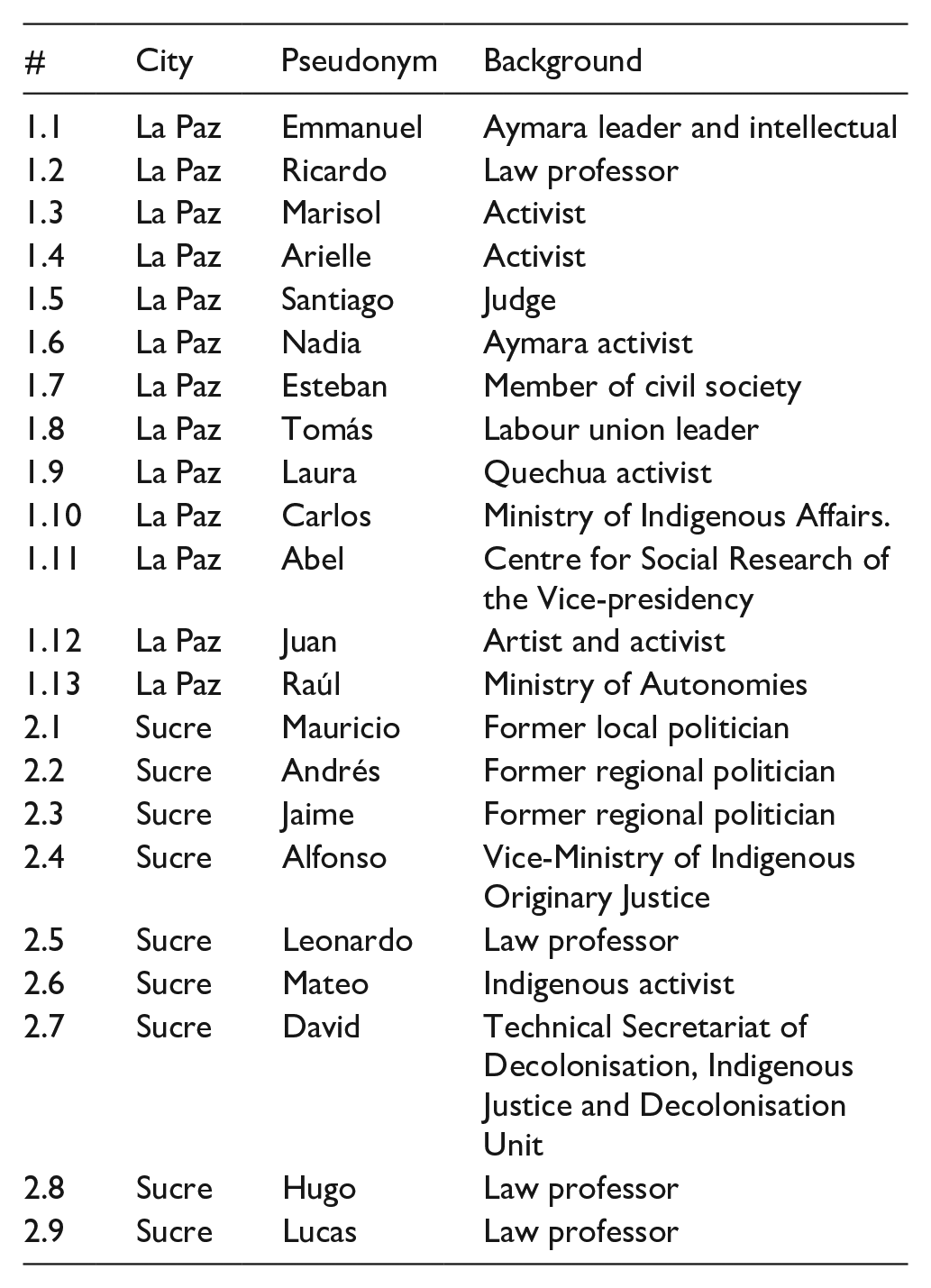
| # | City | Pseudonym | Background |
|---|---|---|---|
| 1.1 | La Paz | Emmanuel | Aymara leader and intellectual |
| 1.2 | La Paz | Ricardo | Law professor |
| 1.3 | La Paz | Marisol | Activist |
| 1.4 | La Paz | Arielle | Activist |
| 1.5 | La Paz | Santiago | Judge |
| 1.6 | La Paz | Nadia | Aymara activist |
| 1.7 | La Paz | Esteban | Member of civil society |
| 1.8 | La Paz | Tomás | Labour union leader |
| 1.9 | La Paz | Laura | Quechua activist |
| 1.10 | La Paz | Carlos | Ministry of Indigenous Affairs. |
| 1.11 | La Paz | Abel | Centre for Social Research of the Vice-presidency |
| 1.12 | La Paz | Juan | Artist and activist |
| 1.13 | La Paz | Raúl | Ministry of Autonomies |
| 2.1 | Sucre | Mauricio | Former local politician |
| 2.2 | Sucre | Andrés | Former regional politician |
| 2.3 | Sucre | Jaime | Former regional politician |
| 2.4 | Sucre | Alfonso | Vice-Ministry of Indigenous Originary Justice |
| 2.5 | Sucre | Leonardo | Law professor |
| 2.6 | Sucre | Mateo | Indigenous activist |
| 2.7 | Sucre | David | Technical Secretariat of Decolonisation, Indigenous Justice and Decolonisation Unit |
| 2.8 | Sucre | Hugo | Law professor |
| 2.9 | Sucre | Lucas | Law professor |
Author’s note
Declaration of conflicting interests
The author declared no potential conflicts of interest with respect to the research, authorship and publication of this article.
Funding
The author received no financial support for the research, authorship and publication of this article.

Glossary
Aguas del Tunari Waters of the Tunari—a multinational corporation
blancoides white
chola a woman of Indigenous or part Indigenous ancestry
pollera a colourful skirt typically worn by some Indigenous women
señora a lady
suma qamaña the harmonious coexistence between humans and the rest of nature