




Abstract
We examine how 20 university students interacted with a virtual Residential School that was designed in partnership with a group of Indigenous Survivors of Canada’s Residential Schools system. We begin by offering a brief history of Canada’s Residential Schools system as well as the origins and ambitions of the Embodying Empathy project. We also reflect on the idea of empathy as it has been taken up both in the design and testing phases of the project and on how student participants enacted their empathy. We demonstrate how participants worked through their immersion in the virtual Residential School, selecting empathy frames that allowed them to grapple with its content and connect with the Survivor narratives presented therein.
Embodying Empathy (EE) is a multi-year interdisciplinary critical and creative collaboration designed to grapple with the facts and conflicting legacies of Canada’s Residential Schools (RS) system. Starting in 2014, alongside and responding to the Truth and Reconciliation Commission of Canada (TRC), members of the extended EE team, guided by a Survivor Governing Council (SGS), began constructing an immersive virtual reality Residential School (vRS). There were several distinct but overlapping objectives throughout the EE collaboration: Refining protocols for Survivor-led processes of Indigenous/non-Indigenous co-creation; designing, building, and testing multiple iterations of an immersive storyworld to adequately represent Survivor experiences of Canada’s RS system; and allowing for the formation of durable empathy bonds between historical and intergenerational victims of the RS and contemporary viewers of the storyworld.
The EE team has produced several publications detailing the genesis of the project, its methodological contributions, and its potential to promote empathy (Muller et al., 2017, 2018; Woolford et al., 2019). In this article, we examine how a group of 20 university students interacted with the vRS during their participation in a study designed to assess their responses to the storyworld’s empathy cues. We begin by offering a brief history of Canada’s RS system, and the origins and ambitions of the project. We also reflect on the idea of empathy as it has been taken up in the design and testing phases of the project and on how student participants enacted their empathy. We demonstrate how the participants worked through their immersion in the vRS, selecting empathy frames that allowed them to grapple with its content and connect with the Survivor narratives presented therein.
Residential Schools and Embodying Empathy
From the early 1880s until 1996, over 150,000 Indigenous children were removed from their families by the Canadian government and required to attend Christian-run RS (MacDonald, 2019). These schools operated in concert with other attempts to destroy Indigenous peoples, such as policies of starvation and dismantling their governments, impeding their ability to operate as political, economic, and social units. Canadian settler colonialism sought to remove Indigenous Peoples from their territories to make way for European settlement, resource extraction, and nation building (Woolford, 2015). The RS were underfunded by the Canadian government, resulting in inadequate health care for students, poor ventilation, season-inappropriate clothing, a lack of nutrition, and unqualified staff (Milloy, 1999). Moreover, children suffered from damaging devaluations of their cultures, including prohibitions on Indigenous languages and ceremonies, shorn hair, mandated wearing of westernized clothing, Europeanizing name changes, and other assaults upon their Indigenous lives (TRC, 2015).
The schools were notoriously physically violent. A large proportion of children suffered sexual abuse, and regular physical, mental, and emotional assaults, among myriad other indignities. Thousands died, either within the schools, while trying to escape, or due to ill health and challenges brought on by their experiences there (TRC, 2015). In January 2015, the federal government’s Independent Assessment Process compiled claims by RS Survivors for abuses suffered in the system. Almost 38,000 claims were received for injuries suffered from physical and sexual abuse, with nearly 31,000 claims resolved (TRC, 2015, p. 105). As the TRC (2015) concluded, “Successive Canadian governments and various churches were complicit in the mental, physical and sexual abuse of thousands of Aboriginal children through the residential schools system” (p. 372).
Settler colonialism attempted to destroy bonds of empathy and understanding between generations of Indigenous Peoples, severing Indigenous children from their families and communities to thrust them into European systems of labor and property. Children were taught to despise their parents and grandparents, skin color, stories, languages, and traditions (Papequash, 2011). The project of instilling an internalized version of the colonizer’s desired reality served to further normalize settler colonialism. The result was often a process in which students “internalized the goals of colonial institutions” and therefore “saw themselves through the eyes of the colonizer, seeking recognition and therefore mimicking non-Indigenous ways of being” (Jobin, 2016, p. 40).
The state undermined the potential for empathy between settlers and Indigenous Peoples, presenting the latter as inferior and underserving of the same basic human regard that white settlers could take for granted. For example, Indigenous parents who protested the removal of their children were viewed as ungrateful rather than as guardians protecting their offspring (Woolford, 2015). In short, such parents were treated to scorn with little effort made to understand the impact of child removal on their and their children’s lives.
Settler Canadians are only beginning to learn of the horrors of RS. Even after the national events and final report of the TRC (2015), many possess only the vaguest understanding of why many Indigenous and non-Indigenous scholars refer to RS as an instrument of genocide (Chrisjohn & Young, 1997; Fontaine, 2010; MacDonald, 2019; Muller, 2016; Woolford, 2015). In response to this knowledge deficit, in their final report, the TRC’s commissioners listed 94 Calls to Action demanding changes to all facets of Canadian life intended to promote reconciliation between the country’s Indigenous and settler peoples. Prominent among these calls are demands to address knowledge gaps through Indigenous-led commemorations of RS. Whatever else it may be and do, EE models one potential way to satisfy the TRC’s call for the creation of shared and reparative public memory.
Despite the magnitude of the TRC’s undertaking, the Canadian discourse of reconciliation remains contested by many Indigenous scholars (Daigle, 2019). Several have challenged the idea of reconciliation, presenting concerns that it remains performative and metaphorical (Tuck & Yang, 2012), tacitly implies a previous state of peace between settlers and Indigenous peoples to which we can somehow return (Chrisjohn & Wasacase, 2009), and engages a politics of recognition that positions Indigenous Survivors as supplicants to an unchallenged settler colonial state (Coulthard, 2014). EE members, led by the Survivor Governing Council (SGC), share a skepticism of acts of macro-reconciliation prescribed by settler governments and instead aspire toward the practice of micro-reconciliation as experienced by people in relationships with one another daily (Fox, 2021, p. 114). Indeed, the design of the EE storyworld, structured as an experience between an individual participant isolated from external stimuli by the virtual reality (VR) equipment and a series of Survivors recalling their direct experiences of RS, effectively models such micro-level acts.
The vRS engages users in an immersive experience of everyday reconciliation, just as our experience of the project as researchers has. As five settler-scholars from diverse academic backgrounds, we met with the SGC regularly over a 2-year period, building important relationships, but also being robustly challenged on our assumptions about the nature of knowledge, expertise, and representation. Given the unsettling research design described below, our team had to learn to be patient and to form a trusting and respectful relational accountability with the SGC before our project design work could begin (Wilson, 2001). This included meeting over meals, assisting with a Survivor reunion, and cooking and serving breakfast at a holiday event for Survivors. These everyday yet important acts of reconciliation radically renovated our own understanding of RS experiences and how these might be represented in ways consonant with the SGC’s vision.
An immersive storyworld
EE’s immersive storyworld was modeled substantially on the Fort Alexander Indian Residential School, which operated from September 1, 1905, through June 30, 1970, on the Sagkeeng First Nation, about 125 km north-east of Winnipeg, Manitoba. The school was administered by the Roman Catholic Missionary Oblates of Mary Immaculate, and it comprised overlapping dormitory, classroom, administrative, and religious spaces. Very little of the original school’s structure remains onsite today and the vRS was constructed following detailed site visits, group and individual interviews with Survivors, and the careful study of available building plans, photographs, and maintenance records (Figure 1).
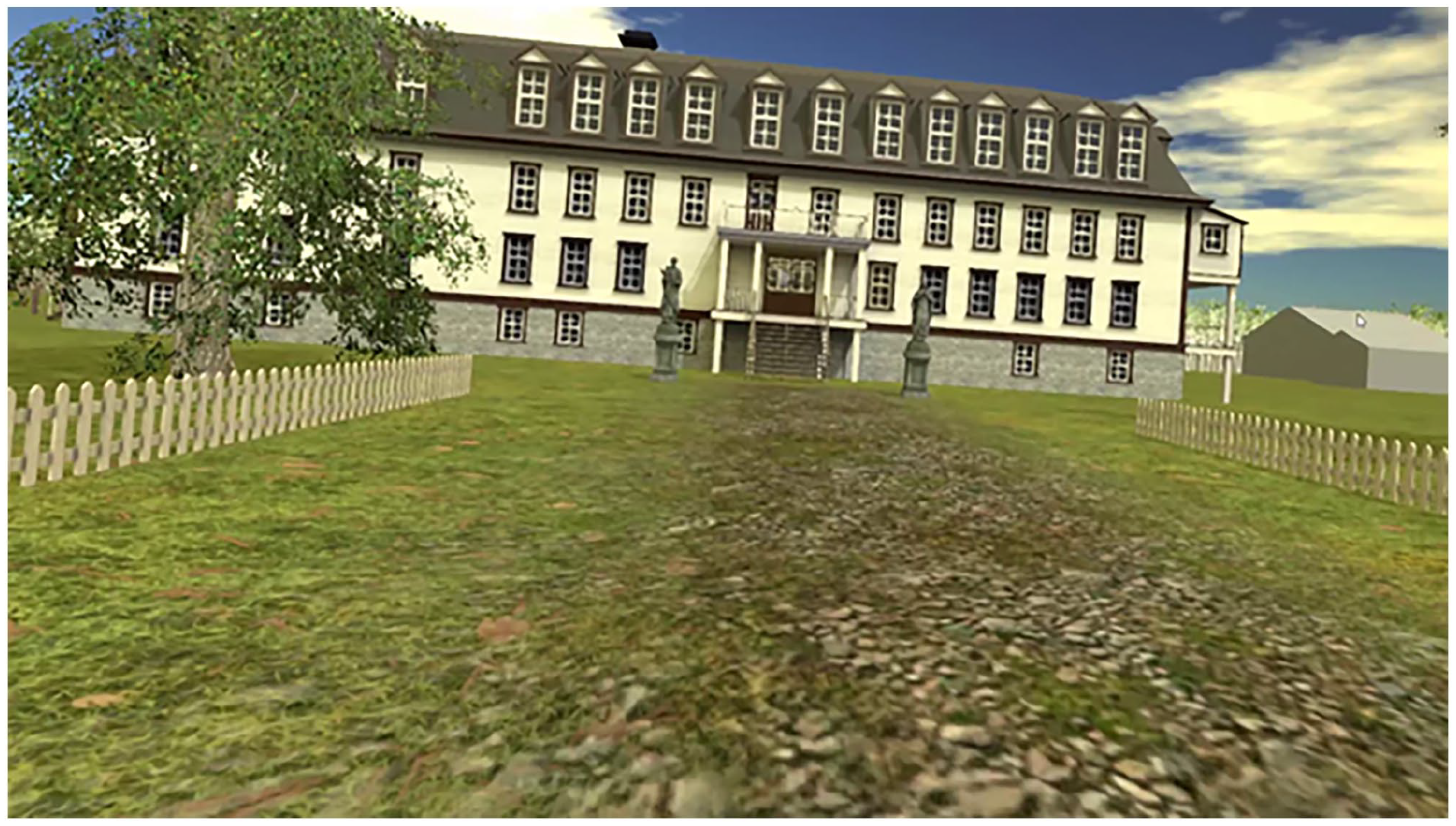
Walking toward the virtual Residential School (Credit: Embodying empathy).
The first step taken by the EE team was to implement a set of unsettling research ethics protocols. Our work was informed by the Assembly of First Nations influential Ownership, Control, Access, and Possession principles as well as later revisions to the Canadian government’s Tri-Council Policy on Ethical Conduct for Research Involving Humans: CORE-2022 (Panel on Research Ethics, n.d.). Such principles and policies are designed to promote and guide respectful and non-extractive research with Indigenous people and communities (Schnarch, 2004). In the spirit of the ownership, control, access, and possession principles, steps were taken at the outset to ensure that the vRS is owned, controlled, and led by the SGC. The SGC has overseen and guided all levels of the project, including research and storyworld design, as well as public exhibition.
To facilitate the role of the SGC in designing the vRS, we committed to principles of participatory design, a core methodology in the field of human–computer interaction that integrates the perspectives of all stakeholders, including programmers, designers, end users, and those being represented during the design process (Spinuzzi, 2005). In our project, we committed to a process we termed participant led design to reflect more clearly the SGC’s primacy in settling all matters relating to the vRS (Muller et al., 2015, 2017, 2018).
It should be noted that the vRS is not an open world in which participants move around freely in real time. Instead, users are directed along a specific narrative path that guides and limits their exposure to the storyworld’s potentially traumatic content. The everyday terrors of forced assimilation are present in every glance. Users are immersed in the virtual world through the 360-degree visual and auditory perspectives provided by an Oculus Rift VR headset. Prominent among visual items is a depiction of Catholicism’s Lacombe’s ladder (Figure 2), a pictorial catechism, or summary of religious doctrine, which hierarchically contrasts a settler-led assimilative path up to heaven with an Indigenous descent into a Christian-defined hell.
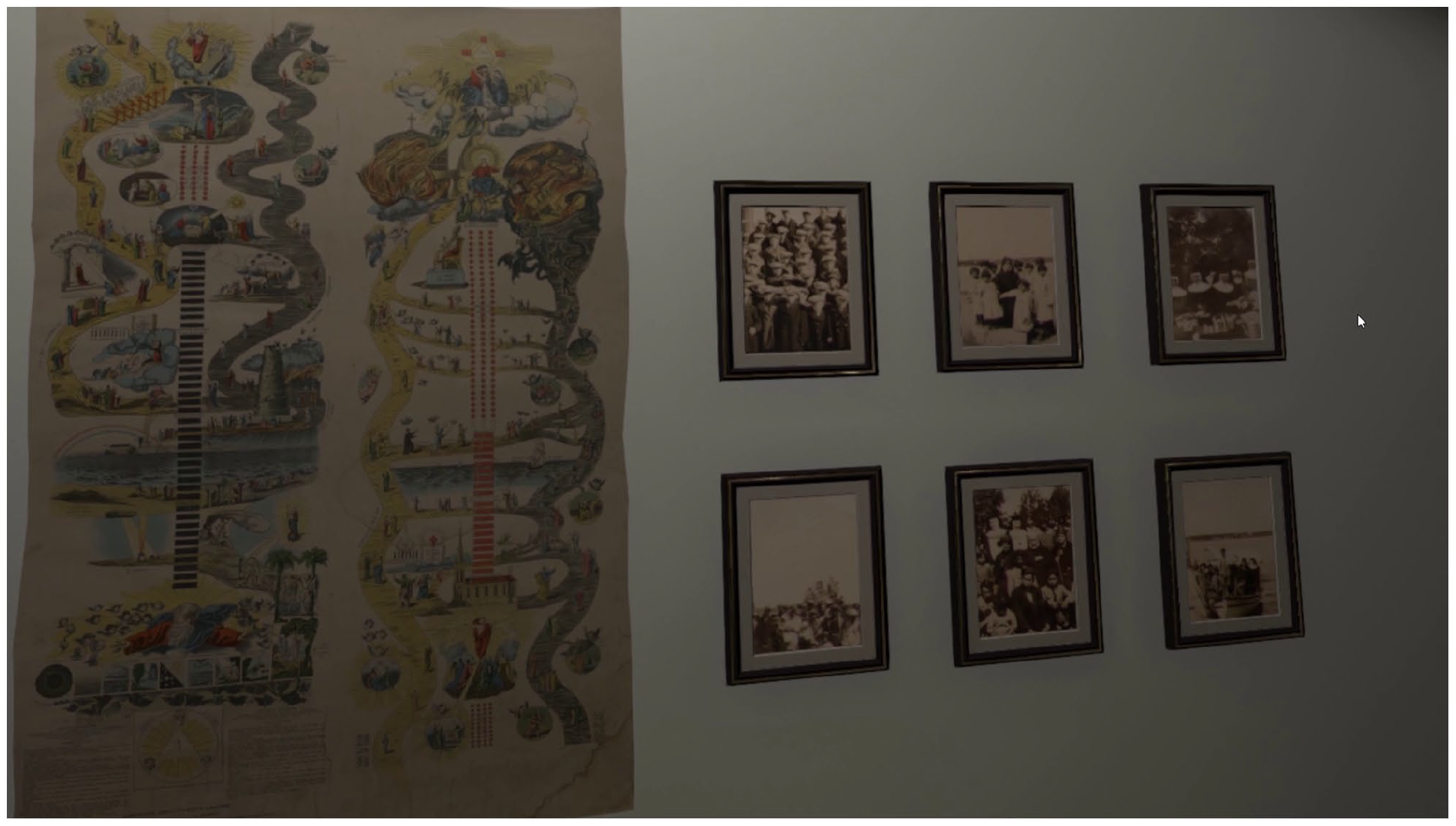
Lacombe’s ladder and pictures on the wall of the virtual Residential School (Credit: Embodying empathy).
The storyworld also features expressionistic representations that grew from Survivors’ own remembered responses to features of RS life, such as the elongated and progressively distorted clerical shadows that haunt the chapel, dormitories, and cellar—all spaces identified as potent sites of trauma by the SGC (Figure 3). Likewise, one path through the storyworld begins with a car journey to the RS, in which the user’s perspective is tethered to a child’s eye view, adrift in a bench seat that is too large while navigating exaggerated angles and forms designed to capture feelings of strangeness and powerlessness related by Survivors. Other aspects of embodiment feature in the intimate, searching text fragments that appear on a bathroom mirror in the girl’s dormitory, covered over with cardboard to guard against vanity, according to the nuns, and the animated pages of a missal, a Catholic liturgical book for use during mass, hovering in the dark, isolated furnace room that was notoriously a site of ongoing violence. These experiences aid in recruiting users into a morally attuned awareness of the large and small abuses characteristic of RS life. This awareness is intended to unsettle and encourage concern rather than to distress participants.
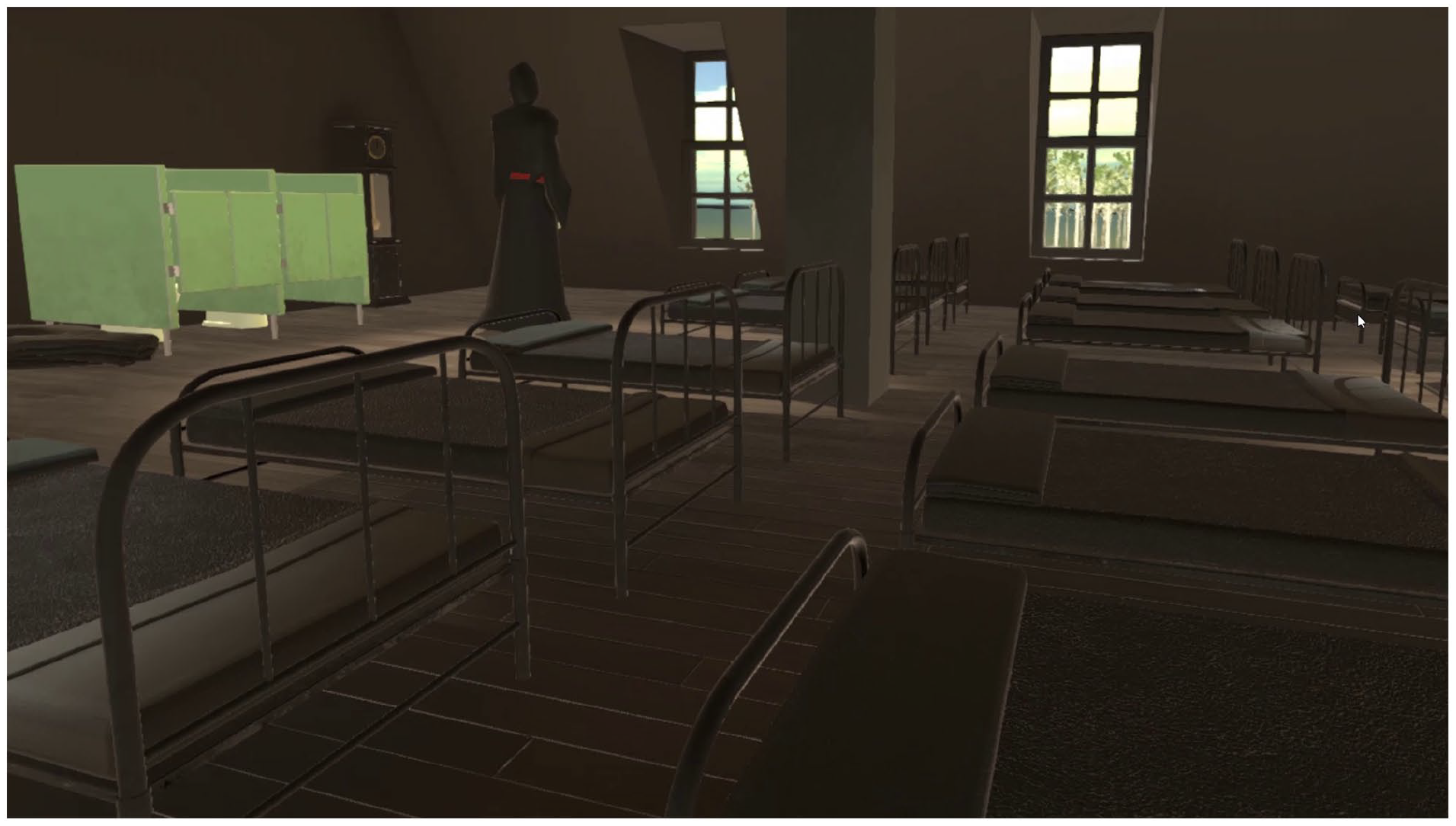
A clerical shadow in the boy’s dormitory from the virtual Residential School (Credit: Embodying empathy).
Empathy measures, empathy frames, empathy rules
The EE project was not built on one single approach to the concept of empathy. As researchers from diverse disciplines, we allowed our different understandings of empathy to cross-illuminate rather than impose a single master definition of the term. For present purposes, however, while acknowledging affective and cognitive approaches to the study of empathy, our explanatory focus primarily rests conceptually on ideas concerning the social construction of empathy, looking closely at the work performed by actors seeking to communicate a perceived empathetic experience to others.
It is possible to distinguish between empathy as a personality trait and as a state. Some people end up being more likely to experience empathy than others, though characteristics of situations will affect whether people feel empathy. It is therefore possible to measure and manipulate, that is, increase or decrease, feelings of empathy in experiments or, importantly, in virtual environments (van Loon et al., 2018). One important situational variable is what we might call the target or focus of empathy. People typically experience empathy only if they value the welfare of the target person or group, such that one must be deemed worthy of others’ empathetic regard to receive it (Batson et al., 2007).
Although several empathy measures exist, researchers commonly use the 28-item Interpersonal Reactivity Index (Davis, 1983) to assess trait empathy, along with Batson et al.’s (1997) 6-item measure to assess state empathy. Both these sets of items are self-report, but how they conceptualize empathy differs markedly. The Interpersonal Reactivity Index includes the following four subscales: empathic concern, fantasy, perspective-taking, and personal distress. Despite the popularity of the Interpersonal Reactivity Index, it is debatable whether these subscales are indeed the components of trait empathy (Batson et al., 1987). In contrast, Batson and colleagues conceptualize empathy as a set of emotions people experience toward another person or group, asking respondents to rate how much they feel an emotion, such as compassion, in response to a target person or group.
In addition, some scholars distinguish the affective or emotional aspect of empathy from its social cognitive aspect. Those who do this often refer to the social cognitive aspect as perspective-taking (Erle & Topolinksi, 2017). Imagining themselves in the shoes of the other or being otherwise exposed to the feelings or thoughts that the other might have in a given situation; researchers within this area commonly use the terms imagine self and imagine other to refer to these two forms of perspective-taking (Batson & Ahmad, 2009), drawing a useful distinction between affective and cognitive elements. For example, after conceptually reviewing the pedagogy of historical empathy, Endacott and Brooks (2013) proposed that empathy is a two-dimensional, cognitive-affective construct (Endacott, 2012, 2014). To develop historical empathy in particular, Endacott and Brooks (2013) also argue that historical empathy must include historical contextualization, perspective-taking, and affective connection. However, even brief historical education, without intentional empathy or perspective-taking components, may increase empathy for Indigenous people (Neufeld et al., 2021). Certainly, the design of our vRS embodies all the elements Endacott and Brooks (2013) propose are key. Furthermore, our interviews suggest the storyworld elicited from participants’ empathy frames consistent with these components. This is in line with other projects that have investigated the role of VR on empathy. In their meta-analytic review of seven studies in this emerging literature, Ventura et al. (2020) found VR caused small positive changes for affective empathy and moderate positive changes in perspective-taking.
Empathy is also an excellent predictor of support for reparations (Starzyk & Ross, 2008) and attitudes toward Indigenous Peoples in Canada (Starzyk et al., 2021). This echoes ideas and findings that empathy is important for prosocial behavior, as Batson (1991) explains in his empathy–altruism hypothesis. Whether people act for only truly unselfish reasons is debatable and those who feel empathy may not act altruistically for several reasons, but on balance those who feel empathy toward a person or group are more likely to do something to help or act favorably toward them (Batson et al., 2007; Davis, 1994). Within the Canadian context specifically, empathy predicts support for better water and wastewater services being provided to Indigenous Peoples (Starzyk et al., 2021).
To date, several authors have noted the potential of VR as an empathy machine (Barbot & Kaufman, 2020). VR is viewed to enable the perspective-taking required to better understand and feel concern for another person, potentially resulting in greater willingness to act on this empathy (Falconer et al., 2014). Noni de la Peña et al.’s (2010) immersive journalism is a well-known example of immersive VR whereby a person enters a re-created news story, such as being imprisoned in a Guantanamo-like detention center. In these and other studies, empathy is viewed to be enhanced by several recognizable factors. Presence captures the state when one’s mind is attentive “to embodied feelings with other present-moment bodily sensations to produce a heightened awareness of the moment and of the sensory self” (Heeter, 2016, p. 175). Immersivity refers to how vivid and real the virtual world appears (Cummings & Bailenson, 2016). Embodiment describes the extent to which the participant feels they occupy the body of the avatar or subject of the virtual world (Banakou et al., 2016). And agency is the feeling of having control over one’s actions within the virtual world (Tsakiris et al., 2007).
Experiences of presence, immersivity, embodiment, and agency must also be discursively constructed if they are to be communicated to others. Empathy, therefore, whether affective or cognitive, is produced within and shaped by interactive contexts. By attending to interaction, we gain a sense of empathy rules, or role expectations; through our reading of tone, gestures, facial expressions, and other cues. These cues alert us to instances where empathy is warranted, why it is warranted, and to whom it should be directed (Ruiz-Junco, 2017). After experiencing empathy through the interpretation of these rules, actors further face the challenge of making sense of this experience, especially when they seek to convey their feelings to others (Alexander, 2002). To facilitate both personal comprehension and communication of empathy, discursive frames are used to connect the experience of empathetic feelings to culturally salient values. Such empathy frames thus allow an empathetic individual to construct themselves and their feelings of concern in relation to a specific recipient and a set of shared values that have been transgressed (Ruiz-Junco, 2017), bringing order to experiences of empathy while allowing those experiences to be transmitted meaningfully before others. In this manner, empathy is always in the process of formation, being negotiated by actors wrapped in relations out of which they work through their experience of empathy (LaCapra, 2001). In our use, working through speaks to the process of enacting a legible empathy frame out of complex interactions without facilely or superficially appropriating the experience of another.
Within the vRS, empathy rules that encourage affective and cognitive reactions are communicated by the severe, unsettling spaces of the RS, the disturbing clerical specters, and the gravity of Survivors’ voices as they recount their experiences, among other signals. While engaging users within a particular historical context, these signals also designate the vRS as a specific type of empathetic space that seeks to produce perspective-taking, as well as feelings of care and concern. To capture the meaning of this experience, users deploy empathy frames when they communicate their experiences to others, as our qualitative interviews with participants strongly suggest.
Methodology
In what follows, we identify some of the empathy frames enacted in accordance with the empathy rules that participants intuited from their experience of the vRS. For this qualitative study, 20 university students from the University of Manitoba were introduced to the vRS through a 15-min tour, followed by a 1-hr, semi-structured lifeworld interview. Students participated in this study in exchange for partial course credit in an introductory psychology course. Anyone enrolled in the course, a pool of more than 2,000 students, who was not Indigenous and 18 years or above was eligible to sign up for the study online through the recruitment portal. Based on advice from the SGC, students who self-identified as Indigenous were not invited to participate. Given these students potentially carry intergenerational trauma from family experiences of Canadian settler colonialism, it was decided they should be assessed through a future study with robust cultural supports available to minimize potential distress. Recruitment occurred in the fall of 2018 and interviews took place between November 7, 2018, and February 8, 2019. Our goal was not to seek a representative sample, which would be impossible to accomplish with a small selection of university students. Instead, we sought only to explore some of the variety of empathy frames participants draw upon in making sense of the vRS. Recruitment criteria were therefore left open to encourage participation.
The lifeworld interview was used to develop rapport with research participants to examine how they make sense of their experiences (Kvale & Brinkman, 2009). This strategy is particularly well suited for exploring the empathy rules sensed and empathy frames used by participants because it provides opportunity to ask them to elaborate upon their claimed experiences of empathy. In lifeworld interviews, meaning is not taken for granted; instead, the words and phrases used by participants to describe their experiences are opened to further discussion to gain a more nuanced sense of the meaning assigned to such terms as empathy.
Research participants ranged in age from 19 to 40, with the majority in the 19 to 22 age range. Most (65%) identified as men, which is unusual for a sample drawn from a pool of first-year psychology students at the University of Manitoba, who typically predominantly identify as women. Many suggested they were drawn to participate in the study because they enjoy video games or were curious about VR and saw participation as an opportunity to try it out. Most were Canadian citizens, though we also interviewed five who are permanent residents. Pseudonyms are used to maintain the anonymity of our participants.
Interview transcripts underwent multi-staged review using line-to-line thematic coding (Attride-Stirling, 2001). Basic themes were established in the first stage, capturing the broadest range of topics covered by the participants. These basic themes were subsequently reviewed to create empathy frames that help make empathy self-presentations more visible and connectable to the broader literature on empathy. What follows are five empathy frames that our participants used to communicate their experience, as well as insight into the empathy rules to which they responded.
Enacting empathy
Being there
Many participants drew on an empathy frame of presence or being there to articulate their experiences. What differentiated the vRS from previous exposure to Survivor testimonies was not necessarily increased knowledge about Canada’s RS, but the sense of being closer to the RS experience through the help of VR. All participants had learned about Canadian RS in either their high school or university classes. All were familiar with Survivor retellings of their experiences and had either read these testimonies in textual form or heard them recounted in documentary films or classroom guest presentations. Even so, all participants felt this testimony was enhanced when situated within the vRS. Although many felt they gained new knowledge of RS through their experience of virtual immersion, this was not what they cited as the primary takeaway from their engagement with the vRS. Instead, they remained most alive to how their embodied feelings of “sadness” (Zhang, male, 22 years; Kingsley, male, 21 years; Amos, male, 25 years), “unease” (Ahmed, male, 21 years; Kingsley, male 21 years), “anger” (Jagvir, male, 40 years; Garvin, male, 23 years), “loneliness” (Chioma, female, 21 years; Gloria, female, 19 years), and other emotions were intensified by the experience of being virtually present where the harm occurred. One participant reported, “I definitely felt like I was there,” noting how the vRS allowed her to “give more meaning to it” (Lena, female, 19 years). Another observed a relation between presence and immersivity: “it puts you . . . in the school. So, . . . you’re living in it. It makes it look like it’s real, like you’re really there” (Frida, female, 20 years). Moreover, a sense of intimate connection to the Survivors was heightened, since participants felt closer to Survivor experiences of isolation, injustice, and abandonment. One participant added, “it definitely made me feel more like I was a part of what they were actually saying when I was in the actual place they were describing” (Ahmed, male, 21 years).
Participants were mostly aware that they were not fully sharing in the experiences of those who suffered the abuses and violence of RS. Nonetheless, they did refer to the vRS as making the idea of those experiences “more real” (Dawn, female, 20 years) and “personal” (Dawn, female, 20 years; Emile, male, 19 years; Mike, male, 19 years). These being there frames thus allowed participants to express the challenge of closing the epistemological gap between the self and a suffering other. The particularity of the others’ experience is brought nearer to the participant when they listen to Survivor testimony while walking in the vRS. The temporal positioning of this experience within the broader context of post-TRC, as well as the warnings provided by the consent form and other ethics material presented to participants, alerted them that they were about to experience something likely to cause discomfort and attuned them to the empathy rules that accompany the heightened awareness in Canada of the need for all Canadians to commit to reconciliation and the commemoration of RS (TRC, 2015). Participants navigated the difficult knowledge to which they were exposed by drawing on language to describe a sense of greater closeness to the participants. The notion of nearness, or empathetic presence, can thus be interpreted as a form of working through because the participants are trying to articulate that they feel closer to Survivor experiences rather than fully in the experience as themselves. The presence of being there, we suggest, is not simply a consequence of the virtual rendering of a realistic RS space; it also requires the enactment of a disposition toward being present whereby the participant is attuned to the virtual space and engages in the practice of bonding with the actors therein (Heeter, 2016). It is thus a reflective consciousness that simultaneously seeks a closeness with the other while also acknowledging differentiation from the experiences of the other. It represents not just a being with the Survivors who provide testimony in the vRS, but also a becoming with, as the participant shapes an empathy frame alongside and in presence of the virtual storyworld.
Walking in the shoes of another
All but one participant felt that their empathy toward Survivors, however they understood the term, increased through their experience of the vRS. They explained that this was the case because of the “eeriness” (Robert, male, 19 years; Ahmed, male, 21 years; Asha, female, 19 years; Gloria, female, 19 year), “loneliness” (Asha, female, 19 years), or “intimidating” (Tina, female, 20 years) nature of the vRS. Their high degree of recall of the Survivor testimony they heard while immersed was also impressive, demonstrating that the Survivor experiences were memorable. To this extent, they sought to describe an experience of embodiment in relation to the RS Survivors featured in the vRS.
Some, despite their reluctance to create an equivalence between the experiences of Survivors and the vRS, turned toward perspective-taking metaphors to define empathy. They described empathy, in general, as the experience of “being in the shoes of another” (John, male, 22 years; Robert, male, 19 years; Ahmed, male, 21 years; Kingsley, male, 21 years), “helping someone” (Juan, male, 20 years), and “connecting with them” (Lena, female, 19 years). For others, the affective dimensions of empathy are its characteristic quality, with empathy defined as “to feel what another person is going through” (Jagvir, male, 40 years; Amos, male, 25 years; Trevor, male, 19 years) or, simply put, “feeling with the people” (Dawn, female, 20 years). The latter participant showed her awareness of the difference between empathy and sympathy, as well as the implications of these definitions for the empathy rules of the vRS: I think . . . sympathy would be feeling for them and empathy would be more . . . feeling with them, I guess. And I think that’s what the project . . . touched on for me was the very . . . personal kind of aspect to it. (Dawn, female, 20 years)
Participants were not naïve in this study, as they were made aware that its purpose is to explore the empathy impacts of VR representations of childhood suffering, although we did not offer them a definition of empathy but instead asked them to define it themselves. In so doing, they demonstrated their sense of the role expectations of a person experiencing empathy. They recognized that the empathy rules of this situation required them to try to imagine and feel with the Survivors who shared their testimony within the vRS. They opened themselves to a degree of embodied empathy, yet also continued to work through how their experience differed from and only approximated that of the Survivors.
Gaming
For almost all our participants, the association with gaming was not pronounced (Tina, female, 20 years; Garvin, male, 23 years). Following the guidance of the SGC, who raised profound concerns about the possible gamification of their experiences of trauma within the RS, EE’s designers took special care to avoid or mitigate video game tropes, such as setting tasks or goals for the participant, and the participants toured the vRS on rails, meaning they had very limited agency within their journey. By turning their head, participants could choose where they looked within the rooms of the vRS, but they could not wander freely about or manipulate objects. Despite these efforts, participant expectations of traumatic content could potentially elicit empathy-dampening strategies from the world of video games. One participant noted that “I think the only reason it felt like I was in a video game was because it was with a video game console” (Emile, male, 19 years).
Surprises built into the vRS are potentially reminiscent of some types of video games. The designers’ goal in rendering spectral clerical figures to float through the school was to communicate the frightening size and seeming omnipresence of staff members for RS students. However, in one instance, this representational gambit backfired and led a participant to withhold empathy: “I’m looking in one direction, suddenly this thing passes me, and I start: what the heck happened? Is this like a horror game?” (Mike, male, 19 years). This participant did not feel he had experienced empathy. He self-identified as an avid video game player and the experience of the vRS was less emotionally powerful because he adopted strategies he used when playing “horror” video games to avoid feeling distress or unwanted surprise. He added, Once it started feeling like a horror game, I started feeling . . . kind of jumpy and looking around for when certain things might pop up. . . . It’s kind of weird to describe. The games that I play, if they get scary, then usually I almost start to distance myself from the game. (Mike, male, 19 years)
The similarity of the graphics of the vRS to that of some of the games he played seems to have triggered in him a different set of tactical enactments designed to limit and foreclose feeling rather than allow it free reign. He closed off the empathy frame and resisted the storyworld’s empathy rules because the vRS, for him, became too much, and his expectations led him to believe that its horror would increase to unacceptable levels.
Healing
Aside from this individual, other participants expressed a sense of connection to Survivors and endeavored to communicate their concern for them. Some wanted to know whether the Survivors are “okay now” (Juan, male, 20 years). Others wanted to “congratulate them” or express respect for their “bravery” or “strength” (Zhang, male, 22 years; Kingsley, male, 21 years; Amos, male, 25 years), for surviving violence. The frame of healing and wanting to know that a particular Survivor was now well could potentially be interpreted as performing a desire to keep the RS in the past. Such redemptive framings of the RS experience might signal a limit or obstruction to fully working through toward “empathic unsettlement,” whereby empathy for others’ suffering is cultivated without being “conflated with unchecked identification, vicarious experience, and surrogate victimage” (LaCapra, 2001, p. 40), since the healing narrative potentially betrays a desire to have settler discomfort or shame come to an end.
This is not, however, the only possible interpretation suggested by such responses. Indeed, rather than seeking to foreclose on empathy, we understood these responses to communicate an embodied ethical concern for Survivors. This concern was often expressed by drawing upon empathy frames that highlight courage and strength. As one participant noted, I don’t want to say I felt sorry for them because they seemed like they were . . . so proud of . . . what they are. I felt . . . strong with them. I felt . . . proud of them for . . . standing up and talking and teaching other people about this whole experience they went through. (Tina, female, 20 years)
The empathy frame shifts in this instance from feeling pain on behalf of to feeling strength with the Survivor. As another participant reflected, “They didn’t just . . . give up afterwards. They got through it and they’re still going” (Mike, male, 19 years). Such a statement demonstrates that the participant is not seeing the Survivor as an object of pity but rather an agent able to use traumatic experiences to teach future generations. Rather than facilely recuperating the Survivor, the participant communicates a relational understanding of the humanity and ongoing agency of the other.
In similar instances, participants turned to the interviewer for reassurance that Survivors are now healthy. For example, one asked, “Did they ever go back to their . . . routine [from] before they . . . were in Residential School?” (Frida, female, 20 years). Evident in such questions was an investment in the lives of Survivors; a sense of a relationship with them and hope that they found a good life despite their experiences in RS.
It is therefore important not to reduce empathy frames to simply being efforts to construct and overdetermine a redemptive meaning for the vRS. First, the SGC made it clear that their intention was to convey as much as possible of the entire experience of life within the RS as well as to inspire strength and resilience in participants rather than a debilitating sadness. The participants received this message and adjusted their empathy toward healing and courage. Second, the concern expressed about the Survivors testifying within the VRS suggests a sense of ongoing felt responsibility toward the targets of empathy presented by the storyworld. Rather than simply seeking a happy ending, participants work through their empathy frames toward concern for the present well-being of Survivors.
Reconciliation
Connecting the vRS to their daily lives, the participants felt less able to address the broader national project of reconciliation and suggested instead how they hoped to live in a way that respected Indigenous Peoples: “I will go and do . . . a little research and find out more about them” (Robert, male, 19 years); “I just want to listen to them talking for more about their experience” (Zhang, male, 22 years).
Participants varied with respect to their understanding of the temporality of RS. For one participant, this was a wrongful act committed by individuals in the past: I don’t necessarily feel personally responsible because I know that . . . no one in my family’s history was part of . . . making the Residential Schools happen . . . I’m just more or less ashamed in just people for letting that happen and people for doing that. (Emile, male, 19 years)
This participant expresses a general disappointment in humanity but sees the abuse in RS as an individual rather than systemic problem. However, later in the interview, the same participant made the connection between RS and contemporary harms of settler colonialism experienced by Indigenous people: I see a lot of people just walking around, downtown Winnipeg . . . who are of Indian descent and . . . people look at them like they’re not people. Just cause they don’t . . . look the same as . . . your typical white person or whatever. They still do get discriminated against quite a bit. I don’t think we’re at a full point of reconciliation. But . . . we are trying to get there. (Emile, male, 19 years)
The elision from I to we in this comment is instructive, showing a process of working through that is moving from the individual experience to a collective responsibility to address settler colonial harms in the past and present.
Several participants suggested that we include more graphic representations of hardship, particularly of the sexual and physical abuse that were a common feature of RS, in future iterations of the storyworld (Amos, male, 25 years; Frida, female, 20 years). Participants were also surprised by some aspects of the vRS, such as how the classroom in the RS looked like any other classroom (Frida, female, 20 years) or the cleanliness of the building (Mike, male, 19 years). The latter point relates to a memorable discussion between university-based researchers and the SGC. An initial rendering of the vRS portrayed it as a significantly darker and grimier space, and the Survivors took offense to this. As children, Survivor chores included cleaning the school. Cleaning was also assigned as a punishment. The nuns and priests would never have allowed them to keep a dirty school, as cleanliness, understood as being near to godliness, was an essential plank of the assimilative project. Still, the empathy frames the participants brought with them from their cultural knowledge of the horrors of RS, led them to expect a more dismal environment: “I was almost expecting it to look like a prison . . . It still did look . . . unfriendly . . . but there weren’t . . . bars on the windows” (Mike, male, 19 years).
The settler and newcomer participants in our interviews felt there existed real reconciliatory potential in the vRS, but these more often took the form of micro- or everyday reconciliation, rather than subscribing to a national project of reconciliation. As one participant argued, If it was used for people who don’t really know what Residential Schools are, for them to understand what people in the past went through and then try to find ways to reconcile with each other, I think it would help. (Frida, female, 19 years)
One testimonial moment in the vRS seemed to trouble several participants. In the dormitory room, after a Survivor recounts how finding a piece of fruit under one’s pillow meant spending the night with the priest, implying the resulting sexual violence, another recalls one night when the dorm room was transformed into a place of fun rather than fear. With the dormitory supervisor away from his post, the boys engaged in a rowdy pillow fight that ended up with feathers from burst pillows floating about the room. The account of this moment of rebellion confused some participants, because the empathy frame they are accustomed to is one of there being unrelenting control and violence within the schools. There is a continuing challenge within Canada to find empathy frames that allow for acknowledgment of Indigenous resilience and rebellion within the schools alongside recognition of the fact that these educational sites were also spaces of genocidal violence. The SGC was clear that they wanted the full picture of RS presented, including the fact that they found occasions for resistance and mischief. Our belief is that these representational challenges are productive since they require users to develop a more complicated empathy frame. Their performance of reconciliation cannot simply draw upon a passive victim and/or evil school dichotomy; instead, they must work through the complexity of the persistence of human agency in the face of deeply habituated institutional and personal violence.
Conclusion
Still more work needs to be done to see if a deepened experience of empathic unsettlement can be evoked through an encounter with the EE vIRS. Cognitive and affective empathy frames such as walking in another’s shoes or healing were generally employed by participants in a manner conducive to further empathetic engagement with the experiences of Survivors. This engagement led them to perceive empathy rules whereby they sought to relate to, rather than appropriate, Survivor memories. There is always the risk that such empathetic enactments could slip to become a form of performatively acting out rather than working through the RS experience (LaCapra, 2001). However, following Landsberg (1997), even this former response can serve as a moral and political point of departure, through the formation of prosthetic memories—through which a person, by embodying another’s traumatic experience may develop greater or deeper empathy at a later stage—ideally leads to reconciliatory activities as the individual continues to grapple with the legacies of the Canadian colonial past.
For the most part, our participants engaged thoughtfully with the vRS, intuited the intended empathy rules, and sought to enact them and make them meaningful through various empathy frames. They appeared to work through and showed promise of empathic unsettlement that was expressed through their questioning not only of the past, but of the settler colonial present as well. While the vRS offers a modular construction and can be updated and augmented as needed to reflect ongoing developments in our knowledge of the RS system as well as the potential for empathy frames to make those experiences available and meaningful to others, it would be too much to ask of any vRS that it educate about and resolve the totality of Canadian settler-Indigenous issues fully, on its own. But what the experience of creating and sharing the virtual RS has shown is that it can do important work facilitating productive empathy enactments among those who are immersed in it.
Footnotes
Authors’ note
 ).
).
Declaration of conflicting interests
The authors declared no potential conflicts of interest with respect to the research, authorship, and publication of this article.
Funding
The authors disclosed receipt of the following financial support for the research, authorship, and publication of this article: Funding for our project was provided by a Social Sciences and Humanities Council of Canada Partnership Development Grant.