



Abstract
The concepts of the core, semi-periphery, and periphery emanated from a mix of dependency and postmodernist thoughts, which rejected the notion of a Third World from which local knowledge emanates and develops. That local or Indigenous knowledge is perceived as backward and antidevelopment is no longer new. The illogical arguments or enthymemes, the rhizomes, and minor literatures and disruptive narratives continue to threaten the hegemony of the Academy. Although the autochthonous and ambivalent nature of local knowledge appears problematic for finding a methodological coherence for these knowledge systems in the knowledge production frontier, it certainly provides an opportunity for the advocacy of a context-specific approach to addressing development problems. Critical literature review and analysis form the methodological approach of the article. The analysis offers a critique on insider academics and researchers who aid and abet the outsiders’ development agenda, which are problematic for valorizing grassroots peoples’ knowledge.
Our voices may have started out as a low murmur from the margin but it has now become a distinct and unified cacophony of resistance and distrust
Introduction
Among others, the concept of core-periphery which had earlier been developed by the United Nations Economic Commission for Latin America and the amplification of the dependency theory among social science scholars ignited some of the debates that led to the emergence of the world-systems analysis (Wallerstein, 2004). Dependency theory posits that natural resources and cheap labor flow from poor countries to rich, industrialized West and through which the latter derives its socioeconomic well-being and progress. The machination of rich economies, which somewhat monopolizes the production process, therefore, is to ensure that poor nations remain perpetually subservient to the West to maintain the economic and politico-cultural status quo. The notion of the periphery, which is one of the central themes in this article, stems from the World-Systems Theory (Wallerstein, 1974, 2004) comprising three domains of world-systems analysis, which include the historical development of the modern world-system; the contemporary crisis of the capitalist world-economy, the structures of knowledge. Immanuel Wallerstein rejects the idea of a Third World, arguing that the world is a single entity but comprising regions and nation-states, which are intricately connected by economic relations (So, 1990; Sorinel, 2010). Wallerstein (1974, 2004) argues that these economic relations have led to the fragmentation of the world into dynamic units of core, semi-periphery, and periphery. The core-periphery relationship is structural in nature and in-between the core and periphery are semi-peripheral states that interface with them, thus acting as a buffer zone embedded with a mixture of similar activities and institutions that exist in both the core and the periphery (Skocpol, 1977). To remain within the core zone would, therefore, mean the perpetuation of the monopoly of knowledge and sustained technological advancement and industrial growth. And to remain in the periphery is to maintain the “primitive” approach to development.
Put differently, while the core economies are connoted as the industrial West, the semi-periphery and periphery are categorized as semi and less-industrialized economies or regions, respectively. In sum, the degree of sophistication of knowledge and industrialization is at the heart of the whole matter. Thus, the extent to which a country has recorded economic progress is largely a function of ts scientific discoveries and technological advancement. While Wallerstein’s compartmentalization and descriptions are understandable and permissible, the geographic distribution of the core in relation to the semi-periphery and periphery does not suggest that his categorization is entirely plausible—many industrialized and advanced economies are indeed geographically situated within the periphery. Some examples are Australia, Japan, the United States, and New Zealand. The emphasis here is straightforward. Strong economies that derive their current status as a result of mainstream scientific discoveries and technological advancement as well as their prevailing strong institutions cannot be divorced from those which wield the power of knowledge production as against developing countries that are technologically challenged and thus construed or constructed as being situated within the periphery because of their poor economic and dependency status. In the current context, therefore, this article adopts the same concept of periphery to connote the so-called poor economies of the Global South, and whose local knowledge (LK) or Indigenous knowledge (IK) infrastructures largely built on oral traditions have long been perceived as an aberration or enthymeme (Milovanovic, 1997). In general, the main thrust of the article borders on knowledge production and the politics associated with it (Kolawole, 2013). Although widely critiqued by the postmodernists who support the existence of a “multiplicity of theoretical standpoints” (Lyotard, 1984; Milovanovic, 1997; Olukoshi, 2006; Peters, 2001, p. 7), the modernists argue that developing countries or “backward” societies will experience socio-economic progress if they religiously adopt technological innovations introduced to them by Western nations. By implication, knowledge emanating from the periphery or the margin may have been perceived as grossly deficient in advancing human socioeconomic progress. The inability to discern that societal progress is not as straightforward as portrayed in certain quarters is probably the undoing of that proposition.
Attempting to portray postmodernism as otiose, Ley (2003) argues that the thrashing of the past and emboldening the present, and the temporality of things as entrenched in modernists’ thoughts “is a defining characteristic of modernism as local knowledge” (p. 547). Although unsure of what his theoretical standpoint is in relation to the perpetuity and diffused nature of postmodernism as a social fact, Ley (2003), however, admits that “the fact that knowledge is locally positioned does not mean that it has to be false—nor that it has to be correct—before some generic yardstick” (p. 556). Indeed, that conclusion is in itself a confirmation of the complexities of knowledge systems whose applicability mainly depends on geographical and sociocultural contexts as opposed to universalism and which cannot be easily explained away. And to push one universal truth against multiple truths is indeed an aberration (Gödel, 1962; Kolawole, 2013; Milovanovic, 1997) in a complex and ever-changing world. Theoretical arguments in support of multiple realities (as against one single reality) as well as cultural relativism are abundant in the literature (Eriksen, 2001; Wallerstein, 2007; Williams & Moore, 2019).
This article begins by presenting an analytical perspective on knowledge production and the origin of LK or IK and how the West generally perceives it. It also analyzes the emergence of dominant knowledge and shows the similarities and differences between Western science and IK. Pertinent reasons why LK will remain relevant to international development are outlined in the article. I also provide a critique of the insider academic and outline the roles of institutions in knowledge production. While the article presents a framework for operationalizing LK, its concluding part provides a pathway for mainstreaming the knowledge from the margin in the development frontiers.
Analytical perspective
The analytical framework of this article is premised on the sociological perspectives on knowledge production both in the West and in the South economies. Critical literature review and personal experiences constitute the analytical basis and central arguments in this article. Specifically, the concept of periphery is used to elaborate on the nature and development of LK and how these are relevant to development practice. The analysis is thus predicated on the second theme of the Knowledge from the Margin conference—Objectivity at the Margins—held at Michigan State University in 2015. In this article, the concept of periphery is thus used instead of the concept of margin—the two concepts semantically connote the same thing. Specifically, the analysis attempts to answer the question as to whether LK is peripheral in nature. In sum, the entire argument of the article is weaved around the need to recognize the knowledge systems in the Global South, how this body of knowledge fits into the world’s sustainability agenda, and how it could be justifiably rewarded.
The origin of local knowledge
LK is as old as humans’ existence. Man’s desire to overcome the challenges posed by the vagaries of his environment and the need for survival set the scene for the development of IK. The early man had devised several survival strategies through fruit gathering, game hunting, domestication of wildlife, and so on to meet his immediate needs. In the process, several branches of LK in medicine, veterinary medicine, botany, agriculture, music, architecture, and so on began to emerge. Systematic investigations on LK commenced in the 1900s and interests in the subject increased tremendously in the 1970s. Many reasons ignited keen interests in the subject among scholars. These include, among many others, the climate change-related crises such as the prolonged drought in the Sahel and southern Africa in the 1990s, which was associated with human-induced problems such as the use of fossil fuels and the like; the failings of the Green Revolution (Osunade, 1996); and the rise of post-modernism in the 1980s and 1990s. Post-modernist scholars such as Michael Foucault (1980), Michael Warren and his team at Iowa State University, and Robert Chambers and his research group at the Institute of Development Studies based in the University of Sussex and many others became eminent champions of LK infrastructures in the 1980s (Osunade, 1996). Thus, the analysis of LK and its management systems are at a 4-level sphere, which includes the knowledge of land, water, plants, and animals; development of natural resource management system; social institutions that regulate access and use of the resources; and the Indigenous peoples’ worldview that shapes how they perceive their environment (Berkes, 2008; Cleaver, 2000, 2001; Ostrom, 1990).
While, on the one hand, the postmodernists and naturalists are of the opinion that there are “multiple, constructed realities,” the positivists, on the other hand, maintain the viewpoint that “there is a single reality” (Tashakkori & Teddlie, 2008, p. 22). The scientists who perceive LK as enthymemes, subversive texts, and minor literatures (Kolawole, 2013; Milovanovic, 1997), which appear inherently disruptive, reason that the place-based nature of that body of knowledge and its multiple realities thus make its operationalization difficult in every day science. Naturally then, LK constitutes a threat to the hegemony—the dominant knowledge. To silence the subversion is to device certain machinations, in a subtle manner, to make the rhizomes irrelevant in the mainstream. It is, therefore, not surprising that Louis (2007) is emboldened to show how the feeble but constant protestations from the margins have become the platform for disharmony and distrust between the hegemony and the subjugated voices.
The metamorphosis of mainstream knowledge—science
Mainstream knowledge emerged through the expositions in theology wherein the clergy was held dearly as the conduit through which knowledge was derived. As society progressed, divine knowledge was no longer seen as the authentic form of knowledge. Thus, the appeal to authority became somewhat fallacious. The rise of philosophy put aside the authority of the church on the basis that any speculative knowledge that cannot be questioned or based on deductive reasoning may not be adjudged as the authentic form of knowledge. Science, however, gained supremacy over the first two sources of knowledge as scholars argued that knowledge derived through objectivity and verifiable, procedural analyses could only be acceptable as a form of true knowledge, provided the person seeking insights observes the rules guiding the process (Kolawole & Cooper, 2022; Wallerstein, 2007). But then, the linear mode of scientific enquiry is problematic; the post-modernists have rejected the idea that there is only one reality but argued that there are multiple realities. They proffered that the Grand narrative should be foreclosed and give way to meta-narratives. Lyotard (1984) refers to these meta-narratives as petits récits or localized narratives that are location specific. The following section addresses the similarities and dissimilarities between LK and science.
Differences and similarities between LK and Western knowledge
Some scholars (Agrawal, 1995; Banuri & Apffel-Marglin, 1993; Chambers, 1980; Dei, 1993; Kolawole, 2012a; Warren, 1991) have written extensively on the differences and similarities between science and LK. Nonetheless, I will endeavor to highlight a few but pertinent issues on the similarities and dissimilarities of mainstream science and the knowledge from the periphery. Clearly, the similarity between science and LK is that they both engage in a three-stage process of knowledge production, which includes (a) observation, (b) experimentation, and (c) validation (Kolawole, 2001, 2013). Nonetheless, there are procedural differentials in the two forms of knowledge. These major procedural differences are closely associated with issues on regimentation and documentation; while science is heavily regulated and documented, LK is not. Thus, the major weakness of LK, as it were, is its unsystematic procedural modes (Kolawole, 2012a). While experts are of the opinion that LK is based on trial and error, science may also not be absolved of a similar weakness as witnessed in instances where certain scientific experiments have failed due to trial and error (Kolawole & Cooper, 2022).
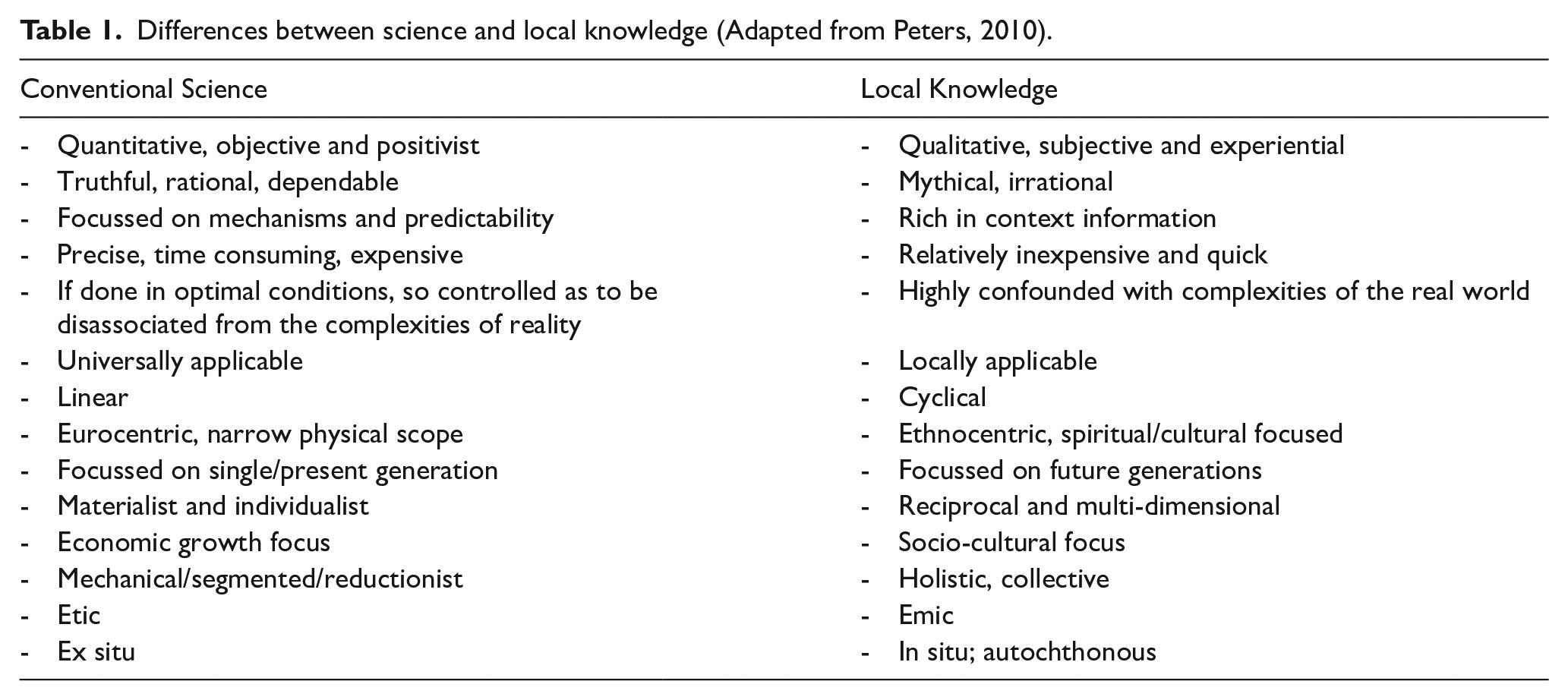
While the positivist science mode of operation is based on a single reality, LK operates based on multiple realities. And while science is a grand narrative in nature, LK comprises meta-narratives, which are unique to different sociocultural milieus. Indeed, Western science “privileges apparently empirical knowledge that can only be established and verified through specific evidential standards and specialist hermeneutic techniques usually located within socially closed academic institutions” (Sriprakash et al., 2020, p. 6) as against LK, which is established and validated through everyday experience of Indigenous peoples. Monica Peters (2010) summarized the dissimilarities between science and LK, which I have adapted and expanded to include production and use (Table 1). While, on one hand, scientific knowledge could be produced and used far away from where it is produced ex situ, LK, on the other hand, is autochthonous in nature—it is naturally found where produced. Nonetheless, this is not to imply that LK cannot be adapted elsewhere, particularly in places with similar sociocultural and ecological conditions. Of paramount interest is the etic-emic differentiation between the two forms of knowledge. While mainstream science adopts etic approach to employ preestablished categories for organizing and interpreting anthropological data, LK adopts the emic approach in the use of data categories recognized by the people being studied. Thus, conventional science may have been implicated in its penchant for stereotyping and distant labeling of subjects, particularly during social field survey investigations. In addition to that, the proposition that science is universally applicable may, however, not be universally correct as certain problems like health issues defy scientific solutions in some specific contexts in which Western-trained, sophisticated specialists in surgery or the like would tell their patients to “go back to the village” and seek traditional medical help for their ailments after they themselves have failed to resolve the problem (Hountondji, 1997, p. 14). This has often led to recourse to local solutions for local problems, thus making science as diffuse as LK itself.
Differences between science and local knowledge (Adapted from Peters, 2010).
Relevance of the knowledge from the periphery
Although Sillitoe and Marzano observe that there are many challenges, which might impede the inclusion of IK in development practice and consequently its potential, future impact, they recognize the ability of IK research “to inform and better guide scientific understanding and so assist in the formulation of policy in a way that can relate to local realities” (Sillitoe & Marzano, 2009, p. 21). Thus, the importance of knowledge from the periphery is implicated in the crucial roles it plays in development practice. Over the years, it has become increasingly difficult for development practitioners to successfully work at the community level without local support. In addressing development issues, particularly those bordering on the environment, both outsider and insider experts rely heavily on local community knowledge to enable them to achieve any measure of success. Kolawole (2015) outlines several exogenous and endogenous reasons why LK will remain relevant to international development practice in the 21st century and beyond. A few of them will suffice in this article. Some of the pertinent issues include (a) local preference for endogenous technologies, which are environmentally friendly, easy to understand, and adapt; (b) local people’s poor financial strength, which naturally predisposes them to relate easily with local innovations, and which they in-turn use to address local challenges; (c) people’s habitus, which explains how societies are deposited into people living within them (Bourdieu, 1977; Wacquant, 2005) and makes local people to naturally uphold certain ways of doing things; (d) globalization, which encourages global integration, and supports the idea of import substitution industrialization proposed by the structuralists—LK could play a significant role in trades in local textiles, music, and artifacts; (e) identity preservation, which is enhanced through cultural practices emanating from LK, helps to further entrench endogenous knowledge in the face of modernity; (f) boundary maintenance, which enables local people to stand out from the rest, is achieved through LK; (g) complementarities of knowledge, which creates the room for people to maneuver through some peculiar challenges arising within specific locales, and which ordinarily may not have been possible to surmount if a linear approach to problem-solving is adopted; (h) socialization, which is firmly rooted in people’s way of life, is a means through which societal norms and values are perpetuated from one generation to the other; (i) boundary maintenance, which is a process of preserving the integrity of any social system, is a strategy devised to wade off outsiders and prevent them from gaining access to the internal dynamics and machinations of any community of people, and by that means ensure the sustenance of a unique identity for its members (Collins & Evans, 2002); (j) local peoples’ reliance on ecosystem-dependent livelihood systems, which are fundamentally built around Indigenous technologies, and serves as the motivator for perpetuating LK in rural communities; and (k) the domineering nature of Western science, which somewhat suggests that any other forms of knowledge are inadequate, provides the impetus for LK to continue to find its voice and seek relevance in the development process (Louis, 2007).
Other reasons include compulsive reorientation and reversal, which enable local people to revert to Indigenous strategies when orthodox approaches to problem-solving have failed to resolve knotty problems confronting them; government failure to address certain rural problems such as poverty and insecurity, which ultimately ignites community people’s desire to devise own strategies in resolving problems that directly challenge their existence and well-being; and the emergence of complexity studies, and cultural studies (Wallerstein, 2007), which question the linear mode of mainstream science (Kolawole, 2019), and provides the platform for seeking other alternatives for addressing inherently complex societal problems.
Generally, the significant role of LK in addressing global environmental issues such as climate change and problems associated with inorganic agriculture cannot be overstated. Many efforts emphasizing the need to move away from chemical agriculture but revert to organic farming or conservation agriculture enshrined in LK are already underway. Sillitoe and Marzano (2009) succinctly argue that unless bolder steps are taken to change dominant discourses, rejuggle power relations, and by that means provide empowering opportunities for LK to thrive, IK research may be permanently relegated to the “margins . . . where it may indeed have no real long-term future” (p. 21). That said, it may be foolhardy and too simplistic to speculate one single pathway for achieving progress. This is because the autochthonous nature and contextuality of IK, its attendant multiplicity of interests and their associated power hierarchies among and between Indigenous groups as well as individual knowledge holders may constitute some challenges in operationalizing the knowledge system in research and development. Hountondji (1997, pp. 50–51), however, suggests that “we have to adopt specific approaches tailored to individual cases” and “proceed cautiously, step by step, through ‘trial and error.’”
The insider academic and the role of institutions
Many years of working with academic colleagues in Africa have broadened my horizon about how the elite perceive LK. Given their training background whether at home or abroad, not too many Western-trained African academics and researchers avoid exhibiting a measure of hostility toward some of us who have developed interests in LK. To them, those who push for the development of LK are anti-development and archaic in their thinking. Conscious of the need to refrain from any sweeping generalizations, it is rather fair to say that not all African elite are anti-LK. There are indeed many elites in other parts of the developing world who see the injustice in the domineering stance of Western knowledge but who are in themselves constrained to make any significant change because of their “social locations” and “the dominance of western social scientific categories within the knowledge institutions in which they worked” (Sriprakash et al., 2020, p. 5). While a significant number of these academics openly identify with the process, quite a handful of them are secret disciples who will not in the open identify with endogenous knowledge; these are sophisticated individuals who consult local herbalists and witch doctors in the cover of darkness to resolve some daunting problems confronting them at home or workplace (Hountondji, 1997). Their dismissive attitudes toward LK infrastructure continue to jeopardize the advancement of LK in development practice. One pertinent example will suffice in the context of this article.
A few years ago, a faith-based organization under the auspices of the Catholic Church Rural Development Programme started to implement some organic agriculture initiatives in southwestern Nigeria. The organization worked with farmers to develop a few organic-based innovations, which are cheap, locally adaptable, and environmentally friendly. Siam-weed (Chromolaena odorata) soap solution was among other innovations developed and found effective in curing black pod disease of cocoa (Alao, 2008; Kolawole, 2013). However, one home-based agronomist quickly dismissed the efficacy of the innovation by claiming that “[w]e need scientific research backing or publications to affirm . . . [that] Siam Soap Solution can replace long tested fungicides and pesticides developed by scientists and notable chemical companies” (Oduntan, 2008, p. 6).
Clearly, the above commentary typifies a Eurocentric standpoint, which wittingly or unwittingly denounces an endogenous technology and by that means continues to stymie the future of IK and its relevance in any development agenda. Rather than endeavor to find out the veracity of the claim, the agronomist immediately wrote off the local technology on the basis that it had not been tested and proven. The hastiness with which the individual dismissed the possibility for product replacement portends an institutional barrier already erected against any veritable, local alternative at least in the immediate future. This means a lot to an outsider development agent who seeks collaborative effort with an acclaimed knowledgeable insider expert. It is thus a contestation of issues from within and without, and of which internal attritions are highly probable. Nonetheless, Manyozo (2010) warns that an obituary should immediately be written against a development project the very day insider and outsider experts who lack in-depth knowledge of the local terrain begin to prescribe “strange systems and strategies” (p. 268), which are in dissonance with local aspirations and goals in any development practice. Thus, the political economy and ecology of knowledge production most certainly would shape institutional framings of knowledge and policy issues relating to the promotion or otherwise of LK in any social space. How LK is viewed and framed by relevant national institutions vis-à-vis mainstream science will provide a roadmap for country-level policy direction on the subject.
Going forward, it is important to interrogate this fundamental question: How might the struggle for control over the future play out between Western-educated elites and Indigenous communities? It is perhaps a daunting task to provide a direct and immediate answer to the question. As observed by Smith (1999), research is perceived “as a significant site of struggle between the interests and ways of knowing of the West and the interests and ways of resisting of the Other” (p. 2). The Other connotes Indigenous peoples whose voices, in the words of Louis (2007), “may have started out as a low murmur from the margin but it has now become a distinct and unified cacophony of resistance and distrust” (p. 130). To lessen the tension is to create a robust platform of engagement between Western scientists and Indigenous peoples wherever and whenever possible. Upholding healthy, respectful, and mutually beneficial research relationships between Western-trained researchers and Indigenous communities might indeed be the point of departure (Windchief & San Pedro, 2019). In certain contexts, the design and implementation of bicultural, partnership, and multidisciplinary research may have started to yield some positive results in knowledge ownership and benefit-sharing between mainstream scientists and Indigenous communities (Smith, 1999).
Operationalizing local knowledge—toward developing a theoretical framework
Contrary to Sillitoe and Marzano’s (2009) viewpoint on the danger of being perceived as ethnocentric if we develop a guiding tool or a theory of LK, it is more desirable to attempt the operationalization of the concept if we are to make it more acceptable as a researchable subject in both qualitative and quantitative research. Until now, earlier works highlighting local people’s tendency and preference for the use of IK in addressing context-specific issues (Kolawole, 2001, 2012a, 2012b, 2015) have not analyzed in detail the relationships between key factors, which influence grassroots people’s decision to prioritize the use of their knowledge systems. As earlier observed, the need to address knotty and local challenges, which Western strategies cannot immediately resolve—either because the strategies are not within reach or are ineffective, triggers local people’s drive to devise alternative solutions derived from their knowledge systems. Apart from being readily available to the end-users, LK is more cost-effective and locally adaptable unlike most Western technologies. Thus, the usage preference theory of LK posits that “[r]egardless of the degree to which they have embraced modernity, local people continue to prefer concrete knowledge, which belongs to them in time and space” (Kolawole, 2001, p. 13).
In any given sociocultural and geographical context, preexisting conditions under which a local community operates do dictate the kind of response, which people provide to address the situation at hand and how they devise survival strategies to counter a debilitating phenomenon. For instance, ecological, socioeconomic, and political realities will most likely influence how people mobilize themselves and the resources available to them to enhance their total well-being in time and space. Indeed, the environment, which provides the operational space within which a given social system is situated, also offers other important facilities required for people’s well-being and co-existence. The natural resources available within an ecosystem influence, to a considerable degree, people’s cultural traits and the in situ knowledge, which they eventually produce. Invariably, the environment is intricately connected to the cultural life of a people and the economy on which their sustenance hinges.
Thus, the evolvement of culture, which is a way of life of a certain group of people, is as a result of their lived experience and worldviews. The development and use of LKs are closely associated with culture; its material and non-material features are borne out of people’s peculiarity and needs, which also are intricately connected to the environment in which they live. For instance, the development of certain cultural traits, tools, and artifacts are influenced by people’s livelihoods and social life as dictated by the ecological features of their habitations. Largely agrarian in nature, local people’s economies are directly influenced by the peculiarity of their environment, which is also a strong determinant of the people’s way of life. For instance, riparian communities are more likely to be fishers whose local technologies or cultural traits are mainly tailored toward fisheries development, and from which certain knowledge systems evolve. The intersection of the environment, culture, and economy of a people produces a unique identity, with which the people are eventually associated and described. To perpetuate this identity is to devise ways and means to consistently maintain and protect it. Thus, boundary maintenance is borne out of the need to protect community identity, interest, and geographical space in the face of external threats (Loomis & Beagle, 1951), which might arise due to certain socio-politico-cultural and economic maneuverings by outsiders who are probably perceived as intruders and exploiters. Through esotericism, gatekeeping in rules, norms, and procedures is a ritualistic and protective strategy devised communally to wade off outsiders (Collins & Evans, 2002). This gatekeeping activity is further strengthened within the spheres of IK systems where certain LKs are produced and jealously guarded for the purpose of protecting intellectual property rights. This is common in ethno-medical and other related practices. Local peoples’ convictions about the effectiveness and activeness of these practices engender the pride, which they take in the practices. As they pride themselves in what belongs to them, local peoples’ desire to perpetuate this knowledge is, therefore, a strong motivator for utilizing them even in the face of modernity.
In sum, the environment, culture, economy, and boundary maintenance are the major interacting factors within which are embedded all the elements and processes of a social system. All these four factors interplay to determine how local people utilize the IK systems that have evolved over many years of constant observation of local phenomena, experimenting with the phenomena and validating them.
Ultimately, the awareness of a phenomenon drives people’s perceptions about the enormity or otherwise of the problem associated with this phenomenon. An individual or people’s motivation to address the problem is invariably contingent on how they perceive it. Where the problem is perceived as a threat to the community or individual’s well-being, people are then driven to devise a solution to address the problem through some experimentation procedures. To determine the efficacy of the solution that is devised, the experimenters then subject the solution to an evaluation process, which then determines whether or not the solution will be utilized now and, in the future (Kolawole, 2012b, 2015) The above description is a three-stage continuum comprising preexisting conditions present within a social-ecological milieu, the processes leading to decision-making on the use of LK to solve immediate problems and the final utilization of the knowledge (Figure 1).
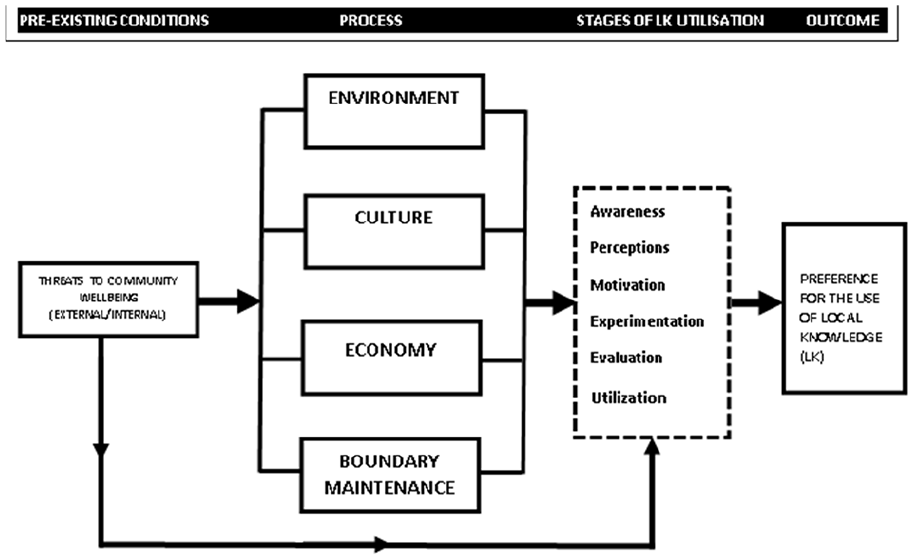
Local knowledge usage preference model
Futures pathway—a suggestion
This article provided highlights on the origin of IK and how the West perceives it. It also analyzed the emergence of dominant knowledge and showed the similarities and differences between Western science and LK. The significance of LK in development practice is outlined as well. While the article in part provided a critique of the insider academic and outlined the roles of institutions in knowledge production, it also attempted the development of a theoretical framework meant for advancing LK’s future research. In this section, I propose a four-phase model (Figure 2) for the entrenchment of LK in development theory and practice. While this is not entirely new (Kolawole, 2014), it is my opinion that a simplification of the process through the delineation of the identified key activities will help readers to better understand the process.
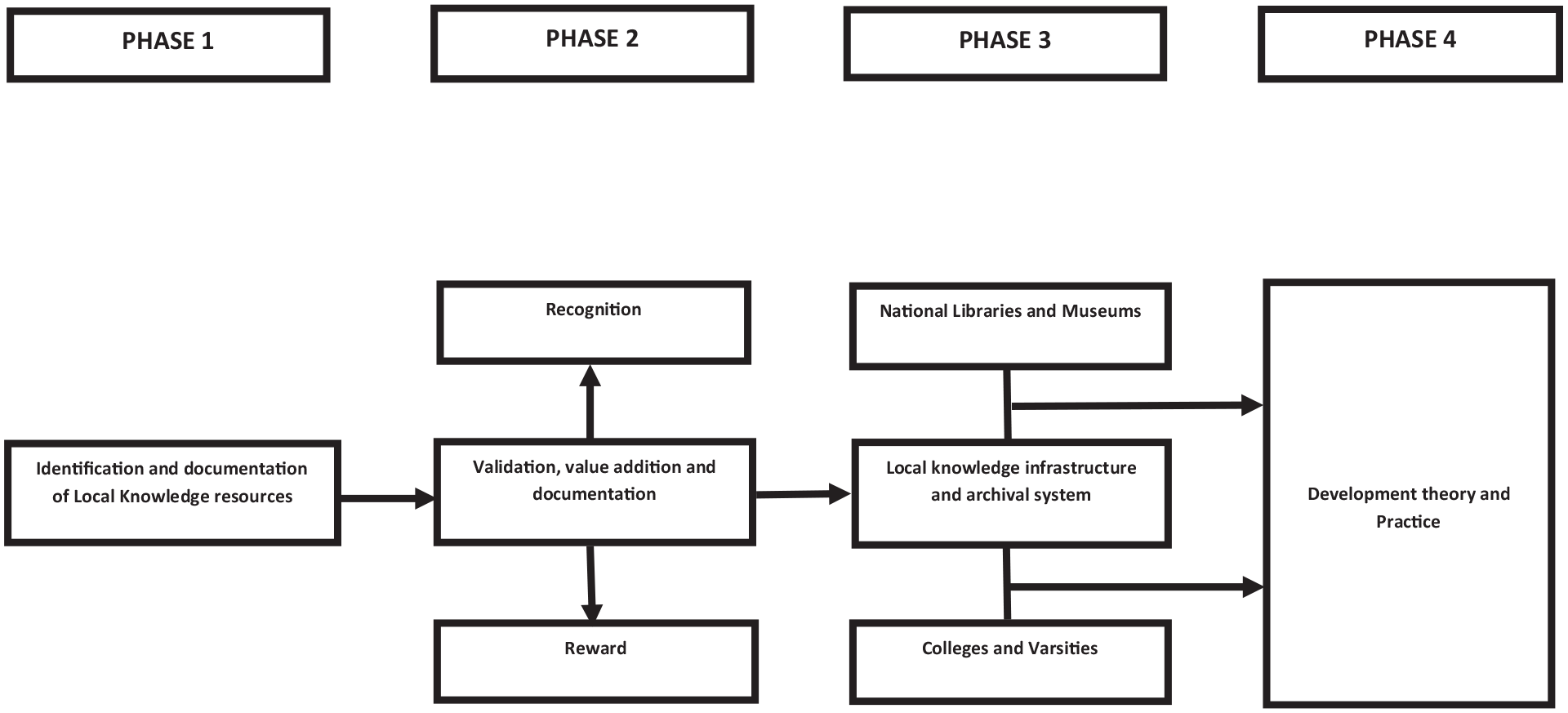
Model for mainstreaming local knowledge in development theory and practice (Adapted from Kolawole, 2014)
The first phase of LK valorization borders on an objective research engagement in the subject matter. This includes the identification and documentation of LK resources. Given the level at which we currently are, this phase has reached an advanced stage as many works have been documented in all parts of Africa and the rest of the world in relation to LK resources. Many other research endeavors addressing the subject are underway in many parts of the globe as well. The second phase, which is the second-level research, and which also encompasses validation, value additions, and further documentation, would eventually lead to recognition and reward for intellectual property rights of those who own the knowledge systems. It is unethical for Western academics and researchers to take knowledge from local people without acknowledging the source of the knowledge. It is also unethical for academics and Western scientists to play the role of the high priest while exhibiting disdain toward community knowledge and voices, particularly in matters that directly affect community people. Social and cognitive justices come to the fore at this point. While LK may not necessarily need validation in the eyes of those who own them, I have deliberately used the concept to draw attention to the assumption that the acceptability of LK among the skeptics will be predicated on the ability to convince those who doubt the efficacy of the body of knowledge through development research, which are relevant to drug development and the like. The third phase will include the development of accessible knowledge infrastructure through information storage in national libraries and museums and colleges and universities. The fourth phase would include the application of LK in the mainstream as a major component of development theory and practice. To be sure, the way lived experiences and histories are created at the “margin” and from “below” (Sriprakash et al., 2020, p. 7)—in the forms of storytelling, public testimonies, writing, theater arts, or dance—could form the basis for hypothesizing and theorizing culturally-laden, futures development issues. Here the operationalization of LK will allow for the development of framework, models, or theories, which could be translated to useful tools in devising solutions for development problems and readily designed for application in everyday life. Practically, and in the words of Sriprakash et al. (2020), “futures-oriented policy in education must give space to the experiences and knowledges of people whose histories have been silenced by or made marginal in educational systems and processes” (p. 7).
In summary, many efforts are already underway in developing economies to valorize the knowledge perceived as emanating from the fringes. Nonetheless, the perpetuation of stereotypes through stigma and labeling from a distance constitutes a barrier to development in an era where it is increasingly acknowledged that LK is as relevant as Western science. One pertinent standpoint of this article is that knowledge production is crucial for enhancing economic and human development. As such, knowledge from the margin and the sustainability agenda of the United Nations are not in any way mutually exclusive. The importance of LK as outlined in this article is an attestation to the all-important role, which the supposed knowledge from the margin could play in sustainable development both in the global South and North. The challenge of man-made disasters associated with climate change witnessed in many parts of the world buttresses the fact that business cannot remain as usual. Besides, knowledge fragmentation, which is a recipe for unprofitable chaos, needs to be undone to pave the way for defragmented knowledge in which both science and LK could both complement each other for enhancing environmental sustainability and advancing human progress (Kolawole, 2012a; Tengo et al., 2017). It is indeed out of knowledge chaos that academic order will naturally emerge in the 21st century and beyond. And whether the patronizing perceptions about LK is conceived as being marginal or peripheral will endure is a question of time.
Footnotes
Declaration of conflicting interests
The author(s) declared no potential conflicts of interest with respect to the research, authorship, and publication of this article.
Funding
The author(s) received no financial support for the research, authorship, and publication of this article.
