




Abstract
Conducting Indigenous research with a Western research methodology has barriers to achieving the maximum utility and benefit for the Indigenous community involved in the research project. This article discusses the translation of the author’s Haudenosaunee knowledge into a Western methodological framework of ontology, epistemology, axiology, and research methods to formulate Ogwehowehneha: a Haudenosaunee research methodology while also detailing its adaptation and application for use in an Anishnawbe context. I called this new adapted methodology One Dish, One Spoon, which references a covenant agreement between the Haudenosaunee and Anishnawbe to peacefully share lands and resources. By sharing my experience of researching as a Haudenosaunee scholar in an Anishnawbe context, I share my understanding of the need to advance commonalities of Indigenous law and philosophy while researching cross-culturally among Indigenous Nations.
Keywords
Introduction
Although many emerging critical approaches to Indigenous research have demonstrated success for Indigenous communities, the most promising strategy is to conduct Indigenous research with an Indigenous research methodology. For Indigenous research to be beneficial, one must research with a paradigm that accounts for Indigenous ways of knowing. In this article, I articulate a Haudenosaunee (Six Nations; Iroquois) research methodology, the importance of researching with an Indigenous research methodology, and the challenge of being an Indigenous researcher in a community and culture different than my own.
To fully appreciate and understand my theoretical arguments, I will discuss Haudenosaunee’s knowledge and philosophies; I will then outline the reasoning for and adaptation for application and utility of the findings for the Oji-Cree Nations in the Matawa communities of Northern Ontario.
My dissertation project was part of a Social Sciences and Humanities Research Council Insight Grant titled Resource governance and Indigenous rights: Understanding intercultural frameworks for negotiating free prior and informed consent secured by Dr Terry Mitchell. The goal of the larger research project is to advance intercultural knowledge to inform policy development for the effective implementation of free, prior, and informed consent in emerging sites of resource extraction in Canada and Chile. This research used case studies to compare the experiences of Indigenous Peoples in Chile, Northwest Territories, Nunavut, and Northern Ontario. Dr Terry Mitchell is the principal investigator and is leading the case study in the Ring of Fire (ROF) in Northern Ontario.
This article raises some critical theoretical advancement as there is limited scholarship related to researching across the diversity among Canadian Indigenous Nations. Finally, I will explain why the use of an Indigenous methodology is vital to account for Indigenous ways of knowing and for the uptake of the findings of Indigenous research.
Standpoint
My name is Darren Thomas, I am Onondawaga (Seneca Nation), Nyagwai (Bear Clan), and part of the Haudenosaunee Confederacy. I was born and raised in my community of Six Nations by the Grand River in Southern Ontario, Canada. I am four generations removed from Indian Residential School; I grew up attending ceremony; I grew up hearing my original language; I never questioned my identity as an Indigenous person. I have a very sound foundation for Haudenosaunee law and philosophy. I have come to understand what an extreme privilege this is. When I am trying to understand any phenomenon, I naturally want to comprehend my experiences through my Haudenosaunee lens. I returned to university as a mature student to complete my master’s degree in community psychology. As an emerging Indigenous scholar, having to bridge my Haudenosaunee reality into Western scholarship was not easy, as early on, I realized how different my thinking about the world was from the theories I was learning in my courses. This article’s theoretical work originates from my master’s thesis Ogwehowehneha (Thomas, 2012), where I translated Haudenosaunee knowledge into Western constructs of ontology, epistemology, axiology, and research methods. For my doctoral research, I adapted this methodology for use and application in Matawa in the hopes of maximizing utility of the Oji-Cree communities that the research was being conducted with and for.
Under reflection and advisement from my dissertation committee, this concept of blending my Haudenosaunee thought and philosophy with those I was learning from the Anishnawbe in the Matawa region was reflective of the principles contained in the dish with one spoon treaty (Martin-Hill et al., 2007). Therefore, I chose to call this new adapted methodology One Dish, One Spoon, to honour this ancient covenant treaty agreement between the Haudenosaunee and the Anishnawbe.
Context
The focus of this article is not specifically about the large mining research but rather about my experiences of conducting my doctoral research as a Haudenosaunee scholar researching in Anishnawbe land. I will, however, detail the context in which my research took place. At the time of my research, the Matawa communities in Northern Ontario were in negotiations regarding the development of the area nicknamed the Ring of Fire. The entire Matawa region is a mineral-rich environment with numerous active claims in all stages of activity, from prospecting, early exploration, and full mining. However, the primary concern in the region is the Eagles Nest Mine. This proposed mining project has an estimated value of US$65 billion of chromite located 750 km north of Thunder Bay, Ontario.
The ROF area lies within the Treaty 9 [1905–1906, adhesions 1929–1930] area and is the ancestral home of Anishinaabeg (Oji-Cree Nations). Matawa First Nations Management is a tribal council formed in 1988 to support nine First Nation member communities in the region: Aroland, Constance Lake, Eabametoong, Ginoogaming, Long Lake #58, Nibinamik, Marten Falls, Neskantaga, and Webequie. With a total membership population of 9,500, the Matawa First Nations communities have unique sets of needs and priorities. Some communities accessible by all-weather roads—Aroland, Constance Lake, Ginoogaming, and Long Lake #58. Other communities are only accessible by air or seasonal ice roads—Eabametoong, Nibinamik, Marten Falls, Neskantaga, and Webequie.
My doctoral research project considered how international and domestic rights-based instruments such as s.35 of the Canadian Constitution (Canadian Charter of Rights and Freedoms, 1982) and the United Nations Declaration on the Rights of Indigenous Peoples (United Nations, 2007) help in the assertion of Indigenous inherent rights. This research context crosses many legal interpretations of who has the legal and legislative authority on Matawa lands and who can decide the direction of future developments in the region. These complexities are beyond the scope of this article as these findings are in other publications from my dissertation. This article’s focus is on maximizing the benefits of Indigenous research by using an Indigenous research methodology.
Literature review
Western methodologies
Emerging scholars contemplate metaphysical truths about reality when selecting an appropriate research paradigm for their research. When questioning the nature of reality, understanding truth, and pursuing knowledge, some intensive philosophical assumptions emerge. These questions are essential to answer, as it confirms the methodology with which researchers align themselves and further determines the design, the instruments, the analysis, and dissemination of the research (Patton, 2002).
A research paradigm encompasses beliefs about the nature of reality, assumptions about knowledge, and the values related to the pursuit of knowledge. Paradigms represent certain fundamental or metaphysical beliefs that formulate entire systems of ideas. Lincoln and Guba (1985) refer to a paradigm as the systematic set of beliefs and accompanying research methods. Patton (2002) says, A paradigm is a worldview—a way of thinking about and making sense of the complexities of the real world. As such, paradigms are deeply rooted in the socialization of adherents and practitioners. Paradigms tell us what is important, legitimate, and reasonable. (p. 69)
Creswell (2003) further delineates the term paradigm to four philosophical assumptions “about the beliefs about ontology (the nature of reality), epistemology (what counts as knowledge and how knowledge claims are justified), axiology (the role of values in research), and methodology (the process of research)” (p. 20).
There are plenty of methodologies within Western science, which have become allied approaches to researching with Indigenous peoples. Narrative inquiry (Connelly & Clandinin, 1990) seems to be an obvious choice for many emerging Indigenous scholars as many Indigenous Nations rely heavily on acquiring knowledge through stories and visiting. Narrative inquiry helps bridge philosophical differences between Indigenous and Western knowledges. Furthermore, in recent years, there has been an influx of innovative approaches called interpretive frameworks (Cresswell, 2012; Creswell, 2003). These focus on using various strategies to locate reality through multiple methods of inquiry and various lenses. Critical theory, queer theory, feminist theory, and transformational theory examine knowledge and truth through various lenses of power, gender, and privilege. While these methodologies are beneficial and work in allyship of Indigenous Peoples, one consideration I made when completing a research theory course and learning about these methodologies was, if colonialism did not happen in the manner that it did, if we as Haudenosaunee did not experience the attempted destruction of our civilization, as a Haudenosaunee scholar would I be as interested in understanding phenomena through these critical lenses? Or would I want to understand various phenomena through a lens grounded purely in my Haudenosaunee reality? Therefore, I developed Ogwehowehneha (Thomas, 2012) for my master’s thesis.
Scholars conducting Indigenous research have bridged the divide between Western methods and Indigenous ways of knowing by utilizing community-based participatory research methods (CBPR) (Blodgett et al., 2011; Evans et al., 2009). CBPR is limited in its success based on how successful the research team implements the principles of CBPR (LaVeaux & Christopher, 2009; Minkler & Wallerstein, 2008). These CBPR principles ask the research team to share power with the community they are researching; this should include collecting, analysing, and disseminating the findings. These principles share power with the marginalized voices in the community to have the opportunity to contribute to the research. In the case of Indigenous research, if the research team dominates and controls the entire research process, you will lose the contributions and understanding of Indigenous reality. Despite these varied methodologies and approaches, they simply cannot account for an Indigenous reality that exists on a spiritual and relational stance. The best strategy to capture Indigenous thought and philosophy is to implement an Indigenous research methodology.
Indigenous methodologies
Drawson et al. (2017) conducted a systematic review of Indigenous research methods and catalogued the vast array of Indigenous research methods in the peer-reviewed literature and described commonalities among methods to guide researchers and communities in future method development. Sixty-four articles met inclusionary criteria, and five themes emerged: General Indigenous Frameworks, Western Methods in an Indigenous Context, Community-Based Participatory Research, Storytelling, and Culture-Specific Methods.
The team discovered that research that implemented some form of Indigenous research methods or methodology minimized the influence and impact of Western ways of knowing and privileged Indigenous knowledge systems. Another critical aspect of using an Indigenous framework is it situates a non-Indigenous researcher directly into a relationship with the Indigenous community in which the research is taking place. This approach results in the researcher learning directly from the Indigenous experience and context, which is crucial to a thorough and rigorous understanding of the phenomenon. In their conclusion, the authors state that: Researchers interested in pursuing a program that includes Indigenous research methods should incorporate this perspective in every step of the process—from the conception of the research question through knowledge translation and exchange. Unlike Western research methods, Indigenous research methods require that all components in the process embody the Indigenous group’s values. (Drawson et al., 2017, p. 15)
This current demand for using Indigenous research methodologies in Indigenous research can thank Smith (1999, 2013), a seminal Indigenous scholar who began to assert the importance of Indigenizing research within the academy as a pathway for a decolonization process for Indigenous people. Smith (1999, 2013) advances that Indigenous populations set their research agendas because Indigenous research agendas have different objectives than Western research. Her framework for Indigenous peoples research focuses on four processes: decolonization, healing, mobilization, and transformation. These processes are four states of being: survival, recovery, development, and self-determination. These processes and states are what she calls the Indigenous Peoples’ Project. It has a research agenda of reclaiming, reconstructing, and reformulating Indigenous cultures and languages. It is driven by an agenda of social justice that advances cultural survival and restoration, self-determination, and healing.
Indigenous scholars (Absolon & Willet, 2004; Battiste, 2001; Debassige, 2010; Kovach, 2009; Lavallée, 2009; A. C. Wilson, 2004; S. Wilson, 2008) have insisted that the development of Indigenous methodologies for Indigenous research is necessary, as these will incorporate the critical aspect of Indigenous relationality. These Indigenous scholars made significant contributions to Western scholarship by creating the space for Indigenous scholarship to challenge how the academy conceptualizes research with Indigenous communities.
These scholars’ primary claim is that Indigenous peoples have a unique way of knowing that is incompatible with positivism and much of Western scholarship. Indigenous scholars criticize a science that focuses on determining cause and effect relationships; such linear thinking is limiting and inconsistent with Indigenous cultures. These assertions are not to discount Western scholarship or the allied researchers conducting critical, feminist, and social constructivist research but simply state that Indigenous peoples need research completed with Indigenous methodologies. Indigenous ways of knowing are emerging so strongly across multiple disciplines in the academy. Denzin and Lincoln (2008) consider this a time of “critical Indigenous pedagogy” (p. 2). They assert this it is necessary for Indigenous populations to redefine all elements of inquiry involving their community: The work must represent Indigenous persons honestly, without distortion or stereotype, and the research should honour Indigenous knowledge, customs, and rituals, not be judged in terms of neocolonial paradigms. (Denzin & Lincoln, 2008, p. 2)
In the next two sections, it is essential to share the roots of Indigenous law and philosophy for the Haudenosaunee and Anishnawbe peoples used to inform my research.
Haudenosaunee reality
The Haudenosaunee believes that you gain knowledge by understanding the relationships in the natural world. Ogwehowehneha is a Haudenosaunee research methodology based on an ancient understanding that humans are to maintain a spiritual existence within the Universe and that our highest motivation of being is to be seeking Ganikwi:yo (Good Mind) in all relationships. This spiritual way of life is not to be confused with a religious doctrine. How one chooses to have a relationship with the Creator is not part of this methodology. Still, when one considers a Good Mind, you should think of it more as a philosophical standpoint than a religion. The ceremonies the Haudenosaunee conduct are about celebrating and being grateful for the gifts of life provided to human beings. The Good Mind is part of a broader philosophy called Gayensragowa (The Great Law), which states that we should be striving for a life of peace, power, and righteousness, and instructs us how to be the absolute best person possible. In Supplemental Appendix A, I provide a complete explanation of these Haudenosaunee principles.
These core beliefs of Haudenosaunee inform a relational and spiritual approach to knowledge and knowing. These beliefs make Haudenosaunee reality distinct from the philosophical assumptions expressed in Western research methodologies. Modern Western ways of knowing dismiss spirituality notions, but there are expressions of relational thinking in some interpretive frameworks like feminism and critical theory. Social constructivism does recognize that time and place influence reality, and these realities are subjective to make many meanings. However, these interpretive frameworks do not locate a spiritual connection to all elements in the Universe as its centre of philosophical assumptions.
Anishnawbe reality
Although Ogwehowehneha focuses on Haudenosaunee knowledge and reality, I will explain its use, adaptation, and application for a research project involving Anishnawbe peoples. I must state here, my learning of Anishnawbe reality was acquired through this project by reading Matawa archival documents, attending and participating in Matawa community events and gatherings, as well as building relationships with Matawa community members. As I remain in my infancy of understanding Anishnawbe thought and philosophy, what I did learn is that Haudenosaunee are more similar than different. This level of analysis that I share here is based upon me being at the start of learning Anishnawbe ways of knowing, and certainly no expert in this regard.
One consideration to make when talking about Indigenous methodologies is that there are several hundred different Indigenous Nations across the globe, each with their own diverse and distinct Indigenous laws and philosophies. Therefore, each Indigenous Nation could have its own Indigenous research methodology based upon its own Indigenous ways of knowing. To ensure maximum utility and impact for researching with Indigenous Nations, appropriate use of Indigenous methodologies that reflect their Indigenous ontological positioning is required.
As I stated, since I am Haudenosaunee and grounded in my own Nations’ ways of knowing, it would not be appropriate to research and generate knowledge using an Anishnawbe perspective. What I did to work on Anishnawbe lands and with Anishnawbe peoples is to adapt my ways of knowing into an Anishnawbe framing to help make sense of these differences. To assist me in this process, I spent time in the community in non-research capacity attending community meetings and conferences. I also was provided access to the Matawa archives which allowed me to spend time learning about the Matawa member communities that has been documented in community gathering reports and conferences. These documents allowed me to learn about Matawa’s priorities and commitment to Anishnawbe law and philosophy accessible.
As I briefly described Haudenosaunee philosophy on the Good Mind and the Great Law, the Anishnawbe have similar philosophies that are Mino-Bimaadiziwin (Good Life) (Debassige, 2010) and the Seven Grandfather Teachings (Seven Generations Education Institute, 2021). When examining global Indigenous peoples, one learns that there are similarities to their philosophies behind their cultural practices and ceremonies. These Indigenous laws are their original instructions (Lyons, 2008; Mohawk, 2010). These principles and values shape Indigenous societies, cultures, and ceremonies and promote an individual’s expected roles, duties, and responsibilities to their community.
The Seven Grandfather Teachings guide Mino-Bimaadiziwin
I provide a detailed explanation of these principles of Anishnawbe’s original instructions in Supplemental Appendix B. In English, these principles are love, humility, courage, honesty, respect, wisdom, and truth. In Supplemental Appendix C, I provide a more in-depth explanation of Mino-Bimaadiziwin, which means living in a Good Life. Mino-Bimaadiziwin is a similar philosophy to the Good Mind, where Anishnawbe Law states that there is a perfect way to exist as a human being in this Universe, Living a Good Life. Like the Haudenosaunee, this existence is based entirely upon one’s relationships with all elements in the Universe. These relationships are fluid and active and based on how an individual exists in the Anishnawbe language, ceremonies, the natural world, in Anishnawbe thought and understanding, and how one fulfils these duties to live a Good Life.
These philosophies are not static but a thriving engagement of pursuing healthy relations with the Universe; over time, you acquire great wisdom and knowledge through your lived experiences. Elders are revered because of the belief of their attainment of wisdom over a long-lived experience.
Ogwehowehgeka (original instructions)
Translating Haudenosaunee knowledge into a research methodology in a manner that would be understood and respected by Indigenous and Western scholarship is a challenge. In Haudenosaunee thought, there is no concept of epistemology, axiology, or ontology. I used the same philosophical assumptions of ontology—the nature of reality, epistemology—what counts as knowledge and how knowledge claims are justified, axiology—the role of values in research, and research methods—the process of research—to translate Haudenosaunee knowledge into a theoretical model that both Western and Indigenous thinkers could appreciate.
Ontology: Seniyohdwae:haode (our civilization)—the nature of Haudenosaunee reality
Four central tenets form Haudenosaunee’s reality and philosophy; the first is Geiniyogwedage (four sacred ceremonies); these are ceremonies to demonstrate to the Creator that we are grateful. The second is the Ganohonyohk (our thanksgiving), a protocol speech recited at the dawn of every day and before any business, meeting, or ceremony. This protocol is not a ceremony but a reminder and an acknowledgement of our relationships with Creation. When someone recites the speech, the words are symbolic as it brings our minds together, all thinking about the same place, to understand how we are to coexist with all of Creation. The third pillar of Haudenosaunee civilization is the Gayensragowa (Great Law of Peace). The Haudenosaunee learned this philosophy from a prophet called the Peacemaker. He introduced the Haudenosaunee to a powerful way of knowing during a time of warfare among the Haudenosaunee. The Haudenosaunee exists as a Confederacy of several Nations; before receiving the Great Law, these Nations were all separate and at war. The Confederacy formed after the Peacemaker taught the Haudenosaunee about Gayensragowa.
There are several components entwined within this teaching, all of which lay the foundation for Haudenosaunee civilization. Central to the Great Law is the ability to live a life in balance, wellness, and peace. Achieving this means to have Ganikwi:yo. The Haudenosaunee believes each of us has inherent connections to the Creator through our minds. When we achieve this balance by living with each of these values of Gayensragowa, then we are closest to the Creator. The last element of Haudenosaunee reality is the Gaihwi:yo (Good Words). These teachings came to the Haudenosaunee after contact with Western society; Sganyadaiyo’s—a Seneca prophet whose name translates into Handsome Lake—life and journey of sharing these good words are called the Code of Handsome Lake. After the Western nations began to live among the Haudenosaunee, some of our people began abandoning their original ways. Handsome Lake was visited by spirits that reminded him of the Creator’s expectations of how the Haudenosaunee were to live. Handsome Lake’s teachings connect to our cycle of ceremonies, demonstrating to the Creator our gratefulness for Creation. The Gaihwi:yo teachings remind the Haudenosaunee how to live an honourable life of citizenship, peace, kindness, and family. The lessons describe the roles of the family and their relationships with each other.
These four elements of Haudenosaunee civilization are what forms Haudenosaunee reality. These central tenets inform everything within our society, how we practised our laws, our health care, education, governance structures, ceremonies, and economy. To fully understand Haudenosaunee thought, one must be grounded in each of these elements of Seniyohdwae:haode (our civilization).
Epistemology: Ogwehowehgeka (original instructions)—Haudenosaunee knowledge
Haudenosaunee’s knowledge of the original instructions are instructions the Creator left for humans to learn to live a full life. Haudenosaunee knowledge comes from the relationships within Creation. Most central to Haudenosaunee knowledge systems is the Creation Story itself. The story of Creation takes several days to share all the ways it informs our lives as human beings. The lessons teach us that we have sacred relationships between all elements of Creation. Everything has a spirit; the earth, the waters, the medicines, our sustenance—fruits and vegetables, the trees, the animals, the birds, the winds, the rains, the thunders, the stars; all have a spirit and are worthy of respect.
The natural world is our teacher and models how we should exist with each other. When you examine various natural world elements, you learn about the natural laws that govern life. These natural laws are tremendous teachers and role models, and several Haudenosaunee teachings derive from Creation. For example, during rites of passage for young women after they begin their menstruation cycles, their aunties teach them about their grandmother the moon, and their relationship between the moon and their 28-day cycle. This relationship teaches them to understand their connection to giving life. When their voice starts to change for young men, their uncles teach them about their relationship with their elder brother, the sun. The sun is a role model for men, how it provides light, warmth, and nutrients to sustain life, how it rises early and shines brightly to provides unconditionally to the world. These teachings from the natural world demonstrate and model behaviours to attain knowledge and understanding of Haudenosaunee philosophy. As Haudenosaunee, we carry tremendous respect for the natural world; we do not essentialize our existence to dominate other life forms. The Haudenosaunee believes that all of Creation is here for the benefit of all life to share.
One additional aspect of Haudenosaunee knowledge that came from the original instructions is this responsibility to ensure that learning is shared. This responsibility of sharing knowledge acquired during your lifetime is a reciprocal responsibility to pass knowledge on to future generations. In the language, you would say seniyohgwe:hode (we are living our ways); this philosophy asks us to ensure this knowledge transmits to the coming faces. The coming faces are the children not born yet, so while we are alive, it is our responsibility to learn as much as we can, to share the knowledge when we mature.
Axiology: Gengohowas:toh (it holds it all together)—the role of Haudenosaunee values in research
Haudenosaunee values reflect the understanding of Creation and how everything is inherently connected and interrelated, and back to one of the central tenets of Haudenosaunee civilization, Good Mind. Understanding the Good Mind asks us to seek Sken:nen (peace) in all our relationships. However, Sken:nen is a difficult word to translate into English; it means a spiritual grounding, a relational concept that you attain peace within your existence in Creation. This concept of having a Good Mind is central to understand all the elements of Haudenosaunee reality and knowledge. Having a Good Mind means that you try to live the Great Law’s values in every aspect of your life as a human being. The central ethics of conducting Haudenosaunee research is to maintain and respect these elements of Indigenous reality, not question Indigenous laws but ensuring as researchers, we honour, and respect Indigenous law is paramount.
Methods: Sedowanes (learn)—the research process
Haudenosaunee knowledge and reality focuses on understanding our relationships with the natural world. When one seeks to acquire more insight, you must use the methods that make the most sense. In this sense, the Haudenosaunee are pragmatic in seeking knowledge. The most important aspect of learning is the skill of observation. We believe all Haudenosaunee knowledge lies within the natural world. If we want to learn more or increase our understanding of a phenomenon, we simply must look to the first teacher, our Mother Earth. Knowledge may come in the form of passive observance, but it may come by participating. Knowledge from participation comes from actively engaging in a learning process, where observing is more about learning through role modelling. There were formal learning practices, but much was informal. It was a natural part of living in a collective society.
Haudenosaunee seeks knowledge through visiting and is a primary method of knowledge generation that follows distinct protocols. Visiting is not an interview, but a discovery process over the time you spend with another person or a group of people. Visiting is how knowledge is generated as if you were visiting with an auntie or a grandparent, you discuss and learn, and offer ideas together. It is this unique process of the co-generation of knowledge that happens. With the Haudenosaunee, how you make your inquiry is just as critical as what you hope to learn. You would not ask a direct question of a person with traditional knowledge, as they likely will not tell you an answer. Elders understand that knowledge comes from your observance or reflecting, so they may ask you to seek something in the natural world to discover your way of answering your query. They may guide you to reflect on certain things but will seldom just provide you with a direct answer. This process of visiting can take many years of learning.
Reflecting is a crucial part of acquiring knowledge, which stems from the belief that we are inherently connected to the Creator through our brains. This belief emerged from the Haudenosaunee Creation story when the Creator breathed life into us; He provided us with the ability to understand, know, and think about how all things in Creation. That is why dreams, visions, and ceremonies are instrumental to knowledge generation. Remember that Haudenosaunee reality is in Creation, and each element of Creation has the knowledge and a spirit. As humans, we can learn from these elements in Creation, but sometimes these come in the forms of spiritual awakenings that occur through ceremony, dreams, or visions. These spiritual awakenings are what I call witnessing and is when profound learning has occurred. It may happen to an individual, a group, to yourself, or someone else; we learn from our lived experiences and the experience of others.
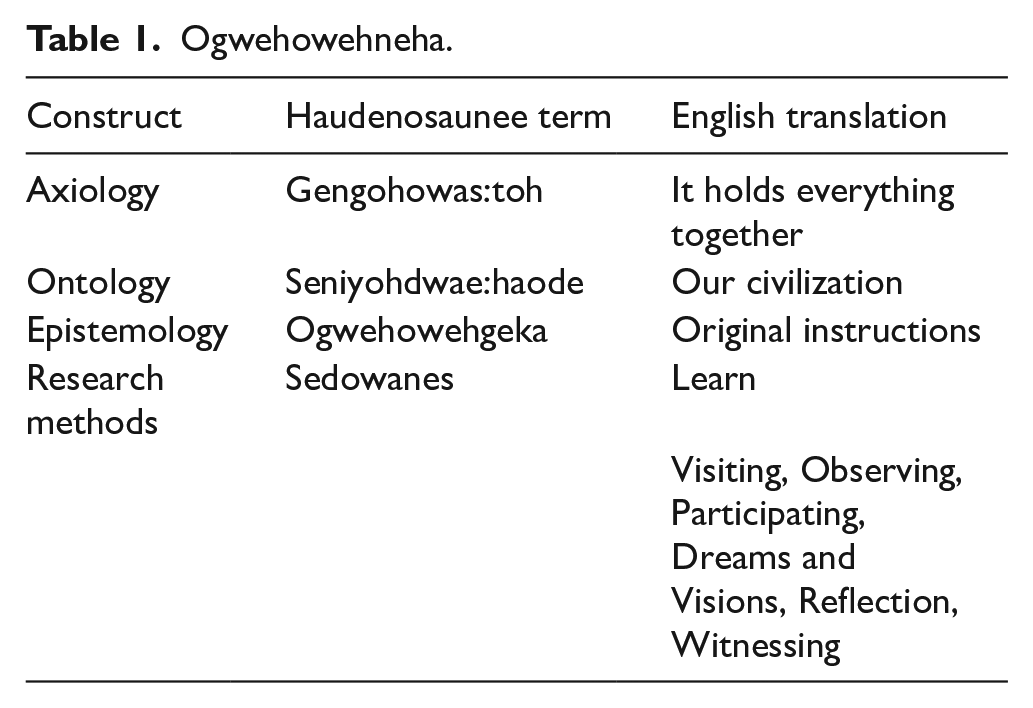
Haudenosaunee knowledge is an intricate connection to all elements in the Universe. It is difficult to frame these separate concepts and assumptions on reality, knowledge, values, and methods that form a methodology, as there are elements within each that intertwine with each other. The late Jake Thomas during a Great Law Recital in 1994 (Jake Thomas Learning Centre, 1994) described Haudenosaunee knowledge like the grapevines; they may go all over the place and stretch far, but they are all connected. These are the elements of Haudenosaunee philosophy that form Ogwehowehneha (living our original ways) as a full research methodology. In Table 1, these Haudenosaunee concepts appear with their corresponding Western philosophical assumptions.
Ogwehowehneha.
Discussion
The history of research on Indigenous people has been fraught with abuse of power by outside researchers (Royal Commission on Aboriginal Peoples, 1996). Historically, Indigenous communities received little benefit for their participation; findings were created and interpreted without vetting how they may impact Indigenous communities (Schnarch, 2004). There was so much evidence of abuse in Canada that the Tri-Council Policy Statement: Ethical Conduct for Research Involving Humans (Government of Canada, 2014) dedicated a specific chapter for researching with Indigenous populations. This policy ensures that researchers meet a certain standard to protect the Indigenous communities they engage in research and that researchers should respect Indigenous knowledge and worldviews throughout the design, analysis, and dissemination of their research.
The philosophical assumptions that guide a research project’s design inform where to seek answers for the research questions, the design, the interpretation, and the dissemination strategies. Suppose we rely only upon Western methodologies to inform our investigations with Indigenous populations. In that case, we immediately are discounting a significant portion of understanding the phenomenon if we do not locate and centre Indigenous reality as a standpoint.
Gengohowas:toh (it holds it all together-axiology) is about advancing the unquestioning understanding and respect for Indigenous law and philosophy. As an outsider, if you do not position your understanding with fundamental Indigenous Laws like the Good Mind or the Good Life, then you will be doing an injustice to any investigation with Indigenous peoples. Any interpretations of findings will have limited benefit for the Indigenous community. The values contained in Ogwehowehneha guide how we build relationships with the participants that may be involved in the research. The length of time we invest in capturing the data, remembering that visiting is creating a meaningful relationship of trust. Visiting happens in a manner that will allow a connection to form. These extra demands may be challenging for Western researchers to navigate because of the concept that we are all equal in the Universe. The privileges you may experience in the Western world as a professional means little in the Indigenous community. Within Indigenous society, everyone has an equal level of respect. Everyone is the same, even those who carry a traditional titles such as chief, clan-mother, faith-keepers, or other traditional titles. Carrying a traditional title means that the individual titleholder has an extra duty to fulfil, but this does not mean that individual has any superiority over other community members. The title they carry is a special relationship and responsibility between that titleholder and the Creator, not between that individual and everyone else. Respect is earned by how you live and carry yourself, which is dramatically different from Western society. In the Western world, the knowledge you have spent years acquiring your degrees do not carry the same value within the Indigenous community. You attain merit within the Indigenous community by your contributions to the community and how you live your life. It takes time to build trust, and why, at times, the community may even challenge you to see how you react or respond in certain situations. The people you are hoping to research with will want to determine what kind of human being you are, not what Western degree or title you carry.
When we get to the design of a research project within an Indigenous community, we need to remember the basis of Indigenous knowing is Creation Ogwehowehgeka (original instructions). We need to consider whether any evidence and understanding of the phenomenon under investigation exist in the natural world. Is there any evidence of this being natural in the Universe; might there be a spiritual explanation for this phenomenon? We might look to understand the history of this phenomenon; was it part of the community in their original instructions. If not, then we ask when it became part of the community and if there is a spiritual disruption causing this phenomenon. If it was, how did Indigenous ancestors deal with this phenomenon, and what relationship to this phenomenon exists elsewhere? In learning where to discover knowledge, researchers conducting Indigenous research must accept and understand that knowledge can come from outside of human existence.
Sedowanes (how we learn-methods) is like Western methods, through observation and participation. Learning may even come through ceremony, dreams, or visions. Many Indigenous Nations believe we are born with our original instructions encoded in our DNA. That deep within our minds, all the answers to the Universe are there. To locate this knowledge takes time, patience, and the ability to reflect on the situation at hand profoundly and critically; the Universe will answer our questions.
At times, this process may be a spiritual learning journey; therefore, Indigenous research methodologies that embrace Indigenous reality demonstrates why its use is necessary to complete Indigenous research. This position aligns with what Smith (1999, 2013) refers to as a decolonization project; the opportunity for Indigenous peoples to be truly self-determining by using their Indigenous knowledge and philosophy to guide the process of rebuilding their Nations.
A Dish with One Spoon Treaty
The Haudenosaunee Confederacy was formed when a prophet known as the Peacemaker explained the benefits of peace to the original five Nations—Cayuga, Mohawk, Oneida, Onondaga, and Seneca, that formed the Haudenosaunee Confederacy. The Tuscarora Nation came to join the Confederacy to be formally known as Six Nations in the 1700s as they were fleeing what became North Carolina. This message of peace is known as the Gayensragowa (Great Law of Peace). Within that message, a metaphor was used to explain the need for stewardship principles of Creation, which is the basis for the teaching of One Dish, One Spoon Treaty. The dish with one spoon became known as a wampum belt treaty as it was shared among many Indigenous Nations in the spirit of this stewardship.
In Figure 1, the purple symbol represents a dish, with a beavertail inside. The meaning of this agreement was the idea that Creation is here for the benefit of all humankind, and there should be no war, conflict, or fear of being able to enjoy the gifts of the Creator. That if we consider the dish being Creation, we must share and take care of all the benefits of Creation for all the generations to come.
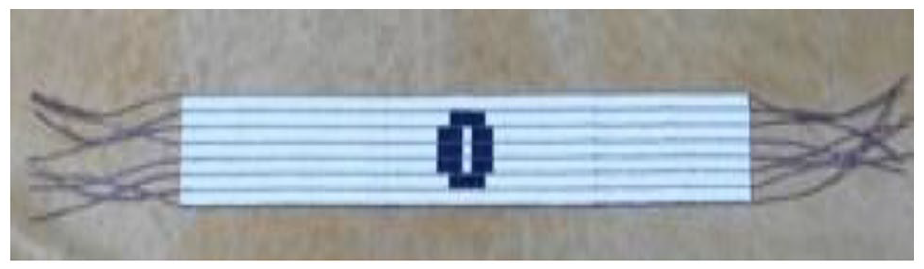
A replica of the dish with one spoon wampum belt. This image represents a dish for all peoples to share the foods of Creation without fear of conflict. (Photo courtesy of wampumshop.com)
Due to the loss of archeological evidence with the building and settlement of southern Ontario, it is hard to determine which Nations had lived on the lands. What is known is the Grand River basin has been home to Indigenous Peoples for 13,000 years (Warrick, 2012). According to Warrick (2012), during the late 16th and early 17th centuries, evidence of the Iroquoian/Woodland peoples called the Neutrals by Samuel Champlain was documented along the Grand River. It has been falsely believed that the Neutrals were extinct and that the Mississauga and Haudenosaunee were more recent arrivals to the lands in Southern Ontario. Archeological evidence does show that the lands have been peacefully shared by Haudenosaunee and Mississauga since the 18th century (Warrick, 2004). The unfortunate reality is that through increasing Settler contact earlier in the 17th century, the Beaver Wars erupted because of the demand for furs with the emerging market economy (Wallace, 1956).
It was these same principles in the dish with one spoon treaty that were shared with the Mississauga Nation in southern Ontario that ended this conflict. This treaty was acknowledged by the British Crown as the Nanfan Treaty of 1701 also known as the “Beaver Hunting Grounds” (Six Nations, 2010, p. 2) and remains why the Haudenosaunee continue to harvest from these lands today.
Rick Hill, a prominent and respected Haudenosaunee historian, commented about A dish with one spoon treaty: [It] is probably the most significant in terms of the Native people in this land. . .the old people say this represents the first treaty made in North America. It was made between all the Native nations before the Europeans arrived. It’s a simple belt with a field of white that represents peace and unity and harmony, with a little dark figure which represents the bowl. . . . Of particular importance in this age of environmental degradation is the fact that the dish with one spoon is also a covenant with nature. “Nature says, ‘Here’s the great dish and inside the dish are all the plants, the animals, the birds, the fish, the bushes, the trees, everything you need to be healthy and therefore, happy. . . .’” “The three basic rules are: only take what you need, second, you always leave something in the dish for everybody else, including the dish, and third, you keep the dish clean. . .that was the treaty between us and nature, and then the treaty between us and everybody else.” (Nahwegahbow, 2014, paras. 7–9)
Although my research agreement and relationship with Matawa was not based on harvesting foods from the lands to nurture our bodies, we harvested knowledge from each other’s lived experiences to nurture our minds to ensure a complete and comprehensive outcome. The belief by myself and my dissertation committee was that in this blending and sharing of Indigenous knowledge(s), the use of this metaphor was appropriate.
Applying One Dish, One Spoon in Anishinaabe territory
For any researcher, Indigenous or not, having to research within another cultural group, in this case, another Indigenous Nation other than your own, is a challenge. In these Oji-Cree communities in Northern Ontario, Canada, I was no different from a non-Indigenous researcher. I was an outsider; I had to build trust and develop a relationship with these communities and their leadership to accomplish my dissertation research goals. The negative history of poorly conducted research that I mentioned is the reason even though I am Indigenous, I am an outsider. Although my doctoral research as an entirety is to advance and secure the assertion of the Matawa communities’ inherent rights, these research goals are not enough to guarantee trust. My philosophical assumptions may be just as harmful as Western ones if I neglect the Indigenous community I am researching. Therefore, prioritizing the Indigenous community’s ontological stance is critical to building a foundation of trust. To prevent further harm, in recent years, the advancement of more critical and Indigenous research methodologies is emerging (McGregor et al., 2018; S. Wilson et al., 2019). One popular approach is Two-eyed seeing; Bartlett et al. (2012) describe this as an approach to examine a phenomenon with a binocular view, with one eye being an Indigenous perspective and the other being a Western one. It is the blending of the two-eyes that establishes a learning scenario from the best of both worlds.
My goal to decolonize this research and ensure historic ontological violence is not repeated, meaning I will advance knowledge, understanding, and priority purely from the one-eye of Indigenous thought and philosophy. I do not state that Western research methodologies cause harm or that they are unable to make meaningful contributions. I merely assert that Indigenous thought and philosophy must be the central focus to understand Indigenous reality, which is based on S. Wilson’s (2008) three Rs of relationality, responsibility, and reciprocity. Relationality means you place yourself into the context to understand the settings under investigation. Responsibility means that you ensure that you are responsible for the inclusion of Indigenous voices, and reciprocity means as a researcher, you must give back to the Indigenous Peoples involved in your research. As an outside researcher, understanding the infinite number of relationships within Indigenous realities is critical to your relationship and accountability with the Indigenous community involved in the research. These relationships can only build through time and a continued, consistent, trustworthy, and meaningful engagement. One pathway to building this trust is demonstrating to the community your commitment, understanding, and respect for their philosophical positioning.
Years before any actual research, our research team in this case study began discussions with Matawa leadership. To secure our research approval within the Matawa Chiefs Council, it took us 2 years of attending their meetings while also becoming familiar with their priorities and learning how we may serve their needs while accomplishing our research goals. We were using visiting methods to develop our relationship. On occasion, we were challenged by community members, unsure of our role as researchers in their communities. Still, overall, we established trust and met the needs and priorities in our research. By making ourselves known and building the trust of time, we demonstrated our utility. The Matawa leadership and communities learned we are allies to their Indigenous law and philosophy advancement.
Conclusion
This article details the ontological differences between Indigenous and Western assumptions of reality and how bridging these philosophical differences with Indigenous research methodologies to conduct Indigenous research provides the opportunity for increased Indigenous community uptake and benefit. I also discussed the challenge of being an outsider as a Haudenosaunee researcher involved in a research project on Anishnawbe lands and cultural context which is different than my own.
The responsibility lies on the researcher, Indigenous or not, to focus on the needs and priorities of the communities participating in the research, not the researcher’s needs. To bridge these cultural differences, I had to translate and frame my Haudenosaunee knowledge into a context that would respect and privilege Anishnawbe thought and philosophy. What provided me the opportunity to be successful was my personal commitment to learn about Anishnawbe law and philosophy while also learning from community members and their history. By demonstrating my willingness to learn, I gained trust and acceptance.
Indigenous scholars like Linda Smith (2013) and Margaret Kovach (2009) state that any research with Indigenous peoples must carry an aspect of a decolonization/liberation objective. The opportunity to conduct research that assists with reclaiming, rebuilding, and restoring Indigenous communities and their Indigenous laws and philosophies is vital to rebuild their Indigenous Nations (Alfred, 2004; Simpson, 2004; Smith, 2013; United Nations, 2007; A. C. Wilson, 2004).
Despite Anishnawbe and Haudenosaunee having diverse ways of knowing, one can see that at the root of our Indigenous Laws exists parallel understandings of the Universe and how one is to live as a genuine person. Applying One Dish, One Spoon is about maintaining the same cosmological understanding with integrity, duty, honour, and responsibility that I would if I were conducting a research project in Haudenosaunee territory. When this research is conducted cross-culturally among Indigenous Nations, with additional learning and adaptation to each of our Indigenous knowledges we can find similarities that help to advance and generate knowledge that will have impact for our Nations.
One Dish, One Spoon requires a focus on relational understanding based upon natural and spiritual existence, this being Anishnawbe territory. I combined what I know and understand about Haudenosaunee’s knowledge and reality to advance Anishnawbe philosophy, values, and Indigenous laws of Mino-Bimaadiziwin and the Seven Grandfather Teachings. This plan allowed my research to be relevant for the Anishnawbe and has greater acceptance by these Anishnawbe communities because their ways of knowing are a priority. This commitment ensures that the research project will best inform the Anishnawbe in this region to be on a pathway to be self-determining. Researching in this manner aligns with the assertions that all Indigenous peoples have an inherent right to self-determination.
Supplemental Material
sj-pdf-1-aln-10.1177_11771801221087864 – Supplemental material for Applying One Dish, One Spoon as an Indigenous research methodology
Supplemental material, sj-pdf-1-aln-10.1177_11771801221087864 for Applying One Dish, One Spoon as an Indigenous research methodology by Darren Scott Thomas in AlterNative: An International Journal of Indigenous Peoples
Footnotes
Declaration of conflicting interests
The author(s) declared no potential conflicts of interest with respect to the research, authorship, and publication of this article.
Funding
The author disclosed receipt of the following financial support for the research, authorship, and publication of this article: This work was supported by the Social Sciences and Humanities Research Council [grant number 777289]

Supplemental material
Supplemental material for this article is available online.
References
Supplementary Material
Please find the following supplemental material available below.
For Open Access articles published under a Creative Commons License, all supplemental material carries the same license as the article it is associated with.
For non-Open Access articles published, all supplemental material carries a non-exclusive license, and permission requests for re-use of supplemental material or any part of supplemental material shall be sent directly to the copyright owner as specified in the copyright notice associated with the article.
